About the Report
Base Year 2024Listen to the audio summary
Global Self Storage Market Overview
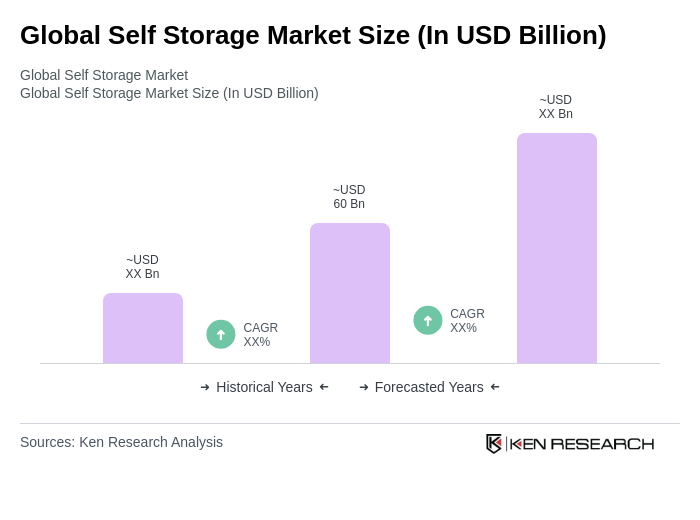
- The Global Self Storage Market is valued at approximately USD 60 billion, based on a five-year historical analysis. This level aligns with multiple industry trackers that place the market around the low-sixty billions range, reflecting sustained demand from urban households and businesses for flexible storage capacity .
- Key markets include the United States, Canada, and the United Kingdom, underpinned by high facility penetration, mature REIT participation, and robust consumer adoption; North America remains the largest regional market, supported by dense self-storage networks and strong utilization by residential and small-business customers .
- In 2023, the U.S. federal government did not enact nationwide, industry-specific self-storage regulations; consumer protection and lien/auction processes remain governed primarily by state self?storage lien laws and state-level consumer statutes, with ongoing updates and standardization efforts led by state legislatures and industry associations rather than federal rulemaking .
Global Self Storage Market Segmentation
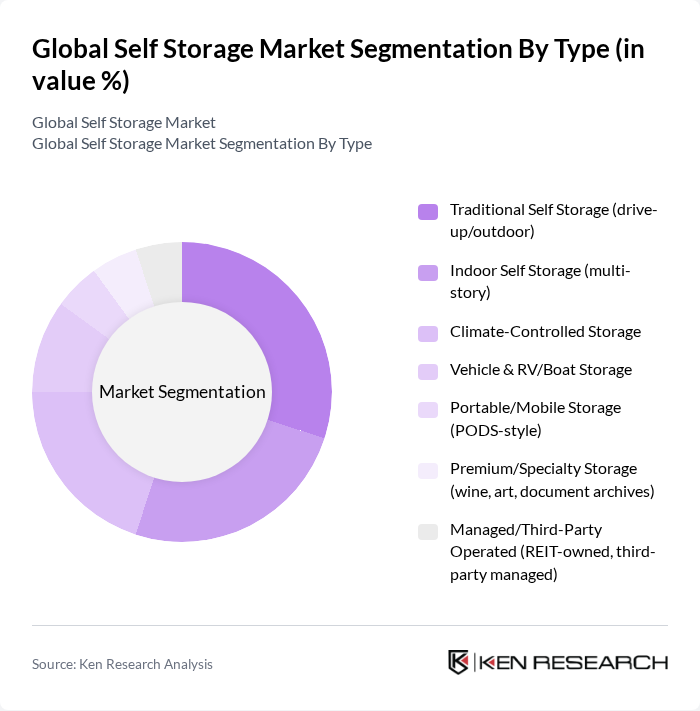
By Type:The self-storage market can be segmented into various types, including Traditional Self Storage, Indoor Self Storage, Climate-Controlled Storage, Vehicle & RV/Boat Storage, Portable/Mobile Storage, Premium/Specialty Storage, and Managed/Third-Party Operated facilities. Each type caters to different consumer needs, with specific features and benefits that appeal to various demographics. Demand continues to favor climate-controlled and multi?story indoor formats in urban cores due to temperature/humidity protection and space efficiency, while drive?up traditional units remain prevalent in suburban and exurban locations. Portable/mobile storage is supported by moving/renovation use cases and e-commerce micro-fulfillment, and specialty storage (e.g., wine, documents) serves niche, higher-yield segments .
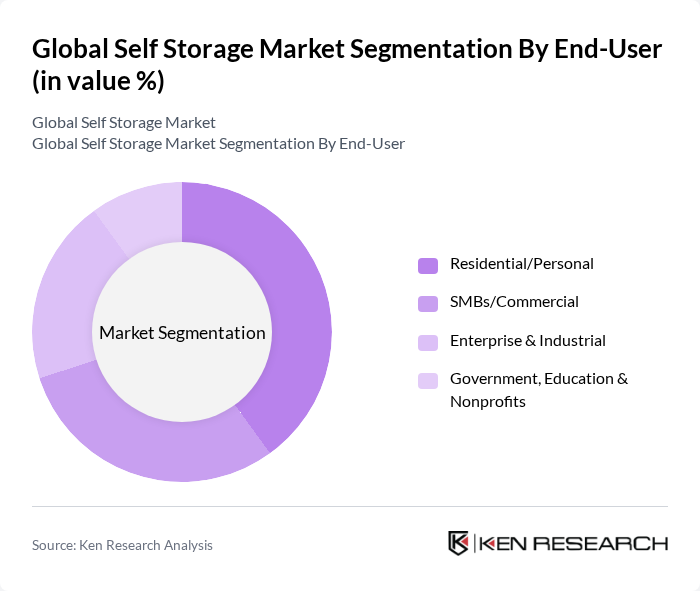
By End-User:The end-user segmentation includes Residential/Personal, SMBs/Commercial, Enterprise & Industrial, and Government, Education & Nonprofits. Each segment has unique storage needs, with residential users often seeking short-term solutions (moving, downsizing, life events), while businesses increasingly use units for inventory overflow, micro-warehousing, seasonal goods, and records. Adoption among SMBs is buoyed by e-commerce growth and last?mile logistics needs, while institutional users employ secure units for archives and equipment .
Global Self Storage Market Competitive Landscape
The Global Self Storage Market is characterized by a dynamic mix of regional and international players. Leading participants such as Public Storage, Extra Space Storage, CubeSmart, U-Haul (AMERCO/U-Haul Holding Company), National Storage Affiliates, Life Storage (a CubeSmart brand; formerly Life Storage, Inc.), Big Yellow Group plc, Safestore Holdings plc, Shurgard Self Storage, StorageMart, SmartStop Self Storage, Access Self Storage (UK), Metro Self Storage, A-1 Self Storage, Kennards Self Storage contribute to innovation, geographic expansion, and service delivery in this space. Ongoing trends include digital leasing and access, dynamic pricing, and expanded climate-controlled footprints, with North America maintaining the largest installed base of facilities .
Global Self Storage Market Industry Analysis
Growth Drivers
- Increasing Urbanization:Urbanization is a significant driver of the self-storage market, with the United Nations projecting that by in future, 56.2% of the global population will reside in urban areas. This shift leads to higher demand for storage solutions as urban dwellers often face space constraints. In cities like Tokyo and New York, where population density exceeds 6,000 people per square kilometer, the need for additional storage options becomes critical, fueling market growth.
- Rising Demand for Flexible Storage Solutions:The trend towards flexible living arrangements is increasing the demand for self-storage facilities. In future, it is estimated that 30% of consumers will prefer renting storage units over traditional long-term leases. This shift is driven by the gig economy, where individuals frequently relocate for work. As a result, self-storage facilities are becoming essential for those seeking adaptable living and working spaces, enhancing market potential.
- Growth in E-commerce and Online Retail:The e-commerce sector is projected to reach $6.4 trillion in sales by in future, significantly impacting the self-storage market. Online retailers require additional storage for inventory management, leading to increased demand for storage units. In the U.S. alone, e-commerce businesses are expected to utilize 1.2 billion square feet of storage space, highlighting the interdependence between e-commerce growth and self-storage facility expansion.
Market Challenges
- High Competition and Market Saturation:The self-storage market is characterized by intense competition, with over 50,000 facilities operating in the U.S. alone as of in future. This saturation leads to price wars and reduced profit margins, making it challenging for new entrants to establish a foothold. Additionally, established players are continuously innovating, further complicating the landscape for smaller operators seeking market share.
- Regulatory Compliance and Zoning Issues:Navigating regulatory frameworks poses a significant challenge for self-storage operators. In future, approximately 40% of new facility developments face delays due to zoning laws and compliance requirements. Local governments often impose strict regulations on land use, which can hinder expansion efforts. This regulatory environment can lead to increased operational costs and project timelines, impacting overall market growth.
Global Self Storage Market Future Outlook
The self-storage market is poised for continued evolution, driven by technological advancements and changing consumer preferences. As urbanization accelerates, facilities will increasingly integrate smart technology, enhancing security and operational efficiency. Additionally, the rise of subscription-based services will cater to consumers seeking flexibility. By in future, the market is expected to see a significant shift towards eco-friendly storage solutions, aligning with global sustainability trends and consumer demand for environmentally responsible practices.
Market Opportunities
- Expansion into Emerging Markets:Emerging markets present a lucrative opportunity for self-storage operators. Countries like India and Brazil are experiencing rapid urbanization, with urban populations projected to grow by 200 million by in future. This demographic shift creates a burgeoning demand for storage solutions, allowing companies to tap into new customer bases and expand their footprint in these regions.
- Technological Advancements in Storage Solutions:The integration of technology in self-storage facilities is a significant opportunity. By in future, it is anticipated that 25% of facilities will adopt smart technology, including mobile access and automated inventory management. These advancements not only enhance customer experience but also streamline operations, providing a competitive edge in a crowded market.
Scope of the Report
| Segment | Sub-Segments |
|---|---|
| By Type | Traditional Self Storage (drive-up/outdoor) Indoor Self Storage (multi-story) Climate-Controlled Storage Vehicle & RV/Boat Storage Portable/Mobile Storage (PODS-style) Premium/Specialty Storage (wine, art, document archives) Managed/Third-Party Operated (REIT-owned, third-party managed) |
| By End-User | Residential/Personal SMBs/Commercial Enterprise & Industrial Government, Education & Nonprofits |
| By Size of Storage Unit | Small Units (?50 sq. ft.; 5x5, 5x10) Medium Units (50–150 sq. ft.; 10x10) Large Units (150–300 sq. ft.; 10x15, 10x20) Extra Large Units (>300 sq. ft.; 10x30 and above) |
| By Location | Urban/Infill Suburban Exurban/Rural |
| By Service Type | Self-Service (unattended, kiosk/app-enabled) Full-Service (pick-up, pack, store, return) Hybrid (self-service with value-add services) |
| By Duration of Rental | Short-term (month-to-month) Long-term (6+ months/annual) |
| By Pricing/Revenue Model | Monthly Rent (street rate) Dynamic/Yield-Managed Pricing Ancillary Revenues (insurance, admin fees, locks) Promotions & Concessions (first-month free, discounts) |
Key Target Audience
Investors and Venture Capitalist Firms
Government and Regulatory Bodies (e.g., Federal Trade Commission, Department of Housing and Urban Development)
Real Estate Investment Trusts (REITs)
Property Management Companies
Self Storage Facility Operators
Insurance Providers
Logistics and Supply Chain Companies
Financial Institutions
Players Mentioned in the Report:
Public Storage
Extra Space Storage
CubeSmart
U-Haul (AMERCO/U-Haul Holding Company)
National Storage Affiliates
Life Storage (a CubeSmart brand; formerly Life Storage, Inc.)
Big Yellow Group plc
Safestore Holdings plc
Shurgard Self Storage
StorageMart
SmartStop Self Storage
Access Self Storage (UK)
Metro Self Storage
A-1 Self Storage
Kennards Self Storage
Table of Contents
Market Assessment Phase
1. Executive Summary and Approach
2. Global Self Storage Market Overview
2.1 Key Insights and Strategic Recommendations
2.2 Global Self Storage Market Overview
2.3 Definition and Scope
2.4 Evolution of Market Ecosystem
2.5 Timeline of Key Regulatory Milestones
2.6 Value Chain & Stakeholder Mapping
2.7 Business Cycle Analysis
2.8 Policy & Incentive Landscape
3. Global Self Storage Market Analysis
3.1 Growth Drivers
3.1.1 Increasing Urbanization
3.1.2 Rising Demand for Flexible Storage Solutions
3.1.3 Growth in E-commerce and Online Retail
3.1.4 Increased Mobility and Relocation Trends
3.2 Market Challenges
3.2.1 High Competition and Market Saturation
3.2.2 Regulatory Compliance and Zoning Issues
3.2.3 Economic Downturns Affecting Consumer Spending
3.2.4 Security Concerns and Theft Risks
3.3 Market Opportunities
3.3.1 Expansion into Emerging Markets
3.3.2 Technological Advancements in Storage Solutions
3.3.3 Partnerships with E-commerce Platforms
3.3.4 Development of Eco-friendly Storage Facilities
3.4 Market Trends
3.4.1 Growth of Mobile Storage Units
3.4.2 Integration of Smart Technology in Facilities
3.4.3 Increasing Popularity of Climate-Controlled Units
3.4.4 Shift Towards Subscription-based Storage Services
3.5 Government Regulation
3.5.1 Zoning Laws for Storage Facilities
3.5.2 Safety and Security Regulations
3.5.3 Environmental Compliance Standards
3.5.4 Tax Incentives for Storage Facility Development
4. SWOT Analysis
5. Stakeholder Analysis
6. Porter's Five Forces Analysis
7. Global Self Storage Market Market Size, 2019-2024
7.1 By Value
7.2 By Volume
7.3 By Average Selling Price
8. Global Self Storage Market Segmentation
8.1 By Type
8.1.1 Traditional Self Storage (drive-up/outdoor)
8.1.2 Indoor Self Storage (multi-story)
8.1.3 Climate-Controlled Storage
8.1.4 Vehicle & RV/Boat Storage
8.1.5 Portable/Mobile Storage (PODS-style)
8.1.6 Premium/Specialty Storage (wine, art, document archives)
8.1.7 Managed/Third-Party Operated (REIT-owned, third-party managed)
8.2 By End-User
8.2.1 Residential/Personal
8.2.2 SMBs/Commercial
8.2.3 Enterprise & Industrial
8.2.4 Government, Education & Nonprofits
8.3 By Size of Storage Unit
8.3.1 Small Units (?50 sq. ft.; 5x5, 5x10)
8.3.2 Medium Units (50–150 sq. ft.; 10x10)
8.3.3 Large Units (150–300 sq. ft.; 10x15, 10x20)
8.3.4 Extra Large Units (>300 sq. ft.; 10x30 and above)
8.4 By Location
8.4.1 Urban/Infill
8.4.2 Suburban
8.4.3 Exurban/Rural
8.5 By Service Type
8.5.1 Self-Service (unattended, kiosk/app-enabled)
8.5.2 Full-Service (pick-up, pack, store, return)
8.5.3 Hybrid (self-service with value-add services)
8.6 By Duration of Rental
8.6.1 Short-term (month-to-month)
8.6.2 Long-term (6+ months/annual)
8.7 By Pricing/Revenue Model
8.7.1 Monthly Rent (street rate)
8.7.2 Dynamic/Yield-Managed Pricing
8.7.3 Ancillary Revenues (insurance, admin fees, locks)
8.7.4 Promotions & Concessions (first-month free, discounts)
9. Global Self Storage Market Competitive Analysis
9.1 Market Share of Key Players
9.2 Cross Comparison of Key Players
9.2.1 Company Name
9.2.2 Portfolio Scale (number of facilities and total rentable square feet)
9.2.3 Same-Store Occupancy Rate (%)
9.2.4 Average Rent per Occupied Square Foot (or per Unit)
9.2.5 Revenue per Available Square Foot (RevPAF)
9.2.6 Net Operating Income (NOI) Margin (%)
9.2.7 Average Length of Stay (months)
9.2.8 Move-in/Move-out Turnover Rate
9.2.9 Customer Acquisition Cost (digital and total, per lease)
9.2.10 Same-Store Revenue Growth (YoY %)
9.2.11 Development/Expansion Pipeline (sq. ft. or sites)
9.2.12 Leverage Metrics (Net Debt/EBITDA) and FFO per Share Growth
9.3 SWOT Analysis of Top Players
9.4 Pricing Analysis
9.5 Detailed Profile of Major Companies
9.5.1 Public Storage
9.5.2 Extra Space Storage
9.5.3 CubeSmart
9.5.4 U-Haul (AMERCO/U-Haul Holding Company)
9.5.5 National Storage Affiliates
9.5.6 Life Storage (a CubeSmart brand; formerly Life Storage, Inc.)
9.5.7 Big Yellow Group plc
9.5.8 Safestore Holdings plc
9.5.9 Shurgard Self Storage
9.5.10 StorageMart
9.5.11 SmartStop Self Storage
9.5.12 Access Self Storage (UK)
9.5.13 Metro Self Storage
9.5.14 A-1 Self Storage
9.5.15 Kennards Self Storage
10. Global Self Storage Market End-User Analysis
10.1 Procurement Behavior of Key Ministries
10.1.1 Government Storage Needs
10.1.2 Budget Allocation for Storage Solutions
10.1.3 Decision-Making Processes
10.2 Corporate Spend on Infrastructure & Energy
10.2.1 Investment in Storage Facilities
10.2.2 Budgeting for Logistics and Storage
10.2.3 Trends in Corporate Storage Solutions
10.3 Pain Point Analysis by End-User Category
10.3.1 Space Constraints
10.3.2 Cost Management
10.3.3 Security Concerns
10.4 User Readiness for Adoption
10.4.1 Awareness of Storage Options
10.4.2 Willingness to Pay for Services
10.4.3 Adoption of Technology in Storage
10.5 Post-Deployment ROI and Use Case Expansion
10.5.1 Measuring ROI from Storage Solutions
10.5.2 Expansion of Use Cases in Different Sectors
10.5.3 Long-term Benefits of Storage Investments
11. Global Self Storage Market Future Size, 2025-2030
11.1 By Value
11.2 By Volume
11.3 By Average Selling Price
Go-To-Market Strategy Phase
1. Whitespace Analysis + Business Model Canvas
1.1 Market Gaps Identification
1.2 Business Model Development
2. Marketing and Positioning Recommendations
2.1 Branding Strategies
2.2 Product USPs
3. Distribution Plan
3.1 Urban Retail vs Rural NGO Tie-ups
4. Channel & Pricing Gaps
4.1 Underserved Routes
4.2 Pricing Bands
5. Unmet Demand & Latent Needs
5.1 Category Gaps
5.2 Consumer Segments
6. Customer Relationship
6.1 Loyalty Programs
6.2 After-sales Service
7. Value Proposition
7.1 Sustainability
7.2 Integrated Supply Chains
8. Key Activities
8.1 Regulatory Compliance
8.2 Branding
8.3 Distribution Setup
9. Entry Strategy Evaluation
9.1 Domestic Market Entry Strategy
9.1.1 Product Mix
9.1.2 Pricing Band
9.1.3 Packaging
9.2 Export Entry Strategy
9.2.1 Target Countries
9.2.2 Compliance Roadmap
10. Entry Mode Assessment
10.1 JV
10.2 Greenfield
10.3 M&A
10.4 Distributor Model
11. Capital and Timeline Estimation
11.1 Capital Requirements
11.2 Timelines
12. Control vs Risk Trade-Off
12.1 Ownership vs Partnerships
13. Profitability Outlook
13.1 Breakeven Analysis
13.2 Long-term Sustainability
14. Potential Partner List
14.1 Distributors
14.2 JVs
14.3 Acquisition Targets
15. Execution Roadmap
15.1 Phased Plan for Market Entry
15.1.1 Market Setup
15.1.2 Market Entry
15.1.3 Growth Acceleration
15.1.4 Scale & Stabilize
15.2 Key Activities and Milestones
15.2.1 Activity Planning
15.2.2 Milestone Tracking
Research Methodology
Phase 1: Approach1
Desk Research
- Analysis of industry reports from self-storage associations and market research firms
- Review of government publications and economic data related to real estate and urban development
- Examination of online databases for historical trends and market forecasts in the self-storage sector
Primary Research
- Interviews with self-storage facility owners and operators to gather insights on market dynamics
- Surveys targeting customers of self-storage services to understand usage patterns and preferences
- Field visits to various self-storage facilities to assess operational practices and customer engagement
Validation & Triangulation
- Cross-validation of findings through comparison with industry benchmarks and key performance indicators
- Triangulation of data from primary interviews, secondary research, and market trends
- Sanity checks conducted through expert panel discussions to validate assumptions and findings
Phase 2: Market Size Estimation1
Top-down Assessment
- Estimation of total addressable market based on real estate growth and urbanization rates
- Segmentation of market size by geographic regions and customer demographics
- Incorporation of trends in consumer behavior towards renting storage space
Bottom-up Modeling
- Collection of data on facility capacities and occupancy rates from leading self-storage operators
- Analysis of pricing strategies and revenue models employed by various self-storage facilities
- Calculation of market size based on average revenue per unit and total number of units available
Forecasting & Scenario Analysis
- Development of predictive models using historical growth rates and economic indicators
- Scenario analysis based on potential impacts of economic downturns and shifts in consumer behavior
- Creation of multiple forecasts (baseline, optimistic, and pessimistic) through 2030
Phase 3: CATI Sample Composition1
| Scope Item/Segment | Sample Size | Target Respondent Profiles |
|---|---|---|
| Urban Self-Storage Facilities | 120 | Facility Managers, Regional Directors |
| Residential Self-Storage Users | 100 | Homeowners, Renters |
| Commercial Self-Storage Clients | 80 | Business Owners, Office Managers |
| Self-Storage Industry Experts | 40 | Consultants, Market Analysts |
| Self-Storage Technology Providers | 70 | Product Managers, IT Directors |
Frequently Asked Questions
What is the current value of the Global Self Storage Market?
The Global Self Storage Market is valued at approximately USD 60 billion, reflecting sustained demand from urban households and businesses for flexible storage solutions. This valuation is supported by various industry trackers and historical analyses.
Which regions are the key markets for self-storage?
What types of self-storage facilities are available?
What are the primary end-user segments in the self-storage market?
Why Buy From Us?

What makes us stand out is that our consultants follow Robust, Refine and Result (RRR) methodology. Robust for clear definitions, approaches and sanity checking, Refine for differentiating respondents' facts and opinions, and Result for presenting data with story.

We have set a benchmark in the industry by offering our clients with syndicated and customized market research reports featuring coverage of entire market as well as meticulous research and analyst insights.

While we don't replace traditional research, we flip the method upside down. Our dual approach of Top Bottom & Bottom Top ensures quality deliverable by not just verifying company fundamentals but also looking at the sector and macroeconomic factors.

With one step in the future, our research team constantly tries to show you the bigger picture. We help with some of the tough questions you may encounter along the way: How is the industry positioned? Best marketing channel? KPI's of competitors? By aligning every element, we help maximize success.

Our report gives you instant access to the answers and sources that other companies might choose to hide. We elaborate each steps of research methodology we have used and showcase you the sample size to earn your trust.

If you need any support, we are here! We pride ourselves on universe strength, data quality, and quick, friendly, and professional service.