About the Report
Base Year 2024Listen to the audio summary
Middle East Self Storage Market Overview
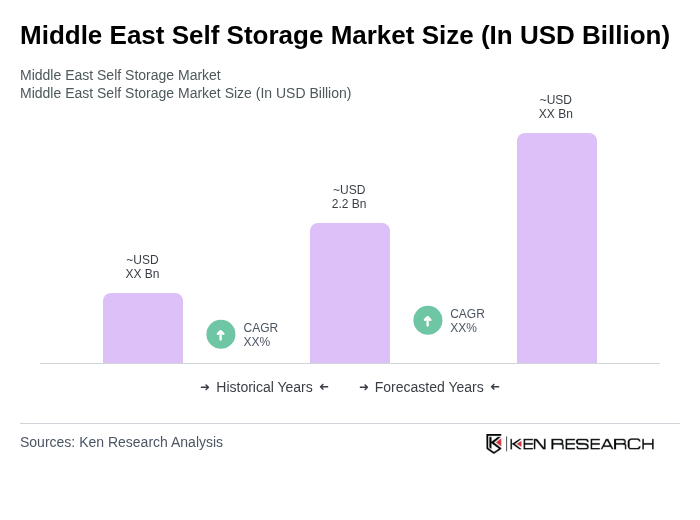
- The Middle East Self Storage Market is valued at USD 2.2 billion, based on a five-year historical analysis. This growth is primarily driven by increasing urbanization, a rise in expatriate populations, and the growing trend of downsizing among individuals and businesses. The demand for flexible storage solutions has surged, particularly in urban centers where space is at a premium.
- Key players in this market include the UAE, Saudi Arabia, and Qatar, which dominate due to their rapid economic development, high disposable incomes, and a significant expatriate community. The presence of major cities like Dubai and Riyadh, with their booming real estate sectors, further enhances the demand for self-storage facilities.
- In 2023, the UAE government implemented regulations to enhance the self-storage industry, mandating that all facilities adhere to specific safety and security standards. This includes the installation of surveillance systems and fire safety measures, as stipulated in the "UAE Fire and Life Safety Code of Practice, 2018" issued by the UAE Civil Defence, which requires storage facilities to comply with fire protection, emergency exits, and security protocols.
Middle East Self Storage Market Segmentation
By Type:The self-storage market can be segmented into various types, includingClimate-Controlled Storage,Drive-Up Access Storage,Container Storage,Vehicle Storage,Document Storage,Furniture Storage, andOthers. Each type caters to specific consumer needs, with climate-controlled storage being particularly popular for sensitive items such as electronics, artwork, and important documents, especially in regions with extreme temperatures and humidity.
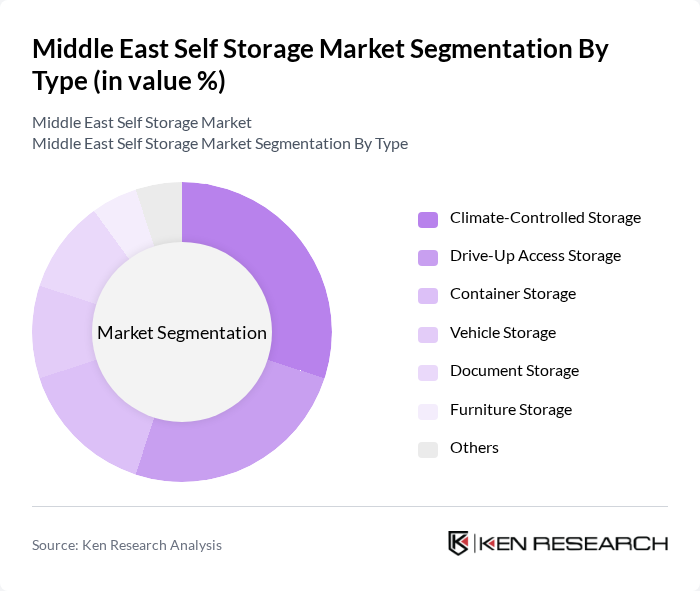
TheClimate-Controlled Storagesegment is currently leading the market due to the increasing need for protecting sensitive items from extreme temperatures and humidity. This type of storage is particularly favored by businesses and individuals who require assurance that their valuables are kept in optimal conditions. The growing awareness of the benefits of climate-controlled environments has driven consumer preference towards this segment, making it a dominant force in the self-storage market.
By End-User:The market can also be segmented by end-user categories, includingResidential (Individuals, Families, Expats),Commercial (SMEs, Retailers, E-commerce),Industrial (Manufacturers, Distributors),Government & Utilities, andOthers. Each segment has unique storage needs, with residential users often seeking short-term solutions while businesses may require long-term storage. The surge in e-commerce and the need for inventory management among SMEs have also contributed to commercial demand.
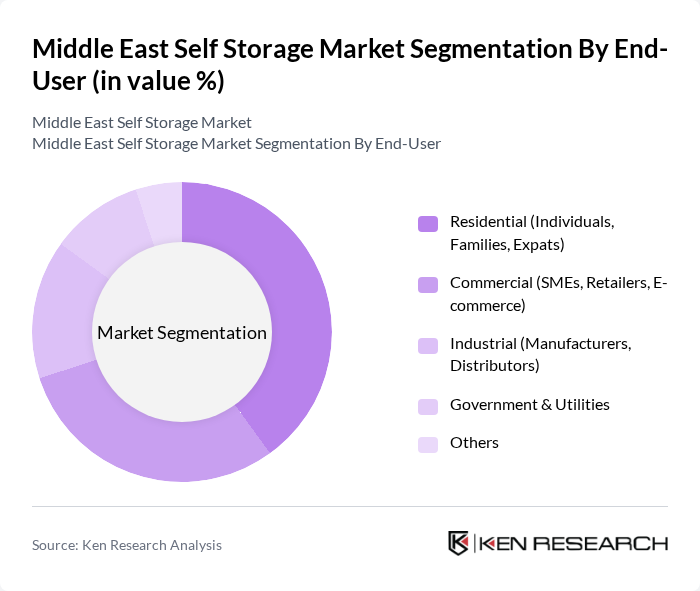
TheResidentialsegment is the largest end-user category, driven by the increasing number of expatriates and urban dwellers who require additional space for their belongings. This trend is particularly pronounced in cities with high population density, where living spaces are often limited. The flexibility and convenience offered by self-storage solutions make them an attractive option for individuals and families looking to manage their space effectively.
Middle East Self Storage Market Competitive Landscape
The Middle East Self Storage Market is characterized by a dynamic mix of regional and international players. Leading participants such as The Box Self Storage (UAE), Extra Space Storage (UAE, KSA), Storage Souq (UAE), Vachi Storage (UAE), Self Storage Dubai (UAE), CubeSmart (International, MEA), Public Storage (International), Shurgard Self Storage (International, MEA), The Storage Place (KSA), Storall (UAE), Safestore Holdings PLC (International, MEA), Big Yellow Group PLC (International, MEA), Lockable Storage (UAE), Smart Box Storage (KSA), Easytruck Storage (UAE) contribute to innovation, geographic expansion, and service delivery in this space.
Middle East Self Storage Market Industry Analysis
Growth Drivers
- Increasing Urbanization:The Middle East is experiencing rapid urbanization, with urban populations projected to reach 85% in future, according to the World Bank. This shift drives the need for self-storage solutions as urban dwellers often face space constraints. In cities like Dubai, the population density is expected to exceed 4,500 people per square kilometer, necessitating additional storage options for both residents and businesses. This urban growth fuels demand for flexible storage solutions, enhancing market potential.
- Rising Demand for Flexible Storage Solutions:The demand for flexible storage options is surging, particularly among millennials and expatriates. In future, the number of expatriates in the UAE is projected to reach approximately 8.84 million, creating a significant market for self-storage. Additionally, the rise of remote work has led to increased downsizing, with 65% of individuals seeking storage for personal belongings. This trend highlights the necessity for adaptable storage solutions that cater to diverse consumer needs in the region.
- Growth in E-commerce and Online Retail:The e-commerce sector in the Middle East is expected to grow to $37 billion in future, according to a report by Bain & Company. This growth drives demand for self-storage as online retailers require additional space for inventory management. With over 75% of consumers in the region shopping online, businesses are increasingly seeking storage solutions to accommodate their logistics needs. This trend presents a lucrative opportunity for self-storage providers to cater to the expanding e-commerce market.
Market Challenges
- High Competition Among Providers:The self-storage market in the Middle East is becoming increasingly competitive, with over 250 facilities operating in Dubai alone. This saturation leads to price wars and reduced profit margins for providers. As new entrants continue to emerge, established companies must innovate and differentiate their services to maintain market share. The intense competition poses a significant challenge for profitability and long-term sustainability in the self-storage sector.
- Regulatory Hurdles:Regulatory challenges significantly impact the self-storage industry in the Middle East. Licensing requirements vary by country, with some regions imposing stringent regulations that can delay facility openings. For instance, in Saudi Arabia, new storage facilities must comply with local zoning laws, which can take up to eight months for approval. These regulatory hurdles can hinder market entry and expansion, creating barriers for both new and existing providers in the region.
Middle East Self Storage Market Future Outlook
The future of the self-storage market in the Middle East appears promising, driven by urbanization and technological advancements. As cities expand and populations grow, the demand for storage solutions will likely increase. Additionally, the integration of smart technologies and IoT in storage facilities will enhance operational efficiency and customer experience. Providers that adapt to these trends and focus on sustainability will be well-positioned to capture market share and meet evolving consumer needs in the coming years.
Market Opportunities
- Technological Advancements in Storage Solutions:The adoption of advanced technologies, such as automated storage systems and mobile apps, presents a significant opportunity for self-storage providers. In future, facilities that implement these technologies can enhance customer engagement and streamline operations, potentially increasing occupancy rates by 25%. This technological shift can attract tech-savvy consumers seeking convenience and efficiency in their storage solutions.
- Partnerships with Real Estate Developers:Collaborating with real estate developers can create synergies that benefit both parties. As new residential and commercial projects emerge, integrating self-storage facilities can enhance property value and appeal. In future, partnerships could lead to the establishment of at least 20 new self-storage facilities across major urban centers, addressing the growing demand for storage solutions in tandem with real estate development.
Scope of the Report
| Segment | Sub-Segments |
|---|---|
| By Type | Climate-Controlled Storage Drive-Up Access Storage Container Storage Vehicle Storage Document Storage Furniture Storage Others |
| By End-User | Residential (Individuals, Families, Expats) Commercial (SMEs, Retailers, E-commerce) Industrial (Manufacturers, Distributors) Government & Utilities Others |
| By Facility Size | Small Facilities (<5,000 sq. ft.) Medium Facilities (5,000–20,000 sq. ft.) Large Facilities (>20,000 sq. ft.) Mega Facilities (>50,000 sq. ft.) Others |
| By Location | Urban Areas Suburban Areas Industrial Zones Rural Areas Others |
| By Security Features | Gated Access Surveillance Cameras Alarm Systems Biometric Access On-site Security Personnel Others |
| By Duration of Rental | Short-Term Rentals (<3 months) Medium-Term Rentals (3–12 months) Long-Term Rentals (>12 months) Others |
| By Pricing Model | Monthly Rentals Annual Rentals Pay-As-You-Go Dynamic Pricing (Seasonal/Promotional) Others |
Key Target Audience
Investors and Venture Capitalist Firms
Government and Regulatory Bodies (e.g., Ministry of Housing, Ministry of Economy)
Real Estate Developers
Logistics and Supply Chain Companies
Property Management Firms
Insurance Companies
Construction Firms
Local Municipalities
Players Mentioned in the Report:
The Box Self Storage (UAE)
Extra Space Storage (UAE, KSA)
Storage Souq (UAE)
Vachi Storage (UAE)
Self Storage Dubai (UAE)
CubeSmart (International, MEA)
Public Storage (International)
Shurgard Self Storage (International, MEA)
The Storage Place (KSA)
Storall (UAE)
Safestore Holdings PLC (International, MEA)
Big Yellow Group PLC (International, MEA)
Lockable Storage (UAE)
Smart Box Storage (KSA)
Easytruck Storage (UAE)
Table of Contents
Market Assessment Phase
1. Executive Summary and Approach
2. Middle East Self Storage Market Overview
2.1 Key Insights and Strategic Recommendations
2.2 Middle East Self Storage Market Overview
2.3 Definition and Scope
2.4 Evolution of Market Ecosystem
2.5 Timeline of Key Regulatory Milestones
2.6 Value Chain & Stakeholder Mapping
2.7 Business Cycle Analysis
2.8 Policy & Incentive Landscape
3. Middle East Self Storage Market Analysis
3.1 Growth Drivers
3.1.1 Increasing Urbanization
3.1.2 Rising Demand for Flexible Storage Solutions
3.1.3 Growth in E-commerce and Online Retail
3.1.4 Expansion of Expatriate Population
3.2 Market Challenges
3.2.1 High Competition Among Providers
3.2.2 Regulatory Hurdles
3.2.3 Economic Fluctuations
3.2.4 Limited Awareness of Self Storage Benefits
3.3 Market Opportunities
3.3.1 Technological Advancements in Storage Solutions
3.3.2 Growing Demand from SMEs
3.3.3 Development of Smart Storage Facilities
3.3.4 Partnerships with Real Estate Developers
3.4 Market Trends
3.4.1 Increased Adoption of Contactless Services
3.4.2 Integration of IoT in Storage Facilities
3.4.3 Focus on Sustainability and Eco-Friendly Practices
3.4.4 Customization of Storage Solutions
3.5 Government Regulation
3.5.1 Licensing Requirements for Storage Facilities
3.5.2 Zoning Laws Impacting Facility Locations
3.5.3 Safety and Security Regulations
3.5.4 Consumer Protection Laws
4. SWOT Analysis
5. Stakeholder Analysis
6. Porter's Five Forces Analysis
7. Middle East Self Storage Market Market Size, 2019-2024
7.1 By Value
7.2 By Volume
7.3 By Average Selling Price
8. Middle East Self Storage Market Segmentation
8.1 By Type
8.1.1 Climate-Controlled Storage
8.1.2 Drive-Up Access Storage
8.1.3 Container Storage
8.1.4 Vehicle Storage
8.1.5 Document Storage
8.1.6 Furniture Storage
8.1.7 Others
8.2 By End-User
8.2.1 Residential (Individuals, Families, Expats)
8.2.2 Commercial (SMEs, Retailers, E-commerce)
8.2.3 Industrial (Manufacturers, Distributors)
8.2.4 Government & Utilities
8.2.5 Others
8.3 By Facility Size
8.3.1 Small Facilities (<5,000 sq. ft.)
8.3.2 Medium Facilities (5,000–20,000 sq. ft.)
8.3.3 Large Facilities (>20,000 sq. ft.)
8.3.4 Mega Facilities (>50,000 sq. ft.)
8.3.5 Others
8.4 By Location
8.4.1 Urban Areas
8.4.2 Suburban Areas
8.4.3 Industrial Zones
8.4.4 Rural Areas
8.4.5 Others
8.5 By Security Features
8.5.1 Gated Access
8.5.2 Surveillance Cameras
8.5.3 Alarm Systems
8.5.4 Biometric Access
8.5.5 On-site Security Personnel
8.5.6 Others
8.6 By Duration of Rental
8.6.1 Short-Term Rentals (<3 months)
8.6.2 Medium-Term Rentals (3–12 months)
8.6.3 Long-Term Rentals (>12 months)
8.6.4 Others
8.7 By Pricing Model
8.7.1 Monthly Rentals
8.7.2 Annual Rentals
8.7.3 Pay-As-You-Go
8.7.4 Dynamic Pricing (Seasonal/Promotional)
8.7.5 Others
9. Middle East Self Storage Market Competitive Analysis
9.1 Market Share of Key Players
9.2 Cross Comparison of Key Players
9.2.1 Company Name
9.2.2 Group Size (Large, Medium, or Small as per industry convention)
9.2.3 Number of Facilities in Middle East
9.2.4 Total Net Leasable Area (sq. ft.)
9.2.5 Occupancy Rate (%)
9.2.6 Revenue per Available Storage Unit (RevPAU)
9.2.7 Average Unit Size (sq. ft.)
9.2.8 Customer Acquisition Cost (CAC)
9.2.9 Pricing Strategy (Premium, Value, Discount)
9.2.10 Customer Retention Rate (%)
9.2.11 Average Length of Stay (months)
9.2.12 Net Promoter Score (NPS)
9.2.13 Return on Investment (ROI)
9.2.14 Digital Adoption (Online Booking, Smart Access)
9.2.15 Sustainability Initiatives
9.3 SWOT Analysis of Top Players
9.4 Pricing Analysis
9.5 Detailed Profile of Major Companies
9.5.1 The Box Self Storage (UAE)
9.5.2 Extra Space Storage (UAE, KSA)
9.5.3 Storage Souq (UAE)
9.5.4 Vachi Storage (UAE)
9.5.5 Self Storage Dubai (UAE)
9.5.6 CubeSmart (International, MEA)
9.5.7 Public Storage (International)
9.5.8 Shurgard Self Storage (International, MEA)
9.5.9 The Storage Place (KSA)
9.5.10 Storall (UAE)
9.5.11 Safestore Holdings PLC (International, MEA)
9.5.12 Big Yellow Group PLC (International, MEA)
9.5.13 Lockable Storage (UAE)
9.5.14 Smart Box Storage (KSA)
9.5.15 Easytruck Storage (UAE)
10. Middle East Self Storage Market End-User Analysis
10.1 Procurement Behavior of Key Ministries
10.1.1 Government Storage Needs
10.1.2 Budget Allocation for Storage Solutions
10.1.3 Decision-Making Processes
10.1.4 Contracting Procedures
10.2 Corporate Spend on Infrastructure & Energy
10.2.1 Investment in Storage Facilities
10.2.2 Budgeting for Operational Costs
10.2.3 Trends in Corporate Storage Needs
10.3 Pain Point Analysis by End-User Category
10.3.1 Space Constraints
10.3.2 Security Concerns
10.3.3 Accessibility Issues
10.3.4 Cost Management
10.4 User Readiness for Adoption
10.4.1 Awareness of Self Storage Benefits
10.4.2 Willingness to Pay for Services
10.4.3 Adoption of Technology in Storage
10.5 Post-Deployment ROI and Use Case Expansion
10.5.1 Measuring ROI from Storage Solutions
10.5.2 Use Cases for Different End-Users
10.5.3 Long-Term Benefits of Self Storage
11. Middle East Self Storage Market Future Size, 2025-2030
11.1 By Value
11.2 By Volume
11.3 By Average Selling Price
Go-To-Market Strategy Phase
1. Whitespace Analysis + Business Model Canvas
1.1 Market Gaps Identification
1.2 Business Model Development
2. Marketing and Positioning Recommendations
2.1 Branding Strategies
2.2 Product USPs
3. Distribution Plan
3.1 Urban Retail vs Rural NGO Tie-Ups
4. Channel & Pricing Gaps
4.1 Underserved Routes
4.2 Pricing Bands
5. Unmet Demand & Latent Needs
5.1 Category Gaps
5.2 Consumer Segments
6. Customer Relationship
6.1 Loyalty Programs
6.2 After-Sales Service
7. Value Proposition
7.1 Sustainability
7.2 Integrated Supply Chains
8. Key Activities
8.1 Regulatory Compliance
8.2 Branding
8.3 Distribution Setup
9. Entry Strategy Evaluation
9.1 Domestic Market Entry Strategy
9.1.1 Product Mix
9.1.2 Pricing Band
9.1.3 Packaging
9.2 Export Entry Strategy
9.2.1 Target Countries
9.2.2 Compliance Roadmap
10. Entry Mode Assessment
10.1 JV
10.2 Greenfield
10.3 M&A
10.4 Distributor Model
11. Capital and Timeline Estimation
11.1 Capital Requirements
11.2 Timelines
12. Control vs Risk Trade-Off
12.1 Ownership vs Partnerships
13. Profitability Outlook
13.1 Breakeven Analysis
13.2 Long-Term Sustainability
14. Potential Partner List
14.1 Distributors
14.2 JVs
14.3 Acquisition Targets
15. Execution Roadmap
15.1 Phased Plan for Market Entry
15.1.1 Market Setup
15.1.2 Market Entry
15.1.3 Growth Acceleration
15.1.4 Scale & Stabilize
15.2 Key Activities and Milestones
15.2.1 Milestone Planning
15.2.2 Activity Tracking
Research Methodology
Phase 1: Approach1
Desk Research
- Analysis of industry reports from regional real estate and storage associations
- Review of government publications and economic indicators related to the self-storage sector
- Examination of market trends and consumer behavior studies published in academic journals
Primary Research
- Interviews with self-storage facility owners and operators across key Middle Eastern markets
- Surveys targeting potential customers to understand storage needs and preferences
- Focus groups with real estate developers to gauge interest in self-storage investments
Validation & Triangulation
- Cross-validation of findings with multiple data sources, including trade publications and market surveys
- Triangulation of qualitative insights from interviews with quantitative data from surveys
- Sanity checks through expert panel reviews comprising industry veterans and analysts
Phase 2: Market Size Estimation1
Top-down Assessment
- Estimation of total addressable market based on population growth and urbanization rates
- Segmentation of market size by country and type of self-storage facilities (e.g., climate-controlled, drive-up access)
- Incorporation of economic factors such as GDP growth and disposable income trends
Bottom-up Modeling
- Collection of operational data from leading self-storage companies to establish average revenue per unit
- Estimation of facility occupancy rates and average rental durations
- Calculation of market size based on the number of facilities and average unit sizes
Forecasting & Scenario Analysis
- Development of growth scenarios based on demographic shifts and urban development plans
- Analysis of potential impacts from economic fluctuations and regulatory changes on the self-storage market
- Creation of baseline, optimistic, and pessimistic forecasts through 2030
Phase 3: CATI Sample Composition1
| Scope Item/Segment | Sample Size | Target Respondent Profiles |
|---|---|---|
| Residential Self-Storage Users | 100 | Homeowners, Renters |
| Commercial Self-Storage Clients | 60 | Small Business Owners, Retail Managers |
| Real Estate Developers | 40 | Project Managers, Investment Analysts |
| Facility Operators | 50 | Operations Managers, Marketing Managers |
| Potential Investors in Self-Storage | 40 | Venture Capitalists, Private Equity Investors |
Frequently Asked Questions
What is the current value of the Middle East Self Storage Market?
The Middle East Self Storage Market is valued at approximately USD 2.2 billion, driven by factors such as urbanization, an increase in expatriate populations, and a growing trend of downsizing among individuals and businesses seeking flexible storage solutions.
Which countries dominate the Middle East Self Storage Market?
What types of self-storage solutions are available in the Middle East?
What are the key growth drivers for the Middle East Self Storage Market?
Other Adjacent Reports
Bahrain Moving and Relocation Services Market
Singapore Warehousing and Logistics Market
Germany E-commerce Fulfillment Market
Philippines Document Management Market
UAE Vehicle Storage Market
South Korea Real Estate Development Market
India Facility Management Market Size, Share & Forecast, By Service Type, Delivery Model & End-Use Industry, 2025-2032KSA Security Systems Market
Japan Insurance Services Market
KSA packaging materials market report size, share, growth drivers, trends, opportunities & forecast 2025–2030Why Buy From Us?

What makes us stand out is that our consultants follow Robust, Refine and Result (RRR) methodology. Robust for clear definitions, approaches and sanity checking, Refine for differentiating respondents' facts and opinions, and Result for presenting data with story.

We have set a benchmark in the industry by offering our clients with syndicated and customized market research reports featuring coverage of entire market as well as meticulous research and analyst insights.

While we don't replace traditional research, we flip the method upside down. Our dual approach of Top Bottom & Bottom Top ensures quality deliverable by not just verifying company fundamentals but also looking at the sector and macroeconomic factors.

With one step in the future, our research team constantly tries to show you the bigger picture. We help with some of the tough questions you may encounter along the way: How is the industry positioned? Best marketing channel? KPI's of competitors? By aligning every element, we help maximize success.

Our report gives you instant access to the answers and sources that other companies might choose to hide. We elaborate each steps of research methodology we have used and showcase you the sample size to earn your trust.

If you need any support, we are here! We pride ourselves on universe strength, data quality, and quick, friendly, and professional service.