About the Report
Base Year 2024Global Swimming Pool Market Overview
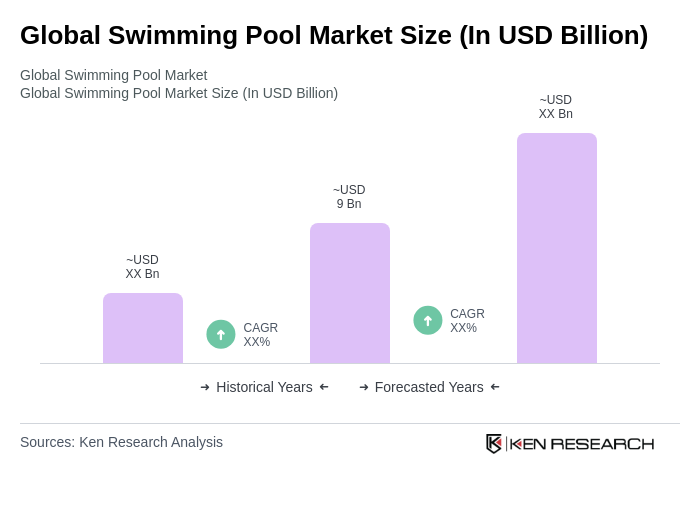
- The Global Swimming Pool Market is valued at USD 9 billion, based on a five-year historical analysis. This growth is primarily driven by increasing disposable incomes, rapid urbanization, and a strong trend toward outdoor leisure and wellness activities. The market is further supported by rising investments in home improvement and the expansion of the tourism and hospitality sectors, which are fueling demand for both residential and commercial pools .
- Key players in this market include the United States, China, and Australia. The United States leads due to its extensive residential pool base and a culture emphasizing outdoor living and wellness. China is experiencing rapid market expansion, driven by urbanization and increased consumer spending on leisure activities, while Australia benefits from a warm climate and a deeply rooted swimming culture .
- In 2023, the U.S. Consumer Product Safety Commission (CPSC) updated the Pool and Spa Safety Act, requiring that all new residential pools be equipped with compliant safety barriers and alarms. This regulation, formally titled the Virginia Graeme Baker Pool and Spa Safety Act (as amended, CPSC, 2023), mandates specific barrier heights, self-closing gates, and alarm systems to reduce child drowning incidents and enhance public safety standards .
Global Swimming Pool Market Segmentation
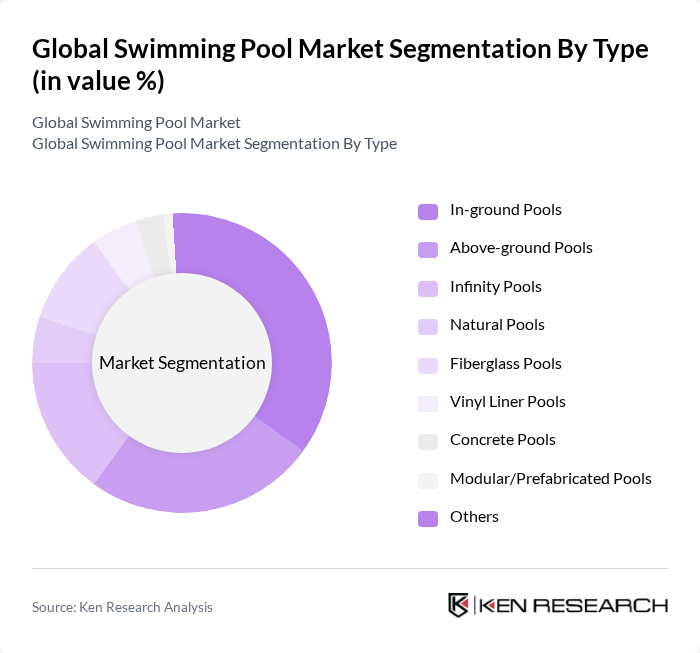
By Type:The market is segmented into various types of pools, including In-ground Pools, Above-ground Pools, Infinity Pools, Natural Pools, Fiberglass Pools, Vinyl Liner Pools, Concrete Pools, Modular/Prefabricated Pools, and Others. Each type addresses different consumer preferences, installation requirements, and budget considerations, with in-ground and above-ground pools accounting for the majority of installations due to their versatility and cost-effectiveness .
By End-User:The market is segmented by end-users into Residential, Commercial (Hotels, Resorts, Water Parks, Fitness Centers), and Government & Public Utilities (Municipal Pools, Community Centers). The residential segment dominates, driven by home improvement trends and increased consumer focus on health and wellness, while commercial and public utility segments are supported by tourism growth and municipal investments in recreational infrastructure .

Global Swimming Pool Market Competitive Landscape
The Global Swimming Pool Market is characterized by a dynamic mix of regional and international players. Leading participants such as Hayward Holdings, Inc., Pentair plc, Fluidra S.A., Zodiac Pool Systems LLC, Waterco Ltd., Pleatco LLC, Valterra Products LLC, Therm Products (HydroQuip Inc.), Intex Recreation Corp., Aladdin Equipment Co., Blue Haven Pools & Spas, Premier Pools and Spas, Swimart, Narellan Pools, Pool & Spa Warehouse contribute to innovation, geographic expansion, and service delivery in this space.
Global Swimming Pool Market Industry Analysis
Growth Drivers
- Increasing Disposable Income:The rise in disposable income in None has been significant, with an average increase of 5.2% annually, reaching approximately $50,000 per household in future. This financial growth enables consumers to invest in luxury items, including swimming pools. As more households can afford leisure amenities, the demand for residential pools is expected to surge, driving market growth. The correlation between income levels and pool ownership is evident, as higher income brackets typically lead to increased spending on recreational facilities.
- Rising Demand for Leisure and Recreational Activities:The trend towards healthier lifestyles has led to a 20% increase in leisure spending in None, with consumers prioritizing recreational activities. Swimming pools are increasingly viewed as essential for relaxation and fitness, contributing to this demand. In future, the leisure and recreation sector is projected to generate over $250 billion, with a significant portion allocated to home-based leisure facilities. This shift towards personal wellness and leisure activities is a key driver for the swimming pool market.
- Growth in Residential Construction:The residential construction sector in None is projected to grow by 10% in future, with over 1.8 million new housing units expected to be built. This expansion directly correlates with increased swimming pool installations, as new homeowners often seek to enhance their properties with pools. Additionally, the trend of integrating pools into new residential designs is becoming more prevalent, further driving demand. The construction boom is a vital factor in the overall growth of the swimming pool market.
Market Challenges
- High Initial Investment Costs:The average cost of installing a swimming pool in None ranges from $35,000 to $55,000, which can be a significant barrier for many potential buyers. This high initial investment often deters consumers, especially in a fluctuating economic environment. With rising material costs and labor shortages, the financial burden of pool installation remains a critical challenge. As a result, many consumers may opt for alternative leisure activities that require lower upfront costs.
- Seasonal Demand Fluctuations:The swimming pool market in None experiences pronounced seasonal demand fluctuations, with peak sales occurring during the summer months. In future, it is estimated that sales drop by nearly 65% during the winter season. This seasonality can lead to inconsistent revenue streams for manufacturers and installers, complicating financial planning and resource allocation. Companies must develop strategies to mitigate these fluctuations, such as offering winter maintenance services or promoting indoor pool solutions.
Global Swimming Pool Market Future Outlook
The future of the swimming pool market in None appears promising, driven by increasing consumer interest in home leisure activities and advancements in pool technology. As disposable incomes rise, more households are likely to invest in pools, while innovations in energy-efficient and smart pool technologies will enhance user experience. Additionally, the growing trend of eco-friendly solutions will shape market dynamics, encouraging manufacturers to develop sustainable products that align with consumer preferences for environmental responsibility.
Market Opportunities
- Expansion in Emerging Markets:Emerging markets in None present significant opportunities for growth, with an estimated 25% increase in pool installations expected in future. As urbanization continues, more consumers in these regions are seeking recreational amenities, including swimming pools, to enhance their lifestyles. This trend offers manufacturers and service providers a chance to tap into new customer bases and expand their market reach.
- Increasing Popularity of Smart Pools:The integration of smart technology in pool management is gaining traction, with a projected 35% increase in smart pool installations in future. Homeowners are increasingly interested in automation features that enhance convenience and energy efficiency. This trend presents a lucrative opportunity for companies to innovate and offer advanced solutions, catering to the growing demand for smart home technologies in the leisure sector.
Scope of the Report
| Segment | Sub-Segments |
|---|---|
| By Type | In-ground Pools Above-ground Pools Infinity Pools Natural Pools Fiberglass Pools Vinyl Liner Pools Concrete Pools Modular/Prefabricated Pools Others |
| By End-User | Residential Commercial (Hotels, Resorts, Water Parks, Fitness Centers) Government & Public Utilities (Municipal Pools, Community Centers) |
| By Application | Recreational Use Competitive Swimming Therapeutic & Wellness Use Adventure & Specialty Pools |
| By Sales Channel | Direct Sales Online Retail Distributors/Dealers Specialty Retailers |
| By Distribution Mode | Wholesale Retail |
| By Price Range | Budget Mid-range Premium |
| By Pool Features | Heating Systems Lighting Systems Water Filtration & Purification Systems Automation & Smart Controls Safety Features Eco-friendly Solutions |
Key Target Audience
Investors and Venture Capitalist Firms
Government and Regulatory Bodies (e.g., Environmental Protection Agency, National Swimming Pool Foundation)
Manufacturers and Producers
Distributors and Retailers
Pool Construction and Installation Companies
Maintenance and Service Providers
Industry Associations (e.g., Association of Pool & Spa Professionals)
Financial Institutions
Players Mentioned in the Report:
Hayward Holdings, Inc.
Pentair plc
Fluidra S.A.
Zodiac Pool Systems LLC
Waterco Ltd.
Pleatco LLC
Valterra Products LLC
Therm Products (HydroQuip Inc.)
Intex Recreation Corp.
Aladdin Equipment Co.
Blue Haven Pools & Spas
Premier Pools and Spas
Swimart
Narellan Pools
Pool & Spa Warehouse
Table of Contents
Market Assessment Phase
1. Executive Summary and Approach
2. Global Swimming Pool Market Overview
2.1 Key Insights and Strategic Recommendations
2.2 Global Swimming Pool Market Overview
2.3 Definition and Scope
2.4 Evolution of Market Ecosystem
2.5 Timeline of Key Regulatory Milestones
2.6 Value Chain & Stakeholder Mapping
2.7 Business Cycle Analysis
2.8 Policy & Incentive Landscape
3. Global Swimming Pool Market Analysis
3.1 Growth Drivers
3.1.1 Increasing disposable income
3.1.2 Rising demand for leisure and recreational activities
3.1.3 Growth in residential construction
3.1.4 Technological advancements in pool maintenance
3.2 Market Challenges
3.2.1 High initial investment costs
3.2.2 Seasonal demand fluctuations
3.2.3 Regulatory compliance issues
3.2.4 Environmental concerns regarding water usage
3.3 Market Opportunities
3.3.1 Expansion in emerging markets
3.3.2 Increasing popularity of smart pools
3.3.3 Growth in eco-friendly pool solutions
3.3.4 Partnerships with hospitality sectors
3.4 Market Trends
3.4.1 Rise of modular and inflatable pools
3.4.2 Integration of automation and IoT in pool management
3.4.3 Focus on energy-efficient pool heating solutions
3.4.4 Customization and personalization in pool design
3.5 Government Regulation
3.5.1 Water conservation regulations
3.5.2 Safety standards for pool installations
3.5.3 Environmental impact assessments
3.5.4 Incentives for energy-efficient pool technologies
4. SWOT Analysis
5. Stakeholder Analysis
6. Porter's Five Forces Analysis
7. Global Swimming Pool Market Market Size, 2019-2024
7.1 By Value
7.2 By Volume
7.3 By Average Selling Price
8. Global Swimming Pool Market Segmentation
8.1 By Type
8.1.1 In-ground Pools
8.1.2 Above-ground Pools
8.1.3 Infinity Pools
8.1.4 Natural Pools
8.1.5 Fiberglass Pools
8.1.6 Vinyl Liner Pools
8.1.7 Concrete Pools
8.1.8 Modular/Prefabricated Pools
8.1.9 Others
8.2 By End-User
8.2.1 Residential
8.2.2 Commercial (Hotels, Resorts, Water Parks, Fitness Centers)
8.2.3 Government & Public Utilities (Municipal Pools, Community Centers)
8.3 By Application
8.3.1 Recreational Use
8.3.2 Competitive Swimming
8.3.3 Therapeutic & Wellness Use
8.3.4 Adventure & Specialty Pools
8.4 By Sales Channel
8.4.1 Direct Sales
8.4.2 Online Retail
8.4.3 Distributors/Dealers
8.4.4 Specialty Retailers
8.5 By Distribution Mode
8.5.1 Wholesale
8.5.2 Retail
8.6 By Price Range
8.6.1 Budget
8.6.2 Mid-range
8.6.3 Premium
8.7 By Pool Features
8.7.1 Heating Systems
8.7.2 Lighting Systems
8.7.3 Water Filtration & Purification Systems
8.7.4 Automation & Smart Controls
8.7.5 Safety Features
8.7.6 Eco-friendly Solutions
9. Global Swimming Pool Market Competitive Analysis
9.1 Market Share of Key Players
9.2 Cross Comparison of Key Players
9.2.1 Company Name
9.2.2 Global Market Share (%)
9.2.3 Revenue Growth Rate (YoY)
9.2.4 Geographic Presence (Number of Countries/Regions)
9.2.5 Product Portfolio Breadth (Number of Product Categories)
9.2.6 R&D Investment (% of Revenue)
9.2.7 Customer Retention Rate (%)
9.2.8 Pricing Strategy (Premium, Value, Mixed)
9.2.9 Distribution Network Coverage (Number of Distributors/Dealers)
9.2.10 Innovation Rate (Number of Patents/Annual Product Launches)
9.2.11 Sustainability Initiatives (Eco-friendly Product Share, Certifications)
9.2.12 Brand Recognition (Global/Regional Rankings)
9.3 SWOT Analysis of Top Players
9.4 Pricing Analysis
9.5 Detailed Profile of Major Companies
9.5.1 Hayward Holdings, Inc.
9.5.2 Pentair plc
9.5.3 Fluidra S.A.
9.5.4 Zodiac Pool Systems LLC
9.5.5 Waterco Ltd.
9.5.6 Pleatco LLC
9.5.7 Valterra Products LLC
9.5.8 Therm Products (HydroQuip Inc.)
9.5.9 Intex Recreation Corp.
9.5.10 Aladdin Equipment Co.
9.5.11 Blue Haven Pools & Spas
9.5.12 Premier Pools and Spas
9.5.13 Swimart
9.5.14 Narellan Pools
9.5.15 Pool & Spa Warehouse
10. Global Swimming Pool Market End-User Analysis
10.1 Procurement Behavior of Key Ministries
10.1.1 Budget Allocation Trends
10.1.2 Decision-Making Processes
10.1.3 Preferred Suppliers
10.2 Corporate Spend on Infrastructure & Energy
10.2.1 Investment Trends
10.2.2 Budget Prioritization
10.2.3 Long-term Contracts
10.3 Pain Point Analysis by End-User Category
10.3.1 Maintenance Costs
10.3.2 Safety Concerns
10.3.3 Seasonal Usage
10.4 User Readiness for Adoption
10.4.1 Awareness Levels
10.4.2 Training Needs
10.4.3 Technology Acceptance
10.5 Post-Deployment ROI and Use Case Expansion
10.5.1 Performance Metrics
10.5.2 User Satisfaction
10.5.3 Future Investment Plans
11. Global Swimming Pool Market Future Size, 2025-2030
11.1 By Value
11.2 By Volume
11.3 By Average Selling Price
Go-To-Market Strategy Phase
1. Whitespace Analysis + Business Model Canvas
1.1 Market Gaps Identification
1.2 Value Proposition Development
1.3 Revenue Streams Analysis
1.4 Cost Structure Evaluation
1.5 Key Partnerships
1.6 Customer Segments
1.7 Channels
2. Marketing and Positioning Recommendations
2.1 Branding Strategies
2.2 Product USPs
2.3 Target Audience Identification
2.4 Communication Strategies
3. Distribution Plan
3.1 Urban Retail Strategies
3.2 Rural NGO Tie-ups
3.3 Online Distribution Channels
4. Channel & Pricing Gaps
4.1 Underserved Routes
4.2 Pricing Bands Analysis
5. Unmet Demand & Latent Needs
5.1 Category Gaps
5.2 Consumer Segments
6. Customer Relationship
6.1 Loyalty Programs
6.2 After-sales Service
7. Value Proposition
7.1 Sustainability Initiatives
7.2 Integrated Supply Chains
8. Key Activities
8.1 Regulatory Compliance
8.2 Branding Efforts
8.3 Distribution Setup
9. Entry Strategy Evaluation
9.1 Domestic Market Entry Strategy
9.1.1 Product Mix
9.1.2 Pricing Band
9.1.3 Packaging
9.2 Export Entry Strategy
9.2.1 Target Countries
9.2.2 Compliance Roadmap
10. Entry Mode Assessment
10.1 Joint Ventures
10.2 Greenfield Investments
10.3 Mergers & Acquisitions
10.4 Distributor Model
11. Capital and Timeline Estimation
11.1 Capital Requirements
11.2 Timelines
12. Control vs Risk Trade-Off
12.1 Ownership vs Partnerships
13. Profitability Outlook
13.1 Breakeven Analysis
13.2 Long-term Sustainability
14. Potential Partner List
14.1 Distributors
14.2 Joint Ventures
14.3 Acquisition Targets
15. Execution Roadmap
15.1 Phased Plan for Market Entry
15.1.1 Market Setup
15.1.2 Market Entry
15.1.3 Growth Acceleration
15.1.4 Scale & Stabilize
15.2 Key Activities and Milestones
15.2.1 Milestone Planning
15.2.2 Activity Tracking
Research Methodology
Phase 1: Approach1
Desk Research
- Industry reports from global swimming pool associations and market research firms
- Government publications on construction and recreational facility regulations
- Market analysis from trade journals focusing on pool equipment and maintenance
Primary Research
- Interviews with pool installation contractors and service providers
- Surveys with homeowners and property managers regarding pool ownership and maintenance
- Field interviews with landscape architects and urban planners involved in pool design
Validation & Triangulation
- Cross-validation of data from multiple sources including sales figures and consumer surveys
- Triangulation of insights from industry experts and market trends
- Sanity checks through expert panel reviews and feedback loops
Phase 2: Market Size Estimation1
Top-down Assessment
- Analysis of overall construction spending and its allocation to residential and commercial pools
- Segmentation of the market by pool type (in-ground, above-ground) and geographical region
- Incorporation of trends in leisure spending and outdoor living preferences
Bottom-up Modeling
- Estimation of unit sales based on historical data from pool manufacturers and distributors
- Operational cost analysis for installation and maintenance services
- Volume x average price calculations for different pool types and accessories
Forecasting & Scenario Analysis
- Multi-factor regression analysis incorporating economic indicators and demographic trends
- Scenario modeling based on potential regulatory changes and environmental considerations
- Baseline, optimistic, and pessimistic projections through 2030
Phase 3: CATI Sample Composition1
| Scope Item/Segment | Sample Size | Target Respondent Profiles |
|---|---|---|
| Residential Pool Owners | 100 | Homeowners, Property Managers |
| Commercial Pool Operators | 80 | Facility Managers, Recreation Directors |
| Pool Installation Contractors | 60 | Business Owners, Project Managers |
| Pool Maintenance Service Providers | 50 | Service Technicians, Operations Managers |
| Landscape Architects and Designers | 40 | Design Professionals, Urban Planners |
Frequently Asked Questions
What is the current value of the Global Swimming Pool Market?
The Global Swimming Pool Market is valued at approximately USD 9 billion, driven by factors such as increasing disposable incomes, urbanization, and a growing trend towards outdoor leisure and wellness activities.
What are the main types of swimming pools in the market?
Which countries are leading in the Global Swimming Pool Market?
What are the key drivers of growth in the swimming pool market?
Other Regional/Country Reports
Indonesia Swimming Pool Market
Malaysia Swimming Pool Market
APAC Swimming Pool Market
SEA Swimming Pool Market
Other Adjacent Reports
Bahrain Spa and Hot Tub Market
United States Water Treatment Chemicals Market Outlook to 2030: Size, Share, Growth and TrendsMiddle East Outdoor Furniture Market Report Size Share Growth Drivers Trends Opportunities & Forecast 2025–2030Global Landscaping Services Market Outlook 2030Indonesia Home Improvement Retail Market
Saudi Arabia Fitness Equipment MarketJapan Hospitality and Tourism Market
Europe Residential Construction MarketOman Pool Maintenance Services Market
Qatar Smart Home Technology MarketWhy Buy From Us?

What makes us stand out is that our consultants follow Robust, Refine and Result (RRR) methodology. Robust for clear definitions, approaches and sanity checking, Refine for differentiating respondents' facts and opinions, and Result for presenting data with story.

We have set a benchmark in the industry by offering our clients with syndicated and customized market research reports featuring coverage of entire market as well as meticulous research and analyst insights.

While we don't replace traditional research, we flip the method upside down. Our dual approach of Top Bottom & Bottom Top ensures quality deliverable by not just verifying company fundamentals but also looking at the sector and macroeconomic factors.

With one step in the future, our research team constantly tries to show you the bigger picture. We help with some of the tough questions you may encounter along the way: How is the industry positioned? Best marketing channel? KPI's of competitors? By aligning every element, we help maximize success.

Our report gives you instant access to the answers and sources that other companies might choose to hide. We elaborate each steps of research methodology we have used and showcase you the sample size to earn your trust.

If you need any support, we are here! We pride ourselves on universe strength, data quality, and quick, friendly, and professional service.