Ken Research Logo

Global thermostatic faucet market Size, Share, Growth Drivers, Trends, Opportunities & Forecast 2025–2030

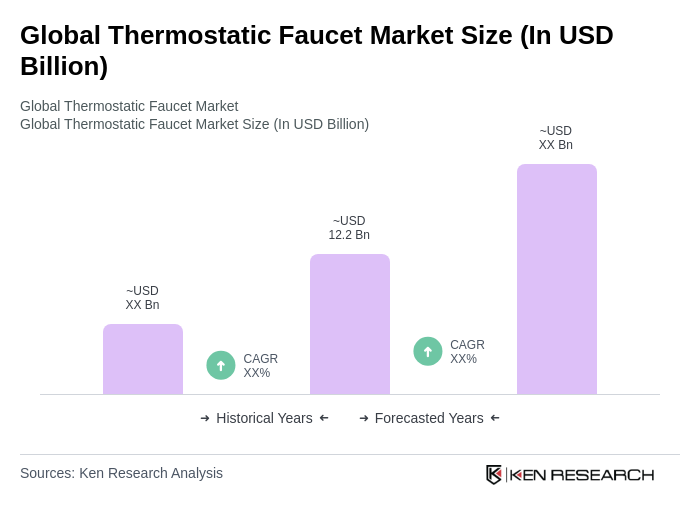
The Global Thermostatic Faucet Market, valued at USD 12.2 billion, is growing due to demand for efficient, smart faucets in homes, hospitality, and healthcare sectors.

Region:Global

Author(s):Shubham

Product Code:KRAC4268

Pages:92

Published On:October 2025
About the Report

Base Year 2024

Global Thermostatic Faucet Market Overview

  • The Global Thermostatic Faucet Market is valued at USD 12.2 billion, based on a five-year historical analysis. This growth is primarily driven by increasing consumer demand for water-saving technologies, heightened awareness of hygiene, and the rapid integration of smart home solutions. The market has seen a significant uptick in the adoption of advanced faucet technologies that enhance user convenience, safety, and operational efficiency, with smart and touchless features becoming mainstream in both residential and commercial sectors .
  • Key players in this market include the United States, Germany, and China, which dominate due to robust manufacturing capabilities, advanced technological infrastructure, and high consumer spending on home improvement products. The presence of established brands and a growing trend towards luxury, water-efficient, and smart home solutions further solidify their market leadership .
  • The European Union’s “Ecodesign for Energy-Related Products and Energy Labelling Regulations, 2023” issued by the European Commission, mandates that all new faucets placed on the EU market must meet specific water efficiency and performance standards. These regulations require manufacturers to ensure faucets achieve at least a 20% reduction in water consumption in residential and commercial buildings, driving innovation and adoption of thermostatic faucets that comply with these standards .
Global Thermostatic Faucet Market Size

Global Thermostatic Faucet Market Segmentation

By Technology Type:The technology type segmentation encompasses a range of innovative faucet designs tailored to evolving consumer and commercial needs. Manual thermostatic faucets remain widely used for their reliability, while digital and smart faucets with IoT integration are rapidly gaining traction due to their enhanced convenience, remote control, and data-driven water management. Infrared sensing and voice-activated faucets are increasingly popular, especially in commercial and healthcare environments where touchless operation and hygiene are critical. The adoption of touchless and smart features is a key trend, reflecting broader shifts toward automation and connected living .
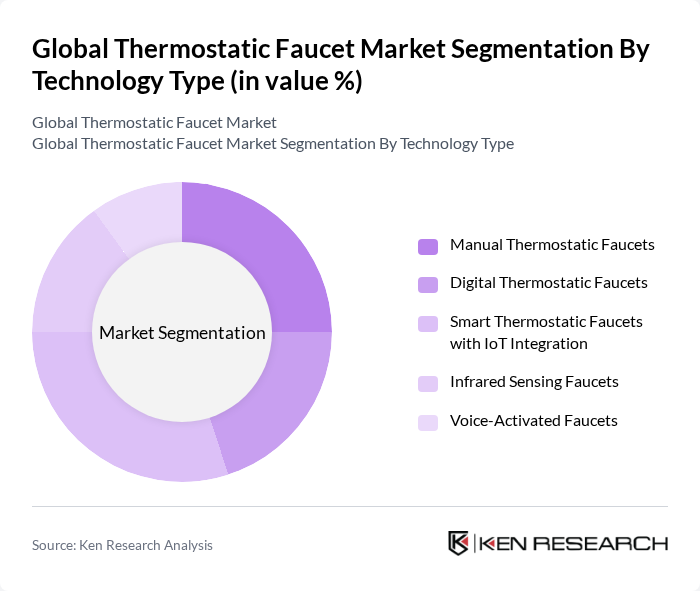
Global Thermostatic Faucet Market segmentation by Technology Type.

By End-User:The end-user segmentation reflects the diverse applications of thermostatic faucets across residential, commercial, healthcare, and industrial sectors. The residential segment remains the largest, driven by urbanization, rising disposable incomes, and increased home renovation activity. The commercial sector—including hotels, hospitality, and office spaces—shows robust demand as businesses prioritize customer experience, hygiene, and operational efficiency. Healthcare facilities are adopting thermostatic faucets for infection control and safety, while the industrial segment focuses on durability and compliance with workplace safety standards .
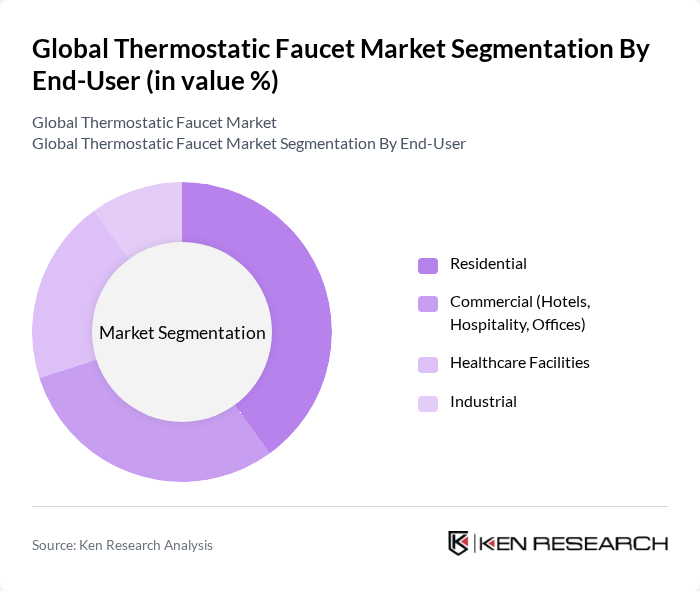
Global Thermostatic Faucet Market segmentation by End-User.

Global Thermostatic Faucet Market Competitive Landscape

The Global Thermostatic Faucet Market is characterized by a dynamic mix of regional and international players. Leading participants such as Moen Incorporated, Kohler Co., Delta Faucet Company, Grohe AG, Hansgrohe SE, American Standard Brands, Pfister (Formerly Marmon Holdings), Roca Sanitario S.A., TOTO Ltd., Brizo (Subsidiary of Masco Corporation), Danze (Subsidiary of Masco Corporation), Vigo Industries, Waterstone Faucets, Blanco Group, Elkay Manufacturing Company, Jaquar Group, Hindware Homes Limited, and Huida Sanitary Ware contribute to innovation, geographic expansion, and service delivery in this space.

Moen Incorporated

1937

North Olmsted, Ohio, USA

Kohler Co.

1873

Kohler, Wisconsin, USA

Delta Faucet Company

1954

Indianapolis, Indiana, USA

Grohe AG

1936

Höhr-Grenzhausen, Germany

Hansgrohe SE

1901

Schiltach, Germany

Company

Establishment Year

Headquarters

Company Size Classification (Large, Medium, Small)

Year-over-Year Revenue Growth Rate (%)

Market Share & Geographic Penetration (%)

Product Portfolio Breadth (Number of SKUs)

R&D Investment as % of Revenue

Average Selling Price (ASP) by Segment

Global Thermostatic Faucet Market Industry Analysis

Growth Drivers

  • Increasing Demand for Water Conservation:The global push for water conservation is driving the thermostatic faucet market, with the World Bank reporting that water scarcity affects over 2 billion people. In future, the global water demand is projected to reach 6,900 billion cubic meters, emphasizing the need for efficient water usage. Thermostatic faucets, which can reduce water wastage by up to 30%, are increasingly favored in residential and commercial sectors, aligning with sustainability goals and regulatory frameworks.
  • Rising Consumer Awareness of Smart Home Technologies:The smart home market is expected to reach $135 billion in future, with thermostatic faucets playing a crucial role. As consumers become more tech-savvy, the demand for smart faucets that integrate with home automation systems is surging. According to Statista, 70% of homeowners are interested in smart home devices, driving manufacturers to innovate and incorporate features like remote temperature control and water usage tracking, enhancing user experience and convenience.
  • Growth in the Hospitality Sector:The hospitality industry is projected to grow by 5.5% annually, reaching $4.5 trillion in future. This growth is fueling demand for high-quality fixtures, including thermostatic faucets, which enhance guest experiences through improved water temperature control and comfort. Hotels and restaurants are increasingly adopting these faucets to meet customer expectations for luxury and efficiency, thereby driving market expansion and innovation in faucet technology.

Market Challenges

  • High Initial Installation Costs:The initial installation costs for thermostatic faucets can be significantly higher than traditional models, often ranging from $200 to $500 per unit. This financial barrier can deter consumers, especially in regions where budget constraints are prevalent. Additionally, the need for professional installation adds to the overall expense, making it challenging for widespread adoption in cost-sensitive markets, despite long-term savings on water bills.
  • Limited Consumer Knowledge:A significant challenge facing the thermostatic faucet market is the limited consumer knowledge regarding the benefits and functionalities of these products. According to a survey by the American Society of Plumbing Engineers, only 40% of consumers are aware of the advantages of thermostatic faucets. This lack of awareness can hinder market growth, as potential buyers may opt for traditional faucets due to familiarity, impacting overall sales and market penetration.

Global Thermostatic Faucet Market Future Outlook

The future of the thermostatic faucet market appears promising, driven by increasing environmental awareness and technological advancements. As consumers prioritize sustainability, manufacturers are likely to innovate further, focusing on energy-efficient and water-saving designs. Additionally, the integration of IoT technology will enhance user experience, allowing for greater control and customization. The market is expected to adapt to evolving consumer preferences, ensuring that thermostatic faucets remain a vital component of modern plumbing solutions.

Market Opportunities

  • Expansion in Emerging Markets:Emerging markets, particularly in Asia and Africa, present significant growth opportunities for thermostatic faucets. With urbanization rates projected to reach 60% in future, the demand for modern plumbing solutions is set to rise. Manufacturers can capitalize on this trend by introducing affordable, efficient products tailored to local needs, thereby increasing market share in these regions.
  • Integration with IoT Devices:The integration of thermostatic faucets with IoT devices offers a lucrative opportunity for innovation. As smart home technology continues to evolve, faucets that can communicate with other devices for enhanced control and monitoring will attract tech-savvy consumers. This trend is expected to drive product development, leading to increased functionality and user engagement, ultimately boosting sales in the thermostatic faucet market.

Scope of the Report

SegmentSub-Segments
By Technology Type

Manual Thermostatic Faucets

Digital Thermostatic Faucets

Smart Thermostatic Faucets with IoT Integration

Infrared Sensing Faucets

Voice-Activated Faucets

By End-User

Residential

Commercial (Hotels, Hospitality, Offices)

Healthcare Facilities

Industrial

By Distribution Channel

Online Retail

Offline Retail

Direct Sales

Plumbing Contractors & Installers

By Material

Brass

Stainless Steel

Plastic Composites

Antibacterial Materials

By Design

Contemporary

Traditional

Minimalist

Luxury/Premium Designs

By Price Range

Budget (Under $100)

Mid-Range ($100-$300)

Premium ($300-$600)

Luxury (Above $600)

By Installation Type

Wall-Mounted

Deck-Mounted

Retrofit Solutions

By Flow Rate

Low-Flow (Below 1.5 GPM)

Standard Flow (1.5-2.5 GPM)

High-Flow (Above 2.5 GPM)

By Geography

Americas

Europe, Middle East & Africa

Asia-Pacific

Key Target Audience

Investors and Venture Capitalist Firms

Government and Regulatory Bodies (e.g., Environmental Protection Agency, Department of Energy)

Manufacturers and Producers

Distributors and Retailers

Plumbing and HVAC Contractors

Home Improvement and Renovation Companies

Industry Associations (e.g., American Society of Plumbing Engineers)

Financial Institutions

Players Mentioned in the Report:

Moen Incorporated

Kohler Co.

Delta Faucet Company

Grohe AG

Hansgrohe SE

American Standard Brands

Pfister (Formerly Marmon Holdings)

Roca Sanitario S.A.

TOTO Ltd.

Brizo (Subsidiary of Masco Corporation)

Danze (Subsidiary of Masco Corporation)

Vigo Industries

Waterstone Faucets

Blanco Group

Elkay Manufacturing Company

Jaquar Group

Hindware Homes Limited

Huida Sanitary Ware

Table of Contents

Market Assessment Phase

1. Executive Summary and Approach


2. Global Thermostatic Faucet Market Overview

2.1 Key Insights and Strategic Recommendations

2.2 Global Thermostatic Faucet Market Overview

2.3 Definition and Scope

2.4 Evolution of Market Ecosystem

2.5 Timeline of Key Regulatory Milestones

2.6 Value Chain & Stakeholder Mapping

2.7 Business Cycle Analysis

2.8 Policy & Incentive Landscape


3. Global Thermostatic Faucet Market Analysis

3.1 Growth Drivers

3.1.1 Increasing Demand for Water Conservation
3.1.2 Rising Consumer Awareness of Smart Home Technologies
3.1.3 Growth in the Hospitality Sector
3.1.4 Technological Advancements in Faucet Design

3.2 Market Challenges

3.2.1 High Initial Installation Costs
3.2.2 Limited Consumer Knowledge
3.2.3 Competition from Traditional Faucets
3.2.4 Regulatory Compliance Issues

3.3 Market Opportunities

3.3.1 Expansion in Emerging Markets
3.3.2 Integration with IoT Devices
3.3.3 Customization and Personalization Trends
3.3.4 Sustainable Product Innovations

3.4 Market Trends

3.4.1 Shift Towards Eco-Friendly Products
3.4.2 Increasing Popularity of Touchless Faucets
3.4.3 Growth of E-commerce Platforms
3.4.4 Focus on Aesthetic Designs

3.5 Government Regulation

3.5.1 Water Efficiency Standards
3.5.2 Energy Conservation Regulations
3.5.3 Health and Safety Compliance
3.5.4 Import Tariffs and Trade Policies

4. SWOT Analysis


5. Stakeholder Analysis


6. Porter's Five Forces Analysis


7. Global Thermostatic Faucet Market Market Size, 2019-2024

7.1 By Value

7.2 By Volume

7.3 By Average Selling Price


8. Global Thermostatic Faucet Market Segmentation

8.1 By Technology Type

8.1.1 Manual Thermostatic Faucets
8.1.2 Digital Thermostatic Faucets
8.1.3 Smart Thermostatic Faucets with IoT Integration
8.1.4 Infrared Sensing Faucets
8.1.5 Voice-Activated Faucets

8.2 By End-User

8.2.1 Residential
8.2.2 Commercial (Hotels, Hospitality, Offices)
8.2.3 Healthcare Facilities
8.2.4 Industrial

8.3 By Distribution Channel

8.3.1 Online Retail
8.3.2 Offline Retail
8.3.3 Direct Sales
8.3.4 Plumbing Contractors & Installers

8.4 By Material

8.4.1 Brass
8.4.2 Stainless Steel
8.4.3 Plastic Composites
8.4.4 Antibacterial Materials

8.5 By Design

8.5.1 Contemporary
8.5.2 Traditional
8.5.3 Minimalist
8.5.4 Luxury/Premium Designs

8.6 By Price Range

8.6.1 Budget (Under $100)
8.6.2 Mid-Range ($100-$300)
8.6.3 Premium ($300-$600)
8.6.4 Luxury (Above $600)

8.7 By Installation Type

8.7.1 Wall-Mounted
8.7.2 Deck-Mounted
8.7.3 Retrofit Solutions

8.8 By Flow Rate

8.8.1 Low-Flow (Below 1.5 GPM)
8.8.2 Standard Flow (1.5-2.5 GPM)
8.8.3 High-Flow (Above 2.5 GPM)

8.9 By Geography

8.9.1 Americas
8.9.2 Europe, Middle East & Africa
8.9.3 Asia-Pacific

9. Global Thermostatic Faucet Market Competitive Analysis

9.1 Market Share of Key Players

9.2 Cross Comparison of Key Players

9.2.1 Company Name
9.2.2 Company Size Classification (Large, Medium, Small)
9.2.3 Year-over-Year Revenue Growth Rate (%)
9.2.4 Market Share & Geographic Penetration (%)
9.2.5 Product Portfolio Breadth (Number of SKUs)
9.2.6 R&D Investment as % of Revenue
9.2.7 Average Selling Price (ASP) by Segment
9.2.8 Distribution Channel Mix (Online vs Offline %)
9.2.9 Brand Recognition & Market Positioning Score
9.2.10 Customer Satisfaction & Net Promoter Score (NPS)
9.2.11 Sustainability Certifications & Green Product %
9.2.12 Supply Chain Resilience & Lead Times

9.3 SWOT Analysis of Top Players

9.4 Pricing Analysis

9.5 Detailed Profile of Major Companies

9.5.1 Moen Incorporated
9.5.2 Kohler Co.
9.5.3 Delta Faucet Company
9.5.4 Grohe AG
9.5.5 Hansgrohe SE
9.5.6 American Standard Brands
9.5.7 Pfister (Formerly Marmon Holdings)
9.5.8 Roca Sanitario S.A.
9.5.9 TOTO Ltd.
9.5.10 Brizo (Subsidiary of Masco Corporation)
9.5.11 Danze (Subsidiary of Masco Corporation)
9.5.12 Vigo Industries
9.5.13 Waterstone Faucets
9.5.14 Blanco Group
9.5.15 Elkay Manufacturing Company
9.5.16 Jaquar Group
9.5.17 Hindware Homes Limited
9.5.18 Huida Sanitary Ware

10. Global Thermostatic Faucet Market End-User Analysis

10.1 Procurement Behavior of Key Ministries

10.1.1 Budget Allocation Trends
10.1.2 Decision-Making Processes
10.1.3 Supplier Selection Criteria

10.2 Corporate Spend on Infrastructure & Energy

10.2.1 Investment Priorities
10.2.2 Spending Patterns
10.2.3 Long-term Contracts

10.3 Pain Point Analysis by End-User Category

10.3.1 Common Challenges Faced
10.3.2 Feedback on Current Solutions
10.3.3 Desired Features and Improvements

10.4 User Readiness for Adoption

10.4.1 Awareness Levels
10.4.2 Training and Support Needs
10.4.3 Adoption Barriers

10.5 Post-Deployment ROI and Use Case Expansion

10.5.1 Performance Metrics
10.5.2 Case Studies of Successful Implementations
10.5.3 Future Expansion Opportunities

11. Global Thermostatic Faucet Market Future Size, 2025-2030

11.1 By Value

11.2 By Volume

11.3 By Average Selling Price


Go-To-Market Strategy Phase

1. Whitespace Analysis + Business Model Canvas

1.1 Market Gaps Identification

1.2 Value Proposition Development

1.3 Revenue Streams Analysis

1.4 Cost Structure Evaluation

1.5 Key Partnerships Exploration

1.6 Customer Segments Definition

1.7 Channels of Distribution


2. Marketing and Positioning Recommendations

2.1 Branding Strategies

2.2 Product USPs

2.3 Target Audience Identification

2.4 Communication Strategies

2.5 Digital Marketing Approaches


3. Distribution Plan

3.1 Urban Retail Strategies

3.2 Rural NGO Tie-ups

3.3 E-commerce Integration

3.4 Direct Sales Channels


4. Channel & Pricing Gaps

4.1 Underserved Routes

4.2 Pricing Bands Analysis

4.3 Competitor Pricing Comparison


5. Unmet Demand & Latent Needs

5.1 Category Gaps Identification

5.2 Consumer Segments Analysis

5.3 Future Trends Exploration


6. Customer Relationship

6.1 Loyalty Programs

6.2 After-sales Service Strategies

6.3 Customer Feedback Mechanisms


7. Value Proposition

7.1 Sustainability Initiatives

7.2 Integrated Supply Chains

7.3 Competitive Advantages


8. Key Activities

8.1 Regulatory Compliance

8.2 Branding Initiatives

8.3 Distribution Setup


9. Entry Strategy Evaluation

9.1 Domestic Market Entry Strategy

9.1.1 Product Mix Considerations
9.1.2 Pricing Band Strategy
9.1.3 Packaging Innovations

9.2 Export Entry Strategy

9.2.1 Target Countries Identification
9.2.2 Compliance Roadmap Development

10. Entry Mode Assessment

10.1 Joint Ventures

10.2 Greenfield Investments

10.3 Mergers & Acquisitions

10.4 Distributor Model Evaluation


11. Capital and Timeline Estimation


Research Methodology

ApproachModellingSample

Phase 1: Approach1

Desk Research

  • Industry reports from global plumbing and faucet associations
  • Market analysis publications focusing on thermostatic faucet technology
  • Government and regulatory documents related to water conservation standards

Primary Research

  • Interviews with product managers at leading faucet manufacturers
  • Surveys with plumbing contractors and installation professionals
  • Field interviews with architects and designers specializing in residential and commercial projects

Validation & Triangulation

  • Cross-validation of market data through multiple industry sources
  • Triangulation of sales data with consumer feedback and expert opinions
  • Sanity checks through focus group discussions with end-users

Phase 2: Market Size Estimation1

Top-down Assessment

  • Analysis of overall plumbing fixture market size and growth trends
  • Segmentation of thermostatic faucets by residential and commercial applications
  • Incorporation of regional market dynamics and consumer preferences

Bottom-up Modeling

  • Volume estimates based on sales data from major retailers and distributors
  • Cost analysis of manufacturing processes and pricing strategies
  • Estimation of market share based on product innovation and technology adoption

Forecasting & Scenario Analysis

  • Multi-variable regression analysis incorporating economic indicators and housing market trends
  • Scenario modeling based on potential regulatory changes and environmental initiatives
  • Baseline, optimistic, and pessimistic forecasts through 2030

Phase 3: CATI Sample Composition1

Scope Item/SegmentSample SizeTarget Respondent Profiles
Residential Thermostatic Faucet Users120Homeowners, Renovation Contractors
Commercial Building Managers90Facility Managers, Maintenance Supervisors
Plumbing Supply Distributors60Sales Representatives, Product Managers
Architects and Designers50Interior Designers, Project Architects
Water Conservation Advocates40Environmental Consultants, Policy Makers

Frequently Asked Questions

What is the current value of the Global Thermostatic Faucet Market?

The Global Thermostatic Faucet Market is valued at approximately USD 12.2 billion, reflecting a significant growth trend driven by consumer demand for water-saving technologies and smart home solutions.

What are the main drivers of growth in the thermostatic faucet market?

Which regions dominate the Global Thermostatic Faucet Market?

What are the key technologies used in thermostatic faucets?

Other Regional/Country Reports

Indonesia thermostatic faucet market

Malaysia thermostatic faucet market

KSA thermostatic faucet market

APAC thermostatic faucet market

SEA thermostatic faucet market

Vietnam thermostatic faucet market

Why Buy From Us?

Refine Robust Result (RRR) Framework

What makes us stand out is that our consultants follow Robust, Refine and Result (RRR) methodology. Robust for clear definitions, approaches and sanity checking, Refine for differentiating respondents' facts and opinions, and Result for presenting data with story.

Our Reach Is Unmatched

We have set a benchmark in the industry by offering our clients with syndicated and customized market research reports featuring coverage of entire market as well as meticulous research and analyst insights.

Shifting the Research Paradigm

While we don't replace traditional research, we flip the method upside down. Our dual approach of Top Bottom & Bottom Top ensures quality deliverable by not just verifying company fundamentals but also looking at the sector and macroeconomic factors.

More Insights-Better Decisions

With one step in the future, our research team constantly tries to show you the bigger picture. We help with some of the tough questions you may encounter along the way: How is the industry positioned? Best marketing channel? KPI's of competitors? By aligning every element, we help maximize success.

Transparency and Trust

Our report gives you instant access to the answers and sources that other companies might choose to hide. We elaborate each steps of research methodology we have used and showcase you the sample size to earn your trust.

Round the Clock Support

If you need any support, we are here! We pride ourselves on universe strength, data quality, and quick, friendly, and professional service.

Why Clients Choose Us?

400000+
Reports in repository
150+
Consulting projects a year
100+
Analysts
8000+
Client Queries in 2022








