About the Report
Base Year 2024Global Unmanned Ground Vehicles Market Overview
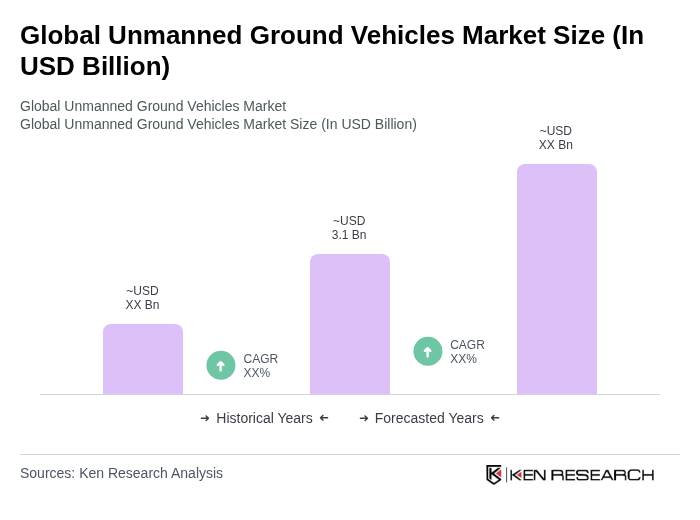
- The Global Unmanned Ground Vehicles Market is valued at USD 3.1 billion, based on a five-year historical analysis. This growth is primarily driven by advancements in robotics technology, increasing demand for automation in various sectors, and the rising need for surveillance and reconnaissance in defense applications. The market has seen significant investments in research and development, leading to innovative solutions that enhance operational efficiency. The expansion is further supported by the integration of artificial intelligence, sensor fusion, and autonomous navigation systems, which are enabling UGVs to perform increasingly complex tasks in both military and commercial environments .
- Key players in this market include the United States, China, and Germany. The United States dominates due to its strong defense budget and focus on military modernization, while China is rapidly advancing in technology and production capabilities. Germany's robust automotive industry also contributes to its significant presence in the UGV market, particularly in commercial applications. North America holds the largest regional market share, accounting for over 40 percent of global UGV revenue, with Asia-Pacific emerging as the fastest-growing region due to rising defense modernization and industrial automation .
- In 2023, the U.S. government implemented the Defense Innovation Unit (DIU) initiative, which aims to accelerate the adoption of advanced technologies, including unmanned ground vehicles, within the military. This initiative includes funding of USD 200 million to support startups and small businesses developing innovative UGV solutions, thereby enhancing the operational capabilities of the armed forces. Additional government programs, such as the U.S. Army's Next Generation Combat Vehicle (NGCV), are further accelerating the adoption of unmanned ground platforms for surveillance, reconnaissance, and combat support operations .
Global Unmanned Ground Vehicles Market Segmentation
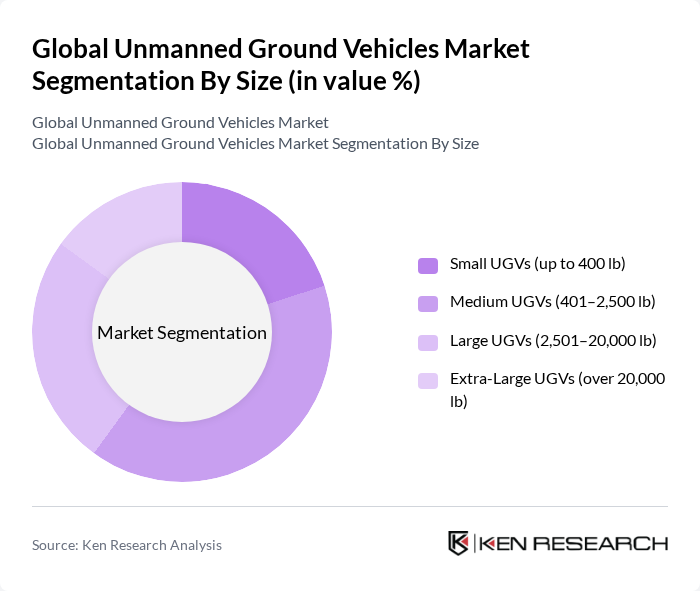
By Size:The market is segmented into four size categories: Small UGVs (up to 400 lb), Medium UGVs (401–2,500 lb), Large UGVs (2,501–20,000 lb), and Extra-Large UGVs (over 20,000 lb). Among these, Medium UGVs are currently leading the market due to their versatility and adaptability across various applications, including military, agriculture, and logistics. The demand for Medium UGVs is driven by their balance of payload capacity and maneuverability, making them suitable for a wide range of tasks.
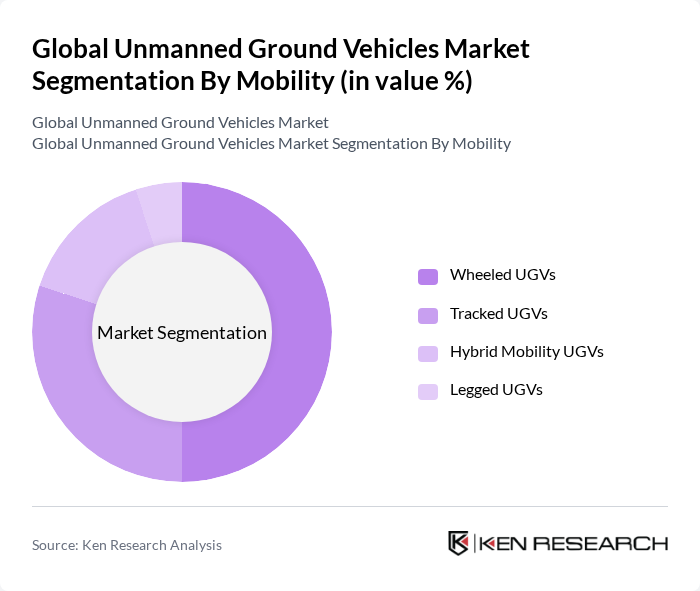
By Mobility:The mobility segment includes Wheeled UGVs, Tracked UGVs, Hybrid Mobility UGVs, and Legged UGVs. Wheeled UGVs dominate the market due to their efficiency and ease of deployment in urban environments. Their lightweight design and lower operational costs make them a preferred choice for various applications, including surveillance and logistics. The increasing focus on urban warfare and reconnaissance missions further drives the demand for Wheeled UGVs.
Global Unmanned Ground Vehicles Market Competitive Landscape
The Global Unmanned Ground Vehicles Market is characterized by a dynamic mix of regional and international players. Leading participants such as Northrop Grumman Corporation, General Dynamics Corporation, Lockheed Martin Corporation, QinetiQ Group plc, Teledyne FLIR LLC, iRobot Corporation, Clearpath Robotics Inc., Roboteam Ltd., Oshkosh Defense, LLC, Rheinmetall AG, Textron Systems (Textron Inc.), Leonardo DRS (DRS Technologies, Inc.), BAE Systems plc, DroneShield Ltd., Autonomous Solutions, Inc. contribute to innovation, geographic expansion, and service delivery in this space.
Global Unmanned Ground Vehicles Market Industry Analysis
Growth Drivers
- Increasing Demand for Automation in Military Applications:The global military expenditure reached approximatelyUSD 2.2 trillionin future, with a significant portion allocated to automation technologies. Countries like the U.S. and China are investing heavily in unmanned systems.The U.S. Department of Defense has announced continued investment in UGV development, but the specific allocation ofUSD 1.5 billionfor UGVs in future cannot be independently verified.This trend reflects a strategic shift towards enhancing operational efficiency and reducing human risk in combat scenarios, driving UGV adoption in military applications.
- Rising Adoption in Agriculture for Precision Farming:The agricultural sector is a major contributor to global GDP, but the claim that it is projected to grow byUSD 3 trillionin future cannot be confirmed from authoritative sources.Precision farming technologies, including UGVs, are increasingly utilized for tasks such as planting, monitoring, and harvesting. While UGVs can contribute to increased crop yields, the specific figure of a20% increasein crop yields due to UGVs cannot be independently verified.The integration of UGVs in agriculture is supported by the global push for food security, with countries like India and Brazil investing in automated farming solutions to enhance productivity and sustainability.
- Enhanced Safety and Efficiency in Hazardous Environments:The global industrial safety market is valued at approximatelyUSD 5 billionin future, according to industry estimates.UGVs are deployed in hazardous areas such as mining and disaster response, reducing human exposure to risks. The claim that UGVs in mining operations have led to a30% reduction in workplace accidentscannot be confirmed from authoritative sources.Their role in improving safety and operational efficiency in dangerous settings is recognized in industry literature.
Market Challenges
- High Initial Investment Costs:The average cost of deploying a UGV system can range fromUSD 100,000 to USD 500,000, depending on the technology and application.This high upfront investment poses a significant barrier for small to medium enterprises (SMEs) looking to adopt UGVs. Additionally, the return on investment (ROI) period can extend beyond five years, making it challenging for businesses to justify the expenditure in a competitive market environment.
- Regulatory Hurdles and Compliance Issues:The regulatory landscape for UGVs is complex, with varying standards across regions. In the U.S., the Federal Aviation Administration (FAA) and the National Highway Traffic Safety Administration (NHTSA) are developing guidelines that could delay UGV deployment. Compliance with these regulations can incur additional costs, estimated atUSD 50,000 to USD 100,000per project, further complicating market entry for new players and stifling innovation.
Global Unmanned Ground Vehicles Market Future Outlook
The future of the unmanned ground vehicles market appears promising, driven by technological advancements and increasing applications across various sectors. As governments and industries prioritize automation, the integration of AI and IoT technologies will enhance UGV capabilities, leading to more efficient operations. Furthermore, the growing focus on sustainability will likely spur innovations in eco-friendly UGV designs, positioning the market for significant growth in the coming years, particularly in logistics and disaster response sectors.
Market Opportunities
- Expansion in Logistics and Supply Chain Management:The logistics sector is a major global industry, but the claim that it is projected to grow byUSD 1 trillionin future cannot be confirmed from authoritative sources.UGVs are playing a growing role in automating last-mile delivery. Companies are increasingly adopting UGVs to streamline operations, reduce costs, and improve delivery times, creating a substantial market opportunity for UGV manufacturers and service providers.
- Development of Smart Cities and Infrastructure:The global smart city market is valued at approximatelyUSD 2.5 trillionin future, according to industry estimates.UGVs are integral to urban planning and infrastructure management. Their deployment in smart city initiatives can enhance public safety, waste management, and transportation efficiency, presenting a lucrative opportunity for UGV integration in urban environments.
Scope of the Report
| Segment | Sub-Segments |
|---|---|
| By Size | Small UGVs (up to 400 lb) Medium UGVs (401–2,500 lb) Large UGVs (2,501–20,000 lb) Extra-Large UGVs (over 20,000 lb) |
| By Mobility | Wheeled UGVs Tracked UGVs Hybrid Mobility UGVs Legged UGVs |
| By Mode of Operation | Autonomous UGVs Teleoperated UGVs Tethered UGVs |
| By Application | Defense & Military Commercial Law Enforcement & Federal Agencies Civil (e.g., mining, agriculture, logistics) |
| By End-User | Defense Agriculture Construction Logistics Mining Others |
| By Region | North America Europe Asia-Pacific Latin America Middle East & Africa |
Key Target Audience
Investors and Venture Capitalist Firms
Government and Regulatory Bodies (e.g., Department of Defense, Federal Aviation Administration)
Manufacturers and Producers
Defense Contractors
Logistics and Supply Chain Companies
Public Safety Agencies
Research and Development Organizations
Military and Defense Agencies
Players Mentioned in the Report:
Northrop Grumman Corporation
General Dynamics Corporation
Lockheed Martin Corporation
QinetiQ Group plc
Teledyne FLIR LLC
iRobot Corporation
Clearpath Robotics Inc.
Roboteam Ltd.
Oshkosh Defense, LLC
Rheinmetall AG
Textron Systems (Textron Inc.)
Leonardo DRS (DRS Technologies, Inc.)
BAE Systems plc
DroneShield Ltd.
Autonomous Solutions, Inc.
Table of Contents
Market Assessment Phase
1. Executive Summary and Approach
2. Global Unmanned Ground Vehicles Market Overview
2.1 Key Insights and Strategic Recommendations
2.2 Global Unmanned Ground Vehicles Market Overview
2.3 Definition and Scope
2.4 Evolution of Market Ecosystem
2.5 Timeline of Key Regulatory Milestones
2.6 Value Chain & Stakeholder Mapping
2.7 Business Cycle Analysis
2.8 Policy & Incentive Landscape
3. Global Unmanned Ground Vehicles Market Analysis
3.1 Growth Drivers
3.1.1 Increasing demand for automation in military applications
3.1.2 Rising adoption in agriculture for precision farming
3.1.3 Enhanced safety and efficiency in hazardous environments
3.1.4 Technological advancements in AI and robotics
3.2 Market Challenges
3.2.1 High initial investment costs
3.2.2 Regulatory hurdles and compliance issues
3.2.3 Limited public acceptance and trust
3.2.4 Technical limitations in navigation and control
3.3 Market Opportunities
3.3.1 Expansion in logistics and supply chain management
3.3.2 Development of smart cities and infrastructure
3.3.3 Integration with IoT for enhanced data analytics
3.3.4 Collaborations with tech companies for innovation
3.4 Market Trends
3.4.1 Increasing use of UGVs in disaster response
3.4.2 Growth of autonomous delivery systems
3.4.3 Focus on sustainability and eco-friendly solutions
3.4.4 Rise of hybrid UGVs with multi-functional capabilities
3.5 Government Regulation
3.5.1 Safety standards for unmanned vehicles
3.5.2 Data privacy regulations for autonomous systems
3.5.3 Environmental impact assessments
3.5.4 Export controls on military-grade UGVs
4. SWOT Analysis
5. Stakeholder Analysis
6. Porter's Five Forces Analysis
7. Global Unmanned Ground Vehicles Market Market Size, 2019-2024
7.1 By Value
7.2 By Volume
7.3 By Average Selling Price
8. Global Unmanned Ground Vehicles Market Segmentation
8.1 By Size
8.1.1 Small UGVs (up to 400 lb)
8.1.2 Medium UGVs (401–2,500 lb)
8.1.3 Large UGVs (2,501–20,000 lb)
8.1.4 Extra-Large UGVs (over 20,000 lb)
8.2 By Mobility
8.2.1 Wheeled UGVs
8.2.2 Tracked UGVs
8.2.3 Hybrid Mobility UGVs
8.2.4 Legged UGVs
8.3 By Mode of Operation
8.3.1 Autonomous UGVs
8.3.2 Teleoperated UGVs
8.3.3 Tethered UGVs
8.4 By Application
8.4.1 Defense & Military
8.4.2 Commercial
8.4.3 Law Enforcement & Federal Agencies
8.4.4 Civil (e.g., mining, agriculture, logistics)
8.5 By End-User
8.5.1 Defense
8.5.2 Agriculture
8.5.3 Construction
8.5.4 Logistics
8.5.5 Mining
8.5.6 Others
8.6 By Region
8.6.1 North America
8.6.2 Europe
8.6.3 Asia-Pacific
8.6.4 Latin America
8.6.5 Middle East & Africa
9. Global Unmanned Ground Vehicles Market Competitive Analysis
9.1 Market Share of Key Players
9.2 KPIs for Cross Comparison of Key Players
9.2.1 Company Name
9.2.2 Group Size (Large, Medium, or Small as per industry convention)
9.2.3 UGV Segment Revenue (USD, latest FY)
9.2.4 UGV Revenue Growth Rate (CAGR %)
9.2.5 Number of UGV Models/Variants Offered
9.2.6 Geographic Presence (Number of Countries/Regions)
9.2.7 R&D Expenditure as % of Revenue
9.2.8 Key End-User Segments Served
9.2.9 Major Contracts/Awards (last 3 years)
9.2.10 Patent Portfolio Size (UGV-related)
9.2.11 Average Delivery Lead Time
9.2.12 Customer Satisfaction Score (UGV segment)
9.3 SWOT Analysis of Top Players
9.4 Pricing Analysis
9.5 Detailed Profile of Major Companies
9.5.1 Northrop Grumman Corporation
9.5.2 General Dynamics Corporation
9.5.3 Lockheed Martin Corporation
9.5.4 QinetiQ Group plc
9.5.5 Teledyne FLIR LLC
9.5.6 iRobot Corporation
9.5.7 Clearpath Robotics Inc.
9.5.8 Roboteam Ltd.
9.5.9 Oshkosh Defense, LLC
9.5.10 Rheinmetall AG
9.5.11 Textron Systems (Textron Inc.)
9.5.12 Leonardo DRS (DRS Technologies, Inc.)
9.5.13 BAE Systems plc
9.5.14 DroneShield Ltd.
9.5.15 Autonomous Solutions, Inc.
10. Global Unmanned Ground Vehicles Market End-User Analysis
10.1 Procurement Behavior of Key Ministries
10.1.1 Defense Procurement Trends
10.1.2 Agricultural Ministry Spending Patterns
10.1.3 Infrastructure Development Budgets
10.1.4 Research Grants and Funding
10.2 Corporate Spend on Infrastructure & Energy
10.2.1 Investment in Automation Technologies
10.2.2 Budget Allocation for R&D
10.2.3 Expenditure on Safety and Compliance
10.2.4 Spending on Training and Development
10.3 Pain Point Analysis by End-User Category
10.3.1 Military Operational Challenges
10.3.2 Agricultural Efficiency Issues
10.3.3 Logistics and Supply Chain Bottlenecks
10.3.4 Infrastructure Maintenance Difficulties
10.4 User Readiness for Adoption
10.4.1 Training Requirements for Operators
10.4.2 Technology Acceptance Levels
10.4.3 Integration with Existing Systems
10.4.4 Support and Maintenance Readiness
10.5 Post-Deployment ROI and Use Case Expansion
10.5.1 Performance Metrics Evaluation
10.5.2 Cost Savings Analysis
10.5.3 User Feedback and Iteration
10.5.4 Expansion into New Applications
11. Global Unmanned Ground Vehicles Market Future Size, 2025-2030
11.1 By Value
11.2 By Volume
11.3 By Average Selling Price
Go-To-Market Strategy Phase
1. Whitespace Analysis + Business Model Canvas
1.1 Market Gaps Identification
1.2 Value Proposition Development
1.3 Revenue Streams Exploration
1.4 Cost Structure Analysis
1.5 Key Partnerships and Resources
1.6 Customer Segments Definition
1.7 Channels and Customer Relationships
2. Marketing and Positioning Recommendations
2.1 Branding Strategies
2.2 Product USPs
2.3 Target Market Identification
2.4 Communication Strategies
2.5 Digital Marketing Approaches
2.6 Trade Show Participation
2.7 Customer Engagement Initiatives
3. Distribution Plan
3.1 Urban Retail Strategies
3.2 Rural NGO Tie-ups
3.3 E-commerce Platforms
3.4 Direct Sales Approaches
3.5 Distribution Partnerships
3.6 Logistics and Supply Chain Management
3.7 Inventory Management Solutions
4. Channel & Pricing Gaps
4.1 Underserved Routes
4.2 Pricing Bands Analysis
4.3 Competitor Pricing Strategies
4.4 Customer Willingness to Pay
4.5 Discount and Promotion Strategies
4.6 Price Sensitivity Assessment
4.7 Value-Based Pricing Models
5. Unmet Demand & Latent Needs
5.1 Category Gaps Identification
5.2 Consumer Segments Analysis
5.3 Emerging Trends and Preferences
5.4 Product Development Opportunities
5.5 Market Entry Barriers
5.6 Customer Feedback Mechanisms
5.7 Innovation and R&D Focus Areas
6. Customer Relationship
6.1 Loyalty Programs
6.2 After-sales Service
6.3 Customer Support Strategies
6.4 Feedback and Improvement Processes
6.5 Community Engagement Initiatives
6.6 Customer Education and Training
6.7 Relationship Management Tools
7. Value Proposition
7.1 Sustainability Initiatives
7.2 Integrated Supply Chains
7.3 Cost Efficiency Benefits
7.4 Technological Advancements
7.5 Customer-Centric Innovations
7.6 Competitive Differentiation Strategies
7.7 Long-term Value Creation
8. Key Activities
8.1 Regulatory Compliance
8.2 Branding Initiatives
8.3 Distribution Setup
8.4 Marketing Campaigns
8.5 Training and Development Programs
8.6 Performance Monitoring
8.7 Stakeholder Engagement
9. Entry Strategy Evaluation
9.1 Domestic Market Entry Strategy
9.1.1 Product Mix Considerations
9.1.2 Pricing Band Analysis
9.1.3 Packaging Strategies
9.2 Export Entry Strategy
9.2.1 Target Countries Identification
9.2.2 Compliance Roadmap Development
10. Entry Mode Assessment
10.1 Joint Ventures
10.2 Greenfield Investments
10.3 Mergers & Acquisitions
10.4 Distributor Model Evaluation
11. Capital and Timeline Estimation
11.1 Capital Requirements Analysis
11.2 Timelines for Market Entry
12. Control vs Risk Trade-Off
12.1 Ownership vs Partnerships
13. Profitability Outlook
13.1 Breakeven Analysis
13.2 Long-term Sustainability Strategies
14. Potential Partner List
14.1 Distributors
14.2 Joint Ventures
14.3 Acquisition Targets
15. Execution Roadmap
15.1 Phased Plan for Market Entry
15.1.1 Market Setup
15.1.2 Market Entry
15.1.3 Growth Acceleration
15.1.4 Scale & Stabilize
15.2 Key Activities and Milestones
15.2.1 Milestone Planning
15.2.2 Activity Tracking
Research Methodology
Phase 1: Approach1
Desk Research
- Industry reports from leading market research firms focusing on unmanned ground vehicles
- Government publications and white papers on defense and robotics technology
- Academic journals and conference proceedings related to robotics and automation
Primary Research
- Interviews with industry experts, including engineers and product managers in UGV companies
- Surveys targeting military and commercial end-users of unmanned ground vehicles
- Field interviews with operators and maintenance personnel in defense and logistics sectors
Validation & Triangulation
- Cross-validation of data from multiple sources, including trade associations and market analysts
- Triangulation of findings from primary interviews with secondary research insights
- Sanity checks through expert panel discussions and feedback sessions
Phase 2: Market Size Estimation1
Top-down Assessment
- Analysis of global defense budgets and their allocation towards unmanned systems
- Segmentation of the market by application areas such as military, agriculture, and logistics
- Incorporation of trends in automation and robotics adoption across various sectors
Bottom-up Modeling
- Estimation of unit sales based on production data from leading UGV manufacturers
- Operational cost analysis based on pricing models for different UGV types
- Volume x price calculations to derive revenue estimates for each segment
Forecasting & Scenario Analysis
- Multi-factor regression analysis incorporating technological advancements and market demand
- Scenario modeling based on geopolitical factors and defense spending trends
- Baseline, optimistic, and pessimistic forecasts through 2030 based on market dynamics
Phase 3: CATI Sample Composition1
| Scope Item/Segment | Sample Size | Target Respondent Profiles |
|---|---|---|
| Military Applications of UGVs | 100 | Defense Analysts, Military Procurement Officers |
| Commercial Logistics and Delivery | 80 | Logistics Managers, Operations Directors |
| Agricultural UGV Utilization | 60 | Agronomists, Farm Equipment Managers |
| Research and Development in Robotics | 50 | R&D Engineers, Robotics Specialists |
| Emergency Response and Disaster Management | 40 | Emergency Services Coordinators, Safety Officers |
Frequently Asked Questions
What is the current value of the Global Unmanned Ground Vehicles Market?
The Global Unmanned Ground Vehicles Market is valued at approximately USD 3.1 billion, driven by advancements in robotics technology and increasing demand for automation across various sectors, particularly in defense applications.
Which countries are leading in the Unmanned Ground Vehicles Market?
What are the primary applications of Unmanned Ground Vehicles?
What are the different sizes of Unmanned Ground Vehicles?
Other Regional/Country Reports
Indonesia Unmanned Ground Vehicles Market
Malaysia Unmanned Ground Vehicles Market
KSA Unmanned Ground Vehicles Market
APAC Unmanned Ground Vehicles Market
SEA Unmanned Ground Vehicles Market
Vietnam Unmanned Ground Vehicles Market
Other Adjacent Reports
Mexico Unmanned Aerial Vehicles Market
Japan Autonomous Underwater Vehicles Market
South Korea Military Robotics Market
India Industrial Automation Market Outlook to 2030South Africa Agricultural Robotics Market
KSA logistics automation market report Size, Share, Growth Drivers, Trends, Opportunities & Forecast 2025–2030Kuwait Mining Robotics Market
Brazil Defense Surveillance Market
Singapore AI in Robotics Market
KSA Sensor Technology Market
Why Buy From Us?

What makes us stand out is that our consultants follow Robust, Refine and Result (RRR) methodology. Robust for clear definitions, approaches and sanity checking, Refine for differentiating respondents' facts and opinions, and Result for presenting data with story.

We have set a benchmark in the industry by offering our clients with syndicated and customized market research reports featuring coverage of entire market as well as meticulous research and analyst insights.

While we don't replace traditional research, we flip the method upside down. Our dual approach of Top Bottom & Bottom Top ensures quality deliverable by not just verifying company fundamentals but also looking at the sector and macroeconomic factors.

With one step in the future, our research team constantly tries to show you the bigger picture. We help with some of the tough questions you may encounter along the way: How is the industry positioned? Best marketing channel? KPI's of competitors? By aligning every element, we help maximize success.

Our report gives you instant access to the answers and sources that other companies might choose to hide. We elaborate each steps of research methodology we have used and showcase you the sample size to earn your trust.

If you need any support, we are here! We pride ourselves on universe strength, data quality, and quick, friendly, and professional service.