Ken Research Logo

Global Veterinary Assistive Reproduction Technology Market Report Size, Share, Growth Drivers, Trends, Opportunities & Forecast 2025–2030

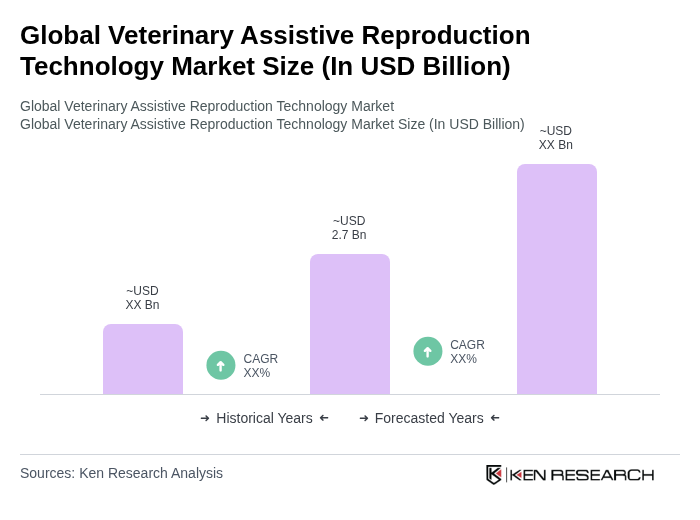
Global Veterinary Assistive Reproduction Technology Market, valued at USD 2.7 Bn, grows via reproductive tech like AI and IVF for livestock breeding and genetic enhancement.

Region:Global

Author(s):Shubham

Product Code:KRAD5324

Pages:95

Published On:December 2025
About the Report

Base Year 2024

Global Veterinary Assistive Reproduction Technology Market Overview

  • The Global Veterinary Assistive Reproduction Technology Market is valued at USD 2.7 billion, based on a five-year historical analysis, reflecting consolidated estimates from recent global assessments. This growth is primarily driven by advancements in reproductive technologies (including artificial insemination, embryo transfer, and IVF), increasing demand for high-quality livestock, and a growing focus on genetic improvement in animal breeding. The market is also supported by rising awareness among farmers regarding the benefits of assisted reproductive technologies in enhancing productivity and profitability, alongside expanding organized livestock farming and growth in dairy and meat consumption in emerging economies.
  • Key players in this market are predominantly located in North America and Europe, with the United States and Germany being among the most dominant countries in terms of technology development, commercial AI service networks, and genetic companies. The dominance is attributed to the presence of advanced veterinary practices, significant investments in research and development, strong artificial insemination and IVF service infrastructure, and a well-established agricultural sector that prioritizes animal health, productivity, and genetic improvement.
  • The European Union has progressively strengthened animal welfare requirements applicable to reproductive technologies through instruments such as Council Directive 98/58/EC concerning the protection of animals kept for farming purposes, and Council Directive 89/556/EEC on animal health conditions governing intra?Community trade in and importation of embryos of domestic animals of the bovine species, which set conditions for collection, storage, and transfer of embryos and semen. In addition, Regulation (EU) 2016/429 on transmissible animal diseases (“Animal Health Law”) and its implementing acts lay down operational rules for approvals of semen and embryo collection centres, traceability, and health certification, ensuring that artificial insemination and embryo transfer are carried out under conditions that safeguard animal health and welfare and support sustainable agricultural practices.
Global Veterinary Assistive Reproduction Technology Market Size

Global Veterinary Assistive Reproduction Technology Market Segmentation

By Type:

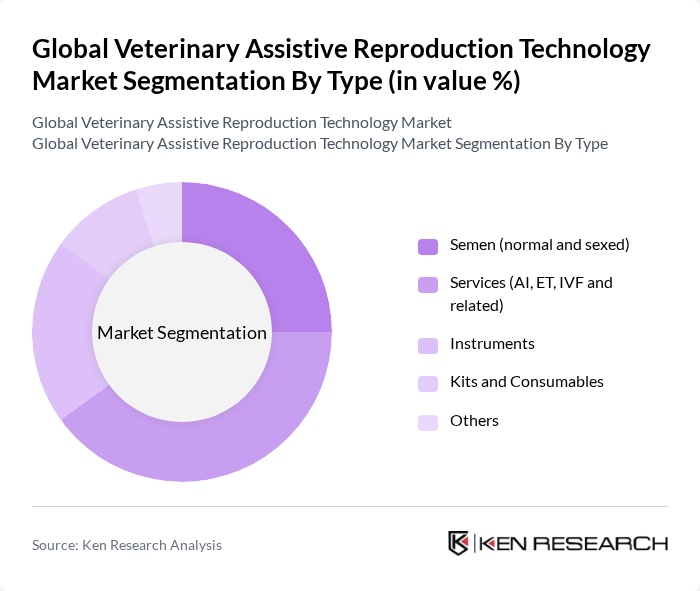
Global Veterinary Assistive Reproduction Technology Market segmentation by Type.

The segmentation by type includes various subsegments such as Semen (normal and sexed), Services (AI, ET, IVF and related), Instruments, Kits and Consumables, and Others. This structure is consistent with major industry studies that classify the market into semen, services, instruments, and kits & consumables. Among these, the Services segment, particularly Artificial Insemination (AI) and In Vitro Fertilization (IVF), is a key revenue contributor, supported by the dominant role of AI technologies in commercial breeding programs and organized livestock systems. The growing trend towards genetic improvement, use of sexed semen, and the need for efficient breeding practices are driving the demand for these services, alongside increasing adoption of embryo transfer and IVF in both bovine and companion animals. The Instruments and Semen segments also hold significant market shares, reflecting the essential role of quality reproductive tools (AI guns, catheters, cryopreservation equipment) and high?value genetic materials (conventional and sexed semen) in successful breeding programs.

By End-User:
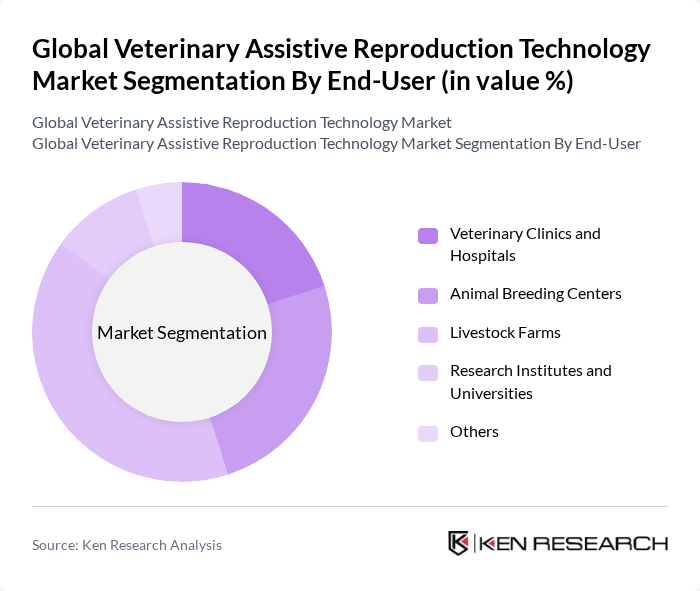
Global Veterinary Assistive Reproduction Technology Market segmentation by End-User.

This segmentation includes Veterinary Clinics and Hospitals, Animal Breeding Centers, Livestock Farms, Research Institutes and Universities, and Others. This end?user structure aligns with current market analyses that identify farms, breeding organizations, and veterinary facilities as primary users of assistive reproduction technologies. The Livestock Farms segment is the leading subsegment, driven by the increasing need for efficient breeding practices to enhance productivity and profitability, particularly in dairy and beef cattle, swine, and small ruminants. Livestock farms are increasingly adopting advanced reproductive technologies such as artificial insemination, sexed semen, and embryo transfer to improve herd genetics, optimize calving intervals, increase milk and meat yields, and reduce disease transmission associated with natural mating. Veterinary Clinics and Hospitals also play a crucial role in the market, providing essential services and support for reproductive technologies, including fertility evaluation, synchronization protocols, assisted birthing, and advanced IVF and embryo transfer procedures for both livestock and companion animals.

Global Veterinary Assistive Reproduction Technology Market Competitive Landscape

The Global Veterinary Assistive Reproduction Technology Market is characterized by a dynamic mix of regional and international players. Leading participants such as Zoetis Inc., Merck Animal Health (Merck & Co., Inc.), Elanco Animal Health Incorporated, Boehringer Ingelheim Animal Health GmbH, Neogen Corporation, Genus plc, Trans Ova Genetics LC, Select Sires Inc., CRV Holding B.V., Alta Genetics Inc., URUS Group LP (ABS Global, GENEX, etc.), SEMEX Alliance, Cogent Breeding Ltd, IMV Technologies, STgenetics (Sexing Technologies) contribute to innovation, geographic expansion, and service delivery in this space.

Zoetis Inc.

1952

Parsippany, New Jersey, USA

Merck Animal Health

1891

Rahway, New Jersey, USA

Elanco Animal Health Incorporated

1954

Greenfield, Indiana, USA

Boehringer Ingelheim Animal Health GmbH

1885

Ingelheim am Rhein, Germany

Neogen Corporation

1982

Lansing, Michigan, USA

Company

Establishment Year

Headquarters

Group Size (Large, Medium, or Small as per industry convention)

Global Veterinary Reproductive Revenue

Veterinary Assistive Reproduction Technology Revenue Share (%)

3-year CAGR in VART Segment

Geographic Footprint (Number of Countries / Regions Served)

Insemination and Embryo Transfer Procedure Volume

Global Veterinary Assistive Reproduction Technology Market Industry Analysis

Growth Drivers

  • Increasing Demand for High-Quality Livestock:The global livestock population is projected to reach 1.5 billion, driven by rising meat consumption, which is expected to increase by 1.5% annually. This demand for high-quality livestock is pushing farmers to adopt advanced reproductive technologies to enhance breeding efficiency. Countries like Brazil and China are investing heavily in these technologies, with Brazil's livestock sector alone contributing approximately $35 billion to the economy, highlighting the economic significance of quality livestock production.
  • Advancements in Reproductive Technologies:The veterinary reproductive technology sector is witnessing rapid advancements, with investments in artificial insemination and embryo transfer technologies expected to exceed $6 billion in future. Innovations such as sexed semen and in vitro fertilization are becoming more accessible, improving breeding success rates. For instance, the use of sexed semen has increased by 25% in the dairy industry, allowing farmers to produce more female calves, which are essential for milk production, thus enhancing overall productivity.
  • Rising Awareness of Animal Health and Welfare:The global focus on animal welfare is intensifying, with the World Organisation for Animal Health reporting that 75% of consumers are willing to pay more for products from ethically raised animals. This trend is prompting farmers to invest in reproductive technologies that ensure better health outcomes for livestock. In future, the global expenditure on animal health is projected to reach $55 billion, reflecting the growing commitment to improving animal welfare standards across the industry.

Market Challenges

  • High Costs of Advanced Reproductive Technologies:The implementation of advanced reproductive technologies can be prohibitively expensive, with costs for procedures like in vitro fertilization reaching up to $3,500 per cycle. This financial barrier limits access for many small-scale farmers, particularly in developing regions where average farm income is around $12,000 annually. Consequently, the high costs hinder widespread adoption, slowing the overall growth of the veterinary assistive reproduction technology market.
  • Regulatory Hurdles and Compliance Issues:The veterinary reproductive technology sector faces stringent regulatory frameworks that vary significantly across regions. For instance, the European Union has strict guidelines on the use of reproductive technologies, which can delay product approvals by up to 20 months. These regulatory challenges create uncertainty for companies looking to innovate, as compliance costs can exceed $1.2 million, deterring investment in new technologies and limiting market expansion.

Global Veterinary Assistive Reproduction Technology Market Future Outlook

The future of the veterinary assistive reproduction technology market appears promising, driven by technological advancements and increasing consumer demand for ethically produced animal products. As emerging markets expand their veterinary services, the adoption of innovative reproductive technologies is expected to rise significantly. Additionally, the integration of digital solutions in veterinary practices will enhance service delivery, making reproductive technologies more accessible and efficient, ultimately benefiting both livestock producers and pet owners alike.

Market Opportunities

  • Expansion of Veterinary Services in Emerging Markets:Emerging markets, particularly in Asia and Africa, are experiencing a surge in veterinary services, with investments projected to reach $3 billion in future. This growth presents significant opportunities for reproductive technology providers to establish a foothold in these regions, catering to the increasing demand for livestock productivity and health.
  • Development of Innovative Reproductive Products:The market for innovative reproductive products is set to expand, with new technologies such as gene editing and precision breeding gaining traction. In future, the global market for these products is expected to grow by $2 billion, driven by the need for improved livestock genetics and productivity, creating lucrative opportunities for companies focused on research and development.

Scope of the Report

SegmentSub-Segments
By Type

Semen (normal and sexed)

Services (AI, ET, IVF and related)

Instruments

Kits and Consumables

Others

By End-User

Veterinary Clinics and Hospitals

Animal Breeding Centers

Livestock Farms

Research Institutes and Universities

Others

By Species (Animal Type)

Bovine (Dairy and Beef Cattle)

Swine

Ovine and Caprine

Equine

Canine

Others

By Region

North America

Europe

Asia-Pacific

Latin America

Middle East & Africa

By Technology

Artificial Insemination (AI)

In Vitro Fertilization (IVF)

Embryo Transfer (MOET and related)

Other Assisted Reproductive Technologies

By Application

Commercial Breeding Programs

Genetic Improvement and Selection

Research and Clinical Applications

Conservation and Rare/Companion Animal Breeding

By Investment Source

Private Investments

Government Funding

Grants and Subsidies

Others

Key Target Audience

Investors and Venture Capitalist Firms

Government and Regulatory Bodies (e.g., U.S. Department of Agriculture, European Food Safety Authority)

Veterinary Clinics and Animal Hospitals

Animal Breeding Organizations

Pharmaceutical Companies specializing in Veterinary Medicine

Biotechnology Firms focused on Animal Reproduction

Animal Health Product Distributors

Trade Associations in Veterinary Medicine

Players Mentioned in the Report:

Zoetis Inc.

Merck Animal Health (Merck & Co., Inc.)

Elanco Animal Health Incorporated

Boehringer Ingelheim Animal Health GmbH

Neogen Corporation

Genus plc

Trans Ova Genetics LC

Select Sires Inc.

CRV Holding B.V.

Alta Genetics Inc.

URUS Group LP (ABS Global, GENEX, etc.)

SEMEX Alliance

Cogent Breeding Ltd

IMV Technologies

STgenetics (Sexing Technologies)

Table of Contents

Market Assessment Phase

1. Executive Summary and Approach


2. Global Veterinary Assistive Reproduction Technology Market Overview

2.1 Key Insights and Strategic Recommendations

2.2 Global Veterinary Assistive Reproduction Technology Market Overview

2.3 Definition and Scope

2.4 Evolution of Market Ecosystem

2.5 Timeline of Key Regulatory Milestones

2.6 Value Chain & Stakeholder Mapping

2.7 Business Cycle Analysis

2.8 Policy & Incentive Landscape


3. Global Veterinary Assistive Reproduction Technology Market Analysis

3.1 Growth Drivers

3.1.1 Increasing demand for high-quality livestock
3.1.2 Advancements in reproductive technologies
3.1.3 Rising awareness of animal health and welfare
3.1.4 Growth in pet ownership and veterinary services

3.2 Market Challenges

3.2.1 High costs of advanced reproductive technologies
3.2.2 Regulatory hurdles and compliance issues
3.2.3 Limited access to technology in developing regions
3.2.4 Lack of skilled professionals in veterinary reproductive services

3.3 Market Opportunities

3.3.1 Expansion of veterinary services in emerging markets
3.3.2 Development of innovative reproductive products
3.3.3 Collaborations with research institutions
3.3.4 Increasing investment in animal biotechnology

3.4 Market Trends

3.4.1 Growing adoption of artificial insemination techniques
3.4.2 Integration of digital technologies in veterinary practices
3.4.3 Focus on genetic improvement of livestock
3.4.4 Rise in telemedicine for veterinary services

3.5 Government Regulation

3.5.1 Animal welfare regulations
3.5.2 Licensing requirements for veterinary practices
3.5.3 Standards for reproductive technology products
3.5.4 Import/export regulations for animal reproductive materials

4. SWOT Analysis


5. Stakeholder Analysis


6. Porter's Five Forces Analysis


7. Global Veterinary Assistive Reproduction Technology Market Market Size, 2019-2024

7.1 By Value

7.2 By Volume

7.3 By Average Selling Price


8. Global Veterinary Assistive Reproduction Technology Market Segmentation

8.1 By Type

8.1.1 Semen (normal and sexed)
8.1.2 Services (AI, ET, IVF and related)
8.1.3 Instruments
8.1.4 Kits and Consumables
8.1.5 Others

8.2 By End-User

8.2.1 Veterinary Clinics and Hospitals
8.2.2 Animal Breeding Centers
8.2.3 Livestock Farms
8.2.4 Research Institutes and Universities
8.2.5 Others

8.3 By Species (Animal Type)

8.3.1 Bovine (Dairy and Beef Cattle)
8.3.2 Swine
8.3.3 Ovine and Caprine
8.3.4 Equine
8.3.5 Canine
8.3.6 Others

8.4 By Region

8.4.1 North America
8.4.2 Europe
8.4.3 Asia-Pacific
8.4.4 Latin America
8.4.5 Middle East & Africa

8.5 By Technology

8.5.1 Artificial Insemination (AI)
8.5.2 In Vitro Fertilization (IVF)
8.5.3 Embryo Transfer (MOET and related)
8.5.4 Other Assisted Reproductive Technologies

8.6 By Application

8.6.1 Commercial Breeding Programs
8.6.2 Genetic Improvement and Selection
8.6.3 Research and Clinical Applications
8.6.4 Conservation and Rare/Companion Animal Breeding

8.7 By Investment Source

8.7.1 Private Investments
8.7.2 Government Funding
8.7.3 Grants and Subsidies
8.7.4 Others

9. Global Veterinary Assistive Reproduction Technology Market Competitive Analysis

9.1 Market Share of Key Players

9.2 Cross Comparison of Key Players

9.2.1 Company Name
9.2.2 Group Size (Large, Medium, or Small as per industry convention)
9.2.3 Global Veterinary Reproductive Revenue
9.2.4 Veterinary Assistive Reproduction Technology Revenue Share (%)
9.2.5 3-year CAGR in VART Segment
9.2.6 Geographic Footprint (Number of Countries / Regions Served)
9.2.7 Insemination and Embryo Transfer Procedure Volume
9.2.8 Installed Base of Reproductive Instruments and Devices
9.2.9 R&D Intensity (% of Revenue Spent on Reproduction R&D)
9.2.10 Product Portfolio Breadth (Type / Technology Coverage)
9.2.11 Strategic Partnerships and Breeding Program Alliances
9.2.12 Average Selling Price Positioning (Premium / Mid / Value)

9.3 SWOT Analysis of Top Players

9.4 Pricing Analysis

9.5 Detailed Profile of Major Companies

9.5.1 Zoetis Inc.
9.5.2 Merck Animal Health (Merck & Co., Inc.)
9.5.3 Elanco Animal Health Incorporated
9.5.4 Boehringer Ingelheim Animal Health GmbH
9.5.5 Neogen Corporation
9.5.6 Genus plc
9.5.7 Trans Ova Genetics LC
9.5.8 Select Sires Inc.
9.5.9 CRV Holding B.V.
9.5.10 Alta Genetics Inc.
9.5.11 URUS Group LP (ABS Global, GENEX, etc.)
9.5.12 SEMEX Alliance
9.5.13 Cogent Breeding Ltd
9.5.14 IMV Technologies
9.5.15 STgenetics (Sexing Technologies)

10. Global Veterinary Assistive Reproduction Technology Market End-User Analysis

10.1 Procurement Behavior of Key Ministries

10.1.1 Budget Allocation for Veterinary Services
10.1.2 Policy Framework for Animal Health
10.1.3 Collaboration with Private Sector
10.1.4 Adoption of New Technologies

10.2 Corporate Spend on Infrastructure & Energy

10.2.1 Investment in Veterinary Facilities
10.2.2 Funding for Research and Development
10.2.3 Expenditure on Training and Development
10.2.4 Others

10.3 Pain Point Analysis by End-User Category

10.3.1 Cost of Advanced Technologies
10.3.2 Access to Skilled Professionals
10.3.3 Regulatory Compliance Challenges
10.3.4 Others

10.4 User Readiness for Adoption

10.4.1 Awareness of Reproductive Technologies
10.4.2 Training Needs Assessment
10.4.3 Infrastructure Readiness
10.4.4 Others

10.5 Post-Deployment ROI and Use Case Expansion

10.5.1 Measurement of Success Metrics
10.5.2 Case Studies of Successful Implementations
10.5.3 Feedback Mechanisms for Improvement
10.5.4 Others

11. Global Veterinary Assistive Reproduction Technology Market Future Size, 2025-2030

11.1 By Value

11.2 By Volume

11.3 By Average Selling Price


Go-To-Market Strategy Phase

1. Whitespace Analysis + Business Model Canvas

1.1 Market Gaps Identification

1.2 Business Model Development


2. Marketing and Positioning Recommendations

2.1 Branding Strategies

2.2 Product USPs


3. Distribution Plan

3.1 Urban Retail vs Rural NGO Tie-ups


4. Channel & Pricing Gaps

4.1 Underserved Routes

4.2 Pricing Bands


5. Unmet Demand & Latent Needs

5.1 Category Gaps

5.2 Consumer Segments


6. Customer Relationship

6.1 Loyalty Programs

6.2 After-sales Service


7. Value Proposition

7.1 Sustainability

7.2 Integrated Supply Chains


8. Key Activities

8.1 Regulatory Compliance

8.2 Branding

8.3 Distribution Setup


9. Entry Strategy Evaluation

9.1 Domestic Market Entry Strategy

9.1.1 Product Mix
9.1.2 Pricing Band
9.1.3 Packaging

9.2 Export Entry Strategy

9.2.1 Target Countries
9.2.2 Compliance Roadmap

10. Entry Mode Assessment

10.1 JV

10.2 Greenfield

10.3 M&A

10.4 Distributor Model


11. Capital and Timeline Estimation

11.1 Capital Requirements

11.2 Timelines


12. Control vs Risk Trade-Off

12.1 Ownership vs Partnerships


13. Profitability Outlook

13.1 Breakeven Analysis

13.2 Long-term Sustainability


14. Potential Partner List

14.1 Distributors

14.2 JVs

14.3 Acquisition Targets


15. Execution Roadmap

15.1 Phased Plan for Market Entry

15.1.1 Market Setup
15.1.2 Market Entry
15.1.3 Growth Acceleration
15.1.4 Scale & Stabilize

15.2 Key Activities and Milestones

15.2.1 Milestone Planning
15.2.2 Activity Tracking

Research Methodology

ApproachModellingSample

Phase 1: Approach1

Desk Research

  • Industry reports from veterinary associations and agricultural organizations
  • Market analysis publications focusing on veterinary reproductive technologies
  • Academic journals and research papers on advancements in animal reproduction

Primary Research

  • Interviews with veterinarians specializing in reproductive technologies
  • Surveys with veterinary clinic owners and managers
  • Focus groups with animal breeders and livestock producers

Validation & Triangulation

  • Cross-validation of data from multiple veterinary industry sources
  • Triangulation of findings from primary interviews and secondary data
  • Sanity checks through expert panels comprising veterinary professionals

Phase 2: Market Size Estimation1

Top-down Assessment

  • Analysis of global veterinary market size and growth trends
  • Segmentation by technology type (e.g., artificial insemination, embryo transfer)
  • Incorporation of regional market dynamics and regulatory impacts

Bottom-up Modeling

  • Estimates based on the number of veterinary clinics and their service offerings
  • Cost analysis of reproductive technology services provided by clinics
  • Volume of procedures performed annually across different animal species

Forecasting & Scenario Analysis

  • Multi-factor regression analysis considering factors like livestock population growth
  • Scenario modeling based on technological advancements and market adoption rates
  • Baseline, optimistic, and pessimistic forecasts through 2030

Phase 3: CATI Sample Composition1

Scope Item/SegmentSample SizeTarget Respondent Profiles
Veterinary Clinics Offering Reproductive Services120Veterinarians, Clinic Owners
Livestock Breeders Utilizing Reproductive Technologies100Farm Managers, Breeding Specialists
Research Institutions Focused on Animal Reproduction60Research Scientists, Academic Professors
Pet Breeders and Enthusiasts50Pet Breeders, Animal Welfare Advocates
Veterinary Technology Providers40Product Managers, Sales Executives

Frequently Asked Questions

What is the current value of the Global Veterinary Assistive Reproduction Technology Market?

The Global Veterinary Assistive Reproduction Technology Market is valued at approximately USD 2.7 billion, reflecting a comprehensive analysis of recent global assessments and historical data over the past five years.

What factors are driving the growth of the veterinary assistive reproduction technology market?

Which regions are leading in the veterinary assistive reproduction technology market?

What are the main types of products in the veterinary assistive reproduction technology market?

Other Regional/Country Reports

Indonesia Veterinary Assistive Reproduction Technology Market

Malaysia Veterinary Assistive Reproduction Technology Market

KSA Veterinary Assistive Reproduction Technology Market

APAC Veterinary Assistive Reproduction Technology Market

SEA Veterinary Assistive Reproduction Technology Market

Vietnam Veterinary Assistive Reproduction Technology Market

Why Buy From Us?

Refine Robust Result (RRR) Framework

What makes us stand out is that our consultants follow Robust, Refine and Result (RRR) methodology. Robust for clear definitions, approaches and sanity checking, Refine for differentiating respondents' facts and opinions, and Result for presenting data with story.

Our Reach Is Unmatched

We have set a benchmark in the industry by offering our clients with syndicated and customized market research reports featuring coverage of entire market as well as meticulous research and analyst insights.

Shifting the Research Paradigm

While we don't replace traditional research, we flip the method upside down. Our dual approach of Top Bottom & Bottom Top ensures quality deliverable by not just verifying company fundamentals but also looking at the sector and macroeconomic factors.

More Insights-Better Decisions

With one step in the future, our research team constantly tries to show you the bigger picture. We help with some of the tough questions you may encounter along the way: How is the industry positioned? Best marketing channel? KPI's of competitors? By aligning every element, we help maximize success.

Transparency and Trust

Our report gives you instant access to the answers and sources that other companies might choose to hide. We elaborate each steps of research methodology we have used and showcase you the sample size to earn your trust.

Round the Clock Support

If you need any support, we are here! We pride ourselves on universe strength, data quality, and quick, friendly, and professional service.

Why Clients Choose Us?

400000+
Reports in repository
150+
Consulting projects a year
100+
Analysts
8000+
Client Queries in 2022