Region:Global
Author(s):Shubham
Product Code:KRAD6668
Pages:90
Published On:December 2025
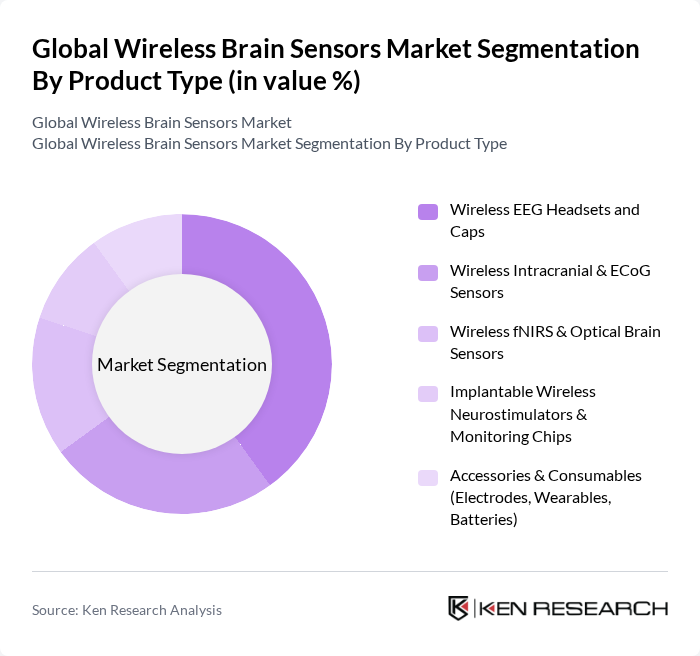
By Product Type:The product type segmentation includes various categories such as Wireless EEG Headsets and Caps, Wireless Intracranial & ECoG Sensors, Wireless fNIRS & Optical Brain Sensors, Implantable Wireless Neurostimulators & Monitoring Chips, and Accessories & Consumables (Electrodes, Wearables, Batteries). This structure is consistent with common industry segmentation that groups devices into non-invasive EEG systems, implantable neurodevices and supporting accessories. Among these, Wireless EEG Headsets and Caps are leading the market due to their widespread use in clinical neurology, emergency and ICU settings, as well as in research environments, for real-time brain activity monitoring, seizure detection, coma assessment and cognitive workload analysis. The increasing adoption of these devices in mental health assessments, sleep monitoring, neurorehabilitation and cognitive research, along with demand for portable, dry-electrode and wearable EEG systems, is driving their dominance within the wireless brain sensors portfolio.
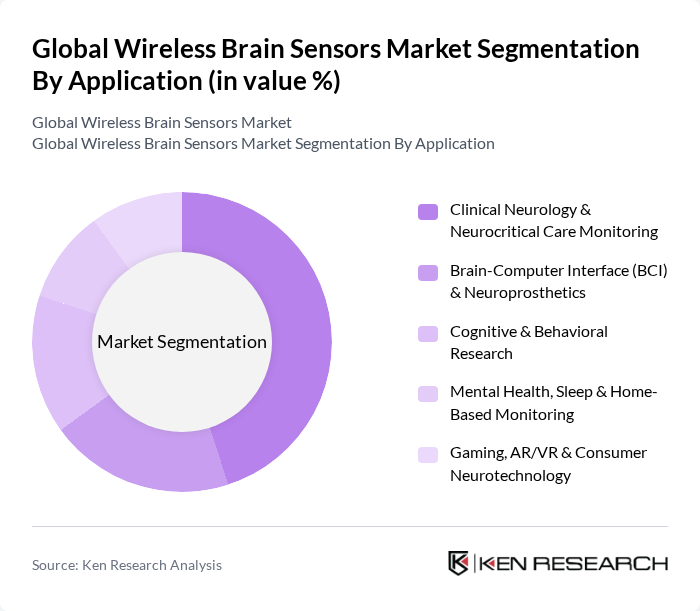
By Application:The application segmentation encompasses Clinical Neurology & Neurocritical Care Monitoring, Brain-Computer Interface (BCI) & Neuroprosthetics, Cognitive & Behavioral Research, Mental Health, Sleep & Home-Based Monitoring, and Gaming, AR/VR & Consumer Neurotechnology. This breakdown aligns with how leading market studies separate clinical diagnostic uses, research applications and emerging consumer and BCI segments. The Clinical Neurology & Neurocritical Care Monitoring segment is currently the most significant, driven by the increasing need for continuous monitoring of patients with epilepsy, traumatic brain injury, stroke, neurodegenerative diseases and disorders of consciousness in hospital and ICU environments. The rise in telehealth and remote patient monitoring services has also contributed to the growth of this segment, as healthcare providers seek efficient solutions for out-of-hospital EEG monitoring, at?home sleep and seizure surveillance, and cloud-connected diagnostic workflows that reduce in?person visits while maintaining clinical quality.
The Global Wireless Brain Sensors Market is characterized by a dynamic mix of regional and international players. Leading participants such as Medtronic plc, NeuroSky, Inc., EMOTIV, Inc., BrainCo, Inc., Blackrock Neurotech (Blackrock Microsystems LLC), Cognionics, Inc., Neuroelectrics Barcelona S.L., Advanced Brain Monitoring, Inc., g.tec medical engineering GmbH, BrainScope Company, Inc., MindMaze SA, NeuroPace, Inc., Koninklijke Philips N.V., Natus Medical Incorporated, Zeto, Inc. contribute to innovation, geographic expansion, and service delivery in this space.
The future of the wireless brain sensors market appears promising, driven by technological advancements and increasing healthcare demands. As AI integration becomes more prevalent, the accuracy and functionality of brain sensors will improve, enhancing diagnostic capabilities. Additionally, the shift towards non-invasive monitoring solutions will likely attract more healthcare providers, fostering greater adoption. With a growing emphasis on personalized medicine, tailored solutions for individual patients will emerge, further propelling market growth and innovation in the coming years.
| Segment | Sub-Segments |
|---|---|
| By Product Type | Wireless EEG Headsets and Caps Wireless Intracranial & ECoG Sensors Wireless fNIRS & Optical Brain Sensors Implantable Wireless Neurostimulators & Monitoring Chips Accessories & Consumables (Electrodes, Wearables, Batteries) |
| By Application | Clinical Neurology & Neurocritical Care Monitoring Brain-Computer Interface (BCI) & Neuroprosthetics Cognitive & Behavioral Research Mental Health, Sleep & Home-Based Monitoring Gaming, AR/VR & Consumer Neurotechnology |
| By End-User | Hospitals & Specialty Neurology Clinics Academic & Research Institutions Ambulatory Surgical Centers & Diagnostic Centers Home Care & Telehealth Providers Consumer & Commercial Users |
| By Technology | Bluetooth & BLE-Enabled Brain Sensors Wi?Fi & Cloud-Connected Brain Sensors Implantable RF / NFC & Inductive Telemetry Sensors AI-Enabled Signal Processing & Edge Analytics Multi?modal & Hybrid Brain Sensing Platforms |
| By Distribution Channel | Direct Sales to Hospitals & Research Institutions OEM & Strategic Partnerships E?commerce & Company Online Portals Distributors & Value-Added Resellers |
| By Region | North America Europe Asia-Pacific Latin America Middle East & Africa |
| By Regulatory & Reimbursement Environment | Favorable Regulatory Approvals (FDA, CE, PMDA, etc.) Reimbursement-Backed Clinical Use Cases Public & Private Research Funding Programs Innovation Grants & Tax Incentives for Neurotechnology |
| Scope Item/Segment | Sample Size | Target Respondent Profiles |
|---|---|---|
| Clinical Applications of Wireless Brain Sensors | 100 | Neurologists, Neurosurgeons |
| Research and Development in Neurotechnology | 80 | Medical Device Engineers, Product Managers |
| Patient Experience and Feedback | 75 | Patients, Caregivers |
| Market Trends and Insights | 90 | Healthcare Analysts, Market Researchers |
| Regulatory and Compliance Perspectives | 60 | Regulatory Affairs Specialists, Compliance Officers |
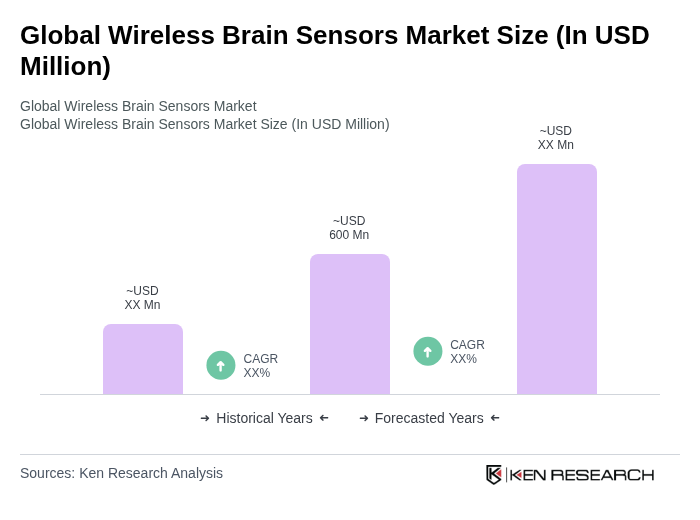
The Global Wireless Brain Sensors Market is valued at approximately USD 600 million, based on a five-year historical analysis of various industry sources. This valuation reflects the growing demand for advanced neurotechnology solutions in healthcare settings.

What makes us stand out is that our consultants follow Robust, Refine and Result (RRR) methodology. Robust for clear definitions, approaches and sanity checking, Refine for differentiating respondents' facts and opinions, and Result for presenting data with story.

We have set a benchmark in the industry by offering our clients with syndicated and customized market research reports featuring coverage of entire market as well as meticulous research and analyst insights.

While we don't replace traditional research, we flip the method upside down. Our dual approach of Top Bottom & Bottom Top ensures quality deliverable by not just verifying company fundamentals but also looking at the sector and macroeconomic factors.

With one step in the future, our research team constantly tries to show you the bigger picture. We help with some of the tough questions you may encounter along the way: How is the industry positioned? Best marketing channel? KPI's of competitors? By aligning every element, we help maximize success.

Our report gives you instant access to the answers and sources that other companies might choose to hide. We elaborate each steps of research methodology we have used and showcase you the sample size to earn your trust.

If you need any support, we are here! We pride ourselves on universe strength, data quality, and quick, friendly, and professional service.













