About the Report
Base Year 2024Global Wireless Network Security Market Overview
- The Global Wireless Network Security Market is valued at USD 30 billion, based on a five-year historical analysis. This growth is primarily driven by the increasing frequency and sophistication of cyber threats, the surge in mobile device and IoT adoption, and the growing demand for secure wireless communication across industries. Organizations are investing heavily in advanced security solutions—such as AI-driven threat detection, next-generation firewalls, and cloud-based security management—to protect sensitive data and maintain compliance with evolving regulatory standards .
- Key players in this market include the United States, China, and Germany. The United States leads due to its advanced technological infrastructure, high adoption rates of wireless technologies, and significant investments in cybersecurity. China follows closely, driven by rapid digital transformation, a vast population, and increased government focus on cybersecurity. Germany’s strong regulatory framework and emphasis on data protection, especially under the European Union’s data privacy mandates, contribute to its significant market presence .
- The General Data Protection Regulation (GDPR), Regulation (EU) 2016/679, issued by the European Parliament and Council in 2016 and enforced from 2018, mandates strict data protection measures for organizations handling personal data within the European Union. This regulation has significantly impacted the wireless network security landscape, compelling businesses to adopt robust security solutions to ensure compliance and protect user privacy. GDPR requires organizations to implement appropriate technical and organizational measures, including encryption and continuous monitoring, to safeguard personal data .

Global Wireless Network Security Market Segmentation
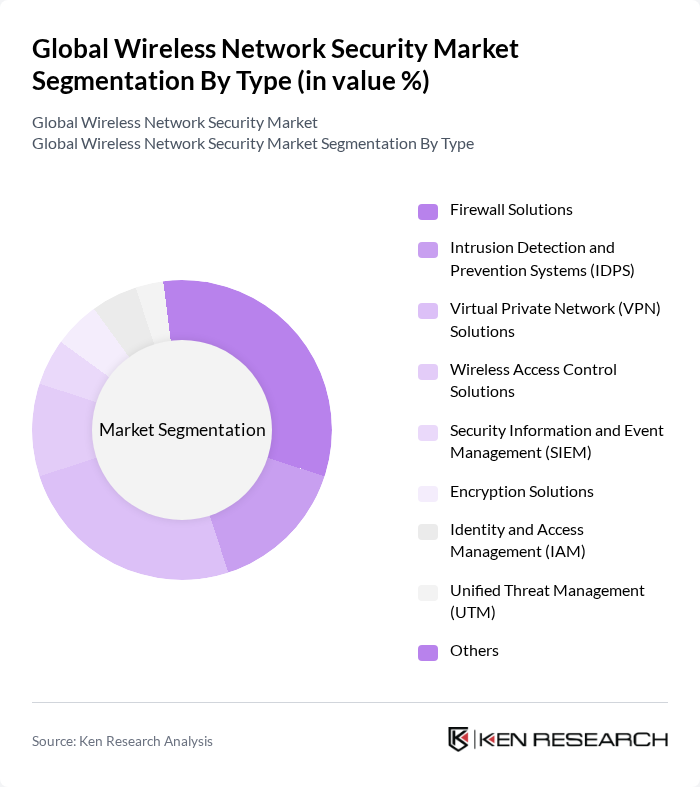
By Type:The market is segmented into various types of wireless network security solutions, including Firewall Solutions, Intrusion Detection and Prevention Systems (IDPS), Virtual Private Network (VPN) Solutions, Wireless Access Control Solutions, Security Information and Event Management (SIEM), Encryption Solutions, Identity and Access Management (IAM), Unified Threat Management (UTM), and Others. Among these, Firewall Solutions and VPN Solutions are particularly dominant due to their critical role in safeguarding network perimeters and ensuring secure remote access. The adoption of AI-powered threat detection and cloud-based security management is also accelerating across all solution types .
By End-User Industry:The wireless network security market is also segmented by end-user industries, including Banking, Financial Services and Insurance (BFSI), Healthcare, Retail, Manufacturing, IT and Telecom, Government, Aerospace and Defense, Education, and Others. The BFSI sector is the largest consumer of wireless security solutions due to the sensitive nature of financial data and the stringent regulatory requirements it faces. Healthcare and IT & Telecom sectors are also rapidly increasing their adoption of wireless security solutions in response to rising cyberattacks and the proliferation of connected devices .

Global Wireless Network Security Market Competitive Landscape
The Global Wireless Network Security Market is characterized by a dynamic mix of regional and international players. Leading participants such as Cisco Systems, Inc., Palo Alto Networks, Inc., Fortinet, Inc., Check Point Software Technologies Ltd., Juniper Networks, Inc., Aruba Networks (Hewlett Packard Enterprise), SonicWall, Inc., Trend Micro Incorporated, McAfee Corp., Barracuda Networks, Inc., CrowdStrike Holdings, Inc., Zscaler, Inc., Symantec Corporation (Broadcom Inc.), Bitdefender LLC, F5, Inc., WatchGuard Technologies, Inc., Sophos Ltd., Huawei Technologies Co., Ltd., Dell Technologies Inc. (Secureworks), Extreme Networks, Inc. contribute to innovation, geographic expansion, and service delivery in this space .
Global Wireless Network Security Market Industry Analysis
Growth Drivers
- Increasing Cybersecurity Threats:The global cost of cybercrime is projected to reach $10.5 trillion annually in future, highlighting the urgent need for robust wireless network security solutions. In future, organizations are expected to allocate approximately $150 billion to cybersecurity measures, driven by the rising frequency of data breaches and ransomware attacks. This escalating threat landscape compels businesses to invest in advanced security technologies to protect sensitive information and maintain customer trust, thereby fueling market growth.
- Rising Adoption of IoT Devices:The number of connected IoT devices is anticipated to exceed 30 billion in future, creating significant vulnerabilities in wireless networks. As organizations increasingly integrate IoT solutions, the demand for secure wireless communication rises correspondingly. In future, the global IoT security market is projected to reach $38 billion, emphasizing the critical need for effective wireless network security measures to safeguard these devices from cyber threats and ensure seamless operations.
- Regulatory Compliance Requirements:Governments worldwide are implementing stringent regulations to protect consumer data, with compliance costs expected to reach $3.5 billion in future. Regulations such as GDPR and CCPA mandate organizations to adopt comprehensive security measures, driving the demand for wireless network security solutions. Companies that fail to comply face hefty fines and reputational damage, motivating them to invest in security technologies that meet regulatory standards and protect sensitive information.
Market Challenges
- High Implementation Costs:The initial investment required for advanced wireless network security solutions can be substantial, often exceeding $1 million for large enterprises. This financial barrier can deter smaller organizations from adopting necessary security measures, leaving them vulnerable to cyber threats. In future, the average cost of implementing a comprehensive security framework is projected to be around $500,000, which may limit market penetration and growth in certain segments.
- Lack of Skilled Professionals:The cybersecurity workforce gap is expected to reach 3.5 million unfilled positions in future, significantly impacting the implementation of effective wireless network security solutions. Organizations struggle to find qualified professionals who can manage and maintain complex security systems. This shortage not only hinders the deployment of security measures but also increases operational risks, as existing staff may lack the expertise to address evolving threats effectively.
Global Wireless Network Security Market Future Outlook
The future of wireless network security is poised for significant transformation, driven by technological advancements and evolving threat landscapes. As organizations increasingly adopt zero trust security models, the focus will shift towards continuous verification and monitoring of user access. Additionally, the integration of AI and machine learning will enhance threat detection capabilities, enabling proactive responses to potential breaches. The expansion of 5G networks will further necessitate robust security measures, creating a dynamic environment for innovation and investment in wireless security solutions.
Market Opportunities
- Growth in Cloud-Based Security Solutions:The global cloud security market is projected to reach $76 billion in future, driven by the increasing reliance on cloud services. This trend presents a significant opportunity for wireless network security providers to develop integrated solutions that protect data across multiple platforms, ensuring comprehensive security for organizations transitioning to cloud environments.
- Development of AI-Driven Security Tools:The AI security market is expected to grow to $37 billion in future, offering opportunities for innovation in wireless network security. Companies can leverage AI-driven tools to enhance threat detection, automate responses, and improve overall security posture, addressing the challenges posed by sophisticated cyber threats and the need for real-time protection.
Scope of the Report
| Segment | Sub-Segments |
|---|---|
| By Type | Firewall Solutions Intrusion Detection and Prevention Systems (IDPS) Virtual Private Network (VPN) Solutions Wireless Access Control Solutions Security Information and Event Management (SIEM) Encryption Solutions Identity and Access Management (IAM) Unified Threat Management (UTM) Others |
| By End-User Industry | Banking, Financial Services and Insurance (BFSI) Healthcare Retail Manufacturing IT and Telecom Government Aerospace and Defense Education Others |
| By Deployment Mode | On-Premises Cloud-Based Hybrid |
| By Component | Hardware Software Services |
| By Sales Channel | Direct Sales Distributors Online Sales Value-Added Resellers (VARs) |
| By Region | North America Europe Asia Pacific Latin America Middle East & Africa |
| By Policy Support | Government Initiatives Industry Standards Cybersecurity Frameworks Incentives for Cybersecurity Investments |
Key Target Audience
Investors and Venture Capitalist Firms
Government and Regulatory Bodies (e.g., Federal Communications Commission, National Institute of Standards and Technology)
Telecommunication Service Providers
Network Equipment Manufacturers
Cybersecurity Solution Providers
Industry Associations (e.g., Internet Security Alliance, Telecommunications Industry Association)
Financial Institutions
Telecom Regulatory Authorities
Players Mentioned in the Report:
Cisco Systems, Inc.
Palo Alto Networks, Inc.
Fortinet, Inc.
Check Point Software Technologies Ltd.
Juniper Networks, Inc.
Aruba Networks (Hewlett Packard Enterprise)
SonicWall, Inc.
Trend Micro Incorporated
McAfee Corp.
Barracuda Networks, Inc.
CrowdStrike Holdings, Inc.
Zscaler, Inc.
Symantec Corporation (Broadcom Inc.)
Bitdefender LLC
F5, Inc.
WatchGuard Technologies, Inc.
Sophos Ltd.
Huawei Technologies Co., Ltd.
Dell Technologies Inc. (Secureworks)
Extreme Networks, Inc.
Table of Contents
Market Assessment Phase
1. Executive Summary and Approach
2. Global Wireless Network Security Market Overview
2.1 Key Insights and Strategic Recommendations
2.2 Global Wireless Network Security Market Overview
2.3 Definition and Scope
2.4 Evolution of Market Ecosystem
2.5 Timeline of Key Regulatory Milestones
2.6 Value Chain & Stakeholder Mapping
2.7 Business Cycle Analysis
2.8 Policy & Incentive Landscape
3. Global Wireless Network Security Market Analysis
3.1 Growth Drivers
3.1.1 Increasing Cybersecurity Threats
3.1.2 Rising Adoption of IoT Devices
3.1.3 Demand for Secure Wireless Communication
3.1.4 Regulatory Compliance Requirements
3.2 Market Challenges
3.2.1 High Implementation Costs
3.2.2 Complexity of Security Solutions
3.2.3 Lack of Skilled Professionals
3.2.4 Rapidly Evolving Threat Landscape
3.3 Market Opportunities
3.3.1 Growth in Cloud-Based Security Solutions
3.3.2 Expansion of 5G Networks
3.3.3 Increased Investment in Cybersecurity
3.3.4 Development of AI-Driven Security Tools
3.4 Market Trends
3.4.1 Shift Towards Zero Trust Security Models
3.4.2 Integration of AI and Machine Learning
3.4.3 Rise of Managed Security Service Providers (MSSPs)
3.4.4 Growing Focus on Data Privacy Regulations
3.5 Government Regulation
3.5.1 GDPR Compliance
3.5.2 CCPA Implementation
3.5.3 NIST Cybersecurity Framework
3.5.4 FCC Wireless Security Guidelines
4. SWOT Analysis
5. Stakeholder Analysis
6. Porter's Five Forces Analysis
7. Global Wireless Network Security Market Market Size, 2019-2024
7.1 By Value
7.2 By Volume
7.3 By Average Selling Price
8. Global Wireless Network Security Market Segmentation
8.1 By Type
8.1.1 Firewall Solutions
8.1.2 Intrusion Detection and Prevention Systems (IDPS)
8.1.3 Virtual Private Network (VPN) Solutions
8.1.4 Wireless Access Control Solutions
8.1.5 Security Information and Event Management (SIEM)
8.1.6 Encryption Solutions
8.1.7 Identity and Access Management (IAM)
8.1.8 Unified Threat Management (UTM)
8.1.9 Others
8.2 By End-User Industry
8.2.1 Banking, Financial Services and Insurance (BFSI)
8.2.2 Healthcare
8.2.3 Retail
8.2.4 Manufacturing
8.2.5 IT and Telecom
8.2.6 Government
8.2.7 Aerospace and Defense
8.2.8 Education
8.2.9 Others
8.3 By Deployment Mode
8.3.1 On-Premises
8.3.2 Cloud-Based
8.3.3 Hybrid
8.4 By Component
8.4.1 Hardware
8.4.2 Software
8.4.3 Services
8.5 By Sales Channel
8.5.1 Direct Sales
8.5.2 Distributors
8.5.3 Online Sales
8.5.4 Value-Added Resellers (VARs)
8.6 By Region
8.6.1 North America
8.6.2 Europe
8.6.3 Asia Pacific
8.6.4 Latin America
8.6.5 Middle East & Africa
8.7 By Policy Support
8.7.1 Government Initiatives
8.7.2 Industry Standards
8.7.3 Cybersecurity Frameworks
8.7.4 Incentives for Cybersecurity Investments
9. Global Wireless Network Security Market Competitive Analysis
9.1 Market Share of Key Players
9.2 Cross Comparison of Key Players
9.2.1 Company Name
9.2.2 Company Size (by Revenue/Employees)
9.2.3 Global Market Share (%)
9.2.4 Revenue Growth Rate (3/5-Year CAGR)
9.2.5 R&D Expenditure as % of Revenue
9.2.6 Number of Patents/Intellectual Property Assets
9.2.7 Number of Wireless Security Product Deployments
9.2.8 Customer Base (Number of Clients/Enterprises Served)
9.2.9 Geographic Presence (Regions/Countries Served)
9.2.10 Product Portfolio Breadth (Number of Wireless Security Solutions)
9.2.11 Strategic Partnerships/Alliances
9.2.12 Customer Satisfaction/Net Promoter Score (NPS)
9.2.13 Average Deal Size
9.2.14 Pricing Strategy
9.2.15 Product Innovation Rate (New Launches per Year)
9.2.16 Brand Equity/Recognition
9.3 SWOT Analysis of Top Players
9.4 Pricing Analysis
9.5 Detailed Profile of Major Companies
9.5.1 Cisco Systems, Inc.
9.5.2 Palo Alto Networks, Inc.
9.5.3 Fortinet, Inc.
9.5.4 Check Point Software Technologies Ltd.
9.5.5 Juniper Networks, Inc.
9.5.6 Aruba Networks (Hewlett Packard Enterprise)
9.5.7 SonicWall, Inc.
9.5.8 Trend Micro Incorporated
9.5.9 McAfee Corp.
9.5.10 Barracuda Networks, Inc.
9.5.11 CrowdStrike Holdings, Inc.
9.5.12 Zscaler, Inc.
9.5.13 Symantec Corporation (Broadcom Inc.)
9.5.14 Bitdefender LLC
9.5.15 F5, Inc.
9.5.16 WatchGuard Technologies, Inc.
9.5.17 Sophos Ltd.
9.5.18 Huawei Technologies Co., Ltd.
9.5.19 Dell Technologies Inc. (Secureworks)
9.5.20 Extreme Networks, Inc.
10. Global Wireless Network Security Market End-User Analysis
10.1 Procurement Behavior of Key Ministries
10.1.1 Government Procurement Policies
10.1.2 Budget Allocation for Cybersecurity
10.1.3 Decision-Making Processes
10.2 Corporate Spend on Infrastructure & Energy
10.2.1 Investment Trends in Cybersecurity
10.2.2 Budgeting for Wireless Security Solutions
10.2.3 Long-Term Financial Commitments
10.3 Pain Point Analysis by End-User Category
10.3.1 Security Breaches and Incidents
10.3.2 Compliance Challenges
10.3.3 Integration Issues with Existing Systems
10.4 User Readiness for Adoption
10.4.1 Awareness of Wireless Security Solutions
10.4.2 Training and Skill Development Needs
10.4.3 Organizational Culture towards Cybersecurity
10.5 Post-Deployment ROI and Use Case Expansion
10.5.1 Measuring Effectiveness of Security Solutions
10.5.2 Expanding Use Cases for Wireless Security
10.5.3 Long-Term Value Realization
11. Global Wireless Network Security Market Future Size, 2025-2030
11.1 By Value
11.2 By Volume
11.3 By Average Selling Price
Go-To-Market Strategy Phase
1. Whitespace Analysis + Business Model Canvas
1.1 Market Gaps Identification
1.2 Value Proposition Development
1.3 Revenue Streams Analysis
1.4 Customer Segmentation
1.5 Key Partnerships
1.6 Cost Structure
1.7 Channels of Distribution
2. Marketing and Positioning Recommendations
2.1 Branding Strategies
2.2 Product USPs
2.3 Target Audience Identification
2.4 Marketing Channels
2.5 Messaging and Communication
3. Distribution Plan
3.1 Urban Retail Strategies
3.2 Rural NGO Tie-Ups
3.3 Online Distribution Channels
3.4 Partnerships with Distributors
4. Channel & Pricing Gaps
4.1 Underserved Routes
4.2 Pricing Bands Analysis
4.3 Competitor Pricing Strategies
5. Unmet Demand & Latent Needs
5.1 Category Gaps
5.2 Consumer Segments Analysis
5.3 Emerging Trends
6. Customer Relationship
6.1 Loyalty Programs
6.2 After-Sales Service
6.3 Customer Feedback Mechanisms
7. Value Proposition
7.1 Sustainability Initiatives
7.2 Integrated Supply Chains
7.3 Unique Selling Points
8. Key Activities
8.1 Regulatory Compliance
8.2 Branding Efforts
8.3 Distribution Setup
9. Entry Strategy Evaluation
9.1 Domestic Market Entry Strategy
9.1.1 Product Mix
9.1.2 Pricing Band
9.1.3 Packaging Strategies
9.2 Export Entry Strategy
9.2.1 Target Countries
9.2.2 Compliance Roadmap
10. Entry Mode Assessment
10.1 Joint Ventures
10.2 Greenfield Investments
10.3 Mergers & Acquisitions
10.4 Distributor Model
11. Capital and Timeline Estimation
11.1 Capital Requirements
11.2 Timelines for Implementation
12. Control vs Risk Trade-Off
12.1 Ownership vs Partnerships
13. Profitability Outlook
13.1 Breakeven Analysis
13.2 Long-Term Sustainability
14. Potential Partner List
14.1 Distributors
14.2 Joint Ventures
14.3 Acquisition Targets
15. Execution Roadmap
15.1 Phased Plan for Market Entry
15.1.1 Market Setup
15.1.2 Market Entry
15.1.3 Growth Acceleration
15.1.4 Scale & Stabilize
15.2 Key Activities and Milestones
15.2.1 Milestone Planning
15.2.2 Activity Tracking
Research Methodology
Phase 1: Approach1
Desk Research
- Analysis of industry reports from telecommunications and cybersecurity organizations
- Review of white papers and publications from leading wireless network security firms
- Examination of regulatory frameworks and compliance guidelines from global standards organizations
Primary Research
- Interviews with cybersecurity experts and consultants specializing in wireless networks
- Surveys targeting IT managers and network security professionals across various industries
- Field interviews with decision-makers in organizations implementing wireless security solutions
Validation & Triangulation
- Cross-validation of findings through multiple data sources, including market reports and expert opinions
- Triangulation of data from primary interviews and secondary research to ensure consistency
- Sanity checks conducted through expert panel reviews to validate market trends and insights
Phase 2: Market Size Estimation1
Top-down Assessment
- Estimation of market size based on global wireless network spending and security investments
- Segmentation by industry verticals such as healthcare, finance, and retail
- Incorporation of growth rates from emerging markets and technological advancements
Bottom-up Modeling
- Collection of data on the number of wireless devices and their security requirements
- Estimation of average spending on wireless security solutions per organization
- Aggregation of data from various sectors to build a comprehensive market model
Forecasting & Scenario Analysis
- Multi-factor regression analysis incorporating factors like IoT growth and cyber threat landscape
- Scenario planning based on potential regulatory changes and technological disruptions
- Development of baseline, optimistic, and pessimistic forecasts through 2030
Phase 3: CATI Sample Composition1
| Scope Item/Segment | Sample Size | Target Respondent Profiles |
|---|---|---|
| Healthcare Wireless Security Solutions | 100 | IT Security Managers, Compliance Officers |
| Financial Services Network Security | 80 | Network Administrators, Risk Management Executives |
| Retail Wireless Security Implementations | 50 | IT Directors, Security Managers |
| Manufacturing IoT Security Measures | 40 | Operations Managers, Cybersecurity Analysts |
| Telecommunications Security Strategies | 90 | Network Engineers, Security Architects |
Frequently Asked Questions
What is the current value of the Global Wireless Network Security Market?
The Global Wireless Network Security Market is valued at approximately USD 30 billion, driven by increasing cyber threats, mobile device adoption, and the demand for secure wireless communication across various industries.
What are the key drivers of growth in the Wireless Network Security Market?
Which regions are leading in the Wireless Network Security Market?
How does GDPR impact the Wireless Network Security Market?
Other Regional/Country Reports
Indonesia Wireless Network Security Market
Malaysia Wireless Network Security Market
APAC Wireless Network Security Market
Other Adjacent Reports
Mexico 5G Security Market
Saudi Arabia AI in Cybersecurity MarketOman Network Firewall Market
Japan Identity and Access Management Market
Why Buy From Us?

What makes us stand out is that our consultants follow Robust, Refine and Result (RRR) methodology. Robust for clear definitions, approaches and sanity checking, Refine for differentiating respondents' facts and opinions, and Result for presenting data with story.

We have set a benchmark in the industry by offering our clients with syndicated and customized market research reports featuring coverage of entire market as well as meticulous research and analyst insights.

While we don't replace traditional research, we flip the method upside down. Our dual approach of Top Bottom & Bottom Top ensures quality deliverable by not just verifying company fundamentals but also looking at the sector and macroeconomic factors.

With one step in the future, our research team constantly tries to show you the bigger picture. We help with some of the tough questions you may encounter along the way: How is the industry positioned? Best marketing channel? KPI's of competitors? By aligning every element, we help maximize success.

Our report gives you instant access to the answers and sources that other companies might choose to hide. We elaborate each steps of research methodology we have used and showcase you the sample size to earn your trust.

If you need any support, we are here! We pride ourselves on universe strength, data quality, and quick, friendly, and professional service.