About the Report
Base Year 2024Indonesia AI Life Science Analytics Market Overview
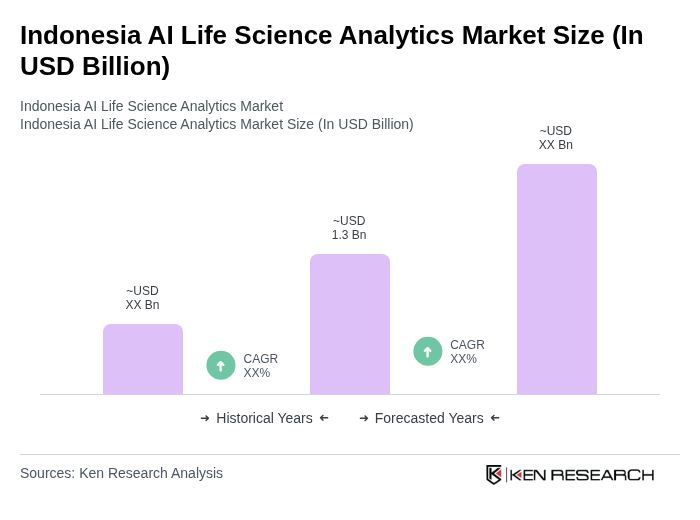
- The Indonesia AI Life Science Analytics Market is valued at USD 1.3 billion, based on a five-year historical analysis. This growth is primarily driven by the increasing adoption of AI technologies in healthcare, the rising demand for personalized medicine, the need for efficient data management in life sciences, and the integration of artificial intelligence and machine learning into data analytics for decision-making processes. The integration of AI in drug discovery and patient management has significantly contributed to the market's expansion.
- Key cities such as Jakarta, Surabaya, and Bandung dominate the market due to their robust healthcare infrastructure, presence of research institutions, and a growing number of tech startups focusing on AI solutions. Jakarta, being the capital, serves as a hub for innovation and investment, while Surabaya and Bandung are emerging as centers for research and development in life sciences.
- The Government Regulation No. 27 of 2022 on the Implementation of Positive Investment List, issued by the Ministry of Investment/Investment Coordinating Board, promotes the use of AI in healthcare by prioritizing investment in digital health technologies including AI analytics, requiring compliance through licensing for foreign investments exceeding IDR 10 billion thresholds and adherence to national data protection standards. This regulation encourages public-private partnerships to enhance research and development in AI technologies, providing incentives for companies that invest in AI-driven healthcare solutions. The initiative aims to improve healthcare delivery and patient outcomes across the country.
Indonesia AI Life Science Analytics Market Segmentation
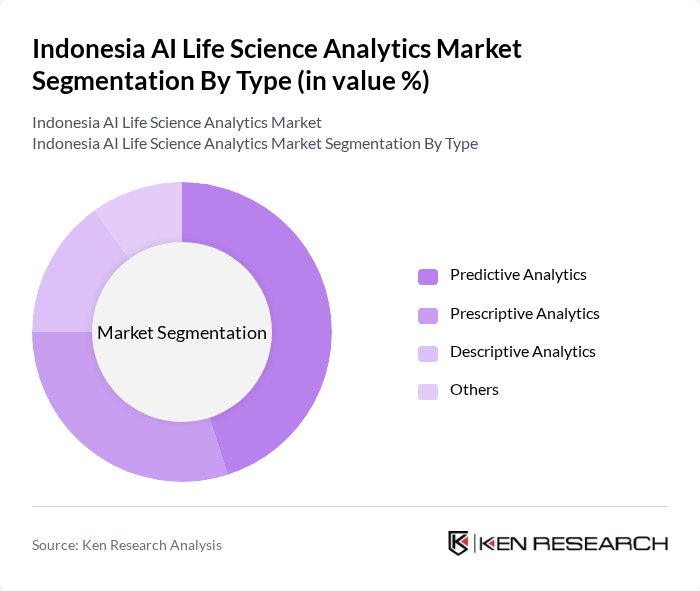
By Type:The market is segmented into Predictive Analytics, Prescriptive Analytics, Descriptive Analytics, and Others. Predictive Analytics is currently the leading sub-segment, driven by its ability to forecast patient outcomes and optimize treatment plans. The increasing reliance on data-driven decision-making in healthcare is propelling the demand for predictive solutions. Prescriptive Analytics follows closely, as it aids in recommending actions based on data analysis, enhancing operational efficiency in healthcare settings.
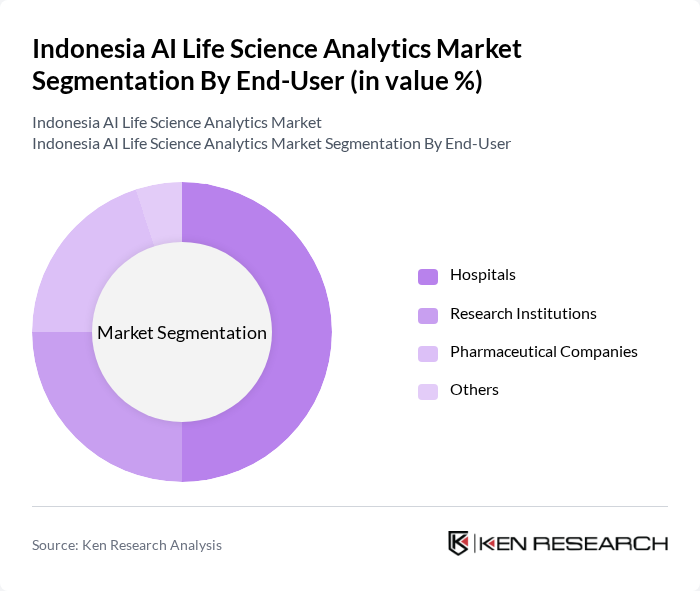
By End-User:The primary end-users in this market include Hospitals, Research Institutions, Pharmaceutical Companies, and Others. Hospitals are the dominant end-user, leveraging AI analytics for patient management, operational efficiency, and clinical decision support. The growing emphasis on improving patient care and reducing costs is driving hospitals to adopt AI solutions. Research Institutions also play a significant role, focusing on drug discovery and clinical trials, thus contributing to the market's growth.
Indonesia AI Life Science Analytics Market Competitive Landscape
The Indonesia AI Life Science Analytics Market is characterized by a dynamic mix of regional and international players. Leading participants such as Bioinformatics Institute, Genomik Solidaritas, Halodoc, Alodokter, Medigo, Prodia, Kalbe Farma, Siloam Hospitals, Bina Sehat, SehatQ, Klinik Pintar, Aido Health, eHealth Indonesia, Medika Komunika, CekAja contribute to innovation, geographic expansion, and service delivery in this space.
Indonesia AI Life Science Analytics Market Industry Analysis
Growth Drivers
- Increasing Demand for Personalized Medicine:The Indonesian healthcare sector is witnessing a surge in demand for personalized medicine, driven by a population of over 275 million. In future, the market for personalized medicine is projected to reach IDR 12 trillion, reflecting a growing preference for tailored treatment plans. This shift is supported by advancements in genomics and biotechnology, which are expected to enhance patient outcomes and reduce healthcare costs, thereby fostering the adoption of AI life science analytics.
- Advancements in Data Analytics Technologies:The rapid evolution of data analytics technologies is a significant growth driver for the AI life science analytics market in Indonesia. In future, the country is expected to invest approximately IDR 6 trillion in AI and data analytics solutions. This investment will facilitate the integration of machine learning and big data analytics into healthcare, enabling more accurate diagnostics and treatment recommendations, ultimately improving patient care and operational efficiency.
- Government Initiatives Promoting AI in Healthcare:The Indonesian government is actively promoting AI in healthcare through various initiatives, including the National Health Insurance program, which covers over 225 million citizens. In future, the government plans to allocate IDR 3 trillion for AI research and development in healthcare. These initiatives aim to enhance healthcare accessibility and quality, driving the adoption of AI life science analytics solutions across the nation.
Market Challenges
- Data Privacy and Security Concerns:Data privacy and security remain significant challenges for the AI life science analytics market in Indonesia. With over 65% of healthcare organizations reporting data breaches recently, the need for robust data protection measures is critical. The implementation of stringent data privacy regulations, such as the Personal Data Protection Law, is essential to build trust among patients and healthcare providers, ensuring the secure use of AI technologies.
- High Implementation Costs:The high costs associated with implementing AI life science analytics solutions pose a barrier to market growth. In future, the average expenditure for healthcare facilities to adopt AI technologies is estimated at IDR 1.8 billion per facility. This financial burden can deter smaller healthcare providers from investing in advanced analytics, limiting the overall market potential and hindering widespread adoption across the sector.
Indonesia AI Life Science Analytics Market Future Outlook
The future of the AI life science analytics market in Indonesia appears promising, driven by technological advancements and increasing healthcare demands. As the government continues to invest in healthcare infrastructure, the integration of AI technologies is expected to enhance patient care and operational efficiency. Furthermore, the growing emphasis on preventive healthcare will likely lead to increased adoption of AI-driven analytics, fostering innovation and collaboration among healthcare providers and technology companies in the coming years.
Market Opportunities
- Expansion of Telemedicine Services:The expansion of telemedicine services presents a significant opportunity for AI life science analytics in Indonesia. With over 75 million internet users accessing healthcare online, the integration of AI analytics can enhance remote patient monitoring and diagnostics, improving healthcare delivery in rural areas and increasing patient engagement.
- Integration of AI with Existing Healthcare Systems:There is a substantial opportunity for integrating AI with existing healthcare systems in Indonesia. In future, approximately 45% of healthcare facilities are expected to adopt AI solutions, streamlining operations and improving patient outcomes. This integration can lead to more efficient data management and enhanced decision-making processes within healthcare organizations.
Scope of the Report
| Segment | Sub-Segments |
|---|---|
| By Type | Predictive Analytics Prescriptive Analytics Descriptive Analytics Others |
| By End-User | Hospitals Research Institutions Pharmaceutical Companies Others |
| By Application | Drug Discovery Clinical Trials Patient Management Others |
| By Deployment Model | On-Premises Cloud-Based Hybrid Others |
| By Technology | Machine Learning Natural Language Processing Computer Vision Others |
| By Region | Java Sumatra Bali Others |
| By Investment Source | Private Investments Government Funding International Grants Others |
Key Target Audience
Investors and Venture Capitalist Firms
Government and Regulatory Bodies (e.g., Ministry of Health, National Agency of Drug and Food Control)
Pharmaceutical Companies
Biotechnology Firms
Healthcare Providers and Hospitals
Health Insurance Companies
Medical Device Manufacturers
Data Analytics and AI Technology Providers
Players Mentioned in the Report:
Bioinformatics Institute
Genomik Solidaritas
Halodoc
Alodokter
Medigo
Prodia
Kalbe Farma
Siloam Hospitals
Bina Sehat
SehatQ
Klinik Pintar
Aido Health
eHealth Indonesia
Medika Komunika
CekAja
Table of Contents
Market Assessment Phase
1. Executive Summary and Approach
2. Indonesia AI Life Science Analytics Market Overview
2.1 Key Insights and Strategic Recommendations
2.2 Indonesia AI Life Science Analytics Market Overview
2.3 Definition and Scope
2.4 Evolution of Market Ecosystem
2.5 Timeline of Key Regulatory Milestones
2.6 Value Chain & Stakeholder Mapping
2.7 Business Cycle Analysis
2.8 Policy & Incentive Landscape
3. Indonesia AI Life Science Analytics Market Analysis
3.1 Growth Drivers
3.1.1 Increasing demand for personalized medicine
3.1.2 Advancements in data analytics technologies
3.1.3 Government initiatives promoting AI in healthcare
3.1.4 Rising investment in healthcare infrastructure
3.2 Market Challenges
3.2.1 Data privacy and security concerns
3.2.2 High implementation costs
3.2.3 Lack of skilled workforce
3.2.4 Regulatory hurdles
3.3 Market Opportunities
3.3.1 Expansion of telemedicine services
3.3.2 Integration of AI with existing healthcare systems
3.3.3 Collaborations with tech companies
3.3.4 Growing focus on preventive healthcare
3.4 Market Trends
3.4.1 Increasing use of machine learning algorithms
3.4.2 Rise of cloud-based analytics solutions
3.4.3 Adoption of real-time data processing
3.4.4 Emphasis on patient-centric care models
3.5 Government Regulation
3.5.1 Data protection laws
3.5.2 Healthcare technology standards
3.5.3 AI ethics guidelines
3.5.4 Funding programs for AI research
4. SWOT Analysis
5. Stakeholder Analysis
6. Porter's Five Forces Analysis
7. Indonesia AI Life Science Analytics Market Size, 2019-2024
7.1 By Value
7.2 By Volume
7.3 By Average Selling Price
8. Indonesia AI Life Science Analytics Market Segmentation
8.1 By Type
8.1.1 Predictive Analytics
8.1.2 Prescriptive Analytics
8.1.3 Descriptive Analytics
8.1.4 Others
8.2 By End-User
8.2.1 Hospitals
8.2.2 Research Institutions
8.2.3 Pharmaceutical Companies
8.2.4 Others
8.3 By Application
8.3.1 Drug Discovery
8.3.2 Clinical Trials
8.3.3 Patient Management
8.3.4 Others
8.4 By Deployment Model
8.4.1 On-Premises
8.4.2 Cloud-Based
8.4.3 Hybrid
8.4.4 Others
8.5 By Technology
8.5.1 Machine Learning
8.5.2 Natural Language Processing
8.5.3 Computer Vision
8.5.4 Others
8.6 By Region
8.6.1 Java
8.6.2 Sumatra
8.6.3 Bali
8.6.4 Others
8.7 By Investment Source
8.7.1 Private Investments
8.7.2 Government Funding
8.7.3 International Grants
8.7.4 Others
9. Indonesia AI Life Science Analytics Market Competitive Analysis
9.1 Market Share of Key Players
9.2 Cross Comparison of Key Players
9.2.1 Company Name
9.2.2 Group Size (Large, Medium, or Small as per industry convention)
9.2.3 Revenue Growth Rate
9.2.4 Customer Acquisition Cost
9.2.5 Market Penetration Rate
9.2.6 Customer Retention Rate
9.2.7 Pricing Strategy
9.2.8 Average Deal Size
9.2.9 Sales Cycle Length
9.2.10 Customer Satisfaction Score
9.3 SWOT Analysis of Top Players
9.4 Pricing Analysis
9.5 Detailed Profile of Major Companies
9.5.1 Bioinformatics Institute
9.5.2 Genomik Solidaritas
9.5.3 Halodoc
9.5.4 Alodokter
9.5.5 Medigo
9.5.6 Prodia
9.5.7 Kalbe Farma
9.5.8 Siloam Hospitals
9.5.9 Bina Sehat
9.5.10 SehatQ
9.5.11 Klinik Pintar
9.5.12 Aido Health
9.5.13 eHealth Indonesia
9.5.14 Medika Komunika
9.5.15 CekAja
10. Indonesia AI Life Science Analytics Market End-User Analysis
10.1 Procurement Behavior of Key Ministries
10.1.1 Ministry of Health
10.1.2 Ministry of Research and Technology
10.1.3 Ministry of Finance
10.1.4 Others
10.2 Corporate Spend on Infrastructure & Energy
10.2.1 Healthcare Infrastructure Investments
10.2.2 Technology Upgrades
10.2.3 Training and Development
10.2.4 Others
10.3 Pain Point Analysis by End-User Category
10.3.1 Hospitals
10.3.2 Research Institutions
10.3.3 Pharmaceutical Companies
10.3.4 Others
10.4 User Readiness for Adoption
10.4.1 Awareness Levels
10.4.2 Training Needs
10.4.3 Infrastructure Readiness
10.4.4 Others
10.5 Post-Deployment ROI and Use Case Expansion
10.5.1 ROI Measurement Techniques
10.5.2 Use Case Success Stories
10.5.3 Scalability Potential
10.5.4 Others
11. Indonesia AI Life Science Analytics Market Future Size, 2025-2030
11.1 By Value
11.2 By Volume
11.3 By Average Selling Price
Go-To-Market Strategy Phase
1. Whitespace Analysis + Business Model Canvas
1.1 Market Gaps Identification
1.2 Business Model Framework
2. Marketing and Positioning Recommendations
2.1 Branding Strategies
2.2 Product USPs
3. Distribution Plan
3.1 Urban Retail Strategies
3.2 Rural NGO Tie-Ups
4. Channel & Pricing Gaps
4.1 Underserved Routes
4.2 Pricing Bands
5. Unmet Demand & Latent Needs
5.1 Category Gaps
5.2 Consumer Segments
6. Customer Relationship
6.1 Loyalty Programs
6.2 After-Sales Service
7. Value Proposition
7.1 Sustainability
7.2 Integrated Supply Chains
8. Key Activities
8.1 Regulatory Compliance
8.2 Branding
8.3 Distribution Setup
9. Entry Strategy Evaluation
9.1 Domestic Market Entry Strategy
9.1.1 Product Mix
9.1.2 Pricing Band
9.1.3 Packaging
9.2 Export Entry Strategy
9.2.1 Target Countries
9.2.2 Compliance Roadmap
10. Entry Mode Assessment
10.1 Joint Ventures
10.2 Greenfield Investments
10.3 Mergers & Acquisitions
10.4 Distributor Model
11. Capital and Timeline Estimation
11.1 Capital Requirements
11.2 Timelines
12. Control vs Risk Trade-Off
12.1 Ownership vs Partnerships
13. Profitability Outlook
13.1 Breakeven Analysis
13.2 Long-Term Sustainability
14. Potential Partner List
14.1 Distributors
14.2 Joint Ventures
14.3 Acquisition Targets
15. Execution Roadmap
15.1 Phased Plan for Market Entry
15.1.1 Market Setup
15.1.2 Market Entry
15.1.3 Growth Acceleration
15.1.4 Scale & Stabilize
15.2 Key Activities and Milestones
15.2.1 Milestone Planning
15.2.2 Activity Tracking
Research Methodology
Phase 1: Approach1
Desk Research
- Analysis of industry reports from local and international research firms focusing on AI applications in life sciences
- Review of government publications and health ministry reports on healthcare technology adoption in Indonesia
- Examination of academic journals and white papers discussing AI innovations in life sciences and healthcare analytics
Primary Research
- Interviews with key opinion leaders in the Indonesian healthcare sector, including hospital administrators and health tech entrepreneurs
- Surveys targeting data scientists and AI specialists working in life sciences to gather insights on current trends and challenges
- Focus group discussions with healthcare professionals to understand the practical applications and limitations of AI analytics
Validation & Triangulation
- Cross-validation of findings through multiple data sources, including market reports and expert interviews
- Triangulation of qualitative insights with quantitative data from industry surveys and market analysis
- Sanity checks conducted through expert panel reviews to ensure the reliability of the data collected
Phase 2: Market Size Estimation1
Top-down Assessment
- Estimation of the overall healthcare market size in Indonesia and identification of the AI life science analytics segment
- Analysis of government healthcare spending and investment in technology to gauge market potential
- Segmentation of the market by application areas such as diagnostics, drug discovery, and patient management systems
Bottom-up Modeling
- Collection of data from leading AI life science analytics firms to establish revenue benchmarks
- Estimation of market penetration rates based on current adoption levels in healthcare facilities
- Calculation of potential revenue streams from various AI applications in life sciences
Forecasting & Scenario Analysis
- Development of predictive models using historical data and growth trends in AI technology adoption
- Scenario analysis based on varying levels of regulatory support and technological advancements
- Creation of multiple forecasts (baseline, optimistic, and pessimistic) to project market growth through 2030
Phase 3: CATI Sample Composition1
| Scope Item/Segment | Sample Size | Target Respondent Profiles |
|---|---|---|
| Healthcare Providers | 120 | Hospital Administrators, IT Managers |
| Pharmaceutical Companies | 100 | R&D Directors, Data Analysts |
| Health Tech Startups | 80 | Founders, Product Managers |
| Regulatory Bodies | 50 | Policy Makers, Compliance Officers |
| Academic Institutions | 70 | Researchers, Professors in Health Informatics |
Frequently Asked Questions
What is the current value of the Indonesia AI Life Science Analytics Market?
The Indonesia AI Life Science Analytics Market is valued at approximately USD 1.3 billion, reflecting significant growth driven by the adoption of AI technologies in healthcare, personalized medicine, and efficient data management in life sciences.
What are the key growth drivers for the AI Life Science Analytics Market in Indonesia?
Which cities are leading in the Indonesia AI Life Science Analytics Market?
What role does the Indonesian government play in promoting AI in healthcare?
Other Regional/Country Reports
Other Adjacent Reports
Singapore Healthcare AI Market
US personalized medicine market Size, Share, Growth Drivers, Trends, Opportunities & Forecast 2025–2030Singapore Drug Discovery Market
Global Telemedicine Market Report Size, Share, Growth Drivers, Trends, Opportunities & Forecast 2025–2030UAE Bioinformatics MarketBahrain Genomics Market Report Size Share Growth Drivers Trends Opportunities & Forecast 2025–2030United States Healthcare Analytics Market Outlook to 2030: Size, Share, Growth and TrendsUAE pharmaceutical market report size, share, growth drivers, trends, opportunities & forecast 2025–2030Saudi Arabia biotechnology market Size, Share, Growth Drivers, Trends, Opportunities & Forecast 2025–2030South Korea Health IT Market
Why Buy From Us?

What makes us stand out is that our consultants follow Robust, Refine and Result (RRR) methodology. Robust for clear definitions, approaches and sanity checking, Refine for differentiating respondents' facts and opinions, and Result for presenting data with story.

We have set a benchmark in the industry by offering our clients with syndicated and customized market research reports featuring coverage of entire market as well as meticulous research and analyst insights.

While we don't replace traditional research, we flip the method upside down. Our dual approach of Top Bottom & Bottom Top ensures quality deliverable by not just verifying company fundamentals but also looking at the sector and macroeconomic factors.

With one step in the future, our research team constantly tries to show you the bigger picture. We help with some of the tough questions you may encounter along the way: How is the industry positioned? Best marketing channel? KPI's of competitors? By aligning every element, we help maximize success.

Our report gives you instant access to the answers and sources that other companies might choose to hide. We elaborate each steps of research methodology we have used and showcase you the sample size to earn your trust.

If you need any support, we are here! We pride ourselves on universe strength, data quality, and quick, friendly, and professional service.