Indonesia Beverage Flavoring Systems Market Size Share Growth Drivers Trends Opportunities & Forecast 2025–2030

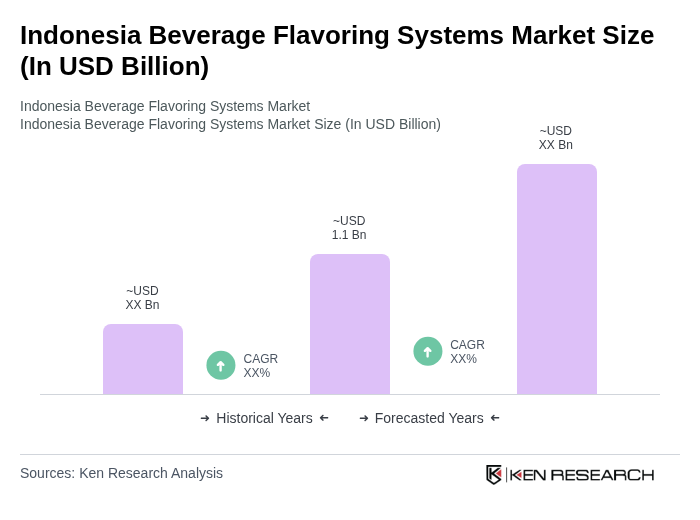
Indonesia beverage flavoring systems market, worth USD 1.1 Bn, grows with rising demand for natural flavors in soft drinks, juices, and functional beverages amid health-conscious trends.

Region:Asia

Author(s):Dev

Product Code:KRAB1870

Pages:86

Published On:January 2026
About the Report

Base Year 2024

Indonesia Beverage Flavoring Systems Market Overview

  • The Indonesia Beverage Flavoring Systems Market is valued at approximately USD 1.1 billion, based on a five-year historical analysis and extrapolation from Indonesia’s role as a key contributor within the Asia-Pacific and global beverage flavoring systems market. This growth is primarily driven by the increasing demand for flavored beverages, particularly among the younger population, and the rising trend of health-conscious consumers seeking natural, clean-label, and organic flavoring options in soft drinks, juices, ready-to-drink teas and coffees, and functional beverages. The market is also supported by the expansion of the broader beverage industry, including carbonated soft drinks, juice drinks, sports and energy drinks, dairy-based beverages, and plant-based beverages, where flavor systems are critical for differentiation and product innovation.
  • Key cities such as Jakarta, Surabaya, and Bandung dominate the market due to their high population density, higher disposable incomes, and urban lifestyles, which drive the demand for diverse, convenient, and premium beverage options. Additionally, these cities are hubs for beverage manufacturing, R&D, and distribution, concentrating bottling plants, flavor houses, and co-packers, making them critical to the growth of the flavoring systems market. The presence of major beverage and flavor companies in these regions, along with strong modern retail and foodservice channels, further enhances their market dominance and accelerates new flavor launches and localized product development.
  • In 2023, the Indonesian government strengthened regulations on food additives and labeling through instruments such as the Regulation of the Head of the National Agency of Drug and Food Control (BPOM) Number 11 of 2019 on Processed Food Labeling and related implementing rules, which require manufacturers to declare all ingredients, including food additives and flavorings, on product labels. This regulatory framework promotes greater transparency, supports safer use of flavoring substances and additives in beverages, and encourages manufacturers to reformulate with natural flavors, reduced sugar, and cleaner ingredient lists to align with national nutrition and health policies and international food safety standards.
Indonesia Beverage Flavoring Systems Market Size

Indonesia Beverage Flavoring Systems Market Segmentation

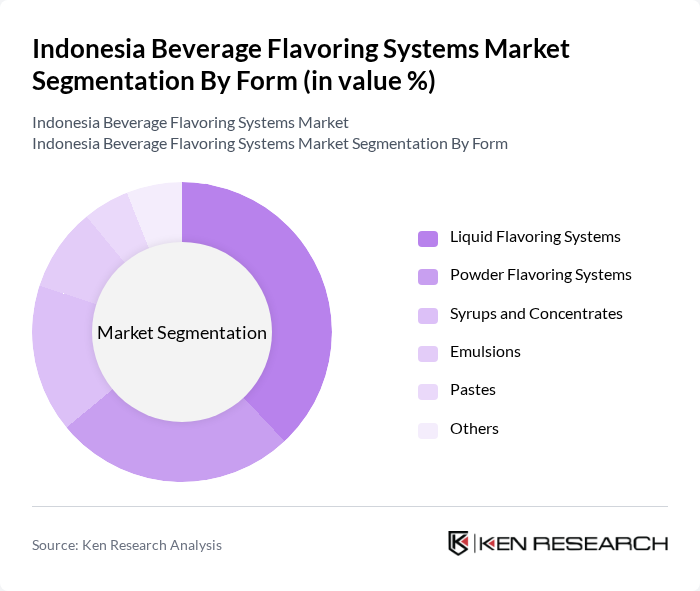
By Form:The market is segmented into various forms of flavoring systems, including liquid, powder, syrups, emulsions, pastes, and others. Each form caters to different beverage applications and consumer preferences, with liquid and powder formats being widely used across carbonated drinks, juices, dairy, plant-based beverages, and instant drink mixes.
Indonesia Beverage Flavoring Systems Market segmentation by Form.

The liquid flavoring systems segment is the most dominant in the market, accounting for a significant share due to its versatility and ease of use in various beverage applications such as carbonated soft drinks, ready-to-drink teas and coffees, juices, and functional beverages. Liquid flavors are preferred by manufacturers for their ability to blend seamlessly into drinks, providing consistent taste and aroma and enabling rapid line changeovers in bottling and aseptic processing. The growing trend of ready-to-drink beverages, flavored water, low- and no-sugar soft drinks, and energy and sports drinks further bolsters the demand for liquid flavoring systems in Indonesia, mirroring wider Asia-Pacific dynamics. Additionally, consumer preferences for natural, organic, and plant-derived ingredients have led to innovations in liquid flavor formulations, including natural extracts, botanicals, and fruit concentrates, enhancing their market appeal and supporting premiumization trends.

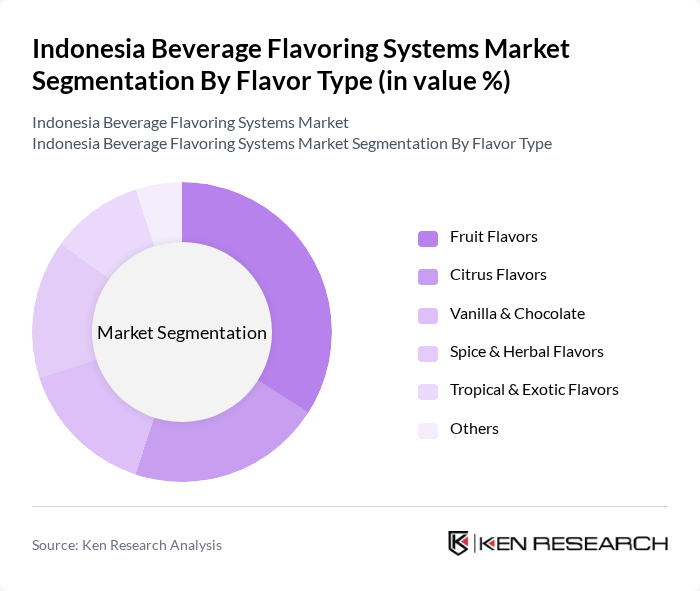
By Flavor Type:The market is categorized into various flavor types, including fruit, citrus, vanilla and chocolate, spice and herbal, tropical and exotic, and others. Each flavor type caters to specific consumer tastes and preferences, with strong localization around Indonesian tropical fruits and traditional herbal profiles.
Indonesia Beverage Flavoring Systems Market segmentation by Flavor Type.

Fruit flavors dominate the market, driven by consumer preferences for refreshing and perceived natural tastes in beverages, including juices, nectars, flavored water, and smoothies. The increasing popularity of fruit-flavored drinks, smoothie-style beverages, and health-oriented drinks such as vitamin-fortified, probiotic, and plant-based beverages has significantly contributed to the growth of this segment in Indonesia’s urban centers. Additionally, the trend towards healthier lifestyles and the demand for natural ingredients have led manufacturers to innovate and expand their fruit flavor offerings, emphasizing reduced sugar, high-juice content, and fruit-derived flavorings. Citrus flavors also hold a substantial share, appealing to consumers seeking zesty and tangy options and being widely used in carbonated soft drinks, isotonic beverages, and flavored water, where lemon, lime, and orange profiles remain core.

Indonesia Beverage Flavoring Systems Market Competitive Landscape

The Indonesia Beverage Flavoring Systems Market is characterized by a dynamic mix of regional and international players. Leading participants such as PT. Indesso Aroma, PT. Tirta Aroma, PT. Haldin Pacific Semesta, PT. Sentarum Mitra Sejahtera, PT. Mane Indonesia, PT. Givaudan Indonesia, PT. Firmenich Indonesia, PT. Symrise Indonesia, PT. Takasago Indonesia, PT. International Flavors & Fragrances Indonesia, PT. Flavorama Indonesia, PT. Djasula Wangi, PT. Bumi Aroma, PT. Indofood CBP – Flavor Division, PT. Sensient Flavors Indonesia contribute to innovation, geographic expansion, and service delivery in this space.

PT. Indesso Aroma

1968

Jakarta, Indonesia

PT. Tirta Aroma

1968

Bandung, Indonesia

PT. Haldin Pacific Semesta

1987

Jakarta, Indonesia

PT. Mane Indonesia

2002

Jakarta, Indonesia

PT. Givaudan Indonesia

1999

Jakarta, Indonesia

Company

Establishment Year

Headquarters

Group Size (Large, Medium, or Small as per industry convention)

Indonesia Beverage Flavoring Systems Revenue (USD Million)

3-Year Revenue CAGR in Indonesia (%)

Indonesia Market Share (%)

EBITDA Margin from Indonesia Operations (%)

R&D Spend as % of Revenue

Indonesia Beverage Flavoring Systems Market Industry Analysis

Growth Drivers

  • Increasing Consumer Demand for Flavored Beverages:The Indonesian beverage market is witnessing a surge in demand for flavored drinks, with the sector projected to reach IDR 300 trillion in future. This growth is driven by changing consumer preferences, particularly among millennials, who favor unique and diverse flavors. The rise in disposable income, which is expected to increase by 6.1% annually, further supports this trend, as consumers are willing to spend more on premium flavored beverages.
  • Growth of the Food and Beverage Industry:The food and beverage industry in Indonesia is anticipated to grow at a rate of 7.5% annually, reaching IDR 2,000 trillion in future. This expansion is fueled by urbanization and a growing middle class, which is driving demand for innovative beverage options. As the industry evolves, beverage flavoring systems are becoming essential for manufacturers to differentiate their products and meet consumer expectations for variety and quality.
  • Rising Health Consciousness Among Consumers:Health awareness is significantly influencing beverage choices in Indonesia, with a 40% increase in demand for low-calorie and functional beverages reported in future. Consumers are increasingly seeking beverages that offer health benefits, such as vitamins and antioxidants. This trend is prompting manufacturers to invest in flavoring systems that enhance the appeal of healthier options, aligning with the growing preference for wellness-oriented products.

Market Challenges

  • Stringent Regulatory Requirements:The beverage flavoring industry in Indonesia faces rigorous regulatory scrutiny, with over 60 specific regulations governing food safety and flavoring agents. Compliance with these regulations can be costly and time-consuming for manufacturers, potentially hindering innovation and market entry for new products. The need for extensive testing and certification processes adds to operational complexities, impacting overall market growth.
  • High Competition Among Local and International Players:The Indonesian beverage flavoring market is characterized by intense competition, with over 120 local and international companies vying for market share. This competitive landscape pressures companies to continuously innovate and reduce prices, which can erode profit margins. The presence of established brands with strong distribution networks further complicates the market entry for new players, making it challenging to gain traction.

Indonesia Beverage Flavoring Systems Market Future Outlook

The future of the Indonesia beverage flavoring systems market appears promising, driven by evolving consumer preferences and technological advancements. As health-consciousness continues to rise, manufacturers are likely to focus on developing innovative flavoring systems that cater to this demand. Additionally, the expansion of e-commerce platforms will facilitate greater access to flavored beverages, enhancing market reach. Collaborations with local producers will also play a crucial role in adapting flavors to regional tastes, further driving market growth.

Market Opportunities

  • Development of Organic and Natural Flavoring Systems:There is a growing opportunity for manufacturers to develop organic and natural flavoring systems, as consumer demand for clean-label products is on the rise. With the organic food market projected to grow by 12% annually, companies that invest in natural flavoring solutions can capture a significant share of this expanding segment, appealing to health-conscious consumers.
  • Expansion of E-commerce Platforms for Beverage Sales:The rapid growth of e-commerce in Indonesia, with online retail sales expected to reach IDR 500 trillion in future, presents a significant opportunity for beverage flavoring systems. Companies can leverage digital platforms to reach a broader audience, enhance brand visibility, and offer personalized flavor options, thus driving sales and market penetration in the beverage sector.

Scope of the Report

SegmentSub-Segments
By Form

Liquid Flavoring Systems

Powder Flavoring Systems

Syrups and Concentrates

Emulsions

Pastes

Others

By Flavor Type

Fruit Flavors

Citrus Flavors

Vanilla & Chocolate

Spice & Herbal Flavors

Tropical & Exotic Flavors

Others

By Source

Natural Flavoring Systems

Nature-Identical Flavoring Systems

Artificial Flavoring Systems

By Beverage Application

Carbonated Soft Drinks

Juices & Nectars

Functional & Energy Drinks

Dairy & Dairy-Alternative Beverages

Ready-to-Drink Tea & Coffee

Alcoholic Beverages

Others

By Distribution Channel

Direct Sales to Beverage Manufacturers

Distributors & Agents

Online B2B Platforms

Others

By End User

Beverage Manufacturers

Contract Packers

Foodservice & HoReCa

Others

By Region

Java

Sumatra

Bali & Nusa Tenggara

Kalimantan

Sulawesi

Eastern Indonesia (Maluku & Papua)

Key Target Audience

Investors and Venture Capitalist Firms

Government and Regulatory Bodies (e.g., Ministry of Industry, National Food and Drug Monitoring Agency)

Manufacturers and Producers

Distributors and Retailers

Flavoring Ingredient Suppliers

Food and Beverage Industry Associations

Packaging Companies

Financial Institutions

Players Mentioned in the Report:

PT. Indesso Aroma

PT. Tirta Aroma

PT. Haldin Pacific Semesta

PT. Sentarum Mitra Sejahtera

PT. Mane Indonesia

PT. Givaudan Indonesia

PT. Firmenich Indonesia

PT. Symrise Indonesia

PT. Takasago Indonesia

PT. International Flavors & Fragrances Indonesia

PT. Flavorama Indonesia

PT. Djasula Wangi

PT. Bumi Aroma

PT. Indofood CBP Flavor Division

PT. Sensient Flavors Indonesia

Table of Contents

Market Assessment Phase

1. Executive Summary and Approach


2. Indonesia Beverage Flavoring Systems Market Overview

2.1 Key Insights and Strategic Recommendations

2.2 Indonesia Beverage Flavoring Systems Market Overview

2.3 Definition and Scope

2.4 Evolution of Market Ecosystem

2.5 Timeline of Key Regulatory Milestones

2.6 Value Chain & Stakeholder Mapping

2.7 Business Cycle Analysis

2.8 Policy & Incentive Landscape


3. Indonesia Beverage Flavoring Systems Market Analysis

3.1 Growth Drivers

3.1.1 Increasing consumer demand for flavored beverages
3.1.2 Growth of the food and beverage industry
3.1.3 Rising health consciousness among consumers
3.1.4 Innovation in flavoring technologies

3.2 Market Challenges

3.2.1 Stringent regulatory requirements
3.2.2 High competition among local and international players
3.2.3 Fluctuating raw material prices
3.2.4 Consumer preference for natural flavors over artificial

3.3 Market Opportunities

3.3.1 Expansion of e-commerce platforms for beverage sales
3.3.2 Development of organic and natural flavoring systems
3.3.3 Collaborations with local beverage manufacturers
3.3.4 Increasing investment in R&D for flavor innovations

3.4 Market Trends

3.4.1 Growing popularity of plant-based and herbal flavors
3.4.2 Shift towards sustainable and eco-friendly packaging
3.4.3 Rise of functional beverages with added health benefits
3.4.4 Customization of flavors to cater to local tastes

3.5 Government Regulation

3.5.1 Food safety standards and regulations
3.5.2 Labeling requirements for beverage products
3.5.3 Import/export regulations for flavoring agents
3.5.4 Environmental regulations impacting production processes

4. SWOT Analysis


5. Stakeholder Analysis


6. Porter's Five Forces Analysis


7. Indonesia Beverage Flavoring Systems Market Market Size, 2019-2024

7.1 By Value

7.2 By Volume

7.3 By Average Selling Price


8. Indonesia Beverage Flavoring Systems Market Segmentation

8.1 By Form

8.1.1 Liquid Flavoring Systems
8.1.2 Powder Flavoring Systems
8.1.3 Syrups and Concentrates
8.1.4 Emulsions
8.1.5 Pastes
8.1.6 Others

8.2 By Flavor Type

8.2.1 Fruit Flavors
8.2.2 Citrus Flavors
8.2.3 Vanilla & Chocolate
8.2.4 Spice & Herbal Flavors
8.2.5 Tropical & Exotic Flavors
8.2.6 Others

8.3 By Source

8.3.1 Natural Flavoring Systems
8.3.2 Nature-Identical Flavoring Systems
8.3.3 Artificial Flavoring Systems

8.4 By Beverage Application

8.4.1 Carbonated Soft Drinks
8.4.2 Juices & Nectars
8.4.3 Functional & Energy Drinks
8.4.4 Dairy & Dairy-Alternative Beverages
8.4.5 Ready-to-Drink Tea & Coffee
8.4.6 Alcoholic Beverages
8.4.7 Others

8.5 By Distribution Channel

8.5.1 Direct Sales to Beverage Manufacturers
8.5.2 Distributors & Agents
8.5.3 Online B2B Platforms
8.5.4 Others

8.6 By End User

8.6.1 Beverage Manufacturers
8.6.2 Contract Packers
8.6.3 Foodservice & HoReCa
8.6.4 Others

8.7 By Region

8.7.1 Java
8.7.2 Sumatra
8.7.3 Bali & Nusa Tenggara
8.7.4 Kalimantan
8.7.5 Sulawesi
8.7.6 Eastern Indonesia (Maluku & Papua)

9. Indonesia Beverage Flavoring Systems Market Competitive Analysis

9.1 Market Share of Key Players

9.2 Cross Comparison of Key Players

9.2.1 Company Name
9.2.2 Group Size (Large, Medium, or Small as per industry convention)
9.2.3 Indonesia Beverage Flavoring Systems Revenue (USD Million)
9.2.4 3-Year Revenue CAGR in Indonesia (%)
9.2.5 Indonesia Market Share (%)
9.2.6 EBITDA Margin from Indonesia Operations (%)
9.2.7 R&D Spend as % of Revenue
9.2.8 Number of Beverage Flavoring SKUs in Indonesia
9.2.9 Geographic Coverage within Indonesia (Number of Provinces/Regions Served)
9.2.10 Key Beverage OEM/Brand Accounts (Count)
9.2.11 Capacity Utilization Rate (%)
9.2.12 Average Contract Tenure with Key Clients (Years)

9.3 SWOT Analysis of Top Players

9.4 Pricing Analysis

9.5 Detailed Profile of Major Companies

9.5.1 PT. Indesso Aroma
9.5.2 PT. Tirta Aroma
9.5.3 PT. Haldin Pacific Semesta
9.5.4 PT. Sentarum Mitra Sejahtera
9.5.5 PT. Mane Indonesia
9.5.6 PT. Givaudan Indonesia
9.5.7 PT. Firmenich Indonesia
9.5.8 PT. Symrise Indonesia
9.5.9 PT. Takasago Indonesia
9.5.10 PT. International Flavors & Fragrances Indonesia
9.5.11 PT. Flavorama Indonesia
9.5.12 PT. Djasula Wangi
9.5.13 PT. Bumi Aroma
9.5.14 PT. Indofood CBP – Flavor Division
9.5.15 PT. Sensient Flavors Indonesia

10. Indonesia Beverage Flavoring Systems Market End-User Analysis

10.1 Procurement Behavior of Key Ministries

10.1.1 Key procurement policies
10.1.2 Budget allocation for beverage flavoring
10.1.3 Preferred suppliers and vendors
10.1.4 Evaluation criteria for procurement

10.2 Corporate Spend on Infrastructure & Energy

10.2.1 Investment trends in beverage production
10.2.2 Budget allocation for flavoring systems
10.2.3 Infrastructure development initiatives
10.2.4 Energy consumption patterns

10.3 Pain Point Analysis by End-User Category

10.3.1 Challenges faced by soft drink manufacturers
10.3.2 Issues in sourcing natural flavors
10.3.3 Regulatory compliance difficulties
10.3.4 Cost management challenges

10.4 User Readiness for Adoption

10.4.1 Awareness of flavoring systems
10.4.2 Willingness to adopt new technologies
10.4.3 Training and support needs
10.4.4 Feedback mechanisms for improvement

10.5 Post-Deployment ROI and Use Case Expansion

10.5.1 Measurement of ROI post-implementation
10.5.2 Case studies of successful deployments
10.5.3 Opportunities for scaling flavoring systems
10.5.4 Long-term benefits analysis

11. Indonesia Beverage Flavoring Systems Market Future Size, 2025-2030

11.1 By Value

11.2 By Volume

11.3 By Average Selling Price


Go-To-Market Strategy Phase

1. Whitespace Analysis + Business Model Canvas

1.1 Market gaps identification

1.2 Business model development


2. Marketing and Positioning Recommendations

2.1 Branding strategies

2.2 Product USPs


3. Distribution Plan

3.1 Urban retail vs rural NGO tie-ups


4. Channel & Pricing Gaps

4.1 Underserved routes

4.2 Pricing bands


5. Unmet Demand & Latent Needs

5.1 Category gaps

5.2 Consumer segments


6. Customer Relationship

6.1 Loyalty programs

6.2 After-sales service


7. Value Proposition

7.1 Sustainability

7.2 Integrated supply chains


8. Key Activities

8.1 Regulatory compliance

8.2 Branding

8.3 Distribution setup


9. Entry Strategy Evaluation

9.1 Domestic Market Entry Strategy

9.1.1 Product mix
9.1.2 Pricing band
9.1.3 Packaging

9.2 Export Entry Strategy

9.2.1 Target countries
9.2.2 Compliance roadmap

10. Entry Mode Assessment

10.1 JV, Greenfield, M&A, Distributor Model


11. Capital and Timeline Estimation

11.1 Capital requirements

11.2 Timelines


12. Control vs Risk Trade-Off

12.1 Ownership vs Partnerships


13. Profitability Outlook

13.1 Breakeven analysis

13.2 Long-term sustainability


14. Potential Partner List

14.1 Distributors

14.2 JVs

14.3 Acquisition targets


15. Execution Roadmap

15.1 Phased Plan for Market Entry

15.1.1 Market Setup
15.1.2 Market Entry
15.1.3 Growth Acceleration
15.1.4 Scale & Stabilize

15.2 Key Activities and Milestones

15.2.1 Milestone tracking
15.2.2 Activity scheduling

Research Methodology

ApproachModellingSample

Phase 1: Approach1

Desk Research

  • Analysis of industry reports from local beverage associations and market research firms
  • Review of government publications on food and beverage regulations in Indonesia
  • Examination of trade journals and articles focusing on flavoring trends and consumer preferences

Primary Research

  • Interviews with flavoring suppliers and manufacturers in the Indonesian beverage sector
  • Surveys conducted with beverage producers to understand flavoring usage and preferences
  • Focus group discussions with consumers to gauge flavor trends and acceptance

Validation & Triangulation

  • Cross-validation of findings through multiple data sources including trade data and consumer surveys
  • Triangulation of insights from industry experts and market participants
  • Sanity checks through expert panel reviews to ensure data reliability

Phase 2: Market Size Estimation1

Top-down Assessment

  • Estimation of market size based on national beverage consumption statistics
  • Segmentation of the market by beverage type (e.g., soft drinks, alcoholic beverages, dairy-based drinks)
  • Incorporation of growth rates from historical data and projected trends in flavoring preferences

Bottom-up Modeling

  • Collection of sales data from key beverage manufacturers to establish baseline figures
  • Estimation of flavoring volumes used per beverage category based on industry standards
  • Calculation of market size by aggregating data from various beverage segments

Forecasting & Scenario Analysis

  • Utilization of time-series analysis to project future market trends based on historical data
  • Scenario modeling based on potential regulatory changes and shifts in consumer behavior
  • Development of multiple forecasts (baseline, optimistic, and pessimistic) through 2030

Phase 3: CATI Sample Composition1

Scope Item/SegmentSample SizeTarget Respondent Profiles
Soft Drink Manufacturers120Product Development Managers, Flavor Technologists
Alcoholic Beverage Producers90Brand Managers, R&D Directors
Dairy Beverage Companies80Quality Assurance Managers, Flavor Specialists
Fruit Juice Manufacturers70Operations Managers, Marketing Executives
Flavoring Suppliers100Sales Managers, Technical Support Staff

Frequently Asked Questions

What is the current value of the Indonesia Beverage Flavoring Systems Market?

The Indonesia Beverage Flavoring Systems Market is valued at approximately USD 1.1 billion, reflecting its significant role in the Asia-Pacific beverage flavoring sector, driven by increasing consumer demand for flavored beverages and health-conscious trends.

What factors are driving the growth of the Indonesia Beverage Flavoring Systems Market?

Which cities are the main hubs for the Indonesia Beverage Flavoring Systems Market?

What regulatory changes have impacted the Indonesia Beverage Flavoring Systems Market?

Other Regional/Country Reports

Malaysia Beverage Flavoring Systems Market

KSA Beverage Flavoring Systems Market

APAC Beverage Flavoring Systems Market

SEA Beverage Flavoring Systems Market

Vietnam Beverage Flavoring Systems Market

Thailand Beverage Flavoring Systems Market

Other Adjacent Reports

UAE Soft Drinks MarketSaudi Arabia Fruit Juice Market Outlook to 2030Middle East Energy Drinks Market

Vietnam Functional Beverages Market

Vietnam Plant-Based Beverages Market

Singapore Dairy Beverages Market

Oman Ready-to-Drink Tea Market

South Korea Ready-to-Drink Coffee Market

Qatar Flavors and Fragrances Market

UAE Food Additives Market

Why Buy From Us?

Refine Robust Result (RRR) Framework

What makes us stand out is that our consultants follow Robust, Refine and Result (RRR) methodology. Robust for clear definitions, approaches and sanity checking, Refine for differentiating respondents' facts and opinions, and Result for presenting data with story.

Our Reach Is Unmatched

We have set a benchmark in the industry by offering our clients with syndicated and customized market research reports featuring coverage of entire market as well as meticulous research and analyst insights.

Shifting the Research Paradigm

While we don't replace traditional research, we flip the method upside down. Our dual approach of Top Bottom & Bottom Top ensures quality deliverable by not just verifying company fundamentals but also looking at the sector and macroeconomic factors.

More Insights-Better Decisions

With one step in the future, our research team constantly tries to show you the bigger picture. We help with some of the tough questions you may encounter along the way: How is the industry positioned? Best marketing channel? KPI's of competitors? By aligning every element, we help maximize success.

Transparency and Trust

Our report gives you instant access to the answers and sources that other companies might choose to hide. We elaborate each steps of research methodology we have used and showcase you the sample size to earn your trust.

Round the Clock Support

If you need any support, we are here! We pride ourselves on universe strength, data quality, and quick, friendly, and professional service.

Why Clients Choose Us?

400000+
Reports in repository
150+
Consulting projects a year
100+
Analysts
8000+
Client Queries in 2022








