Indonesia Disposable Face Mask Market Size, Share, Growth Drivers, Trends, Opportunities & Forecast 2025–2030

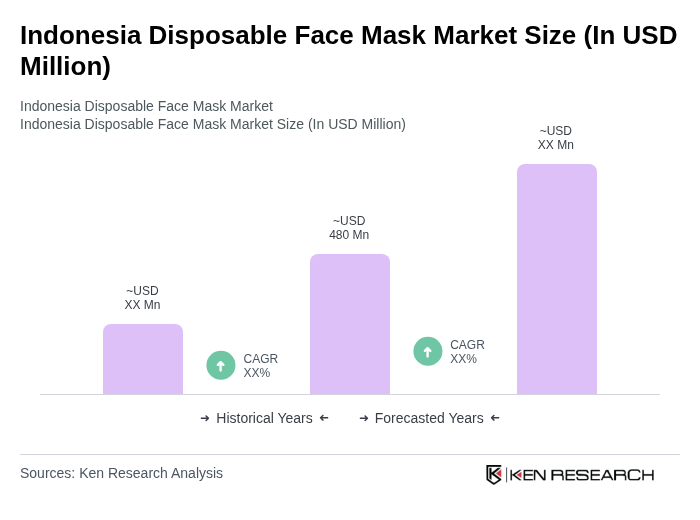
Indonesia disposable face mask market reaches USD 480 million, fueled by post-pandemic hygiene awareness, pollution, and government mandates in cities like Jakarta and Surabaya.

Region:Asia

Author(s):Dev

Product Code:KRAE3455

Pages:82

Published On:March 2026
About the Report

Base Year 2024

Indonesia Disposable Face Mask Market Overview

  • The Indonesia Disposable Face Mask Market is valued at USD 480 million, based on a five-year historical analysis. This growth is primarily driven by the increasing awareness of health and hygiene, particularly in the wake of the COVID-19 pandemic, which has significantly heightened the demand for personal protective equipment, including face masks.
  • Key cities such as Jakarta, Surabaya, and Bandung dominate the market due to their high population density and urbanization, which contribute to a greater need for health safety measures. The concentration of healthcare facilities and educational institutions in these areas further amplifies the demand for disposable face masks.
  • The Minister of Health Regulation No. 9 of 2021 issued by the Ministry of Health requires healthcare facilities to use certified personal protective equipment including disposable face masks meeting SNI standards for infection prevention, mandating compliance through filtration efficiency testing, fit testing, and regular supply chain verification. This regulation has significantly boosted the market for disposable face masks, ensuring compliance and safety for the population.
Indonesia Disposable Face Mask Market Size

Indonesia Disposable Face Mask Market Segmentation

By Type:The market is segmented into various types of disposable face masks, including surgical masks, N95 respirators, cloth masks, pediatric masks, and others. Surgical masks are widely used in healthcare settings due to their effectiveness in preventing the spread of infections. N95 respirators are preferred for their high filtration efficiency, especially in environments with airborne pathogens. Cloth masks have gained popularity for everyday use, while pediatric masks cater specifically to children’s needs.
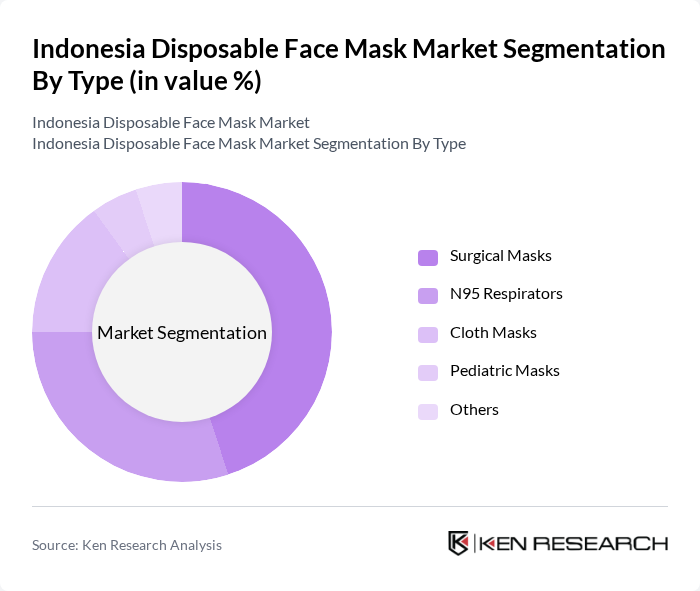
Indonesia Disposable Face Mask Market segmentation by Type.

The surgical masks segment dominates the market due to their widespread use in healthcare facilities and public settings. Their effectiveness in filtering out bacteria and viruses makes them a preferred choice among healthcare professionals and the general public. The N95 respirators follow closely, especially in high-risk environments, while cloth masks are favored for casual use due to their comfort and reusability. Pediatric masks are gaining traction as awareness of children's health needs increases.

By End-User:The market is segmented based on end-users, including healthcare facilities, educational institutions, corporate offices, retail and hospitality, and others. Healthcare facilities are the largest consumers of disposable face masks, driven by stringent health regulations and the need for infection control. Educational institutions and corporate offices have also increased their mask usage to ensure safety among students and employees.
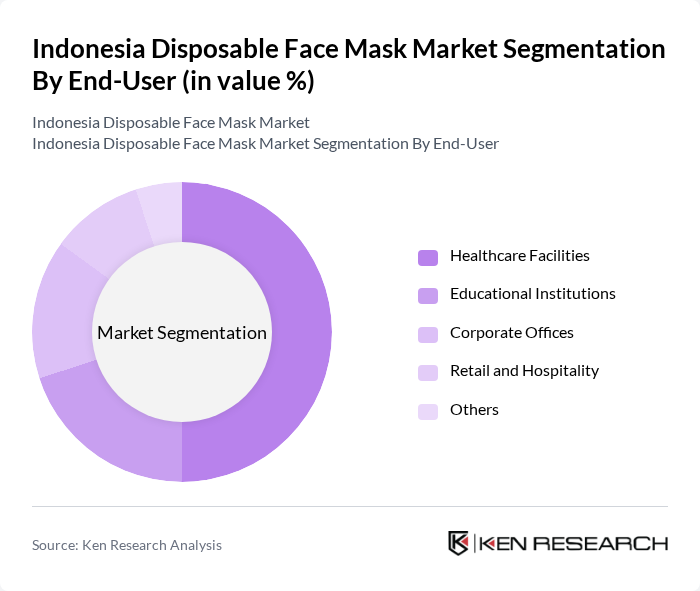
Indonesia Disposable Face Mask Market segmentation by End-User.

Healthcare facilities lead the market due to their critical need for protective equipment to safeguard both patients and staff. The educational sector has seen a rise in mask usage as schools implement health protocols. Corporate offices are also adopting mask mandates to ensure employee safety, while the retail and hospitality sectors are focusing on customer safety to maintain public confidence.

Indonesia Disposable Face Mask Market Competitive Landscape

The Indonesia Disposable Face Mask Market is characterized by a dynamic mix of regional and international players. Leading participants such as PT. Sido Muncul, PT. Kimia Farma, PT. Indofarma, PT. Medisafe Technologies, PT. Hanjin Shipping, PT. Adi Citra, PT. Mitra Keluarga, PT. Sumber Alfaria Trijaya, PT. Duta Masker, PT. Anugerah Masker, PT. Citra Masker, PT. Bina Masker, PT. Sehat Selalu, PT. Karya Masker, PT. Prima Masker contribute to innovation, geographic expansion, and service delivery in this space.

PT. Sido Muncul

1940

Semarang, Indonesia

PT. Kimia Farma

1817

Jakarta, Indonesia

PT. Indofarma

1918

Jakarta, Indonesia

PT. Medisafe Technologies

2000

Jakarta, Indonesia

PT. Hanjin Shipping

2008

Jakarta, Indonesia

Company

Establishment Year

Headquarters

Group Size (Large, Medium, or Small as per industry convention)

Revenue Growth Rate

Market Penetration Rate

Customer Retention Rate

Production Capacity Utilization

Pricing Strategy

Indonesia Disposable Face Mask Market Industry Analysis

Growth Drivers

  • Increased Health Awareness:The Indonesian population has shown a significant rise in health consciousness, particularly post-pandemic. According to the World Health Organization, health expenditure in Indonesia reached approximately IDR 1,500 trillion (USD 100 billion) in future, reflecting a 25% increase from the previous year. This heightened awareness has led to a surge in demand for disposable face masks, as consumers prioritize personal health and hygiene, driving market growth.
  • Government Mandates for Mask Usage:The Indonesian government has implemented strict regulations mandating mask usage in public spaces, especially in urban areas. As of future, over 80% of cities have enforced these mandates, resulting in a substantial increase in mask consumption. The Ministry of Health reported that mask sales surged to 2 billion units in future, highlighting the effectiveness of these policies in boosting the disposable face mask market.
  • Rising Pollution Levels:Indonesia faces significant air quality challenges, with Jakarta consistently ranking among the world's most polluted cities. The Air Quality Index (AQI) in Jakarta often exceeds 200, indicating unhealthy levels of pollution. This environmental concern has prompted consumers to adopt disposable face masks as a protective measure, contributing to a projected increase in demand for masks, particularly in urban centers where pollution levels are critical.

Market Challenges

  • Supply Chain Disruptions:The disposable face mask market in Indonesia is currently facing supply chain challenges, exacerbated by global logistics issues. In future, shipping costs increased by 40% due to ongoing disruptions, affecting the availability of raw materials. This has led to delays in production and distribution, hindering market growth and causing fluctuations in mask availability across various regions.
  • Price Sensitivity Among Consumers:The economic landscape in Indonesia has made consumers increasingly price-sensitive, particularly in lower-income segments. With the average disposable mask retailing at IDR 6,000 (USD 0.40), many consumers are seeking more affordable alternatives. This price sensitivity poses a challenge for manufacturers, as they must balance quality and affordability to maintain market share while addressing consumer needs.

Indonesia Disposable Face Mask Market Future Outlook

The future of the disposable face mask market in Indonesia appears promising, driven by ongoing health awareness and regulatory support. As urbanization continues, the demand for masks is expected to remain robust, particularly in densely populated areas. Additionally, advancements in production technology and materials will likely enhance product offerings, catering to evolving consumer preferences. The market is poised for growth as manufacturers adapt to these trends and address emerging challenges effectively.

Market Opportunities

  • Expansion into Rural Markets:There is a significant opportunity for disposable mask manufacturers to penetrate rural markets, where awareness of health and hygiene is increasing. With a population of over 300 million, targeting rural areas could lead to an estimated additional demand of 600 million masks annually, enhancing market reach and profitability.
  • Development of Eco-friendly Masks:The growing environmental concerns among consumers present an opportunity for innovation in eco-friendly disposable masks. With an estimated 70% of consumers willing to pay a premium for sustainable products, manufacturers can capitalize on this trend by developing biodegradable masks, potentially increasing market share and brand loyalty.

Scope of the Report

SegmentSub-Segments
By Type

Surgical Masks

N95 Respirators

Cloth Masks

Pediatric Masks

Others

By End-User

Healthcare Facilities

Educational Institutions

Corporate Offices

Retail and Hospitality

Others

By Distribution Channel

Online Retail

Pharmacies

Supermarkets

Direct Sales

Others

By Material

Non-woven Fabrics

Melt-blown Fabrics

Cotton

Others

By Certification Type

ISO Certified Masks

CE Marked Masks

FDA Approved Masks

Others

By Price Range

Low Price Masks

Mid-range Masks

Premium Masks

Others

By Usage Frequency

Daily Use Masks

Occasional Use Masks

Emergency Use Masks

Others

Key Target Audience

Investors and Venture Capitalist Firms

Government and Regulatory Bodies (e.g., Ministry of Health, National Agency of Drug and Food Control)

Manufacturers and Producers

Distributors and Retailers

Healthcare Providers and Hospitals

Importers and Exporters

Industry Associations (e.g., Indonesian Medical Device Association)

Financial Institutions

Players Mentioned in the Report:

PT. Sido Muncul

PT. Kimia Farma

PT. Indofarma

PT. Medisafe Technologies

PT. Hanjin Shipping

PT. Adi Citra

PT. Mitra Keluarga

PT. Sumber Alfaria Trijaya

PT. Duta Masker

PT. Anugerah Masker

PT. Citra Masker

PT. Bina Masker

PT. Sehat Selalu

PT. Karya Masker

PT. Prima Masker

Table of Contents

Market Assessment Phase

1. Executive Summary and Approach


2. Indonesia Disposable Face Mask Market Overview

2.1 Key Insights and Strategic Recommendations

2.2 Indonesia Disposable Face Mask Market Overview

2.3 Definition and Scope

2.4 Evolution of Market Ecosystem

2.5 Timeline of Key Regulatory Milestones

2.6 Value Chain & Stakeholder Mapping

2.7 Business Cycle Analysis

2.8 Policy & Incentive Landscape


3. Indonesia Disposable Face Mask Market Analysis

3.1 Growth Drivers

3.1.1 Increased Health Awareness
3.1.2 Government Mandates for Mask Usage
3.1.3 Rising Pollution Levels
3.1.4 Growth in Healthcare Sector

3.2 Market Challenges

3.2.1 Supply Chain Disruptions
3.2.2 Price Sensitivity Among Consumers
3.2.3 Competition from Reusable Masks
3.2.4 Regulatory Compliance Issues

3.3 Market Opportunities

3.3.1 Expansion into Rural Markets
3.3.2 Development of Eco-friendly Masks
3.3.3 Partnerships with Healthcare Providers
3.3.4 E-commerce Growth for Distribution

3.4 Market Trends

3.4.1 Increasing Demand for Customizable Masks
3.4.2 Technological Advancements in Mask Production
3.4.3 Shift Towards Online Sales Channels
3.4.4 Focus on Sustainable Materials

3.5 Government Regulation

3.5.1 Mandatory Mask Policies in Public Spaces
3.5.2 Quality Standards for Medical Masks
3.5.3 Import Regulations on Face Masks
3.5.4 Tax Incentives for Local Manufacturers

4. SWOT Analysis


5. Stakeholder Analysis


6. Porter's Five Forces Analysis


7. Indonesia Disposable Face Mask Market Market Size, 2019-2024

7.1 By Value

7.2 By Volume

7.3 By Average Selling Price


8. Indonesia Disposable Face Mask Market Segmentation

8.1 By Type

8.1.1 Surgical Masks
8.1.2 N95 Respirators
8.1.3 Cloth Masks
8.1.4 Pediatric Masks
8.1.5 Others

8.2 By End-User

8.2.1 Healthcare Facilities
8.2.2 Educational Institutions
8.2.3 Corporate Offices
8.2.4 Retail and Hospitality
8.2.5 Others

8.3 By Distribution Channel

8.3.1 Online Retail
8.3.2 Pharmacies
8.3.3 Supermarkets
8.3.4 Direct Sales
8.3.5 Others

8.4 By Material

8.4.1 Non-woven Fabrics
8.4.2 Melt-blown Fabrics
8.4.3 Cotton
8.4.4 Others

8.5 By Certification Type

8.5.1 ISO Certified Masks
8.5.2 CE Marked Masks
8.5.3 FDA Approved Masks
8.5.4 Others

8.6 By Price Range

8.6.1 Low Price Masks
8.6.2 Mid-range Masks
8.6.3 Premium Masks
8.6.4 Others

8.7 By Usage Frequency

8.7.1 Daily Use Masks
8.7.2 Occasional Use Masks
8.7.3 Emergency Use Masks
8.7.4 Others

9. Indonesia Disposable Face Mask Market Competitive Analysis

9.1 Market Share of Key Players

9.2 Cross Comparison of Key Players

9.2.1 Company Name
9.2.2 Group Size (Large, Medium, or Small as per industry convention)
9.2.3 Revenue Growth Rate
9.2.4 Market Penetration Rate
9.2.5 Customer Retention Rate
9.2.6 Production Capacity Utilization
9.2.7 Pricing Strategy
9.2.8 Distribution Network Efficiency
9.2.9 Brand Recognition Score
9.2.10 Innovation Rate

9.3 SWOT Analysis of Top Players

9.4 Pricing Analysis

9.5 Detailed Profile of Major Companies

9.5.1 PT. Sido Muncul
9.5.2 PT. Kimia Farma
9.5.3 PT. Indofarma
9.5.4 PT. Medisafe Technologies
9.5.5 PT. Hanjin Shipping
9.5.6 PT. Adi Citra
9.5.7 PT. Mitra Keluarga
9.5.8 PT. Sumber Alfaria Trijaya
9.5.9 PT. Duta Masker
9.5.10 PT. Anugerah Masker
9.5.11 PT. Citra Masker
9.5.12 PT. Bina Masker
9.5.13 PT. Sehat Selalu
9.5.14 PT. Karya Masker
9.5.15 PT. Prima Masker

10. Indonesia Disposable Face Mask Market End-User Analysis

10.1 Procurement Behavior of Key Ministries

10.1.1 Ministry of Health
10.1.2 Ministry of Education
10.1.3 Ministry of Industry
10.1.4 Ministry of Trade

10.2 Corporate Spend on Infrastructure & Energy

10.2.1 Healthcare Infrastructure Investments
10.2.2 Corporate Social Responsibility Initiatives

10.3 Pain Point Analysis by End-User Category

10.3.1 Healthcare Providers
10.3.2 Educational Institutions
10.3.3 Corporates

10.4 User Readiness for Adoption

10.4.1 Awareness Levels
10.4.2 Accessibility of Masks

10.5 Post-Deployment ROI and Use Case Expansion

10.5.1 Cost Savings Analysis
10.5.2 User Feedback Mechanisms

11. Indonesia Disposable Face Mask Market Future Size, 2025-2030

11.1 By Value

11.2 By Volume

11.3 By Average Selling Price


Go-To-Market Strategy Phase

1. Whitespace Analysis + Business Model Canvas

1.1 Market Gaps Identification

1.2 Business Model Development


2. Marketing and Positioning Recommendations

2.1 Branding Strategies

2.2 Product USPs


3. Distribution Plan

3.1 Urban Retail vs Rural NGO Tie-ups


4. Channel & Pricing Gaps

4.1 Underserved Routes

4.2 Pricing Bands


5. Unmet Demand & Latent Needs

5.1 Category Gaps

5.2 Consumer Segments


6. Customer Relationship

6.1 Loyalty Programs

6.2 After-sales Service


7. Value Proposition

7.1 Sustainability

7.2 Integrated Supply Chains


8. Key Activities

8.1 Regulatory Compliance

8.2 Branding

8.3 Distribution Setup


9. Entry Strategy Evaluation

9.1 Domestic Market Entry Strategy

9.1.1 Product Mix
9.1.2 Pricing Band
9.1.3 Packaging

9.2 Export Entry Strategy

9.2.1 Target Countries
9.2.2 Compliance Roadmap

10. Entry Mode Assessment

10.1 JV

10.2 Greenfield

10.3 M&A

10.4 Distributor Model


11. Capital and Timeline Estimation

11.1 Capital Requirements

11.2 Timelines


12. Control vs Risk Trade-Off

12.1 Ownership vs Partnerships


13. Profitability Outlook

13.1 Breakeven Analysis

13.2 Long-term Sustainability


14. Potential Partner List

14.1 Distributors

14.2 JVs

14.3 Acquisition Targets


15. Execution Roadmap

15.1 Phased Plan for Market Entry

15.1.1 Market Setup
15.1.2 Market Entry
15.1.3 Growth Acceleration
15.1.4 Scale & Stabilize

15.2 Key Activities and Milestones

15.2.1 Milestone Planning

Research Methodology

ApproachModellingSample

Phase 1: Approach1

Desk Research

  • Analysis of market reports from health organizations and industry associations in Indonesia
  • Review of government publications on health regulations and disposable mask usage
  • Examination of trade statistics and import/export data related to face masks

Primary Research

  • Interviews with key stakeholders in the healthcare sector, including hospital procurement managers
  • Surveys conducted with retailers and distributors of disposable face masks
  • Focus group discussions with consumers to understand purchasing behavior and preferences

Validation & Triangulation

  • Cross-validation of findings through multiple data sources, including sales data and market trends
  • Triangulation of insights from primary interviews with secondary research findings
  • Sanity checks through expert reviews from industry analysts and healthcare professionals

Phase 2: Market Size Estimation1

Top-down Assessment

  • Estimation of total market size based on national health expenditure and disposable mask consumption rates
  • Segmentation of market size by end-user categories such as healthcare, retail, and general consumers
  • Incorporation of government health initiatives and public awareness campaigns on mask usage

Bottom-up Modeling

  • Collection of sales data from major distributors and manufacturers of disposable face masks
  • Estimation of average selling prices and volume sold across different market segments
  • Analysis of production capacity and supply chain dynamics affecting market availability

Forecasting & Scenario Analysis

  • Development of forecasting models based on historical sales data and projected health trends
  • Scenario analysis considering potential impacts of future pandemics and health regulations
  • Creation of baseline, optimistic, and pessimistic market growth projections through 2030

Phase 3: CATI Sample Composition1

Scope Item/SegmentSample SizeTarget Respondent Profiles
Healthcare Sector Procurement100Procurement Managers, Hospital Administrators
Retail Distribution Channels80Retail Managers, Supply Chain Coordinators
Consumer Insights120General Consumers, Health-Conscious Individuals
Manufacturing Insights70Production Managers, Quality Control Officers
Regulatory Compliance60Regulatory Affairs Specialists, Compliance Officers

Frequently Asked Questions

What is the current value of the Indonesia Disposable Face Mask Market?

The Indonesia Disposable Face Mask Market is valued at approximately USD 480 million, reflecting significant growth driven by increased health awareness and demand for personal protective equipment, particularly following the COVID-19 pandemic.

Which cities in Indonesia have the highest demand for disposable face masks?

What regulations govern the use of disposable face masks in Indonesia?

What types of disposable face masks are available in the Indonesian market?

Other Adjacent Reports

Oman Personal Protective Equipment Market Report Size Share Growth Drivers Trends Opportunities & Forecast 2025–2030

Vietnam Medical Gloves Market

Mexico Surgical Gowns Market

Brazil Respirator Market

Bahrain Infection Control Products Market

Thailand Hygiene Products Market

Singapore Non-Woven Fabrics Market

KSA Healthcare Disposables Market

South Korea Air Pollution Masks Market

UAE Medical Supplies Market

Why Buy From Us?

Refine Robust Result (RRR) Framework

What makes us stand out is that our consultants follow Robust, Refine and Result (RRR) methodology. Robust for clear definitions, approaches and sanity checking, Refine for differentiating respondents' facts and opinions, and Result for presenting data with story.

Our Reach Is Unmatched

We have set a benchmark in the industry by offering our clients with syndicated and customized market research reports featuring coverage of entire market as well as meticulous research and analyst insights.

Shifting the Research Paradigm

While we don't replace traditional research, we flip the method upside down. Our dual approach of Top Bottom & Bottom Top ensures quality deliverable by not just verifying company fundamentals but also looking at the sector and macroeconomic factors.

More Insights-Better Decisions

With one step in the future, our research team constantly tries to show you the bigger picture. We help with some of the tough questions you may encounter along the way: How is the industry positioned? Best marketing channel? KPI's of competitors? By aligning every element, we help maximize success.

Transparency and Trust

Our report gives you instant access to the answers and sources that other companies might choose to hide. We elaborate each steps of research methodology we have used and showcase you the sample size to earn your trust.

Round the Clock Support

If you need any support, we are here! We pride ourselves on universe strength, data quality, and quick, friendly, and professional service.

Why Clients Choose Us?

400000+
Reports in repository
150+
Consulting projects a year
100+
Analysts
8000+
Client Queries in 2022








