Indonesia Dried Blood Spot Collection Cards Market Size, Share, Growth Drivers, Trends, Opportunities & Forecast 2025–2030

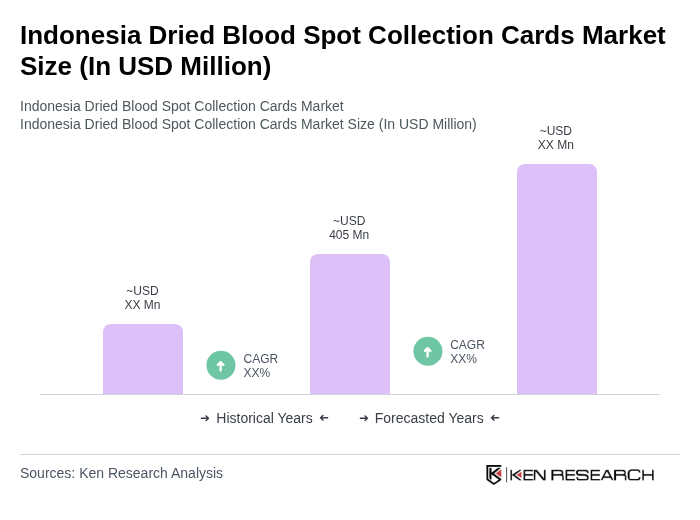
Indonesia Dried Blood Spot Collection Cards Market, valued at USD 405 million, grows with rising infectious diseases, newborn screening programs, and tech integrations in healthcare.

Region:Asia

Author(s):Rebecca

Product Code:KRAD1432

Pages:88

Published On:November 2025
About the Report

Base Year 2024

Indonesia Dried Blood Spot Collection Cards Market Overview

  • The Indonesia Dried Blood Spot Collection Cards Market is valued at USD 405 million, based on a five-year historical analysis. This market size reflects robust growth driven by the increasing prevalence of infectious diseases, the expanding implementation of newborn screening programs, and ongoing advancements in diagnostic technologies. Growth is further supported by heightened awareness of early disease detection benefits and the operational convenience of dried blood spot sampling methods. Key trends include the integration of DBS cards into digital healthcare workflows and the adoption of decentralized diagnostic models, which are enhancing both reach and efficiency .
  • Key players in this market are concentrated in major urban centers such as Jakarta, Surabaya, and Bandung. These cities maintain market dominance due to their advanced healthcare infrastructure, higher population density, and the presence of leading hospitals and diagnostic laboratories. The concentration of healthcare resources and research institutions in these areas continues to reinforce their strategic market position .
  • In 2023, the Indonesian government implemented Peraturan Menteri Kesehatan Republik Indonesia Nomor 24 Tahun 2023 (Regulation of the Minister of Health No. 24 of 2023), issued by the Ministry of Health. This regulation mandates the use of dried blood spot collection methods for newborn screening programs nationwide. The regulation standardizes testing procedures, sets compliance requirements for healthcare providers, and establishes operational thresholds for sample collection and reporting, thereby improving the accuracy of disease detection and enhancing public health outcomes .
Indonesia Dried Blood Spot Collection Cards Market Size

Indonesia Dried Blood Spot Collection Cards Market Segmentation

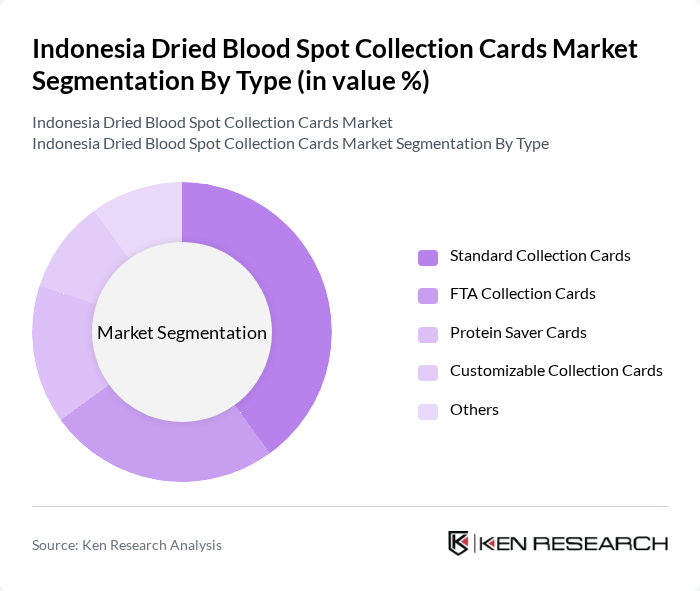
By Type:The market is segmented into various types of dried blood spot collection cards, including Standard Collection Cards, FTA Collection Cards, Protein Saver Cards, Customizable Collection Cards, and Others. Each type serves specific applications and end-user needs, contributing to the overall market dynamics. Standard Collection Cards remain the most widely used due to their compatibility with established laboratory protocols and broad applicability in newborn screening and infectious disease testing. FTA Collection Cards are increasingly adopted for molecular diagnostics and DNA preservation, reflecting the growing demand for advanced testing solutions .
Indonesia Dried Blood Spot Collection Cards Market segmentation by Type.

The Standard Collection Cards segment is currently dominating the market due to their widespread use in various diagnostic applications, including newborn screening and infectious disease testing. Their ease of use, cost-effectiveness, and compatibility with existing laboratory processes make them the preferred choice among healthcare providers. Additionally, the growing emphasis on early disease detection, preventive healthcare, and the expansion of screening programs are further driving the demand for these cards .

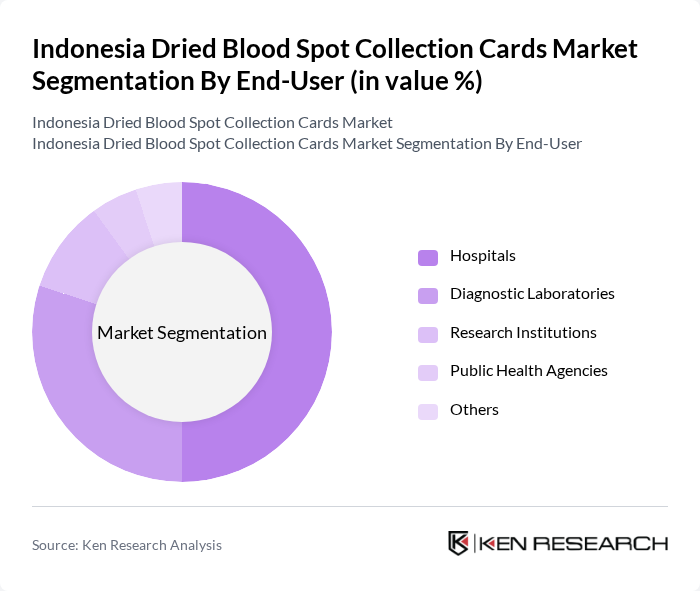
By End-User:The market is segmented based on end-users, including Hospitals, Diagnostic Laboratories, Research Institutions, Public Health Agencies, and Others. Each end-user category has distinct requirements and usage patterns that influence the market landscape. Hospitals remain the primary end-users due to the high volume of diagnostic tests, especially for newborn screening and infectious disease detection. Diagnostic laboratories are expanding their adoption of DBS cards for decentralized and remote testing, while research institutions utilize these cards for epidemiological studies and biomarker research .
Indonesia Dried Blood Spot Collection Cards Market segmentation by End-User.

Hospitals are the leading end-users of dried blood spot collection cards, accounting for a significant portion of the market. This dominance is attributed to the high volume of diagnostic tests conducted in hospitals, particularly for newborn screening and infectious disease testing. The integration of these cards into routine clinical practices enhances patient care and facilitates timely diagnosis, making them indispensable in hospital settings. The growing role of diagnostic laboratories in remote and decentralized testing also contributes to market expansion .

Indonesia Dried Blood Spot Collection Cards Market Competitive Landscape

The Indonesia Dried Blood Spot Collection Cards Market is characterized by a dynamic mix of regional and international players. Leading participants such as PT. Bio Farma, PT. Kimia Farma, PT. Indofarma, PT. Medisafe Technologies, PT. Kalbe Farma, PT. Prodia Widyahusada, PT. Anugerah Pharmindo Lestari, PT. Surya Citra Medika, PT. Mitra Keluarga, PT. Sumber Daya Medika, PT. Citra Medika, PT. Bina Sehat, PT. Sehat Selalu, Qiagen NV, PerkinElmer Inc., Whatman (Cytiva), Ahlstrom-Munksjö contribute to innovation, geographic expansion, and service delivery in this space.

PT. Bio Farma

1890

Bandung, Indonesia

PT. Kimia Farma

1817

Jakarta, Indonesia

PT. Indofarma

1942

Bekasi, Indonesia

PT. Medisafe Technologies

2000

Jakarta, Indonesia

PT. Kalbe Farma

1966

Jakarta, Indonesia

Company

Establishment Year

Headquarters

Group Size (Large, Medium, or Small as per industry convention)

Revenue Growth Rate (Indonesia DBS Cards Segment)

Market Penetration Rate (Share of Indonesian hospitals/labs using their cards)

Product Portfolio Breadth (Number of DBS card types offered)

Regulatory Compliance Rate (ISO, CE, BPOM approvals)

Distribution Network Coverage (Number of provinces/cities served)

Indonesia Dried Blood Spot Collection Cards Market Industry Analysis

Growth Drivers

  • Increasing Prevalence of Chronic Diseases:The rise in chronic diseases such as diabetes and cardiovascular conditions is significant in Indonesia, with approximately10.7 million cases of diabetesreported in the future. This growing health burden necessitates effective diagnostic tools, including dried blood spot collection cards, which facilitate early detection and management. The World Health Organization indicates that chronic diseases account forover 70% of global deaths, emphasizing the urgent need for improved diagnostic solutions in Indonesia's healthcare system.
  • Rising Demand for Early Diagnosis and Screening:The Indonesian healthcare landscape is witnessing an increasing demand for early diagnosis and screening, driven by heightened public awareness and government health initiatives. In the future, the Ministry of Health reported a15% increasein screening programs for infectious diseases. Dried blood spot collection cards are pivotal in these initiatives, allowing for efficient sample collection and transportation, thus enhancing the overall diagnostic process and improving patient outcomes.
  • Technological Advancements in Blood Collection:Innovations in blood collection technologies are transforming the diagnostic landscape in Indonesia. The introduction of automated blood collection systems and improved dried blood spot cards has enhanced accuracy and reduced contamination risks. According to a future industry report, investments in medical technology in Indonesia reached$1.2 billion, indicating a robust trend towards adopting advanced diagnostic tools that support the growth of the dried blood spot collection market.

Market Challenges

  • High Cost of Advanced Collection Technologies:The adoption of advanced blood collection technologies faces significant barriers due to high costs. For instance, the price of automated blood collection devices can exceed$50,000, making them inaccessible for many healthcare facilities in Indonesia. This financial constraint limits the widespread implementation of dried blood spot collection cards, hindering market growth and the potential for improved diagnostic capabilities in underserved regions.
  • Limited Awareness Among Healthcare Providers:A critical challenge in the Indonesian market is the limited awareness and understanding of dried blood spot collection cards among healthcare providers. A future survey indicated that only30%of healthcare professionals were familiar with the benefits of this technology. This lack of knowledge can lead to underutilization, impacting the overall effectiveness of diagnostic programs and delaying the adoption of innovative solutions in patient care.

Indonesia Dried Blood Spot Collection Cards Market Future Outlook

The future of the dried blood spot collection cards market in Indonesia appears promising, driven by ongoing advancements in healthcare technology and increasing public health initiatives. As the government continues to invest in healthcare infrastructure, the accessibility of diagnostic tools is expected to improve. Additionally, the growing trend towards personalized medicine will likely enhance the demand for innovative diagnostic solutions, positioning dried blood spot collection cards as a vital component in the evolving healthcare landscape.

Market Opportunities

  • Expansion of Healthcare Infrastructure:The Indonesian government is actively expanding healthcare infrastructure, with plans to increase the number of healthcare facilities by20%in the future. This expansion presents a significant opportunity for the dried blood spot collection cards market, as more facilities will require efficient diagnostic tools to meet the growing healthcare demands of the population.
  • Increasing Investment in R&D for Diagnostics:Investment in research and development for diagnostic technologies is on the rise, with the Indonesian government allocating$200 millionfor healthcare innovation in the future. This funding will likely foster the development of new diagnostic methods, including dried blood spot collection cards, enhancing their effectiveness and adoption in clinical settings across the country.

Scope of the Report

SegmentSub-Segments
By Type

Standard Collection Cards

FTA Collection Cards

Protein Saver Cards

Customizable Collection Cards

Others

By End-User

Hospitals

Diagnostic Laboratories

Research Institutions

Public Health Agencies

Others

By Application

Newborn Screening

Infectious Disease Testing (e.g., HIV, Hepatitis)

Genetic Testing

Therapeutic Drug Monitoring

Forensic & Toxicology

Others

By Distribution Channel

Direct Sales

Online Sales

Distributors

Hospital Procurement

Others

By Region

Java

Sumatra

Bali and Nusa Tenggara

Kalimantan

Sulawesi

Papua

Others

By Regulatory Compliance

ISO Certified Products

CE Marked Products

Local Regulatory Approved Products (BPOM, Ministry of Health)

Others

By Packaging Type

Individual Packaging

Bulk Packaging

Eco-friendly Packaging

Others

Key Target Audience

Investors and Venture Capitalist Firms

Government and Regulatory Bodies (e.g., Ministry of Health, National Institute of Health Research and Development)

Manufacturers and Producers of Dried Blood Spot Collection Cards

Distributors and Retailers of Medical Supplies

Healthcare Providers and Laboratories

Non-Governmental Organizations (NGOs) focused on Health Initiatives

Pharmaceutical Companies involved in Diagnostic Testing

Public Health Agencies

Players Mentioned in the Report:

PT. Bio Farma

PT. Kimia Farma

PT. Indofarma

PT. Medisafe Technologies

PT. Kalbe Farma

PT. Prodia Widyahusada

PT. Anugerah Pharmindo Lestari

PT. Surya Citra Medika

PT. Mitra Keluarga

PT. Sumber Daya Medika

PT. Citra Medika

PT. Bina Sehat

PT. Sehat Selalu

Qiagen NV

PerkinElmer Inc.

Whatman (Cytiva)

Ahlstrom-Munksjo

Table of Contents

Market Assessment Phase

1. Executive Summary and Approach


2. Indonesia Dried Blood Spot Collection Cards Market Overview

2.1 Key Insights and Strategic Recommendations

2.2 Indonesia Dried Blood Spot Collection Cards Market Overview

2.3 Definition and Scope

2.4 Evolution of Market Ecosystem

2.5 Timeline of Key Regulatory Milestones

2.6 Value Chain & Stakeholder Mapping

2.7 Business Cycle Analysis

2.8 Policy & Incentive Landscape


3. Indonesia Dried Blood Spot Collection Cards Market Analysis

3.1 Growth Drivers

3.1.1 Increasing prevalence of chronic diseases
3.1.2 Rising demand for early diagnosis and screening
3.1.3 Technological advancements in blood collection
3.1.4 Government initiatives for healthcare improvement

3.2 Market Challenges

3.2.1 High cost of advanced collection technologies
3.2.2 Limited awareness among healthcare providers
3.2.3 Regulatory hurdles in product approval
3.2.4 Competition from alternative diagnostic methods

3.3 Market Opportunities

3.3.1 Expansion of healthcare infrastructure
3.3.2 Increasing investment in R&D for diagnostics
3.3.3 Collaborations with NGOs for outreach programs
3.3.4 Growing interest in personalized medicine

3.4 Market Trends

3.4.1 Shift towards home-based testing solutions
3.4.2 Integration of digital health technologies
3.4.3 Focus on sustainable and eco-friendly products
3.4.4 Rise in telemedicine and remote patient monitoring

3.5 Government Regulation

3.5.1 Standards for blood collection and handling
3.5.2 Licensing requirements for manufacturers
3.5.3 Guidelines for clinical use and distribution
3.5.4 Policies promoting local manufacturing

4. SWOT Analysis


5. Stakeholder Analysis


6. Porter's Five Forces Analysis


7. Indonesia Dried Blood Spot Collection Cards Market Market Size, 2019-2024

7.1 By Value

7.2 By Volume

7.3 By Average Selling Price


8. Indonesia Dried Blood Spot Collection Cards Market Segmentation

8.1 By Type

8.1.1 Standard Collection Cards
8.1.2 FTA Collection Cards
8.1.3 Protein Saver Cards
8.1.4 Customizable Collection Cards
8.1.5 Others

8.2 By End-User

8.2.1 Hospitals
8.2.2 Diagnostic Laboratories
8.2.3 Research Institutions
8.2.4 Public Health Agencies
8.2.5 Others

8.3 By Application

8.3.1 Newborn Screening
8.3.2 Infectious Disease Testing (e.g., HIV, Hepatitis)
8.3.3 Genetic Testing
8.3.4 Therapeutic Drug Monitoring
8.3.5 Forensic & Toxicology
8.3.6 Others

8.4 By Distribution Channel

8.4.1 Direct Sales
8.4.2 Online Sales
8.4.3 Distributors
8.4.4 Hospital Procurement
8.4.5 Others

8.5 By Region

8.5.1 Java
8.5.2 Sumatra
8.5.3 Bali and Nusa Tenggara
8.5.4 Kalimantan
8.5.5 Sulawesi
8.5.6 Papua
8.5.7 Others

8.6 By Regulatory Compliance

8.6.1 ISO Certified Products
8.6.2 CE Marked Products
8.6.3 Local Regulatory Approved Products (BPOM, Ministry of Health)
8.6.4 Others

8.7 By Packaging Type

8.7.1 Individual Packaging
8.7.2 Bulk Packaging
8.7.3 Eco-friendly Packaging
8.7.4 Others

9. Indonesia Dried Blood Spot Collection Cards Market Competitive Analysis

9.1 Market Share of Key Players

9.2 KPIs for Cross Comparison of Key Players

9.2.1 Company Name
9.2.2 Group Size (Large, Medium, or Small as per industry convention)
9.2.3 Revenue Growth Rate (Indonesia DBS Cards Segment)
9.2.4 Market Penetration Rate (Share of Indonesian hospitals/labs using their cards)
9.2.5 Product Portfolio Breadth (Number of DBS card types offered)
9.2.6 Regulatory Compliance Rate (ISO, CE, BPOM approvals)
9.2.7 Distribution Network Coverage (Number of provinces/cities served)
9.2.8 Customer Retention Rate (Repeat institutional buyers)
9.2.9 Pricing Strategy (Relative to market average)
9.2.10 Product Innovation Rate (New launches, patents, R&D spend)
9.2.11 Brand Recognition Score (Survey-based, Indonesia healthcare sector)
9.2.12 Customer Satisfaction Index (Survey-based, Indonesian end-users)

9.3 SWOT Analysis of Top Players

9.4 Pricing Analysis

9.5 Detailed Profile of Major Companies

9.5.1 PT. Bio Farma
9.5.2 PT. Kimia Farma
9.5.3 PT. Indofarma
9.5.4 PT. Medisafe Technologies
9.5.5 PT. Kalbe Farma
9.5.6 PT. Prodia Widyahusada
9.5.7 PT. Anugerah Pharmindo Lestari
9.5.8 PT. Surya Citra Medika
9.5.9 PT. Mitra Keluarga
9.5.10 PT. Sumber Daya Medika
9.5.11 PT. Citra Medika
9.5.12 PT. Bina Sehat
9.5.13 PT. Sehat Selalu
9.5.14 Qiagen NV
9.5.15 PerkinElmer Inc.
9.5.16 Whatman (Cytiva)
9.5.17 Ahlstrom-Munksjö

10. Indonesia Dried Blood Spot Collection Cards Market End-User Analysis

10.1 Procurement Behavior of Key Ministries

10.1.1 Ministry of Health
10.1.2 Ministry of Education
10.1.3 Ministry of Social Affairs
10.1.4 Others

10.2 Corporate Spend on Infrastructure & Energy

10.2.1 Healthcare Infrastructure Investments
10.2.2 Research and Development Expenditure
10.2.3 Technology Upgrades
10.2.4 Others

10.3 Pain Point Analysis by End-User Category

10.3.1 Hospitals
10.3.2 Diagnostic Labs
10.3.3 Research Institutions
10.3.4 Others

10.4 User Readiness for Adoption

10.4.1 Training and Support Needs
10.4.2 Infrastructure Readiness
10.4.3 Financial Readiness
10.4.4 Others

10.5 Post-Deployment ROI and Use Case Expansion

10.5.1 Cost Savings Analysis
10.5.2 Efficiency Gains
10.5.3 User Feedback and Adaptation
10.5.4 Others

11. Indonesia Dried Blood Spot Collection Cards Market Future Size, 2025-2030

11.1 By Value

11.2 By Volume

11.3 By Average Selling Price


Go-To-Market Strategy Phase

1. Whitespace Analysis + Business Model Canvas

1.1 Market Gaps Identification

1.2 Business Model Framework


2. Marketing and Positioning Recommendations

2.1 Branding Strategies

2.2 Product USPs


3. Distribution Plan

3.1 Urban Retail Strategies

3.2 Rural NGO Tie-ups


4. Channel & Pricing Gaps

4.1 Underserved Routes

4.2 Pricing Bands


5. Unmet Demand & Latent Needs

5.1 Category Gaps

5.2 Consumer Segments


6. Customer Relationship

6.1 Loyalty Programs

6.2 After-sales Service


7. Value Proposition

7.1 Sustainability Initiatives

7.2 Integrated Supply Chains


8. Key Activities

8.1 Regulatory Compliance

8.2 Branding Efforts

8.3 Distribution Setup


9. Entry Strategy Evaluation

9.1 Domestic Market Entry Strategy

9.1.1 Product Mix
9.1.2 Pricing Band
9.1.3 Packaging Considerations

9.2 Export Entry Strategy

9.2.1 Target Countries
9.2.2 Compliance Roadmap

10. Entry Mode Assessment

10.1 Joint Ventures

10.2 Greenfield Investments

10.3 Mergers & Acquisitions

10.4 Distributor Model


11. Capital and Timeline Estimation

11.1 Capital Requirements

11.2 Timelines


12. Control vs Risk Trade-Off

12.1 Ownership vs Partnerships


13. Profitability Outlook

13.1 Breakeven Analysis

13.2 Long-term Sustainability


14. Potential Partner List

14.1 Distributors

14.2 Joint Ventures

14.3 Acquisition Targets


15. Execution Roadmap

15.1 Phased Plan for Market Entry

15.1.1 Market Setup
15.1.2 Market Entry
15.1.3 Growth Acceleration
15.1.4 Scale & Stabilize

15.2 Key Activities and Milestones

15.2.1 Milestone Planning
15.2.2 Activity Tracking

Research Methodology

ApproachModellingSample

Phase 1: Approach1

Desk Research

  • Analysis of industry reports from health organizations and market research firms
  • Review of academic publications on dried blood spot (DBS) technology and applications
  • Examination of government health statistics and demographic data relevant to Indonesia

Primary Research

  • Interviews with healthcare professionals involved in blood collection and diagnostics
  • Surveys targeting laboratory managers and procurement officers in hospitals
  • Field interviews with manufacturers of dried blood spot collection cards

Validation & Triangulation

  • Cross-validation of findings through multiple expert interviews and focus groups
  • Triangulation of data from primary and secondary sources to ensure consistency
  • Sanity checks through feedback from industry stakeholders and regulatory bodies

Phase 2: Market Size Estimation1

Top-down Assessment

  • Estimation of market size based on national healthcare expenditure and blood testing rates
  • Segmentation by application areas such as infectious disease testing and newborn screening
  • Incorporation of trends in public health initiatives and government funding for diagnostics

Bottom-up Modeling

  • Volume estimates derived from sales data of leading DBS card manufacturers
  • Cost analysis based on pricing models of DBS products in the Indonesian market
  • Calculation of market size using unit sales multiplied by average selling price

Forecasting & Scenario Analysis

  • Multi-variable forecasting considering population growth and disease prevalence rates
  • Scenario analysis based on potential regulatory changes and healthcare policy shifts
  • Development of baseline, optimistic, and pessimistic market growth projections through 2030

Phase 3: CATI Sample Composition1

Scope Item/SegmentSample SizeTarget Respondent Profiles
Healthcare Providers100Doctors, Nurses, Lab Technicians
Laboratory Managers60Laboratory Directors, Quality Control Managers
Manufacturers of DBS Cards40Product Managers, R&D Specialists
Public Health Officials50Policy Makers, Health Program Coordinators
Healthcare Procurement Officers50Procurement Managers, Supply Chain Analysts

Frequently Asked Questions

What is the current market value of the Indonesia Dried Blood Spot Collection Cards Market?

The Indonesia Dried Blood Spot Collection Cards Market is valued at approximately USD 405 million, reflecting significant growth driven by factors such as the rising prevalence of infectious diseases and advancements in diagnostic technologies.

What are the key drivers of growth in the Indonesia Dried Blood Spot Collection Cards Market?

Which cities in Indonesia dominate the Dried Blood Spot Collection Cards Market?

What recent regulation has impacted the use of dried blood spot collection methods in Indonesia?

Other Regional/Country Reports

Malaysia Dried Blood Spot Collection Cards Market

KSA Dried Blood Spot Collection Cards Market

APAC Dried Blood Spot Collection Cards Market

SEA Dried Blood Spot Collection Cards Market

Vietnam Dried Blood Spot Collection Cards Market

Thailand Dried Blood Spot Collection Cards Market

Other Adjacent Reports

Why Buy From Us?

Refine Robust Result (RRR) Framework

What makes us stand out is that our consultants follow Robust, Refine and Result (RRR) methodology. Robust for clear definitions, approaches and sanity checking, Refine for differentiating respondents' facts and opinions, and Result for presenting data with story.

Our Reach Is Unmatched

We have set a benchmark in the industry by offering our clients with syndicated and customized market research reports featuring coverage of entire market as well as meticulous research and analyst insights.

Shifting the Research Paradigm

While we don't replace traditional research, we flip the method upside down. Our dual approach of Top Bottom & Bottom Top ensures quality deliverable by not just verifying company fundamentals but also looking at the sector and macroeconomic factors.

More Insights-Better Decisions

With one step in the future, our research team constantly tries to show you the bigger picture. We help with some of the tough questions you may encounter along the way: How is the industry positioned? Best marketing channel? KPI's of competitors? By aligning every element, we help maximize success.

Transparency and Trust

Our report gives you instant access to the answers and sources that other companies might choose to hide. We elaborate each steps of research methodology we have used and showcase you the sample size to earn your trust.

Round the Clock Support

If you need any support, we are here! We pride ourselves on universe strength, data quality, and quick, friendly, and professional service.

Why Clients Choose Us?

400000+
Reports in repository
150+
Consulting projects a year
100+
Analysts
8000+
Client Queries in 2022








