Indonesia Fabric Filter Market Report Size Share Growth Drivers Trends Opportunities & Forecast 2025–2030

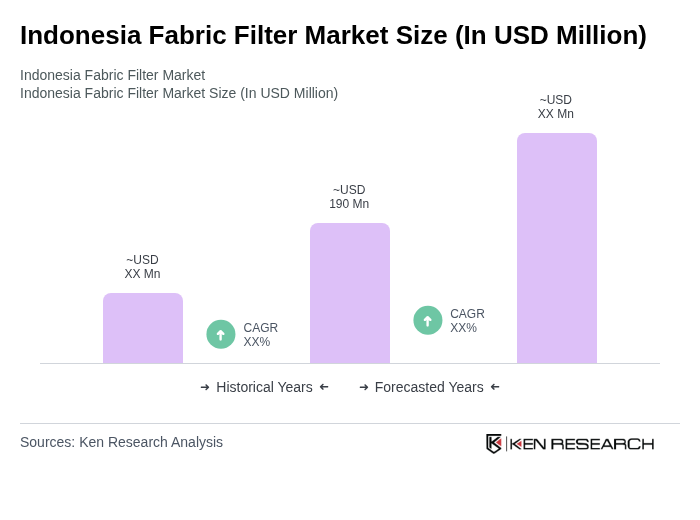
Indonesia Fabric Filter Market, worth USD 190 Mn, grows due to rising industrialization, environmental regulations, and demand for efficient dust collection in key regions like Java and Sumatra.

Region:Asia

Author(s):Dev

Product Code:KRAA3934

Pages:93

Published On:January 2026
About the Report

Base Year 2024

Indonesia Fabric Filter Market Overview

  • The Indonesia Fabric Filter Market is valued at USD 190 million, based on a five-year historical analysis of the broader process filters and industrial filtration space in Indonesia. This growth is primarily driven by increasing industrial activities in sectors such as power generation, cement, metals, mining, and manufacturing, combined with progressively stricter air emission standards and the rising demand for air pollution control technologies across these industries. The market has seen a sustained uptick in investments aimed at enhancing filtration efficiency, lowering particulate emissions, and improving compliance with national ambient air quality and stack emission standards.
  • Key regions dominating the market include Java, Sumatra, and Kalimantan. Java, being the most industrialized region, has a high concentration of manufacturing clusters, power plants, cement units, and other process industries around Jakarta, West Java, and East Java, which drives the demand for fabric filters and dust collection systems. Sumatra and Kalimantan also contribute significantly due to their extensive mining, palm oil, and agro?processing activities, which necessitate effective dust, fume, and emission control solutions in bulk material handling, boilers, and processing lines.
  • In 2021, the Indonesian government strengthened emission control requirements for industrial plants through regulations such as the Regulation of the Minister of Environment and Forestry of the Republic of Indonesia Number 15 of 2019 on Emission Quality Standards for Thermal Power Plants (Peraturan Menteri Lingkungan Hidup dan Kehutanan Republik Indonesia Nomor 15 Tahun 2019 Tentang Baku Mutu Emisi Pembangkit Listrik Tenaga Termal), issued by the Ministry of Environment and Forestry. This binding instrument sets tighter particulate matter (PM) emission limits for coal?fired and other thermal power plants, requiring operators to install and properly operate high?efficiency particulate control equipment such as fabric filters or electrostatic precipitators, conduct continuous or periodic emission monitoring, and maintain compliance documentation, which in turn promotes the adoption of fabric filters in power generation and other industrial sectors.
Indonesia Fabric Filter Market Size

Indonesia Fabric Filter Market Segmentation

By Type (Cleaning Method):The market is segmented into various cleaning methods, including Pulse Jet Fabric Filters, Reverse Air Fabric Filters, Shaker Fabric Filters, Hybrid/Modular Systems, and Others. Pulse Jet Fabric Filters are widely used in Indonesia and globally due to their high collection efficiency for fine particulates, compact footprint, and suitability for continuous operation under high dust loading, especially in power, cement, and metals industries. The increasing focus on energy efficiency, reliability, and compliance with stricter emission norms is driving the adoption of these systems across multiple industries, while reverse air and shaker fabric filters remain relevant for specific legacy plants and lower?pressure or lower?temperature applications.
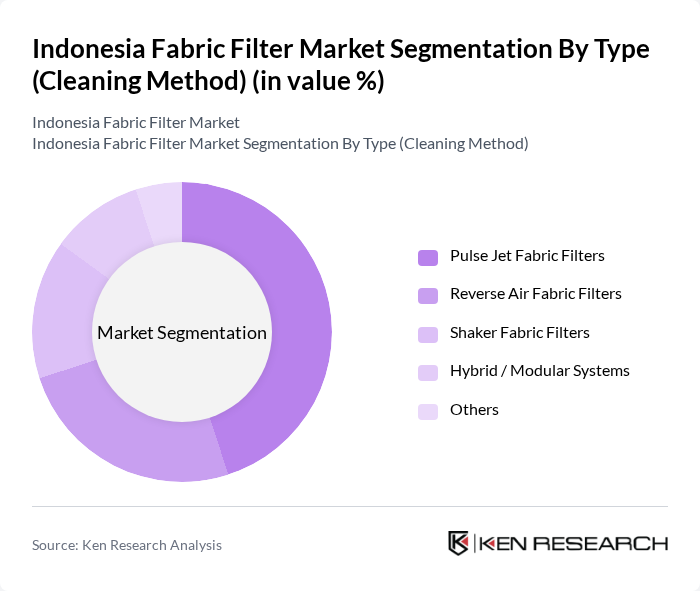
Indonesia Fabric Filter Market segmentation by Type (Cleaning Method).

By Filter Media:The market is also segmented based on filter media, including Polyester, Aramid (e.g., Nomex), Fiberglass, Polypropylene, PTFE and PTFE Laminates, and Others. Polyester filters dominate industrial dust collection and gas filtration applications globally due to their cost-effectiveness, good mechanical strength, and suitability for a wide range of operating conditions in cement, metals, and general manufacturing. The growing demand for high-temperature and chemically resistant filters in boilers, kilns, and incineration units is boosting the adoption of Aramid, fiberglass, and PTFE-based materials in specific high?temperature or corrosive gas applications, particularly in power generation, smelting, and waste-to-energy plants.
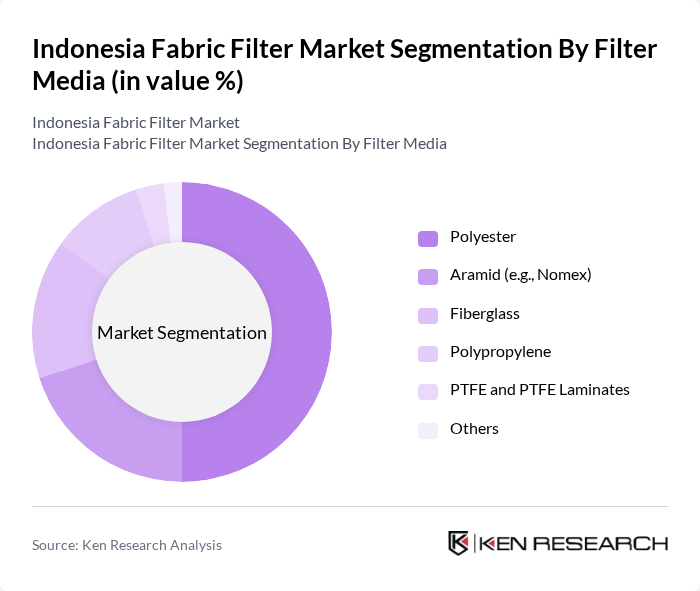
Indonesia Fabric Filter Market segmentation by Filter Media.

Indonesia Fabric Filter Market Competitive Landscape

The Indonesia Fabric Filter Market is characterized by a dynamic mix of regional and international players. Leading participants such as PT. AAF International Indonesia, PT. Donaldson Indonesia, PT. Camfil Indonesia, PT. Thermax International Indonesia, PT. Mikropor Filtrasyon Endüstri ve Ta??mac?l?k Indonesia, PT. Filtrona Indonesia, PT. Indofilter, PT. Filterindo Global Teknik, PT. Eka Jaya Filter, PT. Sefiltra Indonesia, PT. Clean Air Asia Indonesia, PT. Envirotech Indonesia, PT. Multi Filter Indonesia, PT. Bikasatu Filter, PT. Lokal OEM & Engineering Players (Representative Sample) contribute to innovation, geographic expansion, and service delivery in this space.

PT. AAF International Indonesia

1996

Jakarta, Indonesia

PT. Donaldson Indonesia

2012

Jakarta, Indonesia

PT. Camfil Indonesia

2013

Jakarta, Indonesia

PT. Thermax International Indonesia

2007

Jakarta, Indonesia

PT. Mikropor Filtrasyon Endüstri ve Ta??mac?l?k Indonesia

2015

Jakarta, Indonesia

Company

Establishment Year

Headquarters

Group Size (Large, Medium, or Small as per industry convention)

Indonesia Fabric Filter Revenue (USD Million)

3-Year Revenue CAGR in Fabric Filters (%)

EBITDA Margin from Fabric Filter Business (%)

Market Share in Indonesia Fabric Filter Market (%)

Order Backlog / Book-to-Bill Ratio

Indonesia Fabric Filter Market Industry Analysis

Growth Drivers

  • Increasing Environmental Regulations:Indonesia's commitment to environmental sustainability is evident through its stringent regulations. The Ministry of Environment and Forestry reported that in future, over 1,500 industrial facilities were mandated to comply with new emission standards, significantly increasing the demand for fabric filters. This regulatory push is expected to drive the market, as industries invest in advanced filtration technologies to meet compliance requirements, thereby enhancing air quality and reducing pollution levels.
  • Rising Industrialization:Indonesia's industrial sector is projected to grow at a rate of 5.5% in future, according to the World Bank. This growth is primarily driven by the manufacturing and mining sectors, which are significant contributors to air pollution. As industrial activities expand, the need for effective air pollution control solutions, such as fabric filters, becomes critical. Consequently, this rising industrialization is a key driver for the fabric filter market, as companies seek to mitigate their environmental impact.
  • Demand for Air Quality Improvement:The World Health Organization reported that air pollution in Indonesia contributes to approximately 70,000 premature deaths annually. This alarming statistic has led to increased public awareness and demand for cleaner air solutions. In response, industries are investing in fabric filters to enhance air quality. The government’s initiatives to promote cleaner technologies further support this demand, creating a robust market for fabric filters aimed at improving air quality across urban and industrial areas.

Market Challenges

  • High Initial Investment Costs:The adoption of fabric filter systems often requires substantial upfront capital investment, which can deter many small and medium-sized enterprises (SMEs). For instance, the average cost of installing a fabric filter system can range from $60,000 to $250,000, depending on the application. This financial barrier limits market penetration, particularly among SMEs that may lack the necessary resources to invest in advanced filtration technologies, thereby hindering overall market growth.
  • Limited Awareness Among End-Users:Despite the benefits of fabric filters, many potential end-users remain unaware of their advantages. A survey conducted by the Indonesian Chamber of Commerce in future indicated that only 35% of industrial operators were familiar with fabric filter technologies. This lack of awareness can lead to underutilization of effective pollution control solutions, posing a significant challenge for market growth as companies may opt for less effective alternatives due to ignorance of available options.

Indonesia Fabric Filter Market Future Outlook

The Indonesia fabric filter market is poised for significant growth as environmental regulations tighten and industrialization accelerates. The integration of advanced technologies, such as IoT and energy-efficient systems, will likely enhance the performance and appeal of fabric filters. Additionally, the increasing focus on sustainable practices among industries will drive innovation and adoption. As awareness of air quality issues rises, the market is expected to evolve, presenting new opportunities for manufacturers and suppliers to meet the growing demand for effective filtration solutions.

Market Opportunities

  • Expansion in Emerging Industries:The growth of emerging industries, such as renewable energy and waste management, presents significant opportunities for fabric filter manufacturers. As these sectors expand, the demand for efficient air pollution control technologies will increase, allowing companies to capture new market segments and drive revenue growth through tailored filtration solutions.
  • Government Incentives for Clean Technology:The Indonesian government is actively promoting clean technology through various incentives, including tax breaks and grants for pollution control investments. These initiatives encourage industries to adopt fabric filters, creating a favorable environment for market growth. By leveraging these incentives, manufacturers can enhance their market presence and contribute to national sustainability goals.

Scope of the Report

SegmentSub-Segments
By Type (Cleaning Method)

Pulse Jet Fabric Filters

Reverse Air Fabric Filters

Shaker Fabric Filters

Hybrid / Modular Systems

Others

By Filter Media

Polyester

Aramid (e.g., Nomex)

Fiberglass

Polypropylene

PTFE and PTFE Laminates

Others

By Application

Cement and Construction Materials

Power Generation (Coal, Biomass, Waste-to-Energy)

Metal & Mining

Chemicals & Petrochemicals

Food & Beverage Processing

Pulp & Paper and Other Industries

By End-Use Industry

Power Generation

Cement

Metals & Mining

Chemicals

Food & Beverage

Pulp & Paper

Others (Including Waste-to-Energy, Municipal, etc.)

By Installation Type

New Installations (Greenfield)

Retrofit & Replacement (Brownfield)

By System Configuration

Modular / Compartmentalized Systems

Custom Engineered Systems

Standard Package Systems

By Region

Java

Sumatra

Kalimantan

Sulawesi

Others

Key Target Audience

Investors and Venture Capitalist Firms

Government and Regulatory Bodies (e.g., Ministry of Environment and Forestry, Ministry of Industry)

Manufacturers and Producers of Fabric Filters

Distributors and Retailers of Air Pollution Control Equipment

Environmental NGOs and Advocacy Groups

Industrial Facility Operators

Technology Providers for Air Filtration Systems

Financial Institutions and Banks Financing Environmental Projects

Players Mentioned in the Report:

PT. AAF International Indonesia

PT. Donaldson Indonesia

PT. Camfil Indonesia

PT. Thermax International Indonesia

PT. Mikropor Filtrasyon Endustri ve Tasmaclk Indonesia

PT. Filtrona Indonesia

PT. Indofilter

PT. Filterindo Global Teknik

PT. Eka Jaya Filter

PT. Sefiltra Indonesia

PT. Clean Air Asia Indonesia

PT. Envirotech Indonesia

PT. Multi Filter Indonesia

PT. Bikasatu Filter

PT. Lokal OEM & Engineering Players (Representative Sample)

Table of Contents

Market Assessment Phase

1. Executive Summary and Approach


2. Indonesia Fabric Filter Market Overview

2.1 Key Insights and Strategic Recommendations

2.2 Indonesia Fabric Filter Market Overview

2.3 Definition and Scope

2.4 Evolution of Market Ecosystem

2.5 Timeline of Key Regulatory Milestones

2.6 Value Chain & Stakeholder Mapping

2.7 Business Cycle Analysis

2.8 Policy & Incentive Landscape


3. Indonesia Fabric Filter Market Analysis

3.1 Growth Drivers

3.1.1 Increasing Environmental Regulations
3.1.2 Rising Industrialization
3.1.3 Demand for Air Quality Improvement
3.1.4 Technological Advancements in Filtration

3.2 Market Challenges

3.2.1 High Initial Investment Costs
3.2.2 Limited Awareness Among End-Users
3.2.3 Competition from Alternative Technologies
3.2.4 Regulatory Compliance Complexity

3.3 Market Opportunities

3.3.1 Expansion in Emerging Industries
3.3.2 Government Incentives for Clean Technology
3.3.3 Growth in Export Markets
3.3.4 Innovations in Fabric Filter Materials

3.4 Market Trends

3.4.1 Shift Towards Sustainable Practices
3.4.2 Integration of IoT in Filtration Systems
3.4.3 Customization of Filtration Solutions
3.4.4 Increased Focus on Energy Efficiency

3.5 Government Regulation

3.5.1 Emission Standards for Industries
3.5.2 Incentives for Pollution Control Technologies
3.5.3 Regulations on Waste Management
3.5.4 Compliance Requirements for Air Quality

4. SWOT Analysis


5. Stakeholder Analysis


6. Porter's Five Forces Analysis


7. Indonesia Fabric Filter Market Market Size, 2019-2024

7.1 By Value

7.2 By Volume

7.3 By Average Selling Price


8. Indonesia Fabric Filter Market Segmentation

8.1 By Type (Cleaning Method)

8.1.1 Pulse Jet Fabric Filters
8.1.2 Reverse Air Fabric Filters
8.1.3 Shaker Fabric Filters
8.1.4 Hybrid / Modular Systems
8.1.5 Others

8.2 By Filter Media

8.2.1 Polyester
8.2.2 Aramid (e.g., Nomex)
8.2.3 Fiberglass
8.2.4 Polypropylene
8.2.5 PTFE and PTFE Laminates
8.2.6 Others

8.3 By Application

8.3.1 Cement and Construction Materials
8.3.2 Power Generation (Coal, Biomass, Waste-to-Energy)
8.3.3 Metal & Mining
8.3.4 Chemicals & Petrochemicals
8.3.5 Food & Beverage Processing
8.3.6 Pulp & Paper and Other Industries

8.4 By End-Use Industry

8.4.1 Power Generation
8.4.2 Cement
8.4.3 Metals & Mining
8.4.4 Chemicals
8.4.5 Food & Beverage
8.4.6 Pulp & Paper
8.4.7 Others (Including Waste-to-Energy, Municipal, etc.)

8.5 By Installation Type

8.5.1 New Installations (Greenfield)
8.5.2 Retrofit & Replacement (Brownfield)

8.6 By System Configuration

8.6.1 Modular / Compartmentalized Systems
8.6.2 Custom Engineered Systems
8.6.3 Standard Package Systems

8.7 By Region

8.7.1 Java
8.7.2 Sumatra
8.7.3 Kalimantan
8.7.4 Sulawesi
8.7.5 Others

9. Indonesia Fabric Filter Market Competitive Analysis

9.1 Market Share of Key Players

9.2 Cross Comparison of Key Players

9.2.1 Company Name
9.2.2 Group Size (Large, Medium, or Small as per industry convention)
9.2.3 Indonesia Fabric Filter Revenue (USD Million)
9.2.4 3-Year Revenue CAGR in Fabric Filters (%)
9.2.5 EBITDA Margin from Fabric Filter Business (%)
9.2.6 Market Share in Indonesia Fabric Filter Market (%)
9.2.7 Order Backlog / Book-to-Bill Ratio
9.2.8 Installed Base in Indonesia (Number of Systems / m² of Fabric)
9.2.9 Average Project Ticket Size (USD)
9.2.10 Win Rate in Competitive Bids (%)
9.2.11 R&D Spend as % of Fabric Filter Revenue
9.2.12 After-Sales / Services Revenue Share (%)
9.2.13 On-Time Project Delivery Rate (%)

9.3 SWOT Analysis of Top Players

9.4 Pricing Analysis

9.5 Detailed Profile of Major Companies

9.5.1 PT. AAF International Indonesia
9.5.2 PT. Donaldson Indonesia
9.5.3 PT. Camfil Indonesia
9.5.4 PT. Thermax International Indonesia
9.5.5 PT. Mikropor Filtrasyon Endüstri ve Ta??mac?l?k Indonesia
9.5.6 PT. Filtrona Indonesia
9.5.7 PT. Indofilter
9.5.8 PT. Filterindo Global Teknik
9.5.9 PT. Eka Jaya Filter
9.5.10 PT. Sefiltra Indonesia
9.5.11 PT. Clean Air Asia Indonesia
9.5.12 PT. Envirotech Indonesia
9.5.13 PT. Multi Filter Indonesia
9.5.14 PT. Bikasatu Filter
9.5.15 PT. Lokal OEM & Engineering Players (Representative Sample)

10. Indonesia Fabric Filter Market End-User Analysis

10.1 Procurement Behavior of Key Ministries

10.1.1 Ministry of Environment
10.1.2 Ministry of Industry
10.1.3 Ministry of Energy and Mineral Resources
10.1.4 Others

10.2 Corporate Spend on Infrastructure & Energy

10.2.1 Investment Trends
10.2.2 Budget Allocation
10.2.3 Spending Priorities
10.2.4 Others

10.3 Pain Point Analysis by End-User Category

10.3.1 Industrial Users
10.3.2 Government Entities
10.3.3 Commercial Users
10.3.4 Others

10.4 User Readiness for Adoption

10.4.1 Awareness Levels
10.4.2 Training Needs
10.4.3 Financial Readiness
10.4.4 Others

10.5 Post-Deployment ROI and Use Case Expansion

10.5.1 Performance Metrics
10.5.2 Case Studies
10.5.3 User Feedback
10.5.4 Others

11. Indonesia Fabric Filter Market Future Size, 2025-2030

11.1 By Value

11.2 By Volume

11.3 By Average Selling Price


Go-To-Market Strategy Phase

1. Whitespace Analysis + Business Model Canvas

1.1 Market Gaps Identification

1.2 Business Model Development


2. Marketing and Positioning Recommendations

2.1 Branding Strategies

2.2 Product USPs


3. Distribution Plan

3.1 Urban Retail vs Rural NGO Tie-ups


4. Channel & Pricing Gaps

4.1 Underserved Routes

4.2 Pricing Bands


5. Unmet Demand & Latent Needs

5.1 Category Gaps

5.2 Consumer Segments


6. Customer Relationship

6.1 Loyalty Programs

6.2 After-sales Service


7. Value Proposition

7.1 Sustainability

7.2 Integrated Supply Chains


8. Key Activities

8.1 Regulatory Compliance

8.2 Branding

8.3 Distribution Setup


9. Entry Strategy Evaluation

9.1 Domestic Market Entry Strategy

9.1.1 Product Mix
9.1.2 Pricing Band
9.1.3 Packaging

9.2 Export Entry Strategy

9.2.1 Target Countries
9.2.2 Compliance Roadmap

10. Entry Mode Assessment

10.1 JV

10.2 Greenfield

10.3 M&A

10.4 Distributor Model


11. Capital and Timeline Estimation

11.1 Capital Requirements

11.2 Timelines


12. Control vs Risk Trade-Off

12.1 Ownership vs Partnerships


13. Profitability Outlook

13.1 Breakeven Analysis

13.2 Long-term Sustainability


14. Potential Partner List

14.1 Distributors

14.2 JVs

14.3 Acquisition Targets


15. Execution Roadmap

15.1 Phased Plan for Market Entry

15.1.1 Market Setup
15.1.2 Market Entry
15.1.3 Growth Acceleration
15.1.4 Scale & Stabilize

15.2 Key Activities and Milestones

15.2.1 Milestone Planning
15.2.2 Activity Tracking

Research Methodology

ApproachModellingSample

Phase 1: Approach1

Desk Research

  • Industry reports from Indonesian environmental agencies and trade associations
  • Market analysis publications focusing on air pollution control technologies
  • Statistical data from the Central Bureau of Statistics (BPS) on industrial emissions

Primary Research

  • Interviews with environmental compliance officers in manufacturing sectors
  • Surveys with fabric filter manufacturers and suppliers
  • Field visits to industrial sites utilizing fabric filter systems

Validation & Triangulation

  • Cross-validation of data from government reports and industry insights
  • Triangulation of findings from primary interviews and secondary data sources
  • Expert panel reviews to ensure data accuracy and relevance

Phase 2: Market Size Estimation1

Top-down Assessment

  • Analysis of national air quality regulations impacting fabric filter adoption
  • Estimation of market size based on industrial sector emissions data
  • Incorporation of government initiatives promoting cleaner technologies

Bottom-up Modeling

  • Volume estimates based on production capacities of key industries
  • Cost analysis of fabric filter systems across different applications
  • Assessment of installation and maintenance costs for various sectors

Forecasting & Scenario Analysis

  • Multi-variable regression analysis considering economic growth and regulatory changes
  • Scenario modeling based on potential shifts in environmental policies
  • Projections for market growth through 2030 under different regulatory frameworks

Phase 3: CATI Sample Composition1

Scope Item/SegmentSample SizeTarget Respondent Profiles
Manufacturing Sector Emission Control120Environmental Managers, Compliance Officers
Power Generation Fabric Filter Usage90Plant Managers, Operations Directors
Cement Industry Air Quality Management80Production Supervisors, Environmental Engineers
Textile Industry Pollution Control70Quality Assurance Managers, Sustainability Coordinators
Food Processing Emission Solutions60Facility Managers, Health and Safety Officers

Frequently Asked Questions

What is the current value of the Indonesia Fabric Filter Market?

The Indonesia Fabric Filter Market is valued at approximately USD 190 million, driven by increasing industrial activities and stricter air emission standards across sectors such as power generation, cement, metals, mining, and manufacturing.

What are the key drivers of growth in the Indonesia Fabric Filter Market?

Which regions in Indonesia dominate the Fabric Filter Market?

What types of fabric filters are commonly used in Indonesia?

Other Regional/Country Reports

Malaysia Fabric Filter Market

KSA Fabric Filter Market

APAC Fabric Filter Market

SEA Fabric Filter Market

Vietnam Fabric Filter Market

Thailand Fabric Filter Market

Other Adjacent Reports

South Africa Air Pollution Control Equipment Market

Indonesia Dust Collection Systems Market

KSA Electrostatic Precipitator Market Outlook to 2030United States Industrial Filtration Market

Thailand Filter Media Market

Bahrain Emission Monitoring Systems Market Size, Share, Growth Drivers, Trends, Opportunities & Forecast 2025–2030

Japan Power Generation Equipment Market

Indonesia Cement Manufacturing Equipment Market

Global Mining Equipment Market

Mexico Metal Processing Equipment Market

Why Buy From Us?

Refine Robust Result (RRR) Framework

What makes us stand out is that our consultants follow Robust, Refine and Result (RRR) methodology. Robust for clear definitions, approaches and sanity checking, Refine for differentiating respondents' facts and opinions, and Result for presenting data with story.

Our Reach Is Unmatched

We have set a benchmark in the industry by offering our clients with syndicated and customized market research reports featuring coverage of entire market as well as meticulous research and analyst insights.

Shifting the Research Paradigm

While we don't replace traditional research, we flip the method upside down. Our dual approach of Top Bottom & Bottom Top ensures quality deliverable by not just verifying company fundamentals but also looking at the sector and macroeconomic factors.

More Insights-Better Decisions

With one step in the future, our research team constantly tries to show you the bigger picture. We help with some of the tough questions you may encounter along the way: How is the industry positioned? Best marketing channel? KPI's of competitors? By aligning every element, we help maximize success.

Transparency and Trust

Our report gives you instant access to the answers and sources that other companies might choose to hide. We elaborate each steps of research methodology we have used and showcase you the sample size to earn your trust.

Round the Clock Support

If you need any support, we are here! We pride ourselves on universe strength, data quality, and quick, friendly, and professional service.

Why Clients Choose Us?

400000+
Reports in repository
150+
Consulting projects a year
100+
Analysts
8000+
Client Queries in 2022








