About the Report
Base Year 2024Listen to the audio summary
Indonesia Healthcare Medical Tourism Market Overview
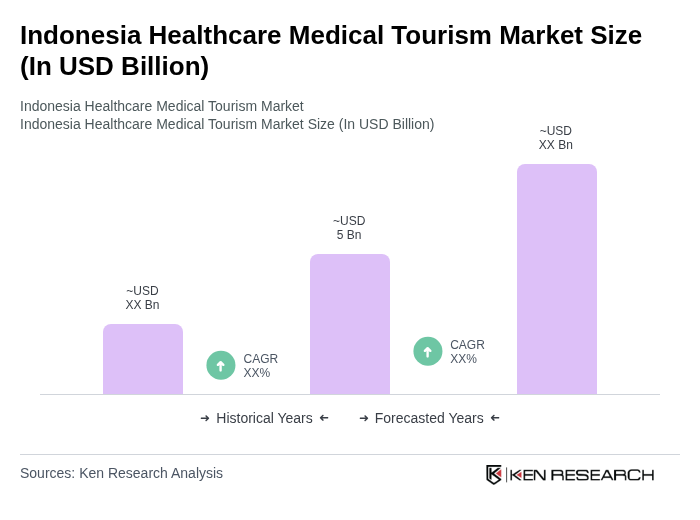
- The Indonesia Healthcare Medical Tourism Market is valued at USD 5 billion, based on a five-year historical analysis. This growth is primarily driven by the increasing number of international patients seeking affordable and high-quality medical services, particularly in cosmetic and dental treatments. The country's reputation for skilled healthcare professionals and advanced medical facilities has further fueled this trend, making it a preferred destination for medical tourists.
- Key cities dominating the market include Jakarta, Bali, and Surabaya. Jakarta is the capital and a major hub for advanced healthcare services, while Bali attracts tourists for both its medical facilities and leisure opportunities. Surabaya, being the second-largest city, also offers a range of medical services, contributing to the overall growth of the medical tourism sector in Indonesia.
- In 2023, the Indonesian government implemented a regulation aimed at enhancing the quality of healthcare services for medical tourists. This regulation mandates that all healthcare facilities catering to international patients must obtain accreditation from recognized international bodies, ensuring that they meet global standards for safety and quality in medical care.
Indonesia Healthcare Medical Tourism Market Segmentation
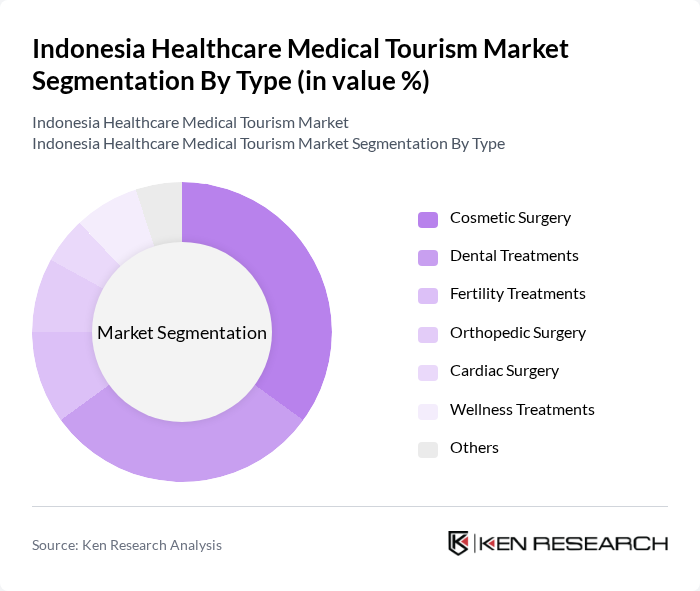
By Type:The market is segmented into various types of medical services, including cosmetic surgery, dental treatments, fertility treatments, orthopedic surgery, cardiac surgery, wellness treatments, and others. Among these, cosmetic surgery and dental treatments are particularly popular due to their affordability and the high quality of care provided. The increasing awareness of aesthetic procedures and the rising demand for dental care among international patients have significantly contributed to the growth of these segments.
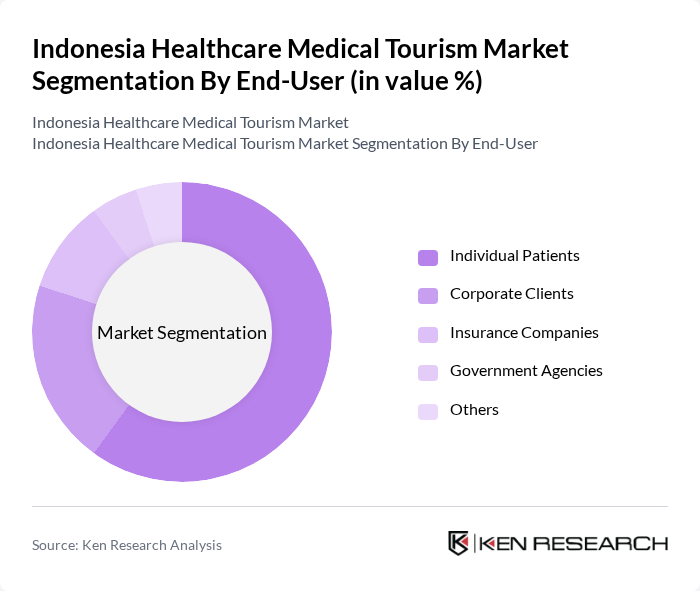
By End-User:The end-user segmentation includes individual patients, corporate clients, insurance companies, government agencies, and others. Individual patients represent the largest segment, driven by the increasing number of people seeking affordable healthcare solutions abroad. Corporate clients and insurance companies are also significant contributors, as they often facilitate medical tourism for their employees and clients, respectively, seeking cost-effective treatment options.
Indonesia Healthcare Medical Tourism Market Competitive Landscape
The Indonesia Healthcare Medical Tourism Market is characterized by a dynamic mix of regional and international players. Leading participants such as Siloam Hospitals, RSUP Dr. Cipto Mangunkusumo, Brawijaya Hospital, Jakarta Hospital, Medistra Hospital, RSU Siloam, RSU Mitra Keluarga, RSU Hermina, RSU Awal Bros, RSU Citra Medika, RSU Siloam Lippo Village, RSU Puri Medika, RSU Siloam Bali, RSU Siloam Surabaya, RSU Siloam Semanggi contribute to innovation, geographic expansion, and service delivery in this space.
Indonesia Healthcare Medical Tourism Market Industry Analysis
Growth Drivers
- Increasing Healthcare Costs in Developed Countries:The rising healthcare costs in developed nations, such as the United States, where average annual healthcare spending reached $13,000 per capita in future, drive patients to seek affordable alternatives abroad. Indonesia offers competitive pricing, with procedures often costing 50-70% less than in Western countries. This cost disparity encourages medical tourists to consider Indonesia for treatments, significantly boosting the local medical tourism sector.
- High-Quality Medical Services at Competitive Prices:Indonesia's healthcare system has made significant strides, with over 1,200 accredited hospitals providing high-quality medical services. The country is recognized for its advanced facilities, particularly in cosmetic and orthopedic surgeries, where costs can be as low as $3,500 compared to $15,000 in the U.S. This combination of quality and affordability attracts a growing number of international patients seeking medical care.
- Government Support and Promotion of Medical Tourism:The Indonesian government has actively promoted medical tourism, allocating approximately $12 million in future to enhance healthcare infrastructure and marketing efforts. Initiatives include partnerships with international health organizations and participation in global health fairs. This support not only improves service quality but also raises awareness of Indonesia as a viable medical tourism destination, further driving growth in the sector.
Market Challenges
- Regulatory Hurdles and Compliance Issues:Navigating the regulatory landscape in Indonesia poses significant challenges for medical tourism. The country has stringent licensing requirements for healthcare providers, with over 35% of hospitals facing compliance issues. These hurdles can deter potential investors and complicate the process for international patients seeking treatment, ultimately impacting the growth of the medical tourism sector.
- Quality Assurance and Accreditation Concerns:Despite improvements, concerns regarding quality assurance remain prevalent. Only 25% of Indonesian hospitals are accredited by international bodies, leading to skepticism among potential medical tourists. This lack of widespread accreditation can hinder patient trust and deter individuals from choosing Indonesia for their medical needs, posing a significant challenge to the market's growth.
Indonesia Healthcare Medical Tourism Market Future Outlook
The future of Indonesia's healthcare medical tourism market appears promising, driven by increasing global demand for affordable and high-quality medical services. As the country continues to enhance its healthcare infrastructure and regulatory framework, it is likely to attract a larger share of international patients. Additionally, the integration of digital health solutions and personalized care approaches will further elevate the patient experience, making Indonesia a competitive player in the global medical tourism landscape.
Market Opportunities
- Expansion of Telemedicine Services:The rise of telemedicine presents a significant opportunity for Indonesia's medical tourism sector. With an estimated 35% of patients preferring virtual consultations, healthcare providers can reach international patients more effectively, facilitating pre- and post-treatment care. This trend can enhance patient engagement and satisfaction, ultimately driving more medical tourists to Indonesia.
- Development of Wellness Tourism Packages:The growing interest in wellness tourism offers a unique opportunity for Indonesia to diversify its medical tourism offerings. By creating comprehensive wellness packages that combine medical treatments with holistic therapies, the country can attract health-conscious travelers. This approach not only enhances the patient experience but also positions Indonesia as a leading destination for wellness and recovery.
Scope of the Report
| Segment | Sub-Segments |
|---|---|
| By Type | Cosmetic Surgery Dental Treatments Fertility Treatments Orthopedic Surgery Cardiac Surgery Wellness Treatments Others |
| By End-User | Individual Patients Corporate Clients Insurance Companies Government Agencies Others |
| By Region | Java Bali Sumatra Sulawesi Others |
| By Treatment Complexity | Simple Procedures Moderate Procedures Complex Procedures Others |
| By Payment Method | Out-of-Pocket Payments Insurance Coverage Financing Options Others |
| By Duration of Stay | Short-term Visits Long-term Stays Others |
| By Patient Demographics | Age Groups Gender Income Levels Others |
Key Target Audience
Investors and Venture Capitalist Firms
Government and Regulatory Bodies (e.g., Ministry of Health, Indonesia Investment Coordinating Board)
Healthcare Providers and Hospitals
Insurance Companies
Travel Agencies Specializing in Medical Tourism
Medical Equipment Suppliers
Health and Wellness Resorts
Pharmaceutical Companies
Players Mentioned in the Report:
Siloam Hospitals
RSUP Dr. Cipto Mangunkusumo
Brawijaya Hospital
Jakarta Hospital
Medistra Hospital
RSU Siloam
RSU Mitra Keluarga
RSU Hermina
RSU Awal Bros
RSU Citra Medika
RSU Siloam Lippo Village
RSU Puri Medika
RSU Siloam Bali
RSU Siloam Surabaya
RSU Siloam Semanggi
Table of Contents
Market Assessment Phase
1. Executive Summary and Approach
2. Indonesia Healthcare Medical Tourism Market Overview
2.1 Key Insights and Strategic Recommendations
2.2 Indonesia Healthcare Medical Tourism Market Overview
2.3 Definition and Scope
2.4 Evolution of Market Ecosystem
2.5 Timeline of Key Regulatory Milestones
2.6 Value Chain & Stakeholder Mapping
2.7 Business Cycle Analysis
2.8 Policy & Incentive Landscape
3. Indonesia Healthcare Medical Tourism Market Analysis
3.1 Growth Drivers
3.1.1 Increasing healthcare costs in developed countries
3.1.2 High-quality medical services at competitive prices
3.1.3 Rising awareness of alternative treatment options
3.1.4 Government support and promotion of medical tourism
3.2 Market Challenges
3.2.1 Regulatory hurdles and compliance issues
3.2.2 Competition from other medical tourism destinations
3.2.3 Language barriers and cultural differences
3.2.4 Quality assurance and accreditation concerns
3.3 Market Opportunities
3.3.1 Expansion of telemedicine services
3.3.2 Development of wellness tourism packages
3.3.3 Partnerships with international insurance providers
3.3.4 Investment in healthcare infrastructure
3.4 Market Trends
3.4.1 Increasing demand for cosmetic and elective surgeries
3.4.2 Growth of wellness and holistic treatment options
3.4.3 Rise in digital health solutions
3.4.4 Focus on patient experience and personalized care
3.5 Government Regulation
3.5.1 Licensing and accreditation requirements for hospitals
3.5.2 Policies promoting foreign investment in healthcare
3.5.3 Regulations on medical advertising and promotion
3.5.4 Health insurance coverage for medical tourists
4. SWOT Analysis
5. Stakeholder Analysis
6. Porter's Five Forces Analysis
7. Indonesia Healthcare Medical Tourism Market Size, 2019-2024
7.1 By Value
7.2 By Volume
7.3 By Average Selling Price
8. Indonesia Healthcare Medical Tourism Market Segmentation
8.1 By Type
8.1.1 Cosmetic Surgery
8.1.2 Dental Treatments
8.1.3 Fertility Treatments
8.1.4 Orthopedic Surgery
8.1.5 Cardiac Surgery
8.1.6 Wellness Treatments
8.1.7 Others
8.2 By End-User
8.2.1 Individual Patients
8.2.2 Corporate Clients
8.2.3 Insurance Companies
8.2.4 Government Agencies
8.2.5 Others
8.3 By Region
8.3.1 Java
8.3.2 Bali
8.3.3 Sumatra
8.3.4 Sulawesi
8.3.5 Others
8.4 By Treatment Complexity
8.4.1 Simple Procedures
8.4.2 Moderate Procedures
8.4.3 Complex Procedures
8.4.4 Others
8.5 By Payment Method
8.5.1 Out-of-Pocket Payments
8.5.2 Insurance Coverage
8.5.3 Financing Options
8.5.4 Others
8.6 By Duration of Stay
8.6.1 Short-term Visits
8.6.2 Long-term Stays
8.6.3 Others
8.7 By Patient Demographics
8.7.1 Age Groups
8.7.2 Gender
8.7.3 Income Levels
8.7.4 Others
9. Indonesia Healthcare Medical Tourism Market Competitive Analysis
9.1 Market Share of Key Players
9.2 Cross Comparison of Key Players
9.2.1 Company Name
9.2.2 Group Size (Large, Medium, or Small as per industry convention)
9.2.3 Patient Satisfaction Rate
9.2.4 Treatment Success Rate
9.2.5 Average Treatment Cost
9.2.6 Market Penetration Rate
9.2.7 Pricing Strategy
9.2.8 Referral Rate
9.2.9 Service Diversification
9.2.10 Brand Recognition
9.3 SWOT Analysis of Top Players
9.4 Pricing Analysis
9.5 Detailed Profile of Major Companies
9.5.1 Siloam Hospitals
9.5.2 RSUP Dr. Cipto Mangunkusumo
9.5.3 Brawijaya Hospital
9.5.4 Jakarta Hospital
9.5.5 Medistra Hospital
9.5.6 RSU Siloam
9.5.7 RSU Mitra Keluarga
9.5.8 RSU Hermina
9.5.9 RSU Awal Bros
9.5.10 RSU Citra Medika
9.5.11 RSU Siloam Lippo Village
9.5.12 RSU Puri Medika
9.5.13 RSU Siloam Bali
9.5.14 RSU Siloam Surabaya
9.5.15 RSU Siloam Semanggi
10. Indonesia Healthcare Medical Tourism Market End-User Analysis
10.1 Procurement Behavior of Key Ministries
10.1.1 Ministry of Health
10.1.2 Ministry of Tourism
10.1.3 Ministry of Foreign Affairs
10.1.4 Others
10.2 Corporate Spend on Infrastructure & Energy
10.2.1 Corporate Healthcare Spending Trends
10.2.2 Investment in Medical Facilities
10.2.3 Partnerships with Healthcare Providers
10.2.4 Others
10.3 Pain Point Analysis by End-User Category
10.3.1 Individual Patients
10.3.2 Corporates
10.3.3 Insurance Companies
10.3.4 Others
10.4 User Readiness for Adoption
10.4.1 Awareness Levels
10.4.2 Accessibility of Services
10.4.3 Financial Preparedness
10.4.4 Others
10.5 Post-Deployment ROI and Use Case Expansion
10.5.1 ROI Measurement Techniques
10.5.2 Use Case Scenarios
10.5.3 Long-term Benefits Analysis
10.5.4 Others
11. Indonesia Healthcare Medical Tourism Market Future Size, 2025-2030
11.1 By Value
11.2 By Volume
11.3 By Average Selling Price
Go-To-Market Strategy Phase
1. Whitespace Analysis + Business Model Canvas
1.1 Market Gaps Identification
1.2 Business Model Development
2. Marketing and Positioning Recommendations
2.1 Branding Strategies
2.2 Product USPs
3. Distribution Plan
3.1 Urban Retail vs Rural NGO Tie-ups
4. Channel & Pricing Gaps
4.1 Underserved Routes
4.2 Pricing Bands
5. Unmet Demand & Latent Needs
5.1 Category Gaps
5.2 Consumer Segments
6. Customer Relationship
6.1 Loyalty Programs
6.2 After-sales Service
7. Value Proposition
7.1 Sustainability
7.2 Integrated Supply Chains
8. Key Activities
8.1 Regulatory Compliance
8.2 Branding
8.3 Distribution Setup
9. Entry Strategy Evaluation
9.1 Domestic Market Entry Strategy
9.1.1 Product Mix
9.1.2 Pricing Band
9.1.3 Packaging
9.2 Export Entry Strategy
9.2.1 Target Countries
9.2.2 Compliance Roadmap
10. Entry Mode Assessment
10.1 JV
10.2 Greenfield
10.3 M&A
10.4 Distributor Model
11. Capital and Timeline Estimation
11.1 Capital Requirements
11.2 Timelines
12. Control vs Risk Trade-Off
12.1 Ownership vs Partnerships
13. Profitability Outlook
13.1 Breakeven Analysis
13.2 Long-term Sustainability
14. Potential Partner List
14.1 Distributors
14.2 JVs
14.3 Acquisition Targets
15. Execution Roadmap
15.1 Phased Plan for Market Entry
15.1.1 Market Setup
15.1.2 Market Entry
15.1.3 Growth Acceleration
15.1.4 Scale & Stabilize
15.2 Key Activities and Milestones
15.2.1 Milestone Planning
15.2.2 Activity Tracking
Research Methodology
Phase 1: Approach1
Desk Research
- Analysis of government healthcare reports and statistics from the Indonesian Ministry of Health
- Review of industry publications and market reports on medical tourism trends in Indonesia
- Examination of travel and tourism data from the Indonesian Tourism Ministry and international health organizations
Primary Research
- Interviews with healthcare providers and hospital administrators in key medical tourism destinations
- Surveys with international patients who have utilized Indonesian healthcare services
- Focus group discussions with travel agencies specializing in medical tourism packages
Validation & Triangulation
- Cross-validation of findings through multiple data sources, including patient feedback and hospital performance metrics
- Triangulation of qualitative insights from interviews with quantitative data from surveys
- Sanity checks conducted through expert panel reviews comprising healthcare professionals and tourism experts
Phase 2: Market Size Estimation1
Top-down Assessment
- Estimation of the total market size based on national healthcare expenditure and tourism revenue
- Segmentation of the market by treatment types, such as cosmetic surgery, dental care, and wellness treatments
- Incorporation of growth rates from historical data and projected trends in international patient arrivals
Bottom-up Modeling
- Collection of data on patient volumes and revenue from leading hospitals and clinics catering to medical tourists
- Analysis of pricing structures for various medical procedures and packages offered to international patients
- Estimation of market size based on the aggregate of individual healthcare provider data
Forecasting & Scenario Analysis
- Multi-factor regression analysis incorporating variables such as global health trends, economic conditions, and travel restrictions
- Scenario modeling based on potential changes in healthcare regulations and international travel policies
- Development of baseline, optimistic, and pessimistic forecasts for market growth through 2030
Phase 3: CATI Sample Composition1
| Scope Item/Segment | Sample Size | Target Respondent Profiles |
|---|---|---|
| Cosmetic Surgery Patients | 150 | International Patients, Medical Coordinators |
| Dental Care Recipients | 100 | Dental Tourists, Clinic Managers |
| Wellness Retreat Participants | 80 | Health Tourists, Wellness Center Directors |
| Healthcare Providers | 120 | Hospital Administrators, Marketing Managers |
| Travel Agencies Specializing in Medical Tourism | 70 | Travel Agents, Business Development Managers |
Frequently Asked Questions
What is the current value of the Indonesia Healthcare Medical Tourism Market?
The Indonesia Healthcare Medical Tourism Market is valued at approximately USD 5 billion, driven by the increasing number of international patients seeking affordable and high-quality medical services, particularly in cosmetic and dental treatments.
Which cities in Indonesia are popular for medical tourism?
What types of medical services are most sought after by medical tourists in Indonesia?
How does the cost of medical procedures in Indonesia compare to developed countries?
Other Regional/Country Reports
Other Adjacent Reports
Egypt Cosmetic Surgery Market
Thailand Dental Treatment Market
South Korea Fertility Treatment Market
Thailand Orthopedic Surgery Market
South Korea Cardiac Surgery Market
Global wellness tourism market Size, Share, Growth Drivers, Trends, Opportunities & Forecast 2025–2030Bahrain Telemedicine Services Market
Middle East Health Insurance MarketBahrain hospital services market report size, share, growth drivers, trends, opportunities & forecast 2025–2030Egypt Healthcare Infrastructure Market
Why Buy From Us?

What makes us stand out is that our consultants follow Robust, Refine and Result (RRR) methodology. Robust for clear definitions, approaches and sanity checking, Refine for differentiating respondents' facts and opinions, and Result for presenting data with story.

We have set a benchmark in the industry by offering our clients with syndicated and customized market research reports featuring coverage of entire market as well as meticulous research and analyst insights.

While we don't replace traditional research, we flip the method upside down. Our dual approach of Top Bottom & Bottom Top ensures quality deliverable by not just verifying company fundamentals but also looking at the sector and macroeconomic factors.

With one step in the future, our research team constantly tries to show you the bigger picture. We help with some of the tough questions you may encounter along the way: How is the industry positioned? Best marketing channel? KPI's of competitors? By aligning every element, we help maximize success.

Our report gives you instant access to the answers and sources that other companies might choose to hide. We elaborate each steps of research methodology we have used and showcase you the sample size to earn your trust.

If you need any support, we are here! We pride ourselves on universe strength, data quality, and quick, friendly, and professional service.