Indonesia Pharmaceutical Impurity Synthesis Isolation Services Market Report Size Share Growth Drivers Trends Opportunities & Forecast 2025–2030

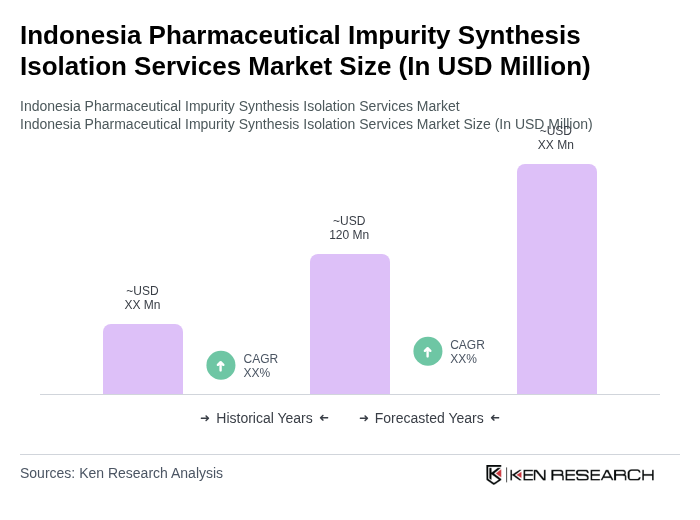
Indonesia Pharmaceutical Impurity Synthesis Isolation Services Market, worth USD 120M, grows via regulatory needs and analytical tech, focusing on synthesis, isolation, and profiling for drug safety.

Region:Asia

Author(s):Dev

Product Code:KRAA3777

Pages:97

Published On:January 2026
About the Report

Base Year 2024

Indonesia Pharmaceutical Impurity Synthesis Isolation Services Market Overview

  • The Indonesia Pharmaceutical Impurity Synthesis Isolation Services Market is valued at USD 120 million, based on a five-year historical analysis and benchmarking against the global pharmaceutical impurity synthesis and isolation services market size of about USD 1.25 billion and the scale of Indonesia’s pharmaceutical and active pharmaceutical ingredient (API) markets. This growth is primarily driven by the increasing demand for high-quality pharmaceuticals, stringent regulatory requirements, and the rising focus on drug safety and efficacy. The market is also supported by advancements in analytical techniques and technologies (such as high?resolution chromatography, LC?MS and GC?MS) that enhance impurity profiling and isolation processes, in line with global trends in impurity services.
  • Key cities such as Jakarta, Bandung, and Surabaya dominate the market due to their robust pharmaceutical manufacturing infrastructure and research capabilities. Jakarta, being the capital, serves as a hub for pharmaceutical companies and regulatory bodies, while Bandung and Surabaya are known for their academic institutions and research organizations that contribute to innovation in drug development. The concentration of major domestic manufacturers such as PT Kimia Farma Tbk, PT Kalbe Farma Tbk, PT Bio Farma and PT Indofarma Tbk in these regions further reinforces demand for specialized impurity synthesis, isolation, and analytical services.
  • The growth of this market is also supported by national policy frameworks to strengthen local pharmaceutical and API production. The Ministry of Health and related agencies are implementing measures under the broader pharmaceutical industrial development agenda, including incentives for domestic API manufacturing and quality upgrading. In parallel, quality and impurity?related controls are guided by binding instruments such as the Indonesian Pharmacopoeia and the Regulation of the Minister of Health of the Republic of Indonesia Number 1010/MENKES/PER/XI/2008 on the Registration of Medicines, which require manufacturers to demonstrate safety, efficacy, and quality (including impurity control) when registering drugs, thereby supporting demand for impurity synthesis and isolation services.
Indonesia Pharmaceutical Impurity Synthesis Isolation Services Market Size

Indonesia Pharmaceutical Impurity Synthesis Isolation Services Market Segmentation

By Service:The services offered in this market include Synthesis Services, Isolation Services, Analytical / Impurity Profiling Services, and Other Specialized Support Services. Among these, Synthesis Services are currently leading due to the increasing need for customized synthesis of pharmaceutical compounds and reference standards, driven by the growing demand for novel drug formulations and complex APIs in Indonesia’s expanding API and finished dose markets. Analytical / Impurity Profiling Services are gaining traction in line with global trends where analytical services represent one of the fastest?growing segments, supported by investments in advanced LC?MS, GC?MS, NMR, and hyphenated techniques for comprehensive impurity characterization. Isolation Services also hold significant importance as they ensure the purity and safety of pharmaceutical products, which is critical for regulatory compliance and for supporting local manufacturers seeking to meet international pharmacopeial and export standards.
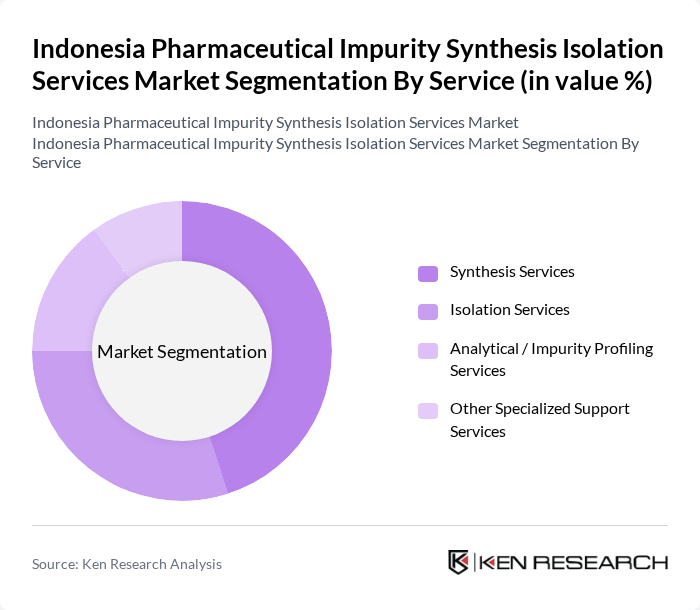
Indonesia Pharmaceutical Impurity Synthesis Isolation Services Market segmentation by Service.

By Impurity Type:The market is segmented based on impurity types, including Organic Impurities, Inorganic Impurities, Residual Solvents, and Nitrosamine and Genotoxic Impurities. Organic Impurities dominate the market due to their prevalence in pharmaceutical formulations and the increasing regulatory scrutiny surrounding them, which aligns with global impurity services trends where organic impurities account for a substantial share of service demand. The focus on reducing these impurities is driving demand for specialized services that can effectively identify and mitigate them, particularly as Indonesian manufacturers expand synthetic and biotech API production and must comply with ICH?aligned impurity guidelines.
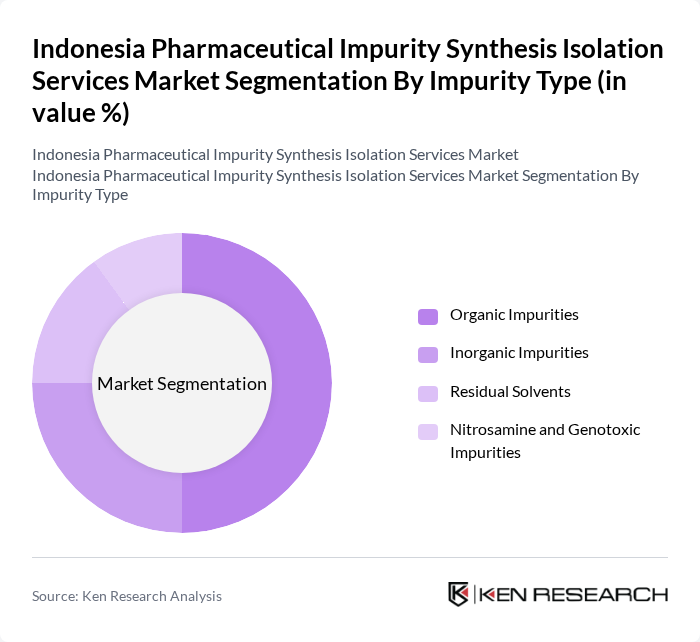
Indonesia Pharmaceutical Impurity Synthesis Isolation Services Market segmentation by Impurity Type.

Indonesia Pharmaceutical Impurity Synthesis Isolation Services Market Competitive Landscape

The Indonesia Pharmaceutical Impurity Synthesis Isolation Services Market is characterized by a dynamic mix of regional and international players. Leading participants such as PT Kimia Farma Tbk, PT Indofarma Tbk, PT Bio Farma (Persero), PT Kalbe Farma Tbk, PT Ferron Par Pharmaceuticals, PT Phapros Tbk, PT Dexa Medica, PT Sanbe Farma, PT Pfizer Indonesia, PT Novartis Indonesia, PT Bayer Indonesia, PT Sanofi Indonesia, PT Takeda Indonesia, PT GlaxoSmithKline Indonesia, Selected Regional CROs/CDMOs Serving Indonesia contribute to innovation, geographic expansion, and service delivery in this space.

PT Kimia Farma Tbk

1817

Jakarta, Indonesia

PT Indofarma Tbk

1918

Bekasi, Indonesia

PT Bio Farma (Persero)

1890

Bandung, Indonesia

PT Kalbe Farma Tbk

1966

Jakarta, Indonesia

PT Ferron Par Pharmaceuticals

2001

Cikarang, Indonesia

Company

Establishment Year

Headquarters

Size Segment (Global, Regional, Local/Niche)

Indonesia Market Revenue (USD, latest financial year)

3?Year Revenue CAGR in Indonesia (%)

Share of Revenue from Impurity Synthesis & Isolation Services (%)

Number of Active Indonesia Pharmaceutical Clients

Average Contract Value (ACV) and Deal Tenure

Indonesia Pharmaceutical Impurity Synthesis Isolation Services Market Industry Analysis

Growth Drivers

  • Increasing Demand for High-Quality Pharmaceuticals:The Indonesian pharmaceutical market is projected to reach IDR 120 trillion (approximately USD 8.3 billion) by 2025, driven by a rising population and increased healthcare spending. The demand for high-quality pharmaceuticals is further fueled by the growing prevalence of chronic diseases, which necessitates effective and safe medications. This trend is supported by the World Bank's report indicating a 6% annual increase in healthcare expenditure, emphasizing the need for stringent impurity synthesis and isolation services.
  • Stringent Regulatory Requirements:Indonesia's regulatory framework, governed by the National Agency of Drug and Food Control (BPOM), mandates rigorous testing and quality assurance for pharmaceuticals. In future, BPOM is expected to enhance its oversight, requiring pharmaceutical companies to comply with Good Manufacturing Practices (GMP). This regulatory environment drives the demand for specialized impurity synthesis and isolation services, as companies must ensure their products meet these stringent standards to avoid penalties and maintain market access.
  • Advancements in Analytical Technologies:The pharmaceutical industry in Indonesia is witnessing significant advancements in analytical technologies, such as high-performance liquid chromatography (HPLC) and mass spectrometry. These technologies enable precise detection and quantification of impurities, enhancing drug safety and efficacy. In future, investments in these technologies are projected to increase by 20%, as companies seek to improve their testing capabilities, thereby driving the demand for specialized synthesis and isolation services to meet evolving quality standards.

Market Challenges

  • High Costs of Synthesis and Isolation Services:The costs associated with pharmaceutical impurity synthesis and isolation services in Indonesia are significant, often exceeding IDR 600 million (approximately USD 41,000) per project. This financial burden can deter smaller pharmaceutical companies from investing in necessary services, limiting their ability to comply with regulatory standards. As a result, many firms may struggle to maintain product quality, which could impact their competitiveness in the growing market.
  • Limited Availability of Skilled Professionals:The Indonesian pharmaceutical sector faces a shortage of skilled professionals trained in impurity synthesis and isolation techniques. According to the Ministry of Health, there are only about 12,000 qualified pharmaceutical scientists in the country, which is insufficient to meet the industry's growing demands. This skills gap poses a significant challenge for companies seeking to enhance their capabilities in drug safety and efficacy, potentially hindering market growth.

Indonesia Pharmaceutical Impurity Synthesis Isolation Services Market Future Outlook

The future of the Indonesian pharmaceutical impurity synthesis isolation services market appears promising, driven by increasing investments in research and development, projected to reach IDR 20 trillion (approximately USD 1.4 billion) in future. Additionally, the trend towards outsourcing synthesis services is expected to grow, as companies seek to reduce operational costs while ensuring compliance with stringent regulations. This shift will likely create a more competitive landscape, fostering innovation and collaboration within the industry.

Market Opportunities

  • Expansion of Pharmaceutical Manufacturing:The Indonesian government aims to boost local pharmaceutical manufacturing, with a target of increasing production capacity by 25% in future. This expansion presents opportunities for impurity synthesis and isolation service providers to partner with manufacturers, ensuring compliance with quality standards and enhancing product safety.
  • Collaborations with Research Institutions:Collaborations between pharmaceutical companies and research institutions are on the rise, with over 40 active partnerships reported in future. These collaborations can facilitate the development of innovative impurity synthesis techniques, providing opportunities for service providers to enhance their offerings and contribute to advancements in drug safety and efficacy.

Scope of the Report

SegmentSub-Segments
By Service

Synthesis Services

Isolation Services

Analytical / Impurity Profiling Services

Other Specialized Support Services

By Impurity Type

Organic Impurities

Inorganic Impurities

Residual Solvents

Nitrosamine and Genotoxic Impurities

By Technique / Technology

Chromatography (HPLC, UPLC, GC, Flash, Prep)

Spectroscopy (UV-Vis, IR, NMR)

Mass Spectrometry & Hyphenated Techniques (LC?MS, GC?MS, LC?MS/MS)

Crystallization and Other Isolation Techniques

By Application

Drug Development & Clinical Studies

Commercial Manufacturing Support

Quality Control & Batch Release Testing

Regulatory Filing & Compliance Support

By End User

Biotechnology and Pharmaceutical Companies

Contract Research Organizations (CROs)

Contract Development and Manufacturing Organizations (CDMOs/CMOs)

Academic & Research Institutes / Others

By Molecule Type

Small Molecule Drugs

Biologics and Biosimilars

Advanced Therapies (e.g., Gene and Cell Therapies)

Others

By Region

Java

Sumatra

Kalimantan, Sulawesi, Papua & Other Islands

Greater Jakarta and Key Industrial Clusters

Key Target Audience

Investors and Venture Capitalist Firms

Government and Regulatory Bodies (e.g., Badan Pengawas Obat dan Makanan - BPOM)

Pharmaceutical Manufacturers

Biotechnology Companies

Contract Research Organizations (CROs)

Quality Control and Assurance Departments

Pharmaceutical Supply Chain Managers

Industry Associations (e.g., Indonesian Pharmaceutical Association)

Players Mentioned in the Report:

PT Kimia Farma Tbk

PT Indofarma Tbk

PT Bio Farma (Persero)

PT Kalbe Farma Tbk

PT Ferron Par Pharmaceuticals

PT Phapros Tbk

PT Dexa Medica

PT Sanbe Farma

PT Pfizer Indonesia

PT Novartis Indonesia

PT Bayer Indonesia

PT Sanofi Indonesia

PT Takeda Indonesia

PT GlaxoSmithKline Indonesia

Selected Regional CROs/CDMOs Serving Indonesia

Table of Contents

Market Assessment Phase

1. Executive Summary and Approach


2. Indonesia Pharmaceutical Impurity Synthesis Isolation Services Market Overview

2.1 Key Insights and Strategic Recommendations

2.2 Indonesia Pharmaceutical Impurity Synthesis Isolation Services Market Overview

2.3 Definition and Scope

2.4 Evolution of Market Ecosystem

2.5 Timeline of Key Regulatory Milestones

2.6 Value Chain & Stakeholder Mapping

2.7 Business Cycle Analysis

2.8 Policy & Incentive Landscape


3. Indonesia Pharmaceutical Impurity Synthesis Isolation Services Market Analysis

3.1 Growth Drivers

3.1.1 Increasing demand for high-quality pharmaceuticals
3.1.2 Stringent regulatory requirements
3.1.3 Advancements in analytical technologies
3.1.4 Growing focus on drug safety and efficacy

3.2 Market Challenges

3.2.1 High costs of synthesis and isolation services
3.2.2 Limited availability of skilled professionals
3.2.3 Complex regulatory landscape
3.2.4 Competition from alternative methods

3.3 Market Opportunities

3.3.1 Expansion of pharmaceutical manufacturing
3.3.2 Collaborations with research institutions
3.3.3 Development of personalized medicine
3.3.4 Increasing investment in R&D

3.4 Market Trends

3.4.1 Shift towards outsourcing synthesis services
3.4.2 Adoption of green chemistry practices
3.4.3 Integration of AI in drug development
3.4.4 Focus on sustainability in pharmaceutical processes

3.5 Government Regulation

3.5.1 Implementation of Good Manufacturing Practices (GMP)
3.5.2 Compliance with the National Agency of Drug and Food Control (BPOM)
3.5.3 Regulations on hazardous substances
3.5.4 Policies promoting local pharmaceutical production

4. SWOT Analysis


5. Stakeholder Analysis


6. Porter's Five Forces Analysis


7. Indonesia Pharmaceutical Impurity Synthesis Isolation Services Market Size, 2019-2024

7.1 By Value

7.2 By Volume

7.3 By Average Selling Price


8. Indonesia Pharmaceutical Impurity Synthesis Isolation Services Market Segmentation

8.1 By Service

8.1.1 Synthesis Services
8.1.2 Isolation Services
8.1.3 Analytical / Impurity Profiling Services
8.1.4 Other Specialized Support Services

8.2 By Impurity Type

8.2.1 Organic Impurities
8.2.2 Inorganic Impurities
8.2.3 Residual Solvents
8.2.4 Nitrosamine and Genotoxic Impurities

8.3 By Technique / Technology

8.3.1 Chromatography (HPLC, UPLC, GC, Flash, Prep)
8.3.2 Spectroscopy (UV-Vis, IR, NMR)
8.3.3 Mass Spectrometry & Hyphenated Techniques (LC?MS, GC?MS, LC?MS/MS)
8.3.4 Crystallization and Other Isolation Techniques

8.4 By Application

8.4.1 Drug Development & Clinical Studies
8.4.2 Commercial Manufacturing Support
8.4.3 Quality Control & Batch Release Testing
8.4.4 Regulatory Filing & Compliance Support

8.5 By End User

8.5.1 Biotechnology and Pharmaceutical Companies
8.5.2 Contract Research Organizations (CROs)
8.5.3 Contract Development and Manufacturing Organizations (CDMOs/CMOs)
8.5.4 Academic & Research Institutes / Others

8.6 By Molecule Type

8.6.1 Small Molecule Drugs
8.6.2 Biologics and Biosimilars
8.6.3 Advanced Therapies (e.g., Gene and Cell Therapies)
8.6.4 Others

8.7 By Region

8.7.1 Java
8.7.2 Sumatra
8.7.3 Kalimantan, Sulawesi, Papua & Other Islands
8.7.4 Greater Jakarta and Key Industrial Clusters

9. Indonesia Pharmaceutical Impurity Synthesis Isolation Services Market Competitive Analysis

9.1 Market Share of Key Players

9.2 Cross Comparison of Key Players

9.2.1 Company Name
9.2.2 Size Segment (Global, Regional, Local/Niche)
9.2.3 Indonesia Market Revenue (USD, latest financial year)
9.2.4 3?Year Revenue CAGR in Indonesia (%)
9.2.5 Share of Revenue from Impurity Synthesis & Isolation Services (%)
9.2.6 Number of Active Indonesia Pharmaceutical Clients
9.2.7 Average Contract Value (ACV) and Deal Tenure
9.2.8 GMP?Compliant Capacity Utilization Rate (%)
9.2.9 R&D Intensity (% of Revenue Spent on R&D)
9.2.10 EBITDA Margin from Indonesia Operations (%)
9.2.11 On?Time Project Delivery Rate (%)
9.2.12 Regulatory Inspection Track Record (BPOM/ICH/EMA/US?FDA)

9.3 SWOT Analysis of Top Players

9.4 Pricing Analysis

9.5 Detailed Profile of Major Companies

9.5.1 PT Kimia Farma Tbk
9.5.2 PT Indofarma Tbk
9.5.3 PT Bio Farma (Persero)
9.5.4 PT Kalbe Farma Tbk
9.5.5 PT Ferron Par Pharmaceuticals
9.5.6 PT Phapros Tbk
9.5.7 PT Dexa Medica
9.5.8 PT Sanbe Farma
9.5.9 PT Pfizer Indonesia
9.5.10 PT Novartis Indonesia
9.5.11 PT Bayer Indonesia
9.5.12 PT Sanofi Indonesia
9.5.13 PT Takeda Indonesia
9.5.14 PT GlaxoSmithKline Indonesia
9.5.15 Selected Regional CROs/CDMOs Serving Indonesia

10. Indonesia Pharmaceutical Impurity Synthesis Isolation Services Market End-User Analysis

10.1 Procurement Behavior of Key Ministries

10.1.1 Ministry of Health
10.1.2 Ministry of Industry
10.1.3 Ministry of Research and Technology
10.1.4 Others

10.2 Corporate Spend on Infrastructure & Energy

10.2.1 Investment in R&D Facilities
10.2.2 Budget Allocation for Quality Control
10.2.3 Expenditure on Compliance and Regulation
10.2.4 Others

10.3 Pain Point Analysis by End-User Category

10.3.1 Pharmaceutical Manufacturers
10.3.2 CROs
10.3.3 Academic Institutions
10.3.4 Others

10.4 User Readiness for Adoption

10.4.1 Awareness of Impurity Risks
10.4.2 Training and Skill Development
10.4.3 Infrastructure Readiness
10.4.4 Others

10.5 Post-Deployment ROI and Use Case Expansion

10.5.1 Measurement of Service Effectiveness
10.5.2 Expansion into New Applications
10.5.3 Long-term Cost Savings
10.5.4 Others

11. Indonesia Pharmaceutical Impurity Synthesis Isolation Services Market Future Size, 2025-2030

11.1 By Value

11.2 By Volume

11.3 By Average Selling Price


Go-To-Market Strategy Phase

1. Whitespace Analysis + Business Model Canvas

1.1 Market Gaps Identification

1.2 Value Proposition Development

1.3 Revenue Model Structuring

1.4 Key Partnerships Identification

1.5 Customer Segmentation

1.6 Cost Structure Analysis

1.7 Competitive Advantage Assessment


2. Marketing and Positioning Recommendations

2.1 Branding Strategies

2.2 Product USPs

2.3 Target Market Identification

2.4 Communication Strategy

2.5 Digital Marketing Approach

2.6 Customer Engagement Tactics

2.7 Performance Metrics


3. Distribution Plan

3.1 Urban Retail Strategies

3.2 Rural NGO Tie-ups

3.3 Online Distribution Channels

3.4 Direct Sales Approaches

3.5 Partnership with Distributors

3.6 Logistics and Supply Chain Management

3.7 Performance Evaluation


4. Channel & Pricing Gaps

4.1 Underserved Routes

4.2 Pricing Bands Analysis

4.3 Competitor Pricing Comparison

4.4 Customer Willingness to Pay

4.5 Value-Based Pricing Strategies

4.6 Discount and Promotion Strategies

4.7 Pricing Strategy Evaluation


5. Unmet Demand & Latent Needs

5.1 Category Gaps Identification

5.2 Consumer Segments Analysis

5.3 Emerging Trends Exploration

5.4 Customer Feedback Mechanisms

5.5 Product Development Opportunities

5.6 Market Entry Barriers

5.7 Future Demand Projections


6. Customer Relationship

6.1 Loyalty Programs

6.2 After-sales Service

6.3 Customer Feedback Integration

6.4 Relationship Management Tools

6.5 Customer Retention Strategies

6.6 Engagement Metrics

6.7 Community Building Initiatives


7. Value Proposition

7.1 Sustainability Initiatives

7.2 Integrated Supply Chains

7.3 Unique Selling Points

7.4 Customer-Centric Innovations

7.5 Competitive Differentiation

7.6 Value Delivery Mechanisms

7.7 Performance Metrics


8. Key Activities

8.1 Regulatory Compliance

8.2 Branding Initiatives

8.3 Distribution Setup

8.4 Training and Development

8.5 Quality Assurance Processes

8.6 Market Research Activities

8.7 Performance Monitoring


9. Entry Strategy Evaluation

9.1 Domestic Market Entry Strategy

9.1.1 Product Mix
9.1.2 Pricing Band
9.1.3 Packaging

9.2 Export Entry Strategy

9.2.1 Target Countries
9.2.2 Compliance Roadmap

10. Entry Mode Assessment

10.1 Joint Ventures

10.2 Greenfield Investments

10.3 Mergers & Acquisitions

10.4 Distributor Model

10.5 Risk Assessment

10.6 Strategic Fit Evaluation

10.7 Performance Metrics


11. Capital and Timeline Estimation

11.1 Capital Requirements

11.2 Timelines

11.3 Funding Sources

11.4 Financial Projections

11.5 Risk Management Strategies

11.6 Milestone Tracking

11.7 Performance Evaluation


12. Control vs Risk Trade-Off

12.1 Ownership vs Partnerships

12.2 Risk Mitigation Strategies

12.3 Control Mechanisms

12.4 Performance Metrics

12.5 Strategic Alignment

12.6 Long-term Sustainability

12.7 Exit Strategies


13. Profitability Outlook

13.1 Breakeven Analysis

13.2 Long-term Sustainability

13.3 Financial Health Indicators

13.4 Revenue Growth Projections

13.5 Cost Management Strategies

13.6 Profit Margin Analysis

13.7 Performance Metrics


14. Potential Partner List

14.1 Distributors

14.2 Joint Ventures

14.3 Acquisition Targets

14.4 Strategic Alliances

14.5 Collaboration Opportunities

14.6 Partnership Evaluation Criteria

14.7 Performance Metrics


15. Execution Roadmap

15.1 Phased Plan for Market Entry

15.1.1 Market Setup
15.1.2 Market Entry
15.1.3 Growth Acceleration
15.1.4 Scale & Stabilize

15.2 Key Activities and Milestones

15.2.1 Activity Planning
15.2.2 Milestone Tracking
15.2.3 Performance Evaluation

Research Methodology

ApproachModellingSample

Phase 1: Approach1

Desk Research

  • Analysis of industry reports from Indonesian pharmaceutical associations and regulatory bodies
  • Review of scientific literature on impurity synthesis and isolation techniques
  • Examination of market trends and forecasts from reputable market research publications

Primary Research

  • Interviews with R&D heads at leading pharmaceutical companies in Indonesia
  • Surveys with quality control managers regarding impurity testing and isolation practices
  • Field visits to laboratories specializing in pharmaceutical impurity analysis

Validation & Triangulation

  • Cross-validation of findings through multiple expert interviews and industry reports
  • Triangulation of data from primary and secondary sources to ensure consistency
  • Sanity checks through feedback from a panel of industry experts

Phase 2: Market Size Estimation1

Top-down Assessment

  • Estimation of the total pharmaceutical market size in Indonesia as a baseline
  • Segmentation of the market by therapeutic areas and impurity types
  • Incorporation of regulatory impacts on impurity testing requirements

Bottom-up Modeling

  • Collection of data on service pricing from key players in the impurity synthesis market
  • Estimation of service volumes based on historical data and projected growth rates
  • Calculation of market size using volume x price methodology for various service offerings

Forecasting & Scenario Analysis

  • Development of forecasting models based on historical growth trends and market drivers
  • Scenario analysis considering regulatory changes and technological advancements
  • Creation of baseline, optimistic, and pessimistic forecasts through 2030

Phase 3: CATI Sample Composition1

Scope Item/SegmentSample SizeTarget Respondent Profiles
Pharmaceutical Manufacturers110R&D Managers, Quality Assurance Heads
Contract Research Organizations (CROs)85Project Managers, Laboratory Directors
Regulatory Bodies45Regulatory Affairs Specialists, Compliance Officers
Academic Institutions55Research Professors, Graduate Students in Pharmaceutical Sciences
Quality Control Laboratories65Laboratory Technicians, Quality Control Managers

Frequently Asked Questions

What is the current value of the Indonesia Pharmaceutical Impurity Synthesis Isolation Services Market?

The Indonesia Pharmaceutical Impurity Synthesis Isolation Services Market is valued at approximately USD 120 million, reflecting a significant growth trajectory influenced by increasing demand for high-quality pharmaceuticals and stringent regulatory requirements.

What factors are driving the growth of the pharmaceutical impurity synthesis market in Indonesia?

Which cities are the main hubs for pharmaceutical impurity synthesis services in Indonesia?

What types of services are offered in the Indonesia Pharmaceutical Impurity Synthesis Isolation Services Market?

Other Regional/Country Reports

Malaysia Pharmaceutical Impurity Synthesis Isolation Services Market

KSA Pharmaceutical Impurity Synthesis Isolation Services Market

APAC Pharmaceutical Impurity Synthesis Isolation Services Market

SEA Pharmaceutical Impurity Synthesis Isolation Services Market

Vietnam Pharmaceutical Impurity Synthesis Isolation Services Market

Thailand Pharmaceutical Impurity Synthesis Isolation Services Market

Why Buy From Us?

Refine Robust Result (RRR) Framework

What makes us stand out is that our consultants follow Robust, Refine and Result (RRR) methodology. Robust for clear definitions, approaches and sanity checking, Refine for differentiating respondents' facts and opinions, and Result for presenting data with story.

Our Reach Is Unmatched

We have set a benchmark in the industry by offering our clients with syndicated and customized market research reports featuring coverage of entire market as well as meticulous research and analyst insights.

Shifting the Research Paradigm

While we don't replace traditional research, we flip the method upside down. Our dual approach of Top Bottom & Bottom Top ensures quality deliverable by not just verifying company fundamentals but also looking at the sector and macroeconomic factors.

More Insights-Better Decisions

With one step in the future, our research team constantly tries to show you the bigger picture. We help with some of the tough questions you may encounter along the way: How is the industry positioned? Best marketing channel? KPI's of competitors? By aligning every element, we help maximize success.

Transparency and Trust

Our report gives you instant access to the answers and sources that other companies might choose to hide. We elaborate each steps of research methodology we have used and showcase you the sample size to earn your trust.

Round the Clock Support

If you need any support, we are here! We pride ourselves on universe strength, data quality, and quick, friendly, and professional service.

Why Clients Choose Us?

400000+
Reports in repository
150+
Consulting projects a year
100+
Analysts
8000+
Client Queries in 2022








