Brazil Sports and Athletic Apparel Online Market

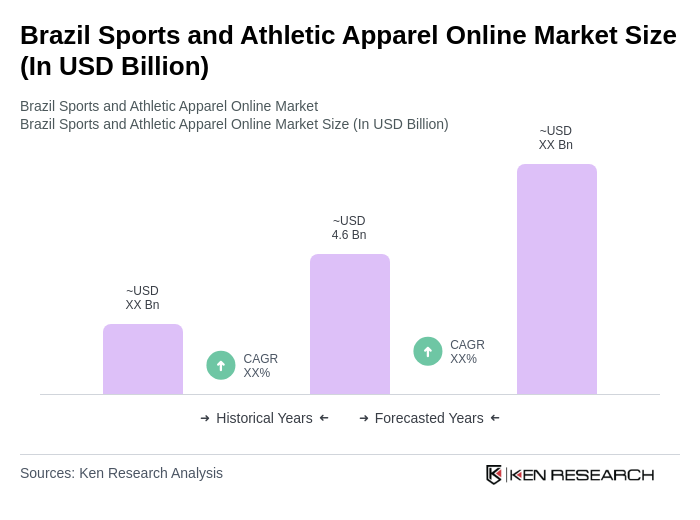
The Brazil sports and athletic apparel online market, valued at USD 4.6 billion, is growing due to rising fitness trends, e-commerce expansion, and sustainable practices in key cities like São Paulo.

Region:Central and South America

Author(s):Geetanshi

Product Code:KRAA4788

Pages:91

Published On:September 2025
About the Report

Base Year 2024

Brazil Sports and Athletic Apparel Online Market Overview

  • The Brazil Sports and Athletic Apparel Online Market is valued at USD 4.6 billion, based on a five-year historical analysis. This growth is primarily driven by increasing health and fitness awareness among consumers, expansion of athleisure fashion, and the rise of e-commerce platforms. The online segment has seen a notable uptick as consumers embrace the convenience of digital shopping, further accelerated by the pandemic and urban lifestyle shifts.
  • Key cities such as São Paulo, Rio de Janeiro, and Brasília continue to dominate the market due to their large populations, advanced urbanization, and concentration of fitness enthusiasts. These metropolitan areas benefit from extensive sports infrastructure and serve as major retail and e-commerce hubs, facilitating efficient distribution and targeted marketing of sports and athletic apparel.
  • In 2023, the Brazilian government enacted the National Solid Waste Policy (Política Nacional de Resíduos Sólidos, Law No. 12.305/2010), with updated directives for the textile sector, including sports apparel. The regulation, issued by the Ministry of Environment, mandates companies to adopt sustainable practices such as reducing carbon emissions, implementing reverse logistics for textile waste, and increasing the use of eco-friendly materials. These requirements are influencing consumer preferences and driving innovation in product offerings.
Brazil Sports and Athletic Apparel Online Market Size

Brazil Sports and Athletic Apparel Online Market Segmentation

By Type:The market is segmented into Activewear, Footwear, Accessories, Athleisure, Performance Apparel, Sports Equipment, and Others. Activewear remains the leading sub-segment, propelled by the growing fitness and wellness movement and demand for versatile apparel suitable for both exercise and casual wear. Footwear and Athleisure also show robust performance, as Brazilian consumers increasingly seek comfort, style, and functional designs in their sportswear choices.
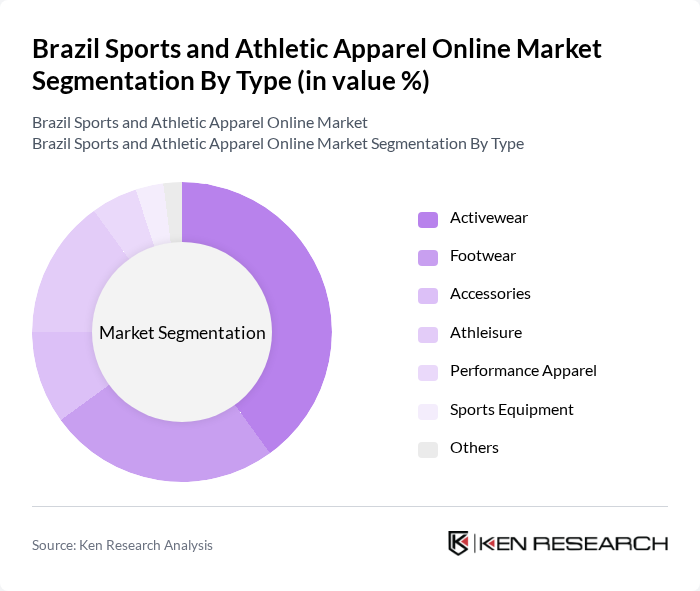
Brazil Sports and Athletic Apparel Online Market segmentation by Type.

By End-User:The market is categorized into Men, Women, and Children. The Men's segment holds the largest share, driven by strong interest in fitness and sports among male consumers. Women’s participation in sports and fitness is rising, fueling demand for women-specific athletic apparel. The Children’s segment is expanding as parents increasingly prioritize quality and comfort in sportswear for their kids.
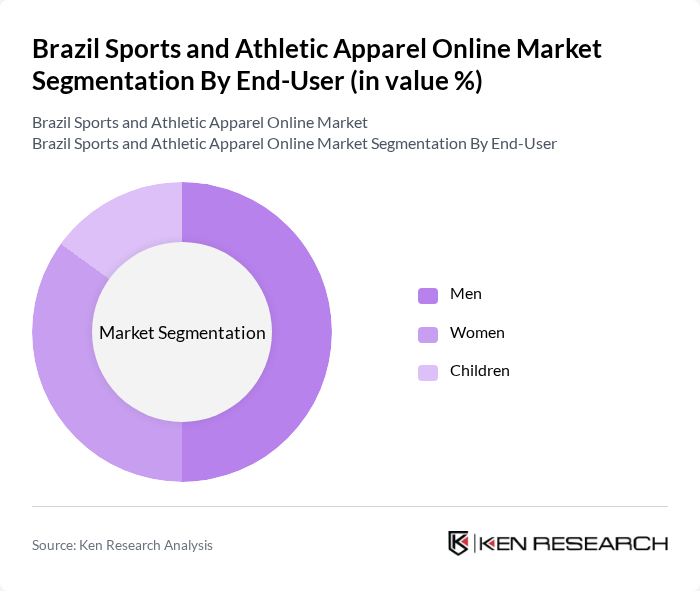
Brazil Sports and Athletic Apparel Online Market segmentation by End-User.

Brazil Sports and Athletic Apparel Online Market Competitive Landscape

The Brazil Sports and Athletic Apparel Online Market is characterized by a dynamic mix of regional and international players. Leading participants such as Nike, Inc., Adidas AG, Puma SE, Under Armour, Inc., Decathlon S.A., Lupo S.A., Track & Field, Alpargatas S.A., Hering S.A., Osklen, Reserva, Le Coq Sportif, Mizuno Corporation, Asics Corporation, New Balance Athletics, Inc., Netshoes (Grupo Magalu), Centauro (Grupo SBF), Fila Brasil, Olympikus (Vulcabras S.A.), Reebok Brasil contribute to innovation, geographic expansion, and service delivery in this space.

Nike, Inc.

1964

Beaverton, Oregon, USA

Adidas AG

1949

Herzogenaurach, Germany

Puma SE

1948

Herzogenaurach, Germany

Under Armour, Inc.

1996

Baltimore, Maryland, USA

Decathlon S.A.

1976

Villeneuve-d'Ascq, France

Company

Establishment Year

Headquarters

Group Size (Large, Medium, or Small as per industry convention)

Revenue Growth Rate (YoY % for Brazil online sales)

Online Market Share (%)

Customer Acquisition Cost (CAC)

Market Penetration Rate (Online channel % of total sales)

Customer Retention Rate (Repeat purchase %)

Brazil Sports and Athletic Apparel Online Market Industry Analysis

Growth Drivers

  • Increasing Health Consciousness:The Brazilian population is increasingly prioritizing health, with 56% of adults engaging in regular physical activity. This trend is supported by the World Health Organization's recommendation of at least 150 minutes of moderate exercise weekly. The rise in health awareness has led to a surge in demand for sports and athletic apparel, with the market expected to benefit from this growing consumer focus on fitness and well-being.
  • Rise of E-commerce Platforms:Brazil's e-commerce sector is projected to reach $41 billion, driven by a 15% annual growth rate. The convenience of online shopping has made it easier for consumers to access a wide range of sports and athletic apparel. Major platforms like Mercado Livre and Amazon Brazil are expanding their offerings, enhancing consumer access and driving sales in the online sports apparel market, which is expected to capture a significant share of overall retail.
  • Growing Participation in Sports and Fitness Activities:The number of Brazilians participating in organized sports has increased by 20%, with over 36 million individuals now engaged in various athletic activities. This growth is fueled by government initiatives promoting sports and fitness, as well as the increasing popularity of fitness events. As participation rises, so does the demand for specialized apparel, creating a robust market for sports and athletic clothing online.

Market Challenges

  • Intense Competition:The Brazilian sports apparel market is characterized by fierce competition, with over 250 brands vying for market share. Major players like Nike and Adidas dominate, but local brands are gaining traction. This saturation leads to price wars and reduced profit margins, making it challenging for new entrants to establish themselves. Companies must innovate and differentiate their offerings to survive in this highly competitive landscape.
  • Economic Instability:Brazil's economy is projected to grow by only 2% in the near future, reflecting ongoing challenges such as inflation and political uncertainty. This economic environment affects consumer spending power, leading to cautious purchasing behavior. As disposable incomes fluctuate, consumers may prioritize essential goods over discretionary items like sports apparel, posing a significant challenge for brands aiming to maintain sales growth in the online market.

Brazil Sports and Athletic Apparel Online Market Future Outlook

The future of Brazil's sports and athletic apparel online market appears promising, driven by increasing health awareness and the expansion of e-commerce. As more consumers embrace fitness, brands are likely to innovate in product offerings, focusing on sustainability and technology. Additionally, the integration of digital marketing strategies will enhance brand visibility. However, companies must navigate economic challenges and competition to capitalize on these trends effectively, ensuring they remain relevant in a dynamic market landscape.

Market Opportunities

  • Growth of Athleisure Trend:The athleisure market in Brazil is expected to grow significantly, with sales projected to reach $6 billion. This trend reflects a shift in consumer preferences towards comfortable yet stylish apparel suitable for both workouts and casual wear. Brands that capitalize on this trend can tap into a lucrative segment, appealing to a broader audience seeking versatility in their clothing choices.
  • Collaborations with Fitness Influencers:Collaborating with fitness influencers can enhance brand visibility and credibility. In the near future, influencer marketing in Brazil is expected to generate $2 billion, with sports and fitness influencers driving a significant portion of this growth. Brands that strategically partner with influencers can effectively reach target demographics, leveraging social media platforms to boost engagement and sales in the online apparel market.

Scope of the Report

SegmentSub-Segments
By Type

Activewear

Footwear

Accessories

Athleisure

Performance Apparel

Sports Equipment

Others

By End-User

Men

Women

Children

By Sales Channel

Online Retail (Brand-owned E-commerce)

Direct-to-Consumer (Brand Websites & Apps)

Third-Party E-commerce Platforms (e.g., Mercado Livre, Netshoes, Amazon Brasil)

By Price Range

Budget

Mid-Range

Premium

By Brand Loyalty

Brand Loyal Customers

Price-Sensitive Customers

By Material

Synthetic Fabrics

Natural Fabrics

Blended Fabrics

By Occasion

Casual Wear

Sports Events

Gym and Fitness

Outdoor Activities

Key Target Audience

Investors and Venture Capitalist Firms

Government and Regulatory Bodies (e.g., Ministério da Economia, Agência Nacional de Vigilância Sanitária)

Manufacturers and Producers

Distributors and Retailers

Fitness and Sports Organizations

Online Marketplaces and E-commerce Platforms

Advertising and Marketing Agencies

Logistics and Supply Chain Companies

Players Mentioned in the Report:

Nike, Inc.

Adidas AG

Puma SE

Under Armour, Inc.

Decathlon S.A.

Lupo S.A.

Track & Field

Alpargatas S.A.

Hering S.A.

Osklen

Reserva

Le Coq Sportif

Mizuno Corporation

Asics Corporation

New Balance Athletics, Inc.

Netshoes (Grupo Magalu)

Centauro (Grupo SBF)

Fila Brasil

Olympikus (Vulcabras S.A.)

Reebok Brasil

Table of Contents

Market Assessment Phase

1. Executive Summary and Approach


2. Brazil Sports and Athletic Apparel Online Market Overview

2.1 Key Insights and Strategic Recommendations

2.2 Brazil Sports and Athletic Apparel Online Market Overview

2.3 Definition and Scope

2.4 Evolution of Market Ecosystem

2.5 Timeline of Key Regulatory Milestones

2.6 Value Chain & Stakeholder Mapping

2.7 Business Cycle Analysis

2.8 Policy & Incentive Landscape


3. Brazil Sports and Athletic Apparel Online Market Analysis

3.1 Growth Drivers

3.1.1 Increasing Health Consciousness
3.1.2 Rise of E-commerce Platforms
3.1.3 Growing Participation in Sports and Fitness Activities
3.1.4 Expansion of Product Offerings

3.2 Market Challenges

3.2.1 Intense Competition
3.2.2 Economic Instability
3.2.3 Supply Chain Disruptions
3.2.4 Consumer Price Sensitivity

3.3 Market Opportunities

3.3.1 Growth of Athleisure Trend
3.3.2 Expansion into Rural Markets
3.3.3 Collaborations with Fitness Influencers
3.3.4 Technological Innovations in Fabric

3.4 Market Trends

3.4.1 Sustainability in Apparel Production
3.4.2 Customization and Personalization
3.4.3 Digital Marketing Strategies
3.4.4 Growth of Subscription Models

3.5 Government Regulation

3.5.1 Import Tariffs on Apparel
3.5.2 Labor Laws and Compliance
3.5.3 Environmental Regulations
3.5.4 Consumer Protection Laws

4. SWOT Analysis


5. Stakeholder Analysis


6. Porter's Five Forces Analysis


7. Brazil Sports and Athletic Apparel Online Market Market Size, 2019-2024

7.1 By Value

7.2 By Volume

7.3 By Average Selling Price


8. Brazil Sports and Athletic Apparel Online Market Segmentation

8.1 By Type

8.1.1 Activewear
8.1.2 Footwear
8.1.3 Accessories
8.1.4 Athleisure
8.1.5 Performance Apparel
8.1.6 Sports Equipment
8.1.7 Others

8.2 By End-User

8.2.1 Men
8.2.2 Women
8.2.3 Children

8.3 By Sales Channel

8.3.1 Online Retail (Brand-owned E-commerce)
8.3.2 Direct-to-Consumer (Brand Websites & Apps)
8.3.3 Third-Party E-commerce Platforms (e.g., Mercado Livre, Netshoes, Amazon Brasil)

8.4 By Price Range

8.4.1 Budget
8.4.2 Mid-Range
8.4.3 Premium

8.5 By Brand Loyalty

8.5.1 Brand Loyal Customers
8.5.2 Price-Sensitive Customers

8.6 By Material

8.6.1 Synthetic Fabrics
8.6.2 Natural Fabrics
8.6.3 Blended Fabrics

8.7 By Occasion

8.7.1 Casual Wear
8.7.2 Sports Events
8.7.3 Gym and Fitness
8.7.4 Outdoor Activities

9. Brazil Sports and Athletic Apparel Online Market Competitive Analysis

9.1 Market Share of Key Players

9.2 Cross Comparison of Key Players

9.2.1 Company Name
9.2.2 Group Size (Large, Medium, or Small as per industry convention)
9.2.3 Revenue Growth Rate (YoY % for Brazil online sales)
9.2.4 Online Market Share (%)
9.2.5 Customer Acquisition Cost (CAC)
9.2.6 Market Penetration Rate (Online channel % of total sales)
9.2.7 Customer Retention Rate (Repeat purchase %)
9.2.8 Pricing Strategy (Premium/Mid/Budget)
9.2.9 Average Order Value (AOV in BRL)
9.2.10 Brand Awareness Level (Digital reach, social media followers, search volume)
9.2.11 Return on Marketing Investment (ROMI)
9.2.12 E-commerce Conversion Rate (%)
9.2.13 Logistics Performance (Average delivery time, return rate)

9.3 SWOT Analysis of Top Players

9.4 Pricing Analysis

9.5 Detailed Profile of Major Companies

9.5.1 Nike, Inc.
9.5.2 Adidas AG
9.5.3 Puma SE
9.5.4 Under Armour, Inc.
9.5.5 Decathlon S.A.
9.5.6 Lupo S.A.
9.5.7 Track & Field
9.5.8 Alpargatas S.A.
9.5.9 Hering S.A.
9.5.10 Osklen
9.5.11 Reserva
9.5.12 Le Coq Sportif
9.5.13 Mizuno Corporation
9.5.14 Asics Corporation
9.5.15 New Balance Athletics, Inc.
9.5.16 Netshoes (Grupo Magalu)
9.5.17 Centauro (Grupo SBF)
9.5.18 Fila Brasil
9.5.19 Olympikus (Vulcabras S.A.)
9.5.20 Reebok Brasil

10. Brazil Sports and Athletic Apparel Online Market End-User Analysis

10.1 Procurement Behavior of Key Ministries

10.1.1 Government Procurement Policies
10.1.2 Budget Allocations for Sports
10.1.3 Supplier Selection Criteria

10.2 Corporate Spend on Infrastructure & Energy

10.2.1 Investment in Sports Facilities
10.2.2 Sponsorship of Sporting Events
10.2.3 Partnerships with Athletic Brands

10.3 Pain Point Analysis by End-User Category

10.3.1 Quality Concerns
10.3.2 Availability of Sizes
10.3.3 Price Sensitivity

10.4 User Readiness for Adoption

10.4.1 Awareness of Online Shopping
10.4.2 Trust in E-commerce Platforms
10.4.3 Digital Payment Adoption

10.5 Post-Deployment ROI and Use Case Expansion

10.5.1 Measurement of Customer Satisfaction
10.5.2 Analysis of Repeat Purchases
10.5.3 Expansion into New Product Lines

11. Brazil Sports and Athletic Apparel Online Market Future Size, 2025-2030

11.1 By Value

11.2 By Volume

11.3 By Average Selling Price


Go-To-Market Strategy Phase

1. Whitespace Analysis + Business Model Canvas

1.1 Market Gaps Identification

1.2 Value Proposition Development

1.3 Revenue Streams Analysis

1.4 Customer Segmentation

1.5 Key Partnerships

1.6 Cost Structure

1.7 Channels of Distribution


2. Marketing and Positioning Recommendations

2.1 Branding Strategies

2.2 Product USPs


3. Distribution Plan

3.1 Urban Retail vs Rural NGO Tie-ups


4. Channel & Pricing Gaps

4.1 Underserved Routes

4.2 Pricing Bands


5. Unmet Demand & Latent Needs

5.1 Category Gaps

5.2 Consumer Segments


6. Customer Relationship

6.1 Loyalty Programs

6.2 After-sales Service


7. Value Proposition

7.1 Sustainability

7.2 Integrated Supply Chains


8. Key Activities

8.1 Regulatory Compliance

8.2 Branding

8.3 Distribution Setup


9. Entry Strategy Evaluation

9.1 Domestic Market Entry Strategy

9.1.1 Product Mix
9.1.2 Pricing Band
9.1.3 Packaging

9.2 Export Entry Strategy

9.2.1 Target Countries
9.2.2 Compliance Roadmap

10. Entry Mode Assessment

10.1 JV

10.2 Greenfield

10.3 M&A

10.4 Distributor Model


11. Capital and Timeline Estimation

11.1 Capital Requirements

11.2 Timelines


12. Control vs Risk Trade-Off

12.1 Ownership vs Partnerships


13. Profitability Outlook

13.1 Breakeven Analysis

13.2 Long-term Sustainability


14. Potential Partner List

14.1 Distributors

14.2 JVs

14.3 Acquisition Targets


15. Execution Roadmap

15.1 Phased Plan for Market Entry

15.1.1 Market Setup
15.1.2 Market Entry
15.1.3 Growth Acceleration
15.1.4 Scale & Stabilize

15.2 Key Activities and Milestones

15.2.1 Activity Planning
15.2.2 Milestone Tracking

Research Methodology

ApproachModellingSample

Phase 1: Approach1

Desk Research

  • Analysis of market reports from Brazilian sports and athletic apparel associations
  • Review of online sales data from e-commerce platforms specializing in sports apparel
  • Examination of consumer behavior studies and trends in Brazil's fitness culture

Primary Research

  • Interviews with industry experts, including brand managers and marketing directors
  • Surveys targeting consumers who purchase sports and athletic apparel online
  • Focus groups with fitness enthusiasts to gather qualitative insights on preferences

Validation & Triangulation

  • Cross-validation of findings with sales data from major online retailers
  • Triangulation of consumer insights with expert opinions and market trends
  • Sanity checks through feedback from a panel of industry veterans

Phase 2: Market Size Estimation1

Top-down Assessment

  • Estimation of total market size based on national retail sales data for apparel
  • Segmentation of the market by product categories such as footwear, clothing, and accessories
  • Incorporation of growth rates from related sectors, such as fitness and wellness

Bottom-up Modeling

  • Collection of sales data from leading online sports apparel retailers
  • Estimation of average transaction values and purchase frequencies among consumers
  • Analysis of demographic data to refine market segmentation and targeting

Forecasting & Scenario Analysis

  • Development of growth projections based on e-commerce trends and consumer behavior shifts
  • Scenario modeling considering economic factors and potential regulatory impacts
  • Creation of baseline, optimistic, and pessimistic forecasts through 2030

Phase 3: CATI Sample Composition1

Scope Item/SegmentSample SizeTarget Respondent Profiles
Online Sports Apparel Purchasers120Active Consumers, Fitness Enthusiasts
Brand Managers in Athletic Apparel60Brand Managers, Product Managers
E-commerce Platform Analysts50Data Analysts, Business Development Managers
Fitness Influencers and Bloggers40Content Creators, Social Media Managers
Retail Buyers for Sports Apparel45Purchasing Agents, Category Managers

Frequently Asked Questions

What is the current value of the Brazil Sports and Athletic Apparel Online Market?

The Brazil Sports and Athletic Apparel Online Market is valued at approximately USD 4.6 billion, reflecting a significant growth trend driven by increased health awareness, the rise of athleisure fashion, and the expansion of e-commerce platforms.

Which cities are the largest markets for sports and athletic apparel in Brazil?

What are the main segments of the Brazil Sports and Athletic Apparel Online Market?

How has the COVID-19 pandemic affected the online sports apparel market in Brazil?

Other Regional/Country Reports

Indonesia Sports and Athletic Apparel Online Market

Malaysia Sports and Athletic Apparel Online Market

KSA Sports and Athletic Apparel Online Market

APAC Sports and Athletic Apparel Online Market

SEA Sports and Athletic Apparel Online Market

Vietnam Sports and Athletic Apparel Online Market

Other Adjacent Reports

Saudi Arabia Fitness Equipment Market

Bahrain Sports Footwear Market

South Africa Athleisure Clothing Market

South Korea Online Fashion Retail Market

South Korea Sports Accessories Market

Indonesia Health Supplements Market

Egypt Gym Membership Services Market

GCC Road Express (Parcel & LTL) E-commerce Logistics Market Size, Share, Growth Drivers, Trends, Opportunities, Competitive Landscape & Forecast 2025–2030

Mexico Wearable Fitness Technology Market

Indonesia Outdoor Recreation Gear Market

Why Buy From Us?

Refine Robust Result (RRR) Framework

What makes us stand out is that our consultants follow Robust, Refine and Result (RRR) methodology. Robust for clear definitions, approaches and sanity checking, Refine for differentiating respondents' facts and opinions, and Result for presenting data with story.

Our Reach Is Unmatched

We have set a benchmark in the industry by offering our clients with syndicated and customized market research reports featuring coverage of entire market as well as meticulous research and analyst insights.

Shifting the Research Paradigm

While we don't replace traditional research, we flip the method upside down. Our dual approach of Top Bottom & Bottom Top ensures quality deliverable by not just verifying company fundamentals but also looking at the sector and macroeconomic factors.

More Insights-Better Decisions

With one step in the future, our research team constantly tries to show you the bigger picture. We help with some of the tough questions you may encounter along the way: How is the industry positioned? Best marketing channel? KPI's of competitors? By aligning every element, we help maximize success.

Transparency and Trust

Our report gives you instant access to the answers and sources that other companies might choose to hide. We elaborate each steps of research methodology we have used and showcase you the sample size to earn your trust.

Round the Clock Support

If you need any support, we are here! We pride ourselves on universe strength, data quality, and quick, friendly, and professional service.

Why Clients Choose Us?

400000+
Reports in repository
150+
Consulting projects a year
100+
Analysts
8000+
Client Queries in 2022








