South Africa Used-Vehicle Finance Market

South Africa used-vehicle finance market, valued at ZAR 400 billion, is growing due to consumer demand for affordable options, digital financing, and segments like SUVs and bank loans dominating the landscape.

Region:Africa

Author(s):Geetanshi

Product Code:KRAA3219

Pages:95

Published On:September 2025

About the Report

Base Year 2024

South Africa Used-Vehicle Finance Market Overview

  • The South Africa Used-Vehicle Finance Market is valued at approximately ZAR 400 billion, based on a five-year historical analysis. This growth is primarily driven by rising consumer demand for affordable mobility, the increasing cost of new vehicles, and the expansion of digital platforms that simplify access to financing for used vehicles. The market has experienced a significant increase in transaction volumes as consumers seek cost-effective alternatives to new vehicles amid persistent economic pressures and inflationary trends .
  • Key cities such as Johannesburg, Cape Town, and Durban dominate the market due to their high population densities, robust economic activity, and concentration of automotive dealerships and financial institutions. Johannesburg, as the financial and commercial hub, offers a broad spectrum of financing products, while Cape Town and Durban benefit from vibrant automotive retail sectors and diversified consumer bases. The clustering of dealerships and lenders in these urban centers further reinforces their leadership in the used-vehicle finance market .
  • The National Credit Act, 2005 (Act No. 34 of 2005), as enforced by the National Credit Regulator, governs responsible lending in the used-vehicle finance sector. This legislation requires all credit providers to conduct comprehensive affordability assessments of borrowers before granting loans, including verification of income, existing debt obligations, and living expenses. The Act mandates clear disclosure of credit terms and aims to prevent over-indebtedness, thereby enhancing consumer protection and promoting sustainable lending practices in the market .
South Africa Used-Vehicle Finance Market Size

South Africa Used-Vehicle Finance Market Segmentation

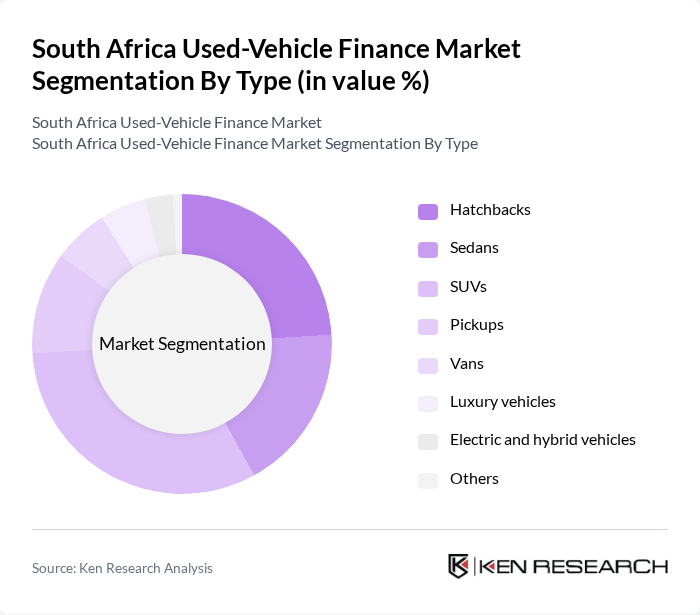
By Type:The used-vehicle finance market is segmented into hatchbacks, sedans, SUVs, pickups, vans, luxury vehicles, electric and hybrid vehicles, and others. Each type addresses distinct consumer needs, with preferences shaped by lifestyle, family requirements, and economic factors. SUVs have become increasingly popular due to their versatility, while hatchbacks and sedans remain staples for urban and budget-conscious buyers. The electric and hybrid segment, though still emerging, is gaining traction as environmental awareness and government incentives grow .
South Africa Used-Vehicle Finance Market segmentation by Type.

The SUV segment is currently dominating the market due to its versatility and rising popularity among consumers seeking both comfort and utility. The shift toward larger vehicles is driven by evolving consumer preferences, with many buyers choosing SUVs for family and recreational use. Increased availability of financing products tailored for SUVs, along with the growing supply of certified pre-owned models, has further strengthened their market position .

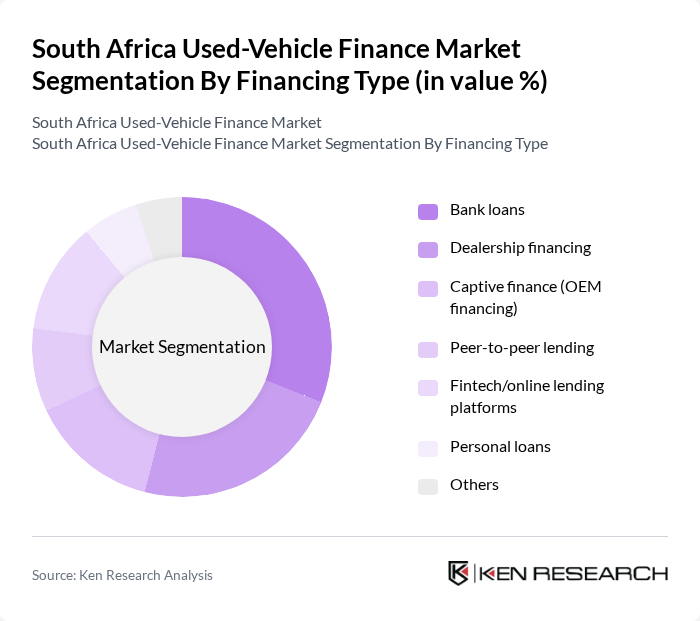
By Financing Type:The financing options available in the used-vehicle finance market include bank loans, dealership financing, captive finance (OEM financing), peer-to-peer lending, fintech/online lending platforms, personal loans, and others. Each financing type offers distinct advantages and targets specific consumer segments. Bank loans remain the preferred option due to their competitive rates and established processes, while fintech platforms and peer-to-peer models are gaining traction among tech-savvy and underserved consumers .
South Africa Used-Vehicle Finance Market segmentation by Financing Type.

Bank loans are the leading financing type in the market, largely due to their established reputation, competitive interest rates, and structured repayment terms. Many consumers prefer traditional bank loans for their reliability and the comprehensive financial guidance provided. The rapid growth of digital banking and online loan application processes has further increased accessibility, while fintech and peer-to-peer lending platforms are expanding the market to new consumer segments .

South Africa Used-Vehicle Finance Market Competitive Landscape

The South Africa Used-Vehicle Finance Market is characterized by a dynamic mix of regional and international players. Leading participants such as ABSA Vehicle and Asset Finance, Standard Bank Vehicle and Asset Finance, Nedbank Vehicle Finance, First National Bank (FNB) WesBank, WesBank (a division of FirstRand Bank), MFC (a division of Nedbank), Toyota Financial Services South Africa, Volkswagen Financial Services South Africa, Mercedes-Benz Financial Services South Africa, BMW Financial Services South Africa, Renault Financial Services South Africa, Hyundai Finance South Africa, Kia Finance South Africa, Isuzu Finance South Africa, Suzuki Finance South Africa, WeBuyCars, AutoTrader South Africa, Motus Group (including Imperial Auto), CMH Group (Combined Motor Holdings), InspectaCar contribute to innovation, geographic expansion, and service delivery in this space.

ABSA Vehicle and Asset Finance

1991

Johannesburg, South Africa

Standard Bank Vehicle and Asset Finance

1862

Johannesburg, South Africa

Nedbank Vehicle Finance

1888

Johannesburg, South Africa

First National Bank (FNB) WesBank

1998

Johannesburg, South Africa

WesBank (a division of FirstRand Bank)

1968

Johannesburg, South Africa

Company

Establishment Year

Headquarters

Group Size (Large, Medium, or Small as per industry convention)

Total Used-Vehicle Finance Portfolio (ZAR)

Market Share in Used-Vehicle Finance (%)

Revenue Growth Rate (YoY %)

Number of Used-Vehicle Loans Disbursed

Average Loan Amount (ZAR)

South Africa Used-Vehicle Finance Market Industry Analysis

Growth Drivers

  • Increasing Demand for Affordable Transportation:The South African used-vehicle market is driven by a significant demand for affordable transportation options. In future, the average price of a used vehicle is projected to be around ZAR 200,000, making it a more accessible choice for many consumers. With approximately 60% of the population relying on public transport, the shift towards personal vehicles is evident, as over 1.5 million used vehicles were sold in future, reflecting a growing trend towards ownership.
  • Growth in the Middle-Class Population:The middle-class population in South Africa is expected to reach 9 million in future, contributing to increased purchasing power. This demographic shift is crucial, as middle-class households typically prioritize vehicle ownership for convenience and status. With a disposable income growth rate of 5% annually, more families are likely to seek financing options for used vehicles, further stimulating the market and enhancing overall economic activity.
  • Expansion of Financing Options:The financing landscape for used vehicles in South Africa is evolving, with a notable increase in available options. In future, it is estimated that over 70% of used vehicle purchases will be financed through loans or credit. This expansion is supported by banks and financial institutions offering competitive interest rates, with average rates around 12% for used vehicles, making financing more accessible and appealing to consumers seeking affordable transportation solutions.

Market Challenges

  • High Interest Rates:One of the significant challenges facing the used-vehicle finance market in South Africa is the prevailing high interest rates. As of future, the average interest rate for vehicle loans is approximately 12%, which can deter potential buyers from financing their purchases. This situation is exacerbated by the South African Reserve Bank's monetary policy aimed at controlling inflation, which has led to increased borrowing costs and reduced consumer spending power.
  • Economic Instability:Economic instability poses a considerable challenge to the used-vehicle finance market. With South Africa's GDP growth projected at only 1% in future, many consumers face uncertainty regarding job security and income stability. This economic environment leads to cautious spending behavior, with many potential buyers delaying vehicle purchases. Consequently, the overall demand for used vehicles and financing options may decline, impacting market growth negatively.

South Africa Used-Vehicle Finance Market Future Outlook

The South African used-vehicle finance market is poised for transformation, driven by technological advancements and changing consumer preferences. As digital financing solutions become more prevalent, the ease of accessing loans will likely increase, attracting a broader customer base. Additionally, the growing interest in electric and hybrid vehicles will shape financing products, catering to environmentally conscious consumers. These trends indicate a dynamic market landscape, where innovation and sustainability will play pivotal roles in shaping future growth.

Market Opportunities

  • Growth in E-commerce for Used Vehicles:The rise of e-commerce platforms for used vehicles presents a significant opportunity. In future, online vehicle sales are expected to account for 25% of total used vehicle transactions, driven by convenience and accessibility. This shift allows financing companies to tap into a broader audience, enhancing their market reach and facilitating seamless transactions through digital financing solutions.
  • Partnerships with Fintech Companies:Collaborating with fintech companies can unlock new financing avenues. In future, partnerships are projected to increase by 30%, enabling traditional financial institutions to leverage innovative technologies. This collaboration can streamline the loan application process, reduce approval times, and enhance customer experiences, ultimately driving growth in the used-vehicle finance sector.

Scope of the Report

SegmentSub-Segments
By Type

Hatchbacks

Sedans

SUVs

Pickups

Vans

Luxury vehicles

Electric and hybrid vehicles

Others

By Financing Type

Bank loans

Dealership financing

Captive finance (OEM financing)

Peer-to-peer lending

Fintech/online lending platforms

Personal loans

Others

By Customer Segment

Individual buyers

Small businesses

Corporate clients

Government agencies

Fleet operators

Others

By Age of Vehicle

3 years

7 years

10 years

+ years

By Purchase Method

Online purchases

In-person dealership purchases

Auctions

Private sales

By Payment Plan

Short-term financing

Long-term financing

Balloon payment plans

Lease-to-own options

By Vendor Type

Organized (dealerships, certified pre-owned, online platforms)

Unorganized (independent dealers, private sellers)

By Region

Gauteng

Western Cape

KwaZulu-Natal

Eastern Cape

Northern Cape

Free State

Mpumalanga

Limpopo

Key Target Audience

Investors and Venture Capitalist Firms

Government and Regulatory Bodies (e.g., National Treasury, Department of Trade, Industry and Competition)

Automobile Manufacturers and Producers

Used Vehicle Dealerships

Financial Institutions (e.g., Banks, Credit Unions)

Insurance Companies

Automotive Industry Associations

Fintech Companies Specializing in Vehicle Financing

Players Mentioned in the Report:

ABSA Vehicle and Asset Finance

Standard Bank Vehicle and Asset Finance

Nedbank Vehicle Finance

First National Bank (FNB) WesBank

WesBank (a division of FirstRand Bank)

MFC (a division of Nedbank)

Toyota Financial Services South Africa

Volkswagen Financial Services South Africa

Mercedes-Benz Financial Services South Africa

BMW Financial Services South Africa

Renault Financial Services South Africa

Hyundai Finance South Africa

Kia Finance South Africa

Isuzu Finance South Africa

Suzuki Finance South Africa

WeBuyCars

AutoTrader South Africa

Motus Group (including Imperial Auto)

CMH Group (Combined Motor Holdings)

InspectaCar

Table of Contents

Market Assessment Phase

1. Executive Summary and Approach


2. South Africa Used-Vehicle Finance Market Overview

2.1 Key Insights and Strategic Recommendations

2.2 South Africa Used-Vehicle Finance Market Overview

2.3 Definition and Scope

2.4 Evolution of Market Ecosystem

2.5 Timeline of Key Regulatory Milestones

2.6 Value Chain & Stakeholder Mapping

2.7 Business Cycle Analysis

2.8 Policy & Incentive Landscape


3. South Africa Used-Vehicle Finance Market Analysis

3.1 Growth Drivers

3.1.1 Increasing demand for affordable transportation
3.1.2 Growth in the middle-class population
3.1.3 Expansion of financing options
3.1.4 Rise in online vehicle sales platforms

3.2 Market Challenges

3.2.1 High interest rates
3.2.2 Economic instability
3.2.3 Limited consumer credit access
3.2.4 Regulatory compliance issues

3.3 Market Opportunities

3.3.1 Growth in e-commerce for used vehicles
3.3.2 Partnerships with fintech companies
3.3.3 Expansion into rural markets
3.3.4 Development of tailored financing products

3.4 Market Trends

3.4.1 Increasing digitalization of financing processes
3.4.2 Shift towards electric and hybrid used vehicles
3.4.3 Enhanced customer experience through technology
3.4.4 Growing importance of sustainability in vehicle choices

3.5 Government Regulation

3.5.1 National Credit Act compliance
3.5.2 Vehicle emissions regulations
3.5.3 Consumer protection laws
3.5.4 Financing disclosure requirements

4. SWOT Analysis


5. Stakeholder Analysis


6. Porter's Five Forces Analysis


7. South Africa Used-Vehicle Finance Market Market Size, 2019-2024

7.1 By Value

7.2 By Volume

7.3 By Average Selling Price


8. South Africa Used-Vehicle Finance Market Segmentation

8.1 By Type

8.1.1 Hatchbacks
8.1.2 Sedans
8.1.3 SUVs
8.1.4 Pickups
8.1.5 Vans
8.1.6 Luxury vehicles
8.1.7 Electric and hybrid vehicles
8.1.8 Others

8.2 By Financing Type

8.2.1 Bank loans
8.2.2 Dealership financing
8.2.3 Captive finance (OEM financing)
8.2.4 Peer-to-peer lending
8.2.5 Fintech/online lending platforms
8.2.6 Personal loans
8.2.7 Others

8.3 By Customer Segment

8.3.1 Individual buyers
8.3.2 Small businesses
8.3.3 Corporate clients
8.3.4 Government agencies
8.3.5 Fleet operators
8.3.6 Others

8.4 By Age of Vehicle

8.4.1 0-3 years
8.4.2 4-7 years
8.4.3 8-10 years
8.4.4 10+ years

8.5 By Purchase Method

8.5.1 Online purchases
8.5.2 In-person dealership purchases
8.5.3 Auctions
8.5.4 Private sales

8.6 By Payment Plan

8.6.1 Short-term financing
8.6.2 Long-term financing
8.6.3 Balloon payment plans
8.6.4 Lease-to-own options

8.7 By Vendor Type

8.7.1 Organized (dealerships, certified pre-owned, online platforms)
8.7.2 Unorganized (independent dealers, private sellers)

8.8 By Region

8.8.1 Gauteng
8.8.2 Western Cape
8.8.3 KwaZulu-Natal
8.8.4 Eastern Cape
8.8.5 Northern Cape
8.8.6 Free State
8.8.7 Mpumalanga
8.8.8 Limpopo

9. South Africa Used-Vehicle Finance Market Competitive Analysis

9.1 Market Share of Key Players

9.2 Cross Comparison of Key Players

9.2.1 Company Name
9.2.2 Group Size (Large, Medium, or Small as per industry convention)
9.2.3 Total Used-Vehicle Finance Portfolio (ZAR)
9.2.4 Market Share in Used-Vehicle Finance (%)
9.2.5 Revenue Growth Rate (YoY %)
9.2.6 Number of Used-Vehicle Loans Disbursed
9.2.7 Average Loan Amount (ZAR)
9.2.8 Non-Performing Loan (NPL) Ratio / Default Rate (%)
9.2.9 Customer Acquisition Cost (ZAR)
9.2.10 Customer Retention Rate (%)
9.2.11 Digital Loan Origination Share (%)
9.2.12 Net Promoter Score (NPS)
9.2.13 Geographic Coverage (Number of Branches/Provinces)
9.2.14 Product Diversification (Number of Financing Products)
9.2.15 Pricing Strategy (Interest Rate Range)

9.3 SWOT Analysis of Top Players

9.4 Pricing Analysis

9.5 Detailed Profile of Major Companies

9.5.1 ABSA Vehicle and Asset Finance
9.5.2 Standard Bank Vehicle and Asset Finance
9.5.3 Nedbank Vehicle Finance
9.5.4 First National Bank (FNB) WesBank
9.5.5 WesBank (a division of FirstRand Bank)
9.5.6 MFC (a division of Nedbank)
9.5.7 Toyota Financial Services South Africa
9.5.8 Volkswagen Financial Services South Africa
9.5.9 Mercedes-Benz Financial Services South Africa
9.5.10 BMW Financial Services South Africa
9.5.11 Renault Financial Services South Africa
9.5.12 Hyundai Finance South Africa
9.5.13 Kia Finance South Africa
9.5.14 Isuzu Finance South Africa
9.5.15 Suzuki Finance South Africa
9.5.16 WeBuyCars
9.5.17 AutoTrader South Africa
9.5.18 Motus Group (including Imperial Auto)
9.5.19 CMH Group (Combined Motor Holdings)
9.5.20 InspectaCar

10. South Africa Used-Vehicle Finance Market End-User Analysis

10.1 Procurement Behavior of Key Ministries

10.1.1 Vehicle procurement policies
10.1.2 Budget allocation for vehicle purchases
10.1.3 Preferred financing options
10.1.4 Evaluation criteria for vehicle selection

10.2 Corporate Spend on Infrastructure & Energy

10.2.1 Investment in fleet upgrades
10.2.2 Financing for energy-efficient vehicles
10.2.3 Budget trends in corporate vehicle financing

10.3 Pain Point Analysis by End-User Category

10.3.1 High financing costs
10.3.2 Limited vehicle availability
10.3.3 Complicated financing processes

10.4 User Readiness for Adoption

10.4.1 Awareness of financing options
10.4.2 Digital literacy levels
10.4.3 Trust in online platforms

10.5 Post-Deployment ROI and Use Case Expansion

10.5.1 Cost savings from financing
10.5.2 Impact on operational efficiency
10.5.3 Opportunities for fleet expansion

11. South Africa Used-Vehicle Finance Market Future Size, 2025-2030

11.1 By Value

11.2 By Volume

11.3 By Average Selling Price


Go-To-Market Strategy Phase

1. Whitespace Analysis + Business Model Canvas

1.1 Market gaps identification

1.2 Value proposition development

1.3 Revenue model exploration

1.4 Customer segment analysis

1.5 Key partnerships identification

1.6 Cost structure assessment

1.7 Competitive advantage analysis


2. Marketing and Positioning Recommendations

2.1 Branding strategies

2.2 Product USPs

2.3 Target audience segmentation

2.4 Communication channels

2.5 Promotional tactics


3. Distribution Plan

3.1 Urban retail strategies

3.2 Rural NGO tie-ups

3.3 Online vs offline distribution

3.4 Partnerships with dealerships


4. Channel & Pricing Gaps

4.1 Underserved routes

4.2 Pricing bands analysis

4.3 Competitor pricing comparison

4.4 Customer willingness to pay


5. Unmet Demand & Latent Needs

5.1 Category gaps identification

5.2 Consumer segments analysis

5.3 Emerging trends exploration


6. Customer Relationship

6.1 Loyalty programs

6.2 After-sales service enhancements

6.3 Customer feedback mechanisms


7. Value Proposition

7.1 Sustainability initiatives

7.2 Integrated supply chains

7.3 Customer-centric offerings


8. Key Activities

8.1 Regulatory compliance

8.2 Branding efforts

8.3 Distribution setup


9. Entry Strategy Evaluation

9.1 Domestic Market Entry Strategy

9.1.1 Product mix considerations
9.1.2 Pricing band strategies
9.1.3 Packaging options

9.2 Export Entry Strategy

9.2.1 Target countries analysis
9.2.2 Compliance roadmap development

10. Entry Mode Assessment

10.1 Joint Ventures

10.2 Greenfield investments

10.3 Mergers & Acquisitions

10.4 Distributor Model


11. Capital and Timeline Estimation

11.1 Capital requirements

11.2 Timelines for market entry


12. Control vs Risk Trade-Off

12.1 Ownership considerations

12.2 Partnerships evaluation


13. Profitability Outlook

13.1 Breakeven analysis

13.2 Long-term sustainability strategies


14. Potential Partner List

14.1 Distributors

14.2 Joint Ventures

14.3 Acquisition targets


15. Execution Roadmap

15.1 Phased Plan for Market Entry

15.1.1 Market Setup
15.1.2 Market Entry
15.1.3 Growth Acceleration
15.1.4 Scale & Stabilize

15.2 Key Activities and Milestones

15.2.1 Activity timelines
15.2.2 Milestone tracking

Research Methodology

ApproachModellingSample

Phase 1: Approach1

Desk Research

  • Analysis of industry reports from South African automotive associations and financial institutions
  • Review of government publications on vehicle financing regulations and market trends
  • Examination of online databases for historical sales data and financing statistics

Primary Research

  • Interviews with financial analysts specializing in automotive finance
  • Surveys conducted with used vehicle dealerships and finance companies
  • Focus groups with consumers who have recently financed used vehicles

Validation & Triangulation

  • Cross-validation of findings with multiple data sources, including trade publications and market surveys
  • Triangulation of insights from primary interviews with secondary data trends
  • Sanity checks through expert panel discussions with industry veterans

Phase 2: Market Size Estimation1

Top-down Assessment

  • Estimation of total vehicle sales in South Africa and percentage financed through loans
  • Analysis of macroeconomic indicators affecting consumer financing behavior
  • Incorporation of demographic trends influencing used vehicle purchases

Bottom-up Modeling

  • Collection of financing terms and conditions from major banks and financial institutions
  • Estimation of average loan amounts and interest rates for used vehicles
  • Calculation of market size based on the number of financed vehicles and average financing terms

Forecasting & Scenario Analysis

  • Multi-variable forecasting using economic growth rates and consumer credit availability
  • Scenario analysis based on potential regulatory changes and market disruptions
  • Development of baseline, optimistic, and pessimistic market growth projections through 2030

Phase 3: CATI Sample Composition1

Scope Item/SegmentSample SizeTarget Respondent Profiles
Used Vehicle Dealerships100Dealership Owners, Sales Managers
Financial Institutions60Loan Officers, Risk Managers
Consumers Financing Used Vehicles120Recent Buyers
Automotive Industry Experts40Market Analysts, Economic Consultants
Regulatory Bodies20Policy Makers, Compliance Officers

Frequently Asked Questions

What is the current value of the South Africa Used-Vehicle Finance Market?

The South Africa Used-Vehicle Finance Market is valued at approximately ZAR 400 billion, driven by increasing consumer demand for affordable mobility and the rising costs of new vehicles. This market has seen significant growth in transaction volumes as consumers seek cost-effective alternatives.

Which cities dominate the South Africa Used-Vehicle Finance Market?

What legislation governs the used-vehicle finance sector in South Africa?

What types of vehicles are financed in the South Africa Used-Vehicle Finance Market?

Other Regional/Country Reports

Indonesia Used-Vehicle Finance Market

Malaysia Used-Vehicle Finance Market

KSA Used-Vehicle Finance Market

APAC Used-Vehicle Finance Market

SEA Used-Vehicle Finance Market

Vietnam Used-Vehicle Finance Market

Other Adjacent Reports

Philippines Used Car Sales Market

Belgium Automotive Insurance Market

Kuwait Vehicle Leasing Market Outlook to 2026F

Belgium Auto Parts Market

Belgium Fintech Lending Market

Brazil Credit Scoring Market

Middle East Electric Vehicle Market Report Size, Share, Growth Drivers, Trends, Opportunities & Forecast 2025–2030

Belgium Automotive Aftermarket Market

APAC car rental market size, share, growth drivers, trends, opportunities & forecast 2025–2030

South Korea Personal Finance Market

Why Buy From Us?

Refine Robust Result (RRR) Framework

What makes us stand out is that our consultants follow Robust, Refine and Result (RRR) methodology. Robust for clear definitions, approaches and sanity checking, Refine for differentiating respondents' facts and opinions, and Result for presenting data with story.

Our Reach Is Unmatched

We have set a benchmark in the industry by offering our clients with syndicated and customized market research reports featuring coverage of entire market as well as meticulous research and analyst insights.

Shifting the Research Paradigm

While we don't replace traditional research, we flip the method upside down. Our dual approach of Top Bottom & Bottom Top ensures quality deliverable by not just verifying company fundamentals but also looking at the sector and macroeconomic factors.

More Insights-Better Decisions

With one step in the future, our research team constantly tries to show you the bigger picture. We help with some of the tough questions you may encounter along the way: How is the industry positioned? Best marketing channel? KPI's of competitors? By aligning every element, we help maximize success.

Transparency and Trust

Our report gives you instant access to the answers and sources that other companies might choose to hide. We elaborate each steps of research methodology we have used and showcase you the sample size to earn your trust.

Round the Clock Support

If you need any support, we are here! We pride ourselves on universe strength, data quality, and quick, friendly, and professional service.

Why Clients Choose Us?

400000+
Reports in repository
150+
Consulting projects a year
100+
Analysts
8000+
Client Queries in 2022








