Japan Digital Remittance and Wallets Market

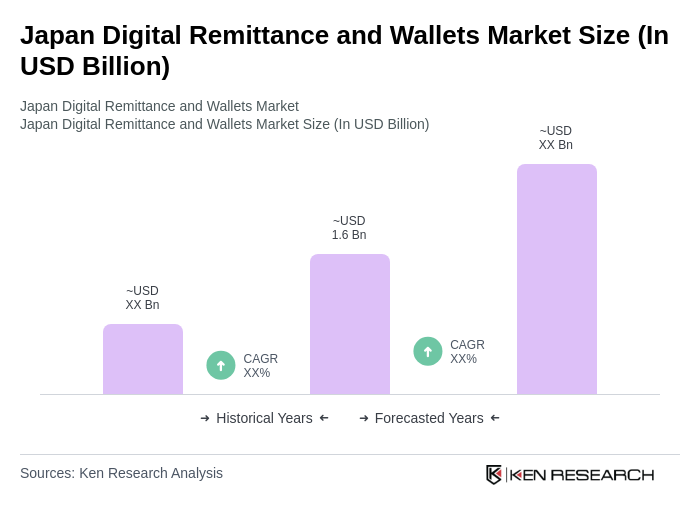
The Japan digital remittance and wallets market, valued at USD 1.6 billion, is growing due to smartphone penetration, cross-border transactions, and fintech innovations.

Region:Asia

Author(s):Rebecca

Product Code:KRAB1688

Pages:90

Published On:October 2025
About the Report

Base Year 2024

Japan Digital Remittance and Wallets Market Overview

  • The Japan Digital Remittance and Wallets Market is valued at USD 1.6 billion, based on a five-year historical analysis. This growth is primarily driven by the increasing adoption of digital payment solutions, the rise of e-commerce, and the growing number of international migrants sending money back home. The convenience, speed, and cost-effectiveness of digital remittance services have significantly contributed to the market's expansion, with fintech innovation and smartphone penetration accelerating user adoption .
  • Tokyo, Osaka, and Yokohama are the dominant cities in the Japan Digital Remittance and Wallets Market. Tokyo, as the capital, serves as a financial hub with a high concentration of technology and financial services. Osaka and Yokohama also benefit from their strategic locations and robust infrastructure, facilitating seamless digital transactions and attracting both local and international players .
  • In 2023, the Japanese government implemented regulations to enhance the security of digital payment systems. The Financial Services Agency (FSA) issued amendments to the Payment Services Act, mandating that all digital wallet providers comply with strict anti-money laundering (AML) and know your customer (KYC) guidelines. These regulations require digital wallet operators to verify customer identities, monitor transactions for suspicious activity, and report certain transactions to authorities, thereby protecting consumers and ensuring the integrity of the financial system .
Japan Digital Remittance and Wallets Market Size

Japan Digital Remittance and Wallets Market Segmentation

By Remittance Type:The remittance type segmentation includes inward and outward digital remittances. Inward digital remittance refers to money sent to Japan from abroad, primarily by foreign workers and expatriates. Outward digital remittance involves funds sent from Japan to other countries, often by Japanese citizens or businesses. The outward segment currently generates the largest revenue, driven by the demand from Japanese residents and businesses transferring funds internationally. However, the inward segment is experiencing the fastest growth, supported by the increasing number of foreign workers in Japan who rely on digital platforms for remitting money back home and the growing acceptance of digital payment methods among the migrant workforce .
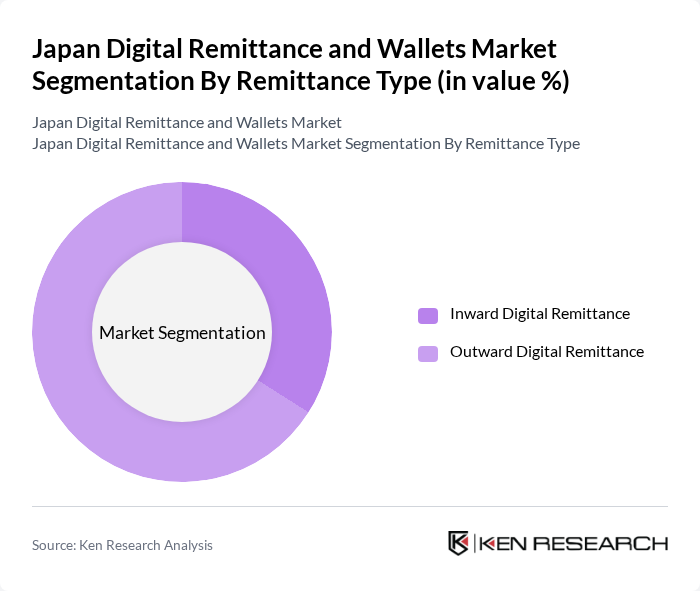
Japan Digital Remittance and Wallets Market segmentation by Remittance Type.

By Channel:The channel segmentation encompasses banks, money transfer operators, online platforms, and others. Banks are traditional players in the remittance market, while money transfer operators provide specialized services for cross-border transactions. Online platforms have gained significant traction due to their convenience, lower fees, and integration with digital wallets. Among these, online platforms are currently leading the market, driven by the increasing preference for digital solutions, the rise of fintech companies offering innovative remittance services, and enhanced user experiences such as multilingual support and instant transfers .
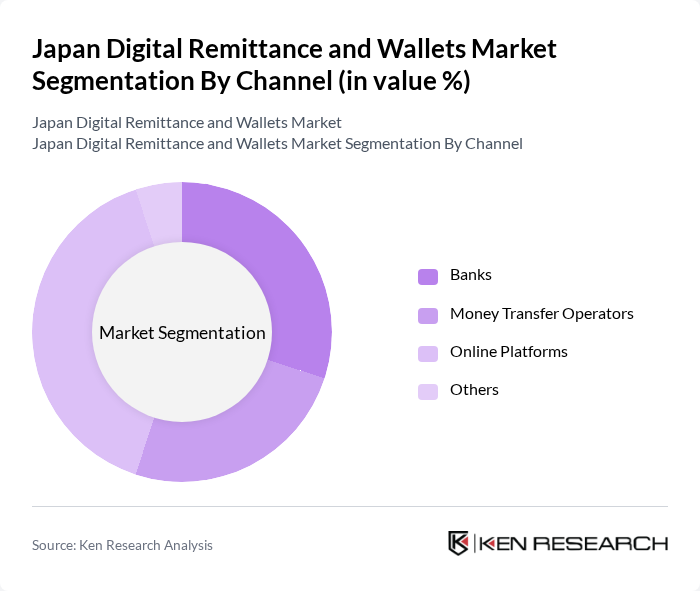
Japan Digital Remittance and Wallets Market segmentation by Channel.

Japan Digital Remittance and Wallets Market Competitive Landscape

The Japan Digital Remittance and Wallets Market is characterized by a dynamic mix of regional and international players. Leading participants such as PayPay Corporation, LINE Pay Corporation, Rakuten Wallet, Inc., SBI Remit Co., Ltd., Wise Japan K.K., MoneyGram Japan, Inc., Western Union Japan K.K., JCB Co., Ltd., NTT Data Corporation, Sumitomo Mitsui Banking Corporation, Mizuho Bank, Ltd., Japan Post Bank Co., Ltd., GMO Payment Gateway, Inc., Aozora Bank, Ltd., Seven Bank, Ltd., Digital Wallet Corporation, Kyodai Remittance (Japan Remit Finance Co., Ltd.), Rakuten Bank, Ltd., PayPal Pte. Ltd. (Japan), and WorldRemit Japan contribute to innovation, geographic expansion, and service delivery in this space .

PayPay Corporation

2018

Tokyo, Japan

LINE Pay Corporation

2014

Tokyo, Japan

Rakuten Wallet, Inc.

2016

Tokyo, Japan

SBI Remit Co., Ltd.

2010

Tokyo, Japan

Wise Japan K.K.

2016

Tokyo, Japan

Company

Establishment Year

Headquarters

Group Size (Large, Medium, or Small as per industry convention)

Customer Acquisition Cost (CAC)

Average Transaction Value (ATV)

Monthly Active Users (MAU)

Customer Retention Rate

Revenue Growth Rate

Japan Digital Remittance and Wallets Market Industry Analysis

Growth Drivers

  • Increasing Smartphone Penetration:As of future, Japan's smartphone penetration rate is projected to reach83%, with approximately104 million users. This widespread adoption facilitates access to digital wallets and remittance services, driving user engagement. The Japan Mobile Phone Association reported that mobile internet usage has surged by20%year-on-year, indicating a growing reliance on mobile devices for financial transactions. This trend is crucial for enhancing the digital remittance landscape, as more consumers opt for mobile solutions.
  • Rising Demand for Cross-Border Transactions:In future, Japan is expected to see a15%increase in cross-border remittances, amounting to approximatelyUSD 45 billioninbound andUSD 7 billionoutbound annually. This growth is driven by the increasing number of Japanese expatriates and foreign workers sending money home. The World Bank estimates that remittances to Japan will continue to rise, reflecting a global trend where remittances are projected to reach$700 billionworldwide. This demand creates significant opportunities for digital remittance services to capture a larger market share.
  • Growth of E-commerce and Online Payments:The e-commerce market in Japan is anticipated to reachUSD 165 billion, with online payment transactions expected to grow by25%. This surge is fueled by the increasing preference for online shopping, especially post-pandemic. According to the Ministry of Economy, Trade and Industry,60%of consumers now prefer digital payment methods over cash. This shift not only enhances the adoption of digital wallets but also drives the need for efficient remittance solutions to support e-commerce transactions.

Market Challenges

  • Regulatory Compliance Complexities:The digital remittance and wallet sector in Japan faces stringent regulatory requirements, including compliance with the Payment Services Act and Anti-Money Laundering (AML) regulations. In future, the Financial Services Agency (FSA) is expected to increase scrutiny on digital wallet providers, leading to potential operational delays and increased costs. Companies may need to allocate up to¥500 millionannually to ensure compliance, which can hinder innovation and market entry for new players.
  • Consumer Trust Issues with Digital Transactions:Despite the growth of digital wallets, consumer trust remains a significant barrier. A survey by the Japan Consumer Affairs Agency indicated that40%of users express concerns about security and fraud in digital transactions. In future, incidents of cyber fraud are projected to increase by30%, further exacerbating these trust issues. Building consumer confidence through enhanced security measures and transparent practices is essential for market growth.

Japan Digital Remittance and Wallets Market Future Outlook

The future of the Japan digital remittance and wallets market appears promising, driven by technological advancements and changing consumer behaviors. As digital payment solutions become more integrated into daily life, the demand for seamless, secure transactions will continue to rise. Additionally, the increasing collaboration between fintech companies and traditional banks is expected to enhance service offerings, making digital remittance more accessible. The adoption of innovative technologies, such as blockchain, will further streamline processes and improve security, positioning the market for sustained growth.

Market Opportunities

  • Expansion of Fintech Solutions:The fintech sector in Japan is projected to grow significantly, with investments expected to reach¥1 trillion. This expansion presents opportunities for digital remittance services to innovate and offer tailored solutions, catering to diverse consumer needs. Enhanced fintech offerings can improve user experience and drive adoption rates among younger demographics, who are more inclined to use digital financial services.
  • Partnerships with Traditional Banks:Collaborations between fintech companies and traditional banks are on the rise, with over50partnerships expected. These alliances can leverage existing banking infrastructure to enhance digital wallet services, providing consumers with greater convenience and security. By integrating digital remittance solutions into traditional banking platforms, companies can tap into a broader customer base and foster trust among users.

Scope of the Report

SegmentSub-Segments
By Remittance Type

Inward Digital Remittance

Outward Digital Remittance

By Channel

Banks

Money Transfer Operators

Online Platforms

Others

By End-User

Migrant Labor Workforce

Personal (Individual Consumers)

Small Businesses

Others

By Payment Method

Bank Transfers

Credit/Debit Cards

Direct Debit

Cash Deposits

By Transaction Type

Domestic Transactions

International Transactions

Remittances

Bill Payments

By Security Features

Two-Factor Authentication

Biometric Verification

Encryption Technologies

Others

By User Demographics

Age Groups

Income Levels

Geographic Distribution

By Customer Loyalty Programs

Cashback Offers

Reward Points

Referral Bonuses

Others

Key Target Audience

Investors and Venture Capitalist Firms

Government and Regulatory Bodies (e.g., Financial Services Agency, Bank of Japan)

Payment Service Providers

Telecommunications Companies

Fintech Startups

Retail Chains and E-commerce Platforms

Payment Processors

Consumer Advocacy Groups

Players Mentioned in the Report:

PayPay Corporation

LINE Pay Corporation

Rakuten Wallet, Inc.

SBI Remit Co., Ltd.

Wise Japan K.K.

MoneyGram Japan, Inc.

Western Union Japan K.K.

JCB Co., Ltd.

NTT Data Corporation

Sumitomo Mitsui Banking Corporation

Mizuho Bank, Ltd.

Japan Post Bank Co., Ltd.

GMO Payment Gateway, Inc.

Aozora Bank, Ltd.

Seven Bank, Ltd.

Digital Wallet Corporation

Kyodai Remittance (Japan Remit Finance Co., Ltd.)

Rakuten Bank, Ltd.

PayPal Pte. Ltd. (Japan)

WorldRemit Japan

Table of Contents

Market Assessment Phase

1. Executive Summary and Approach


2. Japan Digital Remittance and Wallets Market Overview

2.1 Key Insights and Strategic Recommendations

2.2 Japan Digital Remittance and Wallets Market Overview

2.3 Definition and Scope

2.4 Evolution of Market Ecosystem

2.5 Timeline of Key Regulatory Milestones

2.6 Value Chain & Stakeholder Mapping

2.7 Business Cycle Analysis

2.8 Policy & Incentive Landscape


3. Japan Digital Remittance and Wallets Market Analysis

3.1 Growth Drivers

3.1.1 Increasing smartphone penetration
3.1.2 Rising demand for cross-border transactions
3.1.3 Growth of e-commerce and online payments
3.1.4 Enhanced security features in digital wallets

3.2 Market Challenges

3.2.1 Regulatory compliance complexities
3.2.2 High competition among service providers
3.2.3 Consumer trust issues with digital transactions
3.2.4 Technological barriers for older demographics

3.3 Market Opportunities

3.3.1 Expansion of fintech solutions
3.3.2 Partnerships with traditional banks
3.3.3 Increasing remittances from overseas workers
3.3.4 Adoption of blockchain technology

3.4 Market Trends

3.4.1 Shift towards cashless transactions
3.4.2 Integration of AI in customer service
3.4.3 Growth of peer-to-peer payment platforms
3.4.4 Rise of loyalty programs in digital wallets

3.5 Government Regulation

3.5.1 Anti-Money Laundering (AML) regulations
3.5.2 Payment Services Act compliance
3.5.3 Data protection laws
3.5.4 Licensing requirements for digital wallet providers

4. SWOT Analysis


5. Stakeholder Analysis


6. Porter's Five Forces Analysis


7. Japan Digital Remittance and Wallets Market Market Size, 2019-2024

7.1 By Value

7.2 By Volume

7.3 By Average Selling Price


8. Japan Digital Remittance and Wallets Market Segmentation

8.1 By Remittance Type

8.1.1 Inward Digital Remittance
8.1.2 Outward Digital Remittance

8.2 By Channel

8.2.1 Banks
8.2.2 Money Transfer Operators
8.2.3 Online Platforms
8.2.4 Others

8.3 By End-User

8.3.1 Migrant Labor Workforce
8.3.2 Personal (Individual Consumers)
8.3.3 Small Businesses
8.3.4 Others

8.4 By Payment Method

8.4.1 Bank Transfers
8.4.2 Credit/Debit Cards
8.4.3 Direct Debit
8.4.4 Cash Deposits

8.5 By Transaction Type

8.5.1 Domestic Transactions
8.5.2 International Transactions
8.5.3 Remittances
8.5.4 Bill Payments

8.6 By Security Features

8.6.1 Two-Factor Authentication
8.6.2 Biometric Verification
8.6.3 Encryption Technologies
8.6.4 Others

8.7 By User Demographics

8.7.1 Age Groups
8.7.2 Income Levels
8.7.3 Geographic Distribution

8.8 By Customer Loyalty Programs

8.8.1 Cashback Offers
8.8.2 Reward Points
8.8.3 Referral Bonuses
8.8.4 Others

9. Japan Digital Remittance and Wallets Market Competitive Analysis

9.1 Market Share of Key Players

9.2 Cross Comparison of Key Players

9.2.1 Company Name
9.2.2 Group Size (Large, Medium, or Small as per industry convention)
9.2.3 Customer Acquisition Cost (CAC)
9.2.4 Average Transaction Value (ATV)
9.2.5 Monthly Active Users (MAU)
9.2.6 Customer Retention Rate
9.2.7 Revenue Growth Rate
9.2.8 Pricing Structure (Fees, FX Margins, Subscription Models)
9.2.9 Market Penetration Rate
9.2.10 User Satisfaction Score (NPS or Equivalent)
9.2.11 Transaction Processing Speed
9.2.12 Compliance & Regulatory Track Record

9.3 SWOT Analysis of Top Players

9.4 Pricing Analysis

9.5 Detailed Profile of Major Companies

9.5.1 PayPay Corporation
9.5.2 LINE Pay Corporation
9.5.3 Rakuten Wallet, Inc.
9.5.4 SBI Remit Co., Ltd.
9.5.5 Wise Japan K.K.
9.5.6 MoneyGram Japan, Inc.
9.5.7 Western Union Japan K.K.
9.5.8 JCB Co., Ltd.
9.5.9 NTT Data Corporation
9.5.10 Sumitomo Mitsui Banking Corporation
9.5.11 Mizuho Bank, Ltd.
9.5.12 Japan Post Bank Co., Ltd.
9.5.13 GMO Payment Gateway, Inc.
9.5.14 Aozora Bank, Ltd.
9.5.15 Seven Bank, Ltd.
9.5.16 Digital Wallet Corporation
9.5.17 Kyodai Remittance (Japan Remit Finance Co., Ltd.)
9.5.18 Rakuten Bank, Ltd.
9.5.19 PayPal Pte. Ltd. (Japan)
9.5.20 WorldRemit Japan

10. Japan Digital Remittance and Wallets Market End-User Analysis

10.1 Procurement Behavior of Key Ministries

10.1.1 Digital payment adoption rates
10.1.2 Budget allocation for digital services
10.1.3 Collaboration with fintech companies

10.2 Corporate Spend on Infrastructure & Energy

10.2.1 Investment in digital infrastructure
10.2.2 Spending on cybersecurity measures
10.2.3 Budget for employee training on digital tools

10.3 Pain Point Analysis by End-User Category

10.3.1 High transaction fees
10.3.2 Lack of user-friendly interfaces
10.3.3 Security concerns

10.4 User Readiness for Adoption

10.4.1 Awareness of digital wallet benefits
10.4.2 Accessibility of technology
10.4.3 Trust in digital payment systems

10.5 Post-Deployment ROI and Use Case Expansion

10.5.1 Increased transaction volumes
10.5.2 Cost savings from digital processes
10.5.3 Expansion into new markets

11. Japan Digital Remittance and Wallets Market Future Size, 2025-2030

11.1 By Value

11.2 By Volume

11.3 By Average Selling Price


Go-To-Market Strategy Phase

1. Whitespace Analysis + Business Model Canvas

1.1 Market gaps identification

1.2 Value proposition development

1.3 Revenue model exploration

1.4 Customer segment targeting

1.5 Key partnerships and resources

1.6 Cost structure analysis

1.7 Competitive advantage assessment


2. Marketing and Positioning Recommendations

2.1 Branding strategies

2.2 Product USPs

2.3 Target audience engagement

2.4 Digital marketing tactics

2.5 Customer feedback integration


3. Distribution Plan

3.1 Urban retail strategies

3.2 Rural NGO tie-ups

3.3 Online vs offline distribution

3.4 Partnership with local businesses


4. Channel & Pricing Gaps

4.1 Underserved routes

4.2 Pricing bands analysis

4.3 Competitor pricing comparison

4.4 Customer willingness to pay


5. Unmet Demand & Latent Needs

5.1 Category gaps identification

5.2 Consumer segments analysis

5.3 Emerging trends and needs


6. Customer Relationship

6.1 Loyalty programs

6.2 After-sales service

6.3 Customer engagement strategies


7. Value Proposition

7.1 Sustainability initiatives

7.2 Integrated supply chains

7.3 Unique selling points


8. Key Activities

8.1 Regulatory compliance

8.2 Branding efforts

8.3 Distribution setup


9. Entry Strategy Evaluation

9.1 Domestic Market Entry Strategy

9.1.1 Product mix considerations
9.1.2 Pricing band strategy
9.1.3 Packaging options

9.2 Export Entry Strategy

9.2.1 Target countries analysis
9.2.2 Compliance roadmap

10. Entry Mode Assessment

10.1 Joint Ventures

10.2 Greenfield investments

10.3 Mergers & Acquisitions

10.4 Distributor Model


11. Capital and Timeline Estimation

11.1 Capital requirements

11.2 Timelines for market entry


12. Control vs Risk Trade-Off

12.1 Ownership considerations

12.2 Partnerships evaluation


13. Profitability Outlook

13.1 Breakeven analysis

13.2 Long-term sustainability strategies


14. Potential Partner List

14.1 Distributors

14.2 Joint Ventures

14.3 Acquisition targets


15. Execution Roadmap

15.1 Phased Plan for Market Entry

15.1.1 Market Setup
15.1.2 Market Entry
15.1.3 Growth Acceleration
15.1.4 Scale & Stabilize

15.2 Key Activities and Milestones

15.2.1 Activity timelines
15.2.2 Milestone tracking

Research Methodology

ApproachModellingSample

Phase 1: Approach1

Desk Research

  • Analysis of government reports and publications on digital payment trends in Japan
  • Review of industry white papers and market analysis reports from financial institutions
  • Examination of statistical data from the Bank of Japan and other financial regulatory bodies

Primary Research

  • Interviews with executives from leading digital wallet and remittance service providers
  • Surveys targeting consumers using digital remittance services in urban and rural areas
  • Focus group discussions with fintech experts and industry analysts

Validation & Triangulation

  • Cross-validation of findings through multiple data sources including consumer surveys and industry reports
  • Triangulation of qualitative insights from interviews with quantitative data from surveys
  • Sanity checks conducted through expert panel reviews to ensure data reliability

Phase 2: Market Size Estimation1

Top-down Assessment

  • Estimation of total transaction volume in the digital remittance market based on national financial statistics
  • Segmentation of the market by user demographics, including age, income, and geographic location
  • Incorporation of growth rates from related sectors such as e-commerce and mobile banking

Bottom-up Modeling

  • Collection of transaction data from major digital wallet providers to establish baseline metrics
  • Analysis of user adoption rates and transaction frequency across different demographics
  • Estimation of average transaction values to calculate overall market size

Forecasting & Scenario Analysis

  • Development of predictive models using historical growth trends and market drivers
  • Scenario analysis based on potential regulatory changes and technological advancements
  • Creation of multiple forecasts (baseline, optimistic, and pessimistic) through 2030

Phase 3: CATI Sample Composition1

Scope Item/SegmentSample SizeTarget Respondent Profiles
Consumer Digital Wallet Usage120Regular Users, Occasional Users, Non-Users
Remittance Service Providers60Product Managers, Marketing Directors
Fintech Industry Experts40Consultants, Analysts, Academics
Regulatory Bodies Insights45Policy Makers, Compliance Officers
Small Business Owners Using Digital Payments50Business Owners, Financial Managers

Frequently Asked Questions

What is the current value of the Japan Digital Remittance and Wallets Market?

The Japan Digital Remittance and Wallets Market is valued at approximately USD 1.6 billion, reflecting significant growth driven by the adoption of digital payment solutions, e-commerce expansion, and the increasing number of international migrants sending money home.

Which cities dominate the Japan Digital Remittance and Wallets Market?

What regulations has the Japanese government implemented for digital payment systems?

What are the main types of remittances in Japan's digital market?

Other Regional/Country Reports

South Africa Digital Remittance and Wallets MarketItaly Digital Remittance and Wallets Market

Indonesia Digital Remittance and Wallets Market

Malaysia Digital Remittance and Wallets Market

KSA Digital Remittance and Wallets Market

APAC Digital Remittance and Wallets Market

Other Adjacent Reports

Bahrain digital payment solutions market size, share, growth drivers, trends, opportunities & forecast 2025–2030

UAE Fintech Services Market

Belgium Mobile Banking Market

USA E-commerce Payment Market Outlook to 2030

Egypt Cross-Border Payment Market

APAC blockchain technology market Size, Share, Growth Drivers, Trends, Opportunities & Forecast 2025–2030

Thailand Cryptocurrency Exchange Market

Japan Online Money Transfer Market

India Payment Gateway Market Outlook to 2030

South Africa Financial Inclusion Technology Market

Why Buy From Us?

Refine Robust Result (RRR) Framework

What makes us stand out is that our consultants follow Robust, Refine and Result (RRR) methodology. Robust for clear definitions, approaches and sanity checking, Refine for differentiating respondents' facts and opinions, and Result for presenting data with story.

Our Reach Is Unmatched

We have set a benchmark in the industry by offering our clients with syndicated and customized market research reports featuring coverage of entire market as well as meticulous research and analyst insights.

Shifting the Research Paradigm

While we don't replace traditional research, we flip the method upside down. Our dual approach of Top Bottom & Bottom Top ensures quality deliverable by not just verifying company fundamentals but also looking at the sector and macroeconomic factors.

More Insights-Better Decisions

With one step in the future, our research team constantly tries to show you the bigger picture. We help with some of the tough questions you may encounter along the way: How is the industry positioned? Best marketing channel? KPI's of competitors? By aligning every element, we help maximize success.

Transparency and Trust

Our report gives you instant access to the answers and sources that other companies might choose to hide. We elaborate each steps of research methodology we have used and showcase you the sample size to earn your trust.

Round the Clock Support

If you need any support, we are here! We pride ourselves on universe strength, data quality, and quick, friendly, and professional service.

Why Clients Choose Us?

400000+
Reports in repository
150+
Consulting projects a year
100+
Analysts
8000+
Client Queries in 2022








