About the Report
Base Year 2024Listen to the audio summary
Japan Pharmaceutical Contract Manufacturing Services Market Overview
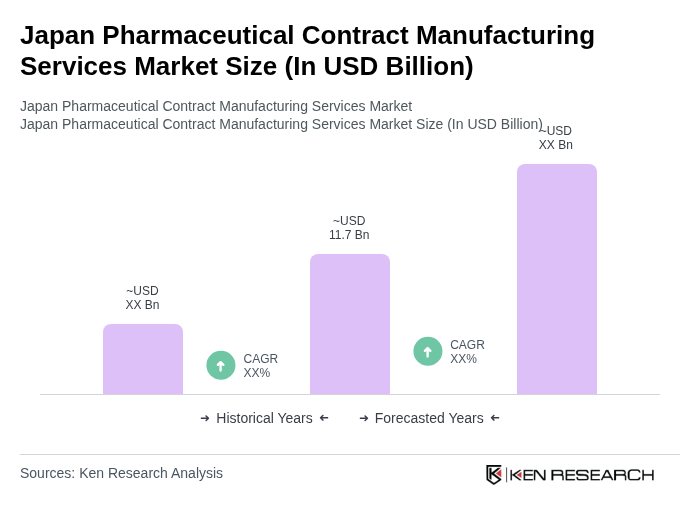
- The Japan Pharmaceutical Contract Manufacturing Services Market is valued at USD 11.7 billion, based on a five-year historical analysis. This growth is primarily driven by the increasing demand for outsourcing manufacturing processes, the rise in the number of pharmaceutical companies, the need for cost-effective production solutions, surging demand for biopharmaceuticals amid an aging population, and focus on advanced therapies such as cell and gene therapies. The market is also supported by advancements in technology including single-use systems and cell culture methods, regulatory compliance, and investments by contract manufacturers to expand facilities and services.
- Key players in this market are concentrated in major urban centers such as Tokyo, Osaka, and Yokohama. These cities dominate due to their robust infrastructure, access to skilled labor, and proximity to leading pharmaceutical companies and research institutions. The presence of advanced manufacturing facilities and a supportive regulatory environment further solidifies their position as leaders in the pharmaceutical contract manufacturing sector.
- The Pharmaceuticals and Medical Devices Agency (PMDA) enforces the Act on Securing Quality, Efficacy and Safety of Products Including Pharmaceuticals and Medical Devices, 2010, issued by the Ministry of Health, Labour and Welfare, which mandates approval processes for manufacturing and marketing authorization holders including contract manufacturers. This regulation requires compliance with Good Manufacturing Practice standards, facility inspections, and post-approval change reporting, thereby encouraging innovation and enhancing the competitiveness of domestic pharmaceutical companies by streamlining quality assurance and fostering growth in the contract manufacturing services sector.
Japan Pharmaceutical Contract Manufacturing Services Market Segmentation
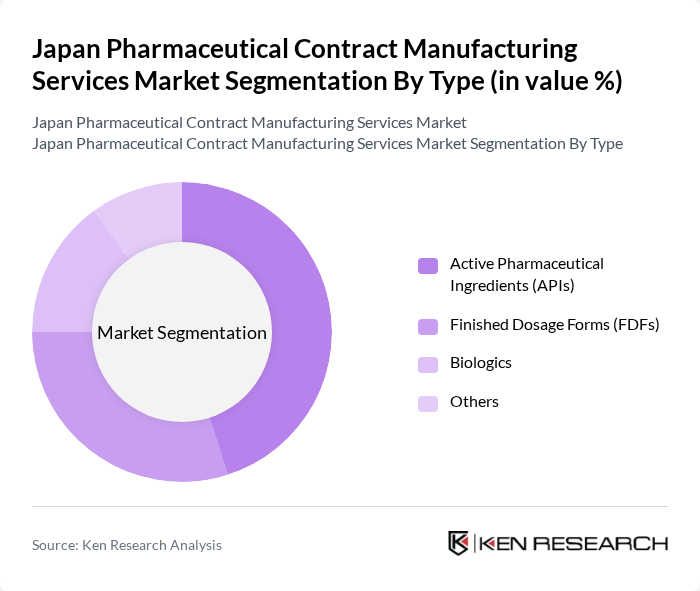
By Type:The market is segmented into Active Pharmaceutical Ingredients (APIs), Finished Dosage Forms (FDFs), Biologics, and Others. Among these, the APIs segment is currently leading the market due to the increasing demand for generic drugs and the growing trend of outsourcing API production to reduce costs. The FDFs segment is also significant, driven by the rising need for customized formulations and packaging solutions. The biologics segment is gaining traction as biopharmaceuticals become more prevalent in treatment protocols for chronic diseases such as diabetes, autoimmune disorders, and cancer.
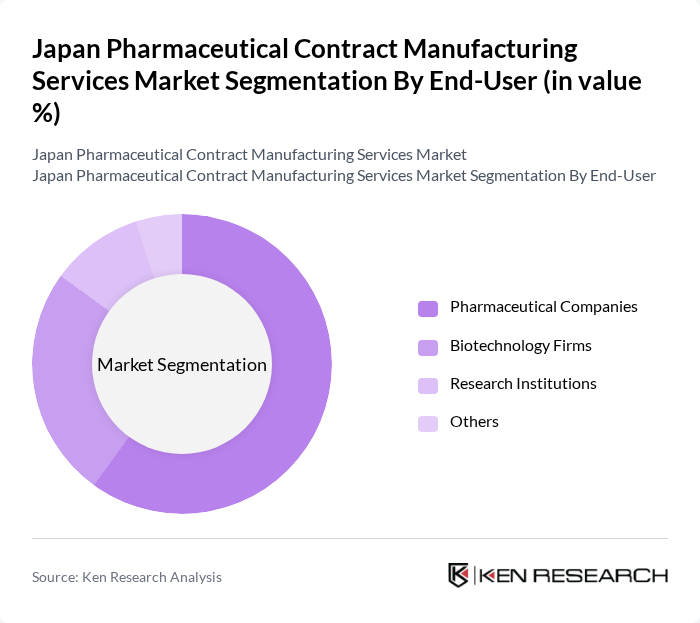
By End-User:The end-user segmentation includes Pharmaceutical Companies, Biotechnology Firms, Research Institutions, and Others. Pharmaceutical companies dominate this segment, driven by their need for reliable manufacturing partners to meet the growing demand for medications. Biotechnology firms are also increasingly outsourcing their manufacturing needs to specialized contract manufacturers to focus on research and development. Research institutions contribute to the market by requiring contract services for clinical trials and product development.
Japan Pharmaceutical Contract Manufacturing Services Market Competitive Landscape
The Japan Pharmaceutical Contract Manufacturing Services Market is characterized by a dynamic mix of regional and international players. Leading participants such as Takeda Pharmaceutical Company Limited, Astellas Pharma Inc., Daiichi Sankyo Company, Limited, Chugai Pharmaceutical Co., Ltd., Otsuka Pharmaceutical Co., Ltd., Mitsubishi Tanabe Pharma Corporation, Sumitomo Dainippon Pharma Co., Ltd., Eisai Co., Ltd., Kyowa Kirin Co., Ltd., Santen Pharmaceutical Co., Ltd., Hoya Corporation, Fujifilm Corporation, A2A Pharmaceuticals, CMIC Holdings Co., Ltd., Nipro Corporation contribute to innovation, geographic expansion, and service delivery in this space.
Japan Pharmaceutical Contract Manufacturing Services Market Industry Analysis
Growth Drivers
- Increasing Demand for Generic Drugs:The Japanese pharmaceutical market is witnessing a significant shift towards generic drugs, with the market size reaching approximately ¥1.6 trillion in future. This growth is driven by the government's initiatives to promote cost-effective healthcare solutions, aiming for a 65% generic drug utilization rate in future. The rising prevalence of chronic diseases and an aging population further fuel this demand, leading to increased outsourcing of manufacturing to meet the growing needs of generic drug production.
- Rising R&D Investments in Pharmaceuticals:Japan's pharmaceutical sector is experiencing a surge in research and development investments, which reached ¥1.3 trillion in future. This increase is attributed to the government's commitment to innovation and the development of new therapies, particularly in oncology and rare diseases. As companies seek to expedite drug development processes, the reliance on contract manufacturing services is expected to grow, allowing firms to focus resources on R&D while outsourcing production capabilities.
- Cost-Effectiveness of Outsourcing Manufacturing:The trend of outsourcing manufacturing is gaining traction in Japan, driven by the need for cost efficiency. Contract manufacturing organizations (CMOs) offer significant savings, with estimates suggesting a reduction in production costs by up to 25%. This financial advantage is particularly appealing to small and medium-sized enterprises (SMEs) that lack the infrastructure for large-scale production. As a result, more pharmaceutical companies are turning to CMOs to enhance their operational efficiency and reduce overhead costs.
Market Challenges
- Stringent Regulatory Compliance:The Japanese pharmaceutical industry faces rigorous regulatory requirements, including compliance with the Pharmaceutical Affairs Law and Good Manufacturing Practices (GMP). In future, the cost of compliance for manufacturers was estimated at ¥250 billion, significantly impacting operational budgets. These stringent regulations can delay product launches and increase the complexity of manufacturing processes, posing a challenge for contract manufacturers striving to meet both local and international standards.
- High Competition Among Contract Manufacturers:The contract manufacturing landscape in Japan is highly competitive, with over 350 registered CMOs vying for market share. This intense competition has led to price wars, driving down profit margins. In future, the average profit margin for CMOs was reported at 4%, a decline from previous years. As companies strive to differentiate themselves, they must invest in advanced technologies and quality assurance to maintain competitiveness in this saturated market.
Japan Pharmaceutical Contract Manufacturing Services Market Future Outlook
The future of the Japan pharmaceutical contract manufacturing services market appears promising, driven by technological advancements and an increasing focus on personalized medicine. As companies adopt automation and digitalization, operational efficiencies are expected to improve significantly. Furthermore, the expansion of biopharmaceuticals and the growing demand for innovative therapies will likely create new avenues for contract manufacturers, enabling them to cater to evolving market needs while maintaining compliance with stringent regulations.
Market Opportunities
- Growth in Personalized Medicine:The rise of personalized medicine presents a substantial opportunity for contract manufacturers. With the market for personalized therapies projected to reach ¥600 billion in future, CMOs can leverage their capabilities to produce tailored treatments, enhancing patient outcomes and driving demand for specialized manufacturing services.
- Technological Advancements in Manufacturing:The integration of advanced technologies, such as artificial intelligence and machine learning, is revolutionizing pharmaceutical manufacturing. In future, it is anticipated that 45% of CMOs will adopt these technologies, leading to improved production efficiency and reduced time-to-market for new drugs, thereby creating a competitive edge in the industry.
Scope of the Report
| Segment | Sub-Segments |
|---|---|
| By Type | Active Pharmaceutical Ingredients (APIs) Finished Dosage Forms (FDFs) Biologics Others |
| By End-User | Pharmaceutical Companies Biotechnology Firms Research Institutions Others |
| By Product Type | Prescription Drugs Over-the-Counter (OTC) Drugs Nutraceuticals Others |
| By Therapeutic Area | Oncology Cardiovascular Neurology Others |
| By Manufacturing Process | Batch Manufacturing Continuous Manufacturing Others |
| By Region | Kanto Kansai Chubu Others |
| By Service Type | Contract Manufacturing Contract Packaging Contract Quality Control Others |
Key Target Audience
Investors and Venture Capitalist Firms
Government and Regulatory Bodies (e.g., Ministry of Health, Labour and Welfare; Pharmaceuticals and Medical Devices Agency)
Pharmaceutical Manufacturers
Biotechnology Companies
Contract Research Organizations (CROs)
Supply Chain and Logistics Providers
Industry Associations (e.g., Japan Pharmaceutical Manufacturers Association)
Financial Institutions and Investment Banks
Players Mentioned in the Report:
Takeda Pharmaceutical Company Limited
Astellas Pharma Inc.
Daiichi Sankyo Company, Limited
Chugai Pharmaceutical Co., Ltd.
Otsuka Pharmaceutical Co., Ltd.
Mitsubishi Tanabe Pharma Corporation
Sumitomo Dainippon Pharma Co., Ltd.
Eisai Co., Ltd.
Kyowa Kirin Co., Ltd.
Santen Pharmaceutical Co., Ltd.
Hoya Corporation
Fujifilm Corporation
A2A Pharmaceuticals
CMIC Holdings Co., Ltd.
Nipro Corporation
Table of Contents
Market Assessment Phase
1. Executive Summary and Approach
2. Japan Pharmaceutical Contract Manufacturing Services Market Overview
2.1 Key Insights and Strategic Recommendations
2.2 Japan Pharmaceutical Contract Manufacturing Services Market Overview
2.3 Definition and Scope
2.4 Evolution of Market Ecosystem
2.5 Timeline of Key Regulatory Milestones
2.6 Value Chain & Stakeholder Mapping
2.7 Business Cycle Analysis
2.8 Policy & Incentive Landscape
3. Japan Pharmaceutical Contract Manufacturing Services Market Analysis
3.1 Growth Drivers
3.1.1 Increasing Demand for Generic Drugs
3.1.2 Rising R&D Investments in Pharmaceuticals
3.1.3 Expansion of Biopharmaceuticals
3.1.4 Cost-Effectiveness of Outsourcing Manufacturing
3.2 Market Challenges
3.2.1 Stringent Regulatory Compliance
3.2.2 High Competition Among Contract Manufacturers
3.2.3 Fluctuating Raw Material Prices
3.2.4 Supply Chain Disruptions
3.3 Market Opportunities
3.3.1 Growth in Personalized Medicine
3.3.2 Technological Advancements in Manufacturing
3.3.3 Expansion into Emerging Markets
3.3.4 Strategic Partnerships and Collaborations
3.4 Market Trends
3.4.1 Increasing Adoption of Automation
3.4.2 Focus on Sustainability in Manufacturing
3.4.3 Shift Towards Digitalization
3.4.4 Growth of Contract Development and Manufacturing Organizations (CDMOs)
3.5 Government Regulation
3.5.1 Good Manufacturing Practices (GMP)
3.5.2 Pharmaceutical Affairs Law
3.5.3 Import and Export Regulations
3.5.4 Environmental Regulations
4. SWOT Analysis
5. Stakeholder Analysis
6. Porter's Five Forces Analysis
7. Japan Pharmaceutical Contract Manufacturing Services Market Size, 2019-2024
7.1 By Value
7.2 By Volume
7.3 By Average Selling Price
8. Japan Pharmaceutical Contract Manufacturing Services Market Segmentation
8.1 By Type
8.1.1 Active Pharmaceutical Ingredients (APIs)
8.1.2 Finished Dosage Forms (FDFs)
8.1.3 Biologics
8.1.4 Others
8.2 By End-User
8.2.1 Pharmaceutical Companies
8.2.2 Biotechnology Firms
8.2.3 Research Institutions
8.2.4 Others
8.3 By Product Type
8.3.1 Prescription Drugs
8.3.2 Over-the-Counter (OTC) Drugs
8.3.3 Nutraceuticals
8.3.4 Others
8.4 By Therapeutic Area
8.4.1 Oncology
8.4.2 Cardiovascular
8.4.3 Neurology
8.4.4 Others
8.5 By Manufacturing Process
8.5.1 Batch Manufacturing
8.5.2 Continuous Manufacturing
8.5.3 Others
8.6 By Region
8.6.1 Kanto
8.6.2 Kansai
8.6.3 Chubu
8.6.4 Others
8.7 By Service Type
8.7.1 Contract Manufacturing
8.7.2 Contract Packaging
8.7.3 Contract Quality Control
8.7.4 Others
9. Japan Pharmaceutical Contract Manufacturing Services Market Competitive Analysis
9.1 Market Share of Key Players
9.2 Cross Comparison of Key Players
9.2.1 Company Name
9.2.2 Group Size (Large, Medium, or Small as per industry convention)
9.2.3 Revenue Growth Rate
9.2.4 Market Penetration Rate
9.2.5 Customer Retention Rate
9.2.6 Operational Efficiency Ratio
9.2.7 Pricing Strategy
9.2.8 Production Capacity Utilization
9.2.9 Quality Control Metrics
9.2.10 Time to Market
9.3 SWOT Analysis of Top Players
9.4 Pricing Analysis
9.5 Detailed Profile of Major Companies
9.5.1 Takeda Pharmaceutical Company Limited
9.5.2 Astellas Pharma Inc.
9.5.3 Daiichi Sankyo Company, Limited
9.5.4 Chugai Pharmaceutical Co., Ltd.
9.5.5 Otsuka Pharmaceutical Co., Ltd.
9.5.6 Mitsubishi Tanabe Pharma Corporation
9.5.7 Sumitomo Dainippon Pharma Co., Ltd.
9.5.8 Eisai Co., Ltd.
9.5.9 Kyowa Kirin Co., Ltd.
9.5.10 Santen Pharmaceutical Co., Ltd.
9.5.11 Hoya Corporation
9.5.12 Fujifilm Corporation
9.5.13 A2A Pharmaceuticals
9.5.14 CMIC Holdings Co., Ltd.
9.5.15 Nipro Corporation
10. Japan Pharmaceutical Contract Manufacturing Services Market End-User Analysis
10.1 Procurement Behavior of Key Ministries
10.1.1 Ministry of Health, Labour and Welfare
10.1.2 Ministry of Economy, Trade and Industry
10.1.3 Ministry of Education, Culture, Sports, Science and Technology
10.1.4 Others
10.2 Corporate Spend on Infrastructure & Energy
10.2.1 Pharmaceutical Infrastructure Investments
10.2.2 Energy Efficiency Initiatives
10.2.3 Technology Upgrades
10.2.4 Others
10.3 Pain Point Analysis by End-User Category
10.3.1 Cost Management
10.3.2 Regulatory Compliance Challenges
10.3.3 Quality Assurance Issues
10.3.4 Others
10.4 User Readiness for Adoption
10.4.1 Awareness of Contract Manufacturing Benefits
10.4.2 Training and Skill Development Needs
10.4.3 Technology Adoption Readiness
10.4.4 Others
10.5 Post-Deployment ROI and Use Case Expansion
10.5.1 Measurement of ROI
10.5.2 Scalability of Solutions
10.5.3 Long-term Partnerships
10.5.4 Others
11. Japan Pharmaceutical Contract Manufacturing Services Market Future Size, 2025-2030
11.1 By Value
11.2 By Volume
11.3 By Average Selling Price
Go-To-Market Strategy Phase
1. Whitespace Analysis + Business Model Canvas
1.1 Market Gaps Identification
1.2 Business Model Development
2. Marketing and Positioning Recommendations
2.1 Branding Strategies
2.2 Product USPs
3. Distribution Plan
3.1 Urban Retail Strategies
3.2 Rural NGO Tie-ups
4. Channel & Pricing Gaps
4.1 Underserved Routes
4.2 Pricing Bands
5. Unmet Demand & Latent Needs
5.1 Category Gaps
5.2 Consumer Segments
6. Customer Relationship
6.1 Loyalty Programs
6.2 After-sales Service
7. Value Proposition
7.1 Sustainability Initiatives
7.2 Integrated Supply Chains
8. Key Activities
8.1 Regulatory Compliance
8.2 Branding Efforts
8.3 Distribution Setup
9. Entry Strategy Evaluation
9.1 Domestic Market Entry Strategy
9.1.1 Product Mix Considerations
9.1.2 Pricing Band Strategy
9.1.3 Packaging Solutions
9.2 Export Entry Strategy
9.2.1 Target Countries Identification
9.2.2 Compliance Roadmap Development
10. Entry Mode Assessment
10.1 Joint Ventures
10.2 Greenfield Investments
10.3 Mergers & Acquisitions
10.4 Distributor Model
11. Capital and Timeline Estimation
11.1 Capital Requirements
11.2 Timelines for Implementation
12. Control vs Risk Trade-Off
12.1 Ownership Considerations
12.2 Partnerships Evaluation
13. Profitability Outlook
13.1 Breakeven Analysis
13.2 Long-term Sustainability Strategies
14. Potential Partner List
14.1 Distributors
14.2 Joint Ventures
14.3 Acquisition Targets
15. Execution Roadmap
15.1 Phased Plan for Market Entry
15.1.1 Market Setup
15.1.2 Market Entry
15.1.3 Growth Acceleration
15.1.4 Scale & Stabilize
15.2 Key Activities and Milestones
15.2.1 Milestone Planning
15.2.2 Activity Tracking
Research Methodology
Phase 1: Approach1
Desk Research
- Analysis of industry reports from Japanese pharmaceutical associations and market research firms
- Review of regulatory frameworks and guidelines from the Ministry of Health, Labour and Welfare (MHLW) in Japan
- Examination of published financial reports and press releases from leading contract manufacturing organizations (CMOs) in Japan
Primary Research
- In-depth interviews with executives from major pharmaceutical companies utilizing contract manufacturing services
- Surveys targeting quality assurance and regulatory affairs professionals within CMOs
- Field interviews with production managers at pharmaceutical manufacturing facilities
Validation & Triangulation
- Cross-validation of data through multiple sources including industry publications and expert opinions
- Triangulation of findings from primary interviews with secondary data trends
- Sanity checks conducted through expert panel discussions and feedback sessions
Phase 2: Market Size Estimation1
Top-down Assessment
- Estimation of market size based on national pharmaceutical sales and contract manufacturing share
- Segmentation by therapeutic areas and types of manufacturing services offered
- Incorporation of growth rates from historical data and projected industry trends
Bottom-up Modeling
- Collection of data on production capacities and service offerings from key CMOs
- Operational cost analysis based on service pricing and contract terms
- Volume estimates derived from client contracts and service agreements
Forecasting & Scenario Analysis
- Multi-variable regression analysis incorporating factors such as R&D spending and market entry of new drugs
- Scenario modeling based on potential regulatory changes and shifts in outsourcing trends
- Development of baseline, optimistic, and pessimistic forecasts through 2030
Phase 3: CATI Sample Composition1
| Scope Item/Segment | Sample Size | Target Respondent Profiles |
|---|---|---|
| Pharmaceutical Manufacturing Services | 120 | Production Managers, Quality Control Officers |
| Biopharmaceutical Contract Services | 100 | R&D Directors, Regulatory Affairs Managers |
| API Manufacturing | 80 | Procurement Managers, Supply Chain Analysts |
| Packaging and Labeling Services | 70 | Packaging Engineers, Compliance Officers |
| Clinical Trial Material Production | 90 | Clinical Operations Managers, Project Managers |
Frequently Asked Questions
What is the current value of the Japan Pharmaceutical Contract Manufacturing Services Market?
The Japan Pharmaceutical Contract Manufacturing Services Market is valued at approximately USD 11.7 billion, reflecting a significant growth driven by increased outsourcing, the rise of pharmaceutical companies, and the demand for biopharmaceuticals and advanced therapies.
What factors are driving growth in the Japan Pharmaceutical Contract Manufacturing Services Market?
Which cities in Japan are major hubs for pharmaceutical contract manufacturing?
What are the main segments of the Japan Pharmaceutical Contract Manufacturing Services Market?
Other Regional/Country Reports
Other Adjacent Reports
South Korea Biopharmaceutical Manufacturing Market
UAE Generic Drugs MarketQatar Cell Therapy Market Report Size Share Growth Drivers Trends Opportunities & Forecast 2025–2030Kuwait Gene Therapy Market Report Size Share Growth Drivers Trends Opportunities & Forecast 2025–2030Indonesia Active Pharmaceutical Ingredients Market Size, Share & Forecast, By API Type, Synthesis Type & Therapeutic Area, 2026-2031Egypt Finished Dosage Forms Market
Saudi Arabia biotechnology market Size, Share, Growth Drivers, Trends, Opportunities & Forecast 2025–2030Global Pharmaceutical Packaging Market Size, Share & Forecast, By Packaging Type, Material & Drug Delivery Mode, 2025-2032South Africa Clinical Trial Services Market
US personalized medicine market Size, Share, Growth Drivers, Trends, Opportunities & Forecast 2025–2030Why Buy From Us?

What makes us stand out is that our consultants follow Robust, Refine and Result (RRR) methodology. Robust for clear definitions, approaches and sanity checking, Refine for differentiating respondents' facts and opinions, and Result for presenting data with story.

We have set a benchmark in the industry by offering our clients with syndicated and customized market research reports featuring coverage of entire market as well as meticulous research and analyst insights.

While we don't replace traditional research, we flip the method upside down. Our dual approach of Top Bottom & Bottom Top ensures quality deliverable by not just verifying company fundamentals but also looking at the sector and macroeconomic factors.

With one step in the future, our research team constantly tries to show you the bigger picture. We help with some of the tough questions you may encounter along the way: How is the industry positioned? Best marketing channel? KPI's of competitors? By aligning every element, we help maximize success.

Our report gives you instant access to the answers and sources that other companies might choose to hide. We elaborate each steps of research methodology we have used and showcase you the sample size to earn your trust.

If you need any support, we are here! We pride ourselves on universe strength, data quality, and quick, friendly, and professional service.