About the Report
Base Year 2024KSA Alkaline Water Electrolysis Market Overview
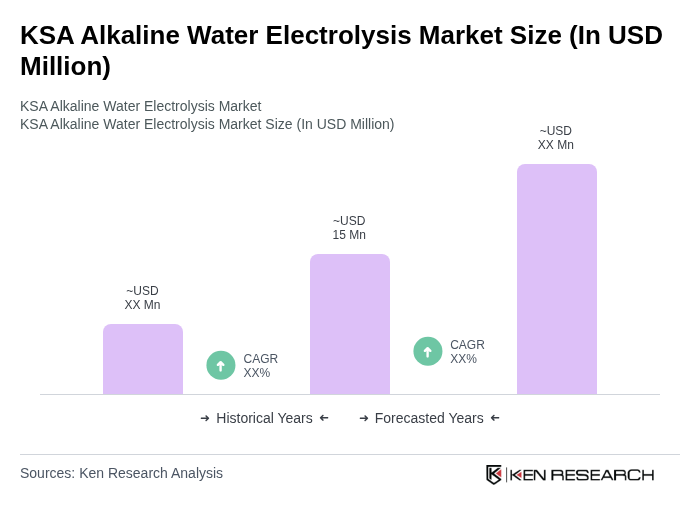
- The KSA Alkaline Water Electrolysis Market is valued at USD 15 million, based on a five-year historical analysis. This growth is primarily driven by the increasing demand for green hydrogen production and the government's commitment to diversifying energy sources. The market is also supported by advancements in electrolyzer technology, which enhance efficiency and reduce operational costs.
- Key cities such as Riyadh, Jeddah, and Dammam dominate the market due to their strategic locations and robust industrial infrastructure. These cities are hubs for energy and chemical industries, which are significant consumers of alkaline water electrolysis technology, thereby driving market growth. The NEOM region has emerged as a critical hub for hydrogen infrastructure development, hosting the flagship NEOM Green Hydrogen Project, which reached 80% construction completion as of early 2025.
- The Saudi government has established a comprehensive regulatory framework promoting renewable energy technologies, including alkaline water electrolysis, as part of its National Hydrogen Strategy. This framework includes incentives for investments in green hydrogen projects and aims to position Saudi Arabia as a leader in the global hydrogen economy. The Kingdom plans to produce 4 million tonnes of clean hydrogen annually by 2030, capturing over 27 million tonnes of CO?e in the process.
KSA Alkaline Water Electrolysis Market Segmentation
By Type (Production Capacity):The market is segmented based on production capacity, which includes various ranges of output. The subsegments include <10 m³/h, <30 m³/h, <50 m³/h, <80 m³/h, and ?80 m³/h. Each of these subsegments caters to different industrial needs, with larger capacities being favored for extensive industrial applications.
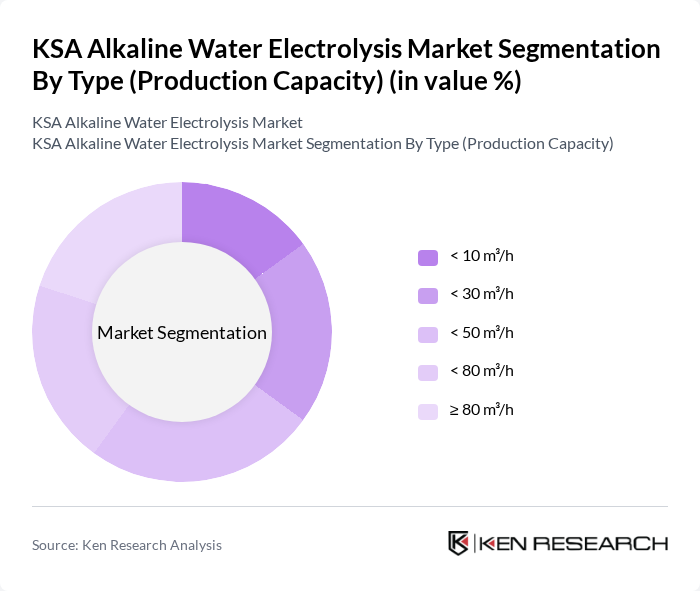
The subsegment of <50 m³/h is currently dominating the market due to its versatility and suitability for various industrial applications, including chemical production and energy storage. This capacity range is particularly favored by small to medium enterprises that require efficient and cost-effective solutions for hydrogen production. The growing trend towards sustainable energy solutions is further propelling the demand for this capacity range, making it a key player in the market.
By End-User:The market is segmented based on end-users, which include Industrial (Refining and Chemical Production), Power & Utilities, Chemical Manufacturing, Transportation & Mobility, and Others. Each end-user segment has distinct requirements and applications for alkaline water electrolysis technology.
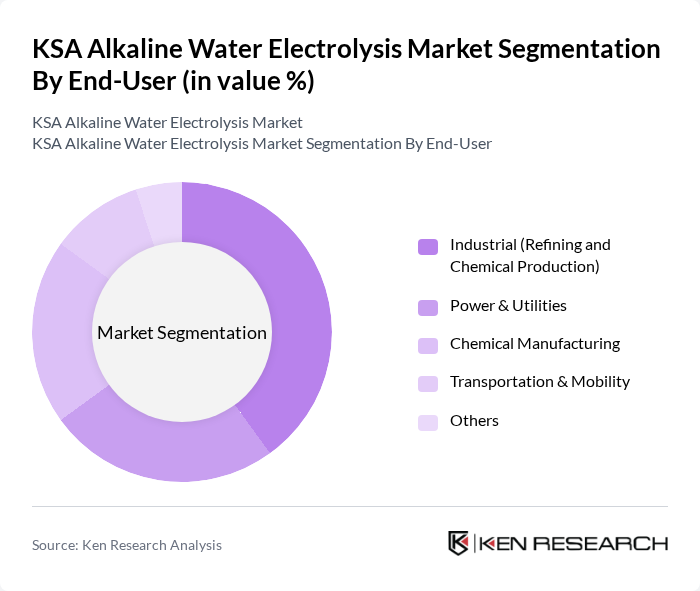
The Industrial (Refining and Chemical Production) segment leads the market due to the high demand for hydrogen in refining processes and chemical production. This sector's growth is driven by the increasing need for cleaner production methods and the transition towards sustainable energy sources. The significant investments in refining capacity and chemical production facilities in Saudi Arabia further bolster this segment's dominance. Large-scale projects such as the NEOM Green Hydrogen Project, designed to produce 600 tonnes of green hydrogen daily, exemplify the Kingdom's commitment to scaling hydrogen infrastructure for industrial applications.
KSA Alkaline Water Electrolysis Market Competitive Landscape
The KSA Alkaline Water Electrolysis Market is characterized by a dynamic mix of regional and international players. Leading participants such as Nel ASA, Thyssenkrupp Nucera, Cummins Inc., McPhy Energy, Asahi Kasei, Peric Hydrogen, Siemens AG, Linde AG, Air Products and Chemicals, Inc., Hydrogenics Corporation contribute to innovation, geographic expansion, and service delivery in this space.
KSA Alkaline Water Electrolysis Market Industry Analysis
Growth Drivers
- Expansion of Industrial-Scale Hydrogen Projects:The Kingdom of Saudi Arabia (KSA) is investing approximately $5 billion in industrial-scale hydrogen projects in the future, driven by the global shift towards sustainable energy. This investment is expected to create over 10,000 jobs and significantly boost the local economy. The establishment of hydrogen production hubs, particularly in NEOM, is anticipated to enhance the demand for alkaline water electrolysis technology, positioning KSA as a leader in green hydrogen production.
- Technological Advancements in Electrolyzer Efficiency:Recent advancements in electrolyzer technology have led to efficiency improvements, with new systems achieving up to 70% energy conversion rates. This increase in efficiency is crucial as it reduces operational costs, making hydrogen production more economically viable. The adoption of advanced materials and innovative designs is projected to lower the cost of electrolyzers by 20% in the future, further driving market growth in KSA.
- Government Decarbonization and Vision 2030 Initiatives:KSA's Vision 2030 aims to diversify the economy and reduce dependence on oil, with a target of generating 58.7 GW of renewable energy in the future. The government has allocated $1.5 billion for hydrogen-related projects, promoting the use of green hydrogen in various sectors. This commitment is expected to create a favorable regulatory environment, encouraging investments in alkaline water electrolysis technologies and infrastructure.
Market Challenges
- High Capital Investment Requirements for Large-Scale Projects:The initial capital investment for large-scale alkaline water electrolysis projects can exceed $100 million, posing a significant barrier to entry for many companies. This high cost is primarily due to the advanced technology and infrastructure required. As a result, only a limited number of players can afford to invest, which may slow down the overall market growth in KSA.
- Limited Local Electrolyzer Manufacturing Capacity:KSA currently lacks sufficient local manufacturing capacity for electrolyzers, relying heavily on imports. In the recent past, local production accounted for only 15% of the total electrolyzer demand. This dependency on foreign suppliers can lead to supply chain vulnerabilities and increased costs, hindering the growth of the alkaline water electrolysis market in the region.
KSA Alkaline Water Electrolysis Market Future Outlook
The KSA alkaline water electrolysis market is poised for significant growth, driven by increasing investments in hydrogen infrastructure and technological advancements. In the future, the integration of renewable energy sources with hydrogen production is expected to become more prevalent, enhancing the sustainability of the sector. Additionally, the government's commitment to decarbonization initiatives will likely foster a supportive regulatory environment, encouraging further innovation and investment in this emerging market.
Market Opportunities
- Mega-Project Development in Hydrogen Production Hubs:The establishment of mega-projects in regions like NEOM presents a significant opportunity for the alkaline water electrolysis market. These projects are expected to attract over $10 billion in investments, creating a robust ecosystem for hydrogen production and distribution, thereby enhancing local manufacturing capabilities.
- Strategic Partnerships with International Technology Providers:Collaborations with global technology leaders can facilitate knowledge transfer and access to advanced electrolyzer technologies. Such partnerships are projected to enhance local capabilities, reduce costs, and improve the overall efficiency of hydrogen production processes in KSA, positioning the country as a competitive player in the global market.
Scope of the Report
| Segment | Sub-Segments |
|---|---|
| By Type (Production Capacity) | < 10 m³/h < 30 m³/h < 50 m³/h < 80 m³/h ? 80 m³/h |
| By End-User | Industrial (Refining and Chemical Production) Power & Utilities Chemical Manufacturing Transportation & Mobility Others |
| By Application | Green Hydrogen Production Ammonia Production Energy Storage Power-to-Gas Others |
| By Distribution Channel | Direct Sales EPC Contractors Distributors Others |
| By Region | Central Region Eastern Region Western Region Southern Region |
| By Investment Source | Domestic Investments Foreign Direct Investments (FDI) Public-Private Partnerships (PPP) Government Schemes |
Key Target Audience
Investors and Venture Capitalist Firms
Government and Regulatory Bodies (e.g., Saudi Arabian Standards Organization, Ministry of Energy)
Manufacturers and Producers of Electrolysis Equipment
Water Treatment and Purification Companies
Energy Providers and Utilities
Environmental NGOs and Advocacy Groups
Industry Associations (e.g., Saudi Water Partnership Company)
Financial Institutions and Banks
Players Mentioned in the Report:
Nel ASA
Thyssenkrupp Nucera
Cummins Inc.
McPhy Energy
Asahi Kasei
Peric Hydrogen
Siemens AG
Linde AG
Air Products and Chemicals, Inc.
Hydrogenics Corporation
Table of Contents
Market Assessment Phase
1. Executive Summary and Approach
2. KSA Alkaline Water Electrolysis Market Overview
2.1 Key Insights and Strategic Recommendations
2.2 KSA Alkaline Water Electrolysis Market Overview
2.3 Definition and Scope
2.4 Evolution of Market Ecosystem
2.5 Timeline of Key Regulatory Milestones
2.6 Value Chain & Stakeholder Mapping
2.7 Business Cycle Analysis
2.8 Policy & Incentive Landscape
3. KSA Alkaline Water Electrolysis Market Analysis
3.1 Growth Drivers
3.1.1 Expansion of Industrial-Scale Hydrogen Projects
3.1.2 Technological Advancements in Electrolyzer Efficiency
3.1.3 Government Decarbonization and Vision 2030 Initiatives
3.1.4 Rising Demand for Green Hydrogen in Refining and Chemical Production
3.2 Market Challenges
3.2.1 High Capital Investment Requirements for Large-Scale Projects
3.2.2 Limited Local Electrolyzer Manufacturing Capacity
3.2.3 Regulatory Framework Development for Hydrogen Infrastructure
3.2.4 Competition from Established Fossil Fuel-Based Processes
3.3 Market Opportunities
3.3.1 Mega-Project Development in Hydrogen Production Hubs
3.3.2 Strategic Partnerships with International Technology Providers
3.3.3 Development of Advanced Pressurized Electrolyzer Systems
3.3.4 Export Potential for Green Hydrogen to Global Markets
3.4 Market Trends
3.4.1 Shift Towards Higher Capacity Electrolyzers (?80 m³/h)
3.4.2 Integration of Renewable Energy with Hydrogen Production
3.4.3 Growing Adoption in Power-to-Gas and Energy Storage Applications
3.4.4 Increasing Use of Advanced Automation and Control Systems
3.5 Government Regulation
3.5.1 Hydrogen Production Standards and Safety Compliance
3.5.2 Incentives for Renewable Energy Integration
3.5.3 Environmental Impact Assessment Requirements
3.5.4 Licensing and Permitting for Hydrogen Infrastructure Projects
4. SWOT Analysis
5. Stakeholder Analysis
6. Porter's Five Forces Analysis
7. KSA Alkaline Water Electrolysis Market Size, 2019-2024
7.1 By Value
7.2 By Volume
7.3 By Average Selling Price
8. KSA Alkaline Water Electrolysis Market Segmentation
8.1 By Type (Production Capacity)
8.1.1 < 10 m³/h
8.1.2 < 30 m³/h
8.1.3 < 50 m³/h
8.1.4 < 80 m³/h
8.1.5 ? 80 m³/h
8.2 By End-User
8.2.1 Industrial (Refining and Chemical Production)
8.2.2 Power & Utilities
8.2.3 Chemical Manufacturing
8.2.4 Transportation & Mobility
8.2.5 Others
8.3 By Application
8.3.1 Green Hydrogen Production
8.3.2 Ammonia Production
8.3.3 Energy Storage
8.3.4 Power-to-Gas
8.3.5 Others
8.4 By Distribution Channel
8.4.1 Direct Sales
8.4.2 EPC Contractors
8.4.3 Distributors
8.4.4 Others
8.5 By Region
8.5.1 Central Region
8.5.2 Eastern Region
8.5.3 Western Region
8.5.4 Southern Region
8.6 By Investment Source
8.6.1 Domestic Investments
8.6.2 Foreign Direct Investments (FDI)
8.6.3 Public-Private Partnerships (PPP)
8.6.4 Government Schemes
9. KSA Alkaline Water Electrolysis Market Competitive Analysis
9.1 Market Share of Key Players
9.2 Cross Comparison of Key Players
9.2.1 Company Name
9.2.2 Company Size Classification (Large, Medium, or Small)
9.2.3 Revenue Growth Rate (CAGR %)
9.2.4 Electrolyzer Capacity Portfolio (m³/h Range)
9.2.5 Geographic Market Presence
9.2.6 Technology Differentiation (Atmospheric vs Pressurized)
9.2.7 Project Pipeline and Order Book
9.2.8 Operational Efficiency Ratio (Capacity Utilization %)
9.2.9 Strategic Partnerships and Collaborations
9.2.10 R&D Investment and Innovation Index
9.3 SWOT Analysis of Top Players
9.4 Pricing Analysis
9.5 Detailed Profile of Major Companies
9.5.1 Nel ASA
9.5.2 Thyssenkrupp Nucera
9.5.3 Cummins Inc.
9.5.4 McPhy Energy
9.5.5 Asahi Kasei
9.5.6 Peric Hydrogen
9.5.7 Siemens AG
9.5.8 Linde AG
9.5.9 Air Products and Chemicals, Inc.
9.5.10 Hydrogenics Corporation
10. KSA Alkaline Water Electrolysis Market End-User Analysis
10.1 Procurement Behavior of Key Ministries and Government Entities
10.1.1 Budget Allocation for Hydrogen Infrastructure Projects
10.1.2 Decision-Making Processes and Approval Timelines
10.1.3 Supplier Selection Criteria and Technical Requirements
10.1.4 Contracting Procedures and Tender Processes
10.2 Corporate Spend on Hydrogen Infrastructure & Energy
10.2.1 Investment Trends in Green Hydrogen Projects
10.2.2 Energy Consumption and Renewable Integration Patterns
10.2.3 Budgeting for Decarbonization Initiatives
10.2.4 Corporate Sustainability and ESG Spending
10.3 Pain Point Analysis by End-User Category
10.3.1 Technology Reliability and Performance Concerns
10.3.2 Infrastructure and Grid Integration Challenges
10.3.3 Capital Intensity and Cost-Effectiveness
10.3.4 Regulatory Compliance and Permitting Challenges
10.4 User Readiness for Adoption
10.4.1 Technical Expertise and Awareness Levels
10.4.2 Training and Operational Support Needs
10.4.3 Infrastructure Readiness for Integration
10.4.4 Financial Readiness and Funding Availability
10.5 Post-Deployment ROI and Use Case Expansion
10.5.1 Hydrogen Production Performance Metrics
10.5.2 Operational Satisfaction and System Reliability
10.5.3 Potential for Capacity Upscaling
10.5.4 Long-term Cost Savings and Payback Period
11. KSA Alkaline Water Electrolysis Market Future Size, 2025-2030
11.1 By Value
11.2 By Volume
11.3 By Average Selling Price
Go-To-Market Strategy Phase
1. Whitespace Analysis + Business Model Canvas
1.1 Market Gaps Identification
1.2 Business Model Framework
2. Marketing and Positioning Recommendations
2.1 Branding Strategies
2.2 Product USPs
3. Distribution Plan
3.1 Direct Sales vs EPC Contractor Partnerships
4. Channel & Pricing Gaps
4.1 Underserved Routes
4.2 Pricing Bands
5. Unmet Demand & Latent Needs
5.1 Category Gaps
5.2 End-User Segments
6. Customer Relationship
6.1 Long-term Service Agreements
6.2 Technical Support and Maintenance
7. Value Proposition
7.1 Green Hydrogen Production Efficiency
7.2 Integrated Supply Chains and Project Delivery
8. Key Activities
8.1 Regulatory Compliance and Certifications
8.2 Technology Positioning and Differentiation
8.3 Distribution and Partnership Setup
9. Entry Strategy Evaluation
9.1 Domestic Market Entry Strategy
9.1.1 Electrolyzer Product Mix and Capacity Range
9.1.2 Pricing Band and Commercial Terms
9.1.3 Packaging and Delivery Model
9.2 Export Entry Strategy
9.2.1 Target Countries in MEA and Asia Pacific
9.2.2 Compliance Roadmap and Certifications
10. Entry Mode Assessment
10.1 Joint Ventures with Local Partners
10.2 Greenfield Investments in Manufacturing
10.3 Mergers & Acquisitions of Local Players
10.4 EPC Contractor and Distributor Model
11. Capital and Timeline Estimation
11.1 Capital Requirements
11.2 Timelines
12. Control vs Risk Trade-Off
12.1 Ownership vs Partnerships
13. Profitability Outlook
13.1 Breakeven Analysis
13.2 Long-term Sustainability
14. Potential Partner List
14.1 EPC Contractors and System Integrators
14.2 Joint Venture Partners
14.3 Acquisition Targets
15. Execution Roadmap
15.1 Phased Plan for Market Entry
15.1.1 Market Setup and Regulatory Approvals
15.1.2 Market Entry and Pilot Projects
15.1.3 Growth Acceleration and Capacity Expansion
15.1.4 Scale & Stabilize Operations
15.2 Key Activities and Milestones
15.2.1 Milestone Planning and KPIs
15.2.2 Activity Tracking and Performance Monitoring
Research Methodology
Phase 1: Approach1
Desk Research
- Analysis of industry reports from relevant KSA government agencies and international organizations
- Review of academic journals and publications focusing on alkaline water electrolysis technologies
- Examination of market trends and forecasts from specialized energy and water treatment publications
Primary Research
- Interviews with industry experts, including engineers and researchers in electrolysis technology
- Surveys targeting decision-makers in water treatment facilities and renewable energy sectors
- Field interviews with operational managers at alkaline water electrolysis plants
Validation & Triangulation
- Cross-validation of findings through multiple data sources, including trade publications and government statistics
- Triangulation of insights from primary interviews with secondary data trends
- Sanity checks conducted through expert panel reviews to ensure data accuracy
Phase 2: Market Size Estimation1
Top-down Assessment
- Estimation of the total addressable market based on national water consumption and energy policies
- Segmentation of the market by application areas such as residential, commercial, and industrial uses
- Incorporation of government initiatives promoting renewable energy and water sustainability
Bottom-up Modeling
- Collection of operational data from leading alkaline water electrolysis manufacturers in KSA
- Estimation of production capacities and operational costs based on facility-level data
- Volume and pricing analysis to derive revenue projections for different market segments
Forecasting & Scenario Analysis
- Multi-factor regression analysis incorporating variables such as population growth and water scarcity
- Scenario modeling based on potential regulatory changes and technological advancements
- Development of baseline, optimistic, and pessimistic forecasts through 2030
Phase 3: CATI Sample Composition1
| Scope Item/Segment | Sample Size | Target Respondent Profiles |
|---|---|---|
| Residential Water Treatment Systems | 45 | Homeowners, Water Quality Specialists |
| Commercial Water Purification | 40 | Facility Managers, Procurement Officers |
| Industrial Electrolysis Applications | 50 | Operations Managers, Process Engineers |
| Research and Development in Electrolysis | 35 | R&D Directors, Academic Researchers |
| Government Policy Makers on Water Sustainability | 30 | Policy Analysts, Environmental Consultants |
Frequently Asked Questions
What is the current value of the KSA Alkaline Water Electrolysis Market?
The KSA Alkaline Water Electrolysis Market is valued at approximately USD 15 million, reflecting a five-year historical analysis. This valuation is driven by the increasing demand for green hydrogen production and advancements in electrolyzer technology.
Which cities are key players in the KSA Alkaline Water Electrolysis Market?
What role does the NEOM region play in the KSA Alkaline Water Electrolysis Market?
How is the Saudi government supporting the alkaline water electrolysis sector?
Other Regional/Country Reports
Indonesia Alkaline Water Electrolysis Market
Malaysia Alkaline Water Electrolysis Market
APAC Alkaline Water Electrolysis Market
SEA Alkaline Water Electrolysis Market
Vietnam Alkaline Water Electrolysis Market
Other Adjacent Reports
Egypt Proton Exchange Membrane Electrolysis Market
South Africa Solid Oxide Electrolysis Market
Germany Renewable Energy Integration Market
Hydrogen Storage Solutions MarketIndonesia Hydrogen Fuel Cell Technology Market
UAE Industrial Gas Supply Market
Brazil Chemical Manufacturing Equipment Market
Philippines Power Generation Utilities Market
UAE Sustainable Transportation Market
Why Buy From Us?

What makes us stand out is that our consultants follow Robust, Refine and Result (RRR) methodology. Robust for clear definitions, approaches and sanity checking, Refine for differentiating respondents' facts and opinions, and Result for presenting data with story.

We have set a benchmark in the industry by offering our clients with syndicated and customized market research reports featuring coverage of entire market as well as meticulous research and analyst insights.

While we don't replace traditional research, we flip the method upside down. Our dual approach of Top Bottom & Bottom Top ensures quality deliverable by not just verifying company fundamentals but also looking at the sector and macroeconomic factors.

With one step in the future, our research team constantly tries to show you the bigger picture. We help with some of the tough questions you may encounter along the way: How is the industry positioned? Best marketing channel? KPI's of competitors? By aligning every element, we help maximize success.

Our report gives you instant access to the answers and sources that other companies might choose to hide. We elaborate each steps of research methodology we have used and showcase you the sample size to earn your trust.

If you need any support, we are here! We pride ourselves on universe strength, data quality, and quick, friendly, and professional service.