About the Report
Base Year 2024KSA Luxury Fashion Boutiques Retail Market Overview
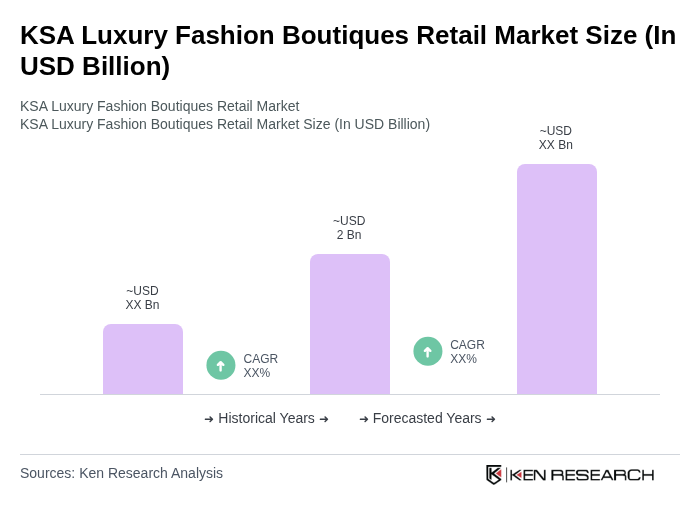
- The KSA Luxury Fashion Boutiques Retail Market is valued at USD 2 billion, based on a five-year historical analysis. This growth is primarily driven by increasing disposable incomes, a growing affluent population, rising tourism activities, and a rising demand for high-end fashion products. The market has seen a significant shift towards luxury brands, with consumers increasingly seeking exclusive and personalized shopping experiences.
- Key cities such as Riyadh, Jeddah, and Dammam dominate the KSA Luxury Fashion Boutiques Retail Market due to their status as economic and cultural hubs. Riyadh, being the capital, attracts a large number of luxury brands and affluent consumers, while Jeddah serves as a gateway for international brands, enhancing its appeal. Dammam, with its growing population and economic development, also contributes to the market's expansion.
- The Fashion and Luxury Retail Rules, 2023 issued by the Ministry of Commerce require luxury boutiques to allocate at least 15% of shelf space to Saudi designers, maintain product authenticity standards through certification, and obtain annual licensing for operations exceeding USD 1 million in sales. This initiative includes financial support and incentives for local designers, encouraging innovation and creativity in the luxury fashion sector, thereby enhancing the overall market landscape.
KSA Luxury Fashion Boutiques Retail Market Segmentation
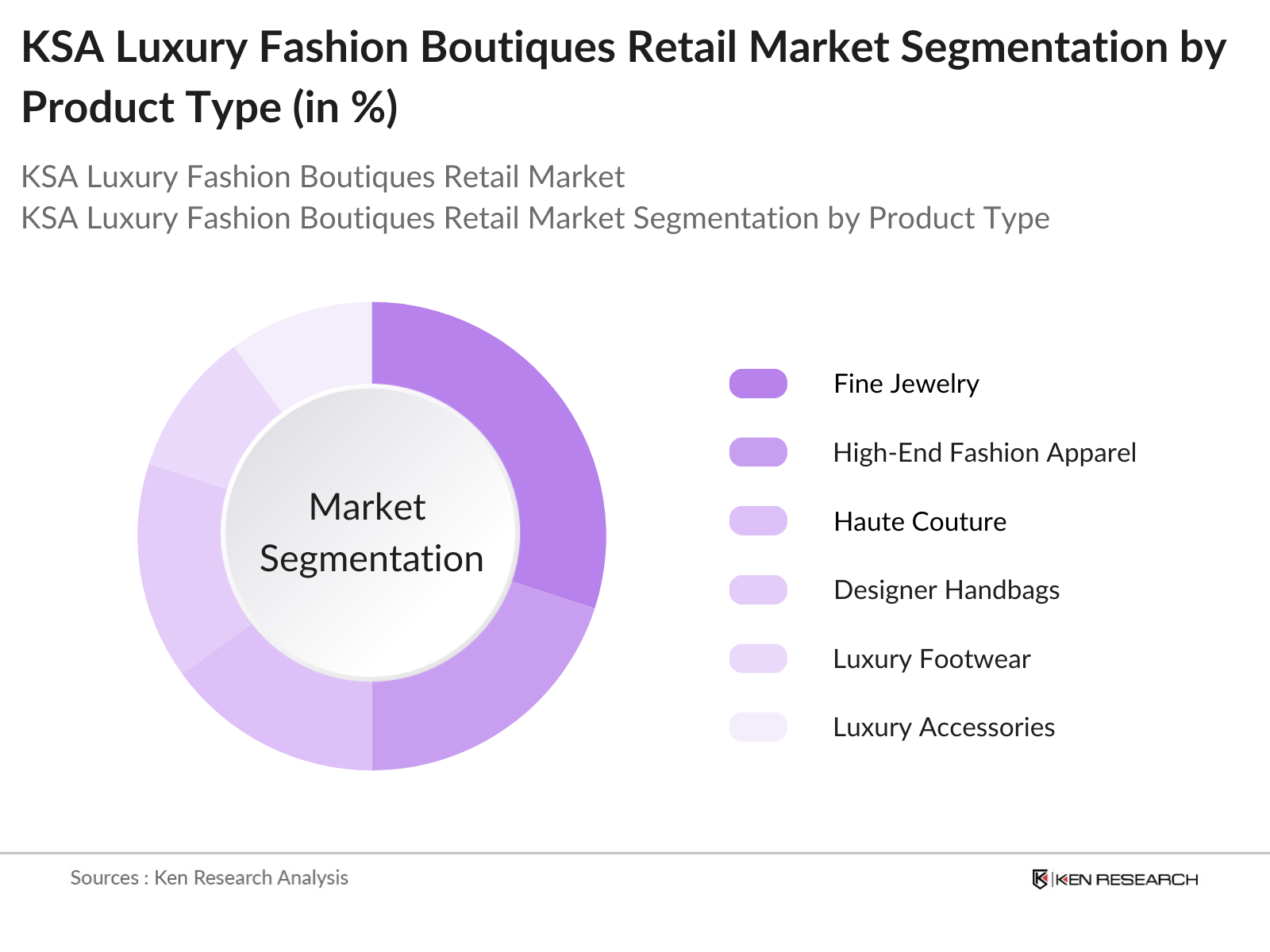
By Product Type:The product type segmentation includes Fine Jewelry, High-End Fashion Apparel, Haute Couture, Designer Handbags, Luxury Footwear, and Luxury Accessories. Among these, Fine Jewelry is the leading sub-segment, driven by its strong cultural relevance, premium positioning, and enduring appeal among affluent consumers. High-End Fashion Apparel also holds a significant share, supported by rising demand for designer collections and luxury ready-to-wear. Designer Handbags and Haute Couture remain important aspirational categories, while Luxury Footwear and Accessories continue to attract consumers seeking exclusivity, craftsmanship, and status-oriented fashion purchases.
By End-User:The end-user segmentation includes Women, Men, and Children. Women represent the largest segment, driven by higher engagement with luxury fashion across apparel, accessories, and jewelry categories. This segment benefits from strong brand affinity, frequent purchase cycles, and a growing focus on premium and personalized fashion. Men also contribute significantly, supported by expanding product offerings and rising interest in luxury grooming and apparel, while the Children segment remains niche but is gradually gaining traction among affluent consumers.
KSA Luxury Fashion Boutiques Retail Market Competitive Landscape
The KSA Luxury Fashion Boutiques Retail Market is characterized by a dynamic mix of regional and international players. Leading participants such as Elie Saab, Zuhair Murad, Mohammed Ashi (Ashi Studio), Yasmin Mansour, and Georges Hobeika contribute to innovation, geographic expansion, and service delivery in this space.
KSA Luxury Fashion Boutiques Retail Market Industry Analysis
Growth Drivers
- Rising Affluence and Expanding Domestic Luxury Demand:Saudi Arabia is witnessing rapid growth in high-net-worth individuals, with millionaire households increasing significantly in recent years. This expanding affluent base, combined with rising credit access and income growth, is driving premium fashion consumption. Unlike earlier dependence on outbound luxury spending, domestic demand is strengthening, supported by Vision 2030 initiatives and increasing preference for luxury retail within the Kingdom.
- Strong Demand for Accessories and Fragrance Categories:Fashion accessories, designer eyewear, and especially luxury fragrances are core revenue drivers in KSA. Fragrance consumption remains deeply embedded in cultural and gifting practices, with strong demand for oud-based and niche premium scents. High repeat purchase behavior and preference for exclusivity are supporting boutique-led sales, while limited-edition collections and personalization trends are enhancing brand engagement and customer loyalty.
- Retail Expansion and Experiential Luxury Ecosystems:The development of mega retail destinations such as Riyadh Boulevard, Diriyah Gate, and Red Sea Project is transforming Saudi Arabia’s luxury retail landscape. These projects are attracting global luxury brands and enhancing in-country retail experiences. Simultaneously, premium mall expansions and entertainment-led retail formats are increasing footfall, while pricing strategies aligned with global benchmarks are strengthening the Kingdom’s positioning as a competitive luxury retail hub.
Market Challenges
- High Dependence on Affluent Urban and Tourism-Led Demand:The KSA luxury fashion boutiques market remains concentrated around Riyadh and Jeddah, with demand supported largely by affluent residents, premium shoppers, and high-spending visitors. Saudi Arabia welcomed around 116 million domestic and inbound tourists in 2024, while Henley projects the Kingdom to attract about 2,400 millionaire net inflows in 2025, largely centered in key cities. This concentration supports luxury demand, but it also creates exposure to shifts in premium consumer sentiment and limits resilience beyond top-tier urban markets.
- Sensitivity to Premium Cost Inflation and Market Volatility:Rising competitive intensity and premium retail expansion are putting pressure on boutique profitability in KSA. Knight Frank notes Riyadh’s retail stock is expected to rise to about 5.2 million sq m by 2026, with significant new supply continuing to reshape brand positioning and store economics. As brands remain selective in expansion and discretionary luxury spending stays sensitive to macroeconomic conditions, boutiques may face tighter margins, especially in secondary cities where sales density and assortment depth remain more limited.
KSA Luxury Fashion Boutiques Retail Market Future Outlook
The KSA luxury fashion boutiques retail market is poised for dynamic growth, driven by evolving consumer preferences and technological advancements. As the market adapts to the increasing demand for personalized shopping experiences, boutiques are likely to invest in innovative retail technologies. Additionally, the integration of sustainable practices will resonate with environmentally conscious consumers, further shaping the market landscape. The anticipated growth in tourism will also provide a significant boost, attracting international shoppers and enhancing the luxury retail experience in the region.
Market Opportunities
- Experience-Led Retail Formats Creating Premium Growth Opportunities:Luxury growth in KSA is increasingly anchored in destination-led, mixed-use environments rather than purely transactional mall traffic. Diriyah Square is being positioned as a heritage-rich retail, dining, and hospitality district, while Saudi retail spending reached a record SAR 1.41 trillion in 2024. This creates strong opportunities for boutiques to invest in curated in-store experiences, private appointments, and high-touch service models for affluent Saudi shoppers.
- Bespoke Collaborations to Serve a Concentrated UHNW Client Base:KSA’s luxury demand is increasingly shaped by affluent domestic buyers in Riyadh and Jeddah, with both cities ranking among the region’s strongest-performing prime markets. This opens opportunities for boutiques to collaborate with niche and local designers on exclusive capsules, limited editions, and personalized products. Such partnerships can strengthen differentiation, elevate cultural relevance, and align with Saudi consumers’ preference for rare, high-touch luxury propositions.
Scope of the Report
| Segment | Sub-Segments |
|---|---|
| By Product Type | Fine Jewelry High-End Fashion Apparel Haute Couture Designer Handbags Luxury Footwear Luxury Accessories |
| By End-User | Women Men Children |
| By Distribution Channel | Exclusive Boutiques Multi-Brand Luxury Stores Online Retail Department Stores Others |
| By Brand Positioning | High-End Luxury Affordable Luxury Premium Brands Others |
| By Consumer Demographics | High-Net-Worth Individuals Affluent Expatriates Tourists Others |
| By Occasion | Casual Wear Formal Wear Seasonal Wear Others |
Key Target Audience
Investors and Venture Capitalist Firms
Government and Regulatory Bodies (e.g., Ministry of Commerce, Saudi Arabian General Investment Authority)
Luxury Fashion Brand Owners
High-End Retail Developers
Luxury Goods Wholesalers
Trade Associations for Fashion and Retail
Real Estate Investment Trusts (REITs) focused on retail
Luxury Fashion Event Organizers
Players Mentioned in the Report:
Elie Saab
Zuhair Murad
Mohammed Ashi (Ashi Studio)
Yasmin Mansour
Georges Hobeika
Ziad Nakad
Wadha (Wadha Al Hajri)
Chalhoub Group
Al Haramain
Majid Al Futtaim
Table of Contents
Market Assessment Phase
1. Executive Summary and Approach
2. KSA Luxury Fashion Boutiques Retail Market Overview
2.1 Key Insights and Strategic Recommendations
2.2 KSA Luxury Fashion Boutiques Retail Market Overview
2.3 Definition and Scope
2.4 Evolution of Market Ecosystem
2.5 Timeline of Key Regulatory Milestones
2.6 Value Chain & Stakeholder Mapping
2.7 Business Cycle Analysis
2.8 Policy & Incentive Landscape
3. KSA Luxury Fashion Boutiques Retail Market Analysis
3.1 Growth Drivers
3.1.1 Increasing Disposable Income
3.1.2 Rising Demand for Luxury Goods
3.1.3 Growth of E-commerce Platforms
3.1.4 Influence of Social Media and Fashion Trends
3.2 Market Challenges
3.2.1 Economic Fluctuations
3.2.2 Intense Competition
3.2.3 Supply Chain Disruptions
3.2.4 Changing Consumer Preferences
3.3 Market Opportunities
3.3.1 Expansion of Online Retail
3.3.2 Collaborations with Local Designers
3.3.3 Growth in Tourism
3.3.4 Sustainable Fashion Initiatives
3.4 Market Trends
3.4.1 Personalization in Luxury Shopping
3.4.2 Rise of Second-Hand Luxury Goods
3.4.3 Integration of Technology in Retail
3.4.4 Focus on Ethical and Sustainable Practices
3.5 Government Regulation
3.5.1 Import Tariffs on Luxury Goods
3.5.2 Consumer Protection Laws
3.5.3 Regulations on E-commerce
3.5.4 Local Content Requirements
4. SWOT Analysis
5. Stakeholder Analysis
6. Porter's Five Forces Analysis
7. KSA Luxury Fashion Boutiques Retail Market Market Size, 2019-2024
7.1 By Value
7.2 By Volume
7.3 By Average Selling Price
8. KSA Luxury Fashion Boutiques Retail Market Segmentation
8.1 By Type
8.1.1Fine Jewelry
8.1.2High-End Fashion Apparel
8.1.3Haute Couture
8.1.4Designer Handbags
8.1.5Luxury Footwear
8.1.6Luxury Accessories
8.2 By Gender
8.2.1 Women
8.2.2 Men
8.2.3 Children
8.3 By Distribution Channel
8.3.1 Exclusive Boutiques
8.3.2 Multi-Brand Luxury Stores
8.3.3 Online Retail
8.3.4 Department Stores
8.3.5 Others
8.4 By Brand Positioning
8.4.1 High-End Luxury
8.4.2 Affordable Luxury
8.4.3 Premium Brands
8.4.4 Others
8.5 By Consumer Demographics
8.5.1 High-Net-Worth Individuals
8.5.2 Affluent Expatriates
8.5.3 Tourists
8.5.4 Others
8.6 By Occasion
8.6.1 Casual Wear
8.6.2 Formal Wear
8.6.3 Seasonal Wear
8.6.4 Others
9. KSA Luxury Fashion Boutiques Retail Market Competitive Analysis
9.1 Market Share of Key Players
9.2 Cross Comparison of Key Players
9.2.1 Company Name.
9.2.2 Group Size (Large, Medium, or Small as per industry convention).
9.2.3 Revenue Growth Rate.
9.2.4 Customer Acquisition Cost.
9.2.5 Average Order Value.
9.2.6 Customer Retention Rate.
9.2.7 Pricing Strategy.
9.2.8 Market Penetration Rate.
9.2.9 Brand Awareness Level.
9.2.10 Return on Investment (ROI).
9.3 SWOT Analysis of Top Players
9.4 Pricing Analysis
9.5 Detailed Profile of Major Companies
9.5.1 Elie Saab
9.5.2 Zuhair Murad
9.5.3 Mohammed Ashi (Ashi Studio)
9.5.4 Yasmin Mansour
9.5.5 Georges Hobeika
9.5.6 Ziad Nakad
9.5.7 Wadha (Wadha Al Hajri)
9.5.8 Chalhoub Group
9.5.9 Al Haramain
9.5.10 Majid Al Futtaim
10. KSA Luxury Fashion Boutiques Retail Market End-User Analysis
10.1 Procurement Behavior of Key Ministries
10.1.1 Ministry of Commerce
10.1.2 Ministry of Culture
10.1.3 Ministry of Tourism
10.2 Corporate Spend on Infrastructure & Energy
10.2.1 Corporate Luxury Spending Trends
10.2.2 Investment in Retail Infrastructure
10.3 Pain Point Analysis by End-User Category
10.3.1 High Pricing of Luxury Goods
10.3.2 Limited Availability of Brands
10.4 User Readiness for Adoption
10.4.1 Digital Adoption Trends
10.4.2 Consumer Education on Luxury Brands
10.5 Post-Deployment ROI and Use Case Expansion
10.5.1 Measuring Customer Satisfaction
10.5.2 Expanding Product Lines
11. KSA Luxury Fashion Boutiques Retail Market Future Size, 2025-2030
11.1 By Value
11.2 By Volume
11.3 By Average Selling Price
Go-To-Market Strategy Phase
1. Whitespace Analysis + Business Model Canvas
1.1 Market Gaps Identification
1.2 Business Model Development
2. Marketing and Positioning Recommendations
2.1 Branding Strategies
2.2 Product USPs
3. Distribution Plan
3.1 Urban Retail vs Rural NGO Tie-ups
4. Channel & Pricing Gaps
4.1 Underserved Routes
4.2 Pricing Bands
5. Unmet Demand & Latent Needs
5.1 Category Gaps
5.2 Consumer Segments
6. Customer Relationship
6.1 Loyalty Programs
6.2 After-sales Service
7. Value Proposition
7.1 Sustainability
7.2 Integrated Supply Chains
8. Key Activities
8.1 Regulatory Compliance
8.2 Branding
8.3 Distribution Setup
9. Entry Strategy Evaluation
9.1 Domestic Market Entry Strategy
9.1.1 Product Mix
9.1.2 Pricing Band
9.1.3 Packaging
9.2 Export Entry Strategy
9.2.1 Target Countries
9.2.2 Compliance Roadmap
10. Entry Mode Assessment
10.1 JV
10.2 Greenfield
10.3 M&A
10.4 Distributor Model
11. Capital and Timeline Estimation
11.1 Capital Requirements
11.2 Timelines
12. Control vs Risk Trade-Off
12.1 Ownership vs Partnerships
13. Profitability Outlook
13.1 Breakeven Analysis
13.2 Long-term Sustainability
14. Potential Partner List
14.1 Distributors
14.2 JVs
14.3 Acquisition Targets
15. Execution Roadmap
15.1 Phased Plan for Market Entry
15.1.1 Market Setup
15.1.2 Market Entry
15.1.3 Growth Acceleration
15.1.4 Scale & Stabilize
15.2 Key Activities and Milestones
15.2.1 Activity Planning
15.2.2 Milestone Tracking
Research Methodology
Phase 1: Approach1
Desk Research
- Analysis of market reports from industry associations and trade publications focused on luxury fashion in KSA
- Review of government publications and economic reports detailing consumer spending trends in the luxury sector
- Examination of online databases and e-commerce platforms to assess sales data and consumer preferences
Primary Research
- Interviews with boutique owners and managers to gather insights on operational challenges and market dynamics
- Surveys with luxury fashion consumers to understand purchasing behavior and brand loyalty
- Focus groups with fashion industry experts to discuss emerging trends and consumer expectations
Validation & Triangulation
- Cross-validation of findings through comparison with historical sales data and market growth rates
- Triangulation of insights from primary interviews with secondary data sources to ensure consistency
- Sanity checks conducted through expert panel reviews to validate assumptions and projections
Phase 2: Market Size Estimation1
Top-down Assessment
- Estimation of total luxury fashion market size based on national retail sales data and luxury goods consumption
- Segmentation of the market by product categories such as apparel, accessories, and footwear
- Incorporation of demographic data to assess potential market growth among affluent consumers
Bottom-up Modeling
- Collection of sales data from key luxury boutiques to establish baseline revenue figures
- Analysis of average transaction values and customer footfall to derive sales volume estimates
- Estimation of growth rates based on historical performance and emerging market trends
Forecasting & Scenario Analysis
- Development of forecasting models incorporating economic indicators and consumer confidence metrics
- Scenario analysis based on potential impacts of global economic conditions and local market changes
- Creation of multiple growth scenarios (baseline, optimistic, and pessimistic) through 2030
Phase 3: CATI Sample Composition1
| Scope Item/Segment | Sample Size | Target Respondent Profiles |
|---|---|---|
| Luxury Apparel Retailers | 100 | Store Managers, Brand Representatives |
| High-End Accessories Market | 80 | Product Managers, Marketing Directors |
| Footwear Boutique Owners | 70 | Business Owners, Sales Executives |
| Luxury Consumer Insights | 120 | Affluent Consumers, Fashion Enthusiasts |
| Fashion Industry Experts | 60 | Consultants, Trend Analysts |
Frequently Asked Questions
What is the current value of the KSA Luxury Fashion Boutiques Retail Market?
The KSA Luxury Fashion Boutiques Retail Market is valued at approximately USD 2 billion, reflecting significant growth driven by increasing disposable incomes, a growing affluent population, and rising tourism activities.
Which cities are the main hubs for luxury fashion boutiques in Saudi Arabia?
What are the recent regulations affecting luxury fashion boutiques in Saudi Arabia?
What factors are driving growth in the KSA Luxury Fashion Boutiques Retail Market?
Other Regional/Country Reports
Indonesia Luxury Fashion Boutiques Retail Market
Malaysia Luxury Fashion Boutiques Retail Market
APAC Luxury Fashion Boutiques Retail Market
SEA Luxury Fashion Boutiques Retail Market
Other Adjacent Reports
Qatar Fashion Retail Market
Malaysia Luxury Jewelry Market Size, Share & Forecast, By Product Category, Price Tier & Distribution Channel, 2025–2032UAE Luxury Handbags Market Size, Share, Growth Drivers, Trends, Opportunities & Forecast 2025–2030Bahrain Luxury Footwear Market Size, Share, Growth Drivers, Trends, Opportunities & Forecast 2025–2030Germany Luxury Accessories Market
UAE Luxury Watches Market Size, Share, Growth Drivers, Trends, Opportunities & Forecast 2025–2030South Africa Luxury Cosmetics Market
Vietnam E-commerce Retail Market
Belgium High-End Apparel Market
Why Buy From Us?

What makes us stand out is that our consultants follow Robust, Refine and Result (RRR) methodology. Robust for clear definitions, approaches and sanity checking, Refine for differentiating respondents' facts and opinions, and Result for presenting data with story.

We have set a benchmark in the industry by offering our clients with syndicated and customized market research reports featuring coverage of entire market as well as meticulous research and analyst insights.

While we don't replace traditional research, we flip the method upside down. Our dual approach of Top Bottom & Bottom Top ensures quality deliverable by not just verifying company fundamentals but also looking at the sector and macroeconomic factors.

With one step in the future, our research team constantly tries to show you the bigger picture. We help with some of the tough questions you may encounter along the way: How is the industry positioned? Best marketing channel? KPI's of competitors? By aligning every element, we help maximize success.

Our report gives you instant access to the answers and sources that other companies might choose to hide. We elaborate each steps of research methodology we have used and showcase you the sample size to earn your trust.

If you need any support, we are here! We pride ourselves on universe strength, data quality, and quick, friendly, and professional service.