About the Report
Base Year 2024KSA Passive Fire Protection Market Overview
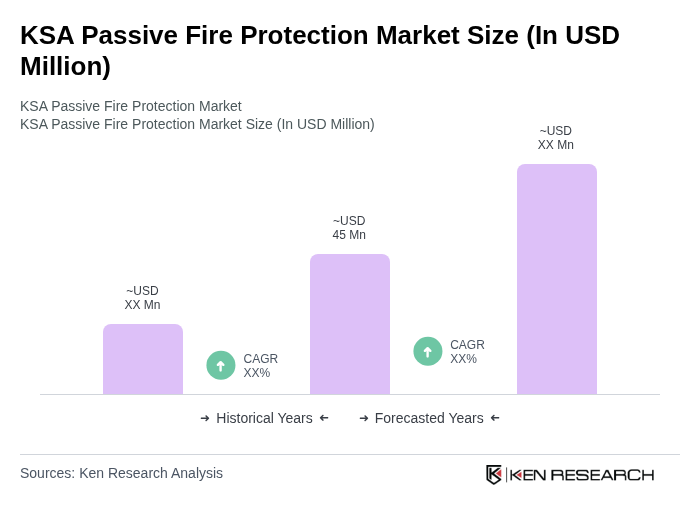
- The KSA Passive Fire Protection Market is valued at USD 45 million, based on a five-year historical analysis. This growth is primarily driven by increasing construction activities, stringent fire safety regulations, heightened awareness of fire safety standards across various industries, and Vision 2030 infrastructure projects. The market has seen a surge in demand for advanced fire protection solutions, particularly in high-rise buildings, industrial facilities, oil and gas sectors, and giga-projects.
- Key cities dominating the market include Riyadh, Jeddah, and Dammam. Riyadh, as the capital, leads in government projects and infrastructure development, while Jeddah and Dammam are pivotal due to their strategic locations and industrial activities. The concentration of commercial and residential projects in these cities significantly contributes to the market's growth.
- The Saudi Building Code (SBC) 2018, issued by the Saudi Building Code National Committee under the Ministry of Municipal and Rural Affairs and Housing, mandates enhanced fire safety measures in construction projects, including fire resistance ratings for structural elements, compartmentation requirements, and passive protection systems for steel and concrete. This regulation requires compliance through certified materials, fire-rated assemblies with minimum 1-4 hour ratings depending on building height and occupancy, and mandatory approvals from Saudi Civil Defense for high-risk structures, thereby increasing the demand for passive fire protection systems in the region.
KSA Passive Fire Protection Market Segmentation
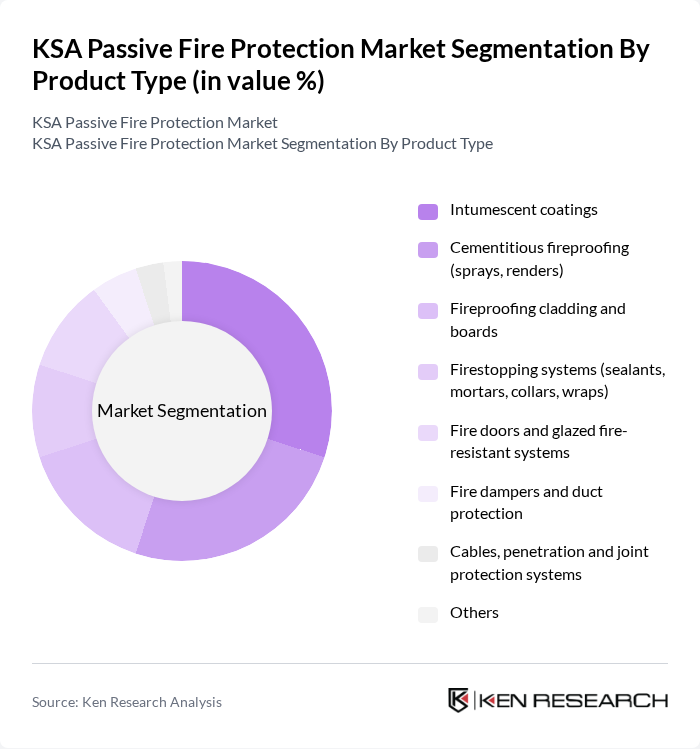
By Product Type:The product type segmentation includes various subsegments that cater to different fire protection needs. The dominant subsegment in this category is intumescent coatings, which are widely used for their effectiveness in protecting structural steel from fire and expected to register the fastest growth. Cementitious fireproofing is also significant due to its application in various construction projects and status as the largest revenue-generating segment. Firestopping systems are gaining traction as they are essential for maintaining the integrity of fire-rated walls and floors. The demand for fire doors and glazed fire-resistant systems is also on the rise, driven by safety regulations and building codes.
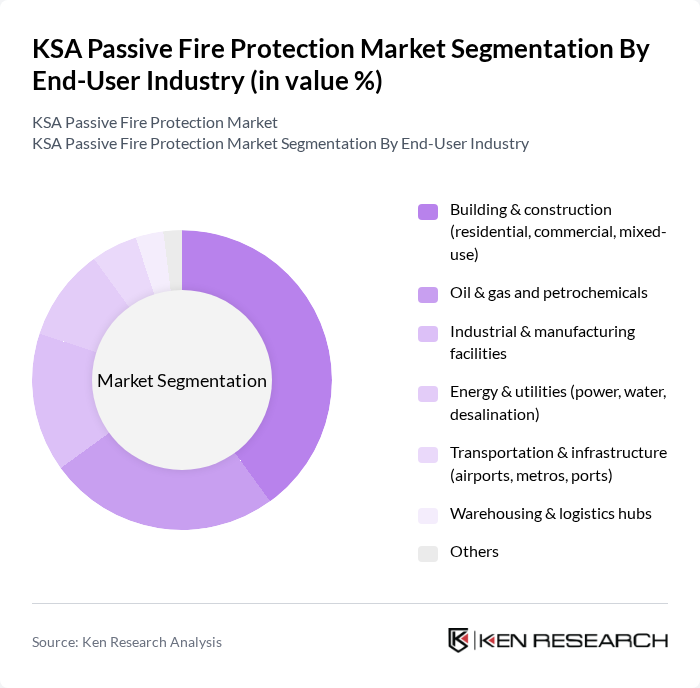
By End-User Industry:The end-user industry segmentation highlights the various sectors utilizing passive fire protection solutions. The building and construction sector is the largest consumer, driven by ongoing residential and commercial projects. The oil and gas industry also significantly contributes to the market due to stringent safety requirements in facilities. Industrial and manufacturing facilities are increasingly adopting fire protection measures to comply with safety regulations. The energy and utilities sector is also a key player, particularly in power generation and water desalination projects.
KSA Passive Fire Protection Market Competitive Landscape
The KSA Passive Fire Protection Market is characterized by a dynamic mix of regional and international players. Leading participants such as Hilti Group, 3M Company, RPM International Inc. (including Carboline), Jotun Saudi Arabia, Sherwin-Williams (Saudi Arabia), Hempel Saudi Arabia, Sika Saudi Arabia, Promat (Etex Group), Saint-Gobain (including Gyproc Saudi Arabia), ROCKWOOL Saudi Arabia, NAFFCO KSA, Firestop Middle East (KSA operations), Riyadh Fireproofing & Insulation Co. (RFIC), Al-Babtain Power & Telecom (fire-rated cable management and enclosures), Bin Ghurair Trading & Contracting (fire doors and passive systems) contribute to innovation, geographic expansion, and service delivery in this space.
KSA Passive Fire Protection Market Industry Analysis
Growth Drivers
- Increasing Construction Activities:The Kingdom of Saudi Arabia (KSA) is witnessing a construction boom, with investments projected to reach approximately SAR 1.5 trillion ($400 billion) in future. This surge is driven by Vision 2030, which aims to diversify the economy and enhance infrastructure. Consequently, the demand for passive fire protection systems is expected to rise significantly, as these systems are essential for ensuring safety in new commercial and residential buildings.
- Stringent Fire Safety Regulations:KSA has implemented rigorous fire safety regulations, including the Saudi Building Code, which mandates the use of fire-resistant materials in construction. The Civil Defense has also established standards that require compliance with fire safety measures. In future, over 80% of new projects are expected to adhere to these regulations, driving the demand for passive fire protection solutions to meet compliance requirements and enhance safety.
- Rising Awareness About Fire Safety:There is a growing awareness of fire safety among businesses and the general public in KSA, particularly following several high-profile incidents. Educational campaigns and training programs have increased knowledge about the importance of fire protection systems. In future, it is estimated that 70% of construction stakeholders will prioritize fire safety measures, further propelling the market for passive fire protection solutions in the region.
Market Challenges
- High Initial Investment Costs:The adoption of passive fire protection systems often requires significant upfront investment, which can deter many developers and contractors. For instance, the cost of installing fire-resistant materials can range from SAR 200 to SAR 500 per square meter. This financial barrier is particularly challenging for small to medium-sized enterprises, limiting their ability to comply with safety regulations and invest in necessary fire protection measures.
- Lack of Skilled Workforce:The KSA passive fire protection market faces a shortage of skilled professionals trained in fire safety standards and installation techniques. In future, it is estimated that only 30% of the workforce in the construction sector possesses the necessary qualifications. This skills gap can lead to improper installation and maintenance of fire protection systems, ultimately compromising safety and compliance with regulations.
KSA Passive Fire Protection Market Future Outlook
The KSA passive fire protection market is poised for significant growth, driven by ongoing construction projects and heightened regulatory scrutiny. As the government continues to invest in infrastructure and urban development, the demand for advanced fire safety solutions will increase. Additionally, the integration of smart technologies in building designs will enhance fire safety measures, creating a more robust market environment. Stakeholders are expected to focus on innovative materials and training programs to address current challenges and capitalize on emerging opportunities.
Market Opportunities
- Expansion in the Industrial Sector:The industrial sector in KSA is projected to grow by 5% annually, creating a substantial demand for passive fire protection systems. Industries such as oil and gas, manufacturing, and logistics require stringent fire safety measures, presenting a lucrative opportunity for market players to provide tailored solutions that meet specific industry needs.
- Government Initiatives for Infrastructure Development:The Saudi government is investing heavily in infrastructure projects, with an estimated SAR 1 trillion allocated for development in future. This investment will drive the demand for passive fire protection systems in new public and private projects, offering significant opportunities for manufacturers and service providers to expand their market presence.
Scope of the Report
| Segment | Sub-Segments |
|---|---|
| By Product Type | Intumescent coatings Cementitious fireproofing (sprays, renders) Fireproofing cladding and boards Firestopping systems (sealants, mortars, collars, wraps) Fire doors and glazed fire-resistant systems Fire dampers and duct protection Cables, penetration and joint protection systems Others |
| By End-User Industry | Building & construction (residential, commercial, mixed-use) Oil & gas and petrochemicals Industrial & manufacturing facilities Energy & utilities (power, water, desalination) Transportation & infrastructure (airports, metros, ports) Warehousing & logistics hubs Others |
| By Application | Structural steel protection Compartmentation (walls, floors, ceilings) Opening and penetration protection Ducts, pipes and cable tray protection New construction Retrofitting & refurbishment Maintenance & repair Others |
| By Material Class | Cementitious and gypsum-based materials Intumescent and epoxy-based coatings Mineral wool, stone wool and fiber-based systems Calcium silicate and other inorganic boards Polymer and composite-based materials Others |
| By Distribution Channel | Direct project sales (to contractors and EPCs) Authorized distributors and dealers Specialized applicators and installers Online and e-procurement platforms Others |
| By Region | Central Region (Riyadh & surrounding) Eastern Region (Dammam, Dhahran, Jubail) Western Region (Jeddah, Makkah, Madinah, Red Sea projects) Southern Region Northern Region |
| By Regulatory & Certification Compliance | Compliance with Saudi Building Code (SBC) Civil Defense approvals International fire standards (UL, FM, EN) Green building and sustainability certifications Others |
Key Target Audience
Investors and Venture Capitalist Firms
Government and Regulatory Bodies (e.g., Saudi Standards, Metrology and Quality Organization)
Manufacturers and Producers
Distributors and Retailers
Construction and Engineering Firms
Fire Safety Equipment Suppliers
Insurance Companies
Real Estate Developers
Players Mentioned in the Report:
Hilti Group
3M Company
RPM International Inc. (including Carboline)
Jotun Saudi Arabia
Sherwin-Williams (Saudi Arabia)
Hempel Saudi Arabia
Sika Saudi Arabia
Promat (Etex Group)
Saint-Gobain (including Gyproc Saudi Arabia)
ROCKWOOL Saudi Arabia
NAFFCO KSA
Firestop Middle East (KSA operations)
Riyadh Fireproofing & Insulation Co. (RFIC)
Al-Babtain Power & Telecom (fire-rated cable management and enclosures)
Bin Ghurair Trading & Contracting (fire doors and passive systems)
Table of Contents
Market Assessment Phase
1. Executive Summary and Approach
2. KSA Passive Fire Protection Market Overview
2.1 Key Insights and Strategic Recommendations
2.2 KSA Passive Fire Protection Market Overview
2.3 Definition and Scope
2.4 Evolution of Market Ecosystem
2.5 Timeline of Key Regulatory Milestones
2.6 Value Chain & Stakeholder Mapping
2.7 Business Cycle Analysis
2.8 Policy & Incentive Landscape
3. KSA Passive Fire Protection Market Analysis
3.1 Growth Drivers
3.1.1 Increasing construction activities in KSA
3.1.2 Stringent fire safety regulations
3.1.3 Rising awareness about fire safety
3.1.4 Technological advancements in fire protection materials
3.2 Market Challenges
3.2.1 High initial investment costs
3.2.2 Lack of skilled workforce
3.2.3 Limited awareness among end-users
3.2.4 Regulatory compliance complexities
3.3 Market Opportunities
3.3.1 Expansion in the industrial sector
3.3.2 Government initiatives for infrastructure development
3.3.3 Adoption of smart building technologies
3.3.4 Growing demand for retrofitting existing buildings
3.4 Market Trends
3.4.1 Increasing use of eco-friendly materials
3.4.2 Integration of IoT in fire safety systems
3.4.3 Shift towards modular construction
3.4.4 Enhanced focus on fire safety training programs
3.5 Government Regulation
3.5.1 Implementation of the Saudi Building Code
3.5.2 Fire safety standards by the Civil Defense
3.5.3 Regulations on fire-resistant materials
3.5.4 Compliance requirements for fire safety audits
4. SWOT Analysis
5. Stakeholder Analysis
6. Porter's Five Forces Analysis
7. KSA Passive Fire Protection Market Market Size, 2019-2024
7.1 By Value
7.2 By Volume
7.3 By Average Selling Price
8. KSA Passive Fire Protection Market Segmentation
8.1 By Product Type
8.1.1 Intumescent coatings
8.1.2 Cementitious fireproofing (sprays, renders)
8.1.3 Fireproofing cladding and boards
8.1.4 Firestopping systems (sealants, mortars, collars, wraps)
8.1.5 Fire doors and glazed fire-resistant systems
8.1.6 Fire dampers and duct protection
8.1.7 Cables, penetration and joint protection systems
8.1.8 Others
8.2 By End-User Industry
8.2.1 Building & construction (residential, commercial, mixed-use)
8.2.2 Oil & gas and petrochemicals
8.2.3 Industrial & manufacturing facilities
8.2.4 Energy & utilities (power, water, desalination)
8.2.5 Transportation & infrastructure (airports, metros, ports)
8.2.6 Warehousing & logistics hubs
8.2.7 Others
8.3 By Application
8.3.1 Structural steel protection
8.3.2 Compartmentation (walls, floors, ceilings)
8.3.3 Opening and penetration protection
8.3.4 Ducts, pipes and cable tray protection
8.3.5 New construction
8.3.6 Retrofitting & refurbishment
8.3.7 Maintenance & repair
8.3.8 Others
8.4 By Material Class
8.4.1 Cementitious and gypsum-based materials
8.4.2 Intumescent and epoxy-based coatings
8.4.3 Mineral wool, stone wool and fiber-based systems
8.4.4 Calcium silicate and other inorganic boards
8.4.5 Polymer and composite-based materials
8.4.6 Others
8.5 By Distribution Channel
8.5.1 Direct project sales (to contractors and EPCs)
8.5.2 Authorized distributors and dealers
8.5.3 Specialized applicators and installers
8.5.4 Online and e-procurement platforms
8.5.5 Others
8.6 By Region
8.6.1 Central Region (Riyadh & surrounding)
8.6.2 Eastern Region (Dammam, Dhahran, Jubail)
8.6.3 Western Region (Jeddah, Makkah, Madinah, Red Sea projects)
8.6.4 Southern Region
8.6.5 Northern Region
8.7 By Regulatory & Certification Compliance
8.7.1 Compliance with Saudi Building Code (SBC)
8.7.2 Civil Defense approvals
8.7.3 International fire standards (UL, FM, EN)
8.7.4 Green building and sustainability certifications
8.7.5 Others
9. KSA Passive Fire Protection Market Competitive Analysis
9.1 Market Share of Key Players
9.2 Cross Comparison of Key Players
9.2.1 Company name and headquarters (global / KSA)
9.2.2 Group size (global revenues, employee base)
9.2.3 KSA passive fire protection revenue and 3–5 year CAGR
9.2.4 Product portfolio breadth (coatings, boards, firestopping, doors, etc.)
9.2.5 Share of KSA revenue from construction vs. oil & gas and industrial projects
9.2.6 Number of KSA approvals (Saudi Civil Defense, SBC-compliant systems)
9.2.7 Project references in KSA (major giga-projects, industrial complexes)
9.2.8 Distribution and applicator network strength in KSA
9.2.9 Average price positioning in KSA (premium, mid, value)
9.2.10 R&D and certification investment (new product launches for KSA/GCC)
9.2.11 After-sales and technical support capability (local technical teams, training)
9.2.12 Brand recognition and specification rate among KSA consultants/EPCs
9.3 SWOT Analysis of Top Players
9.4 Pricing Analysis
9.5 Detailed Profile of Major Companies
9.5.1 Hilti Group
9.5.2 3M Company
9.5.3 RPM International Inc. (including Carboline)
9.5.4 Jotun Saudi Arabia
9.5.5 Sherwin-Williams (Saudi Arabia)
9.5.6 Hempel Saudi Arabia
9.5.7 Sika Saudi Arabia
9.5.8 Promat (Etex Group)
9.5.9 Saint-Gobain (including Gyproc Saudi Arabia)
9.5.10 ROCKWOOL Saudi Arabia
9.5.11 NAFFCO KSA
9.5.12 Firestop Middle East (KSA operations)
9.5.13 Riyadh Fireproofing & Insulation Co. (RFIC)
9.5.14 Al-Babtain Power & Telecom (fire-rated cable management and enclosures)
9.5.15 Bin Ghurair Trading & Contracting (fire doors and passive systems)
10. KSA Passive Fire Protection Market End-User Analysis
10.1 Procurement Behavior of Key Ministries
10.1.1 Ministry of Interior
10.1.2 Ministry of Municipal and Rural Affairs
10.1.3 Ministry of Housing
10.1.4 Others
10.2 Corporate Spend on Infrastructure & Energy
10.2.1 Investment trends in fire safety
10.2.2 Budget allocation for fire protection systems
10.2.3 Corporate social responsibility initiatives
10.2.4 Others
10.3 Pain Point Analysis by End-User Category
10.3.1 Residential sector challenges
10.3.2 Commercial sector challenges
10.3.3 Industrial sector challenges
10.3.4 Government sector challenges
10.4 User Readiness for Adoption
10.4.1 Awareness levels
10.4.2 Training and education needs
10.4.3 Financial readiness
10.4.4 Others
10.5 Post-Deployment ROI and Use Case Expansion
10.5.1 ROI measurement techniques
10.5.2 Case studies of successful implementations
10.5.3 Future use case scenarios
10.5.4 Others
11. KSA Passive Fire Protection Market Future Size, 2025-2030
11.1 By Value
11.2 By Volume
11.3 By Average Selling Price
Go-To-Market Strategy Phase
1. Whitespace Analysis + Business Model Canvas
1.1 Market gaps identification
1.2 Business model development
2. Marketing and Positioning Recommendations
2.1 Branding strategies
2.2 Product USPs
3. Distribution Plan
3.1 Urban retail vs rural NGO tie-ups
4. Channel & Pricing Gaps
4.1 Underserved routes
4.2 Pricing bands
5. Unmet Demand & Latent Needs
5.1 Category gaps
5.2 Consumer segments
6. Customer Relationship
6.1 Loyalty programs
6.2 After-sales service
7. Value Proposition
7.1 Sustainability
7.2 Integrated supply chains
8. Key Activities
8.1 Regulatory compliance
8.2 Branding
8.3 Distribution setup
9. Entry Strategy Evaluation
9.1 Domestic Market Entry Strategy
9.1.1 Product mix
9.1.2 Pricing band
9.1.3 Packaging
9.2 Export Entry Strategy
9.2.1 Target countries
9.2.2 Compliance roadmap
10. Entry Mode Assessment
10.1 JV, Greenfield, M&A, Distributor Model
11. Capital and Timeline Estimation
11.1 Capital requirements
11.2 Timelines
12. Control vs Risk Trade-Off
12.1 Ownership vs Partnerships
13. Profitability Outlook
13.1 Breakeven analysis
13.2 Long-term sustainability
14. Potential Partner List
14.1 Distributors
14.2 JVs
14.3 Acquisition targets
15. Execution Roadmap
15.1 Phased Plan for Market Entry
15.1.1 Market Setup
15.1.2 Market Entry
15.1.3 Growth Acceleration
15.1.4 Scale & Stabilize
15.2 Key Activities and Milestones
15.2.1 Milestone tracking
15.2.2 Activity scheduling
Research Methodology
Phase 1: Approach1
Desk Research
- Industry reports from local fire safety associations and regulatory bodies
- Market analysis publications focusing on passive fire protection technologies
- Statistical data from government agencies on construction and safety compliance
Primary Research
- Interviews with fire safety engineers and consultants in the KSA market
- Surveys with construction project managers and safety compliance officers
- Field visits to construction sites to observe passive fire protection implementations
Validation & Triangulation
- Cross-validation of findings with industry expert panels and focus groups
- Triangulation of data from construction trends, safety regulations, and market demand
- Sanity checks through comparison with historical market performance data
Phase 2: Market Size Estimation1
Top-down Assessment
- Analysis of national construction spending and its allocation to fire safety measures
- Segmentation of the market by building type (commercial, residential, industrial)
- Incorporation of government initiatives promoting fire safety standards
Bottom-up Modeling
- Estimation of product demand based on historical installation rates of fire protection systems
- Cost analysis of passive fire protection materials and installation services
- Volume estimates derived from construction project pipelines and timelines
Forecasting & Scenario Analysis
- Multi-variable regression analysis incorporating economic growth and regulatory changes
- Scenario modeling based on potential shifts in construction activity and safety regulations
- Baseline, optimistic, and pessimistic forecasts through 2030
Phase 3: CATI Sample Composition1
| Scope Item/Segment | Sample Size | Target Respondent Profiles |
|---|---|---|
| Commercial Building Projects | 60 | Project Managers, Safety Compliance Officers |
| Residential Fire Safety Installations | 50 | Home Builders, Architects |
| Industrial Facility Fire Protection | 40 | Facility Managers, Safety Engineers |
| Government Infrastructure Projects | 40 | Public Works Officials, Safety Inspectors |
| Fire Safety Equipment Suppliers | 50 | Sales Managers, Product Development Leads |
Frequently Asked Questions
What is the current value of the KSA Passive Fire Protection Market?
The KSA Passive Fire Protection Market is valued at approximately USD 45 million, driven by increasing construction activities, stringent fire safety regulations, and heightened awareness of fire safety standards across various industries, particularly in high-rise buildings and industrial facilities.
What factors are driving growth in the KSA Passive Fire Protection Market?
Which cities are leading in the KSA Passive Fire Protection Market?
What are the main product types in the KSA Passive Fire Protection Market?
Other Regional/Country Reports
Indonesia Passive Fire Protection Market Size, Share, Growth Drivers, Trends, Opportunities & Forecast 2025–2030
Malaysia Passive Fire Protection Market Size, Share, Growth Drivers, Trends, Opportunities & Forecast 2025–2030
KSA Passive Fire Protection Market Size, Share, Growth Drivers, Trends, Opportunities & Forecast 2025–2030
APAC Passive Fire Protection Market Size, Share, Growth Drivers, Trends, Opportunities & Forecast 2025–2030
SEA Passive Fire Protection Market Size, Share, Growth Drivers, Trends, Opportunities & Forecast 2025–2030
Vietnam Passive Fire Protection Market Size, Share, Growth Drivers, Trends, Opportunities & Forecast 2025–2030
Other Adjacent Reports
Philippines Active Fire Protection Market
Australia Fire Safety Equipment Market Size, Share & Forecast, By Product Type, End-Use Industry, Technology & Sales Channel, 2025–2032India Construction Materials Market Size, Share & Forecast, By Material Type, Application & End User, 2026-2031Philippines Industrial Coatings Market Size, Share & Forecast, By Product Type, End-Use Industry & Technology, 2026–2032Japan Oil and Gas Safety Market
Indonesia Building Insulation Market
KSA Fire Detection Systems Market
Mexico Emergency Response Market
KSA Infrastructure Safety Market
Regulatory Compliance MarketWhy Buy From Us?

What makes us stand out is that our consultants follow Robust, Refine and Result (RRR) methodology. Robust for clear definitions, approaches and sanity checking, Refine for differentiating respondents' facts and opinions, and Result for presenting data with story.

We have set a benchmark in the industry by offering our clients with syndicated and customized market research reports featuring coverage of entire market as well as meticulous research and analyst insights.

While we don't replace traditional research, we flip the method upside down. Our dual approach of Top Bottom & Bottom Top ensures quality deliverable by not just verifying company fundamentals but also looking at the sector and macroeconomic factors.

With one step in the future, our research team constantly tries to show you the bigger picture. We help with some of the tough questions you may encounter along the way: How is the industry positioned? Best marketing channel? KPI's of competitors? By aligning every element, we help maximize success.

Our report gives you instant access to the answers and sources that other companies might choose to hide. We elaborate each steps of research methodology we have used and showcase you the sample size to earn your trust.

If you need any support, we are here! We pride ourselves on universe strength, data quality, and quick, friendly, and professional service.