About the Report
Base Year 2024Japan Fire Safety Equipment Market Overview
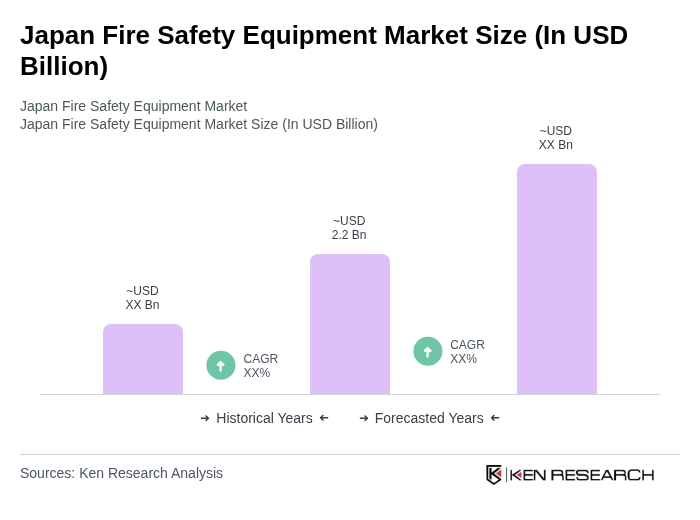
- The Japan Fire Safety Equipment Market is valued at USD 2.2 billion, based on a five-year historical analysis. This growth is primarily driven by stringent government regulations under the Fire Service Act and Building Standards Act, increased awareness of fire safety, and the rising number of commercial, industrial, and high-density urban developments. The market has seen a surge in demand for advanced fire safety solutions, including addressable and IoT-enabled fire detection systems, integrated building management solutions, and smart suppression technologies, as businesses and homeowners prioritize life safety, property protection, and regulatory compliance.
- Key cities such as Tokyo, Osaka, and Yokohama dominate the market due to their high population density, concentration of high-rise buildings, and extensive commercial and industrial activities. The concentration of industries, transport hubs, and critical infrastructure in these urban areas necessitates robust fire safety measures, leading to increased investments in detection, alarm, sprinkler, and suppression equipment for new construction and retrofits. Additionally, the presence of major domestic manufacturers such as Hochiki, Nittan, and Mitsubishi Electric, alongside global players, in and around these regions further enhances market growth through localized engineering, service networks, and ongoing upgrades of installed systems.
- The regulatory framework for fire safety equipment in Japan is anchored by the Fire Service Act (Sh?b?-h?) administered by the Fire and Disaster Management Agency (FDMA), Ministry of Internal Affairs and Communications, and the Building Standards Act enforced by the Ministry of Land, Infrastructure, Transport and Tourism. Under the Fire Service Act and related ordinances, building owners are required to install and maintain appropriate fire alarms, automatic fire detection systems, fire extinguishers, and, where applicable, sprinkler and other suppression systems, with technical standards prescribed in the Ordinance on Fire Prevention Equipment and other FDMA notifications for commercial, industrial, and residential buildings of specified size and use. These legally binding requirements, combined with periodic inspection and reporting obligations, continue to drive stable demand for compliant fire safety equipment across new construction and existing building stock.
Japan Fire Safety Equipment Market Segmentation
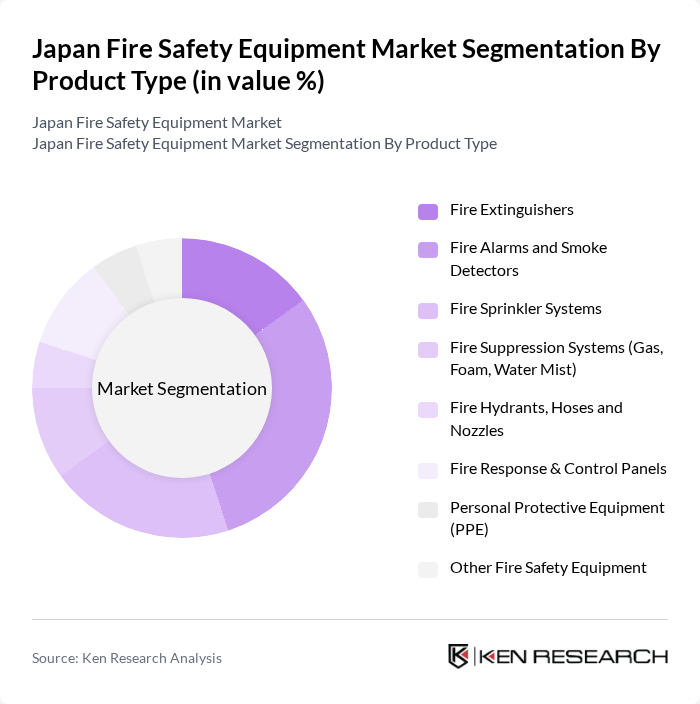
By Product Type:The product type segmentation includes various categories of fire safety equipment that cater to different needs and applications. The primary subsegments are Fire Extinguishers, Fire Alarms and Smoke Detectors, Fire Sprinkler Systems, Fire Suppression Systems (Gas, Foam, Water Mist), Fire Hydrants, Hoses and Nozzles, Fire Response & Control Panels, Personal Protective Equipment (PPE), and Other Fire Safety Equipment. In line with industry data showing that detection and related hardware form the largest component of Japan’s fire protection spend, Fire Alarms and Smoke Detectors are leading the market due to their essential role in early fire detection and prevention, which is critical in both residential and commercial settings and is strongly emphasized by the Fire Service Act and Building Standards Act.
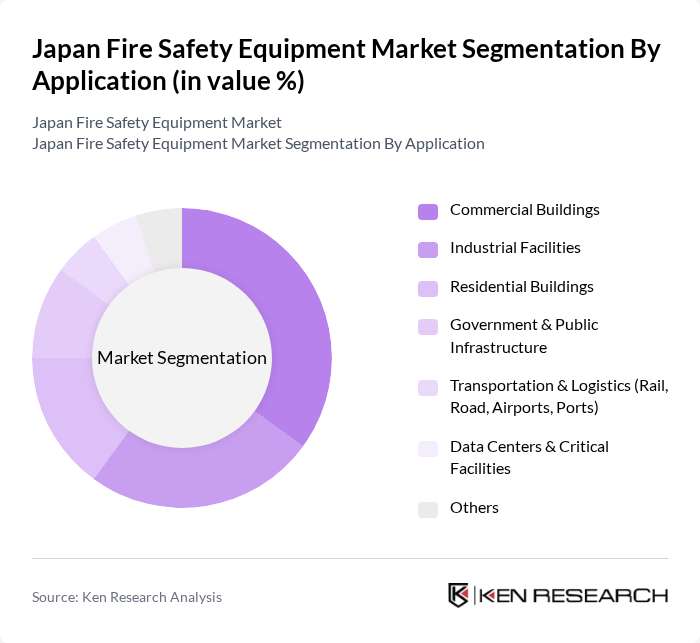
By Application:The application segmentation encompasses various sectors where fire safety equipment is utilized, including Commercial Buildings, Industrial Facilities, Residential Buildings, Government & Public Infrastructure, Transportation & Logistics (Rail, Road, Airports, Ports), Data Centers & Critical Facilities, and Others. The Commercial Buildings segment is the most significant, driven by the increasing number of office spaces, mixed-use developments, retail establishments, and hospitality assets that require comprehensive fire safety solutions to protect occupants and assets and ensure compliance with the Fire Service Act and Building Standards Act. Industrial facilities and data centers are also accelerating adoption of advanced detection, monitoring, and suppression systems, reflecting Japan’s focus on business continuity and protection of high-value critical infrastructure.
Japan Fire Safety Equipment Market Competitive Landscape
The Japan Fire Safety Equipment Market is characterized by a dynamic mix of regional and international players. Leading participants such as Johnson Controls International plc, Honeywell International Inc., Siemens AG, Tyco Fire & Security, Carrier Global Corporation (Kidde, Chubb), Hochiki Corporation, Nittan Company, Limited, Mitsubishi Electric Corporation, NEC Corporation, Panasonic Corporation, Hitachi, Ltd., Daikin Industries, Ltd., Fujitsu Limited, Minimax Viking, UTC Fire & Security contribute to innovation, geographic expansion, and service delivery in this space.
Japan Fire Safety Equipment Market Industry Analysis
Growth Drivers
- Increasing Urbanization:Japan's urban population is projected to reach approximately 93% in future, according to the World Bank. This rapid urbanization drives the demand for fire safety equipment in densely populated areas, where the risk of fire incidents is heightened. Urban centers like Tokyo and Osaka are expanding, necessitating advanced fire safety solutions to protect residential and commercial buildings. The growing number of high-rise structures further emphasizes the need for effective fire safety measures, creating a robust market for fire safety equipment.
- Stringent Government Regulations:The Japanese government has implemented rigorous fire safety regulations, including the Fire Service Act, which mandates compliance for many types of buildings. In future, the government plans to increase inspections by 15%, ensuring adherence to safety standards. This regulatory environment compels businesses to invest in advanced fire safety equipment to avoid penalties and ensure public safety. As a result, the market for fire safety equipment is expected to grow significantly, driven by compliance requirements and the need for enhanced safety measures.
- Technological Advancements in Fire Safety Equipment:The fire safety equipment sector is witnessing significant technological innovations, with investments in smart technologies projected to reach ¥50 billion in future. These advancements include IoT-enabled fire detection systems and automated suppression technologies, which enhance response times and effectiveness. As businesses and homeowners increasingly adopt these technologies, the demand for modern fire safety solutions is expected to rise, driving market growth. The integration of technology into fire safety equipment is reshaping the industry landscape in Japan.
Market Challenges
- High Initial Investment Costs:The initial costs associated with purchasing and installing advanced fire safety equipment can be prohibitively high, often exceeding ¥1 million for comprehensive systems in commercial settings. This financial barrier can deter small and medium-sized enterprises from investing in necessary safety measures. As a result, many businesses may opt for cheaper, less effective alternatives, which can compromise safety and lead to increased risks of fire incidents, ultimately affecting the overall market growth.
- Lack of Skilled Professionals:The fire safety equipment market in Japan faces a significant challenge due to a shortage of skilled professionals. As of future, it is estimated that there will be a deficit of approximately 20,000 trained fire safety technicians. This shortage hampers the installation, maintenance, and effective use of advanced fire safety systems. Consequently, businesses may struggle to implement the latest technologies, limiting the market's potential for growth and innovation in fire safety solutions.
Japan Fire Safety Equipment Market Future Outlook
The future of the fire safety equipment market in Japan appears promising, driven by ongoing urbanization and technological advancements. As cities expand, the demand for innovative fire safety solutions will likely increase, particularly in smart buildings. Additionally, the government's commitment to enhancing fire safety regulations will further stimulate market growth. Companies that invest in training programs and skilled workforce development will be better positioned to capitalize on these trends, ensuring compliance and safety in an evolving landscape.
Market Opportunities
- Growth in Smart Building Technologies:The rise of smart building technologies presents a significant opportunity for the fire safety equipment market. In future, investments in smart building solutions are expected to exceed ¥100 billion, creating demand for integrated fire safety systems that enhance overall building management and safety. This trend will drive innovation and adoption of advanced fire safety technologies, positioning companies to capture a larger market share.
- Rising Demand for Eco-Friendly Fire Safety Solutions:As environmental concerns grow, there is an increasing demand for eco-friendly fire safety solutions. In future, the market for sustainable fire safety products is projected to reach ¥30 billion. Companies that develop and promote environmentally friendly fire safety equipment will not only meet regulatory requirements but also attract environmentally conscious consumers, creating a competitive advantage in the market.
Scope of the Report
| Segment | Sub-Segments |
|---|---|
| By Product Type | Fire Extinguishers Fire Alarms and Smoke Detectors Fire Sprinkler Systems Fire Suppression Systems (Gas, Foam, Water Mist) Fire Hydrants, Hoses and Nozzles Fire Response & Control Panels Personal Protective Equipment (PPE) Other Fire Safety Equipment |
| By Application | Commercial Buildings Industrial Facilities Residential Buildings Government & Public Infrastructure Transportation & Logistics (Rail, Road, Airports, Ports) Data Centers & Critical Facilities Others |
| By System Type | Fire Detection & Alarm Systems Fire Suppression Systems Passive Fire Protection (Doors, Barriers, Coatings) Emergency & Evacuation Systems Integrated Fire & Building Management Systems Others |
| By Technology | Conventional Systems Addressable / Intelligent Systems Wireless & IoT-Enabled Systems Smart, Cloud-Connected Systems Others |
| By Service | Installation & Design Services Maintenance & Inspection Services Managed & Remote Monitoring Services Retrofit & Upgrade Services Others |
| By Building Type | New Construction Existing Buildings / Retrofitting Mixed-Use Developments Others |
| By Region | Kanto Kansai Chubu Tohoku Kyushu Hokkaido Others |
Key Target Audience
Investors and Venture Capitalist Firms
Government and Regulatory Bodies (e.g., Ministry of Internal Affairs and Communications, Fire and Disaster Management Agency)
Manufacturers and Producers
Distributors and Retailers
Fire Safety Equipment Installers and Service Providers
Insurance Companies
Industry Associations (e.g., Japan Fire Protection Association)
Building and Construction Companies
Players Mentioned in the Report:
Johnson Controls International plc
Honeywell International Inc.
Siemens AG
Tyco Fire & Security
Carrier Global Corporation (Kidde, Chubb)
Hochiki Corporation
Nittan Company, Limited
Mitsubishi Electric Corporation
NEC Corporation
Panasonic Corporation
Hitachi, Ltd.
Daikin Industries, Ltd.
Fujitsu Limited
Minimax Viking
UTC Fire & Security
Table of Contents
Market Assessment Phase
1. Executive Summary and Approach
2. Japan Fire Safety Equipment Market Overview
2.1 Key Insights and Strategic Recommendations
2.2 Japan Fire Safety Equipment Market Overview
2.3 Definition and Scope
2.4 Evolution of Market Ecosystem
2.5 Timeline of Key Regulatory Milestones
2.6 Value Chain & Stakeholder Mapping
2.7 Business Cycle Analysis
2.8 Policy & Incentive Landscape
3. Japan Fire Safety Equipment Market Analysis
3.1 Growth Drivers
3.1.1 Increasing Urbanization
3.1.2 Stringent Government Regulations
3.1.3 Rising Awareness of Fire Safety
3.1.4 Technological Advancements in Fire Safety Equipment
3.2 Market Challenges
3.2.1 High Initial Investment Costs
3.2.2 Lack of Skilled Professionals
3.2.3 Competition from Low-Cost Alternatives
3.2.4 Regulatory Compliance Complexity
3.3 Market Opportunities
3.3.1 Growth in Smart Building Technologies
3.3.2 Expansion of E-commerce Platforms
3.3.3 Increased Investment in Infrastructure Development
3.3.4 Rising Demand for Eco-Friendly Fire Safety Solutions
3.4 Market Trends
3.4.1 Integration of IoT in Fire Safety Equipment
3.4.2 Shift Towards Automated Fire Detection Systems
3.4.3 Growing Focus on Fire Safety Training Programs
3.4.4 Adoption of Mobile Applications for Fire Safety Management
3.5 Government Regulation
3.5.1 Fire Service Act Compliance
3.5.2 Building Standards Law Regulations
3.5.3 Fire Prevention and Disaster Management Guidelines
3.5.4 Environmental Protection Regulations
4. SWOT Analysis
5. Stakeholder Analysis
6. Porter's Five Forces Analysis
7. Japan Fire Safety Equipment Market Market Size, 2019-2024
7.1 By Value
7.2 By Volume
7.3 By Average Selling Price
8. Japan Fire Safety Equipment Market Segmentation
8.1 By Product Type
8.1.1 Fire Extinguishers
8.1.2 Fire Alarms and Smoke Detectors
8.1.3 Fire Sprinkler Systems
8.1.4 Fire Suppression Systems (Gas, Foam, Water Mist)
8.1.5 Fire Hydrants, Hoses and Nozzles
8.1.6 Fire Response & Control Panels
8.1.7 Personal Protective Equipment (PPE)
8.1.8 Other Fire Safety Equipment
8.2 By Application
8.2.1 Commercial Buildings
8.2.2 Industrial Facilities
8.2.3 Residential Buildings
8.2.4 Government & Public Infrastructure
8.2.5 Transportation & Logistics (Rail, Road, Airports, Ports)
8.2.6 Data Centers & Critical Facilities
8.2.7 Others
8.3 By System Type
8.3.1 Fire Detection & Alarm Systems
8.3.2 Fire Suppression Systems
8.3.3 Passive Fire Protection (Doors, Barriers, Coatings)
8.3.4 Emergency & Evacuation Systems
8.3.5 Integrated Fire & Building Management Systems
8.3.6 Others
8.4 By Technology
8.4.1 Conventional Systems
8.4.2 Addressable / Intelligent Systems
8.4.3 Wireless & IoT-Enabled Systems
8.4.4 Smart, Cloud-Connected Systems
8.4.5 Others
8.5 By Service
8.5.1 Installation & Design Services
8.5.2 Maintenance & Inspection Services
8.5.3 Managed & Remote Monitoring Services
8.5.4 Retrofit & Upgrade Services
8.5.5 Others
8.6 By Building Type
8.6.1 New Construction
8.6.2 Existing Buildings / Retrofitting
8.6.3 Mixed-Use Developments
8.6.4 Others
8.7 By Region
8.7.1 Kanto
8.7.2 Kansai
8.7.3 Chubu
8.7.4 Tohoku
8.7.5 Kyushu
8.7.6 Hokkaido
8.7.7 Others
9. Japan Fire Safety Equipment Market Competitive Analysis
9.1 Market Share of Key Players
9.2 Cross Comparison of Key Players
9.2.1 Company Name
9.2.2 Group Size (Large, Medium, or Small as per industry convention)
9.2.3 Japan Fire Safety Equipment Revenue (USD Million)
9.2.4 3-Year Revenue CAGR in Japan (%)
9.2.5 EBITDA Margin (%)
9.2.6 R&D Intensity (% of Revenue)
9.2.7 Order Backlog / Book-to-Bill Ratio
9.2.8 Installed Base in Japan (Number of Sites / Systems)
9.2.9 Market Penetration in Priority Segments (%)
9.2.10 Average Contract Tenure (Years)
9.2.11 Recurring Service Revenue Share (%)
9.2.12 Key Strategic Partnerships / Alliances
9.3 SWOT Analysis of Top Players
9.4 Pricing Analysis
9.5 Detailed Profile of Major Companies
9.5.1 Johnson Controls International plc
9.5.2 Honeywell International Inc.
9.5.3 Siemens AG
9.5.4 Tyco Fire & Security
9.5.5 Carrier Global Corporation (Kidde, Chubb)
9.5.6 Hochiki Corporation
9.5.7 Nittan Company, Limited
9.5.8 Mitsubishi Electric Corporation
9.5.9 NEC Corporation
9.5.10 Panasonic Corporation
9.5.11 Hitachi, Ltd.
9.5.12 Daikin Industries, Ltd.
9.5.13 Fujitsu Limited
9.5.14 Minimax Viking
9.5.15 UTC Fire & Security
10. Japan Fire Safety Equipment Market End-User Analysis
10.1 Procurement Behavior of Key Ministries
10.1.1 Budget Allocation Trends
10.1.2 Procurement Processes
10.1.3 Supplier Selection Criteria
10.1.4 Contract Management Practices
10.2 Corporate Spend on Infrastructure & Energy
10.2.1 Investment Trends in Fire Safety
10.2.2 Budgeting for Fire Safety Equipment
10.2.3 Cost-Benefit Analysis Practices
10.2.4 Long-term Financial Commitments
10.3 Pain Point Analysis by End-User Category
10.3.1 Common Challenges Faced
10.3.2 Equipment Reliability Issues
10.3.3 Training and Awareness Gaps
10.3.4 Maintenance and Support Concerns
10.4 User Readiness for Adoption
10.4.1 Awareness Levels
10.4.2 Training Needs
10.4.3 Financial Readiness
10.4.4 Technological Adaptability
10.5 Post-Deployment ROI and Use Case Expansion
10.5.1 Measurement of ROI
10.5.2 Case Studies of Successful Implementations
10.5.3 Expansion Opportunities
10.5.4 Long-term Benefits Realization
11. Japan Fire Safety Equipment Market Future Size, 2025-2030
11.1 By Value
11.2 By Volume
11.3 By Average Selling Price
Go-To-Market Strategy Phase
1. Whitespace Analysis + Business Model Canvas
1.1 Market Gaps Identification
1.2 Business Model Framework
2. Marketing and Positioning Recommendations
2.1 Branding Strategies
2.2 Product USPs
3. Distribution Plan
3.1 Urban Retail vs Rural NGO Tie-ups
4. Channel & Pricing Gaps
4.1 Underserved Routes
4.2 Pricing Bands
5. Unmet Demand & Latent Needs
5.1 Category Gaps
5.2 Consumer Segments
6. Customer Relationship
6.1 Loyalty Programs
6.2 After-sales Service
7. Value Proposition
7.1 Sustainability
7.2 Integrated Supply Chains
8. Key Activities
8.1 Regulatory Compliance
8.2 Branding
8.3 Distribution Setup
9. Entry Strategy Evaluation
9.1 Domestic Market Entry Strategy
9.1.1 Product Mix
9.1.2 Pricing Band
9.1.3 Packaging
9.2 Export Entry Strategy
9.2.1 Target Countries
9.2.2 Compliance Roadmap
10. Entry Mode Assessment
10.1 JV
10.2 Greenfield
10.3 M&A
10.4 Distributor Model
11. Capital and Timeline Estimation
11.1 Capital Requirements
11.2 Timelines
12. Control vs Risk Trade-Off
12.1 Ownership vs Partnerships
13. Profitability Outlook
13.1 Breakeven Analysis
13.2 Long-term Sustainability
14. Potential Partner List
14.1 Distributors
14.2 JVs
14.3 Acquisition Targets
15. Execution Roadmap
15.1 Phased Plan for Market Entry
15.1.1 Market Setup
15.1.2 Market Entry
15.1.3 Growth Acceleration
15.1.4 Scale & Stabilize
15.2 Key Activities and Milestones
15.2.1 Milestone Planning
15.2.2 Activity Tracking
Research Methodology
Phase 1: Approach1
Desk Research
- Analysis of market reports from industry associations such as the Japan Fire Protection Association
- Review of government publications and safety regulations from the Ministry of Internal Affairs and Communications
- Examination of trade publications and journals focusing on fire safety technologies and innovations
Primary Research
- Interviews with key stakeholders in fire safety equipment manufacturing companies
- Surveys conducted with fire safety consultants and engineers to gather insights on market trends
- Field visits to fire safety equipment distributors and retailers to understand market dynamics
Validation & Triangulation
- Cross-validation of data through multiple sources including industry reports and expert opinions
- Triangulation of findings from primary interviews with secondary data to ensure accuracy
- Sanity checks performed through expert panel discussions to validate market assumptions
Phase 2: Market Size Estimation1
Top-down Assessment
- Estimation of the total addressable market based on national fire safety expenditure
- Segmentation of the market by product categories such as extinguishers, alarms, and protective gear
- Incorporation of growth rates from historical data and projected regulatory changes
Bottom-up Modeling
- Collection of sales data from leading fire safety equipment manufacturers
- Estimation of market share based on unit sales and revenue figures from key players
- Analysis of pricing strategies and average selling prices across different product segments
Forecasting & Scenario Analysis
- Development of forecasting models using historical sales data and market trends
- Scenario analysis based on potential changes in regulations and technological advancements
- Creation of multiple forecast scenarios including best-case, worst-case, and most likely outcomes through 2030
Phase 3: CATI Sample Composition1
| Scope Item/Segment | Sample Size | Target Respondent Profiles |
|---|---|---|
| Commercial Fire Safety Equipment | 100 | Facility Managers, Safety Officers |
| Residential Fire Safety Solutions | 80 | Homeowners, Property Managers |
| Industrial Fire Protection Systems | 85 | Plant Managers, Safety Compliance Officers |
| Fire Safety Training Services | 65 | Training Coordinators, HR Managers |
| Fire Safety Equipment Distribution | 95 | Distributors, Retail Managers |
Frequently Asked Questions
What is the current value of the Japan Fire Safety Equipment Market?
The Japan Fire Safety Equipment Market is valued at approximately USD 2.2 billion, reflecting a robust growth driven by stringent regulations, increased awareness of fire safety, and the rising demand for advanced fire safety solutions in urban areas.
What are the key drivers of growth in the Japan Fire Safety Equipment Market?
Which cities are the largest markets for fire safety equipment in Japan?
What types of fire safety equipment are most in demand in Japan?
Other Regional/Country Reports
Other Adjacent Reports
Vietnam Building Automation Market
KSA Security Systems Market
GCC emergency lighting market report Size, Share, Growth Drivers, Trends, Opportunities & Forecast 2025–2030Southeast Asia Personal Protective Equipment Market Outlook to 2030: Size, Share, Growth and TrendsMiddle East iot sensors market report size, share, growth drivers, trends, opportunities & forecast 2025–2030Japan Smart Building Technologies Market
Kuwait Industrial Safety Equipment Market
Oman Disaster Recovery Services Market
U.S. HVAC Systems Market Size, Share & Forecast, By Equipment Type, End-Use Industry & Technology, 2026-2031Indonesia Environmental Monitoring Market Size, Share & Forecast, By Monitoring Type, Component & End-Use Industry, 2025-2032Why Buy From Us?

What makes us stand out is that our consultants follow Robust, Refine and Result (RRR) methodology. Robust for clear definitions, approaches and sanity checking, Refine for differentiating respondents' facts and opinions, and Result for presenting data with story.

We have set a benchmark in the industry by offering our clients with syndicated and customized market research reports featuring coverage of entire market as well as meticulous research and analyst insights.

While we don't replace traditional research, we flip the method upside down. Our dual approach of Top Bottom & Bottom Top ensures quality deliverable by not just verifying company fundamentals but also looking at the sector and macroeconomic factors.

With one step in the future, our research team constantly tries to show you the bigger picture. We help with some of the tough questions you may encounter along the way: How is the industry positioned? Best marketing channel? KPI's of competitors? By aligning every element, we help maximize success.

Our report gives you instant access to the answers and sources that other companies might choose to hide. We elaborate each steps of research methodology we have used and showcase you the sample size to earn your trust.

If you need any support, we are here! We pride ourselves on universe strength, data quality, and quick, friendly, and professional service.