About the Report
Base Year 2024Ksa Private K12 Education Market Overview
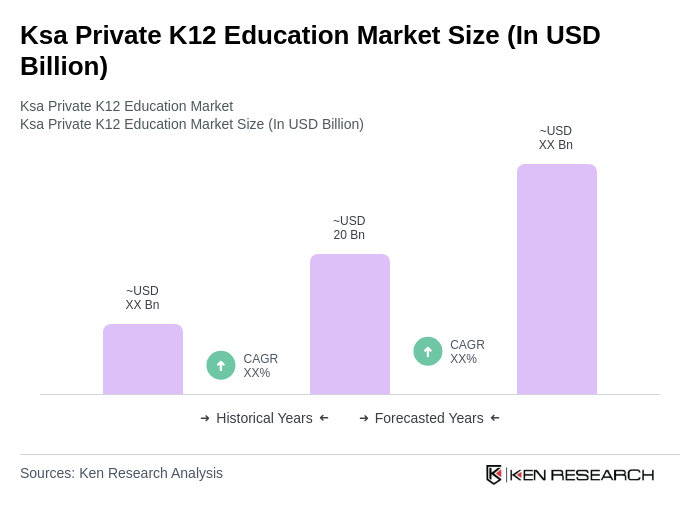
- The Ksa Private K12 Education Market is valued at USD 20 billion, based on a five-year historical analysis. This growth is primarily driven by increasing demand for quality education, a rising expatriate population, and government initiatives aimed at enhancing educational standards. The private sector has seen significant investment, leading to the establishment of numerous institutions catering to diverse educational needs.
- Key cities dominating the Ksa Private K12 Education Market include Riyadh, Jeddah, and Dammam. Riyadh’s large, higher-income population base and corporate presence sustain a dense private school footprint; Jeddah’s commercial role and sizable expatriate community anchor demand; and Dammam/Greater Dammam leverages industrial expansion and multinational employers in the Eastern Province to attract families to private options.
- A national push to raise private enrollment, improve quality standards, and encourage international curricula is reinforcing demand in these hubs, alongside incentives and privatization programs overseen by the National Center for Privatization.
Ksa Private K12 Education Market Segmentation
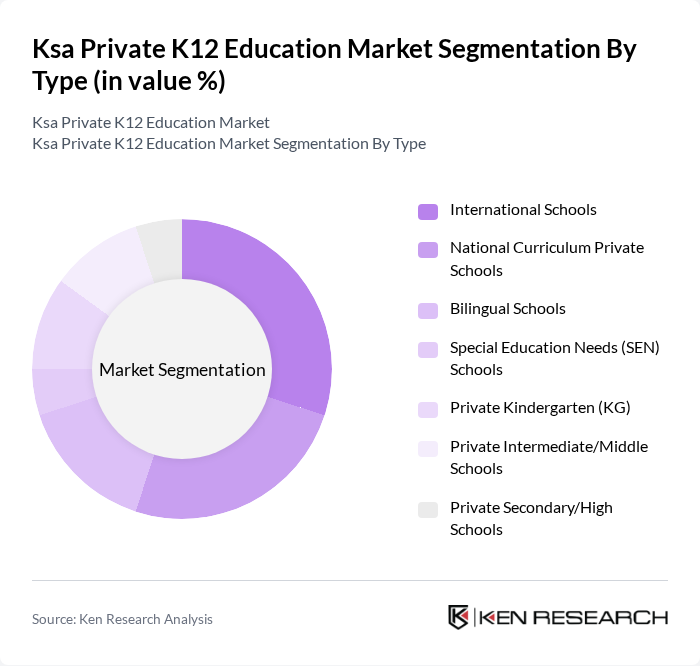
By Type:The Ksa Private K12 Education Market can be segmented into various types, including International Schools, National Curriculum Private Schools, Bilingual Schools, Special Education Needs (SEN) Schools, Private Kindergarten (KG), Private Intermediate/Middle Schools, and Private Secondary/High Schools. Each of these segments caters to different educational needs and preferences of families. Operators increasingly offer multiple curricula (e.g., American, British, IB) and bilingual models to serve both Saudi and expatriate families, aligned with Vision 2030’s emphasis on internationalization and quality enhancement.
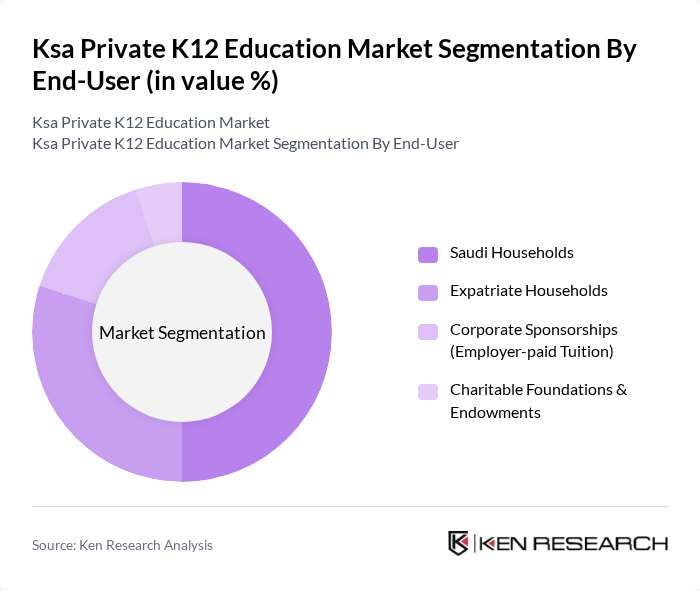
By End-User:The end-users of the Ksa Private K12 Education Market include Saudi Households, Expatriate Households, Corporate Sponsorships (Employer-paid Tuition), and Charitable Foundations & Endowments. Each of these segments reflects the diverse demographic and economic landscape of the Kingdom.
Ksa Private K12 Education Market Competitive Landscape
The Ksa Private K12 Education Market is characterized by a dynamic mix of regional and international players. Leading participants such as ATAA Educational Company (???? ???? ?????????), Maarif for Education & Training (????? ???????), National Company for Learning & Education – NCLE (?????? ??????? ???????), Kingdom Schools (????? ???????), Al Rowad International Schools (????? ??????), British International School of Jeddah – BISJ, American International School of Riyadh – AISR, International Schools Group – ISG (Dhahran, Dammam, Jubail), The International Schools of Choueifat – SABIS (Riyadh, Jeddah, Al Khobar), GEMS Education (Saudi Arabia operations), Aldenham Education Group – Aldenham Prep Riyadh, Downe House Riyadh, Lycée Français International de Riyad (AEFE network), International Indian School, Riyadh (IISR), Philippine International School in Riyadh (PISR) contribute to innovation, geographic expansion, and service delivery in this space.
Ksa Private K12 Education Market Industry Analysis
Growth Drivers
- Increasing Demand for Quality Education:The KSA private K12 education sector is experiencing a surge in demand, driven by a growing middle class and a national focus on educational excellence. In future, the education expenditure is projected to reach approximately SAR 220 billion, reflecting a 10% increase from previous estimates. This financial commitment underscores the public's desire for high-quality educational options, as parents increasingly seek institutions that offer superior academic performance and holistic development for their children.
- Government Initiatives for Private Education:The Saudi government has implemented various initiatives to enhance the private education sector, including the Vision 2030 plan, which allocates SAR 60 billion for educational reforms. These reforms aim to improve the quality of private schools and encourage foreign investment. By future, the government expects to increase the number of private schools by 20%, fostering a competitive environment that benefits students and parents alike, while also enhancing educational standards across the board.
- Technological Advancements in Education:The integration of technology in education is transforming the KSA private K12 landscape. In future, it is estimated that over 80% of private schools will adopt digital learning tools, driven by a SAR 15 billion investment in educational technology. This shift not only enhances learning experiences but also prepares students for a technology-driven workforce, making private institutions more attractive to parents seeking modern educational solutions for their children.
Market Challenges
- Regulatory Compliance Issues:Private K12 schools in KSA face significant regulatory compliance challenges, including adherence to strict licensing requirements and curriculum standards. In future, it is anticipated that over 40% of private institutions will struggle to meet these regulations, risking penalties or closure. This regulatory environment can deter potential investors and limit the growth of new educational establishments, ultimately affecting the quality and availability of private education options.
- Competition from Public Education Sector:The public education sector in KSA is undergoing substantial reforms, which may pose challenges for private K12 institutions. With a budget of SAR 180 billion allocated for public education in future, the government aims to enhance the quality of public schools, making them more competitive. This increased investment could lead to a decline in enrollment at private schools, as families may opt for improved public education options, impacting private sector growth.
Ksa Private K12 Education Market Future Outlook
The KSA private K12 education market is poised for significant transformation, driven by ongoing government reforms and technological advancements. As the demand for quality education continues to rise, private institutions will likely adapt by enhancing their curricula and adopting innovative teaching methods. The focus on personalized learning and STEM education will shape future offerings, while partnerships with international institutions may further enrich the educational landscape, ensuring that KSA remains competitive in the global education arena.
Market Opportunities
- Expansion of Online Learning Platforms:The rise of online learning platforms presents a significant opportunity for private K12 schools in KSA. With an estimated 70% of students engaging in online education in future, schools can leverage this trend to offer flexible learning options, catering to diverse student needs and enhancing accessibility, particularly in remote areas.
- Partnerships with International Educational Institutions:Collaborating with international educational institutions can provide KSA private schools with access to advanced curricula and teaching methodologies. In future, it is projected that at least 30% of private schools will establish such partnerships, enhancing their educational offerings and attracting a broader student base, including expatriates and local families seeking global standards.
Scope of the Report
| Segment | Sub-Segments |
|---|---|
| By Type | International Schools National Curriculum Private Schools Bilingual Schools Special Education Needs (SEN) Schools Private Kindergarten (KG) Private Intermediate/Middle Schools Private Secondary/High Schools |
| By End-User | Saudi Households Expatriate Households Corporate Sponsorships Charitable Foundations & Endowments |
| By Region | Riyadh Eastern Province Makkah Region Madinah & Western Region Asir & Southern Region Northern Region |
| By Curriculum | Saudi National International Baccalaureate British American Indian Other International |
| By School Size | Small Schools Medium Schools Large Schools |
| By Funding Source | Tuition & Fees Private Investors/Owners Corporate & Employer Contributions Philanthropy/Endowments |
| By Policy Support | Investment Licensing Saudization & Teacher Accreditation Compliance PPPs and Land Lease Incentives Quality Assurance & Inspection Ratings |
Key Target Audience
Investors and Venture Capitalist Firms
Government and Regulatory Bodies (e.g., Ministry of Education, Saudi Arabian General Investment Authority)
Private School Operators and Administrators
Educational Technology Providers
Real Estate Developers focusing on Educational Infrastructure
Non-Governmental Organizations (NGOs) involved in Education
Corporate Social Responsibility (CSR) Programs of Large Corporations
Financial Institutions offering Education Financing Solutions
Players Mentioned in the Report:
ATAA Educational Company ( )
Maarif for Education & Training ( )
National Company for Learning & Education NCLE ( )
Kingdom Schools ( )
Al Rowad International Schools ( )
British International School of Jeddah BISJ
American International School of Riyadh AISR
International Schools Group ISG (Dhahran, Dammam, Jubail)
The International Schools of Choueifat SABIS (Riyadh, Jeddah, Al Khobar)
GEMS Education (Saudi Arabia operations)
Aldenham Education Group Aldenham Prep Riyadh
Downe House Riyadh
Lycee Francais International de Riyad (AEFE network)
International Indian School, Riyadh (IISR)
Philippine International School in Riyadh (PISR)
Table of Contents
Market Assessment Phase
1. Executive Summary and Approach
2. Ksa Private K12 Education Market Overview
2.1 Key Insights and Strategic Recommendations
2.2 Ksa Private K12 Education Market Overview
2.3 Definition and Scope
2.4 Evolution of Market Ecosystem
2.5 Timeline of Key Regulatory Milestones
2.6 Value Chain & Stakeholder Mapping
2.7 Business Cycle Analysis
2.8 Policy & Incentive Landscape
3. Ksa Private K12 Education Market Analysis
3.1 Growth Drivers
3.1.1 Increasing Demand for Quality Education
3.1.2 Government Initiatives for Private Education
3.1.3 Rising Population and Youth Demographics
3.1.4 Technological Advancements in Education
3.2 Market Challenges
3.2.1 Regulatory Compliance Issues
3.2.2 Competition from Public Education Sector
3.2.3 Economic Factors Affecting Enrollment
3.2.4 Quality Assurance and Accreditation Concerns
3.3 Market Opportunities
3.3.1 Expansion of Online Learning Platforms
3.3.2 Partnerships with International Educational Institutions
3.3.3 Development of Specialized Curriculum
3.3.4 Investment in Educational Technology
3.4 Market Trends
3.4.1 Shift Towards Personalized Learning
3.4.2 Increasing Focus on STEM Education
3.4.3 Growth of Bilingual Education Programs
3.4.4 Emphasis on Extracurricular Activities
3.5 Government Regulation
3.5.1 Licensing Requirements for Private Schools
3.5.2 Curriculum Standards and Compliance
3.5.3 Teacher Qualification Regulations
3.5.4 Financial Aid and Subsidy Programs
4. SWOT Analysis
5. Stakeholder Analysis
6. Porter's Five Forces Analysis
7. Ksa Private K12 Education Market Market Size, 2019-2024
7.1 By Value
7.2 By Volume
7.3 By Average Selling Price
8. Ksa Private K12 Education Market Segmentation
8.1 By Type
8.1.1 International Schools
8.1.2 National Curriculum Private Schools
8.1.3 Bilingual Schools
8.1.4 Special Education Needs (SEN) Schools
8.1.5 Private Kindergarten (KG)
8.1.6 Private Intermediate/Middle Schools
8.1.7 Private Secondary/High Schools
8.2 By End-User
8.2.1 Saudi Households
8.2.2 Expatriate Households
8.2.3 Corporate Sponsorships (Employer-paid Tuition)
8.2.4 Charitable Foundations & Endowments
8.3 By Region
8.3.1 Riyadh (Central Region)
8.3.2 Eastern Province (Dammam–Khobar–Dhahran)
8.3.3 Makkah Region (Jeddah–Makkah–Taif)
8.3.4 Madinah & Western Region (incl. Yanbu)
8.3.5 Asir & Southern Region
8.3.6 Northern Region
8.4 By Curriculum
8.4.1 Saudi National (Arabic)
8.4.2 International Baccalaureate (IB)
8.4.3 British (IGCSE/A-Levels)
8.4.4 American (Common Core/Advanced Placement)
8.4.5 Indian (CBSE/ICSE)
8.4.6 Other International (e.g., French, Pakistani, Philippine)
8.5 By School Size
8.5.1 Small Schools (?500 students)
8.5.2 Medium Schools (501–1,500 students)
8.5.3 Large Schools (>1,500 students)
8.6 By Funding Source
8.6.1 Tuition & Fees
8.6.2 Private Investors/Owners
8.6.3 Corporate & Employer Contributions
8.6.4 Philanthropy/Endowments
8.7 By Policy Support
8.7.1 Investment Licensing (MEWA/MISA and MoE approvals)
8.7.2 Saudization & Teacher Accreditation Compliance
8.7.3 PPPs and Land Lease Incentives
8.7.4 Quality Assurance & Inspection Ratings (NCAAA/MoE)
9. Ksa Private K12 Education Market Competitive Analysis
9.1 Market Share of Key Players
9.2 Cross Comparison of Key Players
9.2.1 Operator/School Group Name
9.2.2 Group Size (Large/Medium/Small by total enrolled students in KSA)
9.2.3 Total Enrollment (KSA, latest academic year)
9.2.4 Number of Schools/Campuses (KSA)
9.2.5 Revenue (USD/SAR) and 3-year CAGR
9.2.6 Average Annual Tuition per Student (SAR, weighted)
9.2.7 Occupancy Rate (seat utilization, %)
9.2.8 Teacher–Student Ratio
9.2.9 Curriculum Mix (% of seats by Saudi/IB/British/American/Other)
9.2.10 Geographic Footprint (Riyadh/Eastern/Jeddah/Other)
9.2.11 EBITDA Margin (%) or Operating Margin proxy
9.2.12 New Capacity Pipeline (seats announced/under development)
9.2.13 Retention Rate (% returning students)
9.2.14 Accreditation Status (IBO, Cognia, Cambridge, MoE ratings)
9.3 SWOT Analysis of Top Players
9.4 Pricing Analysis
9.5 Detailed Profile of Major Companies
9.5.1 ATAA Educational Company (???? ???? ?????????)
9.5.2 Maarif for Education & Training (????? ???????)
9.5.3 National Company for Learning & Education – NCLE (?????? ??????? ???????)
9.5.4 Kingdom Schools (????? ???????)
9.5.5 Al Rowad International Schools (????? ??????)
9.5.6 British International School of Jeddah – BISJ
9.5.7 American International School of Riyadh – AISR
9.5.8 International Schools Group – ISG (Dhahran, Dammam, Jubail)
9.5.9 The International Schools of Choueifat – SABIS (Riyadh, Jeddah, Al Khobar)
9.5.10 GEMS Education (Saudi Arabia operations)
9.5.11 Aldenham Education Group – Aldenham Prep Riyadh
9.5.12 Downe House Riyadh
9.5.13 Lycée Français International de Riyad (AEFE network)
9.5.14 International Indian School, Riyadh (IISR)
9.5.15 Philippine International School in Riyadh (PISR)
10. Ksa Private K12 Education Market End-User Analysis
10.1 Procurement Behavior of Key Ministries
10.1.1 Ministry of Education Policies
10.1.2 Budget Allocation Trends
10.1.3 Approval Processes for Private Institutions
10.2 Corporate Spend on Infrastructure & Energy
10.2.1 Investment in Educational Facilities
10.2.2 Funding for Technological Integration
10.2.3 Expenditure on Teacher Training Programs
10.3 Pain Point Analysis by End-User Category
10.3.1 Affordability of Private Education
10.3.2 Quality of Educational Resources
10.3.3 Accessibility of Schools
10.4 User Readiness for Adoption
10.4.1 Awareness of Educational Options
10.4.2 Willingness to Invest in Private Education
10.4.3 Perception of Value in Private Schools
10.5 Post-Deployment ROI and Use Case Expansion
10.5.1 Evaluation of Educational Outcomes
10.5.2 Long-term Benefits of Private Education
10.5.3 Opportunities for Curriculum Expansion
11. Ksa Private K12 Education Market Future Size, 2025-2030
11.1 By Value
11.2 By Volume
11.3 By Average Selling Price
Go-To-Market Strategy Phase
1. Whitespace Analysis + Business Model Canvas
1.1 Market Gaps Identification
1.2 Value Proposition Development
1.3 Revenue Streams Analysis
1.4 Cost Structure Evaluation
1.5 Key Partnerships Exploration
1.6 Customer Segmentation Insights
1.7 Channels of Distribution
2. Marketing and Positioning Recommendations
2.1 Branding Strategies
2.2 Product USPs
2.3 Target Audience Identification
2.4 Communication Strategies
2.5 Digital Marketing Approaches
2.6 Community Engagement Plans
3. Distribution Plan
3.1 Urban Retail Strategies
3.2 Rural NGO Tie-ups
3.3 Online Distribution Channels
3.4 Partnerships with Local Businesses
3.5 Logistics and Supply Chain Management
4. Channel & Pricing Gaps
4.1 Underserved Routes
4.2 Pricing Bands Analysis
4.3 Competitor Pricing Strategies
4.4 Customer Willingness to Pay
4.5 Value-Based Pricing Models
5. Unmet Demand & Latent Needs
5.1 Category Gaps Identification
5.2 Consumer Segments Analysis
5.3 Emerging Trends in Education
5.4 Feedback Mechanisms for Improvement
6. Customer Relationship
6.1 Loyalty Programs
6.2 After-sales Service
6.3 Customer Feedback Systems
6.4 Community Building Initiatives
7. Value Proposition
7.1 Sustainability Initiatives
7.2 Integrated Supply Chains
7.3 Unique Selling Points
7.4 Customer-Centric Approaches
8. Key Activities
8.1 Regulatory Compliance
8.2 Branding Efforts
8.3 Distribution Setup
8.4 Training and Development Programs
9. Entry Strategy Evaluation
9.1 Domestic Market Entry Strategy
9.1.1 Product Mix Considerations
9.1.2 Pricing Band Strategies
9.1.3 Packaging Innovations
9.2 Export Entry Strategy
9.2.1 Target Countries Analysis
9.2.2 Compliance Roadmap Development
10. Entry Mode Assessment
10.1 Joint Ventures
10.2 Greenfield Investments
10.3 Mergers & Acquisitions
10.4 Distributor Model Evaluation
11. Capital and Timeline Estimation
11.1 Capital Requirements
11.2 Timelines for Implementation
12. Control vs Risk Trade-Off
12.1 Ownership Considerations
12.2 Partnerships Evaluation
13. Profitability Outlook
13.1 Breakeven Analysis
13.2 Long-term Sustainability Strategies
14. Potential Partner List
14.1 Distributors
14.2 Joint Ventures
14.3 Acquisition Targets
15. Execution Roadmap
15.1 Phased Plan for Market Entry
15.1.1 Market Setup
15.1.2 Market Entry
15.1.3 Growth Acceleration
15.1.4 Scale & Stabilize
15.2 Key Activities and Milestones
15.2.1 Milestone Planning
15.2.2 Activity Tracking
Research Methodology
Phase 1: Approach1
Desk Research
- Analysis of government education reports and statistics from the Ministry of Education in Saudi Arabia
- Review of market studies and white papers published by educational institutions and think tanks
- Examination of demographic data and economic indicators relevant to K12 education from national databases
Primary Research
- Interviews with school administrators and principals from various private K12 institutions
- Surveys conducted with parents to understand their preferences and concerns regarding private education
- Focus group discussions with educators to gather insights on curriculum trends and teaching methodologies
Validation & Triangulation
- Cross-validation of findings through multiple data sources, including government and private sector reports
- Triangulation of qualitative insights from interviews with quantitative data from surveys
- Sanity checks through expert panel reviews comprising education policy analysts and market experts
Phase 2: Market Size Estimation1
Top-down Assessment
- Estimation of total addressable market based on national education expenditure and enrollment rates
- Segmentation of the market by region, school type, and curriculum offered
- Incorporation of trends in private school enrollment growth and demographic shifts
Bottom-up Modeling
- Collection of tuition fee data from a representative sample of private K12 schools
- Estimation of operational costs and revenue streams for different school types
- Volume x fee analysis to derive revenue projections for the private K12 sector
Forecasting & Scenario Analysis
- Multi-factor regression analysis incorporating economic growth, population trends, and education policy changes
- Scenario modeling based on potential shifts in government regulations and funding for private education
- Development of baseline, optimistic, and pessimistic forecasts through 2030
Phase 3: CATI Sample Composition1
| Scope Item/Segment | Sample Size | Target Respondent Profiles |
|---|---|---|
| Private School Administrators | 90 | Principals, School Directors |
| Parents of K12 Students | 140 | Parents, Guardians |
| Educators in Private Schools | 80 | Teachers, Curriculum Coordinators |
| Education Policy Experts | 50 | Policy Analysts, Education Consultants |
| Private Education Investors | 40 | Investors, Financial Analysts |
Frequently Asked Questions
What is the current value of the KSA Private K12 Education Market?
The KSA Private K12 Education Market is valued at approximately USD 20 billion, reflecting significant growth driven by increasing demand for quality education, a rising expatriate population, and government initiatives aimed at enhancing educational standards.
Which cities are key players in the KSA Private K12 Education Market?
What types of schools are included in the KSA Private K12 Education Market?
Who are the primary end-users of private K12 education in Saudi Arabia?
Other Regional/Country Reports
Indonesia Private K12 Education Market
Malaysia Private K12 Education Market
APAC Private K12 Education Market
SEA Private K12 Education Market
Why Buy From Us?

What makes us stand out is that our consultants follow Robust, Refine and Result (RRR) methodology. Robust for clear definitions, approaches and sanity checking, Refine for differentiating respondents' facts and opinions, and Result for presenting data with story.

We have set a benchmark in the industry by offering our clients with syndicated and customized market research reports featuring coverage of entire market as well as meticulous research and analyst insights.

While we don't replace traditional research, we flip the method upside down. Our dual approach of Top Bottom & Bottom Top ensures quality deliverable by not just verifying company fundamentals but also looking at the sector and macroeconomic factors.

With one step in the future, our research team constantly tries to show you the bigger picture. We help with some of the tough questions you may encounter along the way: How is the industry positioned? Best marketing channel? KPI's of competitors? By aligning every element, we help maximize success.

Our report gives you instant access to the answers and sources that other companies might choose to hide. We elaborate each steps of research methodology we have used and showcase you the sample size to earn your trust.

If you need any support, we are here! We pride ourselves on universe strength, data quality, and quick, friendly, and professional service.