About the Report
Base Year 2024Qatar Private K12 Education Market Overview
- The Qatar Private K12 Education Market is valued at USD 1.3 billion, based on a five-year historical analysis. This growth is primarily driven by the increasing expatriate population, rising demand for quality education, and government initiatives to enhance educational standards. The market has seen a significant influx of private institutions catering to diverse curricula, which has further fueled its expansion .
- Doha is the dominant city in the Qatar Private K12 Education Market, primarily due to its status as the capital and largest city, housing a significant number of expatriates and affluent Qatari families. Other notable regions include Al Rayyan and Al Wakrah, which are experiencing rapid urbanization and population growth, leading to increased demand for private educational institutions .
- In 2023, the Qatari government implemented the “National School Accreditation System” under the Ministry of Education and Higher Education, requiring all private K12 schools to comply with defined quality standards for curriculum, facilities, and teacher qualifications. This regulation aims to ensure that educational institutions meet specific quality standards, thereby enhancing the overall educational experience for students and aligning with the country’s vision for educational reform .

Qatar Private K12 Education Market Segmentation
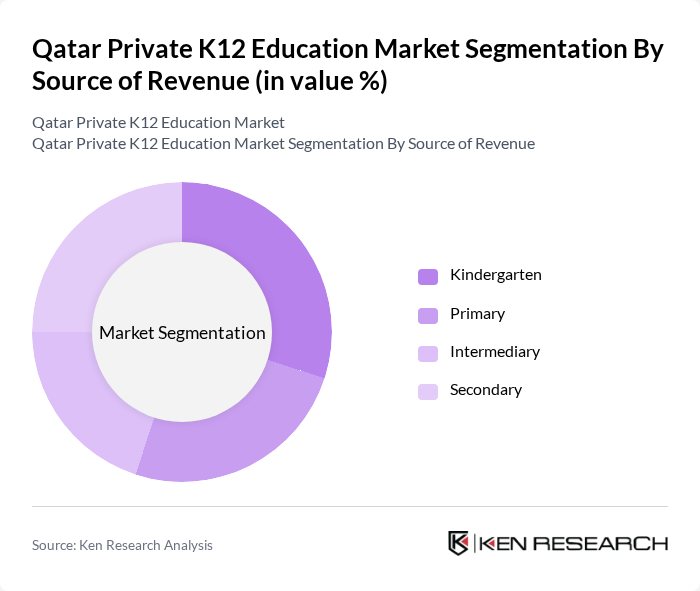
By Source of Revenue:The revenue sources in the Qatar Private K12 Education Market are diverse, encompassing various educational stages. The segments include Kindergarten, Primary, Intermediary, and Secondary education. Each of these segments caters to different age groups and educational needs, contributing significantly to the overall market revenue. The Kindergarten segment is particularly popular among expatriate families, while Secondary education sees a higher enrollment from Qatari nationals .
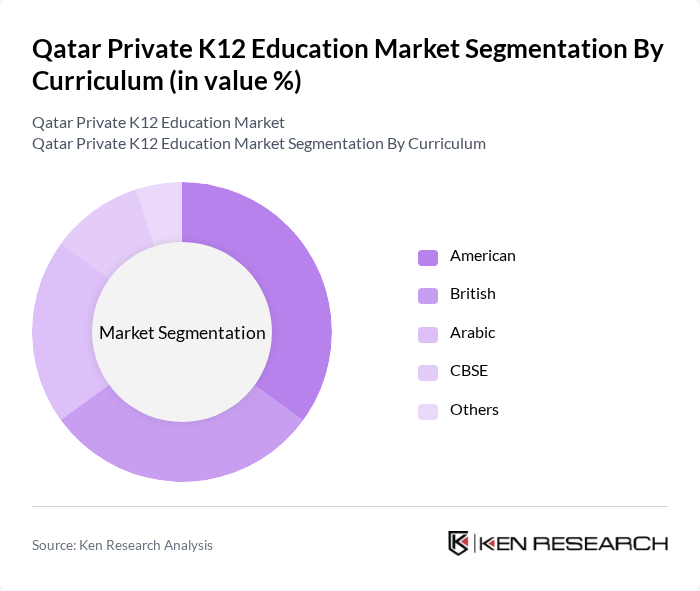
By Curriculum:The curriculum offered by private K12 schools in Qatar is varied, with American, British, Arabic, CBSE, and other curricula available. The American and British curricula are particularly favored by expatriate families, while the Arabic curriculum is preferred by Qatari nationals. The diversity in curriculum options allows parents to choose educational pathways that align with their cultural values and future aspirations for their children .
Qatar Private K12 Education Market Competitive Landscape
The Qatar Private K12 Education Market is characterized by a dynamic mix of regional and international players. Leading participants such as Doha British School, International School of London Qatar, Qatar Academy, The American School of Doha, Doha College, The International School of Choueifat, Qatar International School, Compass International School, Park House English School, GEMS Wellington School Qatar, Al Jazeera Academy, Newton International School, Kings College Doha, The Phoenix Private School, SABIS Education Services contribute to innovation, geographic expansion, and service delivery in this space.
Qatar Private K12 Education Market Industry Analysis
Growth Drivers
- Increasing Expatriate Population:Qatar's expatriate population reached approximately 2.8 million, accounting for about 75% of the total population. This demographic shift drives demand for private K12 education, as expatriates often seek international curricula for their children. The Ministry of Education reported that private schools enrolled over 320,000 students, with a significant portion being expatriate children. This trend is expected to continue, further boosting the private education sector.
- Government Investment in Education:The Qatari government allocated QAR 22 billion (approximately USD 6 billion) for education, reflecting a commitment to enhancing educational infrastructure. This investment supports the establishment of new private schools and the expansion of existing ones, creating a favorable environment for growth. Additionally, government initiatives aim to improve educational quality, which is crucial for attracting expatriate families seeking high-standard education for their children.
- Rising Demand for International Curriculum:The demand for international curricula, such as the British and American systems, has surged, with over 65% of private schools in Qatar offering these programs. Enrollment in international curriculum schools increased by 20,000 students, reflecting a growing preference among parents for globally recognized education. This trend is driven by the desire for quality education that prepares students for higher education abroad, further propelling the private K12 education market.
Market Challenges
- High Competition Among Private Schools:The private K12 education sector in Qatar is highly competitive, with over 320 private schools vying for student enrollment. This competition has led to aggressive marketing strategies and price wars, which can undermine the financial stability of schools. Some institutions reported a decline in enrollment due to this saturation, making it challenging for new entrants to establish themselves in the market.
- Regulatory Compliance Costs:Private schools in Qatar face significant regulatory compliance costs, including licensing fees and adherence to curriculum standards set by the Ministry of Education. These costs are projected to exceed QAR 1.2 million (approximately USD 330,000) for many institutions. This financial burden can limit the ability of schools to invest in quality improvements and innovative educational programs, hindering overall market growth.
Qatar Private K12 Education Market Future Outlook
The future of the Qatar private K12 education market appears promising, driven by ongoing government support and a growing expatriate population. As the demand for international curricula continues to rise, schools are likely to innovate and diversify their offerings. Additionally, the integration of technology in education is expected to enhance learning experiences, making private institutions more attractive. Overall, the market is poised for sustained growth, adapting to the evolving needs of families in Qatar.
Market Opportunities
- Expansion of Online Learning Platforms:The shift towards digital education presents a significant opportunity for private schools to develop online learning platforms. With over 75% of parents expressing interest in hybrid learning models, schools can leverage technology to enhance educational delivery and reach a broader audience, particularly expatriate families seeking flexible options.
- Partnerships with International Educational Institutions:Collaborating with renowned international educational institutions can enhance the credibility and appeal of private schools in Qatar. Such partnerships can facilitate curriculum development, teacher training, and exchange programs, ultimately improving educational quality and attracting more students, particularly from expatriate backgrounds.
Scope of the Report
| Segment | Sub-Segments |
|---|---|
| By Source of Revenue | Kindergarten Primary Intermediary Secondary |
| By Curriculum | American British Arabic CBSE Others |
| By Geography | North Region West Region South Region East Region |
| By School Size | Small Schools (Under 300 Students) Medium Schools (300-1000 Students) Large Schools (Over 1000 Students) |
| By Fee Structure | Low Fee Schools Mid-Range Fee Schools High-End Fee Schools |
| By End-User | Expatriate Families Qatari Nationals Corporate Sponsored Students Government Funded Students |
| By Extracurricular Offerings | Sports Programs Arts and Music Programs STEM Clubs Others |
Key Target Audience
Investors and Venture Capitalist Firms
Government and Regulatory Bodies (e.g., Ministry of Education and Higher Education)
Real Estate Developers
Educational Technology Providers
Curriculum and Content Developers
Non-Governmental Organizations (NGOs) focused on education
Local and International Franchise Operators
Insurance Companies specializing in education sector policies
Players Mentioned in the Report:
Doha British School
International School of London Qatar
Qatar Academy
The American School of Doha
Doha College
The International School of Choueifat
Qatar International School
Compass International School
Park House English School
GEMS Wellington School Qatar
Al Jazeera Academy
Newton International School
Kings College Doha
The Phoenix Private School
SABIS Education Services
Table of Contents
Market Assessment Phase
1. Executive Summary and Approach
2. Qatar Private K12 Education Market Overview
2.1 Key Insights and Strategic Recommendations
2.2 Qatar Private K12 Education Market Overview
2.3 Definition and Scope
2.4 Evolution of Market Ecosystem
2.5 Timeline of Key Regulatory Milestones
2.6 Value Chain & Stakeholder Mapping
2.7 Business Cycle Analysis
2.8 Policy & Incentive Landscape
3. Qatar Private K12 Education Market Analysis
3.1 Growth Drivers
3.1.1 Increasing Expatriate Population
3.1.2 Government Investment in Education
3.1.3 Rising Demand for International Curriculum
3.1.4 Technological Advancements in Education
3.2 Market Challenges
3.2.1 High Competition Among Private Schools
3.2.2 Regulatory Compliance Costs
3.2.3 Limited Availability of Qualified Teachers
3.2.4 Economic Fluctuations Affecting Enrollment
3.3 Market Opportunities
3.3.1 Expansion of Online Learning Platforms
3.3.2 Partnerships with International Educational Institutions
3.3.3 Development of Specialized Programs
3.3.4 Increased Focus on STEM Education
3.4 Market Trends
3.4.1 Growth of Bilingual Education
3.4.2 Emphasis on Holistic Education Approaches
3.4.3 Integration of Artificial Intelligence in Learning
3.4.4 Rise of Parental Involvement in Education Choices
3.5 Government Regulation
3.5.1 Licensing Requirements for Private Schools
3.5.2 Curriculum Standards Set by the Ministry of Education
3.5.3 Teacher Qualification Regulations
3.5.4 Fee Regulation Policies
4. SWOT Analysis
5. Stakeholder Analysis
6. Porter's Five Forces Analysis
7. Qatar Private K12 Education Market Market Size, 2019-2024
7.1 By Value
7.2 By Volume
7.3 By Average Selling Price
8. Qatar Private K12 Education Market Segmentation
8.1 By Source of Revenue
8.1.1 Kindergarten
8.1.2 Primary
8.1.3 Intermediary
8.1.4 Secondary
8.2 By Curriculum
8.2.1 American
8.2.2 British
8.2.3 Arabic
8.2.4 CBSE
8.2.5 Others
8.3 By Geography
8.3.1 North Region
8.3.2 West Region
8.3.3 South Region
8.3.4 East Region
8.4 By School Size
8.4.1 Small Schools (Under 300 Students)
8.4.2 Medium Schools (300-1000 Students)
8.4.3 Large Schools (Over 1000 Students)
8.5 By Fee Structure
8.5.1 Low Fee Schools
8.5.2 Mid-Range Fee Schools
8.5.3 High-End Fee Schools
8.6 By End-User
8.6.1 Expatriate Families
8.6.2 Qatari Nationals
8.6.3 Corporate Sponsored Students
8.6.4 Government Funded Students
8.7 By Extracurricular Offerings
8.7.1 Sports Programs
8.7.2 Arts and Music Programs
8.7.3 STEM Clubs
8.7.4 Others
9. Qatar Private K12 Education Market Competitive Analysis
9.1 Market Share of Key Players
9.2 Cross Comparison of Key Players
9.2.1 Company Name
9.2.2 Group Size (Large, Medium, or Small as per industry convention)
9.2.3 Enrollment Numbers
9.2.4 Revenue Growth Rate
9.2.5 Customer Satisfaction Score
9.2.6 Teacher-Student Ratio
9.2.7 Retention Rate
9.2.8 Pricing Strategy
9.2.9 Curriculum Diversity
9.2.10 Facilities and Infrastructure Quality
9.2.11 Accreditation Status
9.2.12 Percentage of Expatriate Students
9.2.13 Technology Integration Level
9.3 SWOT Analysis of Top Players
9.4 Pricing Analysis
9.5 Detailed Profile of Major Companies
9.5.1 Doha British School
9.5.2 International School of London Qatar
9.5.3 Qatar Academy
9.5.4 The American School of Doha
9.5.5 Doha College
9.5.6 The International School of Choueifat
9.5.7 Qatar International School
9.5.8 Compass International School
9.5.9 Park House English School
9.5.10 GEMS Wellington School Qatar
9.5.11 Al Jazeera Academy
9.5.12 Newton International School
9.5.13 Kings College Doha
9.5.14 The Phoenix Private School
9.5.15 SABIS Education Services
10. Qatar Private K12 Education Market End-User Analysis
10.1 Procurement Behavior of Key Ministries
10.1.1 Budget Allocation for Education
10.1.2 Preference for Private vs Public Education
10.1.3 Evaluation Criteria for School Selection
10.2 Corporate Spend on Infrastructure & Energy
10.2.1 Investment in School Facilities
10.2.2 Funding for Educational Technology
10.2.3 Sponsorship of Educational Programs
10.3 Pain Point Analysis by End-User Category
10.3.1 Affordability of Tuition Fees
10.3.2 Quality of Education
10.3.3 Availability of Extracurricular Activities
10.4 User Readiness for Adoption
10.4.1 Awareness of Educational Options
10.4.2 Acceptance of Online Learning
10.4.3 Parental Involvement in Education Choices
10.5 Post-Deployment ROI and Use Case Expansion
10.5.1 Improvement in Student Performance
10.5.2 Long-term Educational Outcomes
10.5.3 Expansion of Educational Offerings
11. Qatar Private K12 Education Market Future Size, 2025-2030
11.1 By Value
11.2 By Volume
11.3 By Average Selling Price
Go-To-Market Strategy Phase
1. Whitespace Analysis + Business Model Canvas
1.1 Market Gaps Identification
1.2 Value Proposition Development
1.3 Revenue Streams Analysis
2. Marketing and Positioning Recommendations
2.1 Branding Strategies
2.2 Product USPs
3. Distribution Plan
3.1 Urban Retail vs Rural NGO Tie-ups
4. Channel & Pricing Gaps
4.1 Underserved Routes
4.2 Pricing Bands
5. Unmet Demand & Latent Needs
5.1 Category Gaps
5.2 Consumer Segments
6. Customer Relationship
6.1 Loyalty Programs
6.2 After-sales Service
7. Value Proposition
7.1 Sustainability
7.2 Integrated Supply Chains
8. Key Activities
8.1 Regulatory Compliance
8.2 Branding
8.3 Distribution Setup
9. Entry Strategy Evaluation
9.1 Domestic Market Entry Strategy
9.1.1 Product Mix
9.1.2 Pricing Band
9.1.3 Packaging
9.2 Export Entry Strategy
9.2.1 Target Countries
9.2.2 Compliance Roadmap
10. Entry Mode Assessment
10.1 JV, Greenfield, M&A, Distributor Model
11. Capital and Timeline Estimation
11.1 Capital Requirements
11.2 Timelines
12. Control vs Risk Trade-Off
12.1 Ownership vs Partnerships
13. Profitability Outlook
13.1 Breakeven Analysis
13.2 Long-term Sustainability
14. Potential Partner List
14.1 Distributors
14.2 JVs
14.3 Acquisition Targets
15. Execution Roadmap
15.1 Phased Plan for Market Entry
15.1.1 Market Setup
15.1.2 Market Entry
15.1.3 Growth Acceleration
15.1.4 Scale & Stabilize
15.2 Key Activities and Milestones
15.2.1 Activity Planning
15.2.2 Milestone Tracking
Research Methodology
Phase 1: Approach1
Desk Research
- Analysis of government education reports and statistics from the Ministry of Education and Higher Education in Qatar
- Review of academic publications and white papers on K12 education trends in the Gulf region
- Examination of enrollment data and demographic studies from local educational institutions and international organizations
Primary Research
- Interviews with school administrators and principals from various private K12 institutions
- Surveys conducted with parents to understand their preferences and satisfaction levels regarding private education
- Focus group discussions with educators to gather insights on curriculum development and teaching methodologies
Validation & Triangulation
- Cross-validation of findings through comparison with regional education market reports
- Triangulation of data from interviews, surveys, and secondary research sources
- Sanity checks through expert panel reviews involving education policy analysts and market experts
Phase 2: Market Size Estimation1
Top-down Assessment
- Estimation of total addressable market based on national education expenditure and GDP allocation for education
- Segmentation of the market by school type (e.g., international, bilingual, and national curriculum schools)
- Incorporation of demographic trends and population growth projections in Qatar
Bottom-up Modeling
- Collection of tuition fee structures and enrollment numbers from leading private K12 schools
- Analysis of operational costs and revenue streams for private educational institutions
- Estimation of market size based on the number of students and average tuition fees
Forecasting & Scenario Analysis
- Multi-factor regression analysis incorporating factors such as economic growth, population trends, and educational reforms
- Scenario modeling based on potential changes in government policy and private sector investment in education
- Development of baseline, optimistic, and pessimistic forecasts for the next 5-10 years
Phase 3: CATI Sample Composition1
| Scope Item/Segment | Sample Size | Target Respondent Profiles |
|---|---|---|
| Private K12 School Administrators | 80 | Principals, School Directors |
| Parents of K12 Students | 120 | Parents, Guardians |
| Educators in Private Schools | 60 | Teachers, Curriculum Coordinators |
| Education Policy Experts | 40 | Education Analysts, Government Officials |
| Private Education Investors | 40 | Investors, Educational Consultants |
Frequently Asked Questions
What is the current value of the Qatar Private K12 Education Market?
The Qatar Private K12 Education Market is valued at approximately USD 1.3 billion, reflecting significant growth driven by an increasing expatriate population, demand for quality education, and government initiatives aimed at enhancing educational standards.
Which city dominates the Qatar Private K12 Education Market?
What are the key growth drivers in the Qatar Private K12 Education Market?
What challenges does the Qatar Private K12 Education Market face?
Other Regional/Country Reports
Indonesia Private K12 Education Market
Malaysia Private K12 Education Market
APAC Private K12 Education Market
SEA Private K12 Education Market
Why Buy From Us?

What makes us stand out is that our consultants follow Robust, Refine and Result (RRR) methodology. Robust for clear definitions, approaches and sanity checking, Refine for differentiating respondents' facts and opinions, and Result for presenting data with story.

We have set a benchmark in the industry by offering our clients with syndicated and customized market research reports featuring coverage of entire market as well as meticulous research and analyst insights.

While we don't replace traditional research, we flip the method upside down. Our dual approach of Top Bottom & Bottom Top ensures quality deliverable by not just verifying company fundamentals but also looking at the sector and macroeconomic factors.

With one step in the future, our research team constantly tries to show you the bigger picture. We help with some of the tough questions you may encounter along the way: How is the industry positioned? Best marketing channel? KPI's of competitors? By aligning every element, we help maximize success.

Our report gives you instant access to the answers and sources that other companies might choose to hide. We elaborate each steps of research methodology we have used and showcase you the sample size to earn your trust.

If you need any support, we are here! We pride ourselves on universe strength, data quality, and quick, friendly, and professional service.