About the Report
Base Year 2025KSA Retail and Personal Finance Market Overview
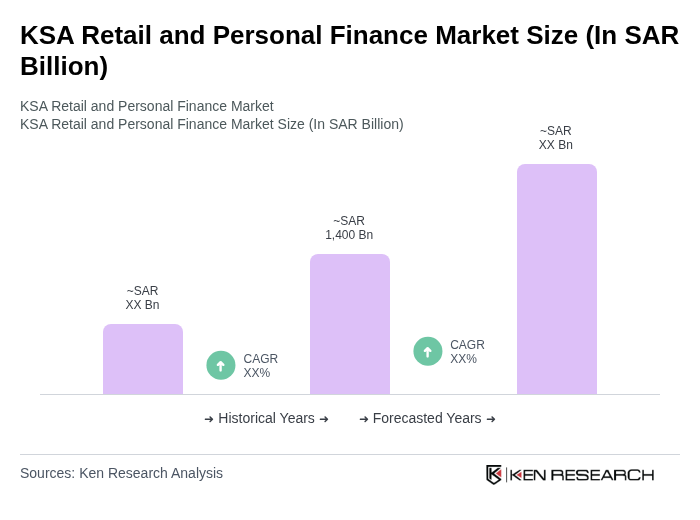
- The KSA Retail and Personal Finance Market is valued at approximately SAR 1,400 billion, based on a five-year historical analysis of retail banking, consumer lending, cards, and personal financial services, aligned with the strong expansion of the broader Saudi retail market and household consumption.This growth is primarily driven by increasing consumer spending supported by higher disposable incomes, demographic expansion, and Vision 2030 reforms that promote non?oil economic activity and financial inclusion.The market has seen a significant shift towards online and mobile banking, with rapid adoption of digital payment solutions, e?commerce, and fintech-enabled services encouraged by SAMA’s initiatives to expand cashless transactions and open banking.
- Key cities such as Riyadh, Jeddah, and Dammam dominate the market due to their economic significance, population density, and concentration of banking branches and payment infrastructure.Riyadh, as the capital and largest city, serves as a financial hub hosting the headquarters of major banks and fintechs, while Jeddah's strategic location as a Red Sea port city supports trade-related retail and financial services and a large consumer base.Dammam, at the heart of the Eastern Province’s industrial and oil?related activity, benefits from a strong corporate and expatriate presence, which in turn supports demand for personal banking, auto finance, and card-based payments.
- In 2023, the Saudi Central Bank (SAMA, formerly the Saudi Arabian Monetary Authority) reinforced regulations to enhance consumer protection in the retail finance sector, building on its Consumer Protection Principles and implementing measures in the Finance Companies Control Law framework.This includes mandatory, standardised disclosures for loan terms, profit rates, fees, and total cost of credit, as well as requirements on suitability and affordability assessments, aimed at increasing transparency and ensuring that consumers are well?informed before making financial decisions and are treated fairly across banks and finance companies.
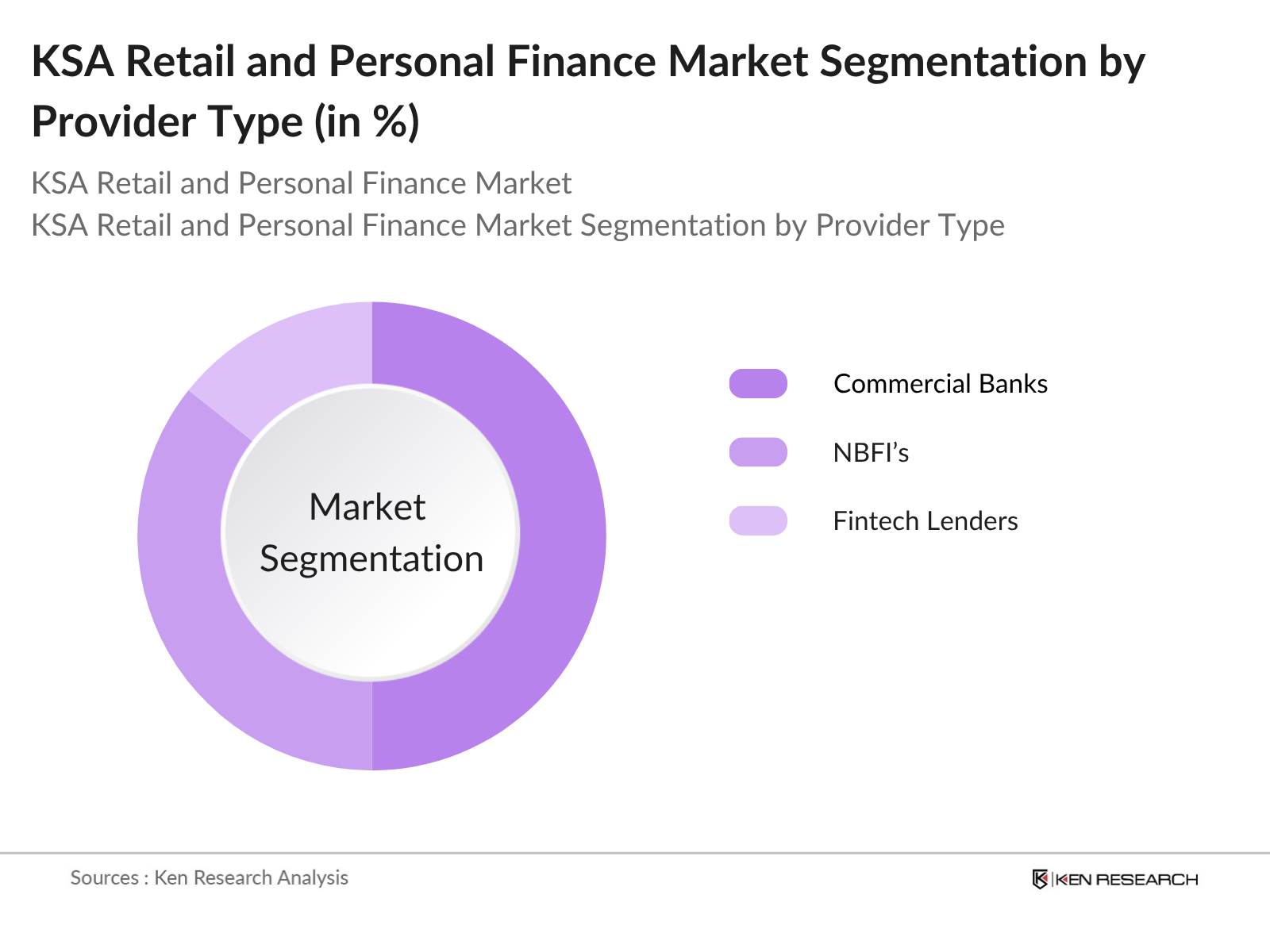
KSA Retail and Personal Finance Market Segmentation
By Provider Type:The provider type segmentation includes Commercial Banks, NBFIs, and Fintech Lenders within the KSA personal finance and lending market. Commercial banks dominate the market, supported by strong balance sheets, established customer relationships, salary-transfer accounts, regulatory trust, and deep distribution across retail banking channels. Their role remains central in personal loans, cards, housing finance, auto finance, and broader consumer credit products. NBFIs also hold a meaningful position, serving customers through specialised lending models, faster approval processes, and targeted financing products outside traditional banking structures. Fintech lenders are emerging from a smaller base, driven by mobile-first onboarding, instant credit assessment, digital wallets, embedded finance, and white-label partnerships with regulated institutions. These collaborations allow fintechs to scale while operating within Saudi Arabia’s evolving financial regulatory framework.
By Tenure:The tenure segmentation includes Three Years and Above, One to Three Years, and Up to One Year, within the KSA personal finance and lending market. The Three Years and Above segment dominates the market, supported by demand for larger-ticket personal finance, housing-related borrowing, auto finance, and structured repayment products that require longer repayment flexibility. This tenure band is preferred by salaried customers seeking manageable monthly instalments and predictable repayment schedules. The One to Three Years segment remains steady, serving medium-ticket consumer loans, lifestyle financing, and planned expenditure needs. Up to one-year lending is smaller but gaining relevance through short-term credit, buy-now-pay-later models, emergency borrowing, and digital lending products designed for quick approval and faster repayment cycles.
KSA Retail and Personal Finance Market Competitive Landscape
The KSA Retail and Personal Finance Market is characterised by a dynamic mix of regional and international players. Leading participants such as Emkan, AU Finance, SNB, Al Rajhi Bank, and JB Finance contribute to innovation, geographic expansion, and service delivery in this space.
KSA Retail and Personal Finance Market Industry Analysis
Growth Drivers
- Increasing Digital Payment Adoption:Electronic payments reached 79% of total retail payments in 2024, compared with 36% in 2019, reflecting Saudi Arabia’s rapid shift towards cash-light consumer behaviour. Non-cash transactions totalled around 12.6 billion in 2024, creating large-scale, traceable payment flows for lenders. This strengthens digital origination, automated underwriting, BNPL usage, repayment tracking, and personal loan servicing, making digital payments a core growth driver for retail credit demand in KSA.
- Employment Stability and Female Workforce Expansion:Saudi Arabia’s unemployment rate declined to around 3.2% in Q2 2025, supporting more stable income pools and reducing near-term volatility in personal credit demand. Female labour force participation also reached 34.5% in Q2 2025, materially expanding the addressable borrower base. As more salaried individuals enter formal employment, banks and finance companies can scale personal loans, consumption-led credit, cards, and salary-linked financing products with stronger repayment visibility.
- Expansion of National Digital Identity Infrastructure:Saudi Arabia’s national digital identity ecosystem is strengthening retail credit access by improving verification, onboarding, and fraud control. Absher has issued over 28 million unified digital identities and offers more than 500 e-services, enabling large-scale digital verification. Nafath has executed 3 billion-plus verification operations, reducing identity risk and underwriting uncertainty. This allows lenders to safely scale unsecured personal lending, digital credit approvals, and remote customer onboarding across KSA.
Market Challenges
- High Compliance and Technology Cost Burden:Saudi Arabia’s personal finance market faces rising structural pressure from tighter data protection and compliance expectations. The country spent SAR 15.2 billion on cybersecurity in 2024, with nearly 70% driven by the private sector, reflecting higher security and monitoring requirements. For lenders, this translates into significant upfront technology investments, recurring audit costs, and higher fixed operating expenses, increasing the scale required to achieve margin efficiency.
- Manual Verification and Approval Delays:Retail lending in KSA remains heavily dependent on traditional verification processes, with lenders relying on 3–6 months of bank statements and employer documents. This lengthens approval cycles, raises manual processing costs, and reduces throughput for underwriting teams. Since most approvals remain salary-linked and tied to employer or payroll records, credit access for self-employed and informal workers remains limited, slowing execution despite healthy personal finance demand.
KSA Retail and Personal Finance Market Future Outlook
The KSA retail and personal finance market is poised for significant transformation, driven by technological advancements and changing consumer behaviours. The integration of artificial intelligence in customer service is expected to enhance user experiences, while the shift towards mobile banking will facilitate greater financial accessibility. Furthermore, sustainability trends are likely to influence product offerings, as consumers increasingly demand eco-friendly financial solutions. These developments will create a dynamic environment for innovation and growth in the coming years.
Market Opportunities
- Open Banking and Fintech Licensing Unlocking Digital Finance Growth:Saudi Arabia’s open banking rollout is enabling account aggregation, instant income verification, and SIMAH API-based credit scoring, creating strong opportunities for digital lenders, BNPL firms, and payment service providers. With SAMA’s fintech licensing framework providing formal market access, new entrants can build compliant digital finance products and scale lending, wallet, and embedded finance solutions.
- AI-Based Scoring and Instant Journeys Improving Personal Finance Access:AI-based scoring and alternative data are transforming personal finance journeys in Saudi Arabia by reducing underwriting windows from 3–6 days to minutes. Salary verification through WPS, Nafath e-signature, and Mada/SADAD integrations enables faster digital approvals and disbursements. This creates opportunities for lenders to offer smarter budgeting, credit, and personal finance tools for digitally active consumers.
Scope of the Report
| Segment | Sub-Segments |
|---|---|
| By Provider Type | Commercial Banks NBFI's Fintech Lenders |
| By Tenure | 3 Years and Above 1-3 Years Up to 1 Year |
| By Region | Riyadh Makkah Eastern Province Aseer Others |
Key Target Audience
Investors and Venture Capitalist Firms
Government and Regulatory Bodies (e.g., Saudi Arabian Monetary Authority, Ministry of Commerce)
Retail Chains and Supermarkets
Payment Solution Providers
Consumer Goods Manufacturers
Logistics and Supply Chain Companies
Financial Technology Startups
Market Research and Analytics Firms
Players Mentioned in the Report:
Emkan
AU Finance
SNB
Al Rajhi Bank
JB Finance
Tamam
SFC (Saudi Finance Company)
Amlak International Finance
Tasheel Finance
Tayseer Finance
Table of Contents
Market Assessment Phase
1. Executive Summary and Approach
2. KSA Retail and Personal Finance Market Overview
2.1 Key Insights and Strategic Recommendations
2.2 KSA Retail and Personal Finance Market Overview
2.3 Definition and Scope
2.4 Evolution of Market Ecosystem
2.5 Timeline of Key Regulatory Milestones
2.6 Value Chain & Stakeholder Mapping
2.7 Business Cycle Analysis
2.8 Policy & Incentive Landscape
3. KSA Retail and Personal Finance Market Analysis
3.1 Growth Drivers
3.1.1 Increasing Digital Payment Adoption
3.1.2 Rising Consumer Spending
3.1.3 Expansion of E-commerce Platforms
3.1.4 Government Initiatives for Financial Inclusion
3.2 Market Challenges
3.2.1 Regulatory Compliance Complexity
3.2.2 High Competition Among Financial Institutions
3.2.3 Consumer Trust Issues
3.2.4 Economic Fluctuations
3.3 Market Opportunities
3.3.1 Growth of Fintech Solutions
3.3.2 Increasing Demand for Personal Finance Management Tools
3.3.3 Expansion into Underserved Markets
3.3.4 Partnerships with Retailers for Financial Products
3.4 Market Trends
3.4.1 Shift Towards Mobile Banking
3.4.2 Personalization of Financial Services
3.4.3 Integration of AI in Customer Service
3.4.4 Sustainability in Financial Products
3.5 Government Regulation
3.5.1 Implementation of Open Banking Regulations
3.5.2 Consumer Protection Laws
3.5.3 Anti-Money Laundering (AML) Policies
3.5.4 Data Privacy Regulations
4. SWOT Analysis
5. Stakeholder Analysis
6. Porter's Five Forces Analysis
7. KSA Retail and Personal Finance Market Size, 2019-2024
7.1 By Value
7.2 By Volume
7.3 By Average Selling Price
8. KSA Retail and Personal Finance Market Segmentation
8.1 By Provider Type
8.1.1 Commercial Banks
8.1.2 NBFIs
8.1.3 Fintech Lenders
8.2 By Tenure
8.2.1 3 Years and Above
8.2.2 1–3 Years
8.2.3 Up to 1 Year
8.3 By Region
8.3.1 Riyadh
8.3.2 Makkah
8.3.3 Eastern Province
8.3.4 Aseer
8.3.5 Others
9. KSA Retail and Personal Finance Market Competitive Analysis
9.1 Market Share of Key Players
9.2 Cross Comparison of Key Players
9.2.1 Company Name
9.2.2 Group Size (Large, Medium, or Small as per industry convention)
9.2.3 Customer Acquisition Cost (CAC)
9.2.4 Customer Lifetime Value (CLV)
9.2.5 Customer Retention Rate
9.2.6 Average Revenue Per User (ARPU)
9.2.7 Net Interest Margin (NIM)
9.2.8 Fee & Commission Income Share
9.2.9 Market Penetration (Active Customers, Cards-in-force)
9.2.10 Digital Adoption Rate (Mobile / Online Active Users)
9.2.11 Non-performing Loan (NPL) Ratio
9.2.12 Cost-to-Income Ratio
9.2.13 Return on Equity (ROE)
9.2.14 Return on Assets (ROA)
9.3 SWOT Analysis of Top Players
9.4 Pricing Analysis
9.5 Detailed Profile of Major Companies
9.5.1 Emkan
9.5.2 AU Finance
9.5.3 SNB
9.5.4 Al Rajhi Bank
9.5.5 JB Finance
9.5.6 Tamam
9.5.7 SFC (Saudi Finance Company)
9.5.8 Amlak International Finance
9.5.9 Tasheel Finance
9.5.10 Tayseer Finance
10. KSA Retail and Personal Finance Market End-User Analysis
10.1 Procurement Behavior of Key Ministries
10.1.1 Budget Allocation Trends
10.1.2 Decision-Making Processes
10.1.3 Preferred Financial Products
10.1.4 Vendor Selection Criteria
10.2 Corporate Spend on Infrastructure & Energy
10.2.1 Investment Priorities
10.2.2 Financial Planning Strategies
10.2.3 Impact of Economic Policies
10.3 Pain Point Analysis by End-User Category
10.3.1 Access to Financial Services
10.3.2 High Fees and Charges
10.3.3 Lack of Financial Literacy
10.4 User Readiness for Adoption
10.4.1 Technology Adoption Rates
10.4.2 Awareness of Financial Products
10.4.3 Trust in Financial Institutions
10.5 Post-Deployment ROI and Use Case Expansion
10.5.1 Measurement of Financial Outcomes
10.5.2 Customer Feedback Mechanisms
10.5.3 Opportunities for Upselling
11. KSA Retail and Personal Finance Market Future Size, 2025-2030
11.1 By Value
11.2 By Volume
11.3 By Average Selling Price
Go-To-Market Strategy Phase
1. Whitespace Analysis + Business Model Canvas
1.1 Market Gaps Identification
1.2 Business Model Development
2. Marketing and Positioning Recommendations
2.1 Branding Strategies
2.2 Product USPs
3. Distribution Plan
3.1 Urban Retail vs Rural NGO Tie-ups
4. Channel & Pricing Gaps
4.1 Underserved Routes
4.2 Pricing Bands
5. Unmet Demand & Latent Needs
5.1 Category Gaps
5.2 Consumer Segments
6. Customer Relationship
6.1 Loyalty Programs
6.2 After-sales Service
7. Value Proposition
7.1 Sustainability
7.2 Integrated Supply Chains
8. Key Activities
8.1 Regulatory Compliance
8.2 Branding
8.3 Distribution Setup
9. Entry Strategy Evaluation
9.1 Domestic Market Entry Strategy
9.1.1 Product Mix
9.1.2 Pricing Band
9.1.3 Packaging
9.2 Export Entry Strategy
9.2.1 Target Countries
9.2.2 Compliance Roadmap
10. Entry Mode Assessment
10.1 JV
10.2 Greenfield
10.3 M&A
10.4 Distributor Model
11. Capital and Timeline Estimation
11.1 Capital Requirements
11.2 Timelines
12. Control vs Risk Trade-Off
12.1 Ownership vs Partnerships
13. Profitability Outlook
13.1 Breakeven Analysis
13.2 Long-term Sustainability
14. Potential Partner List
14.1 Distributors
14.2 JVs
14.3 Acquisition Targets
15. Execution Roadmap
15.1 Phased Plan for Market Entry
15.1.1 Market Setup
15.1.2 Market Entry
15.1.3 Growth Acceleration
15.1.4 Scale & Stabilize
15.2 Key Activities and Milestones
15.2.1 Activity Planning
15.2.2 Milestone Tracking
Research Methodology
Phase 1: Approach1
Desk Research
- Analysis of market reports from local financial institutions and government agencies
- Review of consumer behavior studies published by research firms focusing on the KSA retail sector
- Examination of economic indicators and demographic data from the Saudi Arabian Monetary Authority
Primary Research
- Interviews with financial advisors and retail analysts specializing in the KSA market
- Surveys conducted with consumers to understand spending habits and preferences in personal finance
- Focus groups with retail managers to gather insights on market trends and challenges
Validation & Triangulation
- Cross-validation of findings through multiple data sources, including government statistics and industry reports
- Triangulation of consumer insights with expert opinions to ensure data reliability
- Sanity checks through peer reviews and expert panel discussions to validate assumptions
Phase 2: Market Size Estimation1
Top-down Assessment
- Estimation of total retail market size based on GDP contribution and consumer spending patterns
- Segmentation of the market by product categories and consumer demographics
- Incorporation of growth projections from government economic diversification plans
Bottom-up Modeling
- Collection of sales data from leading retail chains and financial institutions operating in KSA
- Estimation of average transaction values and frequency of purchases across different segments
- Analysis of consumer credit usage and personal finance products to gauge market penetration
Forecasting & Scenario Analysis
- Development of forecasting models based on historical growth rates and economic indicators
- Scenario analysis considering factors such as regulatory changes and shifts in consumer behavior
- Creation of baseline, optimistic, and pessimistic forecasts through 2028
Phase 3: CATI Sample Composition1
| Scope Item/Segment | Sample Size | Target Respondent Profiles |
|---|---|---|
| Retail Consumer Spending | 120 | General Consumers, Retail Shoppers |
| Personal Finance Product Usage | 100 | Bank Customers, Credit Card Holders |
| Investment Behavior Insights | 80 | Investors, Financial Advisors |
| Retail Manager Perspectives | 60 | Store Managers, Regional Directors |
| Consumer Credit Trends | 90 | Loan Applicants, Credit Analysts |
Frequently Asked Questions
What is the current value of the KSA Retail and Personal Finance Market?
The KSA Retail and Personal Finance Market is valued at approximately SAR 1,400 billion, driven by increased consumer spending, higher disposable incomes, and demographic growth, alongside reforms under Vision 2030 that promote financial inclusion and non-oil economic activities.
Which cities are key players in the KSA Retail and Personal Finance Market?
How has digital banking impacted the KSA Retail and Personal Finance Market?
What regulations has SAMA implemented to protect consumers in retail finance?
Other Regional/Country Reports
Indonesia Retail and Personal Finance Market
Malaysia Retail and Personal Finance Market
APAC Retail and Personal Finance Market
SEA Retail and Personal Finance Market
Vietnam Retail and Personal Finance Market
Thailand Retail and Personal Finance Market
Other Adjacent Reports
Thailand Financial Technology Market
Brazil Retail Banking Market Size, Share & Forecast, By Product Type, Customer Segment & Distribution Channel, 2026–2032Japan Consumer Lending Market
India Wealth Management Market Size, Share & Forecast, By Product Type, Customer Segment & Distribution Channel, 2025-2032India Insurance Market (2023-2029)Belgium Fintech Services Market
Kuwait Mobile Banking Market
Oman Personal Finance Software MarketWhy Buy From Us?

What makes us stand out is that our consultants follow Robust, Refine and Result (RRR) methodology. Robust for clear definitions, approaches and sanity checking, Refine for differentiating respondents' facts and opinions, and Result for presenting data with story.

We have set a benchmark in the industry by offering our clients with syndicated and customized market research reports featuring coverage of entire market as well as meticulous research and analyst insights.

While we don't replace traditional research, we flip the method upside down. Our dual approach of Top Bottom & Bottom Top ensures quality deliverable by not just verifying company fundamentals but also looking at the sector and macroeconomic factors.

With one step in the future, our research team constantly tries to show you the bigger picture. We help with some of the tough questions you may encounter along the way: How is the industry positioned? Best marketing channel? KPI's of competitors? By aligning every element, we help maximize success.

Our report gives you instant access to the answers and sources that other companies might choose to hide. We elaborate each steps of research methodology we have used and showcase you the sample size to earn your trust.

If you need any support, we are here! We pride ourselves on universe strength, data quality, and quick, friendly, and professional service.