About the Report
Base Year 2024Kuwait ATM Market Overview
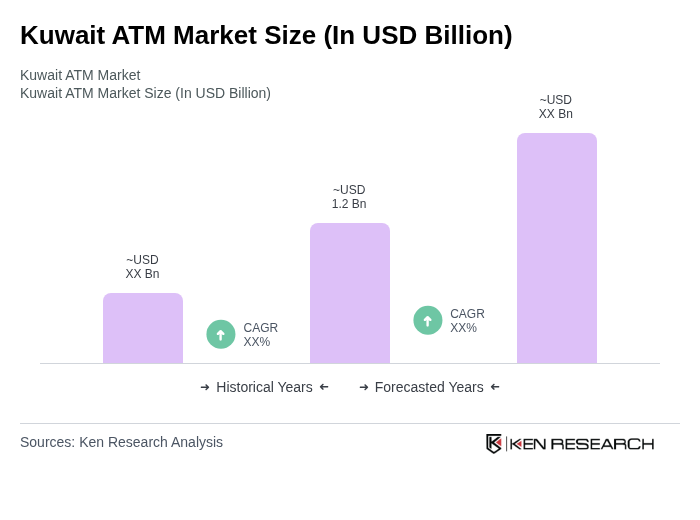
- The Kuwait ATM market is valued at approximately USD 1.2 billion, based on a five-year historical analysis. This growth is primarily driven by the increasing adoption of digital banking services, a rise in cashless transactions, and the expansion of the banking infrastructure across the country. The demand for ATMs has surged as consumers seek convenient access to banking services, particularly in urban areas.
- Kuwait City is the dominant hub in the ATM market, owing to its status as the capital and the largest city in the country. The concentration of financial institutions, retail outlets, and commercial activities in this city drives the demand for ATMs. Other notable areas include Hawalli and Salmiya, which also exhibit significant ATM usage due to their high population density and commercial activities.
- The Central Bank of Kuwait has required banks and payment service providers to comply with international card security and EMV standards on ATMs and POS terminals to enhance security and reduce fraud, which has driven upgrades of ATM fleets and reinforced consumer confidence in ATM transactions.
Kuwait ATM Market Segmentation
By ATM Type:The ATM market can be segmented into various types, including On-site ATMs, Off-site ATMs, Worksite/Corporate ATMs, and Mobile/Portable ATMs. Each type serves different consumer needs and locations, contributing to the overall market dynamics.
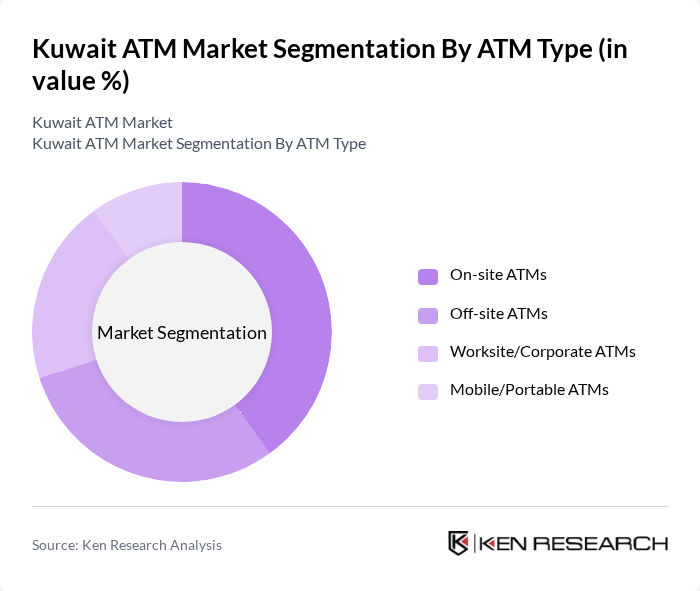
The On-site ATMs segment dominates the market due to their strategic placement within bank branches, providing customers with easy access to cash and banking services. The convenience of having ATMs located at bank premises encourages frequent usage, making them a preferred choice for consumers. Off-site ATMs also play a significant role, particularly in retail locations, but On-site ATMs remain the most utilized due to their reliability and security.
By Deployment Model:The deployment model of ATMs can be categorized into Bank-owned ATMs, Managed service ATMs, Independent ATM deployers (IADs), and White-label/shared network ATMs. Each model has its unique operational framework and market presence.
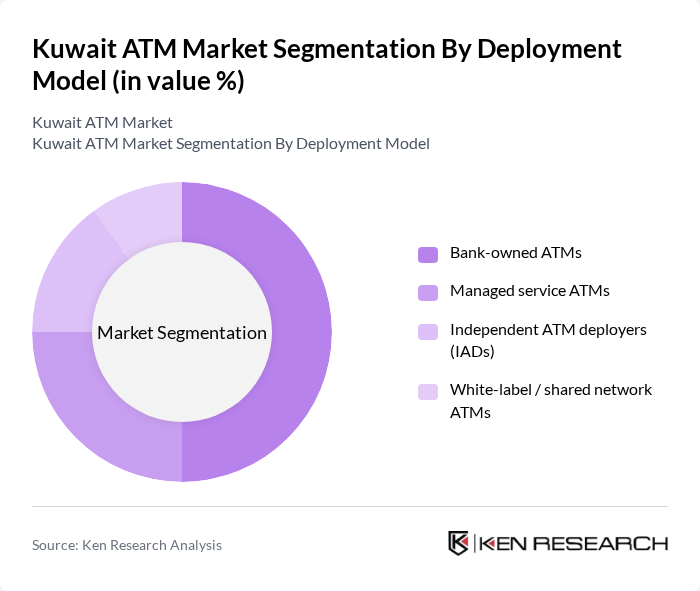
Bank-owned ATMs lead the market due to the established trust and brand recognition associated with financial institutions. These ATMs are often preferred by consumers for their reliability and security. Managed service ATMs are gaining traction as banks look to outsource operations, while IADs and white-label ATMs cater to niche markets, but they do not match the extensive reach of bank-owned ATMs.
Kuwait ATM Market Competitive Landscape
The Kuwait ATM market is characterized by a dynamic mix of regional and international players. Leading participants such as National Bank of Kuwait (NBK), Kuwait Finance House (KFH), Gulf Bank, Burgan Bank, Boubyan Bank, Al Ahli Bank of Kuwait (ABK), Kuwait International Bank (KIB), Warba Bank, Ahli United Bank – Kuwait operations, Qatar National Bank – Kuwait branch, Bank of Bahrain and Kuwait – Kuwait branch, Arab Bank – Kuwait branch, HSBC Bank Middle East – Kuwait, Standard Chartered Bank – Kuwait, Commercial Bank of Kuwait (CBK) contribute to innovation, geographic expansion, and service delivery in this space.
Kuwait ATM Market Industry Analysis
Growth Drivers
- Increasing Cashless Transactions:The rise in cashless transactions in Kuwait is significant, with a reported increase of 30% in digital payment methods from the previous year to the current year. The Central Bank of Kuwait noted that cashless transactions reached approximately 1.8 billion KWD in the current year. This trend is driven by consumer preferences for convenience and safety, as well as the growing acceptance of mobile wallets and contactless cards, which are expected to further boost ATM usage in the coming years.
- Expansion of Banking Services:The banking sector in Kuwait is expanding rapidly, with the number of bank branches increasing by 5% annually, reaching over 420 branches in the current year. This expansion is complemented by the introduction of new banking services, including online banking and mobile applications, which enhance customer access to ATMs. As more consumers engage with these services, the demand for ATMs is expected to rise, facilitating greater financial inclusion across the population.
- Technological Advancements in ATM Systems:The adoption of advanced ATM technologies, such as biometric authentication and AI-driven customer service, is transforming the ATM landscape in Kuwait. In the current year, over 25% of ATMs in Kuwait were equipped with these technologies, enhancing security and user experience. The integration of these features is expected to attract more users, as they provide faster and safer transactions, thereby driving growth in the ATM market.
Market Challenges
- Cybersecurity Threats:The increasing reliance on digital transactions has heightened the risk of cybersecurity threats in Kuwait's ATM market. In the current year, reported incidents of ATM fraud rose by 20%, prompting banks to invest heavily in cybersecurity measures. The financial sector is expected to allocate approximately 12 million KWD annually to combat these threats, which could strain resources and impact overall market growth if not effectively managed.
- High Operational Costs:Operating ATMs in Kuwait incurs significant costs, including maintenance, cash replenishment, and security. In the current year, the average operational cost per ATM was estimated at 15,000 KWD annually. These high costs can deter banks from expanding their ATM networks, particularly in less profitable areas. As a result, the financial burden may limit the overall growth potential of the ATM market in the region.
Kuwait ATM Market Future Outlook
The future of the ATM market in Kuwait appears promising, driven by ongoing technological advancements and a shift towards cashless transactions. As banks continue to innovate and enhance customer experiences, the integration of AI and contactless features will likely become standard. Additionally, the government's push for financial inclusion will encourage the establishment of ATMs in underserved areas, further expanding access to banking services. This evolving landscape presents a unique opportunity for growth and development in the ATM sector.
Market Opportunities
- Growth in E-commerce Transactions:The surge in e-commerce transactions, which reached 1.5 billion KWD in the current year, presents a significant opportunity for ATMs. As more consumers engage in online shopping, the demand for cash withdrawals will increase, driving ATM usage. Banks can capitalize on this trend by strategically placing ATMs in high-traffic areas to meet consumer needs.
- Introduction of Advanced ATM Features:The introduction of advanced features, such as cryptocurrency transactions and personalized banking services, can attract a broader customer base. With over 20% of the population expressing interest in cryptocurrency, integrating these services into ATMs could enhance user engagement and drive growth in the market, positioning banks as innovative leaders in the financial sector.
Scope of the Report
| Segment | Sub-Segments |
|---|---|
| By ATM Type | On-site ATMs Off-site ATMs Worksite/Corporate ATMs Mobile/Portable ATMs |
| By Deployment Model | Bank-owned ATMs Managed service ATMs Independent ATM deployers (IADs) White-label / shared network ATMs |
| By Location | Bank branches Off-site retail locations Transport hubs and fuel stations Government and public sector sites |
| By Functionality | Cash-dispensing ATMs Cash-recycling ATMs Deposit-accepting ATMs Multifunction banking kiosks |
| By Technology | Conventional card-based ATMs EMV and NFC-enabled ATMs Biometric/cardless ATMs Remote monitoring and smart ATMs |
| By Transaction Type | Cash withdrawals Balance inquiries and mini-statements Deposits, transfers and bill payments Foreign exchange and remittance services |
| By End-User Sector | Retail and commercial banks Islamic banks Non-bank financial institutions Large retailers and service merchants |
Key Target Audience
Investors and Venture Capitalist Firms
Government and Regulatory Bodies (e.g., Central Bank of Kuwait, Ministry of Finance)
Manufacturers and Producers of ATM Machines
Distributors and Retailers of ATM Solutions
Technology Providers for ATM Software and Hardware
Industry Associations (e.g., Kuwait Banking Association)
Financial Institutions (e.g., Banks, Credit Unions)
Payment Processing Companies
Players Mentioned in the Report:
National Bank of Kuwait (NBK)
Kuwait Finance House (KFH)
Gulf Bank
Burgan Bank
Boubyan Bank
Al Ahli Bank of Kuwait (ABK)
Kuwait International Bank (KIB)
Warba Bank
Ahli United Bank Kuwait operations
Qatar National Bank Kuwait branch
Bank of Bahrain and Kuwait Kuwait branch
Arab Bank Kuwait branch
HSBC Bank Middle East Kuwait
Standard Chartered Bank Kuwait
Commercial Bank of Kuwait (CBK)
Table of Contents
Market Assessment Phase
1. Executive Summary and Approach
2. Kuwait ATM Market Overview
2.1 Key Insights and Strategic Recommendations
2.2 Kuwait ATM Market Overview
2.3 Definition and Scope
2.4 Evolution of Market Ecosystem
2.5 Timeline of Key Regulatory Milestones
2.6 Value Chain & Stakeholder Mapping
2.7 Business Cycle Analysis
2.8 Policy & Incentive Landscape
3. Kuwait ATM Market Analysis
3.1 Growth Drivers
3.1.1 Increasing Cashless Transactions
3.1.2 Expansion of Banking Services
3.1.3 Technological Advancements in ATM Systems
3.1.4 Government Initiatives for Financial Inclusion
3.2 Market Challenges
3.2.1 Cybersecurity Threats
3.2.2 High Operational Costs
3.2.3 Regulatory Compliance Issues
3.2.4 Limited Consumer Awareness
3.3 Market Opportunities
3.3.1 Growth in E-commerce Transactions
3.3.2 Introduction of Advanced ATM Features
3.3.3 Partnerships with Fintech Companies
3.3.4 Expansion into Underserved Areas
3.4 Market Trends
3.4.1 Rise of Contactless Transactions
3.4.2 Integration of AI in ATM Operations
3.4.3 Shift Towards Multi-Functional ATMs
3.4.4 Increasing Focus on Customer Experience
3.5 Government Regulation
3.5.1 Compliance with Central Bank Guidelines
3.5.2 Anti-Money Laundering Regulations
3.5.3 Data Protection Laws
3.5.4 ATM Accessibility Standards
4. SWOT Analysis
5. Stakeholder Analysis
6. Porter's Five Forces Analysis
7. Kuwait ATM Market Market Size, 2019-2024
7.1 By Value
7.2 By Volume
7.3 By Average Selling Price
8. Kuwait ATM Market Segmentation
8.1 By ATM Type
8.1.1 On-site ATMs
8.1.2 Off-site ATMs
8.1.3 Worksite/Corporate ATMs
8.1.4 Mobile/Portable ATMs
8.2 By Deployment Model
8.2.1 Bank-owned ATMs
8.2.2 Managed service ATMs
8.2.3 Independent ATM deployers (IADs)
8.2.4 White-label / shared network ATMs
8.3 By Location
8.3.1 Bank branches
8.3.2 Off-site retail locations
8.3.3 Transport hubs and fuel stations
8.3.4 Government and public sector sites
8.4 By Functionality
8.4.1 Cash-dispensing ATMs
8.4.2 Cash-recycling ATMs
8.4.3 Deposit-accepting ATMs
8.4.4 Multifunction banking kiosks
8.5 By Technology
8.5.1 Conventional card-based ATMs
8.5.2 EMV and NFC-enabled ATMs
8.5.3 Biometric/cardless ATMs
8.5.4 Remote monitoring and smart ATMs
8.6 By Transaction Type
8.6.1 Cash withdrawals
8.6.2 Balance inquiries and mini-statements
8.6.3 Deposits, transfers and bill payments
8.6.4 Foreign exchange and remittance services
8.7 By End-User Sector
8.7.1 Retail and commercial banks
8.7.2 Islamic banks
8.7.3 Non-bank financial institutions
8.7.4 Large retailers and service merchants
9. Kuwait ATM Market Competitive Analysis
9.1 Market Share of Key Players
9.2 Cross Comparison of Key Players
9.2.1 Installed ATM base in Kuwait.
9.2.2 Share of ATMs by deployment type (on-site vs off-site vs worksite).
9.2.3 Average transactions per ATM per day.
9.2.4 ATM uptime and availability percentage.
9.2.5 Share of multifunction / cash-recycling ATMs in total fleet.
9.2.6 Average operating cost per ATM per month.
9.2.7 Fee income and interchange revenue per ATM.
9.2.8 Share of cardless / contactless transactions.
9.2.9 Compliance and security KPIs (EMV, PCI-DSS, anti-skimming coverage).
9.2.10 Customer satisfaction and Net Promoter Score (NPS) for ATM services.
9.3 SWOT Analysis of Top Players
9.4 Pricing Analysis
9.5 Detailed Profile of Major Companies
9.5.1 National Bank of Kuwait (NBK)
9.5.2 Kuwait Finance House (KFH)
9.5.3 Gulf Bank
9.5.4 Burgan Bank
9.5.5 Boubyan Bank
9.5.6 Al Ahli Bank of Kuwait (ABK)
9.5.7 Kuwait International Bank (KIB)
9.5.8 Warba Bank
9.5.9 Ahli United Bank – Kuwait operations
9.5.10 Qatar National Bank – Kuwait branch
9.5.11 Bank of Bahrain and Kuwait – Kuwait branch
9.5.12 Arab Bank – Kuwait branch
9.5.13 HSBC Bank Middle East – Kuwait
9.5.14 Standard Chartered Bank – Kuwait
9.5.15 Commercial Bank of Kuwait (CBK)
10. Kuwait ATM Market End-User Analysis
10.1 Procurement Behavior of Key Ministries
10.1.1 Ministry of Finance
10.1.2 Ministry of Commerce and Industry
10.1.3 Ministry of Interior
10.1.4 Others
10.2 Corporate Spend on Infrastructure & Energy
10.2.1 Banking Sector Investments
10.2.2 Retail Sector Investments
10.2.3 Government Infrastructure Projects
10.2.4 Others
10.3 Pain Point Analysis by End-User Category
10.3.1 Banks
10.3.2 Retailers
10.3.3 Government Institutions
10.3.4 Others
10.4 User Readiness for Adoption
10.4.1 Awareness Levels
10.4.2 Training Needs
10.4.3 Technology Acceptance
10.4.4 Others
10.5 Post-Deployment ROI and Use Case Expansion
10.5.1 ROI Measurement Techniques
10.5.2 Use Case Scenarios
10.5.3 Customer Feedback Mechanisms
10.5.4 Others
11. Kuwait ATM Market Future Size, 2025-2030
11.1 By Value
11.2 By Volume
11.3 By Average Selling Price
Go-To-Market Strategy Phase
1. Whitespace Analysis + Business Model Canvas
1.1 Market Gaps Identification
1.2 Business Model Framework
2. Marketing and Positioning Recommendations
2.1 Branding Strategies
2.2 Product USPs
3. Distribution Plan
3.1 Urban Retail vs Rural NGO Tie-ups
4. Channel & Pricing Gaps
4.1 Underserved Routes
4.2 Pricing Bands
5. Unmet Demand & Latent Needs
5.1 Category Gaps
5.2 Consumer Segments
6. Customer Relationship
6.1 Loyalty Programs
6.2 After-sales Service
7. Value Proposition
7.1 Sustainability
7.2 Integrated Supply Chains
8. Key Activities
8.1 Regulatory Compliance
8.2 Branding
8.3 Distribution Setup
9. Entry Strategy Evaluation
9.1 Domestic Market Entry Strategy
9.1.1 Product Mix
9.1.2 Pricing Band
9.1.3 Packaging
9.2 Export Entry Strategy
9.2.1 Target Countries
9.2.2 Compliance Roadmap
10. Entry Mode Assessment
10.1 JV
10.2 Greenfield
10.3 M&A
10.4 Distributor Model
11. Capital and Timeline Estimation
11.1 Capital Requirements
11.2 Timelines
12. Control vs Risk Trade-Off
12.1 Ownership vs Partnerships
13. Profitability Outlook
13.1 Breakeven Analysis
13.2 Long-term Sustainability
14. Potential Partner List
14.1 Distributors
14.2 JVs
14.3 Acquisition Targets
15. Execution Roadmap
15.1 Phased Plan for Market Entry
15.1.1 Market Setup
15.1.2 Market Entry
15.1.3 Growth Acceleration
15.1.4 Scale & Stabilize
15.2 Key Activities and Milestones
15.2.1 Activity Planning
15.2.2 Milestone Tracking
Research Methodology
Phase 1: Approach1
Desk Research
- Analysis of industry reports from financial institutions and market research firms
- Review of government publications and regulatory frameworks affecting ATM operations in Kuwait
- Examination of historical data on ATM deployment and transaction volumes from banking associations
Primary Research
- Interviews with key stakeholders in the banking sector, including ATM managers and operations heads
- Surveys targeting end-users to understand usage patterns and preferences regarding ATMs
- Focus group discussions with financial technology experts to gauge future trends in ATM technology
Validation & Triangulation
- Cross-validation of findings through comparison with international ATM market trends
- Triangulation of data from banking reports, consumer surveys, and expert interviews
- Sanity checks conducted through expert panel reviews to ensure data reliability
Phase 2: Market Size Estimation1
Top-down Assessment
- Estimation of total ATM market size based on national banking sector growth rates
- Segmentation of the market by ATM types (e.g., cash dispensers, multifunction ATMs)
- Incorporation of economic indicators such as GDP growth and cashless transaction trends
Bottom-up Modeling
- Collection of data on the number of ATMs installed by major banks in Kuwait
- Analysis of transaction volumes and average transaction values across different ATM types
- Cost analysis based on operational expenses and maintenance of ATMs
Forecasting & Scenario Analysis
- Multi-factor regression analysis incorporating factors such as population growth and urbanization
- Scenario modeling based on potential regulatory changes and technological advancements
- Development of baseline, optimistic, and pessimistic forecasts through 2030
Phase 3: CATI Sample Composition1
| Scope Item/Segment | Sample Size | Target Respondent Profiles |
|---|---|---|
| Banking Sector ATM Operations | 100 | ATM Managers, Operations Heads |
| Consumer Usage Patterns | 120 | Bank Customers, Retail Users |
| Financial Technology Insights | 80 | Fintech Experts, Technology Consultants |
| Regulatory Impact Assessment | 60 | Regulatory Officials, Compliance Officers |
| Market Trends and Forecasting | 70 | Market Analysts, Economic Researchers |
Frequently Asked Questions
What is the current value of the Kuwait ATM market?
The Kuwait ATM market is valued at approximately USD 1.2 billion, reflecting significant growth driven by the increasing adoption of digital banking services and cashless transactions, alongside the expansion of banking infrastructure across the country.
Which areas in Kuwait have the highest demand for ATMs?
What types of ATMs are prevalent in Kuwait?
How does the Central Bank of Kuwait influence ATM security?
Other Regional/Country Reports
Indonesia ATM Market
Malaysia ATM Market
APAC ATM Market
SEA ATM Market
Vietnam ATM Market
Other Adjacent Reports
Mexico Cash Management Market
Bahrain Contactless Payment Market
Egypt Banking Software Market
Belgium Payment Gateway Market
Brazil Financial Inclusion Market
Why Buy From Us?

What makes us stand out is that our consultants follow Robust, Refine and Result (RRR) methodology. Robust for clear definitions, approaches and sanity checking, Refine for differentiating respondents' facts and opinions, and Result for presenting data with story.

We have set a benchmark in the industry by offering our clients with syndicated and customized market research reports featuring coverage of entire market as well as meticulous research and analyst insights.

While we don't replace traditional research, we flip the method upside down. Our dual approach of Top Bottom & Bottom Top ensures quality deliverable by not just verifying company fundamentals but also looking at the sector and macroeconomic factors.

With one step in the future, our research team constantly tries to show you the bigger picture. We help with some of the tough questions you may encounter along the way: How is the industry positioned? Best marketing channel? KPI's of competitors? By aligning every element, we help maximize success.

Our report gives you instant access to the answers and sources that other companies might choose to hide. We elaborate each steps of research methodology we have used and showcase you the sample size to earn your trust.

If you need any support, we are here! We pride ourselves on universe strength, data quality, and quick, friendly, and professional service.