Kuwait Hand Dryer Market Size Share Growth Drivers Trends Opportunities & Forecast 2025–2030

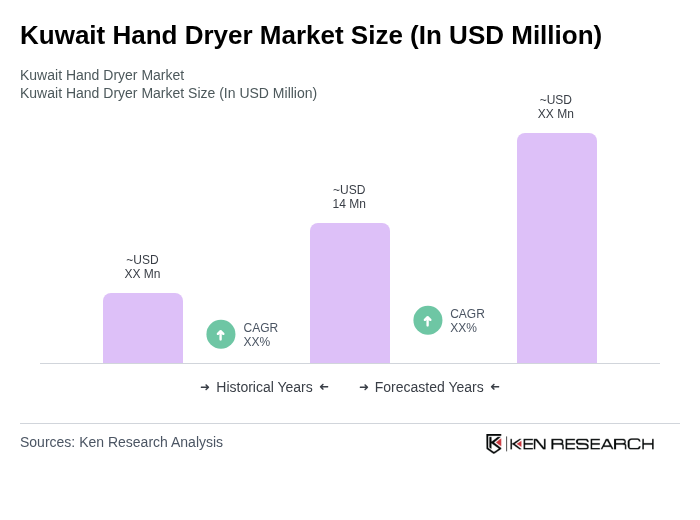
The Kuwait hand dryer market, valued at USD 14 million, grows due to rising hygiene demands, sustainability initiatives, and infrastructure development in commercial spaces.

Region:Middle East

Author(s):Geetanshi

Product Code:KRAA4203

Pages:99

Published On:January 2026
About the Report

Base Year 2024

Kuwait Hand Dryer Market Overview

  • The Kuwait Hand Dryer Market is valued at USD 14 million, based on a five-year historical analysis and Kuwait’s share within the wider Middle East and Africa hand dryer market. This growth is primarily driven by increasing hygiene awareness after recent global health events, the rise of eco-friendly products that reduce paper towel usage, and the expansion of commercial spaces such as malls, airports, offices, and hospitality venues in Kuwait. The demand for hand dryers has surged as businesses and public facilities seek to enhance sanitation while reducing paper waste and overall washroom operating costs.
  • Kuwait City is the dominant hub in the hand dryer market due to its rapid urbanization, higher concentration of commercial establishments, and ongoing investments in premium infrastructure projects, including airports, shopping malls, healthcare facilities, and hotels. The city’s investment in infrastructure and public facilities has led to a higher demand for modern hygiene solutions such as automatic and high?speed hand dryers in high?footfall restrooms. Additionally, the presence of international brands and local distributors in Kuwait City, often serving as regional partners for global hand dryer manufacturers, further strengthens its market position within the country.
  • Energy performance and electrical safety requirements for hand dryers in public and commercial buildings are influenced by the Kuwait Energy Conservation Code for Buildings issued by the Ministry of Electricity, Water and Renewable Energy (MEW) and the Kuwait Public Authority for Housing Welfare, which sets minimum energy?efficiency requirements for building services equipment, including electrical appliances installed in public facilities. In practice, public projects that follow this code increasingly specify energy?efficient and sensor?activated hand dryers to reduce electricity consumption and support national sustainability objectives, encouraging businesses to adopt modern hand drying solutions that comply with these standards.
Kuwait Hand Dryer Market Size

Kuwait Hand Dryer Market Segmentation

By Product Type:The hand dryer market can be segmented into various product types, including Hot Air Hand Dryers, Jet Air / High-Speed Hand Dryers, Warm Air Hand Dryers, Blade Hand Dryers, and Others. This structure is consistent with global industry segmentation, where hot air and jet/high?speed hand dryers are the primary categories. Among these, Jet Air / High-Speed Hand Dryers are gaining significant traction due to their quick drying capabilities (often under 10–12 seconds) and relatively lower energy consumption per use compared with conventional warm air units, making them suitable for high?traffic environments. Consumers and facility operators are increasingly favoring these models for their effectiveness in high-traffic areas, such as airports, shopping malls, and highway service areas, where quick service and shorter queue times are essential.
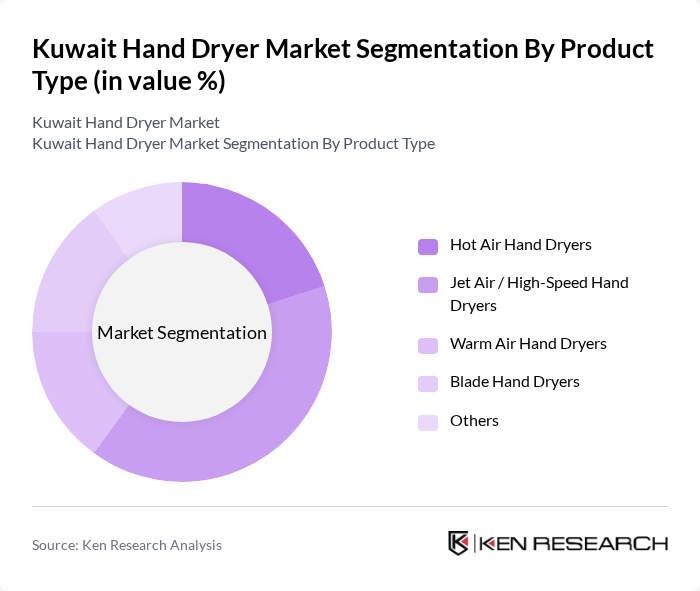
Kuwait Hand Dryer Market segmentation by Product Type.

By Operation Mode:The operation mode segmentation includes Automatic / Sensor-Activated Hand Dryers, Push-Button Hand Dryers, Wave Sensor and Advanced Control Hand Dryers, and Others, which aligns with the global market’s division between automatic (sensor?based) and manual units. Automatic / Sensor-Activated Hand Dryers are leading the market due to their touchless operation, which enhances hygiene, reduces perceived risk of cross?contamination, and lowers maintenance associated with paper waste. The growing emphasis on reducing the spread of germs in public spaces, combined with end?user preference for contactless fixtures in restrooms, has made these models particularly appealing to consumers and businesses alike.
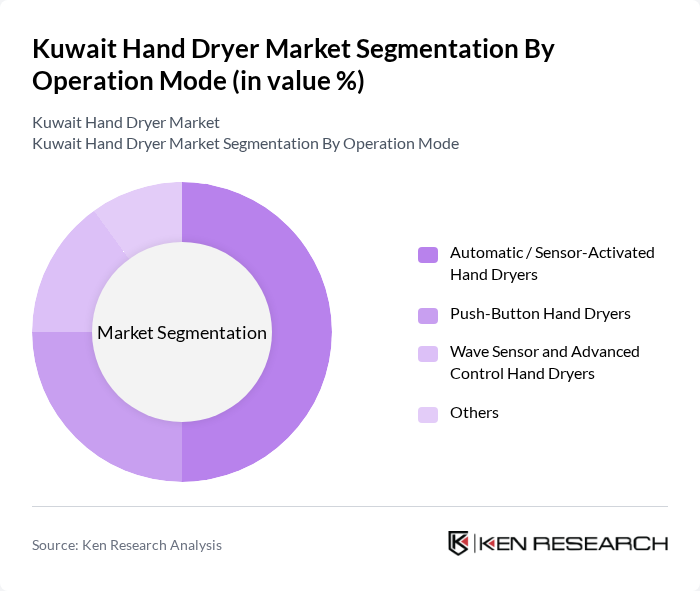
Kuwait Hand Dryer Market segmentation by Operation Mode.

Kuwait Hand Dryer Market Competitive Landscape

The Kuwait Hand Dryer Market is characterized by a dynamic mix of regional and international players. Leading participants such as Dyson Ltd., Mitsubishi Electric Corporation, World Dryer Corporation, Bobrick Washroom Equipment, Inc., American Dryer, Inc., TOTO Ltd., Saniflow Corporation, Excel Dryer, Inc., Panasonic Corporation, Veltia, Airdri, Hokwang Industries Co., Ltd., Euronics Industries Pvt. Ltd., Jaquar & Company Pvt. Ltd., Bradley Corporation contribute to innovation, geographic expansion, and service delivery in this space.

Dyson Ltd.

1991

Malmesbury, UK

Mitsubishi Electric Corporation

1921

Tokyo, Japan

World Dryer Corporation

1950

Illinois, USA

Bobrick Washroom Equipment, Inc.

1906

California, USA

American Dryer, Inc.

1952

Michigan, USA

Company

Establishment Year

Headquarters

Revenue in Kuwait (USD, latest financial year)

3-Year Revenue CAGR in Kuwait Hand Dryer Segment (%)

Installed Base in Kuwait (Number of Units)

Market Share by Volume (%)

Average Selling Price Band in Kuwait (USD/unit)

EBITDA Margin for Kuwait Operations (%)

Kuwait Hand Dryer Market Industry Analysis

Growth Drivers

  • Increasing Demand for Hygiene in Public Spaces:The heightened focus on hygiene, particularly post-pandemic, has led to a significant increase in demand for hand dryers in public facilities. According to the World Health Organization, hand hygiene can reduce the spread of pathogens by up to 50%. In Kuwait, the number of public restrooms equipped with hand dryers has increased by 30% from 2022 to 2023, reflecting a growing commitment to maintaining cleanliness in public areas.
  • Government Initiatives Promoting Eco-Friendly Products:The Kuwaiti government has implemented various initiatives to promote sustainable practices, including the use of eco-friendly products. In future, the government allocated approximately $5 million to support green technology initiatives, which includes incentives for businesses adopting energy-efficient hand dryers. This financial backing is expected to drive the adoption of hand dryers that align with environmental sustainability goals, enhancing market growth.
  • Rising Awareness About Energy-Efficient Appliances:As energy costs continue to rise, there is an increasing awareness among consumers and businesses regarding energy-efficient appliances. The Kuwait Ministry of Electricity and Water reported a 15% increase in energy-efficient appliance sales in future. This trend is particularly evident in the hand dryer market, where models that consume less energy are gaining traction, driven by both cost savings and environmental considerations.

Market Challenges

  • High Initial Investment Costs:One of the significant barriers to the widespread adoption of hand dryers in Kuwait is the high initial investment required for quality models. Premium hand dryers can cost between $1,000 to $1,500, which can deter small businesses and public facilities from making the switch. This upfront cost is compounded by the need for installation and maintenance, making it a considerable challenge for market penetration.
  • Competition from Traditional Paper Towels:Despite the advantages of hand dryers, traditional paper towels remain a strong competitor in the market. In future, paper towel sales in Kuwait reached approximately $3 million, driven by consumer preferences for perceived hygiene and convenience. This competition poses a challenge for hand dryer manufacturers, as many consumers still favor paper towels for their ease of use and immediate availability in various settings.

Kuwait Hand Dryer Market Future Outlook

The future of the Kuwait hand dryer market appears promising, driven by technological advancements and a growing emphasis on sustainability. As businesses increasingly prioritize eco-friendly solutions, the demand for energy-efficient hand dryers is expected to rise. Additionally, the integration of smart technology in hand dryers will likely enhance user experience and operational efficiency, further propelling market growth. The ongoing government support for green initiatives will also play a crucial role in shaping the market landscape in the coming years.

Market Opportunities

  • Expansion in the Healthcare Sector:The healthcare sector in Kuwait is expanding rapidly, with investments projected to reach $1 billion in future. This growth presents a significant opportunity for hand dryer manufacturers, as hospitals and clinics increasingly seek hygienic solutions to enhance patient safety and reduce infection rates. The demand for high-quality hand dryers in these facilities is expected to rise substantially.
  • Technological Advancements in Hand Dryer Efficiency:Continuous innovations in hand dryer technology are creating new market opportunities. For instance, advancements in sensor technology and energy efficiency can reduce drying times and energy consumption. As manufacturers invest in R&D, the introduction of more efficient models is anticipated, appealing to environmentally conscious consumers and businesses looking to reduce operational costs.

Scope of the Report

SegmentSub-Segments
By Product Type

Hot Air Hand Dryers

Jet Air / High-Speed Hand Dryers

Warm Air Hand Dryers

Blade Hand Dryers

Others

By Operation Mode

Automatic / Sensor-Activated Hand Dryers

Push-Button Hand Dryers

Wave Sensor and Advanced Control Hand Dryers

Others

By Installation / Mounting Type

Wall-Mounted Hand Dryers

Recessed Hand Dryers

Floor-Mounted / Free-Standing Hand Dryers

Surface-Mounted Hand Dryers

Others

By End-User

Airports and Transportation Hubs

Hospitality (Hotels, Restaurants, Cafés)

Healthcare Facilities

Educational Institutions

Corporate Offices & Commercial Buildings

Shopping Malls & Retail Outlets

Public & Government Facilities

Others

By Energy Efficiency & Technology

Standard Hand Dryers

Energy-Efficient / Low-Energy Hand Dryers

Eco-Friendly Hand Dryers with HEPA/Filter Systems

Smart / IoT-Enabled Hand Dryers

Others

By Price Range

Economy Hand Dryers

Mid-Range Hand Dryers

Premium / Professional Hand Dryers

Others

By Distribution Channel

Direct Sales

Offline (Distributors, Dealers, Retail)

Online (E-commerce, Marketplaces)

Project-Based / EPC & Facility Management Channels

Others

Key Target Audience

Investors and Venture Capitalist Firms

Government and Regulatory Bodies (e.g., Ministry of Health, Kuwait Municipality)

Manufacturers and Producers

Distributors and Retailers

Facility Management Companies

Hospitality Industry Stakeholders

Construction and Real Estate Developers

Environmental Organizations and NGOs

Players Mentioned in the Report:

Dyson Ltd.

Mitsubishi Electric Corporation

World Dryer Corporation

Bobrick Washroom Equipment, Inc.

American Dryer, Inc.

TOTO Ltd.

Saniflow Corporation

Excel Dryer, Inc.

Panasonic Corporation

Veltia

Airdri

Hokwang Industries Co., Ltd.

Euronics Industries Pvt. Ltd.

Jaquar & Company Pvt. Ltd.

Bradley Corporation

Table of Contents

Market Assessment Phase

1. Executive Summary and Approach


2. Kuwait Hand Dryer Market Overview

2.1 Key Insights and Strategic Recommendations

2.2 Kuwait Hand Dryer Market Overview

2.3 Definition and Scope

2.4 Evolution of Market Ecosystem

2.5 Timeline of Key Regulatory Milestones

2.6 Value Chain & Stakeholder Mapping

2.7 Business Cycle Analysis

2.8 Policy & Incentive Landscape


3. Kuwait Hand Dryer Market Analysis

3.1 Growth Drivers

3.1.1 Increasing demand for hygiene in public spaces
3.1.2 Government initiatives promoting eco-friendly products
3.1.3 Rising awareness about energy-efficient appliances
3.1.4 Growth in the hospitality and commercial sectors

3.2 Market Challenges

3.2.1 High initial investment costs
3.2.2 Competition from traditional paper towels
3.2.3 Variability in consumer preferences
3.2.4 Regulatory compliance complexities

3.3 Market Opportunities

3.3.1 Expansion in the healthcare sector
3.3.2 Technological advancements in hand dryer efficiency
3.3.3 Increasing adoption in educational institutions
3.3.4 Potential for export to neighboring regions

3.4 Market Trends

3.4.1 Shift towards touchless technology
3.4.2 Integration of smart features in hand dryers
3.4.3 Focus on sustainability and eco-friendly materials
3.4.4 Customization options for branding in commercial spaces

3.5 Government Regulation

3.5.1 Standards for energy efficiency
3.5.2 Health and safety regulations for public facilities
3.5.3 Environmental impact assessments
3.5.4 Incentives for using renewable energy sources

4. SWOT Analysis


5. Stakeholder Analysis


6. Porter's Five Forces Analysis


7. Kuwait Hand Dryer Market Market Size, 2019-2024

7.1 By Value

7.2 By Volume

7.3 By Average Selling Price


8. Kuwait Hand Dryer Market Segmentation

8.1 By Product Type

8.1.1 Hot Air Hand Dryers
8.1.2 Jet Air / High-Speed Hand Dryers
8.1.3 Warm Air Hand Dryers
8.1.4 Blade Hand Dryers
8.1.5 Others

8.2 By Operation Mode

8.2.1 Automatic / Sensor-Activated Hand Dryers
8.2.2 Push-Button Hand Dryers
8.2.3 Wave Sensor and Advanced Control Hand Dryers
8.2.4 Others

8.3 By Installation / Mounting Type

8.3.1 Wall-Mounted Hand Dryers
8.3.2 Recessed Hand Dryers
8.3.3 Floor-Mounted / Free-Standing Hand Dryers
8.3.4 Surface-Mounted Hand Dryers
8.3.5 Others

8.4 By End-User

8.4.1 Airports and Transportation Hubs
8.4.2 Hospitality (Hotels, Restaurants, Cafés)
8.4.3 Healthcare Facilities
8.4.4 Educational Institutions
8.4.5 Corporate Offices & Commercial Buildings
8.4.6 Shopping Malls & Retail Outlets
8.4.7 Public & Government Facilities
8.4.8 Others

8.5 By Energy Efficiency & Technology

8.5.1 Standard Hand Dryers
8.5.2 Energy-Efficient / Low-Energy Hand Dryers
8.5.3 Eco-Friendly Hand Dryers with HEPA/Filter Systems
8.5.4 Smart / IoT-Enabled Hand Dryers
8.5.5 Others

8.6 By Price Range

8.6.1 Economy Hand Dryers
8.6.2 Mid-Range Hand Dryers
8.6.3 Premium / Professional Hand Dryers
8.6.4 Others

8.7 By Distribution Channel

8.7.1 Direct Sales
8.7.2 Offline (Distributors, Dealers, Retail)
8.7.3 Online (E-commerce, Marketplaces)
8.7.4 Project-Based / EPC & Facility Management Channels
8.7.5 Others

9. Kuwait Hand Dryer Market Competitive Analysis

9.1 Market Share of Key Players

9.2 Cross Comparison of Key Players

9.2.1 Company Name
9.2.2 Revenue in Kuwait (USD, latest financial year)
9.2.3 3-Year Revenue CAGR in Kuwait Hand Dryer Segment (%)
9.2.4 Installed Base in Kuwait (Number of Units)
9.2.5 Market Share by Volume (%)
9.2.6 Average Selling Price Band in Kuwait (USD/unit)
9.2.7 EBITDA Margin for Kuwait Operations (%)
9.2.8 Return on Invested Capital (ROIC) – Kuwait Hand Dryer Business (%)
9.2.9 Customer Acquisition Cost (CAC)
9.2.10 Customer Lifetime Value (CLV)
9.2.11 Tender Win Rate (% of Bids Won)
9.2.12 Product Portfolio Breadth (Number of SKUs Active in Kuwait)
9.2.13 R&D / Innovation Spend as % of Kuwait Revenues
9.2.14 Distribution Coverage (Number of Active Channel Partners)
9.2.15 Average Payback Period for End-Users (Years)

9.3 SWOT Analysis of Top Players

9.4 Pricing Analysis

9.5 Detailed Profile of Major Companies

9.5.1 Dyson Ltd.
9.5.2 Mitsubishi Electric Corporation
9.5.3 World Dryer Corporation
9.5.4 Bobrick Washroom Equipment, Inc.
9.5.5 American Dryer, Inc.
9.5.6 TOTO Ltd.
9.5.7 Saniflow Corporation
9.5.8 Excel Dryer, Inc.
9.5.9 Panasonic Corporation
9.5.10 Veltia
9.5.11 Airdri
9.5.12 Hokwang Industries Co., Ltd.
9.5.13 Euronics Industries Pvt. Ltd.
9.5.14 Jaquar & Company Pvt. Ltd.
9.5.15 Bradley Corporation

10. Kuwait Hand Dryer Market End-User Analysis

10.1 Procurement Behavior of Key Ministries

10.1.1 Ministry of Health
10.1.2 Ministry of Education
10.1.3 Ministry of Public Works
10.1.4 Ministry of Commerce and Industry

10.2 Corporate Spend on Infrastructure & Energy

10.2.1 Investment in Public Facilities
10.2.2 Budget Allocation for Hygiene Products
10.2.3 Spending on Energy-Efficient Solutions
10.2.4 Corporate Social Responsibility Initiatives

10.3 Pain Point Analysis by End-User Category

10.3.1 Healthcare Sector
10.3.2 Educational Institutions
10.3.3 Hospitality Sector
10.3.4 Retail Sector

10.4 User Readiness for Adoption

10.4.1 Awareness of Hand Dryer Benefits
10.4.2 Acceptance of Touchless Technology
10.4.3 Training and Support Needs
10.4.4 Feedback Mechanisms

10.5 Post-Deployment ROI and Use Case Expansion

10.5.1 Cost Savings Analysis
10.5.2 User Experience Improvement
10.5.3 Expansion into New Facilities
10.5.4 Long-term Sustainability Benefits

11. Kuwait Hand Dryer Market Future Size, 2025-2030

11.1 By Value

11.2 By Volume

11.3 By Average Selling Price


Go-To-Market Strategy Phase

1. Whitespace Analysis + Business Model Canvas

1.1 Market Gaps Identification

1.2 Value Proposition Development

1.3 Revenue Streams Analysis

1.4 Cost Structure Evaluation

1.5 Key Partnerships Exploration

1.6 Customer Segmentation

1.7 Channels of Distribution


2. Marketing and Positioning Recommendations

2.1 Branding Strategies

2.2 Product USPs

2.3 Target Audience Identification

2.4 Communication Strategy

2.5 Digital Marketing Approach

2.6 Offline Marketing Tactics

2.7 Performance Metrics


3. Distribution Plan

3.1 Urban Retail vs Rural NGO Tie-ups

3.2 E-commerce Strategy

3.3 Wholesale Distribution Channels

3.4 Direct Sales Approach

3.5 Partnership with Local Distributors

3.6 Logistics and Supply Chain Management

3.7 Inventory Management


4. Channel & Pricing Gaps

4.1 Underserved Routes

4.2 Pricing Bands

4.3 Competitor Pricing Analysis

4.4 Value-Based Pricing Strategy

4.5 Discount and Promotion Strategies

4.6 Price Sensitivity Analysis

4.7 Pricing Model Evaluation


5. Unmet Demand & Latent Needs

5.1 Category Gaps

5.2 Consumer Segments

5.3 Emerging Trends Analysis

5.4 Feedback from Current Users

5.5 Market Research Insights

5.6 Future Demand Projections

5.7 Product Development Opportunities


6. Customer Relationship

6.1 Loyalty Programs

6.2 After-sales Service

6.3 Customer Feedback Mechanisms

6.4 Engagement Strategies

6.5 Community Building Initiatives

6.6 Customer Education Programs

6.7 Relationship Management Tools


7. Value Proposition

7.1 Sustainability

7.2 Integrated Supply Chains

7.3 Unique Selling Points

7.4 Customer-Centric Innovations

7.5 Competitive Advantages

7.6 Long-term Value Creation

7.7 Market Differentiation Strategies


8. Key Activities

8.1 Regulatory Compliance

8.2 Branding

8.3 Distribution Setup

8.4 Marketing Campaigns

8.5 Training and Development

8.6 Performance Monitoring

8.7 Stakeholder Engagement


9. Entry Strategy Evaluation

9.1 Domestic Market Entry Strategy

9.1.1 Product Mix
9.1.2 Pricing Band
9.1.3 Packaging

9.2 Export Entry Strategy

9.2.1 Target Countries
9.2.2 Compliance Roadmap

10. Entry Mode Assessment

10.1 JV

10.2 Greenfield

10.3 M&A

10.4 Distributor Model


11. Capital and Timeline Estimation

11.1 Capital Requirements

11.2 Timelines


12. Control vs Risk Trade-Off

12.1 Ownership vs Partnerships


13. Profitability Outlook

13.1 Breakeven Analysis

13.2 Long-term Sustainability


14. Potential Partner List

14.1 Distributors

14.2 JVs

14.3 Acquisition Targets


15. Execution Roadmap

15.1 Phased Plan for Market Entry

15.1.1 Market Setup
15.1.2 Market Entry
15.1.3 Growth Acceleration
15.1.4 Scale & Stabilize

15.2 Key Activities and Milestones

15.2.1 Activity Planning
15.2.2 Milestone Tracking

Research Methodology

ApproachModellingSample

Phase 1: Approach1

Desk Research

  • Analysis of industry reports from local and international market research firms
  • Review of government publications and trade statistics related to hygiene and sanitation
  • Examination of market trends and consumer behavior studies in the hand dryer segment

Primary Research

  • Interviews with facility managers in commercial and public sectors
  • Surveys targeting distributors and retailers of hand dryers in Kuwait
  • Focus group discussions with end-users to understand preferences and usage patterns

Validation & Triangulation

  • Cross-validation of findings with industry expert opinions and market analysts
  • Triangulation of data from primary and secondary sources to ensure accuracy
  • Sanity checks through comparative analysis with similar markets in the region

Phase 2: Market Size Estimation1

Top-down Assessment

  • Estimation of market size based on overall hygiene product spending in Kuwait
  • Segmentation of the market by product type, including automatic and manual hand dryers
  • Incorporation of growth rates from related sectors such as hospitality and healthcare

Bottom-up Modeling

  • Collection of sales data from key distributors and manufacturers in the hand dryer market
  • Estimation of market penetration rates across various sectors, including education and retail
  • Calculation of average selling prices to derive total market value

Forecasting & Scenario Analysis

  • Utilization of historical sales data to project future market trends through 2030
  • Scenario analysis based on potential regulatory changes and environmental considerations
  • Development of multiple growth scenarios reflecting economic conditions and consumer preferences

Phase 3: CATI Sample Composition1

Scope Item/SegmentSample SizeTarget Respondent Profiles
Commercial Sector Hand Dryer Usage120Facility Managers, Operations Directors
Healthcare Facility Hygiene Practices90Healthcare Administrators, Infection Control Officers
Retail Environment Preferences80Store Managers, Customer Experience Leaders
Educational Institution Hygiene Standards60School Administrators, Facility Coordinators
Public Restroom Management Insights70Public Facility Managers, Sanitation Supervisors

Frequently Asked Questions

What is the current value of the Kuwait Hand Dryer Market?

The Kuwait Hand Dryer Market is valued at approximately USD 14 million, reflecting a significant growth driven by increased hygiene awareness and the expansion of commercial spaces in the region.

What factors are driving the growth of the hand dryer market in Kuwait?

Which city in Kuwait is the primary hub for hand dryer sales?

What types of hand dryers are popular in the Kuwait market?

Other Adjacent Reports

Kuwait Washroom Equipment Market

Vietnam Hand Hygiene Products Market

Egypt Paper Towel Dispenser Market

Thailand Energy-Efficient Appliances Market

Qatar Commercial Sanitation Market

Bahrain Sensor Technology Market

Belgium Building Automation Market

Vietnam Eco-Friendly Hygiene Market

South Korea Air Purification Market

UAE Hospitality Supplies Market

Why Buy From Us?

Refine Robust Result (RRR) Framework

What makes us stand out is that our consultants follow Robust, Refine and Result (RRR) methodology. Robust for clear definitions, approaches and sanity checking, Refine for differentiating respondents' facts and opinions, and Result for presenting data with story.

Our Reach Is Unmatched

We have set a benchmark in the industry by offering our clients with syndicated and customized market research reports featuring coverage of entire market as well as meticulous research and analyst insights.

Shifting the Research Paradigm

While we don't replace traditional research, we flip the method upside down. Our dual approach of Top Bottom & Bottom Top ensures quality deliverable by not just verifying company fundamentals but also looking at the sector and macroeconomic factors.

More Insights-Better Decisions

With one step in the future, our research team constantly tries to show you the bigger picture. We help with some of the tough questions you may encounter along the way: How is the industry positioned? Best marketing channel? KPI's of competitors? By aligning every element, we help maximize success.

Transparency and Trust

Our report gives you instant access to the answers and sources that other companies might choose to hide. We elaborate each steps of research methodology we have used and showcase you the sample size to earn your trust.

Round the Clock Support

If you need any support, we are here! We pride ourselves on universe strength, data quality, and quick, friendly, and professional service.

Why Clients Choose Us?

400000+
Reports in repository
150+
Consulting projects a year
100+
Analysts
8000+
Client Queries in 2022








