Australia Hand Dryer Market Size Share Growth Drivers Trends Opportunities & Forecast 2025–2030

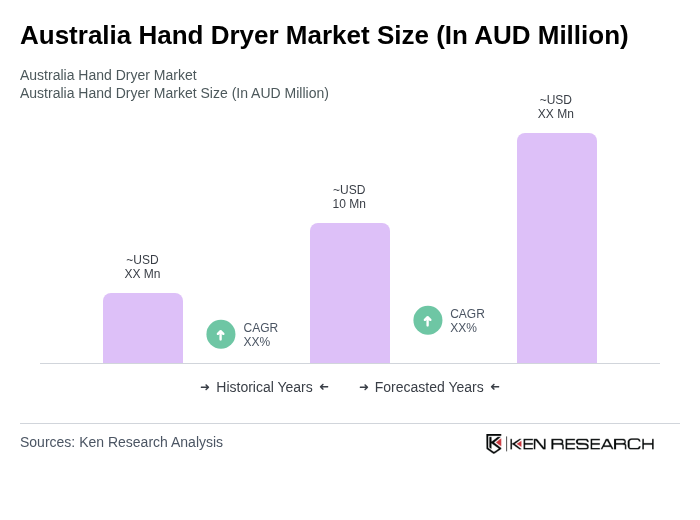
The Australia hand dryer market, worth AUD 10 million, is growing due to rising hygiene demands, eco-friendly initiatives, and adoption of high-speed, sensor-based dryers in key cities like Sydney and Melbourne.

Region:Global

Author(s):Geetanshi

Product Code:KRAA4206

Pages:96

Published On:January 2026
About the Report

Base Year 2024

Australia Hand Dryer Market Overview

  • The Australia Hand Dryer Market is valued at AUD 10 million, based on a five-year historical analysis. This growth is primarily driven by increasing hygiene awareness, the push for sustainable solutions, and the growing adoption of touchless technology in public restrooms, in line with global trends toward automatic, high?speed, and sensor-based dryers for improved hygiene and energy efficiency. The demand for hand dryers has surged as businesses and institutions seek to reduce paper towel waste and improve operational efficiency, supported by broader energy- and cost-saving initiatives in commercial buildings.
  • Key cities such as Sydney, Melbourne, and Brisbane dominate the market due to their high population density and significant commercial activities, consistent with the concentration of large commercial, hospitality, transport, and office infrastructure in major Australian metropolitan areas. These urban centers are home to numerous public facilities, shopping centers, and corporate offices, which are increasingly opting for hand dryers as a cost-effective and eco-friendly alternative to traditional drying methods, aligned with global preferences for reduced paper consumption and operating costs.
  • Energy performance and appliance requirements for hand dryers in Australia are governed under the Greenhouse and Energy Minimum Standards (GEMS) framework, including the Greenhouse and Energy Minimum Standards Act 2012 administered by the Australian Government Department of Climate Change, Energy, the Environment and Water. Under this framework, electrical products such as commercial appliances are subject to minimum energy performance standards and registration where covered, encouraging the installation and use of more energy?efficient hand dryers in commercial buildings and public restrooms and supporting broader national energy and emissions reduction objectives.
Australia Hand Dryer Market Size

Australia Hand Dryer Market Segmentation

By Product Type:The product type segmentation includes various categories such as Hot Air Hand Dryers, Jet Air / High-Speed Hand Dryers, Warm Air Hand Dryers, and Others. Among these, Jet Air / High-Speed Hand Dryers are leading the market due to their rapid drying capabilities and energy efficiency, reflecting a broader global shift toward high-speed, blade and jet-air models designed to minimize drying time and energy use. Consumers are increasingly favoring these models for their effectiveness in high-traffic areas, where quick service is essential, especially in transport hubs, shopping centers, and hospitality venues. The demand for Hot Air Hand Dryers is also significant, particularly in settings where noise reduction and lower upfront cost are a priority, as conventional warm/hot air units remain widely used in many commercial washrooms.
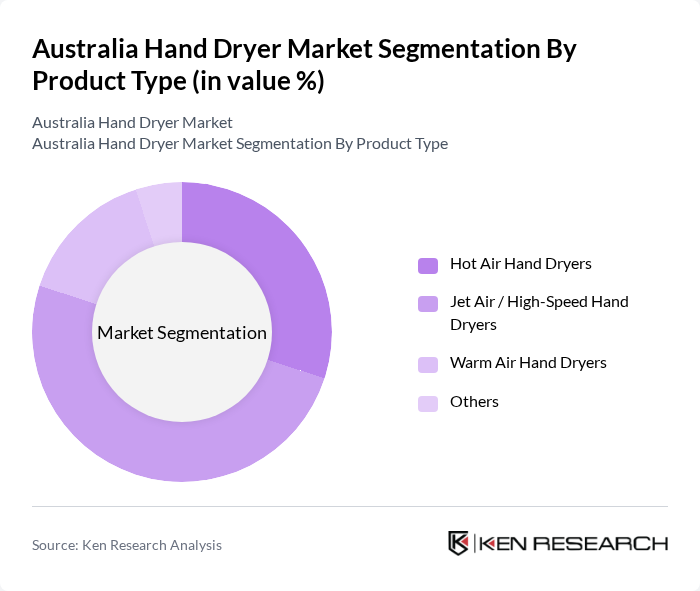
Australia Hand Dryer Market segmentation by Product Type.

By Operation:The operation segmentation includes Fully Automatic (Sensor-Based), Manual On–Automatic Off (Push-Button), and Others. Fully Automatic hand dryers are gaining traction due to their touchless operation, which enhances hygiene and user experience, in line with the post?pandemic emphasis on contactless solutions in public and commercial restrooms. The growing consumer preference for convenience and cleanliness in public restrooms is driving the demand for sensor-based models, with automatic units increasingly specified in new commercial developments and refurbishments. Manual On–Automatic Off dryers still hold a share of the market, particularly in budget-conscious settings and smaller facilities where capital expenditure constraints favor simpler push?button devices.
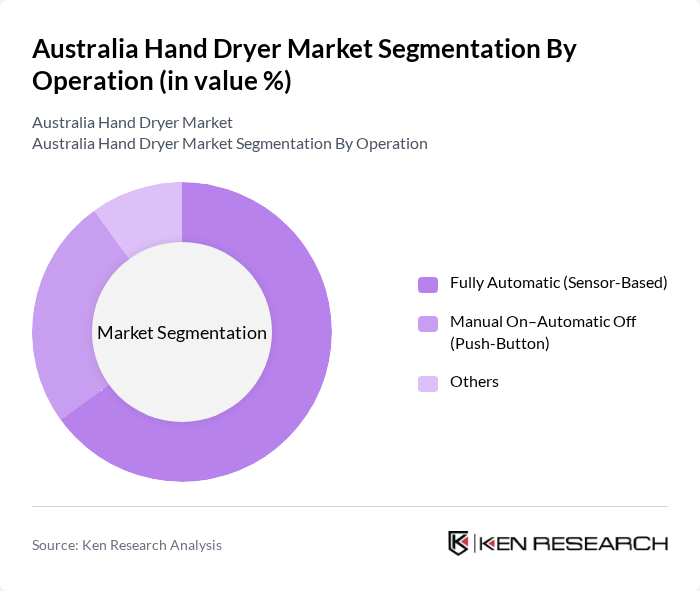
Australia Hand Dryer Market segmentation by Operation.

Australia Hand Dryer Market Competitive Landscape

The Australia Hand Dryer Market is characterized by a dynamic mix of regional and international players. Leading participants such as Dyson Ltd., Mitsubishi Electric Corporation, World Dryer (A Division of Zurn Elkay Water Solutions), Bobrick Washroom Equipment, Inc., TOTO Ltd., American Dryer (a Subsidiary of World Dryer / Zurn Elkay), Saniflow Corporation, Excel Dryer, Inc., Veltia (Veltia Hand Dryers), Airdri Ltd., Mediclinics S.A., Hand Dryers Australia, Jet Towel (Mitsubishi Electric Brand), Sunkist, AEROVENT contribute to innovation, geographic expansion, and service delivery in this space, with many of these global brands highlighted across major hand dryer market studies as key manufacturers of high?speed, automatic, and energy?efficient systems.

Dyson Ltd.

1991

Malmesbury, United Kingdom

Mitsubishi Electric Corporation

1921

Tokyo, Japan

World Dryer (A Division of Zurn Elkay Water Solutions)

1952

Oak Brook, Illinois, USA

Bobrick Washroom Equipment, Inc.

1906

North Hollywood, California, USA

TOTO Ltd.

1917

Kitakyushu, Japan

Company

Establishment Year

Headquarters

Group Size (Large, Medium, or Small as per industry convention)

Australia Hand Dryer Revenue (AUD, Latest Year)

3-Year Australia Revenue CAGR (%)

Market Share in Australia Hand Dryer Market (%)

Installed Base / Units Deployed in Australia

Average Selling Price Band (Low / Medium / Premium)

Australia Hand Dryer Market Industry Analysis

Growth Drivers

  • Increasing Demand for Hygiene in Public Spaces:The heightened awareness of hygiene, particularly post-pandemic, has led to a significant increase in demand for hand dryers in public facilities. According to the Australian Bureau of Statistics, 78% of Australians prioritize hygiene in public restrooms, driving a market growth of approximately AUD 60 million in future. This trend is expected to continue as businesses and public institutions invest in hygiene solutions to meet consumer expectations and regulatory standards.
  • Technological Advancements in Hand Dryer Efficiency:Innovations in hand dryer technology have significantly improved efficiency and user experience. For instance, high-speed hand dryers can dry hands in under 10 seconds, reducing energy consumption by up to 80% compared to traditional models. The Australian government’s Energy Efficiency Opportunities program reported that energy-efficient appliances, including hand dryers, could save businesses approximately AUD 40 million annually, further driving adoption in various sectors.
  • Rising Environmental Concerns and Sustainability Initiatives:With increasing environmental awareness, many Australian businesses are shifting towards sustainable practices. The Australian government has set a target to reduce carbon emissions by 30-32% by future. This has led to a surge in demand for eco-friendly hand dryers, which can reduce paper waste by an estimated 3 billion towels annually. The market for sustainable hand dryers is projected to grow by AUD 30 million in future, reflecting this trend.

Market Challenges

  • High Initial Investment Costs for Advanced Models:The upfront costs associated with advanced hand dryer models can be a significant barrier for many businesses. High-speed and energy-efficient dryers can range from AUD 1,200 to AUD 3,500, which may deter smaller establishments from investing. According to industry reports, approximately 45% of small businesses cite initial costs as a primary challenge, impacting overall market penetration in the sector.
  • Competition from Traditional Paper Towel Dispensers:Despite the advantages of hand dryers, traditional paper towel dispensers remain a strong competitor in the market. In future, paper towel sales in Australia reached AUD 180 million, highlighting consumer preference for perceived hygiene and convenience. This competition poses a challenge for hand dryer manufacturers, as many consumers still favor paper towels, particularly in high-traffic areas where quick disposal is prioritized.

Australia Hand Dryer Market Future Outlook

The Australia hand dryer market is poised for significant growth, driven by technological advancements and increasing hygiene awareness. As businesses continue to prioritize sustainability, the demand for energy-efficient and eco-friendly models will likely rise. Additionally, the integration of smart technology in hand dryers is expected to enhance user experience and operational efficiency. With ongoing government support for energy-efficient appliances, the market is set to evolve, presenting new opportunities for innovation and expansion in various sectors.

Market Opportunities

  • Expansion in the Commercial Sector:The commercial sector, particularly restaurants and shopping malls, presents a significant opportunity for hand dryer manufacturers. With over 1,500 new shopping centers projected to open in future, the demand for efficient hand drying solutions is expected to increase, potentially generating an additional AUD 20 million in revenue for the industry.
  • Growth in Eco-Friendly Product Demand:The rising consumer preference for eco-friendly products is creating new market opportunities. As businesses seek to align with sustainability goals, the demand for hand dryers made from recycled materials is expected to grow. This shift could lead to an estimated AUD 15 million increase in sales for manufacturers focusing on sustainable product lines in future.

Scope of the Report

SegmentSub-Segments
By Product Type

Hot Air Hand Dryers

Jet Air / High-Speed Hand Dryers

Warm Air Hand Dryers

Others

By Operation

Fully Automatic (Sensor-Based)

Manual On–Automatic Off (Push-Button)

Others

By Mounting / Installation Type

Wall-Mounted Hand Dryers

Surface-Mounted Hand Dryers

Recessed / In-Wall Hand Dryers

Others

By End-User

Commercial Spaces & Shopping Centres

Hospitality (Hotels, Restaurants, Clubs)

Healthcare Facilities

Educational Institutions

Corporate Offices & Government Buildings

Transport Hubs (Airports, Stations, Terminals)

Industrial & Other Institutional Facilities

By Material

Stainless Steel Hand Dryers

ABS / Plastic Hand Dryers

Other Metal Hand Dryers (e.g., Aluminum)

Others

By Distribution Channel

Offline (Distributors, Dealers, Retail)

Online (E-commerce, Direct Online)

Project / Direct Institutional Sales

Others

Key Target Audience

Investors and Venture Capitalist Firms

Government and Regulatory Bodies (e.g., Australian Competition and Consumer Commission, Department of Health)

Manufacturers and Producers

Distributors and Retailers

Facility Management Companies

Hospitality Industry Stakeholders

Building and Construction Firms

Environmental Organizations

Players Mentioned in the Report:

Dyson Ltd.

Mitsubishi Electric Corporation

World Dryer (A Division of Zurn Elkay Water Solutions)

Bobrick Washroom Equipment, Inc.

TOTO Ltd.

American Dryer (a Subsidiary of World Dryer / Zurn Elkay)

Saniflow Corporation

Excel Dryer, Inc.

Veltia (Veltia Hand Dryers)

Airdri Ltd.

Mediclinics S.A.

Hand Dryers Australia

Jet Towel (Mitsubishi Electric Brand)

Sunkist

AEROVENT

Table of Contents

Market Assessment Phase

1. Executive Summary and Approach


2. Australia Hand Dryer Market Overview

2.1 Key Insights and Strategic Recommendations

2.2 Australia Hand Dryer Market Overview

2.3 Definition and Scope

2.4 Evolution of Market Ecosystem

2.5 Timeline of Key Regulatory Milestones

2.6 Value Chain & Stakeholder Mapping

2.7 Business Cycle Analysis

2.8 Policy & Incentive Landscape


3. Australia Hand Dryer Market Analysis

3.1 Growth Drivers

3.1.1 Increasing demand for hygiene in public spaces
3.1.2 Technological advancements in hand dryer efficiency
3.1.3 Rising environmental concerns and sustainability initiatives
3.1.4 Government regulations promoting energy-efficient appliances

3.2 Market Challenges

3.2.1 High initial investment costs for advanced models
3.2.2 Competition from traditional paper towel dispensers
3.2.3 Variability in consumer preferences across regions
3.2.4 Maintenance and operational costs of high-speed dryers

3.3 Market Opportunities

3.3.1 Expansion in the commercial sector (restaurants, malls)
3.3.2 Growth in eco-friendly product demand
3.3.3 Innovations in smart technology integration
3.3.4 Potential for export to emerging markets

3.4 Market Trends

3.4.1 Shift towards touchless technology
3.4.2 Increasing focus on energy efficiency
3.4.3 Customization options for branding in commercial spaces
3.4.4 Rise in online sales channels for hand dryers

3.5 Government Regulation

3.5.1 Standards for energy efficiency (MEPS)
3.5.2 Health and safety regulations in public facilities
3.5.3 Environmental impact assessments for new products
3.5.4 Incentives for using sustainable materials

4. SWOT Analysis


5. Stakeholder Analysis


6. Porter's Five Forces Analysis


7. Australia Hand Dryer Market Market Size, 2019-2024

7.1 By Value

7.2 By Volume

7.3 By Average Selling Price


8. Australia Hand Dryer Market Segmentation

8.1 By Product Type

8.1.1 Hot Air Hand Dryers
8.1.2 Jet Air / High-Speed Hand Dryers
8.1.3 Warm Air Hand Dryers
8.1.4 Others

8.2 By Operation

8.2.1 Fully Automatic (Sensor-Based)
8.2.2 Manual On–Automatic Off (Push-Button)
8.2.3 Others

8.3 By Mounting / Installation Type

8.3.1 Wall-Mounted Hand Dryers
8.3.2 Surface-Mounted Hand Dryers
8.3.3 Recessed / In-Wall Hand Dryers
8.3.4 Others

8.4 By End-User

8.4.1 Commercial Spaces & Shopping Centres
8.4.2 Hospitality (Hotels, Restaurants, Clubs)
8.4.3 Healthcare Facilities
8.4.4 Educational Institutions
8.4.5 Corporate Offices & Government Buildings
8.4.6 Transport Hubs (Airports, Stations, Terminals)
8.4.7 Industrial & Other Institutional Facilities

8.5 By Material

8.5.1 Stainless Steel Hand Dryers
8.5.2 ABS / Plastic Hand Dryers
8.5.3 Other Metal Hand Dryers (e.g., Aluminum)
8.5.4 Others

8.6 By Distribution Channel

8.6.1 Offline (Distributors, Dealers, Retail)
8.6.2 Online (E-commerce, Direct Online)
8.6.3 Project / Direct Institutional Sales
8.6.4 Others

9. Australia Hand Dryer Market Competitive Analysis

9.1 Market Share of Key Players

9.2 Cross Comparison of Key Players

9.2.1 Company Name
9.2.2 Group Size (Large, Medium, or Small as per industry convention)
9.2.3 Australia Hand Dryer Revenue (AUD, Latest Year)
9.2.4 3-Year Australia Revenue CAGR (%)
9.2.5 Market Share in Australia Hand Dryer Market (%)
9.2.6 Installed Base / Units Deployed in Australia
9.2.7 Average Selling Price Band (Low / Medium / Premium)
9.2.8 R&D Intensity (% of Revenue)
9.2.9 New Product Launches in Last 3 Years (Number)
9.2.10 Channel Mix (Share of Online vs Offline Sales)
9.2.11 Key End-User Focus Segments
9.2.12 Customer Satisfaction / NPS Score

9.3 SWOT Analysis of Top Players

9.4 Pricing Analysis

9.5 Detailed Profile of Major Companies

9.5.1 Dyson Ltd.
9.5.2 Mitsubishi Electric Corporation
9.5.3 World Dryer (A Division of Zurn Elkay Water Solutions)
9.5.4 Bobrick Washroom Equipment, Inc.
9.5.5 TOTO Ltd.
9.5.6 American Dryer (a Subsidiary of World Dryer / Zurn Elkay)
9.5.7 Saniflow Corporation
9.5.8 Excel Dryer, Inc.
9.5.9 Veltia (Veltia Hand Dryers)
9.5.10 Airdri Ltd.
9.5.11 Mediclinics S.A.
9.5.12 Hand Dryers Australia
9.5.13 Jet Towel (Mitsubishi Electric Brand)
9.5.14 Sunkist
9.5.15 AEROVENT

10. Australia Hand Dryer Market End-User Analysis

10.1 Procurement Behavior of Key Ministries

10.1.1 Budget Allocation Trends
10.1.2 Decision-Making Processes
10.1.3 Preferred Suppliers
10.1.4 Compliance Requirements

10.2 Corporate Spend on Infrastructure & Energy

10.2.1 Investment in Sustainable Solutions
10.2.2 Budgeting for Upgrades
10.2.3 Long-term Contracts
10.2.4 Cost-Benefit Analysis

10.3 Pain Point Analysis by End-User Category

10.3.1 Maintenance Issues
10.3.2 Energy Consumption Concerns
10.3.3 User Experience Feedback
10.3.4 Compliance with Health Standards

10.4 User Readiness for Adoption

10.4.1 Awareness of Benefits
10.4.2 Training and Support Needs
10.4.3 Feedback Mechanisms
10.4.4 Adoption Barriers

10.5 Post-Deployment ROI and Use Case Expansion

10.5.1 Performance Metrics
10.5.2 User Satisfaction Surveys
10.5.3 Cost Savings Analysis
10.5.4 Future Expansion Plans

11. Australia Hand Dryer Market Future Size, 2025-2030

11.1 By Value

11.2 By Volume

11.3 By Average Selling Price


Go-To-Market Strategy Phase

1. Whitespace Analysis + Business Model Canvas

1.1 Market Gaps Identification

1.2 Value Proposition Development

1.3 Revenue Streams

1.4 Cost Structure Analysis

1.5 Key Partnerships

1.6 Customer Segments

1.7 Channels


2. Marketing and Positioning Recommendations

2.1 Branding Strategies

2.2 Product USPs


3. Distribution Plan

3.1 Urban Retail vs Rural NGO Tie-ups


4. Channel & Pricing Gaps

4.1 Underserved Routes

4.2 Pricing Bands


5. Unmet Demand & Latent Needs

5.1 Category Gaps

5.2 Consumer Segments


6. Customer Relationship

6.1 Loyalty Programs

6.2 After-sales Service


7. Value Proposition

7.1 Sustainability

7.2 Integrated Supply Chains


8. Key Activities

8.1 Regulatory Compliance

8.2 Branding

8.3 Distribution Setup


9. Entry Strategy Evaluation

9.1 Domestic Market Entry Strategy

9.1.1 Product Mix
9.1.2 Pricing Band
9.1.3 Packaging

9.2 Export Entry Strategy

9.2.1 Target Countries
9.2.2 Compliance Roadmap

10. Entry Mode Assessment

10.1 JV

10.2 Greenfield

10.3 M&A

10.4 Distributor Model


11. Capital and Timeline Estimation

11.1 Capital Requirements

11.2 Timelines


12. Control vs Risk Trade-Off

12.1 Ownership vs Partnerships


13. Profitability Outlook

13.1 Breakeven Analysis

13.2 Long-term Sustainability


14. Potential Partner List

14.1 Distributors

14.2 JVs

14.3 Acquisition Targets


15. Execution Roadmap

15.1 Phased Plan for Market Entry

15.1.1 Market Setup
15.1.2 Market Entry
15.1.3 Growth Acceleration
15.1.4 Scale & Stabilize

15.2 Key Activities and Milestones

15.2.1 Milestone Planning
15.2.2 Activity Tracking

Research Methodology

ApproachModellingSample

Phase 1: Approach1

Desk Research

  • Analysis of industry reports from Australian hygiene and sanitation associations
  • Review of market trends and forecasts from government publications and trade journals
  • Examination of consumer behavior studies related to hand hygiene practices in Australia

Primary Research

  • Interviews with facility managers in commercial buildings and public restrooms
  • Surveys conducted with manufacturers and distributors of hand dryers
  • Focus groups with end-users to understand preferences and satisfaction levels

Validation & Triangulation

  • Cross-validation of findings through multiple data sources including sales data and market reports
  • Triangulation of insights from primary interviews with secondary research findings
  • Sanity checks through expert panel reviews comprising industry veterans

Phase 2: Market Size Estimation1

Top-down Assessment

  • Estimation of total addressable market based on national hygiene product spending
  • Segmentation of market size by end-user categories such as healthcare, hospitality, and education
  • Incorporation of growth rates from related sectors like commercial cleaning services

Bottom-up Modeling

  • Collection of sales data from leading hand dryer manufacturers in Australia
  • Estimation of market penetration rates across different sectors and regions
  • Volume and pricing analysis based on product types (e.g., automatic vs. manual dryers)

Forecasting & Scenario Analysis

  • Multi-variable forecasting using factors such as population growth and urbanization rates
  • Scenario analysis based on potential regulatory changes regarding hygiene standards
  • Development of baseline, optimistic, and pessimistic market growth projections through 2030

Phase 3: CATI Sample Composition1

Scope Item/SegmentSample SizeTarget Respondent Profiles
Commercial Building Facilities120Facility Managers, Building Operations Directors
Healthcare Sector Hygiene Practices90Healthcare Administrators, Infection Control Officers
Education Sector Restroom Facilities80School Administrators, Facility Maintenance Supervisors
Hospitality Industry Hand Hygiene100Hotel Managers, Restaurant Owners
Public Restroom Management70Municipal Facility Managers, Sanitation Supervisors

Frequently Asked Questions

What is the current value of the Australia Hand Dryer Market?

The Australia Hand Dryer Market is valued at approximately AUD 10 million, reflecting a five-year historical analysis. This growth is driven by increased hygiene awareness, sustainable solutions, and the adoption of touchless technology in public restrooms.

Which cities dominate the Australia Hand Dryer Market?

What are the main types of hand dryers available in Australia?

How do energy performance standards affect hand dryers in Australia?

Other Adjacent Reports

KSA Washroom Equipment Market

Bahrain Paper Towel Dispenser Market

Saudi Arabia Soap Dispenser Market Report Size Share Growth Drivers Trends Opportunities & Forecast 2025–2030

Vietnam Hand Sanitizer Dispenser Market

Mexico Touchless Faucet Market

Bahrain Energy-Efficient Appliance Market

Germany Commercial Hygiene Product Market

UAE Sensor-Based Technology Market

UAE Sustainable Building Product Market

South Korea Facility Management Service Market

Why Buy From Us?

Refine Robust Result (RRR) Framework

What makes us stand out is that our consultants follow Robust, Refine and Result (RRR) methodology. Robust for clear definitions, approaches and sanity checking, Refine for differentiating respondents' facts and opinions, and Result for presenting data with story.

Our Reach Is Unmatched

We have set a benchmark in the industry by offering our clients with syndicated and customized market research reports featuring coverage of entire market as well as meticulous research and analyst insights.

Shifting the Research Paradigm

While we don't replace traditional research, we flip the method upside down. Our dual approach of Top Bottom & Bottom Top ensures quality deliverable by not just verifying company fundamentals but also looking at the sector and macroeconomic factors.

More Insights-Better Decisions

With one step in the future, our research team constantly tries to show you the bigger picture. We help with some of the tough questions you may encounter along the way: How is the industry positioned? Best marketing channel? KPI's of competitors? By aligning every element, we help maximize success.

Transparency and Trust

Our report gives you instant access to the answers and sources that other companies might choose to hide. We elaborate each steps of research methodology we have used and showcase you the sample size to earn your trust.

Round the Clock Support

If you need any support, we are here! We pride ourselves on universe strength, data quality, and quick, friendly, and professional service.

Why Clients Choose Us?

400000+
Reports in repository
150+
Consulting projects a year
100+
Analysts
8000+
Client Queries in 2022








