About the Report
Base Year 2024Kuwait Kidney Transplant Market Overview
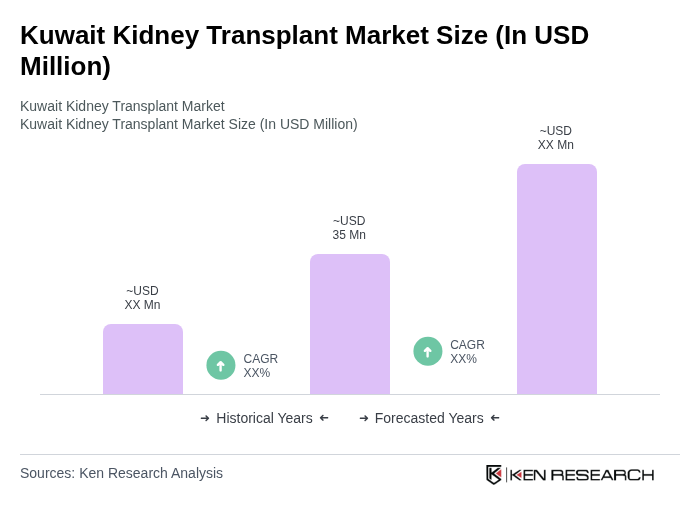
- The Kuwait Kidney Transplant Market is valued at USD 35 million, based on a five-year historical analysis. This growth is primarily driven by the increasing prevalence of chronic kidney diseases, rising awareness about organ donation, and advancements in transplant technologies. Kuwait has one of the highest prevalences of diabetes globally, and diabetic nephropathy remains a leading cause of end-stage kidney disease, along with long-standing hypertension, which significantly increases the demand for kidney replacement therapies, including transplantation.
- Kuwait City is the dominant hub for kidney transplants in the country, primarily due to its advanced healthcare infrastructure and specialized medical facilities. The Kuwait Center for Kidney Diseases and Transplantation and major tertiary hospitals such as Mubarak Al-Kabeer Hospital and Jaber Al-Ahmad Al-Sabah Hospital are concentrated in Kuwait City and perform the bulk of transplant activity, supported by dedicated nephrology and dialysis networks. The presence of leading hospitals and transplant centers, along with a well-established framework for organ procurement and coordination by the Ministry of Health, contributes to its prominence. Additionally, the government's commitment to improving healthcare services and promoting organ donation through public campaigns and investment in transplant programs has further solidified Kuwait City's position in the market.
- In 2023, the Kuwaiti government implemented a new regulation mandating that all hospitals performing kidney transplants must adhere to strict protocols for organ procurement and patient care. This regulation builds on the Organ Transplantation Law No. 55 of 2019 issued by the State of Kuwait, which sets binding rules on deceased and living donation, consent, ethical allocation, and the prohibition of organ trade, and is operationalized through Ministry of Health transplant bylaws and clinical protocols specifying donor evaluation, recipient work-up, infection control, and post-transplant follow-up. This framework aims to enhance the quality of transplant services and ensure better patient outcomes, thereby increasing public trust in the organ donation process and encouraging more individuals to consider becoming donors.
Kuwait Kidney Transplant Market Segmentation
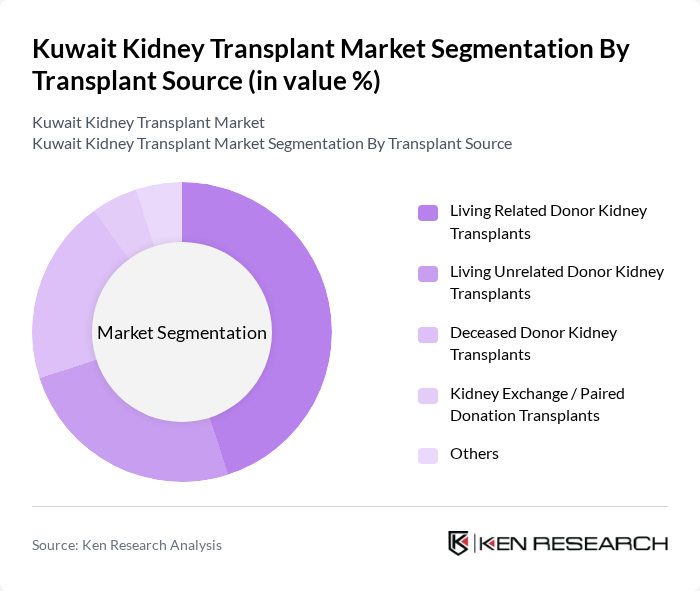
By Transplant Source:The market is segmented into various transplant sources, including Living Related Donor Kidney Transplants, Living Unrelated Donor Kidney Transplants, Deceased Donor Kidney Transplants, Kidney Exchange / Paired Donation Transplants, and Others. In Kuwait and the wider Gulf region, living donor kidney transplantation remains the predominant modality, with a large proportion of grafts sourced from biologically related family members, reflecting strong cultural and familial support for directed donation. This segment is favored for its higher success rates, better graft survival, and shorter waiting times compared to deceased donor transplants, as planned living donor procedures reduce cold ischemia time and allow optimization of both donor and recipient before surgery.
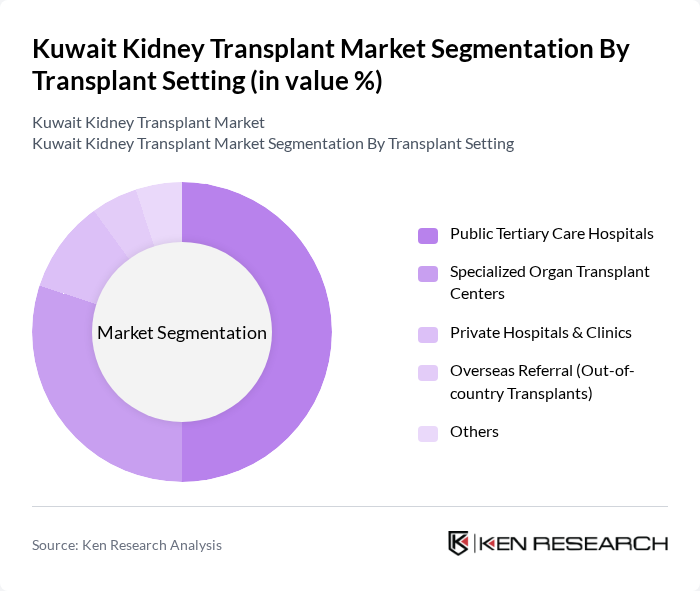
By Transplant Setting:This segment includes Public Tertiary Care Hospitals, Specialized Organ Transplant Centers, Private Hospitals & Clinics, Overseas Referral (Out-of-country Transplants), and Others. Public Tertiary Care Hospitals lead this segment due to their comprehensive facilities, multidisciplinary transplant teams, and experienced nephrology and urology units, which are crucial for performing complex transplant surgeries and managing long-term follow-up. These hospitals are often preferred by patients for their established reputation, coverage under the public health system, and the availability of advanced medical technologies such as high-end imaging, immunological laboratories, and intensive care units tailored to transplant patients.
Kuwait Kidney Transplant Market Competitive Landscape
The Kuwait Kidney Transplant Market is characterized by a dynamic mix of regional and international players. Leading participants such as Kuwait Center for Kidney Diseases and Transplants (KCKDT), Al-Sabah Health Zone, Organ Transplantation Department, Jaber Al-Ahmad Al-Sabah Hospital, Mubarak Al-Kabeer Hospital, Al-Amiri Hospital, Farwaniya Hospital, Adan Hospital (Al-Adan Hospital), Al-Sabah Hospital, Al-Jahra Hospital (New Jahra Hospital), Ibn Sina Hospital, Kuwait University – Faculty of Medicine & affiliated nephrology units, Kuwait Cancer Control Center (For oncology-related transplant comanagement), Al-Razi Orthopedic Hospital (Support services & perioperative care), Private Sector: Dar Al Shifa Hospital, Private Sector: Al Salam International Hospital, Private Sector: New Mowasat Hospital contribute to innovation, geographic expansion, and service delivery in this space.
Kuwait Kidney Transplant Market Industry Analysis
Growth Drivers
- Increasing Prevalence of Kidney Diseases:The prevalence of kidney diseases in Kuwait has been rising, with approximately 1,300 new cases of end-stage renal disease reported annually. According to the Kuwait Ministry of Health, chronic kidney disease affects around 16% of the adult population, leading to a growing demand for kidney transplants. This increase is driven by factors such as diabetes and hypertension, which are prevalent in the region, necessitating enhanced transplant services to address this health crisis.
- Advancements in Transplant Technologies:Technological advancements in kidney transplantation, such as improved surgical techniques and post-operative care, have significantly enhanced patient outcomes. For instance, the introduction of minimally invasive surgical methods has reduced recovery times by up to 25%. Additionally, innovations in immunosuppressive therapies have improved graft survival rates, with current statistics showing a 92% success rate for living donor transplants within the first year, thus encouraging more patients to opt for transplantation.
- Government Support and Funding for Healthcare:The Kuwaiti government has allocated approximately $1.8 billion for healthcare improvements, focusing on enhancing transplant services. This funding supports the establishment of specialized transplant centers and training programs for healthcare professionals. Furthermore, government initiatives aimed at increasing organ donation awareness have led to a 30% rise in registered organ donors over the past two years, directly impacting the availability of organs for transplantation.
Market Challenges
- Limited Availability of Donor Organs:One of the primary challenges facing the kidney transplant market in Kuwait is the limited availability of donor organs. In future, only 160 kidney transplants are expected to be performed, while the waiting list exceeds 1,200 patients. This disparity highlights the urgent need for increased organ donation rates, which remain low due to cultural and societal factors, thereby prolonging patient suffering and increasing healthcare costs associated with dialysis treatments.
- High Costs Associated with Transplantation:The financial burden of kidney transplantation is significant, with the average cost of a transplant procedure in Kuwait estimated at $55,000. This high cost can deter patients from pursuing transplantation, especially those without adequate health insurance coverage. Additionally, ongoing post-transplant care can add another $12,000 annually, creating a substantial financial barrier that limits access to life-saving treatments for many patients in need.
Kuwait Kidney Transplant Market Future Outlook
The future of the kidney transplant market in Kuwait appears promising, driven by increasing government investment in healthcare infrastructure and a growing acceptance of living donor transplants. As public awareness campaigns continue to educate citizens about organ donation, the number of registered donors is expected to rise. Furthermore, the integration of telemedicine in post-transplant care will enhance patient monitoring and support, ultimately improving outcomes and patient satisfaction in the transplant process.
Market Opportunities
- Expansion of Healthcare Infrastructure:The ongoing expansion of healthcare facilities in Kuwait presents a significant opportunity for the kidney transplant market. With the government investing in new hospitals and specialized transplant centers, the capacity to perform more transplants will increase, potentially reducing wait times and improving patient outcomes.
- Collaborations with International Transplant Centers:Establishing partnerships with international transplant centers can enhance Kuwait's capabilities in organ transplantation. These collaborations can facilitate knowledge transfer, improve surgical techniques, and provide access to advanced technologies, ultimately leading to better patient care and increased transplant success rates.
Scope of the Report
| Segment | Sub-Segments |
|---|---|
| By Transplant Source | Living Related Donor Kidney Transplants Living Unrelated Donor Kidney Transplants Deceased Donor Kidney Transplants Kidney Exchange / Paired Donation Transplants Others |
| By Transplant Setting | Public Tertiary Care Hospitals Specialized Organ Transplant Centers Private Hospitals & Clinics Overseas Referral (Out-of-country Transplants) Others |
| By Patient Profile | Adult Patients (?18 years) Pediatric Patients (<18 years) High-Risk / Co-morbid Patients (e.g., diabetes, CVD) Re-transplant / Graft Failure Patients Others |
| By Clinical Indication | Diabetic Nephropathy Hypertensive Nephrosclerosis Glomerulonephritis Polycystic Kidney Disease and Genetic Disorders Other Causes of End-Stage Kidney Disease |
| By Care Pathway | Pre-Transplant Evaluation & Work-Up Transplant Surgery & Perioperative Care Early Post-Transplant Follow-Up (0–12 months) Long-Term Post-Transplant Management (>12 months) Others |
| By Payer / Funding Source | Ministry of Health Funding Government Health Insurance & Social Schemes Private Health Insurance Self-Pay / Out-of-Pocket Others |
| By Supporting Technology & Services | Organ Procurement & Preservation Solutions Surgical & Laparoscopic Transplant Techniques Immunosuppressive Drug Management Laboratory & Imaging Diagnostics for Transplant Tele-nephrology & Remote Monitoring Solutions Others |
Key Target Audience
Investors and Venture Capitalist Firms
Government and Regulatory Bodies (e.g., Ministry of Health, Kuwait Medical Association)
Healthcare Providers and Hospitals
Pharmaceutical Companies
Medical Device Manufacturers
Health Insurance Companies
Non-Governmental Organizations (NGOs) focused on kidney health
Biotechnology Firms
Players Mentioned in the Report:
Kuwait Center for Kidney Diseases and Transplants (KCKDT), Al-Sabah Health Zone
Organ Transplantation Department, Jaber Al-Ahmad Al-Sabah Hospital
Mubarak Al-Kabeer Hospital
Al-Amiri Hospital
Farwaniya Hospital
Adan Hospital (Al-Adan Hospital)
Al-Sabah Hospital
Al-Jahra Hospital (New Jahra Hospital)
Ibn Sina Hospital
Kuwait University Faculty of Medicine & affiliated nephrology units
Kuwait Cancer Control Center (For oncology-related transplant comanagement)
Al-Razi Orthopedic Hospital (Support services & perioperative care)
Private Sector: Dar Al Shifa Hospital
Private Sector: Al Salam International Hospital
Private Sector: New Mowasat Hospital
Table of Contents
Market Assessment Phase
1. Executive Summary and Approach
2. Kuwait Kidney Transplant Market Overview
2.1 Key Insights and Strategic Recommendations
2.2 Kuwait Kidney Transplant Market Overview
2.3 Definition and Scope
2.4 Evolution of Market Ecosystem
2.5 Timeline of Key Regulatory Milestones
2.6 Value Chain & Stakeholder Mapping
2.7 Business Cycle Analysis
2.8 Policy & Incentive Landscape
3. Kuwait Kidney Transplant Market Analysis
3.1 Growth Drivers
3.1.1 Increasing prevalence of kidney diseases
3.1.2 Advancements in transplant technologies
3.1.3 Government support and funding for healthcare
3.1.4 Rising awareness about organ donation
3.2 Market Challenges
3.2.1 Limited availability of donor organs
3.2.2 High costs associated with transplantation
3.2.3 Regulatory hurdles in organ transplantation
3.2.4 Cultural and ethical concerns regarding organ donation
3.3 Market Opportunities
3.3.1 Expansion of healthcare infrastructure
3.3.2 Collaborations with international transplant centers
3.3.3 Development of innovative transplant solutions
3.3.4 Increasing public-private partnerships in healthcare
3.4 Market Trends
3.4.1 Growing acceptance of living donor transplants
3.4.2 Integration of telemedicine in post-transplant care
3.4.3 Focus on personalized medicine in transplant procedures
3.4.4 Rise in health insurance coverage for transplant procedures
3.5 Government Regulation
3.5.1 Regulations on organ donation and transplantation
3.5.2 Licensing requirements for transplant centers
3.5.3 Guidelines for ethical organ procurement
3.5.4 Policies promoting public awareness of organ donation
4. SWOT Analysis
5. Stakeholder Analysis
6. Porter's Five Forces Analysis
7. Kuwait Kidney Transplant Market Market Size, 2019-2024
7.1 By Value
7.2 By Volume
7.3 By Average Selling Price
8. Kuwait Kidney Transplant Market Segmentation
8.1 By Transplant Source
8.1.1 Living Related Donor Kidney Transplants
8.1.2 Living Unrelated Donor Kidney Transplants
8.1.3 Deceased Donor Kidney Transplants
8.1.4 Kidney Exchange / Paired Donation Transplants
8.1.5 Others
8.2 By Transplant Setting
8.2.1 Public Tertiary Care Hospitals
8.2.2 Specialized Organ Transplant Centers
8.2.3 Private Hospitals & Clinics
8.2.4 Overseas Referral (Out-of-country Transplants)
8.2.5 Others
8.3 By Patient Profile
8.3.1 Adult Patients (?18 years)
8.3.2 Pediatric Patients (<18 years)
8.3.3 High-Risk / Co-morbid Patients (e.g., diabetes, CVD)
8.3.4 Re-transplant / Graft Failure Patients
8.3.5 Others
8.4 By Clinical Indication
8.4.1 Diabetic Nephropathy
8.4.2 Hypertensive Nephrosclerosis
8.4.3 Glomerulonephritis
8.4.4 Polycystic Kidney Disease and Genetic Disorders
8.4.5 Other Causes of End-Stage Kidney Disease
8.5 By Care Pathway
8.5.1 Pre-Transplant Evaluation & Work-Up
8.5.2 Transplant Surgery & Perioperative Care
8.5.3 Early Post-Transplant Follow-Up (0–12 months)
8.5.4 Long-Term Post-Transplant Management (>12 months)
8.5.5 Others
8.6 By Payer / Funding Source
8.6.1 Ministry of Health Funding
8.6.2 Government Health Insurance & Social Schemes
8.6.3 Private Health Insurance
8.6.4 Self-Pay / Out-of-Pocket
8.6.5 Others
8.7 By Supporting Technology & Services
8.7.1 Organ Procurement & Preservation Solutions
8.7.2 Surgical & Laparoscopic Transplant Techniques
8.7.3 Immunosuppressive Drug Management
8.7.4 Laboratory & Imaging Diagnostics for Transplant
8.7.5 Tele-nephrology & Remote Monitoring Solutions
8.7.6 Others
9. Kuwait Kidney Transplant Market Competitive Analysis
9.1 Market Share of Key Players
9.2 Cross Comparison of Key Players
9.2.1 Number of Kidney Transplants Performed Annually
9.2.2 Share of National Kidney Transplant Volume (%)
9.2.3 Living vs Deceased Donor Mix (%)
9.2.4 1-Year and 5-Year Graft Survival Rates (%)
9.2.5 30-Day and 1-Year Patient Survival Rates (%)
9.2.6 Average Waiting Time to Transplant (Months)
9.2.7 Average Length of Stay for Transplant Episode (Days)
9.2.8 Average Cost per Kidney Transplant Case (KWD)
9.2.9 Proportion of Cases Funded by MOH vs Private Payers (%)
9.2.10 Adoption Level of Advanced Techniques (e.g., laparoscopic donor nephrectomy, kidney exchange programs)
9.2.11 Readmission and Complication Rates (e.g., acute rejection, infection)
9.2.12 International Accreditation & Quality Certifications (e.g., JCI)
9.3 SWOT Analysis of Top Players
9.4 Pricing Analysis
9.5 Detailed Profile of Major Companies
9.5.1 Kuwait Center for Kidney Diseases and Transplants (KCKDT), Al-Sabah Health Zone
9.5.2 Organ Transplantation Department, Jaber Al-Ahmad Al-Sabah Hospital
9.5.3 Mubarak Al-Kabeer Hospital
9.5.4 Al-Amiri Hospital
9.5.5 Farwaniya Hospital
9.5.6 Adan Hospital (Al-Adan Hospital)
9.5.7 Al-Sabah Hospital
9.5.8 Al-Jahra Hospital (New Jahra Hospital)
9.5.9 Ibn Sina Hospital
9.5.10 Kuwait University – Faculty of Medicine & affiliated nephrology units
9.5.11 Kuwait Cancer Control Center (For oncology-related transplant comanagement)
9.5.12 Al-Razi Orthopedic Hospital (Support services & perioperative care)
9.5.13 Private Sector: Dar Al Shifa Hospital
9.5.14 Private Sector: Al Salam International Hospital
9.5.15 Private Sector: New Mowasat Hospital
10. Kuwait Kidney Transplant Market End-User Analysis
10.1 Procurement Behavior of Key Ministries
10.1.1 Ministry of Health
10.1.2 Ministry of Finance
10.1.3 Ministry of Social Affairs
10.1.4 Others
10.2 Corporate Spend on Infrastructure & Energy
10.2.1 Hospital Infrastructure Investments
10.2.2 Medical Equipment Procurement
10.2.3 Training and Development Expenditure
10.2.4 Others
10.3 Pain Point Analysis by End-User Category
10.3.1 Hospitals
10.3.2 Patients
10.3.3 Healthcare Providers
10.3.4 Others
10.4 User Readiness for Adoption
10.4.1 Awareness Levels
10.4.2 Training Needs
10.4.3 Infrastructure Readiness
10.4.4 Others
10.5 Post-Deployment ROI and Use Case Expansion
10.5.1 Cost Savings Analysis
10.5.2 Patient Outcome Improvements
10.5.3 Service Expansion Opportunities
10.5.4 Others
11. Kuwait Kidney Transplant Market Future Size, 2025-2030
11.1 By Value
11.2 By Volume
11.3 By Average Selling Price
Go-To-Market Strategy Phase
1. Whitespace Analysis + Business Model Canvas
1.1 Market Gaps Identification
1.2 Business Model Development
2. Marketing and Positioning Recommendations
2.1 Branding Strategies
2.2 Product USPs
3. Distribution Plan
3.1 Urban Retail vs Rural NGO Tie-ups
4. Channel & Pricing Gaps
4.1 Underserved Routes
4.2 Pricing Bands
5. Unmet Demand & Latent Needs
5.1 Category Gaps
5.2 Consumer Segments
6. Customer Relationship
6.1 Loyalty Programs
6.2 After-Sales Service
7. Value Proposition
7.1 Sustainability
7.2 Integrated Supply Chains
8. Key Activities
8.1 Regulatory Compliance
8.2 Branding
8.3 Distribution Setup
9. Entry Strategy Evaluation
9.1 Domestic Market Entry Strategy
9.1.1 Product Mix
9.1.2 Pricing Band
9.1.3 Packaging
9.2 Export Entry Strategy
9.2.1 Target Countries
9.2.2 Compliance Roadmap
10. Entry Mode Assessment
10.1 JV
10.2 Greenfield
10.3 M&A
10.4 Distributor Model
11. Capital and Timeline Estimation
11.1 Capital Requirements
11.2 Timelines
12. Control vs Risk Trade-Off
12.1 Ownership vs Partnerships
13. Profitability Outlook
13.1 Breakeven Analysis
13.2 Long-Term Sustainability
14. Potential Partner List
14.1 Distributors
14.2 JVs
14.3 Acquisition Targets
15. Execution Roadmap
15.1 Phased Plan for Market Entry
15.1.1 Market Setup
15.1.2 Market Entry
15.1.3 Growth Acceleration
15.1.4 Scale & Stabilize
15.2 Key Activities and Milestones
15.2.1 Milestone Planning
15.2.2 Activity Tracking
Research Methodology
Phase 1: Approach1
Desk Research
- Analysis of healthcare expenditure reports from the Ministry of Health, Kuwait
- Review of published studies and articles on kidney transplant trends in the Gulf region
- Examination of demographic data and prevalence rates of kidney diseases from WHO and local health authorities
Primary Research
- Interviews with nephrologists and transplant surgeons in leading hospitals
- Surveys with patients who have undergone kidney transplants in Kuwait
- Discussions with healthcare administrators regarding transplant program operations
Validation & Triangulation
- Cross-validation of findings with international transplant registry data
- Triangulation of insights from healthcare professionals and patient feedback
- Sanity checks through expert panel reviews comprising transplant coordinators and policy makers
Phase 2: Market Size Estimation1
Top-down Assessment
- Estimation of total healthcare spending allocated to renal care and transplantation
- Analysis of the growth rate of kidney transplant procedures over the past decade
- Incorporation of government health initiatives aimed at increasing organ donation rates
Bottom-up Modeling
- Data collection on the number of kidney transplants performed annually in Kuwait
- Cost analysis of transplant procedures, including surgery, post-operative care, and medication
- Estimation of market size based on patient volume and average treatment costs
Forecasting & Scenario Analysis
- Multi-factor regression analysis considering population growth and aging demographics
- Scenario modeling based on potential changes in healthcare policies and organ donation rates
- Baseline, optimistic, and pessimistic projections for the kidney transplant market through 2030
Phase 3: CATI Sample Composition1
| Scope Item/Segment | Sample Size | Target Respondent Profiles |
|---|---|---|
| Nephrologist Insights | 50 | Nephrologists, Kidney Specialists |
| Patient Experience Feedback | 120 | Kidney Transplant Recipients, Caregivers |
| Healthcare Administrator Perspectives | 40 | Hospital Administrators, Transplant Coordinators |
| Policy Maker Interviews | 40 | Health Policy Makers, Regulatory Officials |
| Pharmaceutical Insights | 40 | Pharmaceutical Representatives, Medical Sales Reps |
Frequently Asked Questions
What is the current value of the Kuwait Kidney Transplant Market?
The Kuwait Kidney Transplant Market is valued at approximately USD 35 million, reflecting a five-year historical analysis. This growth is driven by the rising prevalence of chronic kidney diseases and advancements in transplant technologies.
What factors are driving the growth of the kidney transplant market in Kuwait?
Where are the primary kidney transplant centers located in Kuwait?
What regulations govern kidney transplants in Kuwait?
Other Regional/Country Reports
Malaysia Kidney Transplant Market
KSA Kidney Transplant Market
APAC Kidney Transplant Market
SEA Kidney Transplant Market
Vietnam Kidney Transplant Market
Other Adjacent Reports
Bahrain Organ Procurement Market
Malaysia Immunosuppressive Drugs Market
Kuwait Nephrology Devices Market
KSA Chronic Kidney Disease Treatment Market
Germany Transplant Diagnostics Market
Japan Post-Transplant Care Market
Kuwait Renal Replacement Therapy Market
Indonesia Biotechnology Transplantation Market
Kuwait Healthcare Infrastructure Development Market
Why Buy From Us?

What makes us stand out is that our consultants follow Robust, Refine and Result (RRR) methodology. Robust for clear definitions, approaches and sanity checking, Refine for differentiating respondents' facts and opinions, and Result for presenting data with story.

We have set a benchmark in the industry by offering our clients with syndicated and customized market research reports featuring coverage of entire market as well as meticulous research and analyst insights.

While we don't replace traditional research, we flip the method upside down. Our dual approach of Top Bottom & Bottom Top ensures quality deliverable by not just verifying company fundamentals but also looking at the sector and macroeconomic factors.

With one step in the future, our research team constantly tries to show you the bigger picture. We help with some of the tough questions you may encounter along the way: How is the industry positioned? Best marketing channel? KPI's of competitors? By aligning every element, we help maximize success.

Our report gives you instant access to the answers and sources that other companies might choose to hide. We elaborate each steps of research methodology we have used and showcase you the sample size to earn your trust.

If you need any support, we are here! We pride ourselves on universe strength, data quality, and quick, friendly, and professional service.