Ken Research Logo

Kuwait Video Telemedicine Market Size, Share, Growth Drivers, Trends, Opportunities & Forecast 2025–2030

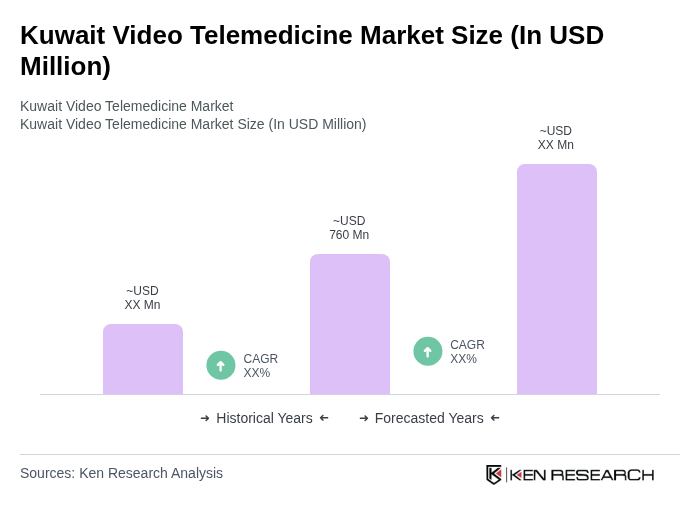
The Kuwait video telemedicine market, valued at USD 760 million, is growing due to rising demand for remote consultations, 5G expansion, and COVID-19 acceleration.

Region:Middle East

Author(s):Shubham

Product Code:KRAD5447

Pages:86

Published On:December 2025
About the Report

Base Year 2024

Kuwait Video Telemedicine Market Overview

  • The Kuwait Video Telemedicine Market is valued at USD 760 million, based on a five-year historical analysis. This growth is primarily driven by the increasing adoption of digital health solutions, rising healthcare costs, the need for accessible medical services, increasing smartphone penetration, government support for digital health, and the expansion of 5G technology enabling seamless connectivity. The COVID-19 pandemic has further accelerated the shift towards telemedicine, as patients and healthcare providers seek safer alternatives to in-person consultations.
  • Kuwait City is the dominant region in the video telemedicine market due to its advanced healthcare infrastructure and high internet penetration rates. The concentration of healthcare facilities and a tech-savvy population in urban areas contribute to the market's growth. Additionally, the expatriate population in Kuwait also drives demand for telemedicine services, as they seek convenient healthcare options.
  • The Ministerial Resolution No. 404 of 2022 issued by the Ministry of Health mandates that all healthcare providers offering telehealth services must obtain prior approval, comply with data privacy and security standards including encryption and secure storage, and adhere to clinical guidelines for remote consultations applicable to all licensed facilities with patient data thresholds exceeding routine consultations.
Kuwait Video Telemedicine Market Size

Kuwait Video Telemedicine Market Segmentation

By Type:The video telemedicine market can be segmented into various types, including Real-time Video Consultation, Store-and-Forward Telemedicine, Remote Patient Monitoring, Mobile Telemedicine Applications, and Virtual Triage & Second-Opinion Services. Among these, Real-time Video Consultation is the leading sub-segment, driven by the increasing demand for immediate medical advice and the convenience it offers to patients. The rise in smartphone usage and internet accessibility has further propelled this segment, making it the preferred choice for many users.
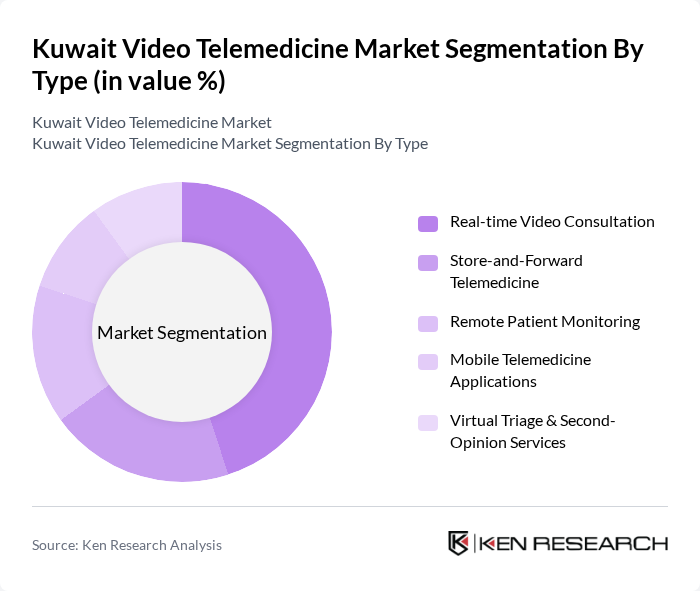
Kuwait Video Telemedicine Market segmentation by Type.

By End-User:The end-user segmentation includes Public Hospitals (MOH and Government-Owned), Private Hospitals and Specialty Centers, Primary Care & Polyclinics, Corporate & Occupational Health Programs, and Direct-to-Consumer (D2C) Platforms. Public Hospitals are the dominant end-user segment, as they are increasingly adopting telemedicine solutions to enhance service delivery and manage patient loads effectively. The support from the Ministry of Health in Kuwait for telehealth initiatives has also played a crucial role in this segment's growth.
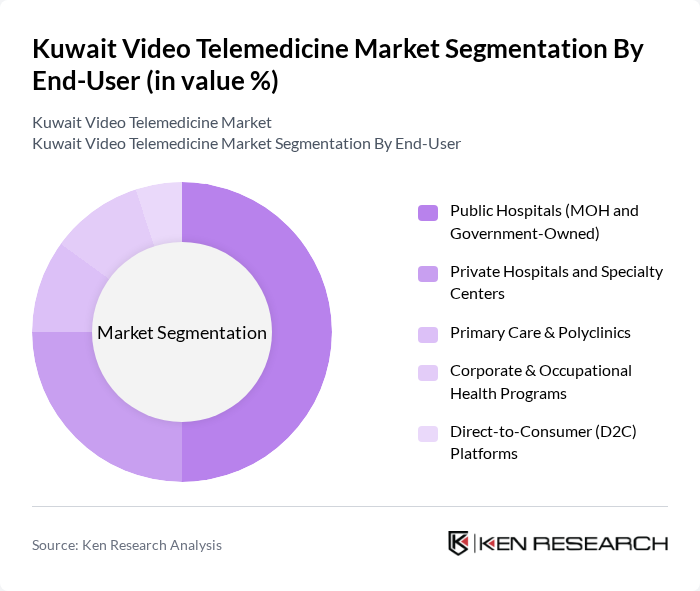
Kuwait Video Telemedicine Market segmentation by End-User.

Kuwait Video Telemedicine Market Competitive Landscape

The Kuwait Video Telemedicine Market is characterized by a dynamic mix of regional and international players. Leading participants such as Ministry of Health (Kuwait) – Central Telemedicine & eHealth Programs, Kuwait Telemedicine Center – Jaber Al-Ahmad Hospital Initiative, Dhaman Health Assurance Hospitals Company (DHAMAN), Kuwait Hospital – Teleconsultation & Virtual Clinic Services, Dar Al Shifa Hospital – Online Video Consultation Platform, New Mowasat Hospital – Telemedicine & Remote Follow-up Services, Kuwait Telecare – Local Multispecialty Video Telehealth Platform, VEZEETA FZ-LLC – Regional Appointment & Teleconsultation Platform Operating in Kuwait, Okadoc – GCC Digital Health Platform with Video Consultation in Kuwait, MyClinic Kuwait – Virtual Clinic and Online Consultation Service, Sehteq / Yodawy – Digital Health & Teleconsultation Partnering with Providers in Kuwait, Altibbi – Arabic Telehealth Platform Serving Users in Kuwait, Babylon Health – International Telehealth Provider with GCC Deployments, Doctori Online – GCC Telemedicine Platform Accessible from Kuwait, InstaPract – Regional Video Consultation Platform Serving Kuwait-based Patients contribute to innovation, geographic expansion, and service delivery in this space.

Ministry of Health (Kuwait)

1962

Kuwait City, Kuwait

Kuwait Telemedicine Center

2015

Kuwait City, Kuwait

Dhaman Health Assurance Hospitals Company (DHAMAN)

2015

Kuwait City, Kuwait

Dar Al Shifa Hospital

1975

Kuwait City, Kuwait

VEZEETA FZ-LLC

2012

Cairo, Egypt

Company

Establishment Year

Headquarters

Scale of Operations in Kuwait (Nationwide, Regional, Niche)

Kuwait Telehealth Revenue & 3-year CAGR

Number of Active Video Consultations per Month in Kuwait

Registered User Base in Kuwait

Average Revenue Per Video Consult (ARPC)

Share of Video Visits in Total Consultations (%)

Kuwait Video Telemedicine Market Industry Analysis

Growth Drivers

  • Increasing Demand for Remote Healthcare Services:The demand for remote healthcare services in Kuwait is surging, driven by a population of approximately 4.5 million people, with around 60% seeking convenient healthcare options. The COVID-19 pandemic accelerated this trend, leading to a reported 250% increase in telemedicine consultations in the future. This shift reflects a growing preference for accessible healthcare, particularly among younger demographics who are more tech-savvy and open to digital solutions.
  • Technological Advancements in Telemedicine Solutions:Kuwait's telemedicine landscape is bolstered by significant technological advancements, with the country investing over $250 million in digital health technologies in the future. Innovations such as high-definition video conferencing, AI-driven diagnostics, and mobile health applications are enhancing service delivery. The integration of these technologies is expected to improve patient outcomes and streamline healthcare processes, making telemedicine a viable alternative to traditional healthcare.
  • Government Initiatives Supporting Telehealth Adoption:The Kuwaiti government has implemented various initiatives to promote telehealth, allocating approximately $75 million in the future for telemedicine infrastructure development. This includes regulatory frameworks that facilitate telehealth services and partnerships with private sectors. Such support is crucial in increasing telemedicine adoption rates, which are projected to reach 45% of all healthcare consultations in the future, significantly enhancing healthcare accessibility across the nation.

Market Challenges

  • Limited Internet Connectivity in Rural Areas:Despite advancements, approximately 25% of rural areas in Kuwait still experience inadequate internet connectivity, hindering telemedicine access. This digital divide affects around 1.1 million residents, limiting their ability to utilize remote healthcare services. The lack of reliable internet infrastructure poses a significant barrier to the widespread adoption of telemedicine, particularly in underserved regions where healthcare access is already limited.
  • Regulatory Hurdles and Compliance Issues:The telemedicine sector in Kuwait faces regulatory challenges, with over 45% of healthcare providers citing compliance issues as a major barrier. The existing regulations are often unclear, leading to confusion among providers regarding licensing and operational standards. This uncertainty can deter investment and slow the growth of telemedicine services, as providers may hesitate to navigate the complex regulatory landscape without clear guidelines.

Kuwait Video Telemedicine Market Future Outlook

The future of the Kuwait video telemedicine market appears promising, driven by ongoing technological innovations and increasing consumer acceptance. As the government continues to invest in digital health infrastructure, the integration of advanced technologies like AI and machine learning will enhance service delivery. Additionally, the growing emphasis on mental health services through telemedicine is expected to expand the market further, catering to diverse healthcare needs and improving overall patient care in the region.

Market Opportunities

  • Expansion of Telemedicine Services to Underserved Regions:There is a significant opportunity to expand telemedicine services to underserved regions in Kuwait, where healthcare access is limited. By targeting these areas, telehealth providers can reach approximately 1.1 million residents, improving healthcare outcomes and reducing disparities in service availability. This expansion can foster greater health equity across the nation.
  • Integration of AI and Machine Learning in Telehealth:The integration of AI and machine learning technologies presents a lucrative opportunity for enhancing telehealth services. By leveraging these technologies, healthcare providers can improve diagnostic accuracy and personalize patient care. This innovation is expected to attract investment, with an estimated $150 million projected for AI-driven telehealth solutions in the future, significantly transforming the healthcare landscape.

Scope of the Report

SegmentSub-Segments
By Type

Real-time Video Consultation

Store-and-Forward Telemedicine

Remote Patient Monitoring

Mobile Telemedicine Applications

Virtual Triage & Second-Opinion Services

By End-User

Public Hospitals (MOH and Government-Owned)

Private Hospitals and Specialty Centers

Primary Care & Polyclinics

Corporate & Occupational Health Programs

Direct-to-Consumer (D2C) Platforms

By Specialty

Primary Care & Family Medicine

Mental & Behavioral Health

Dermatology

Pediatrics & Neonatal Care

Chronic Disease Management (e.g., Diabetes, Cardiology)

By Technology

Web-based Video Platforms

Mobile Health (mHealth) Applications

Cloud-based Telemedicine Platforms

Integrated EMR/Telehealth Solutions

Connected Devices & Wearables

By Payment Model

Self-pay / Out-of-pocket

Private Insurance Reimbursement

Government-funded & MOH Programs

Corporate & Employer-sponsored Plans

By User Demographics

Kuwaiti Nationals

Expatriate Population

Age Groups (Children, Adults, Elderly)

Patients with Chronic Conditions

By Region

Kuwait City & Metropolitan Area

Other Urban Governorates

Semi-urban & Remote Areas

Key Target Audience

Investors and Venture Capitalist Firms

Government and Regulatory Bodies (e.g., Ministry of Health, Kuwait Medical Association)

Healthcare Providers and Hospitals

Telecommunication Companies

Health Insurance Companies

Medical Device Manufacturers

Technology Providers and Software Developers

Healthcare IT Solutions Firms

Players Mentioned in the Report:

Ministry of Health (Kuwait) Central Telemedicine & eHealth Programs

Kuwait Telemedicine Center Jaber Al-Ahmad Hospital Initiative

Dhaman Health Assurance Hospitals Company (DHAMAN)

Kuwait Hospital Teleconsultation & Virtual Clinic Services

Dar Al Shifa Hospital Online Video Consultation Platform

New Mowasat Hospital Telemedicine & Remote Follow-up Services

Kuwait Telecare Local Multispecialty Video Telehealth Platform

VEZEETA FZ-LLC Regional Appointment & Teleconsultation Platform Operating in Kuwait

Okadoc GCC Digital Health Platform with Video Consultation in Kuwait

MyClinic Kuwait Virtual Clinic and Online Consultation Service

Sehteq / Yodawy Digital Health & Teleconsultation Partnering with Providers in Kuwait

Altibbi Arabic Telehealth Platform Serving Users in Kuwait

Babylon Health International Telehealth Provider with GCC Deployments

Doctori Online GCC Telemedicine Platform Accessible from Kuwait

InstaPract Regional Video Consultation Platform Serving Kuwait-based Patients

Table of Contents

Market Assessment Phase

1. Executive Summary and Approach


2. Kuwait Video Telemedicine Market Overview

2.1 Key Insights and Strategic Recommendations

2.2 Kuwait Video Telemedicine Market Overview

2.3 Definition and Scope

2.4 Evolution of Market Ecosystem

2.5 Timeline of Key Regulatory Milestones

2.6 Value Chain & Stakeholder Mapping

2.7 Business Cycle Analysis

2.8 Policy & Incentive Landscape


3. Kuwait Video Telemedicine Market Analysis

3.1 Growth Drivers

3.1.1 Increasing Demand for Remote Healthcare Services
3.1.2 Technological Advancements in Telemedicine Solutions
3.1.3 Rising Healthcare Costs and Need for Cost-Effective Solutions
3.1.4 Government Initiatives Supporting Telehealth Adoption

3.2 Market Challenges

3.2.1 Limited Internet Connectivity in Rural Areas
3.2.2 Regulatory Hurdles and Compliance Issues
3.2.3 Resistance from Traditional Healthcare Providers
3.2.4 Data Privacy and Security Concerns

3.3 Market Opportunities

3.3.1 Expansion of Telemedicine Services to Underserved Regions
3.3.2 Integration of AI and Machine Learning in Telehealth
3.3.3 Partnerships with Local Healthcare Providers
3.3.4 Development of Mobile Health Applications

3.4 Market Trends

3.4.1 Increased Adoption of Wearable Health Technology
3.4.2 Shift Towards Patient-Centric Care Models
3.4.3 Growth of Virtual Health Platforms
3.4.4 Emphasis on Mental Health Services via Telemedicine

3.5 Government Regulation

3.5.1 Telemedicine Licensing Requirements
3.5.2 Reimbursement Policies for Telehealth Services
3.5.3 Data Protection Regulations
3.5.4 Standards for Telehealth Technology

4. SWOT Analysis


5. Stakeholder Analysis


6. Porter's Five Forces Analysis


7. Kuwait Video Telemedicine Market Market Size, 2019-2024

7.1 By Value

7.2 By Volume

7.3 By Average Selling Price


8. Kuwait Video Telemedicine Market Segmentation

8.1 By Type

8.1.1 Real-time Video Consultation
8.1.2 Store-and-Forward Telemedicine
8.1.3 Remote Patient Monitoring
8.1.4 Mobile Telemedicine Applications
8.1.5 Virtual Triage & Second-Opinion Services

8.2 By End-User

8.2.1 Public Hospitals (MOH and Government-Owned)
8.2.2 Private Hospitals and Specialty Centers
8.2.3 Primary Care & Polyclinics
8.2.4 Corporate & Occupational Health Programs
8.2.5 Direct-to-Consumer (D2C) Platforms

8.3 By Specialty

8.3.1 Primary Care & Family Medicine
8.3.2 Mental & Behavioral Health
8.3.3 Dermatology
8.3.4 Pediatrics & Neonatal Care
8.3.5 Chronic Disease Management (e.g., Diabetes, Cardiology)

8.4 By Technology

8.4.1 Web-based Video Platforms
8.4.2 Mobile Health (mHealth) Applications
8.4.3 Cloud-based Telemedicine Platforms
8.4.4 Integrated EMR/Telehealth Solutions
8.4.5 Connected Devices & Wearables

8.5 By Payment Model

8.5.1 Self-pay / Out-of-pocket
8.5.2 Private Insurance Reimbursement
8.5.3 Government-funded & MOH Programs
8.5.4 Corporate & Employer-sponsored Plans

8.6 By User Demographics

8.6.1 Kuwaiti Nationals
8.6.2 Expatriate Population
8.6.3 Age Groups (Children, Adults, Elderly)
8.6.4 Patients with Chronic Conditions

8.7 By Region

8.7.1 Kuwait City & Metropolitan Area
8.7.2 Other Urban Governorates
8.7.3 Semi-urban & Remote Areas

9. Kuwait Video Telemedicine Market Competitive Analysis

9.1 Market Share of Key Players

9.2 Cross Comparison of Key Players

9.2.1 Company Name
9.2.2 Scale of Operations in Kuwait (Nationwide, Regional, Niche)
9.2.3 Kuwait Telehealth Revenue & 3-year CAGR
9.2.4 Number of Active Video Consultations per Month in Kuwait
9.2.5 Registered User Base in Kuwait
9.2.6 Average Revenue Per Video Consult (ARPC)
9.2.7 Share of Video Visits in Total Consultations (%)
9.2.8 Average Waiting Time for Video Appointment
9.2.9 Provider Network Size in Kuwait (Doctors, Specialists)
9.2.10 Uptime / Platform Reliability (%)
9.2.11 Compliance with Kuwait MOH / Data Residency Requirements
9.2.12 Integration Level with Local Hospitals, Insurers & EMR Systems

9.3 SWOT Analysis of Top Players

9.4 Pricing Analysis

9.5 Detailed Profile of Major Companies

9.5.1 Ministry of Health (Kuwait) – Central Telemedicine & eHealth Programs
9.5.2 Kuwait Telemedicine Center – Jaber Al-Ahmad Hospital Initiative
9.5.3 Dhaman Health Assurance Hospitals Company (DHAMAN)
9.5.4 Kuwait Hospital – Teleconsultation & Virtual Clinic Services
9.5.5 Dar Al Shifa Hospital – Online Video Consultation Platform
9.5.6 New Mowasat Hospital – Telemedicine & Remote Follow-up Services
9.5.7 Kuwait Telecare – Local Multispecialty Video Telehealth Platform
9.5.8 VEZEETA FZ-LLC – Regional Appointment & Teleconsultation Platform Operating in Kuwait
9.5.9 Okadoc – GCC Digital Health Platform with Video Consultation in Kuwait
9.5.10 MyClinic Kuwait – Virtual Clinic and Online Consultation Service
9.5.11 Sehteq / Yodawy – Digital Health & Teleconsultation Partnering with Providers in Kuwait
9.5.12 Altibbi – Arabic Telehealth Platform Serving Users in Kuwait
9.5.13 Babylon Health – International Telehealth Provider with GCC Deployments
9.5.14 Doctori Online – GCC Telemedicine Platform Accessible from Kuwait
9.5.15 InstaPract – Regional Video Consultation Platform Serving Kuwait-based Patients

10. Kuwait Video Telemedicine Market End-User Analysis

10.1 Procurement Behavior of Key Ministries

10.1.1 Ministry of Health
10.1.2 Ministry of Interior
10.1.3 Ministry of Education
10.1.4 Others

10.2 Corporate Spend on Infrastructure & Energy

10.2.1 Healthcare Infrastructure Investments
10.2.2 Technology Upgrades
10.2.3 Training and Development
10.2.4 Others

10.3 Pain Point Analysis by End-User Category

10.3.1 Patients
10.3.2 Healthcare Providers
10.3.3 Insurance Companies
10.3.4 Others

10.4 User Readiness for Adoption

10.4.1 Awareness Levels
10.4.2 Technological Proficiency
10.4.3 Acceptance of Telehealth Solutions
10.4.4 Others

10.5 Post-Deployment ROI and Use Case Expansion

10.5.1 Cost Savings Analysis
10.5.2 Patient Satisfaction Metrics
10.5.3 Service Utilization Rates
10.5.4 Others

11. Kuwait Video Telemedicine Market Future Size, 2025-2030

11.1 By Value

11.2 By Volume

11.3 By Average Selling Price


Go-To-Market Strategy Phase

1. Whitespace Analysis + Business Model Canvas

1.1 Market Gaps Identification

1.2 Business Model Development


2. Marketing and Positioning Recommendations

2.1 Branding Strategies

2.2 Product USPs


3. Distribution Plan

3.1 Urban Retail vs Rural NGO Tie-ups


4. Channel & Pricing Gaps

4.1 Underserved Routes

4.2 Pricing Bands


5. Unmet Demand & Latent Needs

5.1 Category Gaps

5.2 Consumer Segments


6. Customer Relationship

6.1 Loyalty Programs

6.2 After-sales Service


7. Value Proposition

7.1 Sustainability

7.2 Integrated Supply Chains


8. Key Activities

8.1 Regulatory Compliance

8.2 Branding

8.3 Distribution Setup


9. Entry Strategy Evaluation

9.1 Domestic Market Entry Strategy

9.1.1 Product Mix
9.1.2 Pricing Band
9.1.3 Packaging

9.2 Export Entry Strategy

9.2.1 Target Countries
9.2.2 Compliance Roadmap

10. Entry Mode Assessment</h3


Research Methodology

ApproachModellingSample

Phase 1: Approach1

Desk Research

  • Analysis of existing market reports and white papers on telemedicine trends in Kuwait
  • Review of government publications and healthcare policies related to telemedicine adoption
  • Examination of demographic and health statistics from the Kuwait Ministry of Health

Primary Research

  • Interviews with healthcare providers and telemedicine service operators in Kuwait
  • Surveys targeting patients who have utilized telemedicine services
  • Focus groups with healthcare professionals discussing telemedicine integration

Validation & Triangulation

  • Cross-validation of findings with international telemedicine case studies
  • Triangulation of data from healthcare providers, patients, and regulatory bodies
  • Sanity checks through expert panel discussions with industry leaders

Phase 2: Market Size Estimation1

Top-down Assessment

  • Estimation of telemedicine market size based on national healthcare expenditure
  • Segmentation by service type (e.g., consultations, remote monitoring) and patient demographics
  • Incorporation of growth rates from regional telemedicine markets

Bottom-up Modeling

  • Data collection from telemedicine providers on service usage and pricing
  • Estimation of patient volume based on healthcare access and technology adoption rates
  • Calculation of revenue projections based on service frequency and average billing rates

Forecasting & Scenario Analysis

  • Multi-factor analysis considering technological advancements and regulatory changes
  • Scenario modeling based on varying levels of telemedicine adoption and healthcare reforms
  • Projections for market growth through 2030 under different economic conditions

Phase 3: CATI Sample Composition1

Scope Item/SegmentSample SizeTarget Respondent Profiles
Healthcare Provider Insights100Doctors, Clinic Managers, Telehealth Coordinators
Patient Experience Feedback140Telemedicine Users, General Patients, Caregivers
Regulatory Perspectives50Health Policy Makers, Regulatory Officials
Technology Adoption Trends80IT Managers, Health Tech Innovators
Market Entry Strategies60Business Development Managers, Market Analysts

Frequently Asked Questions

What is the current value of the Kuwait Video Telemedicine Market?

The Kuwait Video Telemedicine Market is valued at approximately USD 760 million, reflecting significant growth driven by the adoption of digital health solutions, rising healthcare costs, and increased demand for accessible medical services, particularly accelerated by the COVID-19 pandemic.

What factors are driving the growth of telemedicine in Kuwait?

Which region in Kuwait leads the video telemedicine market?

What types of telemedicine services are available in Kuwait?

Other Regional/Country Reports

Indonesia Video Telemedicine Market

Malaysia Video Telemedicine Market

KSA Video Telemedicine Market

APAC Video Telemedicine Market

SEA Video Telemedicine Market

Vietnam Video Telemedicine Market

Why Buy From Us?

Refine Robust Result (RRR) Framework

What makes us stand out is that our consultants follow Robust, Refine and Result (RRR) methodology. Robust for clear definitions, approaches and sanity checking, Refine for differentiating respondents' facts and opinions, and Result for presenting data with story.

Our Reach Is Unmatched

We have set a benchmark in the industry by offering our clients with syndicated and customized market research reports featuring coverage of entire market as well as meticulous research and analyst insights.

Shifting the Research Paradigm

While we don't replace traditional research, we flip the method upside down. Our dual approach of Top Bottom & Bottom Top ensures quality deliverable by not just verifying company fundamentals but also looking at the sector and macroeconomic factors.

More Insights-Better Decisions

With one step in the future, our research team constantly tries to show you the bigger picture. We help with some of the tough questions you may encounter along the way: How is the industry positioned? Best marketing channel? KPI's of competitors? By aligning every element, we help maximize success.

Transparency and Trust

Our report gives you instant access to the answers and sources that other companies might choose to hide. We elaborate each steps of research methodology we have used and showcase you the sample size to earn your trust.

Round the Clock Support

If you need any support, we are here! We pride ourselves on universe strength, data quality, and quick, friendly, and professional service.

Why Clients Choose Us?

400000+
Reports in repository
150+
Consulting projects a year
100+
Analysts
8000+
Client Queries in 2022








