About the Report
Base Year 2024Kuwait Wellness Apps Market Overview
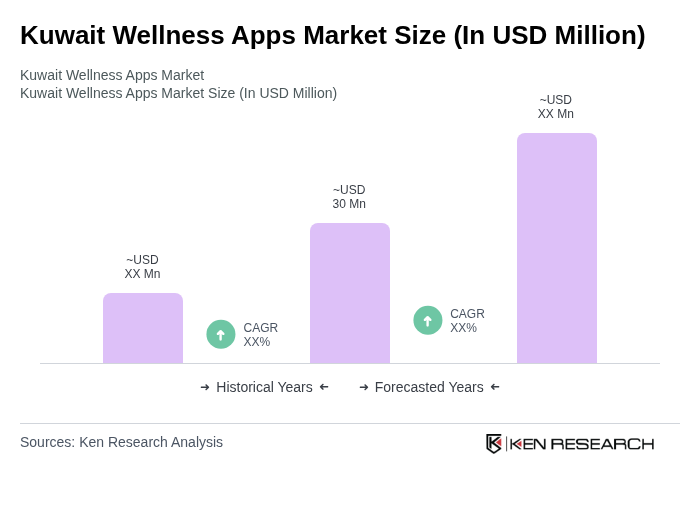
- The Kuwait Wellness Apps Market is valued at USD 30 million, based on a five-year historical analysis and recent country-level revenue estimates for wellness apps and related digital fitness and well-being solutions. This growth is primarily driven by increasing health awareness among the population, a rise in smartphone penetration, and the growing trend of digital health solutions. The demand for wellness apps has surged as consumers seek convenient ways to manage their health and wellness through technology, including fitness tracking, nutrition monitoring, and mental well-being support.
- Kuwait City is the dominant hub for the wellness apps market, attributed to its high smartphone usage and a tech-savvy population, supported by one of the highest mobile and internet penetration rates in the region. The urban lifestyle, coupled with a growing emphasis on health and fitness, has led to a significant adoption of wellness applications, particularly fitness, nutrition, and mindfulness apps. Additionally, the affluent demographic in Kuwait City supports the growth of premium wellness services, including subscription-based coaching and app-linked wearable devices, which are increasingly popular in Gulf urban centers.
- In 2023, the Kuwaiti government implemented regulations to promote digital health solutions, including wellness apps. This initiative aims to enhance public health by encouraging the use of technology in health management. The Ministry of Health’s framework under the Unified Gulf Cooperation Council Guidelines for Digital Health, aligned in Kuwait through ministerial circulars and the implementation of the Electronic Health Record initiatives and e-health standards, sets requirements around data protection, interoperability, and clinical safety for digital health and mobile applications used in patient care, including wellness and lifestyle apps that integrate with health services. The government is investing in digital infrastructure and supporting innovation in telehealth and digital health platforms, which indirectly benefits wellness app developers by improving connectivity, cloud infrastructure, and integration with broader digital health ecosystems.
Kuwait Wellness Apps Market Segmentation
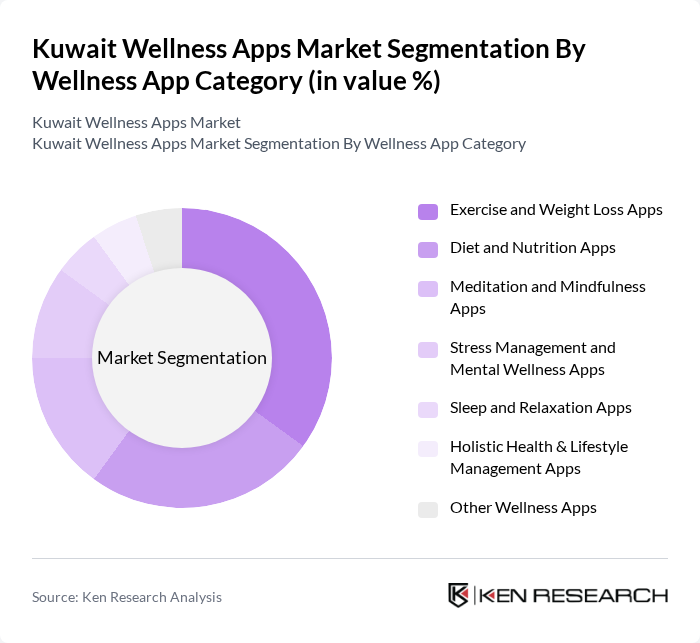
By Wellness App Category:The wellness apps market is segmented into various categories, including Exercise and Weight Loss Apps, Diet and Nutrition Apps, Meditation and Mindfulness Apps, Stress Management and Mental Wellness Apps, Sleep and Relaxation Apps, Holistic Health & Lifestyle Management Apps, and Other Wellness Apps. Among these, Exercise and Weight Loss Apps dominate the market due to the increasing focus on fitness and weight management among consumers, consistent with findings that exercise and weight loss apps represent the largest revenue-generating type in Kuwait. The trend of fitness tracking and personalized workout plans, often integrated with wearables and real-time performance analytics, has led to a surge in the adoption of these apps, making them a preferred choice for users looking to improve their physical health.
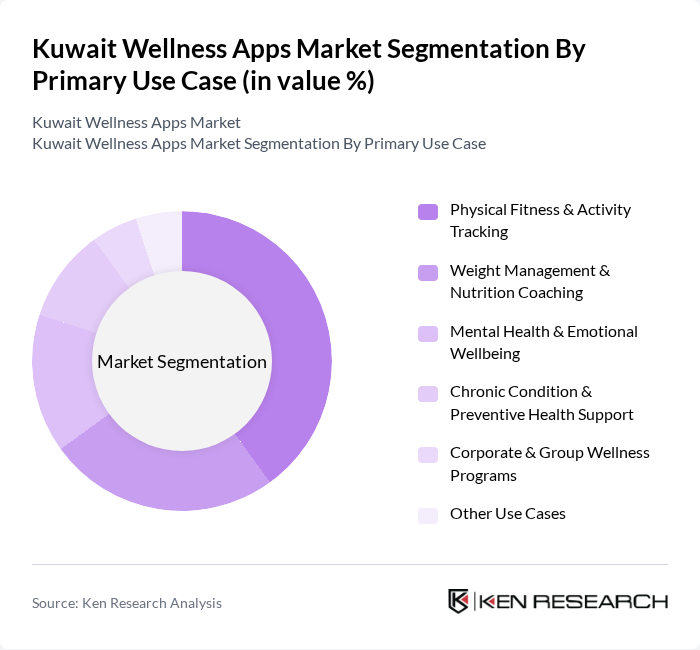
By Primary Use Case:The primary use cases for wellness apps include Physical Fitness & Activity Tracking, Weight Management & Nutrition Coaching, Mental Health & Emotional Wellbeing, Chronic Condition & Preventive Health Support, Corporate & Group Wellness Programs, and Other Use Cases. Physical Fitness & Activity Tracking apps lead the market, driven by the growing trend of fitness monitoring, integration with fitness trackers, and the increasing popularity of app-connected wearable devices in Kuwait and the wider Middle East. Users are increasingly seeking apps that provide real-time feedback on their physical activities, personalized coaching, and progress analytics, which has resulted in a significant market share for this category within the broader digital fitness and wellness ecosystem.
Kuwait Wellness Apps Market Competitive Landscape
The Kuwait Wellness Apps Market is characterized by a dynamic mix of regional and international players. Leading participants such as MyFitnessPal, Noom, Lifesum, Fitbit, Samsung Health, Apple Health, Calm, Headspace, Strava, Sleep Cycle, 8fit, Sworkit, Yummly, Local Kuwait Wellness & Fitness App Players, and Other Emerging Regional Wellness Apps contribute to innovation, geographic expansion, and service delivery in this space.
Kuwait Wellness Apps Market Industry Analysis
Growth Drivers
- Increasing Health Awareness:The health awareness index in Kuwait has risen significantly, with 70% of the population actively seeking health-related information. This trend is supported by the World Health Organization's report indicating that Kuwait's healthcare expenditure reached approximately $5 billion in future. As citizens become more health-conscious, the demand for wellness apps that provide personalized health insights and tracking features is expected to grow, driving market expansion.
- Rising Smartphone Penetration:Kuwait's smartphone penetration rate is projected to reach 95% in future, according to the International Telecommunication Union. This widespread access to smartphones facilitates the adoption of wellness apps, as users increasingly rely on mobile technology for health management. The growing number of mobile internet users, estimated at 5 million, further supports the market's potential, enabling app developers to reach a broader audience.
- Government Initiatives for Health Promotion:The Kuwaiti government has launched several health initiatives, including the "Healthy Kuwait" program, which aims to reduce lifestyle-related diseases. With a budget allocation of $1.5 billion for health promotion in future, these initiatives encourage the use of wellness apps. By integrating app-based solutions into public health strategies, the government is fostering an environment conducive to the growth of the wellness app market.
Market Challenges
- Data Privacy Concerns:Data privacy remains a significant challenge in the Kuwait wellness apps market, with 65% of users expressing concerns about how their health data is managed. The lack of stringent data protection regulations can deter users from fully engaging with wellness apps. As the market grows, addressing these privacy issues will be crucial for maintaining user trust and ensuring compliance with international standards.
- High Competition Among Apps:The Kuwait wellness apps market is becoming increasingly saturated, with over 160 wellness apps currently available. This high level of competition makes it challenging for new entrants to gain market share. Established players dominate the market, making it essential for new apps to differentiate themselves through unique features or superior user experience to attract and retain users effectively.
Kuwait Wellness Apps Market Future Outlook
The Kuwait wellness apps market is poised for significant growth, driven by technological advancements and increasing health consciousness among the population. As more users seek personalized health solutions, the integration of artificial intelligence and machine learning into wellness apps will enhance user experience and engagement. Additionally, the focus on mental health and well-being is expected to shape app development, leading to innovative features that cater to diverse user needs and preferences.
Market Opportunities
- Integration with Wearable Devices:The growing popularity of wearable health technology presents a significant opportunity for wellness apps. By integrating with devices like smartwatches and fitness trackers, apps can provide real-time health data, enhancing user engagement and satisfaction. This integration is expected to attract tech-savvy consumers who prioritize data-driven health management.
- Expansion into Corporate Wellness Programs:With an increasing number of companies in Kuwait investing in employee wellness, wellness apps can tap into corporate wellness programs. By offering tailored solutions for businesses, these apps can enhance employee health and productivity, creating a lucrative market segment that aligns with the growing emphasis on workplace well-being.
Scope of the Report
| Segment | Sub-Segments |
|---|---|
| By Wellness App Category | Exercise and Weight Loss Apps Diet and Nutrition Apps Meditation and Mindfulness Apps Stress Management and Mental Wellness Apps Sleep and Relaxation Apps Holistic Health & Lifestyle Management Apps Other Wellness Apps |
| By Primary Use Case | Physical Fitness & Activity Tracking Weight Management & Nutrition Coaching Mental Health & Emotional Wellbeing Chronic Condition & Preventive Health Support Corporate & Group Wellness Programs Other Use Cases |
| By Customer Segment | Individual Consumers Enterprises & Corporate Employers Healthcare Providers & Clinics Gyms, Fitness Studios & Sports Clubs Insurers and Payers Other Institutional Customers |
| By Revenue Model | Free (Ad-Supported) Freemium with In-App Purchases Recurring Subscriptions (Monthly/Annual) Enterprise/B2B Licensing One-Time Purchase Other Monetization Models |
| By Platform | iOS Android Web-Based Cross-Platform / Hybrid |
| By Device Ecosystem | Smartphone-Only Apps Apps Integrated with Wearable Devices Apps Integrated with Connected Fitness Equipment Apps Integrated with Clinical / EHR Systems Other Device Integrations |
| By Language & Localization | Arabic-Only Apps English-Only Apps Bilingual (Arabic & English) Other Languages & Localized Content |
Key Target Audience
Investors and Venture Capitalist Firms
Government and Regulatory Bodies (e.g., Ministry of Health, Public Authority for Civil Information)
Healthcare Providers and Clinics
Fitness Centers and Gyms
Insurance Companies
Telecommunication Companies
Wellness and Lifestyle Brands
Technology Providers and App Developers
Players Mentioned in the Report:
MyFitnessPal
Noom
Lifesum
Fitbit
Samsung Health
Apple Health
Calm
Headspace
Strava
Sleep Cycle
8fit
Sworkit
Yummly
Local Kuwait Wellness & Fitness App Players
Other Emerging Regional Wellness Apps
Table of Contents
Market Assessment Phase
1. Executive Summary and Approach
2. Kuwait Wellness Apps Market Overview
2.1 Key Insights and Strategic Recommendations
2.2 Kuwait Wellness Apps Market Overview
2.3 Definition and Scope
2.4 Evolution of Market Ecosystem
2.5 Timeline of Key Regulatory Milestones
2.6 Value Chain & Stakeholder Mapping
2.7 Business Cycle Analysis
2.8 Policy & Incentive Landscape
3. Kuwait Wellness Apps Market Analysis
3.1 Growth Drivers
3.1.1 Increasing Health Awareness
3.1.2 Rising Smartphone Penetration
3.1.3 Government Initiatives for Health Promotion
3.1.4 Demand for Personalized Wellness Solutions
3.2 Market Challenges
3.2.1 Data Privacy Concerns
3.2.2 Limited Internet Connectivity in Rural Areas
3.2.3 High Competition Among Apps
3.2.4 User Retention Issues
3.3 Market Opportunities
3.3.1 Integration with Wearable Devices
3.3.2 Expansion into Corporate Wellness Programs
3.3.3 Development of Multilingual Apps
3.3.4 Collaborations with Healthcare Providers
3.4 Market Trends
3.4.1 Growth of Subscription-Based Models
3.4.2 Increasing Use of AI and Machine Learning
3.4.3 Focus on Mental Health and Wellbeing
3.4.4 Gamification of Wellness Apps
3.5 Government Regulation
3.5.1 Data Protection Laws
3.5.2 Health App Certification Requirements
3.5.3 Guidelines for Telehealth Services
3.5.4 Regulations on Advertising Health Apps
4. SWOT Analysis
5. Stakeholder Analysis
6. Porter's Five Forces Analysis
7. Kuwait Wellness Apps Market Market Size, 2019-2024
7.1 By Value
7.2 By Volume
7.3 By Average Selling Price
8. Kuwait Wellness Apps Market Segmentation
8.1 By Wellness App Category
8.1.1 Exercise and Weight Loss Apps
8.1.2 Diet and Nutrition Apps
8.1.3 Meditation and Mindfulness Apps
8.1.4 Stress Management and Mental Wellness Apps
8.1.5 Sleep and Relaxation Apps
8.1.6 Holistic Health & Lifestyle Management Apps
8.1.7 Other Wellness Apps
8.2 By Primary Use Case
8.2.1 Physical Fitness & Activity Tracking
8.2.2 Weight Management & Nutrition Coaching
8.2.3 Mental Health & Emotional Wellbeing
8.2.4 Chronic Condition & Preventive Health Support
8.2.5 Corporate & Group Wellness Programs
8.2.6 Other Use Cases
8.3 By Customer Segment
8.3.1 Individual Consumers
8.3.2 Enterprises & Corporate Employers
8.3.3 Healthcare Providers & Clinics
8.3.4 Gyms, Fitness Studios & Sports Clubs
8.3.5 Insurers and Payers
8.3.6 Other Institutional Customers
8.4 By Revenue Model
8.4.1 Free (Ad-Supported)
8.4.2 Freemium with In-App Purchases
8.4.3 Recurring Subscriptions (Monthly/Annual)
8.4.4 Enterprise/B2B Licensing
8.4.5 One-Time Purchase
8.4.6 Other Monetization Models
8.5 By Platform
8.5.1 iOS
8.5.2 Android
8.5.3 Web-Based
8.5.4 Cross-Platform / Hybrid
8.6 By Device Ecosystem
8.6.1 Smartphone-Only Apps
8.6.2 Apps Integrated with Wearable Devices
8.6.3 Apps Integrated with Connected Fitness Equipment
8.6.4 Apps Integrated with Clinical / EHR Systems
8.6.5 Other Device Integrations
8.7 By Language & Localization
8.7.1 Arabic-Only Apps
8.7.2 English-Only Apps
8.7.3 Bilingual (Arabic & English)
8.7.4 Other Languages & Localized Content
9. Kuwait Wellness Apps Market Competitive Analysis
9.1 Market Share of Key Players
9.2 Cross Comparison of Key Players
9.2.1 Company Name
9.2.2 Group Size (Large, Medium, or Small as per industry convention)
9.2.3 Total Downloads (Kuwait)
9.2.4 Monthly Active Users (MAUs, Kuwait)
9.2.5 Daily Active Users (DAUs, Kuwait)
9.2.6 User Acquisition Cost (CAC)
9.2.7 Customer Lifetime Value (LTV)
9.2.8 Average Revenue Per User (ARPU, Monthly)
9.2.9 Revenue from Kuwait (USD)
9.2.10 Churn Rate (Monthly)
9.2.11 Conversion Rate (Free to Paid)
9.2.12 Average Subscription Price (Kuwait)
9.2.13 Marketing Spend Share in Kuwait
9.2.14 Market Penetration Rate (Share of Addressable Users)
9.2.15 Net Promoter Score (NPS)
9.2.16 App Store Rating & Review Volume
9.3 SWOT Analysis of Top Players
9.4 Pricing Analysis
9.5 Detailed Profile of Major Companies
9.5.1 MyFitnessPal
9.5.2 Noom
9.5.3 Lifesum
9.5.4 Fitbit
9.5.5 Samsung Health
9.5.6 Apple Health
9.5.7 Calm
9.5.8 Headspace
9.5.9 Strava
9.5.10 Sleep Cycle
9.5.11 8fit
9.5.12 Sworkit
9.5.13 Yummly
9.5.14 Local Kuwait Wellness & Fitness App Players
9.5.15 Other Emerging Regional Wellness Apps
10. Kuwait Wellness Apps Market End-User Analysis
10.1 Procurement Behavior of Key Ministries
10.1.1 Health Ministry Initiatives
10.1.2 Education Ministry Collaborations
10.1.3 Corporate Wellness Programs
10.1.4 Public Health Campaigns
10.2 Corporate Spend on Infrastructure & Energy
10.2.1 Investment in Health Technology
10.2.2 Budget Allocation for Wellness Programs
10.2.3 Partnerships with Wellness App Developers
10.3 Pain Point Analysis by End-User Category
10.3.1 Individual User Challenges
10.3.2 Corporate User Needs
10.3.3 Healthcare Provider Requirements
10.4 User Readiness for Adoption
10.4.1 Awareness of Wellness Apps
10.4.2 Accessibility of Technology
10.4.3 User Training and Support
10.5 Post-Deployment ROI and Use Case Expansion
10.5.1 Measuring Effectiveness of Apps
10.5.2 User Feedback and Iteration
10.5.3 Expansion into New Features
11. Kuwait Wellness Apps Market Future Size, 2025-2030
11.1 By Value
11.2 By Volume
11.3 By Average Selling Price
Go-To-Market Strategy Phase
1. Whitespace Analysis + Business Model Canvas
1.1 Market Gaps Identification
1.2 Business Model Development
2. Marketing and Positioning Recommendations
2.1 Branding Strategies
2.2 Product USPs
3. Distribution Plan
3.1 Urban Retail vs Rural NGO Tie-ups
4. Channel & Pricing Gaps
4.1 Underserved Routes
4.2 Pricing Bands
5. Unmet Demand & Latent Needs
5.1 Category Gaps
5.2 Consumer Segments
6. Customer Relationship
6.1 Loyalty Programs
6.2 After-sales Service
7. Value Proposition
7.1 Sustainability
7.2 Integrated Supply Chains
8. Key Activities
8.1 Regulatory Compliance
8.2 Branding
8.3 Distribution Setup
9. Entry Strategy Evaluation
9.1 Domestic Market Entry Strategy
9.1.1 Product Mix
9.1.2 Pricing Band
9.1.3 Packaging
9.2 Export Entry Strategy
9.2.1 Target Countries
9.2.2 Compliance Roadmap
10. Entry Mode Assessment
10.1 JV, Greenfield, M&A, Distributor Model
11. Capital and Timeline Estimation
11.1 Capital Requirements
11.2 Timelines
12. Control vs Risk Trade-Off
12.1 Ownership vs Partnerships
13. Profitability Outlook
13.1 Breakeven Analysis
13.2 Long-term Sustainability
14. Potential Partner List
14.1 Distributors
14.2 JVs
14.3 Acquisition Targets
15. Execution Roadmap
15.1 Phased Plan for Market Entry
15.1.1 Market Setup
15.1.2 Market Entry
15.1.3 Growth Acceleration
15.1.4 Scale & Stabilize
15.2 Key Activities and Milestones
15.2.1 Milestone Planning
15.2.2 Activity Tracking
Research Methodology
Phase 1: Approach1
Desk Research
- Analysis of existing market reports and publications on wellness apps in Kuwait
- Review of government health initiatives and digital health policies
- Examination of demographic and health statistics from the Kuwait Ministry of Health
Primary Research
- Interviews with developers of popular wellness apps in the Kuwaiti market
- Surveys targeting users of wellness apps to gather insights on preferences and usage
- Focus group discussions with health professionals to understand market needs
Validation & Triangulation
- Cross-validation of findings through multiple data sources including user reviews and app store ratings
- Triangulation of insights from primary research with secondary data trends
- Sanity checks conducted through expert panel reviews comprising industry specialists
Phase 2: Market Size Estimation1
Top-down Assessment
- Estimation of total addressable market based on Kuwait's population and health trends
- Segmentation of the market by app categories such as fitness, nutrition, and mental health
- Incorporation of growth rates from regional wellness app markets
Bottom-up Modeling
- Analysis of user acquisition rates and revenue models from leading wellness apps
- Estimation of average revenue per user (ARPU) based on subscription and in-app purchase data
- Volume estimates based on user engagement metrics and app download statistics
Forecasting & Scenario Analysis
- Multi-factor regression analysis incorporating health trends, smartphone penetration, and digital adoption rates
- Scenario modeling based on potential regulatory changes and market entry of new players
- Development of baseline, optimistic, and pessimistic forecasts through 2030
Phase 3: CATI Sample Composition1
| Scope Item/Segment | Sample Size | Target Respondent Profiles |
|---|---|---|
| Fitness App Users | 120 | Health Enthusiasts, Personal Trainers |
| Nutrition Tracking App Users | 100 | Dietitians, Nutritionists, General Users |
| Mental Health App Users | 80 | Psychologists, Mental Health Advocates |
| Corporate Wellness Program Participants | 70 | HR Managers, Wellness Coordinators |
| Healthcare Professionals | 60 | Doctors, Health Coaches, Therapists |
Frequently Asked Questions
What is the current value of the Kuwait Wellness Apps Market?
The Kuwait Wellness Apps Market is valued at approximately USD 30 million, reflecting a significant growth driven by increased health awareness, smartphone penetration, and the demand for digital health solutions among consumers.
What factors are driving the growth of wellness apps in Kuwait?
Which city in Kuwait is the primary hub for wellness apps?
What categories are included in the Kuwait Wellness Apps Market?
Other Regional/Country Reports
Indonesia Wellness Apps Market
Malaysia Wellness Apps Market
KSA Wellness Apps Market
APAC Wellness Apps Market
SEA Wellness Apps Market
Vietnam Wellness Apps Market
Other Adjacent Reports
Japan Sleep Technology Market
GCC Health Data Analytics Market Size, Share, Growth Drivers, Trends, Opportunities & Forecast 2025–2030Qatar Mobile Health Market
Why Buy From Us?

What makes us stand out is that our consultants follow Robust, Refine and Result (RRR) methodology. Robust for clear definitions, approaches and sanity checking, Refine for differentiating respondents' facts and opinions, and Result for presenting data with story.

We have set a benchmark in the industry by offering our clients with syndicated and customized market research reports featuring coverage of entire market as well as meticulous research and analyst insights.

While we don't replace traditional research, we flip the method upside down. Our dual approach of Top Bottom & Bottom Top ensures quality deliverable by not just verifying company fundamentals but also looking at the sector and macroeconomic factors.

With one step in the future, our research team constantly tries to show you the bigger picture. We help with some of the tough questions you may encounter along the way: How is the industry positioned? Best marketing channel? KPI's of competitors? By aligning every element, we help maximize success.

Our report gives you instant access to the answers and sources that other companies might choose to hide. We elaborate each steps of research methodology we have used and showcase you the sample size to earn your trust.

If you need any support, we are here! We pride ourselves on universe strength, data quality, and quick, friendly, and professional service.