Malaysia Parenteral Lipid Emulsion Market Report Size Share Growth Drivers Trends Opportunities & Forecast 2025–2030

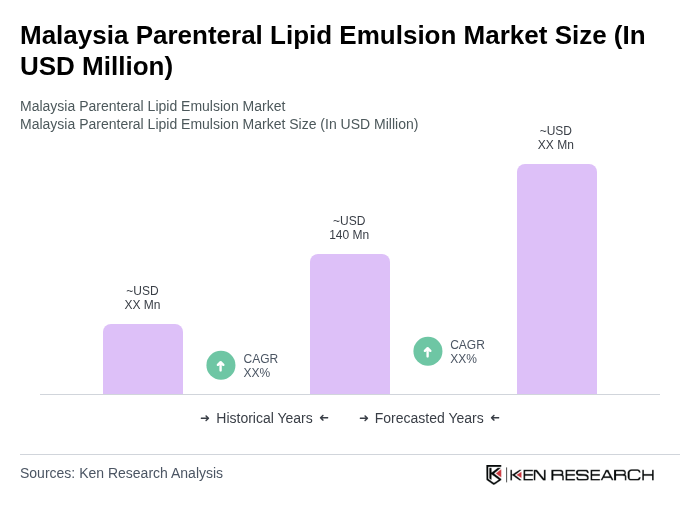
The Malaysia Parenteral Lipid Emulsion Market, valued at USD 140 million, grows due to increasing demand in critical care, oncology, and surgical procedures with advancements in formulations.

Region:Asia

Author(s):Geetanshi

Product Code:KRAE6709

Pages:119

Published On:December 2025
About the Report

Base Year 2024

Malaysia Parenteral Lipid Emulsion Market Overview

  • The Malaysia Parenteral Lipid Emulsion Market is valued at USD 140 million, based on a five-year historical analysis. This growth is primarily driven by increasing adoption of parenteral nutrition in critically ill and oncology patients, rising minimally invasive surgeries which boost demand for propofol emulsion formulations, expanding hospital infrastructure investment especially in ICU and tertiary care expansions, and the growing prevalence of chronic diseases, the rising number of surgical procedures, and the growing demand for nutritional support in clinical settings. The market is also supported by advancements in lipid emulsion formulations that enhance patient outcomes and safety.
  • Key cities such as Kuala Lumpur and Penang dominate the market due to their advanced healthcare infrastructure and concentration of hospitals and clinics, including tertiary hospitals, advanced clinical nutrition programmes and strong private-hospital presence. The presence of leading healthcare providers and pharmaceutical companies in these regions further strengthens their market position, making them pivotal in the distribution and utilization of parenteral lipid emulsions.
  • The National Pharmaceutical Regulatory Agency (NPRA) Quality Guidelines for Sterile Products, 2020 issued by the Ministry of Health Malaysia require all parenteral lipid emulsions to comply with Good Manufacturing Practice standards for sterile injectables, including validation of aseptic processes, endotoxin limits below 0.5 EU/ml, and mandatory product registration with NPRA prior to market entry, thereby enhancing patient safety and product efficacy.
Malaysia Parenteral Lipid Emulsion Market Report Size Share Growth Drivers Trends Opportunities & Forecast 2025–2030 Size

Malaysia Parenteral Lipid Emulsion Market Segmentation

By Product Type:The product type segmentation includes various formulations of parenteral lipid emulsions. The dominant sub-segment is Lipid Injectable Emulsions (Soybean Oil-based), which is widely used due to its established efficacy and safety profile, longstanding use in parenteral nutrition protocols in Malaysian public and private hospitals, cost-effectiveness versus newer blends, and wider formulary listing across MOH Malaysia tender contracts. Mixed-Lipid Emulsions (MCT/Long-Chain Triglyceride Blends) are gaining traction due to their versatility in clinical applications. Propofol Emulsion Formulations are essential for anesthesia, while Specialty Emulsions cater to specific patient needs, such as omega-3 enrichment.

Malaysia Parenteral Lipid Emulsion Market segmentation by Product Type.

By End-User Setting:The end-user setting segmentation highlights the various healthcare environments utilizing parenteral lipid emulsions. Public Hospitals (MOH Malaysia) represent the largest segment due to their extensive patient base and government support, dominating high-volume parenteral nutrition use, government tender procurement, and large ICU/ward bed capacity. Private Hospitals & Clinics are also significant, offering specialized services driven by premium services, medical tourism and higher per-case incident use of sedation/anaesthesia emulsions. Ambulatory Surgical Centres and Home Care Services are emerging segments, reflecting the trend towards outpatient care and patient-centered approaches.
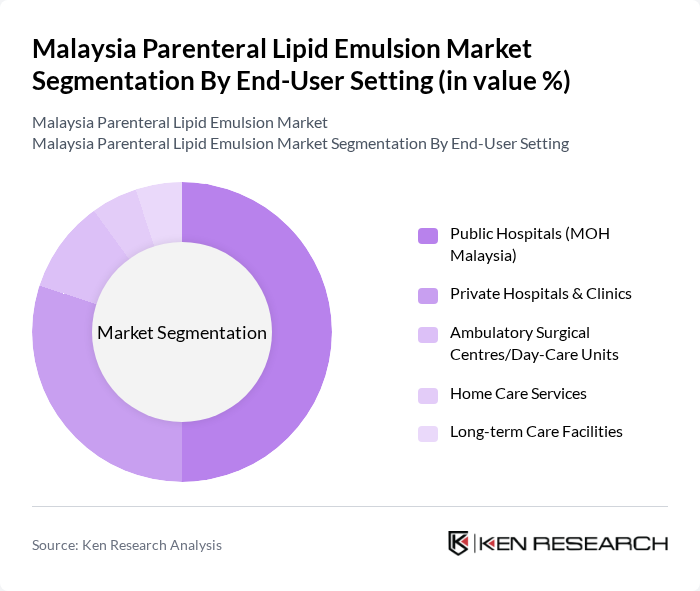
Malaysia Parenteral Lipid Emulsion Market segmentation by End-User Setting.

Malaysia Parenteral Lipid Emulsion Market Competitive Landscape

The Malaysia Parenteral Lipid Emulsion Market is characterized by a dynamic mix of regional and international players. Leading participants such as Fresenius Kabi Malaysia Sdn Bhd, B. Braun Medical Industries Sdn Bhd, Abbott Laboratories (Malaysia) Sdn Bhd, Baxter Healthcare Sdn Bhd, Otsuka Pharmaceutical Co., Ltd., Epsilon Healthcare Sdn Bhd, Pharmaniaga Berhad, Hovid Berhad, Duopharma Biotech Berhad, Medispec (M) Sdn Bhd, Systagenix Wound Management, Merck Sharp & Dohme (Malaysia) Sdn Bhd, Sanofi-Aventis (Malaysia) Sdn Bhd, GlaxoSmithKline (Malaysia) Sdn Bhd, Pfizer Malaysia Sdn Bhd contribute to innovation, geographic expansion, and service delivery in this space.

Fresenius Kabi Malaysia Sdn Bhd

1999

Kuala Lumpur, Malaysia

B. Braun Medical Industries Sdn Bhd

1978

Penang, Malaysia

Abbott Laboratories (Malaysia) Sdn Bhd

1940

Shah Alam, Malaysia

Baxter Healthcare Sdn Bhd

1985

Selangor, Malaysia

Otsuka Pharmaceutical Co., Ltd.

1921

Tokyo, Japan

Company

Establishment Year

Headquarters

Company Size Classification (Multinational, Regional, or Local)

Revenue Growth Rate (Year-over-Year %)

Market Penetration Rate (% of MOH Tenders Won)

Hospital Formulary Coverage Rate (%)

Product Innovation Index (New SKUs Launched in Last 3 Years)

Distribution Network Density (Number of Distribution Partners)

Malaysia Parenteral Lipid Emulsion Market Industry Analysis

Growth Drivers

  • Increasing Prevalence of Malnutrition:In Malaysia, malnutrition affects approximately 20% of children under five, according to the Ministry of Health. This alarming statistic drives the demand for parenteral lipid emulsions, as they provide essential nutrients for those unable to consume food orally. The government’s commitment to reducing malnutrition through various health initiatives further supports the growth of this market, with an estimated allocation of RM 1.8 billion for nutrition programs in future.
  • Rising Demand for Parenteral Nutrition in Hospitals:The Malaysian healthcare sector is witnessing a surge in hospital admissions, with over 1.7 million patients requiring parenteral nutrition annually. This trend is fueled by an increase in chronic diseases and surgical procedures, necessitating specialized nutritional support. Hospitals are investing in advanced parenteral nutrition solutions, with a projected increase in healthcare spending to RM 70 billion in future, enhancing the market for lipid emulsions.
  • Technological Advancements in Lipid Formulations:Innovations in lipid formulations are transforming the parenteral nutrition landscape in Malaysia. The introduction of new lipid emulsions that enhance nutrient absorption and reduce adverse effects is gaining traction. Research institutions are expected to allocate RM 250 million towards R&D in future, fostering the development of more effective lipid products. This technological progress is crucial for meeting the growing demand for safe and efficient parenteral nutrition solutions.

Market Challenges

  • Stringent Regulatory Requirements:The Malaysian parenteral lipid emulsion market faces significant challenges due to stringent regulatory frameworks. Compliance with the Malaysian Food Act and Good Manufacturing Practices (GMP) is mandatory, requiring manufacturers to invest heavily in quality assurance processes. The National Pharmaceutical Regulatory Agency (NPRA) enforces rigorous standards, which can delay product approvals and increase operational costs, impacting market entry for new players.
  • High Cost of Production:The production of parenteral lipid emulsions involves high raw material costs and complex manufacturing processes. For instance, the cost of high-quality lipids can exceed RM 600 per kilogram, significantly impacting overall production expenses. As a result, manufacturers face pressure to maintain competitive pricing while ensuring product quality, which can limit profit margins and hinder market growth in a price-sensitive environment.

Malaysia Parenteral Lipid Emulsion Market Future Outlook

The future of the Malaysia parenteral lipid emulsion market appears promising, driven by increasing healthcare investments and a growing focus on personalized nutrition solutions. As the healthcare infrastructure expands, more patients will have access to specialized nutritional therapies. Additionally, the integration of digital health technologies is expected to enhance patient monitoring and treatment efficacy, further propelling market growth in future. The emphasis on sustainability in production processes will also shape the industry, aligning with global trends towards environmentally friendly practices.

Market Opportunities

  • Expansion of Healthcare Infrastructure:The Malaysian government is investing RM 12 billion in healthcare infrastructure development in future. This expansion will increase the number of healthcare facilities equipped to provide parenteral nutrition, creating significant opportunities for lipid emulsion manufacturers to meet rising demand.
  • Collaborations with Healthcare Providers:Strategic partnerships between manufacturers and healthcare providers can enhance product distribution and education. By collaborating with hospitals and clinics, companies can improve awareness and adoption of parenteral lipid emulsions, tapping into the growing market for specialized nutrition solutions.

Scope of the Report

SegmentSub-Segments
By Product Type

Lipid Injectable Emulsions (Soybean Oil-based)

Mixed-Lipid Emulsions (MCT/Long-Chain Triglyceride Blends)

Propofol Emulsion Formulations (for Anaesthesia/Sedation)

Specialty Emulsions (Structured Lipids, Omega-3 Enriched Fat Emulsions)

By End-User Setting

Public Hospitals (MOH Malaysia)

Private Hospitals & Clinics

Ambulatory Surgical Centres/Day-Care Units

Home Care Services

Long-term Care Facilities

By Distribution Channel

Direct Sales to Hospitals

Pharmaceutical Distributors

Hospital Formulary Procurement

Specialty Pharmacy Networks

Online/E-commerce Channels

By Formulation Type

Ready-to-Use Emulsions

Compounded Emulsions

Nano- and Microemulsion Formulations

By Packaging Type

Bottles

Multi-Chamber Bags

Vials

Prefilled Syringes

By Patient Demographics

Neonatal & Pediatric Patients

Adult Patients

Geriatric Patients

By Clinical Application

Critical Care/ICU Patients

Oncology Patients

Post-Surgical Patients

Gastrointestinal Disorder Patients

By Region

Kuala Lumpur & Selangor (Central Region)

Penang & Kedah (Northern Region)

Johor & Negeri Sembilan (Southern Region)

Sabah & Sarawak (Eastern Region)

Key Target Audience

Investors and Venture Capitalist Firms

Government and Regulatory Bodies (e.g., Ministry of Health Malaysia, National Pharmaceutical Regulatory Agency)

Manufacturers and Producers

Distributors and Retailers

Pharmaceutical Companies

Healthcare Providers and Hospitals

Industry Associations

Financial Institutions

Players Mentioned in the Report:

Fresenius Kabi Malaysia Sdn Bhd

B. Braun Medical Industries Sdn Bhd

Abbott Laboratories (Malaysia) Sdn Bhd

Baxter Healthcare Sdn Bhd

Otsuka Pharmaceutical Co., Ltd.

Epsilon Healthcare Sdn Bhd

Pharmaniaga Berhad

Hovid Berhad

Duopharma Biotech Berhad

Medispec (M) Sdn Bhd

Systagenix Wound Management

Merck Sharp & Dohme (Malaysia) Sdn Bhd

Sanofi-Aventis (Malaysia) Sdn Bhd

GlaxoSmithKline (Malaysia) Sdn Bhd

Pfizer Malaysia Sdn Bhd

Table of Contents

Market Assessment Phase

1. Executive Summary and Approach


2. Malaysia Parenteral Lipid Emulsion Market Overview

2.1 Key Insights and Strategic Recommendations

2.2 Malaysia Parenteral Lipid Emulsion Market Overview

2.3 Definition and Scope

2.4 Evolution of Market Ecosystem

2.5 Timeline of Key Regulatory Milestones

2.6 Value Chain & Stakeholder Mapping

2.7 Business Cycle Analysis

2.8 Policy & Incentive Landscape


3. Malaysia Parenteral Lipid Emulsion Market Analysis

3.1 Growth Drivers

3.1.1 Increasing prevalence of malnutrition
3.1.2 Rising demand for parenteral nutrition in hospitals
3.1.3 Technological advancements in lipid formulations
3.1.4 Growing geriatric population requiring specialized nutrition

3.2 Market Challenges

3.2.1 Stringent regulatory requirements
3.2.2 High cost of production
3.2.3 Limited awareness among healthcare professionals
3.2.4 Competition from alternative nutrition solutions

3.3 Market Opportunities

3.3.1 Expansion of healthcare infrastructure
3.3.2 Increasing investment in research and development
3.3.3 Collaborations with healthcare providers
3.3.4 Growing focus on personalized nutrition solutions

3.4 Market Trends

3.4.1 Shift towards home healthcare services
3.4.2 Rising popularity of lipid-based formulations
3.4.3 Integration of digital health technologies
3.4.4 Emphasis on sustainability in production processes

3.5 Government Regulation

3.5.1 Compliance with Malaysian Food Act
3.5.2 Adherence to Good Manufacturing Practices (GMP)
3.5.3 Registration with the National Pharmaceutical Regulatory Agency (NPRA)
3.5.4 Monitoring of product safety and efficacy

4. SWOT Analysis


5. Stakeholder Analysis


6. Porter's Five Forces Analysis


7. Malaysia Parenteral Lipid Emulsion Market Market Size, 2019-2024

7.1 By Value

7.2 By Volume

7.3 By Average Selling Price


8. Malaysia Parenteral Lipid Emulsion Market Segmentation

8.1 By Product Type

8.1.1 Lipid Injectable Emulsions (Soybean Oil-based)
8.1.2 Mixed-Lipid Emulsions (MCT/Long-Chain Triglyceride Blends)
8.1.3 Propofol Emulsion Formulations (for Anaesthesia/Sedation)
8.1.4 Specialty Emulsions (Structured Lipids, Omega-3 Enriched Fat Emulsions)

8.2 By End-User Setting

8.2.1 Public Hospitals (MOH Malaysia)
8.2.2 Private Hospitals & Clinics
8.2.3 Ambulatory Surgical Centres/Day-Care Units
8.2.4 Home Care Services
8.2.5 Long-term Care Facilities

8.3 By Distribution Channel

8.3.1 Direct Sales to Hospitals
8.3.2 Pharmaceutical Distributors
8.3.3 Hospital Formulary Procurement
8.3.4 Specialty Pharmacy Networks
8.3.5 Online/E-commerce Channels

8.4 By Formulation Type

8.4.1 Ready-to-Use Emulsions
8.4.2 Compounded Emulsions
8.4.3 Nano- and Microemulsion Formulations

8.5 By Packaging Type

8.5.1 Bottles
8.5.2 Multi-Chamber Bags
8.5.3 Vials
8.5.4 Prefilled Syringes

8.6 By Patient Demographics

8.6.1 Neonatal & Pediatric Patients
8.6.2 Adult Patients
8.6.3 Geriatric Patients

8.7 By Clinical Application

8.7.1 Critical Care/ICU Patients
8.7.2 Oncology Patients
8.7.3 Post-Surgical Patients
8.7.4 Gastrointestinal Disorder Patients

8.8 By Region

8.8.1 Kuala Lumpur & Selangor (Central Region)
8.8.2 Penang & Kedah (Northern Region)
8.8.3 Johor & Negeri Sembilan (Southern Region)
8.8.4 Sabah & Sarawak (Eastern Region)

9. Malaysia Parenteral Lipid Emulsion Market Competitive Analysis

9.1 Market Share of Key Players

9.2 Cross Comparison of Key Players

9.2.1 Company Name
9.2.2 Company Size Classification (Multinational, Regional, or Local)
9.2.3 Revenue Growth Rate (Year-over-Year %)
9.2.4 Market Penetration Rate (% of MOH Tenders Won)
9.2.5 Hospital Formulary Coverage Rate (%)
9.2.6 Product Innovation Index (New SKUs Launched in Last 3 Years)
9.2.7 Distribution Network Density (Number of Distribution Partners)
9.2.8 Pricing Competitiveness (Price per Unit vs Market Average)
9.2.9 Brand Recognition Score (Healthcare Provider Awareness %)
9.2.10 Regulatory Compliance Status (NPRA Approvals & GMP Certifications)

9.3 SWOT Analysis of Top Players

9.4 Pricing Analysis

9.5 Detailed Profile of Major Companies

9.5.1 Fresenius Kabi Malaysia Sdn Bhd
9.5.2 B. Braun Medical Industries Sdn Bhd
9.5.3 Abbott Laboratories (Malaysia) Sdn Bhd
9.5.4 Baxter Healthcare Sdn Bhd
9.5.5 Otsuka Pharmaceutical Co., Ltd.
9.5.6 Epsilon Healthcare Sdn Bhd
9.5.7 Pharmaniaga Berhad
9.5.8 Hovid Berhad
9.5.9 Duopharma Biotech Berhad
9.5.10 Medispec (M) Sdn Bhd
9.5.11 Systagenix Wound Management
9.5.12 Merck Sharp & Dohme (Malaysia) Sdn Bhd
9.5.13 Sanofi-Aventis (Malaysia) Sdn Bhd
9.5.14 GlaxoSmithKline (Malaysia) Sdn Bhd
9.5.15 Pfizer Malaysia Sdn Bhd

10. Malaysia Parenteral Lipid Emulsion Market End-User Analysis

10.1 Procurement Behavior of Key Ministries

10.1.1 Budget Allocation for Healthcare
10.1.2 Procurement Processes and Regulations
10.1.3 Supplier Selection Criteria
10.1.4 Contract Management Practices

10.2 Corporate Spend on Infrastructure & Energy

10.2.1 Investment in Healthcare Facilities
10.2.2 Spending on Medical Equipment
10.2.3 Budget for Training and Development
10.2.4 Others

10.3 Pain Point Analysis by End-User Category

10.3.1 Challenges in Supply Chain Management
10.3.2 Issues with Product Availability
10.3.3 Quality Assurance Concerns
10.3.4 Others

10.4 User Readiness for Adoption

10.4.1 Awareness of Parenteral Nutrition
10.4.2 Training Needs for Healthcare Providers
10.4.3 Infrastructure Readiness
10.4.4 Others

10.5 Post-Deployment ROI and Use Case Expansion

10.5.1 Evaluation of Cost Savings
10.5.2 Impact on Patient Outcomes
10.5.3 Opportunities for Product Line Expansion
10.5.4 Others

11. Malaysia Parenteral Lipid Emulsion Market Future Size, 2025-2030

11.1 By Value

11.2 By Volume

11.3 By Average Selling Price


Go-To-Market Strategy Phase

1. Whitespace Analysis + Business Model Canvas

1.1 Market Gaps Identification

1.2 Business Model Framework


2. Marketing and Positioning Recommendations

2.1 Branding Strategies

2.2 Product USPs


3. Distribution Plan

3.1 Urban Retail vs Rural NGO Tie-ups


4. Channel & Pricing Gaps

4.1 Underserved Routes

4.2 Pricing Bands


5. Unmet Demand & Latent Needs

5.1 Category Gaps

5.2 Consumer Segments


6. Customer Relationship

6.1 Loyalty Programs

6.2 After-sales Service


7. Value Proposition

7.1 Sustainability

7.2 Integrated Supply Chains


8. Key Activities

8.1 Regulatory Compliance

8.2 Branding

8.3 Distribution Setup


9. Entry Strategy Evaluation

9.1 Domestic Market Entry Strategy

9.1.1 Product Mix
9.1.2 Pricing Band
9.1.3 Packaging

9.2 Export Entry Strategy

9.2.1 Target Countries
9.2.2 Compliance Roadmap

10. Entry Mode Assessment

10.1 JV

10.2 Greenfield

10.3 M&A

10.4 Distributor Model


11. Capital and Timeline Estimation

11.1 Capital Requirements

11.2 Timelines


12. Control vs Risk Trade-Off

12.1 Ownership vs Partnerships


13. Profitability Outlook

13.1 Breakeven Analysis

13.2 Long-term Sustainability


14. Potential Partner List

14.1 Distributors

14.2 JVs

14.3 Acquisition Targets


15. Execution Roadmap

15.1 Phased Plan for Market Entry

15.1.1 Market Setup
15.1.2 Market Entry
15.1.3 Growth Acceleration
15.1.4 Scale & Stabilize

15.2 Key Activities and Milestones

15.2.1 Milestone Planning
15.2.2 Activity Tracking

Research Methodology

ApproachModellingSample

Phase 1: Approach1

Desk Research

  • Analysis of industry reports from Malaysian health authorities and market research firms
  • Review of academic journals and publications on parenteral nutrition and lipid emulsions
  • Examination of trade publications and white papers from pharmaceutical and healthcare associations

Primary Research

  • Interviews with key opinion leaders in the healthcare and pharmaceutical sectors
  • Surveys conducted with hospital procurement managers and pharmacists
  • Focus group discussions with healthcare professionals involved in parenteral nutrition

Validation & Triangulation

  • Cross-validation of findings through multiple data sources including sales data and clinical studies
  • Triangulation of insights from primary interviews with secondary research findings
  • Sanity checks through expert panel reviews comprising industry veterans

Phase 2: Market Size Estimation1

Top-down Assessment

  • Estimation of market size based on national healthcare expenditure and parenteral nutrition spending
  • Segmentation of the market by product type, application, and end-user demographics
  • Incorporation of government health initiatives promoting parenteral nutrition

Bottom-up Modeling

  • Volume estimates derived from sales data of leading parenteral lipid emulsion manufacturers
  • Cost analysis based on pricing strategies of various product categories
  • Calculation of market size using volume x price methodology for each segment

Forecasting & Scenario Analysis

  • Multi-variable regression analysis incorporating factors such as aging population and chronic disease prevalence
  • Scenario modeling based on potential regulatory changes and healthcare policy shifts
  • Development of baseline, optimistic, and pessimistic forecasts through 2030

Phase 3: CATI Sample Composition1

Scope Item/SegmentSample SizeTarget Respondent Profiles
Hospital Procurement Departments45Procurement Managers, Supply Chain Coordinators
Pharmaceutical Distributors38Sales Managers, Distribution Heads
Healthcare Professionals in Parenteral Nutrition42Clinical Nutritionists, Dietitians
Regulatory Bodies and Health Authorities18Policy Makers, Regulatory Affairs Specialists
Research Institutions and Academia27Researchers, Professors in Nutrition and Pharmacy

Frequently Asked Questions

What is the current value of the Malaysia Parenteral Lipid Emulsion Market?

The Malaysia Parenteral Lipid Emulsion Market is valued at approximately USD 140 million, reflecting a five-year historical analysis. This growth is driven by increased adoption of parenteral nutrition and advancements in lipid emulsion formulations.

What factors are driving the growth of the Malaysia Parenteral Lipid Emulsion Market?

Which cities dominate the Malaysia Parenteral Lipid Emulsion Market?

What are the regulatory requirements for parenteral lipid emulsions in Malaysia?

Other Regional/Country Reports

Qatar Parenteral Lipid Emulsion Market Report Size Share Growth Drivers Trends Opportunities & Forecast 2025–2030

Indonesia Parenteral Lipid Emulsion Market

KSA Parenteral Lipid Emulsion Market

APAC Parenteral Lipid Emulsion Market

SEA Parenteral Lipid Emulsion Market

Vietnam Parenteral Lipid Emulsion Market

Other Adjacent Reports

Philippines Parenteral Nutrition Market Size, Share, Growth Drivers, Trends, Opportunities & Forecast 2025–2030Philippines clinical nutrition market report size, share, growth drivers, trends, opportunities & forecast 2025–2030

Egypt Intravenous Fat Emulsion Market

Belgium Propofol Formulation Market

Vietnam Sterile Injectable Market

South Korea Hospital Nutrition Support Market

Qatar Oncology Nutrition Market

Bahrain Critical Care Therapeutics Market

UAE Pharmaceutical Lipid Market

Bahrain Medical Infusion Systems Market

Why Buy From Us?

Refine Robust Result (RRR) Framework

What makes us stand out is that our consultants follow Robust, Refine and Result (RRR) methodology. Robust for clear definitions, approaches and sanity checking, Refine for differentiating respondents' facts and opinions, and Result for presenting data with story.

Our Reach Is Unmatched

We have set a benchmark in the industry by offering our clients with syndicated and customized market research reports featuring coverage of entire market as well as meticulous research and analyst insights.

Shifting the Research Paradigm

While we don't replace traditional research, we flip the method upside down. Our dual approach of Top Bottom & Bottom Top ensures quality deliverable by not just verifying company fundamentals but also looking at the sector and macroeconomic factors.

More Insights-Better Decisions

With one step in the future, our research team constantly tries to show you the bigger picture. We help with some of the tough questions you may encounter along the way: How is the industry positioned? Best marketing channel? KPI's of competitors? By aligning every element, we help maximize success.

Transparency and Trust

Our report gives you instant access to the answers and sources that other companies might choose to hide. We elaborate each steps of research methodology we have used and showcase you the sample size to earn your trust.

Round the Clock Support

If you need any support, we are here! We pride ourselves on universe strength, data quality, and quick, friendly, and professional service.

Why Clients Choose Us?

400000+
Reports in repository
150+
Consulting projects a year
100+
Analysts
8000+
Client Queries in 2022








