Mexico Online Gaming and Sports Betting Market

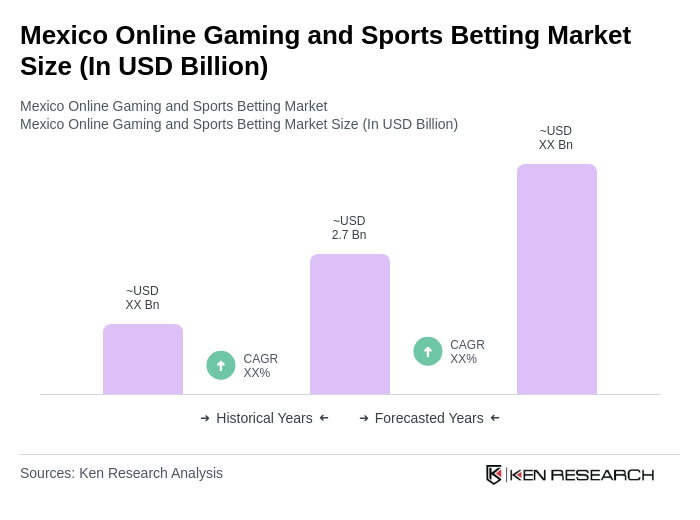
Mexico Online Gaming and Sports Betting Market, valued at USD 2.7 Bn, grows due to rising internet and smartphone use, regulatory changes, and segments like sports betting and esports.

Region:Central and South America

Author(s):Dev

Product Code:KRAB4216

Pages:94

Published On:October 2025
About the Report

Base Year 2024

Mexico Online Gaming and Sports Betting Market Overview

  • The Mexico Online Gaming and Sports Betting Market is valued at USD 2.7 billion, based on a five-year historical analysis. This growth is primarily driven by the increasing penetration of smartphones, the rise of internet accessibility, a young and tech-savvy population, and growing investments from international gaming companies. The market has seen a significant uptick in participation due to the convenience, variety of gaming options available online, and the expansion of esports and mobile gaming platforms.
  • Key urban centers in this market include Mexico City, Guadalajara, and Monterrey. These cities dominate due to their large populations, economic activity, and cultural acceptance of gaming. Robust digital infrastructure and high internet penetration rates in these urban areas make them attractive locations for both operators and consumers.
  • In November 2023, the Mexican government amended the Federal Gaming and Raffles Law, issued by the Ministry of the Interior, introducing stricter licensing requirements for online gaming operators. All operators must obtain a license from the Ministry, comply with operational guidelines regarding advertising, data protection, and responsible gambling, and adhere to new restrictions such as the elimination of sub-licensor agreements and the banning of slot machines in venues.
Mexico Online Gaming and Sports Betting Market Size

Mexico Online Gaming and Sports Betting Market Segmentation

By Type:The market is segmented into Sports Betting, Casino Games, Poker, Bingo, Esports Betting, Live Dealer Games, Lottery, Virtual Sports, and Others. Sports Betting remains the most popular segment, accounting for approximately half of all online wagers, driven by the national enthusiasm for football and other major sports. Casino Games, including slots, blackjack, and table games, attract a significant user base, appealing to both casual and serious players. Lottery and bingo also maintain strong participation, while esports betting and live dealer games are experiencing rapid growth due to increased interest in competitive gaming and immersive experiences.
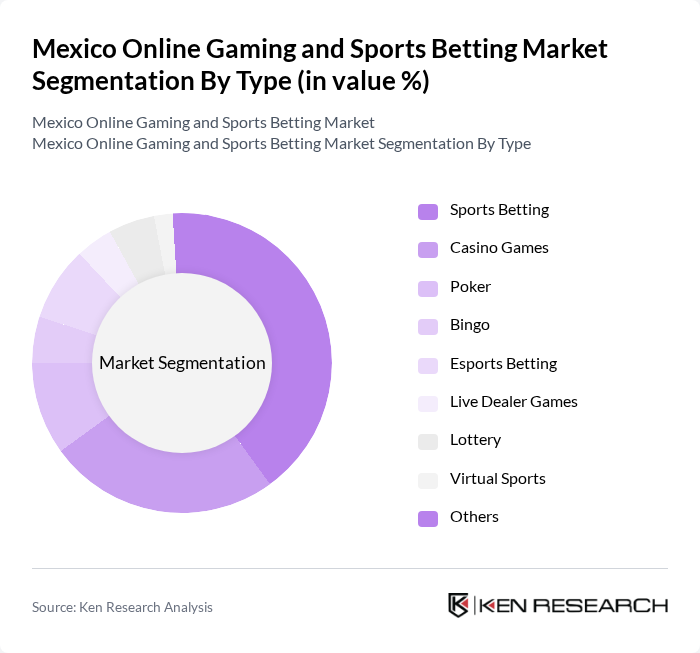
Mexico Online Gaming and Sports Betting Market segmentation by Type.

By End-User:The end-user segmentation includes Individual Gamers, Sports Enthusiasts, Casual Players, Professional Gamblers, and Tourists. Individual Gamers represent the largest segment, as the convenience and accessibility of online platforms attract a wide range of users. Sports Enthusiasts play a significant role, particularly in sports betting, with engagement peaking during major sporting events. Casual players and tourists also contribute to the market, while professional gamblers represent a niche but active segment.
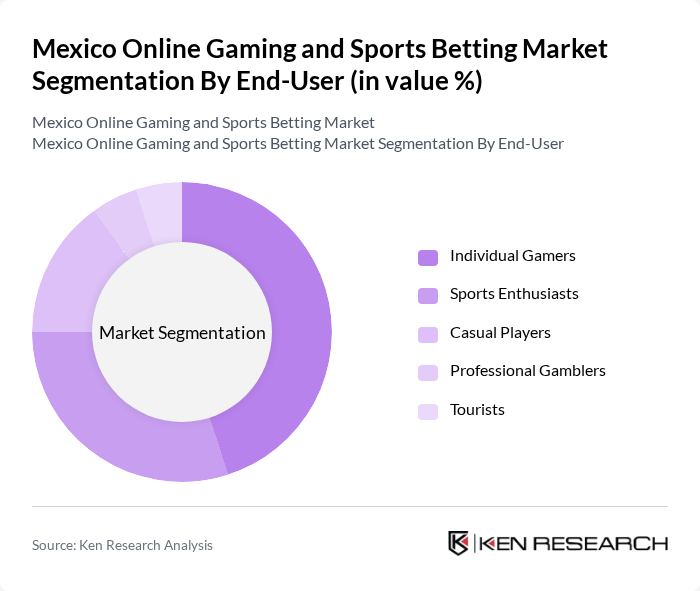
Mexico Online Gaming and Sports Betting Market segmentation by End-User.

Mexico Online Gaming and Sports Betting Market Competitive Landscape

The Mexico Online Gaming and Sports Betting Market is characterized by a dynamic mix of regional and international players. Leading participants such as Grupo Caliente, Bet365, Codere, PlayCity, Betway, 888 Holdings, William Hill, Strendus, Ganabet, Betfair, Bwin, Caliplay, Big Bola Casinos, NetBet, Betsson contribute to innovation, geographic expansion, and service delivery in this space.

Grupo Caliente

1916

Tijuana, Mexico

Bet365

2000

Stoke-on-Trent, UK

Codere

1980

Madrid, Spain

PlayCity

2014

Mexico City, Mexico

Betway

2006

London, UK

Company

Establishment Year

Headquarters

Group Size (Large, Medium, or Small as per industry convention)

Customer Acquisition Cost (CAC)

Average Revenue Per User (ARPU)

Churn Rate

Market Penetration Rate

Pricing Strategy (Fixed odds, dynamic odds, promotional offers)

Mexico Online Gaming and Sports Betting Market Industry Analysis

Growth Drivers

  • Increasing Internet Penetration:As of future, Mexico's internet penetration rate is projected to reach78%, with approximately97 million usersaccessing online platforms. This growth is driven by improved infrastructure and affordable data plans, enabling more individuals to engage in online gaming and sports betting. The World Bank reports that increased connectivity correlates with economic growth, suggesting that as more users come online, the market for digital gaming will expand significantly, attracting both local and international operators.
  • Rising Smartphone Usage:In future, smartphone penetration in Mexico is expected to exceed80%, with over95 million smartphonesin use. This trend facilitates access to online gaming platforms, as mobile devices become the primary means of engagement for users. According to the Mexican Association of Internet (AMIPCI), mobile gaming accounts forabout 60%of the total gaming market, indicating a strong shift towards mobile-first strategies among operators, which is essential for capturing the growing user base.
  • Expanding Youth Demographic:The youth demographic in Mexico, particularly those aged 18-34, is projected to reachabout 30 millionin future. This group is more inclined to participate in online gaming and sports betting, driven by cultural trends and social media influence. The National Institute of Statistics and Geography (INEGI) reports that this demographic is increasingly engaged in digital entertainment, creating a robust market for innovative gaming solutions tailored to their preferences, thus driving overall market growth.

Market Challenges

  • Regulatory Compliance Issues:The online gaming sector in Mexico faces significant regulatory hurdles, with over50%of operators struggling to meet compliance requirements. The government has implemented stringent licensing processes, which can take up tosix monthsto complete. This complexity can deter new entrants and stifle innovation, as operators must navigate a challenging legal landscape while ensuring adherence to consumer protection laws and responsible gaming initiatives.
  • Competition from Illegal Operators:The presence of illegal gaming operators poses a substantial challenge, with estimates suggesting that they capture nearly40%of the market share. These unregulated entities often offer lower prices and fewer restrictions, making it difficult for licensed operators to compete. The government’s efforts to combat illegal gambling have been inconsistent, leading to a fragmented market where legal operators struggle to gain a foothold against these illicit competitors.

Mexico Online Gaming and Sports Betting Market Future Outlook

The future of the Mexico online gaming and sports betting market appears promising, driven by technological advancements and evolving consumer preferences. As internet access continues to improve, more users are expected to engage in online gaming. Additionally, the integration of innovative technologies, such as virtual reality and blockchain, will enhance user experiences. Regulatory frameworks are likely to evolve, promoting a safer environment for consumers while encouraging responsible gaming practices, which will further stimulate market growth and attract investment.

Market Opportunities

  • Growth of Esports Betting:The esports betting segment is rapidly expanding, with an estimated market value of$1 billionin future. This growth is fueled by the increasing popularity of esports among younger audiences, creating opportunities for operators to develop tailored betting platforms that cater to this demographic, thus enhancing engagement and revenue potential.
  • Development of Mobile Gaming Platforms:With mobile gaming projected to account forabout 70%of the online gaming market in future, there is a significant opportunity for operators to invest in mobile-first platforms. Enhancing user experience through optimized applications and innovative features can attract a broader audience, driving market growth and increasing customer loyalty in a competitive landscape.

Scope of the Report

SegmentSub-Segments
By Type

Sports Betting

Casino Games

Poker

Bingo

Esports Betting

Live Dealer Games

Lottery

Virtual Sports

Others

By End-User

Individual Gamers

Sports Enthusiasts

Casual Players

Professional Gamblers

Tourists

By Payment Method

Credit/Debit Cards

E-Wallets

Bank Transfers

Cryptocurrency

Prepaid Cards

Cash (for land-based integration)

By Platform

Mobile Applications

Desktop Websites

Social Media Platforms

Retail Outlets (land-based)

By Region

Northern Mexico

Central Mexico

Southern Mexico

Urban Areas

Rural Areas

By Age Group

24 Years

34 Years

44 Years

+ Years

By Marketing Channel

Online Advertising

Affiliate Marketing

Social Media Marketing

Traditional Media

Sponsorships (e.g., sports teams)

Others

Key Target Audience

Investors and Venture Capitalist Firms

Government and Regulatory Bodies (e.g., Secretaría de Gobernación, Comisión Nacional de Juegos de Suerte y Azar)

Online Gaming Operators

Payment Processing Companies

Advertising and Marketing Agencies

Technology Providers

Industry Associations (e.g., Asociación de Juegos y Sorteos)

Financial Institutions

Players Mentioned in the Report:

Grupo Caliente

Bet365

Codere

PlayCity

Betway

888 Holdings

William Hill

Strendus

Ganabet

Betfair

Bwin

Caliplay

Big Bola Casinos

NetBet

Betsson

Table of Contents

Market Assessment Phase

1. Executive Summary and Approach


2. Mexico Online Gaming and Sports Betting Market Overview

2.1 Key Insights and Strategic Recommendations

2.2 Mexico Online Gaming and Sports Betting Market Overview

2.3 Definition and Scope

2.4 Evolution of Market Ecosystem

2.5 Timeline of Key Regulatory Milestones

2.6 Value Chain & Stakeholder Mapping

2.7 Business Cycle Analysis

2.8 Policy & Incentive Landscape


3. Mexico Online Gaming and Sports Betting Market Analysis

3.1 Growth Drivers

3.1.1 Increasing Internet Penetration
3.1.2 Rising Smartphone Usage
3.1.3 Expanding Youth Demographic
3.1.4 Legalization and Regulation Improvements

3.2 Market Challenges

3.2.1 Regulatory Compliance Issues
3.2.2 Market Saturation
3.2.3 Payment Processing Difficulties
3.2.4 Competition from Illegal Operators

3.3 Market Opportunities

3.3.1 Growth of Esports Betting
3.3.2 Development of Mobile Gaming Platforms
3.3.3 Partnerships with Local Sports Teams
3.3.4 Expansion into Underserved Regions

3.4 Market Trends

3.4.1 Increased Use of Live Betting
3.4.2 Integration of Virtual Reality in Gaming
3.4.3 Focus on Responsible Gaming Initiatives
3.4.4 Adoption of Cryptocurrency for Transactions

3.5 Government Regulation

3.5.1 Licensing Requirements for Operators
3.5.2 Taxation Policies on Winnings
3.5.3 Advertising Restrictions
3.5.4 Consumer Protection Laws

4. SWOT Analysis


5. Stakeholder Analysis


6. Porter's Five Forces Analysis


7. Mexico Online Gaming and Sports Betting Market Market Size, 2019-2024

7.1 By Value

7.2 By Volume

7.3 By Average Selling Price


8. Mexico Online Gaming and Sports Betting Market Segmentation

8.1 By Type

8.1.1 Sports Betting
8.1.2 Casino Games
8.1.3 Poker
8.1.4 Bingo
8.1.5 Esports Betting
8.1.6 Live Dealer Games
8.1.7 Lottery
8.1.8 Virtual Sports
8.1.9 Others

8.2 By End-User

8.2.1 Individual Gamers
8.2.2 Sports Enthusiasts
8.2.3 Casual Players
8.2.4 Professional Gamblers
8.2.5 Tourists

8.3 By Payment Method

8.3.1 Credit/Debit Cards
8.3.2 E-Wallets
8.3.3 Bank Transfers
8.3.4 Cryptocurrency
8.3.5 Prepaid Cards
8.3.6 Cash (for land-based integration)

8.4 By Platform

8.4.1 Mobile Applications
8.4.2 Desktop Websites
8.4.3 Social Media Platforms
8.4.4 Retail Outlets (land-based)

8.5 By Region

8.5.1 Northern Mexico
8.5.2 Central Mexico
8.5.3 Southern Mexico
8.5.4 Urban Areas
8.5.5 Rural Areas

8.6 By Age Group

8.6.1 18-24 Years
8.6.2 25-34 Years
8.6.3 35-44 Years
8.6.4 45+ Years

8.7 By Marketing Channel

8.7.1 Online Advertising
8.7.2 Affiliate Marketing
8.7.3 Social Media Marketing
8.7.4 Traditional Media
8.7.5 Sponsorships (e.g., sports teams)
8.7.6 Others

9. Mexico Online Gaming and Sports Betting Market Competitive Analysis

9.1 Market Share of Key Players

9.2 Cross Comparison of Key Players

9.2.1 Company Name
9.2.2 Group Size (Large, Medium, or Small as per industry convention)
9.2.3 Customer Acquisition Cost (CAC)
9.2.4 Average Revenue Per User (ARPU)
9.2.5 Churn Rate
9.2.6 Market Penetration Rate
9.2.7 Pricing Strategy (Fixed odds, dynamic odds, promotional offers)
9.2.8 Customer Lifetime Value (CLV)
9.2.9 Return on Marketing Investment (ROMI)
9.2.10 User Engagement Metrics (e.g., average session length, bets per user, frequency of play)
9.2.11 Regulatory Compliance Score
9.2.12 Mobile vs Desktop User Ratio
9.2.13 Responsible Gaming Initiatives Adoption

9.3 SWOT Analysis of Top Players

9.4 Pricing Analysis

9.5 Detailed Profile of Major Companies

9.5.1 Grupo Caliente
9.5.2 Bet365
9.5.3 Codere
9.5.4 PlayCity
9.5.5 Betway
9.5.6 888 Holdings
9.5.7 William Hill
9.5.8 Strendus
9.5.9 Ganabet
9.5.10 Betfair
9.5.11 Bwin
9.5.12 Caliplay
9.5.13 Big Bola Casinos
9.5.14 NetBet
9.5.15 Betsson

10. Mexico Online Gaming and Sports Betting Market End-User Analysis

10.1 Procurement Behavior of Key Ministries

10.1.1 Engagement with Regulatory Bodies
10.1.2 Budget Allocation for Gaming Initiatives
10.1.3 Compliance with National Standards

10.2 Corporate Spend on Infrastructure & Energy

10.2.1 Investment in Technology Upgrades
10.2.2 Funding for Marketing Campaigns
10.2.3 Expenditure on Customer Support Services

10.3 Pain Point Analysis by End-User Category

10.3.1 Regulatory Compliance Challenges
10.3.2 Payment Processing Issues
10.3.3 User Experience Concerns

10.4 User Readiness for Adoption

10.4.1 Awareness of Online Gaming Options
10.4.2 Comfort with Digital Transactions
10.4.3 Interest in New Gaming Technologies

10.5 Post-Deployment ROI and Use Case Expansion

10.5.1 Measurement of User Engagement
10.5.2 Analysis of Revenue Growth
10.5.3 Feedback Mechanisms for Improvement

11. Mexico Online Gaming and Sports Betting Market Future Size, 2025-2030

11.1 By Value

11.2 By Volume

11.3 By Average Selling Price


Go-To-Market Strategy Phase

1. Whitespace Analysis + Business Model Canvas

1.1 Identification of Market Gaps

1.2 Value Proposition Development

1.3 Revenue Streams Analysis

1.4 Cost Structure Evaluation

1.5 Key Partnerships Exploration

1.6 Customer Segmentation Insights

1.7 Channels for Distribution


2. Marketing and Positioning Recommendations

2.1 Branding Strategies

2.2 Product USPs

2.3 Target Audience Identification

2.4 Communication Strategies

2.5 Digital Marketing Approaches


3. Distribution Plan

3.1 Urban Retail Strategies

3.2 Rural NGO Tie-ups

3.3 Online Distribution Channels

3.4 Partnerships with Local Businesses


4. Channel & Pricing Gaps

4.1 Underserved Routes

4.2 Pricing Bands Analysis

4.3 Competitor Pricing Strategies


5. Unmet Demand & Latent Needs

5.1 Category Gaps Identification

5.2 Consumer Segments Analysis

5.3 Emerging Trends Exploration


6. Customer Relationship

6.1 Loyalty Programs Development

6.2 After-sales Service Strategies

6.3 Customer Feedback Mechanisms


7. Value Proposition

7.1 Sustainability Initiatives

7.2 Integrated Supply Chains

7.3 Unique Selling Points


8. Key Activities

8.1 Regulatory Compliance

8.2 Branding Initiatives

8.3 Distribution Setup


9. Entry Strategy Evaluation

9.1 Domestic Market Entry Strategy

9.1.1 Product Mix Considerations
9.1.2 Pricing Band Strategies
9.1.3 Packaging Options

9.2 Export Entry Strategy

9.2.1 Target Countries Identification
9.2.2 Compliance Roadmap Development

10. Entry Mode Assessment

10.1 Joint Ventures

10.2 Greenfield Investments

10.3 Mergers & Acquisitions

10.4 Distributor Model Evaluation


11. Capital and Timeline Estimation

11.1 Capital Requirements Analysis

11.2 Timelines for Implementation


12. Control vs Risk Trade-Off

12.1 Ownership vs Partnerships

12.2 Risk Management Strategies


13. Profitability Outlook

13.1 Breakeven Analysis

13.2 Long-term Sustainability Strategies


14. Potential Partner List

14.1 Distributors Identification

14.2 Joint Ventures Opportunities

14.3 Acquisition Targets


15. Execution Roadmap

15.1 Phased Plan for Market Entry

15.1.1 Market Setup
15.1.2 Market Entry
15.1.3 Growth Acceleration
15.1.4 Scale & Stabilize

15.2 Key Activities and Milestones

15.2.1 Milestone Planning
15.2.2 Activity Tracking

Research Methodology

ApproachModellingSample

Phase 1: Approach1

Desk Research

  • Analysis of market reports from government agencies and industry associations related to online gaming and sports betting in Mexico
  • Review of academic journals and publications focusing on consumer behavior in the gaming sector
  • Examination of regulatory frameworks and legal updates from the Mexican government regarding online gaming and betting

Primary Research

  • Interviews with key stakeholders including operators, regulators, and technology providers in the online gaming space
  • Surveys targeting consumers to understand preferences, spending habits, and engagement levels with online gaming platforms
  • Focus groups with avid gamers and bettors to gather qualitative insights on user experience and market trends

Validation & Triangulation

  • Cross-validation of findings through comparison with international market trends and benchmarks
  • Triangulation of data from primary interviews, consumer surveys, and secondary research sources
  • Sanity checks conducted through expert panel reviews comprising industry veterans and market analysts

Phase 2: Market Size Estimation1

Top-down Assessment

  • Estimation of total addressable market (TAM) based on national gambling expenditure reports and demographic data
  • Segmentation of the market by product type, including online casinos, sports betting, and eSports
  • Incorporation of growth rates derived from historical data and projected trends in digital engagement

Bottom-up Modeling

  • Collection of revenue data from leading online gaming operators to establish baseline figures
  • Analysis of user acquisition costs and average revenue per user (ARPU) across different gaming segments
  • Estimation of market penetration rates based on consumer adoption trends and technological advancements

Forecasting & Scenario Analysis

  • Development of forecasting models using historical growth rates and market dynamics
  • Scenario analysis based on potential regulatory changes and shifts in consumer behavior
  • Creation of multiple projections (baseline, optimistic, and pessimistic) to account for market volatility

Phase 3: CATI Sample Composition1

Scope Item/SegmentSample SizeTarget Respondent Profiles
Online Casino Players100Regular Users, Casual Gamblers
Sports Betting Enthusiasts90Sports Fans, Betting Platform Users
eSports Gamers60Competitive Gamers, Streamers
Regulatory Stakeholders40Government Officials, Compliance Officers
Technology Providers50Software Developers, IT Managers

Frequently Asked Questions

What is the current value of the Mexico Online Gaming and Sports Betting Market?

The Mexico Online Gaming and Sports Betting Market is valued at approximately USD 2.7 billion, driven by increased smartphone penetration, internet accessibility, and investments from international gaming companies.

What are the main segments of the Mexico Online Gaming and Sports Betting Market?

Which cities are key players in the Mexico Online Gaming and Sports Betting Market?

What recent regulatory changes have impacted the Mexico Online Gaming Market?

Other Regional/Country Reports

Indonesia Online Gaming and Sports Betting Market

Malaysia Online Gaming and Sports Betting Market

KSA Online Gaming and Sports Betting Market

APAC Online Gaming and Sports Betting Market

SEA Online Gaming and Sports Betting Market

Vietnam Online Gaming and Sports Betting Market

Why Buy From Us?

Refine Robust Result (RRR) Framework

What makes us stand out is that our consultants follow Robust, Refine and Result (RRR) methodology. Robust for clear definitions, approaches and sanity checking, Refine for differentiating respondents' facts and opinions, and Result for presenting data with story.

Our Reach Is Unmatched

We have set a benchmark in the industry by offering our clients with syndicated and customized market research reports featuring coverage of entire market as well as meticulous research and analyst insights.

Shifting the Research Paradigm

While we don't replace traditional research, we flip the method upside down. Our dual approach of Top Bottom & Bottom Top ensures quality deliverable by not just verifying company fundamentals but also looking at the sector and macroeconomic factors.

More Insights-Better Decisions

With one step in the future, our research team constantly tries to show you the bigger picture. We help with some of the tough questions you may encounter along the way: How is the industry positioned? Best marketing channel? KPI's of competitors? By aligning every element, we help maximize success.

Transparency and Trust

Our report gives you instant access to the answers and sources that other companies might choose to hide. We elaborate each steps of research methodology we have used and showcase you the sample size to earn your trust.

Round the Clock Support

If you need any support, we are here! We pride ourselves on universe strength, data quality, and quick, friendly, and professional service.

Why Clients Choose Us?

400000+
Reports in repository
150+
Consulting projects a year
100+
Analysts
8000+
Client Queries in 2022








