Region:Middle East
Author(s):Geetanshi
Product Code:KRAD4168
Pages:80
Published On:December 2025
 Market.png "Middle East Advertising-Based Video on Demand (AVOD) Market Size")
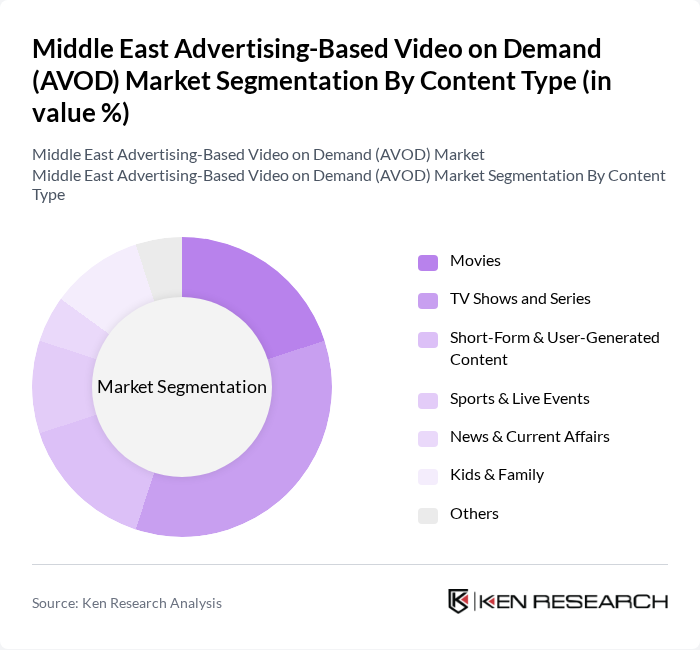
By Content Type:The content type segmentation of the AVOD market includes various categories such as Movies, TV Shows and Series, Short-Form & User-Generated Content, Sports & Live Events, News & Current Affairs, Kids & Family, and Others. Among these, TV Shows and Series are currently dominating the professionally produced, long-form AVOD segment due to the increasing demand for binge-watching, serialized storytelling, and catch-up viewing of network and satellite TV shows. The rise of platforms offering exclusive series, premium Arabic dramas, Turkish and Asian series, and localized originals has significantly influenced consumer preferences, leading to a surge in viewership in this segment, particularly in Saudi Arabia and the UAE.
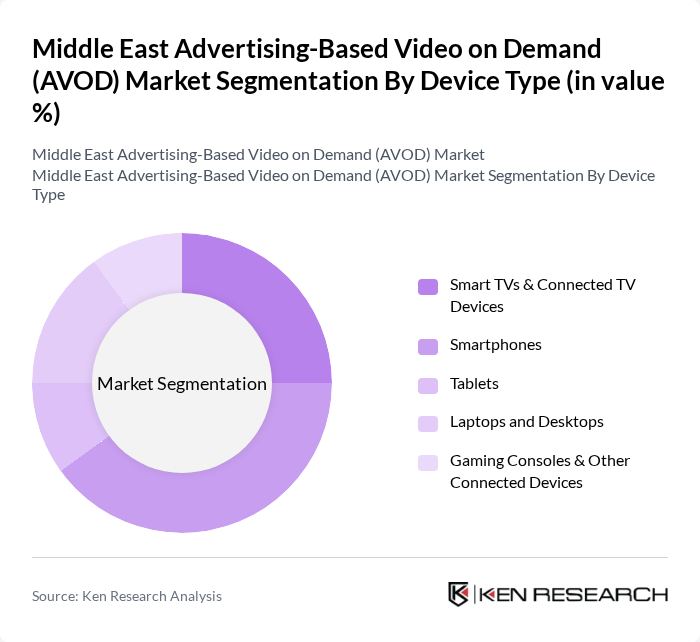
By Device Type:The device type segmentation includes Smart TVs & Connected TV Devices, Smartphones, Tablets, Laptops and Desktops, and Gaming Consoles & Other Connected Devices. The Smartphones segment is leading the market, driven by the widespread use of mobile devices for streaming content and regional smartphone penetration levels above 90% in key Middle Eastern markets. The convenience of accessing AVOD services on-the-go, telco-zero-rated or bundled video packages, and the increasing availability of high-speed fiber and 5G networks have made smartphones the preferred choice for consumers in the region for both short-form and long-form ad-supported video.
The Middle East Advertising-Based Video on Demand (AVOD) Market is characterized by a dynamic mix of regional and international players. Leading participants such as Shahid (MBC Group), OSN+ (OSN Group), Starzplay, Netflix, Amazon Prime Video, YouTube, MBC Group, beIN CONNECT (beIN Media Group), TOD (beIN Media Group), Disney+, Viu, Jawwy TV (stc Group), Watch iT!, ADtv (Abu Dhabi Media), EshailSat / Other Regional Free AVOD & FAST Channels contribute to innovation, geographic expansion, and service delivery in this space.
The future of the AVOD market in the Middle East appears promising, driven by technological advancements and evolving consumer preferences. As internet penetration continues to rise, more users will engage with AVOD platforms, leading to increased advertising revenues. Furthermore, the growing trend of mobile-first strategies will enhance user experiences, making content more accessible. The market is likely to see innovations in interactive content and personalized advertising, which will further attract viewers and advertisers alike, fostering a dynamic ecosystem.
| Segment | Sub-Segments |
|---|---|
| By Content Type | Movies TV Shows and Series Short-Form & User-Generated Content Sports & Live Events News & Current Affairs Kids & Family Others |
| By Device Type | Smart TVs & Connected TV Devices Smartphones Tablets Laptops and Desktops Gaming Consoles & Other Connected Devices |
| By Advertising Model | Pre-roll, Mid-roll and Post-roll Video Ads Bumper & Short-Form Video Ads Display & Overlay Ads Sponsored Content & Brand Integrations Programmatic & Addressable Advertising Others |
| By User Demographics | Age Groups Gender Income Levels Language & Ethnicity Urban vs Rural Others |
| By Geographic Distribution | Saudi Arabia United Arab Emirates Qatar Kuwait Bahrain Oman Rest of GCC Levant (Jordan, Lebanon, Iraq, Others) North Africa (Egypt, Morocco, Others) Others |
| By Monetization / Access Model | Free Ad-Supported (Pure AVOD) Hybrid (Freemium / AVOD + SVOD) Transactional & Pay-Per-View with Ads Operator-Bundled / Telco-Bundled Access Others |
| By Content Genre | Action & Thriller Comedy Drama & Romance Reality & Entertainment Shows Religious & Cultural Programming Others |
| Scope Item/Segment | Sample Size | Target Respondent Profiles |
|---|---|---|
| AVOD Platform Executives | 60 | CEOs, Product Managers, Marketing Directors |
| Advertising Agencies | 80 | Media Buyers, Account Managers, Strategy Planners |
| Consumer Focus Groups | 120 | Regular AVOD Users, Non-users, Content Creators |
| Regulatory Bodies | 40 | Policy Makers, Compliance Officers, Industry Analysts |
| Market Research Analysts | 70 | Market Researchers, Data Analysts, Economic Advisors |
The Middle East Advertising-Based Video on Demand (AVOD) market is valued at approximately USD 1.3 billion. This valuation is based on a five-year historical analysis and reflects the growth of online video and streaming revenues in the region's media and entertainment sector.

What makes us stand out is that our consultants follow Robust, Refine and Result (RRR) methodology. Robust for clear definitions, approaches and sanity checking, Refine for differentiating respondents' facts and opinions, and Result for presenting data with story.

We have set a benchmark in the industry by offering our clients with syndicated and customized market research reports featuring coverage of entire market as well as meticulous research and analyst insights.

While we don't replace traditional research, we flip the method upside down. Our dual approach of Top Bottom & Bottom Top ensures quality deliverable by not just verifying company fundamentals but also looking at the sector and macroeconomic factors.

With one step in the future, our research team constantly tries to show you the bigger picture. We help with some of the tough questions you may encounter along the way: How is the industry positioned? Best marketing channel? KPI's of competitors? By aligning every element, we help maximize success.

Our report gives you instant access to the answers and sources that other companies might choose to hide. We elaborate each steps of research methodology we have used and showcase you the sample size to earn your trust.

If you need any support, we are here! We pride ourselves on universe strength, data quality, and quick, friendly, and professional service.













