About the Report
Base Year 2024Middle East Agro Textile Market Overview
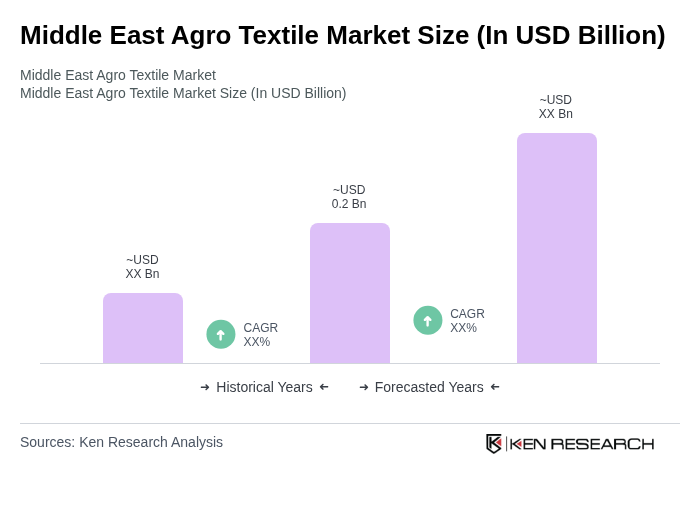
- The Middle East Agro Textile Market is valued at USD 0.2 billion, based on a five-year historical analysis of the Middle East and Africa agro textiles market, which indicates that the region accounts for a modest share of the global agro textiles industry. This growth is primarily driven by the increasing demand for sustainable agricultural practices, the need for crop protection, and the rising awareness of the benefits of agro textiles in enhancing agricultural productivity. The market has seen a significant uptick in investments and innovations aimed at improving crop yields and protecting against environmental factors, including wider use of shade nets, mulching materials, and insect protection nets across arid and semi-arid farming areas.
- Countries such as the United Arab Emirates, Saudi Arabia, and Egypt dominate the Middle East Agro Textile Market due to their substantial agricultural and horticultural activities and government initiatives promoting modern, water-efficient farming techniques such as greenhouse cultivation and protected agriculture. The UAE's focus on food security strategies and controlled-environment agriculture, along with Saudi Arabia's investments in agricultural technology and greenhouse projects under broader food security and sustainability programs, have further solidified their positions as key users of agro textiles in the region.
- In 2021, Saudi Arabia issued the Waste Management Law under Royal Decree No. M/59 and its Implementing Regulations (2022), overseen by the National Center for Waste Management, which set requirements to reduce plastic waste and promote recycling and sustainable materials in sectors including agriculture. Within this policy environment, biodegradable and recyclable agro textile solutions are encouraged as part of broader measures to manage plastic waste and align with Vision 2030 environmental sustainability objectives, influencing procurement specifications for mulching films, crop covers, and related agricultural plastics.
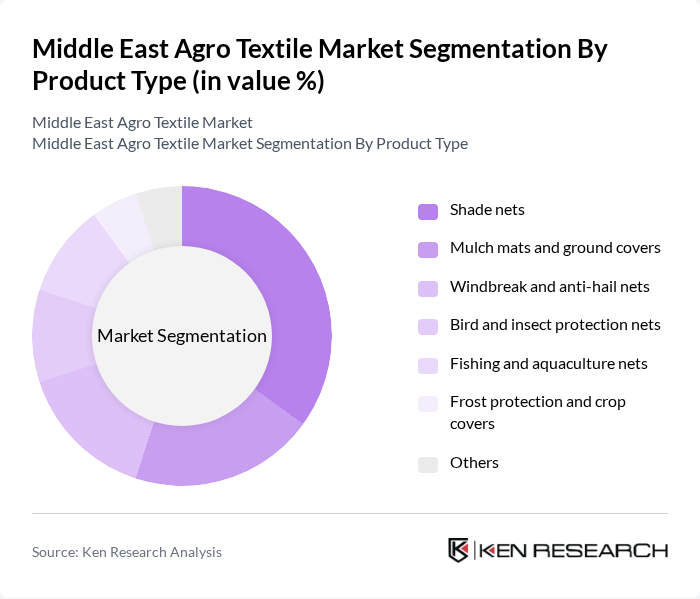
Middle East Agro Textile Market Segmentation
By Product Type:The product type segmentation includes various categories such as shade nets, mulch mats and ground covers, windbreak and anti-hail nets, bird and insect protection nets, fishing and aquaculture nets, frost protection and crop covers, and others. This structure is consistent with global agro textile categorization, where shade nets, mulch materials, crop covers, and protection nets are the key product families. Among these, shade nets are particularly dominant due to their widespread application in protecting crops from excessive sunlight and harsh weather conditions, especially in arid Middle Eastern climates that rely heavily on greenhouse and net-house cultivation. The increasing focus on sustainable agriculture, water-use efficiency, and the need for efficient resource management have further propelled the demand for shade nets and mulching solutions in the region.
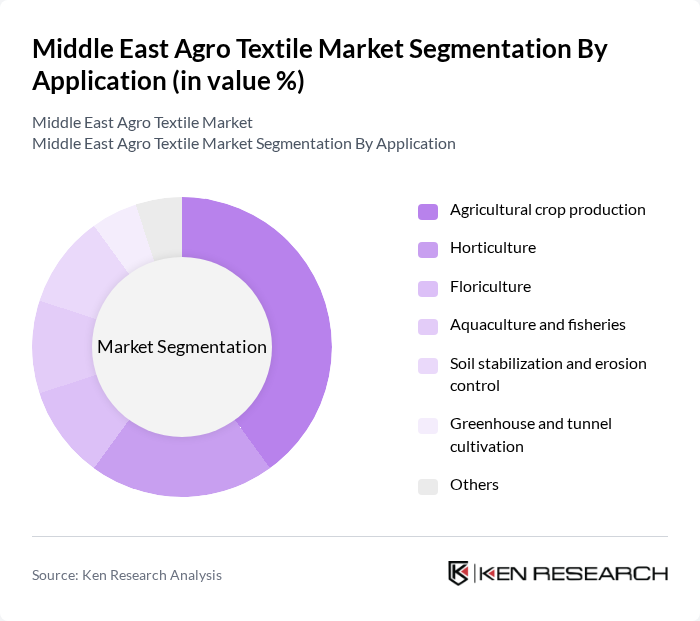
By Application:The application segmentation encompasses agricultural crop production, horticulture, floriculture, aquaculture and fisheries, soil stabilization and erosion control, greenhouse and tunnel cultivation, and others. This aligns with the way leading market studies segment agro textiles by application areas such as agriculture, horticulture and floriculture, aquaculture, and soil stabilization. Agricultural crop production is the leading application area, driven by the increasing need for food security, higher yields per unit of land, and the adoption of advanced agricultural practices such as drip irrigation combined with mulching and protected cultivation. The growing population and urbanization in the Middle East have heightened the demand for efficient crop production methods, making this segment crucial for the agro textile market, while greenhouse and tunnel cultivation, horticulture, and floriculture are also expanding due to investments in high-value crops and export-oriented production.
Middle East Agro Textile Market Competitive Landscape
The Middle East Agro Textile Market is characterized by a dynamic mix of regional and international players. Leading participants such as TenCate Geosynthetics, Berry Global, Inc., Freudenberg Performance Materials, Ahlstrom-Munksjö, RKW Group, Garware Technical Fibres Ltd., Diatex SAS, Beaulieu Technical Textiles, Arrigoni S.p.A., Neo Plastic Industries, Sika AG (SikaBito / related agro & geotextile solutions), Tenax International B.V., Zhongshan Hongjun Nonwovens Co., Ltd., SRF Limited – Technical Textiles Business, and local and regional Middle East converters and fabricators contribute to innovation, geographic expansion, and service delivery in this space, offering products such as shade and insect nets, mulching films, nonwoven crop covers, and geotextiles used in agriculture and landscaping.
Middle East Agro Textile Market Industry Analysis
Growth Drivers
- Increasing Demand for Sustainable Agricultural Practices:The Middle East is witnessing a significant shift towards sustainable agricultural practices, driven by a growing population projected to reach 500 million in future. This demographic change necessitates efficient food production methods. The region's agricultural sector is expected to invest approximately USD 1.5 billion in sustainable technologies in future, enhancing the demand for agro textiles that support these practices, such as biodegradable mulch films and protective covers.
- Government Initiatives Promoting Agro Textiles:Governments across the Middle East are increasingly recognizing the importance of agro textiles in enhancing agricultural productivity. For instance, the UAE's Ministry of Climate Change and Environment allocated USD 200 million in future to support sustainable farming initiatives. This funding is expected to boost the adoption of agro textiles, as they are integral to achieving national food security goals and reducing environmental impact, thereby fostering market growth.
- Technological Advancements in Agro Textile Production:The agro textile industry is benefiting from technological innovations, with investments in R&D projected to reach USD 300 million in future. These advancements include the development of high-performance materials that enhance crop yield and reduce resource consumption. For example, the introduction of smart textiles that monitor soil moisture levels is expected to revolutionize farming practices, driving demand for agro textiles in the region significantly.
Market Challenges
- High Initial Investment Costs:One of the primary challenges facing the agro textile market in the Middle East is the high initial investment required for adopting these materials. Farmers may need to invest up to USD 10,000 per hectare for advanced agro textile solutions in future, which can deter smallholder farmers. This financial barrier limits the widespread adoption of agro textiles, hindering market growth despite their long-term benefits in productivity and sustainability.
- Limited Awareness Among Farmers:A significant challenge is the limited awareness and understanding of agro textiles among farmers in the Middle East. Approximately 60% of farmers lack knowledge about the benefits and applications of these materials in future. This gap in awareness can lead to underutilization of agro textiles, stifling market growth. Educational initiatives and outreach programs are essential to bridge this knowledge gap and promote the adoption of agro textiles in the agricultural sector.
Middle East Agro Textile Market Future Outlook
The future of the Middle East agro textile market appears promising, driven by increasing investments in sustainable agriculture and technological innovations. As governments continue to support eco-friendly practices, the adoption of agro textiles is expected to rise significantly. Additionally, the growing consumer preference for organic and environmentally friendly products will further propel market growth. The integration of smart agriculture technologies will also enhance efficiency, making agro textiles a vital component of modern farming practices in the region.
Market Opportunities
- Expansion into Emerging Markets:The agro textile market has substantial opportunities for expansion into emerging markets within the Middle East, particularly in countries like Iraq and Yemen. With agricultural sectors in these nations projected to grow by 5% annually in future, there is a rising demand for innovative agro textile solutions that can enhance productivity and sustainability, presenting a lucrative opportunity for manufacturers.
- Development of Innovative Agro Textile Products:There is a significant opportunity for the development of innovative agro textile products tailored to the unique climatic conditions of the Middle East. For instance, creating UV-resistant and water-retentive materials can address specific agricultural challenges. This innovation could lead to a projected market growth of USD 200 million in future, as farmers seek effective solutions to optimize crop yields in arid environments.
Scope of the Report
| Segment | Sub-Segments |
|---|---|
| By Product Type | Shade nets Mulch mats and ground covers Windbreak and anti-hail nets Bird and insect protection nets Fishing and aquaculture nets Frost protection and crop covers Others |
| By Application | Agricultural crop production Horticulture Floriculture Aquaculture and fisheries Soil stabilization and erosion control Greenhouse and tunnel cultivation Others |
| By Material | Polypropylene (PP) Polyethylene (PE) Polyester (PET) Natural fibers (cotton, jute, coir, etc.) Biodegradable and bio-based materials Others |
| By Fabric Formation Technology | Woven Knitted Nonwoven Others |
| By End Use | Farmers and grower cooperatives Commercial horticulture and greenhouse operators Agricultural contractors and input suppliers Government and municipal bodies Others |
| By Region | GCC Countries Levant Region North Africa Iran & Turkey Others |
| By Distribution Channel | Direct sales to large farms and agribusinesses Agri-input retailers and cooperatives Distributors and importers Online and e-commerce platforms Others |
Key Target Audience
Investors and Venture Capitalist Firms
Government and Regulatory Bodies (e.g., Ministry of Agriculture, Ministry of Environment)
Manufacturers and Producers
Distributors and Retailers
Agro Textile Exporters
Technology Providers
Industry Associations (e.g., Middle East Textile Association)
Financial Institutions
Players Mentioned in the Report:
TenCate Geosynthetics
Berry Global, Inc.
Freudenberg Performance Materials
Ahlstrom-Munksjo
RKW Group
Garware Technical Fibres Ltd.
Diatex SAS
Beaulieu Technical Textiles
Arrigoni S.p.A.
Neo Plastic Industries
Sika AG (SikaBito / related agro & geotextile solutions)
Tenax International B.V.
Zhongshan Hongjun Nonwovens Co., Ltd.
SRF Limited Technical Textiles Business
Local and regional Middle East converters and fabricators (illustrative profiles)
Table of Contents
Market Assessment Phase
1. Executive Summary and Approach
2. Middle East Agro Textile Market Overview
2.1 Key Insights and Strategic Recommendations
2.2 Middle East Agro Textile Market Overview
2.3 Definition and Scope
2.4 Evolution of Market Ecosystem
2.5 Timeline of Key Regulatory Milestones
2.6 Value Chain & Stakeholder Mapping
2.7 Business Cycle Analysis
2.8 Policy & Incentive Landscape
3. Middle East Agro Textile Market Analysis
3.1 Growth Drivers
3.1.1 Increasing demand for sustainable agricultural practices
3.1.2 Government initiatives promoting agro textiles
3.1.3 Rising awareness of environmental benefits
3.1.4 Technological advancements in agro textile production
3.2 Market Challenges
3.2.1 High initial investment costs
3.2.2 Limited awareness among farmers
3.2.3 Competition from traditional materials
3.2.4 Regulatory hurdles in product certification
3.3 Market Opportunities
3.3.1 Expansion into emerging markets
3.3.2 Development of innovative agro textile products
3.3.3 Collaborations with agricultural organizations
3.3.4 Increasing export potential
3.4 Market Trends
3.4.1 Shift towards biodegradable materials
3.4.2 Growth in organic farming practices
3.4.3 Adoption of smart agriculture technologies
3.4.4 Rising consumer preference for eco-friendly products
3.5 Government Regulation
3.5.1 Standards for agro textile materials
3.5.2 Subsidies for sustainable farming practices
3.5.3 Import/export regulations for agro textiles
3.5.4 Environmental impact assessments
4. SWOT Analysis
5. Stakeholder Analysis
6. Porter's Five Forces Analysis
7. Middle East Agro Textile Market Market Size, 2019-2024
7.1 By Value
7.2 By Volume
7.3 By Average Selling Price
8. Middle East Agro Textile Market Segmentation
8.1 By Product Type
8.1.1 Shade nets
8.1.2 Mulch mats and ground covers
8.1.3 Windbreak and anti-hail nets
8.1.4 Bird and insect protection nets
8.1.5 Fishing and aquaculture nets
8.1.6 Frost protection and crop covers
8.1.7 Others
8.2 By Application
8.2.1 Agricultural crop production
8.2.2 Horticulture
8.2.3 Floriculture
8.2.4 Aquaculture and fisheries
8.2.5 Soil stabilization and erosion control
8.2.6 Greenhouse and tunnel cultivation
8.2.7 Others
8.3 By Material
8.3.1 Polypropylene (PP)
8.3.2 Polyethylene (PE)
8.3.3 Polyester (PET)
8.3.4 Natural fibers (cotton, jute, coir, etc.)
8.3.5 Biodegradable and bio-based materials
8.3.6 Others
8.4 By Fabric Formation Technology
8.4.1 Woven
8.4.2 Knitted
8.4.3 Nonwoven
8.4.4 Others
8.5 By End Use
8.5.1 Farmers and grower cooperatives
8.5.2 Commercial horticulture and greenhouse operators
8.5.3 Agricultural contractors and input suppliers
8.5.4 Government and municipal bodies
8.5.5 Others
8.6 By Region
8.6.1 GCC Countries
8.6.2 Levant Region
8.6.3 North Africa
8.6.4 Iran & Turkey
8.6.5 Others
8.7 By Distribution Channel
8.7.1 Direct sales to large farms and agribusinesses
8.7.2 Agri-input retailers and cooperatives
8.7.3 Distributors and importers
8.7.4 Online and e-commerce platforms
8.7.5 Others
9. Middle East Agro Textile Market Competitive Analysis
9.1 Market Share of Key Players
9.2 Cross Comparison of Key Players
9.2.1 Company name
9.2.2 Revenue (latest financial year, USD million)
9.2.3 Agro textile revenue share in total revenue (%)
9.2.4 3-year CAGR in agro textile revenue (%)
9.2.5 EBITDA margin for agro textile segment (%)
9.2.6 R&D intensity (% of revenue)
9.2.7 Capex intensity (% of revenue)
9.2.8 Market share in Middle East agro textiles (%)
9.2.9 Installed production capacity in MEA (tons/year)
9.2.10 Capacity utilization rate (%)
9.2.11 Average realization per ton (USD/ton)
9.2.12 Customer diversification index (top-10 customers’ share %)
9.2.13 Geographic diversification (number of ME countries served)
9.2.14 Product portfolio breadth (number of agro textile product lines)
9.2.15 On-time delivery rate (%)
9.2.16 Average order lead time (days)
9.2.17 Inventory turnover (x)
9.2.18 Working capital days
9.2.19 Return on invested capital (ROIC, %)
9.2.20 ESG/sustainability score or % revenue from sustainable products
9.3 SWOT Analysis of Top Players
9.4 Pricing Analysis
9.5 Detailed Profile of Major Companies
9.5.1 TenCate Geosynthetics
9.5.2 Berry Global, Inc.
9.5.3 Freudenberg Performance Materials
9.5.4 Ahlstrom-Munksjö
9.5.5 RKW Group
9.5.6 Garware Technical Fibres Ltd.
9.5.7 Diatex SAS
9.5.8 Beaulieu Technical Textiles
9.5.9 Arrigoni S.p.A.
9.5.10 Neo Plastic Industries
9.5.11 Sika AG (SikaBito / related agro & geotextile solutions)
9.5.12 Tenax International B.V.
9.5.13 Zhongshan Hongjun Nonwovens Co., Ltd.
9.5.14 SRF Limited – Technical Textiles Business
9.5.15 Local and regional Middle East converters and fabricators (illustrative profiles)
10. Middle East Agro Textile Market End-User Analysis
10.1 Procurement Behavior of Key Ministries
10.1.1 Ministry of Agriculture
10.1.2 Ministry of Environment
10.1.3 Ministry of Trade
10.1.4 Others
10.2 Corporate Spend on Infrastructure & Energy
10.2.1 Investment in sustainable practices
10.2.2 Budget allocation for agro textiles
10.2.3 Partnerships with agro textile suppliers
10.2.4 Others
10.3 Pain Point Analysis by End-User Category
10.3.1 Farmers
10.3.2 Agricultural cooperatives
10.3.3 Government agencies
10.3.4 Others
10.4 User Readiness for Adoption
10.4.1 Awareness levels
10.4.2 Training and support needs
10.4.3 Financial readiness
10.4.4 Others
10.5 Post-Deployment ROI and Use Case Expansion
10.5.1 Performance metrics
10.5.2 Case studies of successful implementations
10.5.3 Feedback mechanisms
10.5.4 Others
11. Middle East Agro Textile Market Future Size, 2025-2030
11.1 By Value
11.2 By Volume
11.3 By Average Selling Price
Go-To-Market Strategy Phase
1. Whitespace Analysis + Business Model Canvas
1.1 Market gaps identification
1.2 Value proposition development
1.4 Customer segmentation analysis
1.5 Competitive landscape overview
1.6 Key partnerships identification
1.7 Risk assessment
2. Marketing and Positioning Recommendations
2.1 Branding strategies
2.2 Product USPs
2.3 Target audience identification
2.4 Communication strategies
2.5 Digital marketing approaches
2.6 Trade show participation
2.7 Customer engagement tactics
3. Distribution Plan
3.1 Urban retail vs rural NGO tie-ups
3.2 Distribution channel optimization
3.3 Logistics and supply chain management
3.4 Partnership with local distributors
3.5 E-commerce strategies
3.6 Inventory management
3.7 Customer service integration
4. Channel & Pricing Gaps
4.1 Underserved routes
4.2 Pricing bands
4.3 Competitor pricing analysis
4.4 Value-based pricing strategies
4.5 Discount and promotion strategies
4.6 Price elasticity assessment
4.7 Customer willingness to pay
5. Unmet Demand & Latent Needs
5.1 Category gaps
5.2 Consumer segments
5.3 Product development opportunities
5.4 Market entry barriers
5.5 Customer feedback analysis
5.6 Future trends identification
5.7 Innovation opportunities
6. Customer Relationship
6.1 Loyalty programs
6.2 After-sales service
6.3 Customer feedback mechanisms
6.4 Community engagement strategies
6.5 Customer education initiatives
6.6 Relationship management tools
6.7 Customer satisfaction metrics
7. Value Proposition
7.1 Sustainability
7.2 Integrated supply chains
7.3 Cost-effectiveness
7.4 Quality assurance
7.5 Customization options
7.6 Brand reputation
7.7 Customer-centric approach
8. Key Activities
8.1 Regulatory compliance
8.2 Branding
8.3 Distribution setup
8.4 Market research
8.5 Training and development
8.6 Performance monitoring
8.7 Stakeholder engagement
9. Entry Strategy Evaluation
9.1 Domestic Market Entry Strategy
9.1.1 Product mix
9.1.2 Pricing band
9.1.3 Packaging
9.1.4 Marketing approach
9.1.5 Distribution channels
9.1.6 Customer engagement
9.1.7 Risk management
9.2 Export Entry Strategy
9.2.1 Target countries
9.2.2 Compliance roadmap
9.2.3 Market entry barriers
9.2.4 Distribution partnerships
9.2.5 Marketing strategies
9.2.6 Risk assessment
9.2.7 Financial projections
10. Entry Mode Assessment
10.1 JV
10.2 Greenfield
10.3 M&A
10.4 Distributor Model
10.5 Risk vs. control analysis
10.6 Market adaptability
10.7 Long-term sustainability
11. Capital and Timeline Estimation
11.1 Capital requirements
11.2 Timelines
11.3 Funding sources
11.4 Financial modeling
11.5 Investment return analysis
11.6 Budget allocation
11.7 Milestone tracking
12. Control vs Risk Trade-Off
12.1 Ownership vs Partnerships
12.2 Risk management strategies
12.3 Control mechanisms
12.4 Partnership evaluation
12.5 Long-term implications
12.6 Flexibility in operations
12.7 Exit strategies
13. Profitability Outlook
13.1 Breakeven analysis
13.2 Long-term sustainability
13.3 Profit margin assessment
13.4 Revenue forecasting
13.5 Cost management strategies
13.6 Financial health indicators
13.7 Market share growth
14. Potential Partner List
14.1 Distributors
14.2 JVs
14.3 Acquisition targets
14.4 Strategic alliances
14.5 Industry collaborations
14.6 Research partnerships
14.7 Government partnerships
15. Execution Roadmap
15.1 Phased Plan for Market Entry
15.1.1 Market Setup
15.1.2 Market Entry
15.1.3 Growth Acceleration
15.1.4 Scale & Stabilize
15.2 Key Activities and Milestones
15.2.1 Activity planning
15.2.2 Milestone tracking
15.2.3 Performance evaluation
15.2.4 Resource allocation
15.2.5 Risk assessment
15.2.6 Stakeholder engagement
15.2.7 Feedback mechanisms
Research Methodology
Phase 1: Approach1
Desk Research
- Industry reports from agricultural textile associations and market research firms
- Government publications on agricultural production and textile regulations in the Middle East
- Academic journals and white papers focusing on agro textiles and sustainable practices
Primary Research
- Interviews with key stakeholders in agro textile manufacturing and distribution
- Surveys targeting farmers and agricultural cooperatives using agro textiles
- Focus groups with end-users to understand preferences and challenges
Validation & Triangulation
- Cross-validation of findings with multiple data sources including trade statistics and expert opinions
- Triangulation of qualitative insights from interviews with quantitative data from surveys
- Sanity checks through expert panel reviews to ensure data reliability
Phase 2: Market Size Estimation1
Top-down Assessment
- Analysis of total agricultural output in the Middle East to estimate potential agro textile demand
- Segmentation of market size by crop type and textile application (e.g., shade nets, mulch films)
- Incorporation of regional growth trends and government initiatives promoting sustainable agriculture
Bottom-up Modeling
- Collection of sales data from leading agro textile manufacturers in the region
- Estimation of market penetration rates based on historical adoption trends
- Volume and pricing analysis to derive revenue projections for different agro textile products
Forecasting & Scenario Analysis
- Multi-variable forecasting models incorporating factors such as climate change impacts and technological advancements
- Scenario analysis based on varying levels of government support and market adoption rates
- Development of baseline, optimistic, and pessimistic forecasts through 2030
Phase 3: CATI Sample Composition1
| Scope Item/Segment | Sample Size | Target Respondent Profiles |
|---|---|---|
| Agro Textile Manufacturers | 60 | Production Managers, Sales Directors |
| Farmers Utilizing Agro Textiles | 100 | Smallholder Farmers, Cooperative Leaders |
| Distributors and Retailers | 50 | Supply Chain Managers, Retail Buyers |
| Research Institutions and NGOs | 40 | Agricultural Researchers, Sustainability Advocates |
| Government Agricultural Departments | 40 | Policy Makers, Agricultural Extension Officers |
Frequently Asked Questions
What is the current value of the Middle East Agro Textile Market?
The Middle East Agro Textile Market is valued at approximately USD 0.2 billion, reflecting a modest share of the global agro textiles industry. This valuation is based on a five-year historical analysis of the market trends in the region.
What are the main drivers of growth in the Middle East Agro Textile Market?
Which countries dominate the Middle East Agro Textile Market?
What types of products are included in the Middle East Agro Textile Market?
Other Regional/Country Reports
Other Adjacent Reports
Singapore Geotextiles Market
Middle East technical textiles market size, share, growth drivers, trends, opportunities & forecast 2025–2030Thailand Irrigation Systems MarketBahrain Greenhouse Technology Market
France Crop Protection Market Outlook to 2030: Size, Share, Growth and TrendsGermany Sustainable Agriculture Market
Philippines Aquaculture Equipment Market
Thailand Horticulture Supplies Market
Kuwait Floriculture Market Report Size Share Growth Drivers Trends Opportunities & Forecast 2025–2030Bahrain nonwoven fabrics market size, share, growth drivers, trends, opportunities & forecast 2025–2030Why Buy From Us?

What makes us stand out is that our consultants follow Robust, Refine and Result (RRR) methodology. Robust for clear definitions, approaches and sanity checking, Refine for differentiating respondents' facts and opinions, and Result for presenting data with story.

We have set a benchmark in the industry by offering our clients with syndicated and customized market research reports featuring coverage of entire market as well as meticulous research and analyst insights.

While we don't replace traditional research, we flip the method upside down. Our dual approach of Top Bottom & Bottom Top ensures quality deliverable by not just verifying company fundamentals but also looking at the sector and macroeconomic factors.

With one step in the future, our research team constantly tries to show you the bigger picture. We help with some of the tough questions you may encounter along the way: How is the industry positioned? Best marketing channel? KPI's of competitors? By aligning every element, we help maximize success.

Our report gives you instant access to the answers and sources that other companies might choose to hide. We elaborate each steps of research methodology we have used and showcase you the sample size to earn your trust.

If you need any support, we are here! We pride ourselves on universe strength, data quality, and quick, friendly, and professional service.