About the Report
Base Year 2024Listen to the audio summary
Kuwait Floriculture Market Overview
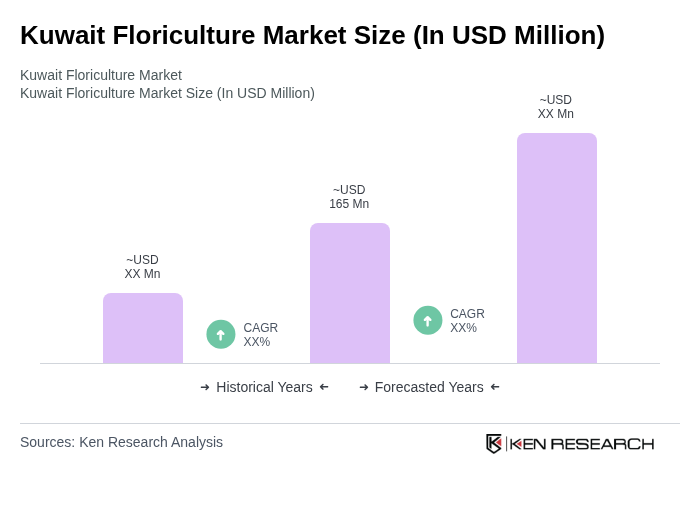
- The Kuwait Floriculture Market is valued at USD 165 million, based on recent industry assessments of Kuwait’s floriculture sector within the wider Middle East and Africa context and dedicated country-level studies. Growth is driven by increasing consumer interest in floral products for events, gifting, and home decoration, alongside rising disposable income and lifestyle shifts toward ornamental plants. The market also benefits from the expansion of online flower delivery services, strong import growth in fresh flowers, and demand for exotic varieties and sustainable, locally grown options.
- Key players in this market include regional online flower and gift delivery firms such as Floward, which operates in Kuwait among other Gulf and international markets and has built its business model around technology-enabled ordering, fulfillment, and regional expansion. The market is influenced by a high reliance on imports of cut flowers and ornamental plants from leading producer and export countries, with local florists, supermarkets, and e-commerce platforms bridging consumer demand through product innovation, curated arrangements, and convenient same-day or next-day delivery options.
- A significant policy initiative under Kuwait’s cooperative sector regulations requires cooperative societies to prioritize locally produced agricultural goods, including horticultural and nursery outputs, through minimum local sourcing quotas, clear product labelling, and dedicated shelf space, in order to support domestic farmers and improve food and agricultural security. In particular, the Ministry of Social Affairs and Community Development has issued binding rules for cooperative societies on the marketing of local agricultural products, stipulating preferential procurement, designated display areas, and transparent pricing mechanisms to strengthen local value chains. These measures align with broader national strategies for agricultural development overseen by the Public Authority for Agricultural Affairs and Fish Resources, which promote greenhouse, nursery, and ornamental plant production.
Kuwait Floriculture Market Segmentation
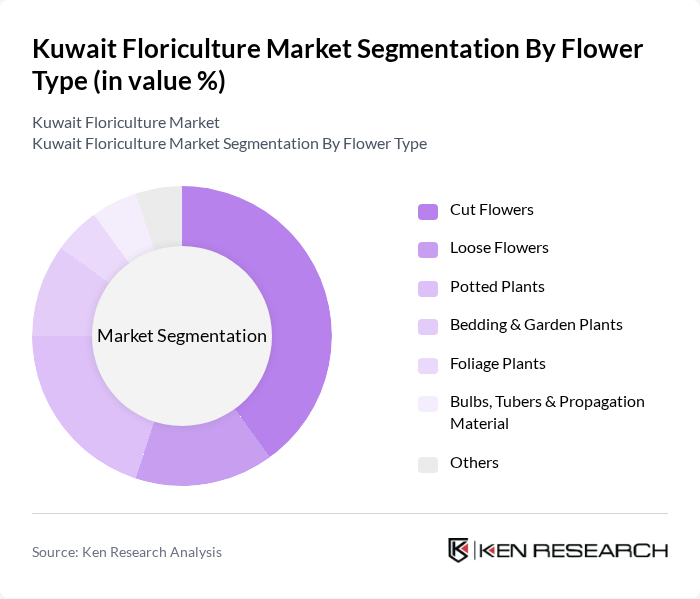
By Flower Type:The flower type segmentation includes various categories such as cut flowers, loose flowers, potted plants, bedding & garden plants, foliage plants, bulbs, tubers & propagation material, and others. This structure is consistent with global floriculture classifications that distinguish between cut flowers, pot plants, bedding plants, foliage and propagation material. Among these, cut flowers dominate the market due to their high demand for gifting, hospitality and event decoration, in line with global trends where cut flowers account for the largest share of floriculture trade. The trend of floral arrangements for weddings, social celebrations and corporate events has significantly boosted the sales of cut flowers, making them a preferred choice for consumers and institutional buyers in Kuwait’s service-driven economy.
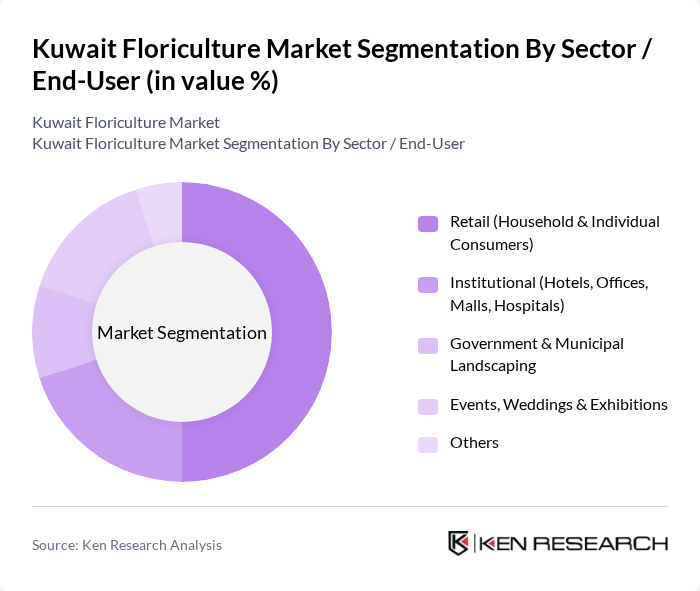
By Sector / End-User:The sector segmentation encompasses retail (household & individual consumers), institutional (hotels, offices, malls, hospitals), government & municipal landscaping, events, weddings & exhibitions, and others. This breakdown reflects the principal demand clusters identified in regional and global floriculture studies, where commercial, hospitality and events segments are key users alongside household retail demand. The retail sector is the largest contributor, driven by the increasing trend of home decoration, personal gifting, and online-to-offline flower purchases, supported by app-based and web-based ordering platforms that make flowers more accessible to individual consumers. Consumers are increasingly purchasing flowers and potted plants for personal use and interior aesthetics, which has led to a surge in demand within this segment and complemented recurring purchases from institutional and event clients.
Kuwait Floriculture Market Competitive Landscape
The Kuwait Floriculture Market is characterized by a dynamic mix of regional and international players. Leading participants such as Flower Shop Co., Alissar Flowers International – Kuwait, Kuwait Garden Center, Al Fares Flowers & Plants, Blooms (Bloomsbury Flowers Kuwait), Flare Floral Co., Floward (Kuwait Operations), Petals Kuwait, Wafra Flowers & Plants, Zyriana Flowers, Rose Garden Nursery, Orchid Flowers & Gifts, Al Shamia Nursery, Green Corner Flowers, and other emerging local florists & nurseries contribute to innovation, geographic expansion, and service delivery in this space.
Kuwait Floriculture Market Industry Analysis
Growth Drivers
- Urban Population Concentration:As of the end of future, Kuwait's population reached approximately 5.200 million. This high urban concentration creates significant demand for ornamental plants and floral products, particularly in residential and commercial spaces. The urban lifestyle encourages the use of indoor plants and landscaping, driving floriculture sales. The growing population in urban areas is a critical factor in the expansion of the floriculture market.
- GDP at Current Prices:In future, Kuwait's total GDP at current prices was reported at 50,000 million Kuwaiti dinars (KWD). This economic capacity indicates a higher disposable income among consumers, which can be allocated to non-essential goods such as flowers and ornamental plants. The increase in GDP supports consumer spending in the floriculture sector, enhancing market growth opportunities.
- Non-Oil Sector Value Added:For the period of future, the non-oil sector contributed 21,000 million KWD to the GDP. This growth in sectors such as services, retail, and real estate fosters increased spending on events, hospitality, and personal décor, all of which are significant drivers for the floriculture market. The expansion of these sectors creates a favorable environment for floriculture businesses to thrive.
Market Challenges
- Agricultural Sector’s Small Scale:Agriculture in Kuwait contributes only 0.5% to the GDP and employs merely 1.9% of the workforce. This limited agricultural infrastructure constrains the local production of flowers, leading to a heavy reliance on imports. The small scale of domestic agriculture presents a significant challenge for the floriculture market, as it limits the availability of locally sourced products and increases costs associated with imports.
- GDP Contraction & Economic Stress:In future, Kuwait experienced a real GDP contraction of 2.5%, primarily due to ongoing OPEC+ production cuts. Although the non-oil sector expanded by 2.5%, the overall economic contraction may lead to reduced consumer discretionary spending on non-essential items like floriculture. This economic stress poses a challenge for the floriculture market, as consumers may prioritize essential goods over ornamental plants.
Kuwait Floriculture Market Future Outlook
The future of the Kuwait floriculture market appears promising, driven by the ongoing digital transformation and the recovery of non-oil economic sectors. Enhanced digital infrastructure will facilitate e-commerce growth, allowing floriculture businesses to reach a broader audience. Additionally, as the non-oil economy continues to expand, there will be increased demand for floral products in events, hospitality, and residential décor, further supporting market growth. The government's focus on diversifying the economy may also create new opportunities for local floriculture initiatives.
Market Opportunities
- Digital Retail Expansion:The robust internet and e-government infrastructure in Kuwait present a significant opportunity for floriculture businesses to expand their online presence. By leveraging e-commerce platforms, companies can reach a wider customer base, enhancing sales and market penetration in the floriculture sector.
- Non-Oil Economic Growth Segments:The continued expansion of the services, real estate, and events industries suggests untapped demand for floriculture products. As these sectors grow, they will likely require more floral arrangements for events and commercial spaces, creating new opportunities for floriculture businesses to cater to this increasing demand.
Scope of the Report
| Segment | Sub-Segments |
|---|---|
| By Flower Type | Cut Flowers Loose Flowers Potted Plants Bedding & Garden Plants Foliage Plants Bulbs, Tubers & Propagation Material Others |
| By Sector / End-User | Retail (Household & Individual Consumers) Institutional (Hotels, Offices, Malls, Hospitals) Government & Municipal Landscaping Events, Weddings & Exhibitions Others |
| By Distribution Channel | Unorganised Retail (Kiosks, Roadside Vendors) Florists & Specialty Stores Supermarkets & Hypermarkets Online Retail & Marketplaces Wholesale Markets & Direct Institutional Sales |
| By Application | Home & Indoor Decoration Commercial & Corporate Spaces Gifting & Personal Occasions Weddings, Events & Hospitality Others |
| By Price Range | Economy Mid-Range Premium Luxury / Designer Others |
| By Region (Within Kuwait) | Capital Governorate Hawalli Governorate Al Ahmadi Governorate Farwaniya Governorate Mubarak Al-Kabeer Governorate Jahra Governorate Others |
| By Sustainability Practices | Organic & Low-Chemical Cultivation Water-Efficient Irrigation & Desert-Adaptive Practices Eco-Friendly Packaging & Waste Reduction Others |
Key Target Audience
Investors and Venture Capitalist Firms
Government and Regulatory Bodies (e.g., Ministry of Agriculture and Fisheries, Public Authority for Agriculture Affairs and Fish Resources)
Floriculture Producers and Growers
Wholesale Flower Distributors
Retail Florists and Garden Centers
Landscape Architects and Designers
Importers and Exporters of Floricultural Products
Environmental NGOs and Sustainability Advocates
Players Mentioned in the Report:
Flower Shop Co.
Alissar Flowers International Kuwait
Kuwait Garden Center
Al Fares Flowers & Plants
Blooms (Bloomsbury Flowers Kuwait)
Flare Floral Co.
Floward (Kuwait Operations)
Petals Kuwait
Wafra Flowers & Plants
Zyriana Flowers
Rose Garden Nursery
Orchid Flowers & Gifts
Al Shamia Nursery
Green Corner Flowers
Other Emerging Local Florists & Nurseries
Table of Contents
Market Assessment Phase
1. Executive Summary and Approach
2. Kuwait Floriculture Market Overview
2.1 Key Insights and Strategic Recommendations
2.2 Kuwait Floriculture Market Overview
2.3 Definition and Scope
2.4 Evolution of Market Ecosystem
2.5 Timeline of Key Regulatory Milestones
2.6 Value Chain & Stakeholder Mapping
2.7 Business Cycle Analysis
2.8 Policy & Incentive Landscape
3. Kuwait Floriculture Market Analysis
3.1 Growth Drivers
3.1.1 Increasing Demand for Ornamental Plants
3.1.2 Rising Interest in Sustainable Gardening
3.1.3 Growth of the Hospitality Sector
3.1.4 Government Initiatives for Green Spaces
3.2 Market Challenges
3.2.1 Limited Water Resources
3.2.2 High Import Dependency
3.2.3 Climate Constraints
3.2.4 Competition from Regional Markets
3.3 Market Opportunities
3.3.1 Expansion of E-commerce Platforms
3.3.2 Development of Local Nurseries
3.3.3 Eco-friendly Product Innovations
3.3.4 Collaborations with Landscape Architects
3.4 Market Trends
3.4.1 Increasing Popularity of Indoor Plants
3.4.2 Growth in Flower Festivals and Events
3.4.3 Adoption of Smart Gardening Technologies
3.4.4 Focus on Organic Floriculture Practices
3.5 Government Regulation
3.5.1 Import Regulations on Plant Species
3.5.2 Environmental Protection Laws
3.5.3 Subsidies for Local Growers
3.5.4 Licensing Requirements for Nurseries
4. SWOT Analysis
5. Stakeholder Analysis
6. Porter's Five Forces Analysis
7. Kuwait Floriculture Market Market Size, 2019-2024
7.1 By Value
7.2 By Volume
7.3 By Average Selling Price
8. Kuwait Floriculture Market Segmentation
8.1 By Flower Type
8.1.1 Cut Flowers
8.1.2 Loose Flowers
8.1.3 Potted Plants
8.1.4 Bedding & Garden Plants
8.1.5 Foliage Plants
8.1.6 Bulbs, Tubers & Propagation Material
8.1.7 Others
8.2 By Sector / End-User
8.2.1 Retail (Household & Individual Consumers)
8.2.2 Institutional (Hotels, Offices, Malls, Hospitals)
8.2.3 Government & Municipal Landscaping
8.2.4 Events, Weddings & Exhibitions
8.2.5 Others
8.3 By Distribution Channel
8.3.1 Unorganised Retail (Kiosks, Roadside Vendors)
8.3.2 Florists & Specialty Stores
8.3.3 Supermarkets & Hypermarkets
8.3.4 Online Retail & Marketplaces
8.3.5 Wholesale Markets & Direct Institutional Sales
8.4 By Application
8.4.1 Home & Indoor Decoration
8.4.2 Commercial & Corporate Spaces
8.4.3 Gifting & Personal Occasions
8.4.4 Weddings, Events & Hospitality
8.4.5 Others
8.5 By Price Range
8.5.1 Economy
8.5.2 Mid-Range
8.5.3 Premium
8.5.4 Luxury / Designer
8.5.5 Others
8.6 By Region (Within Kuwait)
8.6.1 Capital Governorate
8.6.2 Hawalli Governorate
8.6.3 Al Ahmadi Governorate
8.6.4 Farwaniya Governorate
8.6.5 Mubarak Al-Kabeer Governorate
8.6.6 Jahra Governorate
8.6.7 Others
8.7 By Sustainability Practices
8.7.1 Organic & Low-Chemical Cultivation
8.7.2 Water-Efficient Irrigation & Desert-Adaptive Practices
8.7.3 Eco-Friendly Packaging & Waste Reduction
8.7.4 Others
9. Kuwait Floriculture Market Competitive Analysis
9.1 Market Share of Key Players
9.2 Cross Comparison of Key Players
9.2.1 Company Name
9.2.2 Group Size (Large, Medium, or Small as per industry convention)
9.2.3 Revenue CAGR (Last 3–5 Years)
9.2.4 Kuwait Floriculture Revenue (Latest Year, KWD Mn)
9.2.5 EBITDA Margin (%)
9.2.6 Market Share in Kuwait Floriculture (%)
9.2.7 Channel Mix (Share of Online vs Offline Sales %)
9.2.8 Average Order Value – B2C (KWD)
9.2.9 Average Contract Size – B2B / Institutional (KWD)
9.2.10 Capacity Utilization Rate (%)
9.2.11 Inventory Turnover (Times per Year)
9.2.12 On-Time Delivery Rate (%)
9.2.13 Customer Retention Rate (%)
9.2.14 Net Promoter Score (NPS)
9.2.15 Product Portfolio Breadth (No. of SKUs / Flower Types)
9.3 SWOT Analysis of Top Players
9.4 Pricing Analysis
9.5 Detailed Profile of Major Companies
9.5.1 Flower Shop Co.
9.5.2 Alissar Flowers International – Kuwait
9.5.3 Kuwait Garden Center
9.5.4 Al Fares Flowers & Plants
9.5.5 Blooms (Bloomsbury Flowers Kuwait)
9.5.6 Flare Floral Co.
9.5.7 Floward (Kuwait Operations)
9.5.8 Petals Kuwait
9.5.9 Wafra Flowers & Plants
9.5.10 Zyriana Flowers
9.5.11 Rose Garden Nursery
9.5.12 Orchid Flowers & Gifts
9.5.13 Al Shamia Nursery
9.5.14 Green Corner Flowers
9.5.15 Other Emerging Local Florists & Nurseries
10. Kuwait Floriculture Market End-User Analysis
10.1 Procurement Behavior of Key Ministries
10.1.1 Ministry of Public Works
10.1.2 Ministry of Municipal Affairs
10.1.3 Ministry of Education
10.1.4 Ministry of Health
10.2 Corporate Spend on Infrastructure & Energy
10.2.1 Corporate Landscaping Projects
10.2.2 Event Decorations
10.2.3 Green Building Initiatives
10.3 Pain Point Analysis by End-User Category
10.3.1 Cost of Maintenance
10.3.2 Availability of Quality Plants
10.3.3 Seasonal Variability
10.4 User Readiness for Adoption
10.4.1 Awareness of Sustainable Practices
10.4.2 Interest in Indoor Gardening
10.5 Post-Deployment ROI and Use Case Expansion
10.5.1 Increased Aesthetic Value
10.5.2 Enhanced Employee Well-being
11. Kuwait Floriculture Market Future Size, 2025-2030
11.1 By Value
11.2 By Volume
11.3 By Average Selling Price
Go-To-Market Strategy Phase
1. Whitespace Analysis + Business Model Canvas
1.1 Market Gaps Identification
1.2 Value Proposition Development
2. Marketing and Positioning Recommendations
2.1 Branding Strategies
2.2 Product USPs
3. Distribution Plan
3.1 Urban Retail vs Rural NGO Tie-ups
4. Channel & Pricing Gaps
4.1 Underserved Routes
4.2 Pricing Bands
5. Unmet Demand & Latent Needs
5.1 Category Gaps
5.2 Consumer Segments
6. Customer Relationship
6.1 Loyalty Programs
6.2 After-sales Service
7. Value Proposition
7.1 Sustainability
7.2 Integrated Supply Chains
8. Key Activities
8.1 Regulatory Compliance
8.2 Branding
8.3 Distribution Setup
9. Entry Strategy Evaluation
9.1 Domestic Market Entry Strategy
9.1.1 Product Mix
9.1.2 Pricing Band
9.1.3 Packaging
9.2 Export Entry Strategy
9.2.1 Target Countries
9.2.2 Compliance Roadmap
10. Entry Mode Assessment
10.1 JV
10.2 Greenfield
10.3 M&A
10.4 Distributor Model
11. Capital and Timeline Estimation
11.1 Capital Requirements
11.2 Timelines
12. Control vs Risk Trade-Off
12.1 Ownership vs Partnerships
13. Profitability Outlook
13.1 Breakeven Analysis
13.2 Long-term Sustainability
14. Potential Partner List
14.1 Distributors
14.2 JVs
14.3 Acquisition Targets
15. Execution Roadmap
15.1 Phased Plan for Market Entry
15.1.1 Market Setup
15.1.2 Market Entry
15.1.3 Growth Acceleration
15.1.4 Scale & Stabilize
15.2 Key Activities and Milestones
15.2.1 Activity Planning
15.2.2 Milestone Tracking
Research Methodology
Phase 1: Approach1
Desk Research
- Analysis of market reports from local agricultural and floriculture associations
- Review of government publications on agricultural exports and imports in Kuwait
- Examination of academic journals and articles focusing on floriculture trends in the Middle East
Primary Research
- Interviews with key stakeholders in the floriculture supply chain, including growers and distributors
- Surveys conducted with retail florists and garden centers to assess consumer preferences
- Field visits to nurseries and flower markets to gather firsthand insights on operations
Validation & Triangulation
- Cross-validation of findings through multiple data sources, including trade statistics and expert opinions
- Triangulation of qualitative insights from interviews with quantitative data from surveys
- Sanity checks through expert panel discussions with industry veterans and market analysts
Phase 2: Market Size Estimation1
Top-down Assessment
- Estimation of total floriculture market size based on national agricultural output data
- Segmentation of the market by flower types, including cut flowers, potted plants, and landscaping plants
- Incorporation of seasonal demand patterns and cultural events influencing flower sales
Bottom-up Modeling
- Collection of sales data from leading floriculture businesses and retailers in Kuwait
- Estimation of average selling prices for various flower categories and product lines
- Volume estimates based on historical sales trends and projected growth rates
Forecasting & Scenario Analysis
- Multi-factor analysis considering economic indicators, population growth, and urbanization rates
- Scenario modeling based on potential changes in consumer behavior and environmental regulations
- Development of baseline, optimistic, and pessimistic forecasts through 2030
Phase 3: CATI Sample Composition1
| Scope Item/Segment | Sample Size | Target Respondent Profiles |
|---|---|---|
| Retail Florists | 60 | Shop Owners, Sales Managers |
| Wholesale Distributors | 50 | Distribution Managers, Procurement Officers |
| Nursery Operators | 40 | Farm Managers, Horticulturists |
| Event Planners | 40 | Wedding Coordinators, Corporate Event Managers |
| Consumers | 100 | General Public, Flower Enthusiasts |
Frequently Asked Questions
What is the current value of the Kuwait Floriculture Market?
The Kuwait Floriculture Market is valued at approximately USD 165 million, reflecting the growing consumer interest in floral products for gifting, events, and home decoration, alongside rising disposable incomes and lifestyle changes favoring ornamental plants.
What are the main drivers of growth in the Kuwait Floriculture Market?
Which types of flowers dominate the Kuwait Floriculture Market?
Who are the key players in the Kuwait Floriculture Market?
Other Regional/Country Reports
Indonesia Floriculture Market
Other Adjacent Reports
Mexico Ornamental Horticulture Market
Thailand Online Flower Delivery Market
South Africa Event Decoration Market
Brazil Gift Retail Market
Oman Home Decoration Market
Qatar Horticultural Supplies Market
South Africa Nursery Products Market
Egypt Agricultural Imports Market
Singapore E-commerce Solutions Market
Brazil Hospitality Services Market
Why Buy From Us?

What makes us stand out is that our consultants follow Robust, Refine and Result (RRR) methodology. Robust for clear definitions, approaches and sanity checking, Refine for differentiating respondents' facts and opinions, and Result for presenting data with story.

We have set a benchmark in the industry by offering our clients with syndicated and customized market research reports featuring coverage of entire market as well as meticulous research and analyst insights.

While we don't replace traditional research, we flip the method upside down. Our dual approach of Top Bottom & Bottom Top ensures quality deliverable by not just verifying company fundamentals but also looking at the sector and macroeconomic factors.

With one step in the future, our research team constantly tries to show you the bigger picture. We help with some of the tough questions you may encounter along the way: How is the industry positioned? Best marketing channel? KPI's of competitors? By aligning every element, we help maximize success.

Our report gives you instant access to the answers and sources that other companies might choose to hide. We elaborate each steps of research methodology we have used and showcase you the sample size to earn your trust.

If you need any support, we are here! We pride ourselves on universe strength, data quality, and quick, friendly, and professional service.