About the Report
Base Year 2024Middle East Anhydrous Hydrogen Fluoride Market Overview
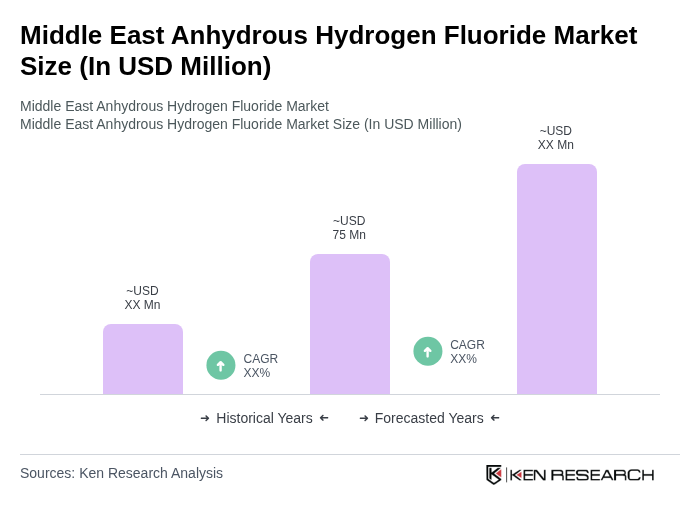
- The Middle East Anhydrous Hydrogen Fluoride Market is valued at USD 75 million, based on a five-year historical analysis. This growth is primarily driven by the increasing demand for fluorinated compounds in applications such as fluoropolymers, refrigerants, metal processing, and chemical intermediates, supported by expanding petrochemical, aluminum, and downstream chemical industries across the region.
- Key players in this market include Saudi Arabia, the United Arab Emirates, and Qatar. These countries dominate the regional demand due to their robust petrochemical and refining base, significant investments in chemical manufacturing, and strategic geographic locations that facilitate export-oriented trade. Additionally, the presence of major oil and gas and aluminum producers in these economies, coupled with large refinery alkylation units and fluorochemical value chains, contributes to sustained consumption of anhydrous hydrogen fluoride in catalyst systems and fluorinated intermediates.
- In 2023, the Gulf Cooperation Council (GCC) member states continued to align their management of fluorinated substances, including anhydrous hydrogen fluoride–based value chains, with multilateral environmental commitments such as the Kigali Amendment to the Montreal Protocol and national chemical safety frameworks. For example, the UAE Cabinet Decision No. 34 of 2022 on the Regulation of Hydrofluorocarbons, issued by the UAE Cabinet, establishes controls on production, import, export, and use of listed fluorinated gases and requires reporting, licensing, and phased reductions in placed-on-market volumes, which in turn drives safer handling, emission control, and monitoring across fluorochemical and refrigerant supply chains in the GCC.
Middle East Anhydrous Hydrogen Fluoride Market Segmentation
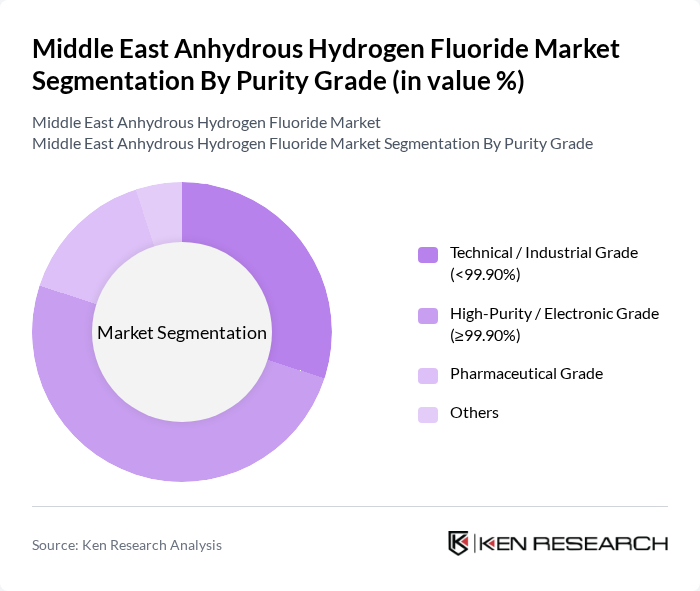
By Purity Grade:The purity grade of anhydrous hydrogen fluoride is a critical factor influencing its application across various industries. The market is segmented into Technical / Industrial Grade, High-Purity / Electronic Grade, Pharmaceutical Grade, and Others. Technical / Industrial Grade covers typical refining, aluminum, and bulk fluorochemical production where purity requirements are around 99.9 wt %. High-Purity / Electronic Grade corresponds to ultra-high-purity material, often at or above 99.999 wt %, used for semiconductor etching, cleaning, and specialty electronic chemicals, and this segment is growing where integrated circuit and display manufacturing investments are taking place. Pharmaceutical Grade involves HF used as a precursor or catalyst in active pharmaceutical ingredient and fluorinated drug intermediate production, while the Others category includes tailored grades for niche applications such as specialty fluorochemicals and laboratory reagents.
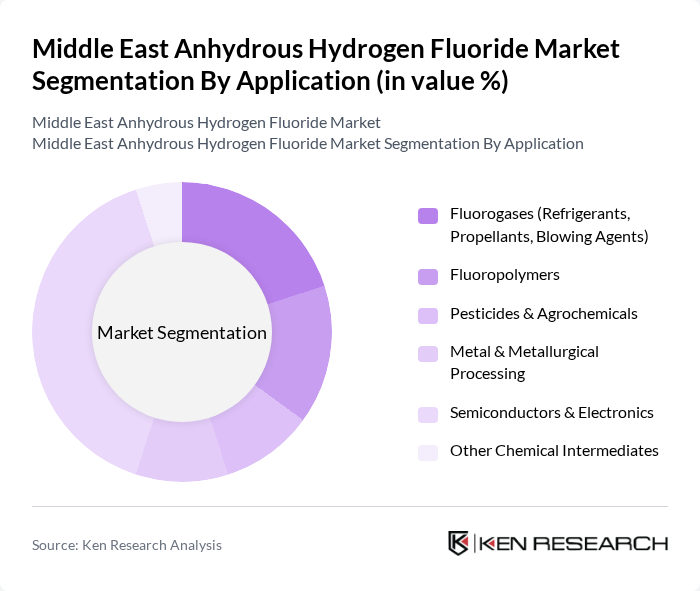
By Application:The applications of anhydrous hydrogen fluoride are diverse, including Fluorogases, Fluoropolymers, Pesticides & Agrochemicals, Metal & Metallurgical Processing, Semiconductors & Electronics, and Other Chemical Intermediates. Fluorogases use HF as a key feedstock for hydrofluorocarbons (HFCs), hydrofluoroolefins (HFOs), and other low?global?warming?potential refrigerants and propellants. Fluoropolymers rely on HF?derived monomers for materials such as PTFE, PVDF, and FEP, which are increasingly used in membranes, coatings, and wire and cable. Pesticides & Agrochemicals utilize HF in synthesizing fluorinated active ingredients that improve efficacy and persistence. Metal & Metallurgical Processing includes pickling, surface treatment, and aluminum production where HF is employed for cleaning and fluxing. Semiconductors & Electronics applications encompass wafer etching, cleaning, and the production of high?purity fluorinated gases and chemicals used in integrated circuits, displays, and solar cells, with demand supported by ongoing electronics and data?center–related investments in the wider Middle East and Africa region. Other Chemical Intermediates cover a broad range of fluorinated intermediates used in specialty chemicals, pharmaceuticals, and performance materials.
Middle East Anhydrous Hydrogen Fluoride Market Competitive Landscape
The Middle East Anhydrous Hydrogen Fluoride Market is characterized by a dynamic mix of regional and international players. Leading participants such as Solvay S.A., Honeywell International Inc., Daikin Industries, Ltd., The Chemours Company, Air Products and Chemicals, Inc., Kanto Chemical Co., Inc., Merck KGaA, Arkema S.A., Linde plc, BASF SE, Air Liquide S.A., Morita Chemical Industries Co., Ltd., Zhejiang Jianye Chemical Co., Ltd., Gulf Fluor LLC, INOVYN (INEOS Group) contribute to innovation, geographic expansion, and service delivery in this space.
Middle East Anhydrous Hydrogen Fluoride Market Industry Analysis
Growth Drivers
- Increasing Demand from the Semiconductor Industry:The semiconductor industry in the Middle East is projected to reach a value of $10 billion in future, driven by the growing adoption of advanced technologies. Anhydrous hydrogen fluoride is essential for etching silicon wafers, which are critical components in semiconductor manufacturing. The rising demand for consumer electronics and automotive applications is further propelling this growth, as the region aims to enhance its technological capabilities and reduce reliance on imports.
- Expansion of the Petrochemical Sector:The Middle East's petrochemical sector is expected to grow to $200 billion in future, fueled by increased production capacities and investments in infrastructure. Anhydrous hydrogen fluoride is a vital feedstock in producing various fluorinated chemicals used in petrochemical processes. This expansion is supported by government initiatives aimed at diversifying economies and enhancing local production capabilities, thereby increasing the demand for anhydrous hydrogen fluoride in the region.
- Rising Applications in Refrigerants:The demand for anhydrous hydrogen fluoride in refrigerants is anticipated to grow significantly, with the refrigerant market projected to reach $30 billion in future. This growth is driven by the transition to more environmentally friendly refrigerants, such as hydrofluorocarbons (HFCs), which require anhydrous hydrogen fluoride in their production. The Middle East's commitment to phasing out ozone-depleting substances further supports this trend, creating a robust market for anhydrous hydrogen fluoride.
Market Challenges
- Environmental Regulations and Compliance:The Middle East faces stringent environmental regulations aimed at reducing greenhouse gas emissions and promoting sustainable practices. Compliance with these regulations can be challenging for manufacturers of anhydrous hydrogen fluoride, as they must invest in cleaner technologies and processes. The cost of compliance is projected to increase by 15% annually, impacting profit margins and potentially limiting market growth in the region.
- Safety Concerns Associated with Handling:Anhydrous hydrogen fluoride is classified as a highly hazardous substance, posing significant safety risks during handling and transportation. The number of reported incidents related to chemical exposure has increased by 20% over the past five years, raising concerns among manufacturers and regulators. This heightened awareness necessitates stringent safety protocols and training, which can increase operational costs and complicate market entry for new players.
Middle East Anhydrous Hydrogen Fluoride Market Future Outlook
The future of the Middle East anhydrous hydrogen fluoride market appears promising, driven by technological advancements and a growing focus on sustainability. As industries increasingly adopt eco-friendly practices, the demand for innovative production methods will rise. Additionally, the region's strategic investments in research and development are expected to foster new applications and enhance product efficiency, positioning the market for significant growth. Collaborative efforts among stakeholders will further facilitate the transition towards greener alternatives, ensuring long-term viability.
Market Opportunities
- Technological Advancements in Production:Innovations in production technologies are creating opportunities for more efficient and cost-effective manufacturing of anhydrous hydrogen fluoride. Companies investing in automation and process optimization can reduce production costs by up to 25%, enhancing competitiveness in the market. This shift towards advanced manufacturing techniques is expected to attract new entrants and stimulate overall market growth.
- Development of Sustainable Production Methods:The increasing emphasis on sustainability presents opportunities for developing greener production methods for anhydrous hydrogen fluoride. Companies that adopt environmentally friendly practices can benefit from government incentives, which are projected to exceed $500 million in future. This focus on sustainability not only aligns with global trends but also enhances brand reputation and customer loyalty in the market.
Scope of the Report
| Segment | Sub-Segments |
|---|---|
| By Purity Grade | Technical / Industrial Grade (<99.90%) High-Purity / Electronic Grade (?99.90%) Pharmaceutical Grade Others |
| By Application | Fluorogases (Refrigerants, Propellants, Blowing Agents) Fluoropolymers Pesticides & Agrochemicals Metal & Metallurgical Processing Semiconductors & Electronics Other Chemical Intermediates |
| By End-Use Industry | Chemical & Petrochemical Oil & Gas and Refining Electronics & Semiconductor Manufacturing Mining & Metallurgy Pharmaceuticals Others |
| By Production Route | Fluorspar-Based Production Fluorine Recovery from By-Products Others |
| By Geography | GCC Countries Rest of Middle East North Africa Others |
Key Target Audience
Investors and Venture Capitalist Firms
Government and Regulatory Bodies (e.g., Ministry of Energy, Ministry of Environment)
Manufacturers and Producers of Anhydrous Hydrogen Fluoride
Chemical Industry Associations
Importers and Exporters of Chemical Products
Environmental Protection Agencies (e.g.,
Petrochemical Companies
Industrial Gas Suppliers
Players Mentioned in the Report:
Solvay S.A.
Honeywell International Inc.
Daikin Industries, Ltd.
The Chemours Company
Air Products and Chemicals, Inc.
Kanto Chemical Co., Inc.
Merck KGaA
Arkema S.A.
Linde plc
BASF SE
Air Liquide S.A.
Morita Chemical Industries Co., Ltd.
Zhejiang Jianye Chemical Co., Ltd.
Gulf Fluor LLC
INOVYN (INEOS Group)
Table of Contents
Market Assessment Phase
1. Executive Summary and Approach
2. Middle East Anhydrous Hydrogen Fluoride Market Overview
2.1 Key Insights and Strategic Recommendations
2.2 Middle East Anhydrous Hydrogen Fluoride Market Overview
2.3 Definition and Scope
2.4 Evolution of Market Ecosystem
2.5 Timeline of Key Regulatory Milestones
2.6 Value Chain & Stakeholder Mapping
2.7 Business Cycle Analysis
2.8 Policy & Incentive Landscape
3. Middle East Anhydrous Hydrogen Fluoride Market Analysis
3.1 Growth Drivers
3.1.1 Increasing demand from the semiconductor industry
3.1.2 Expansion of the petrochemical sector
3.1.3 Rising applications in refrigerants
3.1.4 Growth in the manufacturing of fluoropolymers
3.2 Market Challenges
3.2.1 Environmental regulations and compliance
3.2.3 Limited availability of raw materials
3.2.4 Safety concerns associated with handling
3.3 Market Opportunities
3.3.1 Technological advancements in production
3.3.2 Increasing investments in R&D
3.3.3 Expansion into emerging markets
3.3.4 Development of sustainable production methods
3.4 Market Trends
3.4.1 Shift towards eco-friendly alternatives
3.4.2 Growing focus on supply chain optimization
3.4.3 Increasing mergers and acquisitions
3.4.4 Rise in strategic partnerships
3.5 Government Regulation
3.5.1 Stricter emissions standards
3.5.2 Import/export regulations
3.5.3 Safety and handling guidelines
3.5.4 Incentives for green technologies
4. SWOT Analysis
5. Stakeholder Analysis
6. Porter's Five Forces Analysis
7. Middle East Anhydrous Hydrogen Fluoride Market Market Size, 2019-2024
7.1 By Value
7.2 By Volume
7.3 By Average Selling Price
8. Middle East Anhydrous Hydrogen Fluoride Market Segmentation
8.1 By Purity Grade
8.1.1 Technical / Industrial Grade (<99.90%)
8.1.2 High-Purity / Electronic Grade (≥99.90%)
8.1.3 Pharmaceutical Grade
8.1.4 Others
8.2 By Application
8.2.1 Fluorogases (Refrigerants, Propellants, Blowing Agents)
8.2.2 Fluoropolymers
8.2.3 Pesticides & Agrochemicals
8.2.4 Metal & Metallurgical Processing
8.2.5 Semiconductors & Electronics
8.2.6 Other Chemical Intermediates
8.3 By End-Use Industry
8.3.1 Chemical & Petrochemical
8.3.2 Oil & Gas and Refining
8.3.3 Electronics & Semiconductor Manufacturing
8.3.4 Mining & Metallurgy
8.3.5 Pharmaceuticals
8.3.6 Others
8.4 By Production Route
8.4.1 Fluorspar-Based Production
8.4.2 Fluorine Recovery from By-Products
8.4.3 Others
8.5 By Geography
8.5.1 GCC Countries
8.5.2 Rest of Middle East
8.5.3 North Africa
8.5.4 Others
9. Middle East Anhydrous Hydrogen Fluoride Market Competitive Analysis
9.1 Market Share of Key Players
9.2 Cross Comparison of Key Players
9.2.1 Company Name
9.2.2 Regional Revenue (USD Million, Latest Year)
9.2.3 3-Year Revenue CAGR in Middle East (%)
9.2.4 Middle East Market Share (%)
9.2.5 Capacity Utilization Rate (%)
9.2.6 EBITDA Margin (%)
9.2.7 Return on Invested Capital (ROIC, %)
9.2.8 Average Realized Price (USD/ton)
9.2.9 R&D Intensity (% of Sales)
9.2.10 Share of Sales from High-Purity / Electronic Grade (%)
9.2.11 Contracted vs Spot Sales Mix (%)
9.2.12 Export Share of Production (%)
9.3 SWOT Analysis of Top Players
9.4 Pricing Analysis
9.5 Detailed Profile of Major Companies
9.5.1 Solvay S.A.
9.5.2 Honeywell International Inc.
9.5.3 Daikin Industries, Ltd.
9.5.4 The Chemours Company
9.5.5 Air Products and Chemicals, Inc.
9.5.6 Kanto Chemical Co., Inc.
9.5.7 Merck KGaA
9.5.8 Arkema S.A.
9.5.9 Linde plc
9.5.10 BASF SE
9.5.11 Air Liquide S.A.
9.5.12 Morita Chemical Industries Co., Ltd.
9.5.13 Zhejiang Jianye Chemical Co., Ltd.
9.5.14 Gulf Fluor LLC
9.5.15 INOVYN (INEOS Group)
10. Middle East Anhydrous Hydrogen Fluoride Market End-User Analysis
10.1 Procurement Behavior of Key Ministries
10.1.1 Budget Allocation Trends
10.1.2 Procurement Processes
10.1.3 Supplier Selection Criteria
10.1.4 Contract Management Practices
10.2 Corporate Spend on Infrastructure & Energy
10.2.1 Investment Trends
10.2.2 Budget Prioritization
10.2.3 Long-term Contracts
10.2.4 Cost Management Strategies
10.3 Pain Point Analysis by End-User Category
10.3.1 Supply Chain Disruptions
10.3.2 Quality Assurance Issues
10.3.3 Regulatory Compliance Challenges
10.3.4 Cost Fluctuations
10.4 User Readiness for Adoption
10.4.1 Training and Support Needs
10.4.2 Technology Adoption Rates
10.4.3 Infrastructure Readiness
10.4.4 Feedback Mechanisms
10.5 Post-Deployment ROI and Use Case Expansion
10.5.1 Performance Metrics
10.5.2 Case Studies
10.5.3 User Satisfaction Levels
10.5.4 Future Investment Plans
11. Middle East Anhydrous Hydrogen Fluoride Market Future Size, 2025-2030
11.1 By Value
11.2 By Volume
11.3 By Average Selling Price
Go-To-Market Strategy Phase
1. Whitespace Analysis + Business Model Canvas
1.1 Market Gaps Identification
1.2 Value Proposition Development
1.3 Revenue Streams Analysis
1.4 Cost Structure Evaluation
1.5 Key Partnerships Exploration
1.6 Customer Segmentation
1.7 Competitive Advantage Assessment
2. Marketing and Positioning Recommendations
2.1 Branding Strategies
2.2 Product USPs
2.3 Target Market Identification
2.4 Communication Strategies
2.5 Digital Marketing Approaches
2.6 Customer Engagement Tactics
2.7 Performance Measurement
3. Distribution Plan
3.1 Urban Retail Strategies
3.2 Rural NGO Tie-ups
3.3 E-commerce Integration
3.4 Logistics Optimization
3.5 Channel Partner Development
3.6 Inventory Management
3.7 Distribution Cost Analysis
4. Channel & Pricing Gaps
4.1 Underserved Routes
4.2 Pricing Bands Analysis
4.3 Competitor Pricing Strategies
4.4 Customer Willingness to Pay
4.5 Price Sensitivity Assessment
4.6 Discounting Strategies
4.7 Value-Based Pricing
5. Unmet Demand & Latent Needs
5.1 Category Gaps
5.2 Consumer Segments Analysis
5.3 Product Development Opportunities
5.4 Market Entry Barriers
5.5 Customer Feedback Integration
5.6 Future Trends Anticipation
5.7 Innovation Opportunities
6. Customer Relationship
6.1 Loyalty Programs
6.2 After-sales Service
6.3 Customer Feedback Mechanisms
6.4 Relationship Management Strategies
6.5 Customer Retention Tactics
6.6 Engagement Strategies
6.7 Performance Metrics
7. Value Proposition
7.1 Sustainability Initiatives
7.2 Integrated Supply Chains
7.3 Customer-Centric Approaches
7.4 Competitive Differentiation
7.5 Value-Added Services
7.6 Market Positioning
7.7 Brand Loyalty Development
8. Key Activities
8.1 Regulatory Compliance
8.2 Branding Initiatives
8.3 Distribution Setup
8.4 Marketing Campaigns
8.5 Training and Development
8.6 Performance Monitoring
8.7 Stakeholder Engagement
9. Entry Strategy Evaluation
9.1 Domestic Market Entry Strategy
9.1.1 Product Mix
9.1.2 Pricing Band
9.1.3 Packaging Considerations
9.2 Export Entry Strategy
9.2.1 Target Countries
9.2.2 Compliance Roadmap
10. Entry Mode Assessment
10.1 Joint Ventures
10.2 Greenfield Investments
10.3 Mergers & Acquisitions
10.4 Distributor Model
10.5 Risk Assessment
10.6 Strategic Fit Evaluation
10.7 Long-term Viability
11. Capital and Timeline Estimation
11.1 Capital Requirements
11.2 Timelines
11.3 Funding Sources
11.4 Financial Projections
11.5 Investment Returns
11.6 Risk Mitigation Strategies
11.7 Milestone Tracking
12. Control vs Risk Trade-Off
12.1 Ownership Considerations
12.2 Partnership Dynamics
12.3 Risk Management Framework
12.4 Control Mechanisms
12.5 Strategic Alliances
12.6 Performance Accountability
12.7 Exit Strategies
13. Profitability Outlook
13.1 Breakeven Analysis
13.2 Long-term Sustainability
13.3 Profit Margin Projections
13.4 Cost Reduction Strategies
13.5 Revenue Growth Forecasts
13.6 Financial Health Indicators
13.7 Market Positioning for Profitability
14. Potential Partner List
14.1 Distributors
14.2 Joint Ventures
14.3 Acquisition Targets
14.4 Strategic Collaborations
14.5 Industry Associations
14.6 Research Institutions
14.7 Government Agencies
15. Execution Roadmap
15.1 Phased Plan for Market Entry
15.1.1 Market Setup
15.1.2 Market Entry
15.1.3 Growth Acceleration
15.1.4 Scale & Stabilize
15.2 Key Activities and Milestones
15.2.1 Activity Planning
15.2.2 Milestone Tracking
15.2.3 Performance Evaluation
15.2.4 Resource Allocation
Research Methodology
Phase 1: Approach1
Desk Research
- Analysis of industry reports from chemical associations and market research firms
- Review of government publications and trade statistics related to hydrogen fluoride
- Examination of academic journals and white papers on chemical manufacturing and applications
Primary Research
- Interviews with industry experts and key opinion leaders in the chemical sector
- Surveys targeting procurement managers in industries utilizing anhydrous hydrogen fluoride
- Field visits to manufacturing plants to gather insights on production processes and challenges
Validation & Triangulation
- Cross-referencing data from multiple sources to ensure consistency and accuracy
- Engaging with a panel of experts for qualitative validation of findings
- Utilizing historical data trends to validate current market estimates
Phase 2: Market Size Estimation1
Top-down Assessment
- Estimation of market size based on national chemical production statistics
- Segmentation of market by end-use applications such as electronics, pharmaceuticals, and agrochemicals
- Incorporation of regional demand forecasts based on economic growth indicators
Bottom-up Modeling
- Collection of sales data from major manufacturers of anhydrous hydrogen fluoride
- Estimation of market share based on production capacity and sales volume
- Analysis of pricing trends to calculate revenue potential across different sectors
Forecasting & Scenario Analysis
- Development of predictive models using historical growth rates and market drivers
- Scenario planning based on potential regulatory changes and environmental policies
- Creation of multiple forecasts (baseline, optimistic, and pessimistic) through 2030
Phase 3: CATI Sample Composition1
| Scope Item/Segment | Sample Size | Target Respondent Profiles |
|---|---|---|
| Electronics Manufacturing | 110 | Production Managers, Quality Control Supervisors |
| Pharmaceutical Applications | 90 | Regulatory Affairs Specialists, R&D Managers |
| Agrochemical Sector | 80 | Procurement Managers, Product Development Scientists |
| Specialty Chemicals | 70 | Sales Directors, Market Analysts |
| Environmental Compliance | 60 | Environmental Managers, Compliance Officers |
Frequently Asked Questions
What is the current value of the Middle East Anhydrous Hydrogen Fluoride Market?
The Middle East Anhydrous Hydrogen Fluoride Market is valued at approximately USD 75 million, driven by the increasing demand for fluorinated compounds in various applications, including fluoropolymers and refrigerants, supported by the growth of the petrochemical and aluminum industries in the region.
Which countries are the key players in the Middle East Anhydrous Hydrogen Fluoride Market?
What are the main applications of Anhydrous Hydrogen Fluoride?
How does the purity grade affect the use of Anhydrous Hydrogen Fluoride?
Other Regional/Country Reports
Other Adjacent Reports
Mexico Fluoropolymer Market
Bahrain refrigerant market Size, Share, Growth Drivers, Trends, Opportunities & Forecast 2025–2030UAE Semiconductor Market Outlook to 2030Saudi Arabia petrochemical market Size, Share, Growth Drivers, Trends, Opportunities & Forecast 2025–2030Mexico Aluminum Processing Market
South Africa Fluorogas Market
India Agrochemical Market Outlook to 2030Oman Pesticide Market
Mexico Electronic Chemical Market
Qatar Chemical Intermediate Market
Why Buy From Us?

What makes us stand out is that our consultants follow Robust, Refine and Result (RRR) methodology. Robust for clear definitions, approaches and sanity checking, Refine for differentiating respondents' facts and opinions, and Result for presenting data with story.

We have set a benchmark in the industry by offering our clients with syndicated and customized market research reports featuring coverage of entire market as well as meticulous research and analyst insights.

While we don't replace traditional research, we flip the method upside down. Our dual approach of Top Bottom & Bottom Top ensures quality deliverable by not just verifying company fundamentals but also looking at the sector and macroeconomic factors.

With one step in the future, our research team constantly tries to show you the bigger picture. We help with some of the tough questions you may encounter along the way: How is the industry positioned? Best marketing channel? KPI's of competitors? By aligning every element, we help maximize success.

Our report gives you instant access to the answers and sources that other companies might choose to hide. We elaborate each steps of research methodology we have used and showcase you the sample size to earn your trust.

If you need any support, we are here! We pride ourselves on universe strength, data quality, and quick, friendly, and professional service.