About the Report
Base Year 2024Middle East Artificial Intelligence (AI) Robotics Market Overview
- The Middle East Artificial Intelligence (AI) Robotics Market is valued at USD 8.2 billion, based on a five-year historical analysis of regional AI spending, warehouse and industrial robotics adoption, and autonomous mobile robot deployments across the Middle East and Africa. This growth is primarily driven by increasing investments in automation, advancements in AI technologies, and the rising demand for robotics across various sectors, including manufacturing, healthcare, logistics, and smart cities. The market is witnessing a surge in applications of AI robotics, enhancing operational efficiency, productivity, and data?driven decision?making in both private and public sectors.
- Key players in this market include the United Arab Emirates and Saudi Arabia, which dominate due to their substantial investments in technology, AI infrastructure, and innovation programs. The UAE’s national AI strategy and focus on becoming a global hub for AI and robotics, together with large?scale data center and AI campus initiatives, are accelerating deployments across industry and government. In parallel, Saudi Arabia’s Vision 2030 and related digital transformation programs are channeling multi?billion?dollar investments into automation, smart logistics, and industrial robotics, creating strong demand for AI?enabled robotic solutions. These countries are fostering a conducive environment for AI robotics through government support, sovereign?fund?backed investment vehicles, and strategic partnerships with global technology leaders.
- The UAE government has institutionalized support for AI and robotics through flagship initiatives such as the UAE National Strategy for Artificial Intelligence 2031 and the “AI & Robotics for Good” programs, launched to incentivize the deployment of intelligent systems in public services, healthcare, education, transportation, and humanitarian applications. These initiatives include funding and awards for research and development projects, pilot deployments, and incentives for companies adopting AI technologies, with the goal of enhancing quality of life and positioning the UAE as a regional and global leader in AI and robotics innovation.
 Robotics Market.png "Middle East Artificial Intelligence (AI) Robotics Market Size")
Middle East Artificial Intelligence (AI) Robotics Market Segmentation
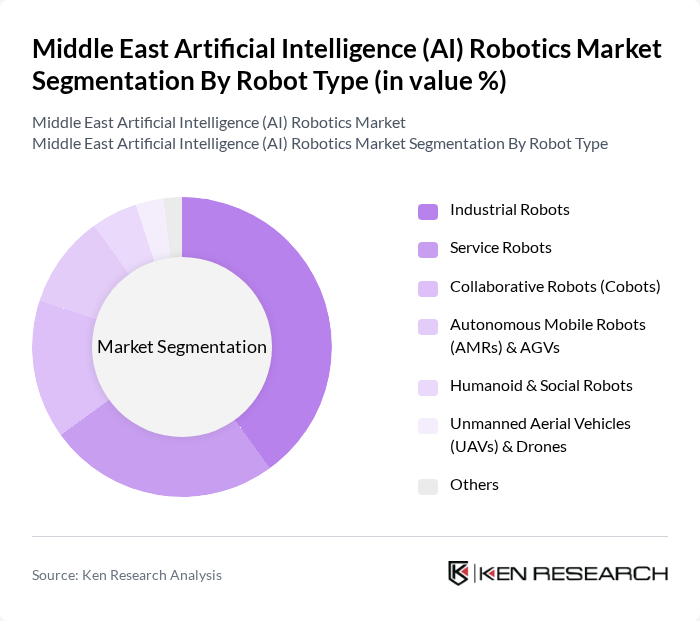
By Robot Type:The market is segmented into various robot types, including Industrial Robots, Service Robots, Collaborative Robots (Cobots), Autonomous Mobile Robots (AMRs) & AGVs, Humanoid & Social Robots, Unmanned Aerial Vehicles (UAVs) & Drones, and Others. Industrial Robots hold a leading share in the Middle East AI robotics landscape, aligned with strong industrial automation and automotive, metals, and discrete manufacturing investments in the region. Their extensive use in welding, material handling, assembly, and packaging is enhancing productivity, quality, and operational safety. Service Robots are also gaining significant traction, particularly in healthcare, hospitality, and public services, where they support tasks such as cleaning, delivery, patient support, and customer interaction, driven by labor?optimization needs and service quality improvements. Autonomous Mobile Robots (AMRs) and AGVs are expanding rapidly in warehouses and logistics centers in the UAE and Saudi Arabia, where they enable goods?to?person workflows, dynamic routing, and AI?driven inventory management.
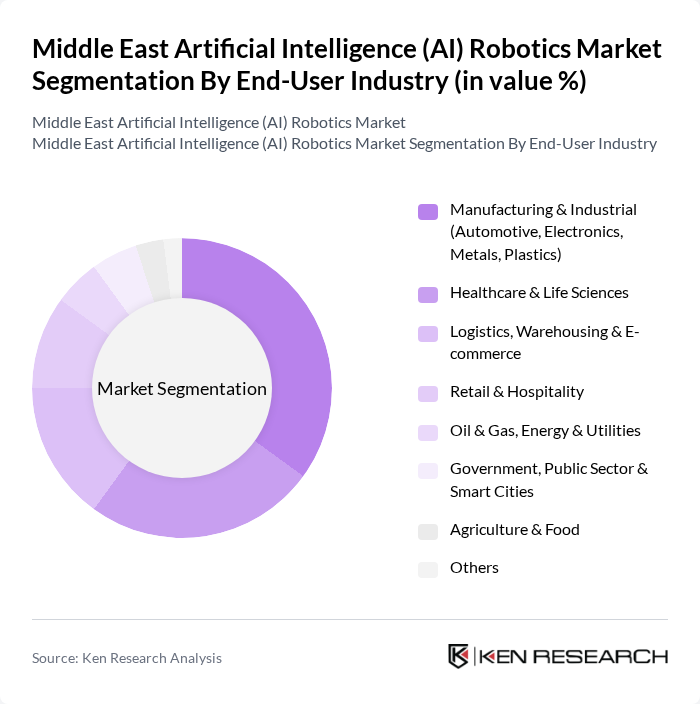
By End-User Industry:The market is segmented by end-user industries, including Manufacturing & Industrial (Automotive, Electronics, Metals, Plastics), Healthcare & Life Sciences, Logistics, Warehousing & E-commerce, Retail & Hospitality, Oil & Gas, Energy & Utilities, Government, Public Sector & Smart Cities, Agriculture & Food, and Others. The Manufacturing & Industrial sector is the dominant segment, supported by rising deployment of industrial robots, machine vision, and AMRs to enhance production efficiency, quality control, and worker safety while reducing operational costs in automotive, metals, and process industries. The Healthcare & Life Sciences sector is also witnessing significant growth, with robots being used for surgical assistance, diagnostics support, laboratory automation, rehabilitation, and patient care, reflecting a broader regional trend toward digital hospitals and smart healthcare infrastructure. Logistics, Warehousing & E-commerce form another high?growth cluster, where warehouse robotics, AMRs, and AI?enabled sortation systems are deployed to handle increasing online order volumes, improve fulfillment speed, and address labor constraints in major hubs such as Riyadh, Jeddah, Dubai, and Abu Dhabi.
Middle East Artificial Intelligence (AI) Robotics Market Competitive Landscape
The Middle East Artificial Intelligence (AI) Robotics Market is characterized by a dynamic mix of regional and international players. Leading participants such as ABB Ltd., FANUC Corporation, Yaskawa Electric Corporation, KUKA AG, Universal Robots A/S, Siemens AG, Omron Corporation, Schneider Electric SE, Huawei Technologies Co., Ltd., NVIDIA Corporation, Google LLC (Intrinsic & Robotics AI Initiatives), Microsoft Corporation (Azure Robotics & AI), Amazon Web Services, Inc. (AWS Robotics & AI), Saudi Data & AI Authority (SDAIA), G42 (Group 42 Holding Ltd.), Dubai Future Foundation, Balyo Middle East, GreyOrange, OTTO Motors, PAL Robotics S.L. contribute to innovation, geographic expansion, and service delivery in this space.
Middle East Artificial Intelligence (AI) Robotics Market Industry Analysis
Growth Drivers
- Increasing Investment in AI Technologies:The Middle East has seen a surge in AI investments, with funding reaching approximately $1.8 billion in future. Countries like the UAE and Saudi Arabia are leading this trend, with the UAE allocating $2.5 billion for AI initiatives as part of its national strategy. This financial commitment is expected to enhance AI capabilities, driving innovation and adoption across various sectors, including robotics, which is projected to benefit significantly from these investments.
- Rising Demand for Automation in Various Sectors:The demand for automation in the Middle East is projected to increase, particularly in sectors such as manufacturing and logistics. In future, the manufacturing sector alone accounted for 14% of the region's GDP, with automation technologies expected to enhance productivity by 35% in future. This shift towards automation is driving the adoption of AI robotics, as companies seek to improve efficiency and reduce operational costs in a competitive market.
- Government Initiatives Supporting AI Development:Governments in the Middle East are actively promoting AI development through various initiatives. For instance, Saudi Arabia's Vision 2030 aims to position the country as a leader in AI, with investments exceeding $25 billion in technology sectors. Similarly, the UAE's AI Strategy 2031 focuses on integrating AI into key sectors, which is expected to create a conducive environment for AI robotics growth, fostering innovation and collaboration across industries.
Market Challenges
- High Initial Investment Costs:One of the significant challenges facing the AI robotics market in the Middle East is the high initial investment required for technology adoption. For instance, the average cost of implementing AI-driven robotics solutions can exceed $600,000 per unit, which poses a barrier for small and medium enterprises. This financial hurdle limits the widespread adoption of robotics, particularly in cost-sensitive sectors, hindering overall market growth.
- Lack of Skilled Workforce:The shortage of skilled professionals in AI and robotics is a critical challenge in the Middle East. According to the World Economic Forum, the region faces a skills gap, with an estimated 1.8 million jobs in technology expected to remain unfilled in future. This lack of expertise hampers the effective implementation and maintenance of AI robotics systems, slowing down innovation and limiting the potential benefits of automation across industries.
Middle East Artificial Intelligence (AI) Robotics Market Future Outlook
The future of the AI robotics market in the Middle East appears promising, driven by technological advancements and increasing government support. As countries invest in smart city initiatives and digital transformation, the integration of AI with robotics is expected to enhance operational efficiencies across various sectors. Furthermore, the growing focus on sustainability and energy efficiency will likely shape the development of innovative robotics solutions, positioning the region as a hub for AI-driven technologies in future.
Market Opportunities
- Growth in Smart City Initiatives:The Middle East is witnessing a rapid expansion of smart city projects, with investments projected to reach $120 billion in future. These initiatives create significant opportunities for AI robotics applications in urban management, transportation, and public safety, driving demand for innovative solutions that enhance city living and operational efficiency.
- Advancements in Machine Learning and AI Algorithms:Continuous advancements in machine learning and AI algorithms are opening new avenues for robotics applications. With the global AI software market expected to reach $140 billion in future, the Middle East can leverage these innovations to develop more sophisticated robotics solutions, enhancing capabilities in sectors like healthcare, logistics, and manufacturing.
Scope of the Report
| Segment | Sub-Segments |
|---|---|
| By Robot Type | Industrial Robots Service Robots Collaborative Robots (Cobots) Autonomous Mobile Robots (AMRs) & AGVs Humanoid & Social Robots Unmanned Aerial Vehicles (UAVs) & Drones Others |
| By End-User Industry | Manufacturing & Industrial (Automotive, Electronics, Metals, Plastics) Healthcare & Life Sciences Logistics, Warehousing & E?commerce Retail & Hospitality Oil & Gas, Energy & Utilities Government, Public Sector & Smart Cities Agriculture & Food Others |
| By Application | Assembly, Welding & Material Handling Pick?and?Place, Packaging & Palletizing Inspection, Quality Control & Predictive Maintenance Surgical, Rehabilitation & Patient Assistance Cleaning, Security & Facility Management Last?Mile Delivery & Intralogistics Customer Engagement, Education & Social Robotics Others |
| By Enabling Technology | Machine Learning & Deep Learning Computer Vision & Image Recognition Natural Language Processing & Speech Interfaces Sensor Fusion, SLAM & Navigation Edge Computing & Cloud Robotics IoT Connectivity & 5G Integration Others |
| By Country/Region | Saudi Arabia United Arab Emirates Qatar Kuwait, Bahrain & Oman (Rest of GCC) Turkey Israel Rest of Middle East & North Africa |
| By Investment Source | Private Investments & Corporate Capex Government Funding & Sovereign Wealth Funds Venture Capital & Private Equity Public?Private Partnerships (PPPs) Multilateral & Development Finance Others |
| By Policy & Program Support | National AI Strategies & Digital Transformation Programs Grants, Subsidies & Innovation Funds Tax Incentives & Special Economic Zones R&D Ecosystem Support (Universities, Labs, Testbeds) Talent Development & Reskilling Initiatives Others |
Key Target Audience
Investors and Venture Capitalist Firms
Government and Regulatory Bodies (e.g., Ministry of Communications and Information Technology, UAE; Saudi Data and Artificial Intelligence Authority)
Manufacturers and Producers of Robotics Technology
Distributors and Retailers of AI Robotics Solutions
Technology Providers and Software Developers
Industry Associations (e.g., Robotics and Automation Society)
Financial Institutions and Banks
Defense and Security Agencies (e.g., Ministry of Defense, Israel)
Players Mentioned in the Report:
ABB Ltd.
FANUC Corporation
Yaskawa Electric Corporation
KUKA AG
Universal Robots A/S
Siemens AG
Omron Corporation
Schneider Electric SE
Huawei Technologies Co., Ltd.
NVIDIA Corporation
Google LLC (Intrinsic & Robotics AI Initiatives)
Microsoft Corporation (Azure Robotics & AI)
Amazon Web Services, Inc. (AWS Robotics & AI)
Saudi Data & AI Authority (SDAIA)
G42 (Group 42 Holding Ltd.)
Dubai Future Foundation
Balyo Middle East
GreyOrange
OTTO Motors
PAL Robotics S.L.
Table of Contents
Market Assessment Phase
1. Executive Summary and Approach
2. Middle East Artificial Intelligence (AI) Robotics Market Overview
2.1 Key Insights and Strategic Recommendations
2.2 Middle East Artificial Intelligence (AI) Robotics Market Overview
2.3 Definition and Scope
2.4 Evolution of Market Ecosystem
2.5 Timeline of Key Regulatory Milestones
2.6 Value Chain & Stakeholder Mapping
2.7 Business Cycle Analysis
2.8 Policy & Incentive Landscape
3. Middle East Artificial Intelligence (AI) Robotics Market Analysis
3.1 Growth Drivers
3.1.1 Increasing Investment in AI Technologies
3.1.2 Rising Demand for Automation in Various Sectors
3.1.3 Government Initiatives Supporting AI Development
3.1.4 Expanding Applications of Robotics in Healthcare and Manufacturing
3.2 Market Challenges
3.2.1 High Initial Investment Costs
3.2.2 Lack of Skilled Workforce
3.2.3 Regulatory Hurdles and Compliance Issues
3.2.4 Concerns Over Data Privacy and Security
3.3 Market Opportunities
3.3.1 Growth in Smart City Initiatives
3.3.2 Advancements in Machine Learning and AI Algorithms
3.3.3 Increasing Adoption of Robotics in Logistics and Supply Chain
3.3.4 Potential for Collaborations with Tech Startups
3.4 Market Trends
3.4.1 Integration of AI with IoT in Robotics
3.4.2 Rise of Collaborative Robots (Cobots)
3.4.3 Focus on Sustainable and Energy-Efficient Robotics
3.4.4 Growth of AI-Powered Analytics in Robotics
3.5 Government Regulation
3.5.1 Implementation of AI Ethics Guidelines
3.5.2 Standards for Robotics Safety and Performance
3.5.3 Incentives for AI Research and Development
3.5.4 Regulations on Data Usage and Privacy in AI Systems
4. SWOT Analysis
5. Stakeholder Analysis
6. Porter's Five Forces Analysis
7. Middle East Artificial Intelligence (AI) Robotics Market Market Size, 2019-2024
7.1 By Value
7.2 By Volume
7.3 By Average Selling Price
8. Middle East Artificial Intelligence (AI) Robotics Market Segmentation
8.1 By Robot Type
8.1.1 Industrial Robots
8.1.2 Service Robots
8.1.3 Collaborative Robots (Cobots)
8.1.4 Autonomous Mobile Robots (AMRs) & AGVs
8.1.5 Humanoid & Social Robots
8.1.6 Unmanned Aerial Vehicles (UAVs) & Drones
8.1.7 Others
8.2 By End-User Industry
8.2.1 Manufacturing & Industrial (Automotive, Electronics, Metals, Plastics)
8.2.2 Healthcare & Life Sciences
8.2.3 Logistics, Warehousing & E?commerce
8.2.4 Retail & Hospitality
8.2.5 Oil & Gas, Energy & Utilities
8.2.6 Government, Public Sector & Smart Cities
8.2.7 Agriculture & Food
8.2.8 Others
8.3 By Application
8.3.1 Assembly, Welding & Material Handling
8.3.2 Pick?and?Place, Packaging & Palletizing
8.3.3 Inspection, Quality Control & Predictive Maintenance
8.3.4 Surgical, Rehabilitation & Patient Assistance
8.3.5 Cleaning, Security & Facility Management
8.3.6 Last?Mile Delivery & Intralogistics
8.3.7 Customer Engagement, Education & Social Robotics
8.3.8 Others
8.4 By Enabling Technology
8.4.1 Machine Learning & Deep Learning
8.4.2 Computer Vision & Image Recognition
8.4.3 Natural Language Processing & Speech Interfaces
8.4.4 Sensor Fusion, SLAM & Navigation
8.4.5 Edge Computing & Cloud Robotics
8.4.6 IoT Connectivity & 5G Integration
8.4.7 Others
8.5 By Country/Region
8.5.1 Saudi Arabia
8.5.2 United Arab Emirates
8.5.3 Qatar
8.5.4 Kuwait, Bahrain & Oman (Rest of GCC)
8.5.5 Turkey
8.5.6 Israel
8.5.7 Rest of Middle East & North Africa
8.6 By Investment Source
8.6.1 Private Investments & Corporate Capex
8.6.2 Government Funding & Sovereign Wealth Funds
8.6.3 Venture Capital & Private Equity
8.6.4 Public?Private Partnerships (PPPs)
8.6.5 Multilateral & Development Finance
8.6.6 Others
8.7 By Policy & Program Support
8.7.1 National AI Strategies & Digital Transformation Programs
8.7.2 Grants, Subsidies & Innovation Funds
8.7.3 Tax Incentives & Special Economic Zones
8.7.4 R&D Ecosystem Support (Universities, Labs, Testbeds)
8.7.5 Talent Development & Reskilling Initiatives
8.7.6 Others
9. Middle East Artificial Intelligence (AI) Robotics Market Competitive Analysis
9.1 Market Share of Key Players
9.2 Cross Comparison of Key Players
9.2.1 Company Name
9.2.2 Regional Presence (Number of Middle East Countries Operated In)
9.2.3 Middle East AI Robotics Revenue
9.2.4 Revenue Growth Rate in Middle East AI Robotics
9.2.5 Installed Robot Base in the Middle East
9.2.6 Share of AI?Enabled Robots in Total Deployments
9.2.7 Exposure by End?User Sector (Manufacturing, Logistics, Healthcare, etc.)
9.2.8 Average Deal Size (Project / Contract Value)
9.2.9 Order Backlog / Pipeline in the Middle East
9.2.10 R&D Intensity (% of Revenue Spent on AI & Robotics R&D)
9.2.11 Partnership Ecosystem (Local SI, Telecom, Cloud, Academic)
9.2.12 Localization Level (Regional Engineering, Service & Manufacturing Footprint)
9.2.13 Compliance with Regional Standards & Data Residency Requirements
9.3 SWOT Analysis of Top Players
9.4 Pricing Analysis
9.5 Detailed Profile of Major Companies
9.5.1 ABB Ltd.
9.5.2 FANUC Corporation
9.5.3 Yaskawa Electric Corporation
9.5.4 KUKA AG
9.5.5 Universal Robots A/S
9.5.6 Siemens AG
9.5.7 Omron Corporation
9.5.8 Schneider Electric SE
9.5.9 Huawei Technologies Co., Ltd.
9.5.10 NVIDIA Corporation
9.5.11 Google LLC (Intrinsic & Robotics AI Initiatives)
9.5.12 Microsoft Corporation (Azure Robotics & AI)
9.5.13 Amazon Web Services, Inc. (AWS Robotics & AI)
9.5.14 Saudi Data & AI Authority (SDAIA)
9.5.15 G42 (Group 42 Holding Ltd.)
9.5.16 Dubai Future Foundation
9.5.17 Balyo Middle East
9.5.18 GreyOrange
9.5.19 OTTO Motors
9.5.20 PAL Robotics S.L.
10. Middle East Artificial Intelligence (AI) Robotics Market End-User Analysis
10.1 Procurement Behavior of Key Ministries
10.1.1 Budget Allocation Trends
10.1.2 Decision-Making Processes
10.1.3 Preferred Suppliers
10.1.4 Evaluation Criteria
10.2 Corporate Spend on Infrastructure & Energy
10.2.1 Investment Priorities
10.2.2 Spending Patterns
10.2.3 Key Projects
10.3 Pain Point Analysis by End-User Category
10.3.1 Common Challenges Faced
10.3.2 Technology Gaps
10.3.3 Support Needs
10.4 User Readiness for Adoption
10.4.1 Training Requirements
10.4.2 Infrastructure Readiness
10.4.3 Attitudes Towards AI
10.5 Post-Deployment ROI and Use Case Expansion
10.5.1 Measurement of Success
10.5.2 Future Use Cases
10.5.3 Feedback Mechanisms
11. Middle East Artificial Intelligence (AI) Robotics Market Future Size, 2025-2030
11.1 By Value
11.2 By Volume
11.3 By Average Selling Price
Go-To-Market Strategy Phase
1. Whitespace Analysis + Business Model Canvas
1.1 Market Gaps Identification
1.2 Business Model Framework
2. Marketing and Positioning Recommendations
2.1 Branding Strategies
2.2 Product USPs
3. Distribution Plan
3.1 Urban Retail Strategies
3.2 Rural NGO Tie-ups
4. Channel & Pricing Gaps
4.1 Underserved Routes
4.2 Pricing Bands
5. Unmet Demand & Latent Needs
5.1 Category Gaps
5.2 Consumer Segments
6. Customer Relationship
6.1 Loyalty Programs
6.2 After-sales Service
7. Value Proposition
7.1 Sustainability Initiatives
7.2 Integrated Supply Chains
8. Key Activities
8.1 Regulatory Compliance
8.2 Branding Efforts
8.3 Distribution Setup
9. Entry Strategy Evaluation
9.1 Domestic Market Entry Strategy
9.1.1 Product Mix
9.1.2 Pricing Band
9.1.3 Packaging
9.2 Export Entry Strategy
9.2.1 Target Countries
9.2.2 Compliance Roadmap
10. Entry Mode Assessment
10.1 Joint Ventures
10.2 Greenfield Investments
10.3 Mergers & Acquisitions
10.4 Distributor Model
11. Capital and Timeline Estimation
11.1 Capital Requirements
11.2 Timelines
12. Control vs Risk Trade-Off
12.1 Ownership vs Partnerships
13. Profitability Outlook
13.1 Breakeven Analysis
13.2 Long-term Sustainability
14. Potential Partner List
14.1 Distributors
14.2 Joint Ventures
14.3 Acquisition Targets
15. Execution Roadmap
15.1 Phased Plan for Market Entry
15.1.1 Market Setup
15.1.2 Market Entry
15.1.3 Growth Acceleration
15.1.4 Scale & Stabilize
15.2 Key Activities and Milestones
15.2.1 Milestone Tracking
15.2.2 Activity Scheduling
Research Methodology
Phase 1: Approach1
Desk Research
- Analysis of market reports from industry associations and government publications
- Review of academic journals and white papers on AI and robotics applications in the Middle East
- Examination of trade publications and news articles covering recent advancements and investments in AI robotics
Primary Research
- Interviews with industry experts, including AI technology developers and robotics engineers
- Surveys targeting business leaders in sectors adopting AI robotics, such as healthcare and manufacturing
- Focus groups with end-users to gather insights on user experience and expectations from AI robotics
Validation & Triangulation
- Cross-validation of findings through multiple data sources, including market reports and expert opinions
- Triangulation of quantitative data with qualitative insights from interviews and surveys
- Sanity checks conducted through expert panel reviews to ensure data accuracy and relevance
Phase 2: Market Size Estimation1
Top-down Assessment
- Estimation of the overall AI robotics market size based on regional economic indicators and technology adoption rates
- Segmentation of the market by application areas such as healthcare, manufacturing, and logistics
- Incorporation of government initiatives and funding aimed at promoting AI and robotics technologies
Bottom-up Modeling
- Collection of data from leading AI robotics firms regarding sales volumes and pricing strategies
- Estimation of market size based on unit sales and average selling prices across different sectors
- Analysis of investment trends in AI robotics startups and established companies in the region
Forecasting & Scenario Analysis
- Development of predictive models using historical data and growth trends in AI and robotics
- Scenario analysis based on varying levels of technology adoption and regulatory impacts
- Creation of baseline, optimistic, and pessimistic forecasts through 2030 to account for market volatility
Phase 3: CATI Sample Composition1
| Scope Item/Segment | Sample Size | Target Respondent Profiles |
|---|---|---|
| Healthcare Robotics Adoption | 120 | Healthcare Administrators, Robotics Engineers |
| Manufacturing Automation Solutions | 90 | Production Managers, Automation Specialists |
| Logistics and Supply Chain Robotics | 80 | Logistics Coordinators, Supply Chain Analysts |
| Consumer Robotics Market Insights | 70 | Product Managers, Marketing Directors |
| AI Robotics in Education | 60 | Educational Technologists, Curriculum Developers |
Frequently Asked Questions
What is the current value of the Middle East Artificial Intelligence Robotics Market?
The Middle East Artificial Intelligence (AI) Robotics Market is valued at approximately USD 8.2 billion, driven by increased investments in automation and advancements in AI technologies across various sectors such as manufacturing, healthcare, and logistics.
Which countries are leading in the Middle East AI Robotics Market?
What are the key applications of AI robotics in the Middle East?
What are the main types of robots used in the Middle East AI Robotics Market?
Other Regional/Country Reports
Indonesia Artificial Intelligence (AI) Robotics Market
Malaysia Artificial Intelligence (AI) Robotics Market
KSA Artificial Intelligence (AI) Robotics Market
APAC Artificial Intelligence (AI) Robotics Market
SEA Artificial Intelligence (AI) Robotics Market
Other Adjacent Reports
Brazil Drone Technology Market
Indonesia Collaborative Robots Market Report Size, Share, Growth Drivers, Trends, Opportunities & Forecast 2025–2030Mexico AI Chip Market
Why Buy From Us?

What makes us stand out is that our consultants follow Robust, Refine and Result (RRR) methodology. Robust for clear definitions, approaches and sanity checking, Refine for differentiating respondents' facts and opinions, and Result for presenting data with story.

We have set a benchmark in the industry by offering our clients with syndicated and customized market research reports featuring coverage of entire market as well as meticulous research and analyst insights.

While we don't replace traditional research, we flip the method upside down. Our dual approach of Top Bottom & Bottom Top ensures quality deliverable by not just verifying company fundamentals but also looking at the sector and macroeconomic factors.

With one step in the future, our research team constantly tries to show you the bigger picture. We help with some of the tough questions you may encounter along the way: How is the industry positioned? Best marketing channel? KPI's of competitors? By aligning every element, we help maximize success.

Our report gives you instant access to the answers and sources that other companies might choose to hide. We elaborate each steps of research methodology we have used and showcase you the sample size to earn your trust.

If you need any support, we are here! We pride ourselves on universe strength, data quality, and quick, friendly, and professional service.