Region:Middle East
Author(s):Dev
Product Code:KRAC3588
Pages:81
Published On:January 2026
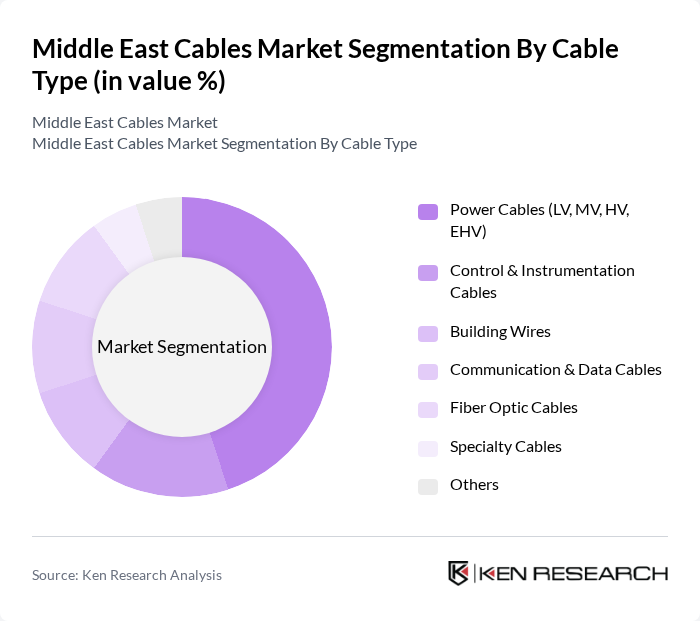
By Cable Type:The cable type segmentation includes various categories such as Power Cables (LV, MV, HV, EHV), Control & Instrumentation Cables, Building Wires, Communication & Data Cables, Fiber Optic Cables, Specialty Cables, and Others. Power Cables represent the largest share of the market due to their essential role in electricity transmission and distribution across utility networks, industrial plants, and large infrastructure projects. The increasing demand for electricity, driven by urbanization, industrial growth, and utility-scale generation and grid expansion, has led to a surge in the installation of low-, medium-, and high-voltage power cables across the region.
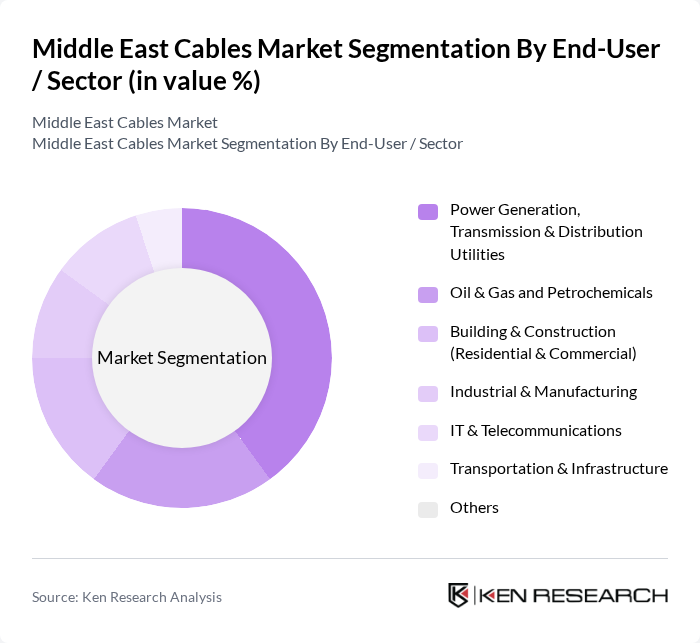
By End-User / Sector:The end-user segmentation encompasses sectors such as Power Generation, Transmission & Distribution Utilities, Oil & Gas and Petrochemicals, Building & Construction (Residential & Commercial), Industrial & Manufacturing, IT & Telecommunications, Transportation & Infrastructure, and Others. The Power Generation, Transmission & Distribution Utilities sector leads the market, supported by sustained investment in new generation capacity, grid reinforcement, and interconnection projects across the Gulf and wider Middle East. Rapid expansion of telecommunications networks, 5G rollout, and data center development is also accelerating demand for communication, data, and fiber optic cables, particularly in the UAE, Saudi Arabia, and Qatar.
The Middle East Cables Market is characterized by a dynamic mix of regional and international players. Leading participants such as Prysmian Group, Nexans, Elsewedy Electric, Riyadh Cables Group Company, Oman Cables Industry, Saudi Cable Company, Dubai Cable Company (DUCAB), National Cable Industry (NCI), Jordan Cable & Wires Manufacturing, Sumitomo Electric Industries, LS Cable & System, NEXans OLEX (Regional Operations), Alfanar, Bahra Electric, Qatar International Cable Company (QICC) contribute to innovation, geographic expansion, and service delivery in this space.
The Middle East cables market is poised for significant transformation driven by technological advancements and a strong focus on sustainability. As governments prioritize renewable energy and infrastructure development, the demand for high-performance cables is expected to rise. Additionally, the integration of smart technologies in energy management will further enhance market dynamics. Companies that adapt to these trends and invest in innovative solutions will likely capture a larger share of the evolving market landscape, ensuring long-term growth and sustainability.
| Segment | Sub-Segments |
|---|---|
| By Cable Type | Power Cables (LV, MV, HV, EHV) Control & Instrumentation Cables Building Wires Communication & Data Cables Fiber Optic Cables Specialty Cables Others |
| By End-User / Sector | Power Generation, Transmission & Distribution Utilities Oil & Gas and Petrochemicals Building & Construction (Residential & Commercial) Industrial & Manufacturing IT & Telecommunications Transportation & Infrastructure Others |
| By Country | Saudi Arabia United Arab Emirates Qatar Kuwait Oman Bahrain Rest of Middle East |
| By Application | Power & Energy Construction IT & Telecommunication Automotive & Transportation Industrial Machinery & Equipment Others |
| By Conductor Material | Copper Aluminum Copper Alloy / Other Conductive Materials Others |
| By Voltage Level | Low Voltage Medium Voltage High Voltage Extra-High Voltage |
| By Installation Type | Overhead Underground Submarine Others |
| Scope Item/Segment | Sample Size | Target Respondent Profiles |
|---|---|---|
| Telecommunications Infrastructure Projects | 120 | Project Managers, Network Engineers |
| Energy Sector Cable Installations | 90 | Operations Managers, Electrical Engineers |
| Smart City Development Initiatives | 70 | Urban Planners, Technology Consultants |
| Fiber Optic Cable Market | 110 | Product Managers, Sales Directors |
| Copper Cable Applications | 80 | Procurement Officers, Installation Supervisors |
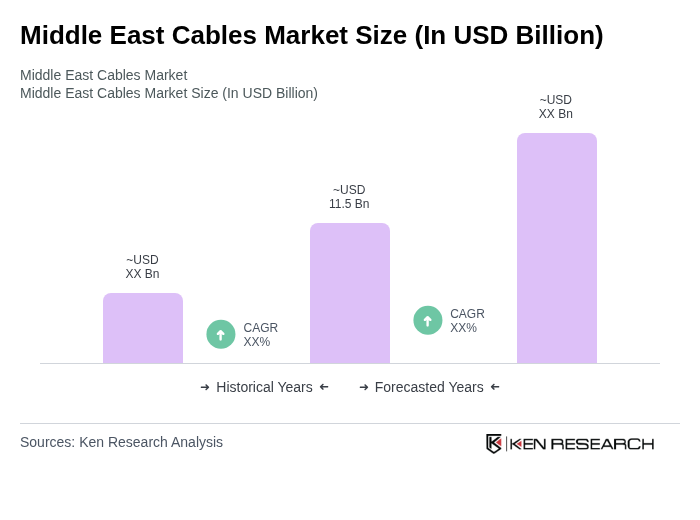
The Middle East Cables Market is valued at approximately USD 11.5 billion, driven by increasing electricity demand, urbanization, and significant infrastructure investments across the region.

What makes us stand out is that our consultants follow Robust, Refine and Result (RRR) methodology. Robust for clear definitions, approaches and sanity checking, Refine for differentiating respondents' facts and opinions, and Result for presenting data with story.

We have set a benchmark in the industry by offering our clients with syndicated and customized market research reports featuring coverage of entire market as well as meticulous research and analyst insights.

While we don't replace traditional research, we flip the method upside down. Our dual approach of Top Bottom & Bottom Top ensures quality deliverable by not just verifying company fundamentals but also looking at the sector and macroeconomic factors.

With one step in the future, our research team constantly tries to show you the bigger picture. We help with some of the tough questions you may encounter along the way: How is the industry positioned? Best marketing channel? KPI's of competitors? By aligning every element, we help maximize success.

Our report gives you instant access to the answers and sources that other companies might choose to hide. We elaborate each steps of research methodology we have used and showcase you the sample size to earn your trust.

If you need any support, we are here! We pride ourselves on universe strength, data quality, and quick, friendly, and professional service.













