Region:Middle East
Author(s):Dev
Product Code:KRAD6396
Pages:96
Published On:December 2025
By Product Type:

The product type segmentation includes Water-Jacketed Incubators, Air-Jacketed Incubators, Direct Heat Incubators, and Others. The overall market is commonly segmented in this manner, with water-jacketed carbon dioxide incubators widely recognized as a leading product category globally due to their superior temperature stability and uniformity, which are critical for sensitive cell culture applications. The preference for these incubators is driven by their reliability in maintaining optimal conditions for cell growth, stem cell culture, and IVF workflows, which is crucial in advanced research and clinical applications. Air-Jacketed Incubators are also gaining traction, particularly in laboratories focused on routine applications and where faster temperature recovery and lighter construction are valued, but Water-Jacketed models remain the preferred choice for high-precision and highly sensitive tasks.
By Capacity:
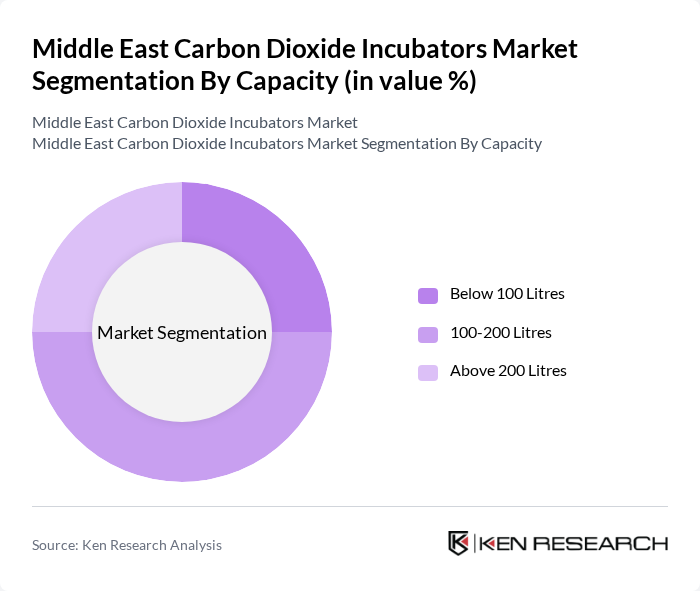
The capacity segmentation includes Below 100 Litres, 100-200 Litres, and Above 200 Litres, which is consistent with common industry taxonomy for carbon dioxide incubators. The segment of 100-200 Litres is dominating the market, as this mid-size range is widely adopted in global and regional analyses because it strikes a balance between space efficiency and capacity, making it suitable for a wide range of laboratory applications, including routine cell culture, microbiology, and IVF labs. This size is particularly favored by research institutions and hospitals that require moderate storage for biological samples and cultures while optimizing laboratory footprint. The Below 100 Litres segment is also significant, catering to smaller labs, incubator stacking configurations, and specific applications such as specialized research units and startup biotech labs, while the Above 200 Litres segment is growing due to increasing demand for larger incubators in extensive research projects, bioprocess development, and high-throughput cell culture facilities in emerging Middle Eastern life science hubs.
The Middle East Carbon Dioxide Incubators Market is characterized by a dynamic mix of regional and international players. Leading participants such as Thermo Fisher Scientific, Eppendorf AG, BINDER GmbH, PHC Holdings Corporation, Sheldon Manufacturing Inc., Memmert GmbH + Co. KG, Panasonic Healthcare, Esco Lifesciences, LabRepCo Inc., NuAire Inc., LEEC Limited, Caron Products & Services, Benchmark Scientific, Labnet International, VWR International contribute to innovation, geographic expansion, and service delivery in this space, in line with global market reports that identify these companies as key suppliers of carbon dioxide incubators worldwide.
The future of the Middle East carbon dioxide incubators market appears promising, driven by ongoing advancements in biotechnology and increased government support for research initiatives. As healthcare investments rise, the demand for high-capacity incubators is expected to grow, particularly in vaccine production and stem cell research. Additionally, the integration of IoT technologies for remote monitoring will enhance operational efficiency, positioning the market for significant growth in the coming years.
| Segment | Sub-Segments |
|---|---|
| By Product Type | Water-Jacketed Incubators Air-Jacketed Incubators Direct Heat Incubators Others |
| By Capacity | Below 100 Litres 200 Litres Above 200 Litres |
| By Application | Cell Culture Bacterial Cultivation IVF and Stem Cell Research Others |
| By End-User | Pharmaceutical & Biotechnology Companies Hospitals & Diagnostic Laboratories Academic & Research Institutes Others |
| By Country | KSA Other GCC Countries Turkiye Others |
| By Distribution Channel | Direct Sales Distributors Online Channels Others |
| Scope Item/Segment | Sample Size | Target Respondent Profiles |
|---|---|---|
| Agricultural Sector CO2 Incubator Usage | 100 | Agronomists, Farm Managers |
| Industrial Applications of CO2 Incubators | 80 | Plant Managers, Process Engineers |
| Research Institutions Utilizing CO2 Technologies | 60 | Research Scientists, Lab Managers |
| Government Policy Makers on Carbon Management | 50 | Environmental Policy Analysts, Regulatory Officials |
| Technology Providers for CO2 Solutions | 70 | Product Development Managers, Sales Directors |
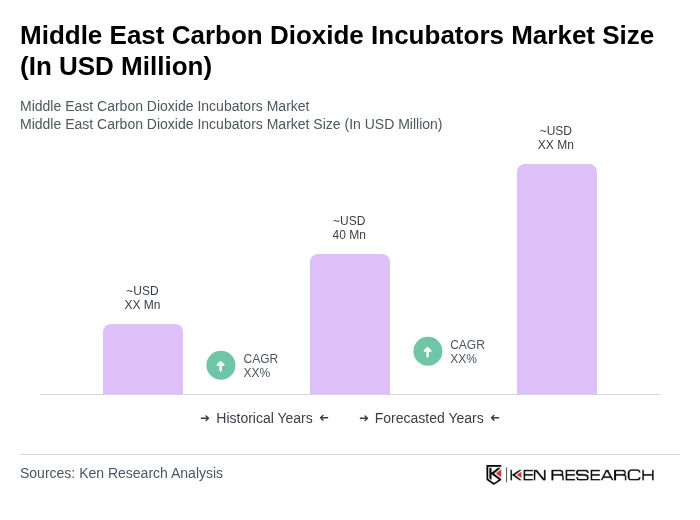
The Middle East Carbon Dioxide Incubators Market is valued at approximately USD 40 million, reflecting a significant growth driven by increased demand for advanced laboratory equipment in research and healthcare sectors across the region.

What makes us stand out is that our consultants follow Robust, Refine and Result (RRR) methodology. Robust for clear definitions, approaches and sanity checking, Refine for differentiating respondents' facts and opinions, and Result for presenting data with story.

We have set a benchmark in the industry by offering our clients with syndicated and customized market research reports featuring coverage of entire market as well as meticulous research and analyst insights.

While we don't replace traditional research, we flip the method upside down. Our dual approach of Top Bottom & Bottom Top ensures quality deliverable by not just verifying company fundamentals but also looking at the sector and macroeconomic factors.

With one step in the future, our research team constantly tries to show you the bigger picture. We help with some of the tough questions you may encounter along the way: How is the industry positioned? Best marketing channel? KPI's of competitors? By aligning every element, we help maximize success.

Our report gives you instant access to the answers and sources that other companies might choose to hide. We elaborate each steps of research methodology we have used and showcase you the sample size to earn your trust.

If you need any support, we are here! We pride ourselves on universe strength, data quality, and quick, friendly, and professional service.













