Middle East cell expansion market Size, Share, Growth Drivers, Trends, Opportunities & Forecast 2025–2030

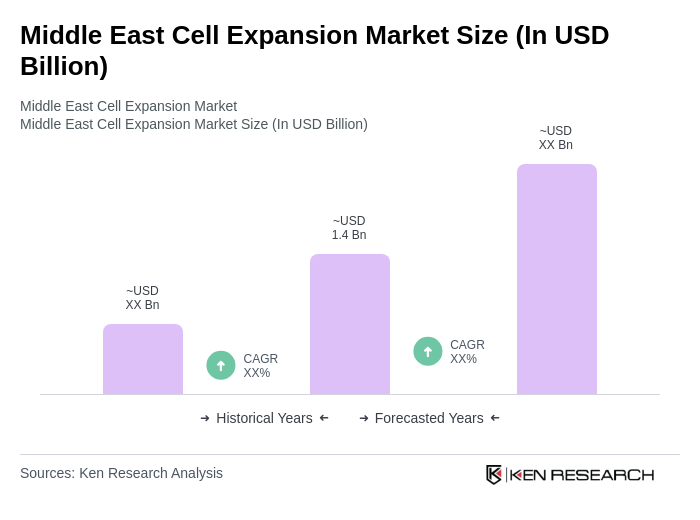
The Middle East cell expansion market, worth USD 1.4 Bn, grows with rising chronic diseases, personalized medicine, and AI integration in biopharma.

Region:Middle East

Author(s):Geetanshi

Product Code:KRAC4415

Pages:90

Published On:October 2025
About the Report

Base Year 2024

Middle East Cell Expansion Market Overview

  • The Middle East Cell Expansion Market is valued at approximately USD 1.4 billion, based on a five-year historical analysis. This growth is primarily driven by advancements in biotechnology, increasing investments in research and development, and a rising prevalence of chronic diseases that necessitate innovative treatment options. The market is also supported by the growing demand for personalized medicine and regenerative therapies, which rely heavily on cell expansion technologies. Recent trends include the integration of artificial intelligence in therapy development, government-led healthcare modernization, and the establishment of biopharma clusters, particularly in Gulf Cooperation Council countries.
  • Key players in this market include Saudi Arabia, the United Arab Emirates, and Qatar, with Israel also emerging as a significant contributor. These countries dominate the market due to their robust healthcare infrastructure, significant government funding for biotechnology research, and a high concentration of leading pharmaceutical companies. Additionally, the presence of advanced research institutions and a favorable regulatory environment further enhance their competitive edge in the cell expansion sector. Recent partnerships, such as between Cellenkos Inc. and King Faisal Specialist Hospital, highlight the region’s focus on advancing cell therapy and expanding local manufacturing capabilities.
  • In 2023, the UAE government implemented the UAE Federal Law No. 2 of 2023 on the Regulation of Human Cells, Tissues, and Organs, issued by the Ministry of Health and Prevention. This regulation mandates that all cell expansion and therapy facilities adhere to stringent Good Manufacturing Practices (GMP) and undergo regular inspections by the National Committee for Bioethics. Compliance is required for licensing, and facilities must meet international standards for quality, safety, and efficacy in cell-based therapies. The initiative is designed to foster innovation while ensuring patient safety and product efficacy in the rapidly evolving field of regenerative medicine.
Middle East Cell Expansion Market Size

Middle East Cell Expansion Market Segmentation

By Cell Type:The cell type segmentation includes various categories such as Stem Cells, T Cells, B Cells, Mesenchymal Stem Cells, Induced Pluripotent Stem Cells (iPSCs), and Others. Among these, Stem Cells are the leading subsegment due to their extensive applications in regenerative medicine and cancer treatment. The increasing focus on stem cell research and therapy has driven significant investments, making it a dominant player in the market. The expansion of stem cell research, CAR-T therapies, and regenerative medicine initiatives across the region further supports this trend.
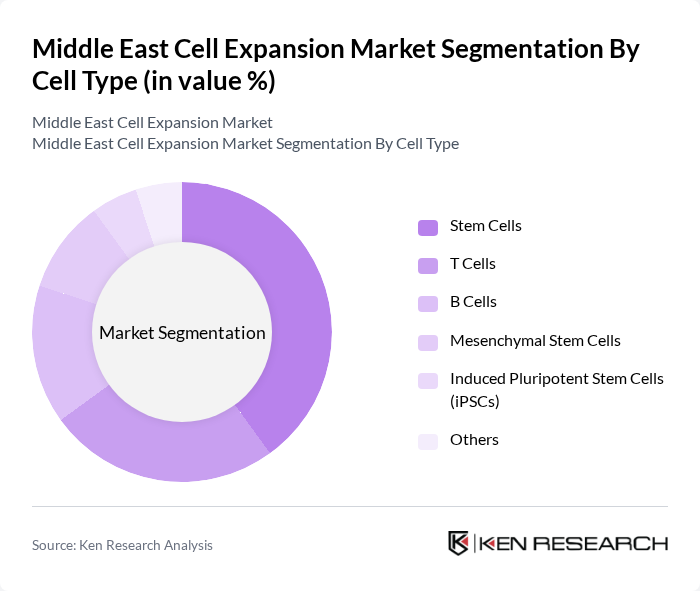
Middle East Cell Expansion Market segmentation by Cell Type.

By Product:The product segmentation encompasses Consumables (Media, Reagents, Supplements), Instruments (Bioreactors, Cell Culture Systems), Automated Cell Expansion Platforms, and Others. Consumables are the leading subsegment, driven by the increasing demand for high-quality media and reagents essential for cell culture processes. The growing number of research activities and clinical trials further supports the dominance of this subsegment in the market. Cell culture supplements, in particular, hold the largest share within consumables, reflecting their critical role in supporting cell growth, viability, and productivity in therapy development and manufacturing.
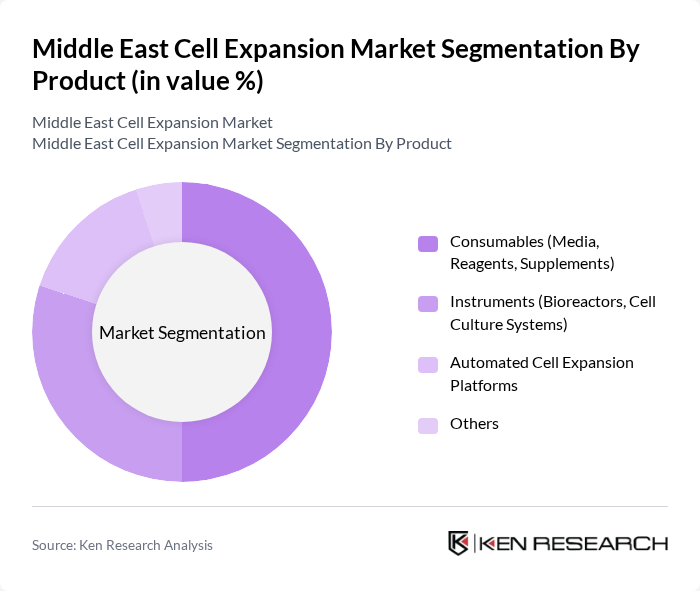
Middle East Cell Expansion Market segmentation by Product.

Middle East Cell Expansion Market Competitive Landscape

The Middle East Cell Expansion Market is characterized by a dynamic mix of regional and international players. Leading participants such as Thermo Fisher Scientific Inc., Merck KGaA, Lonza Group AG, Becton, Dickinson and Company, Sartorius AG, GE HealthCare, Fujifilm Irvine Scientific, Miltenyi Biotec, STEMCELL Technologies Inc., Eppendorf AG, Bio-Rad Laboratories, Inc., Agilent Technologies, Inc., Charles River Laboratories, Corning Incorporated, 10x Genomics, Inc., Novartis AG, Roche Holding AG / Spark Therapeutics, Gilead Sciences, Inc. (Kite Pharma), AstraZeneca plc, Sanofi S.A., Janssen Pharmaceuticals (Johnson & Johnson), Takeda Pharmaceutical Company Limited, Moderna, Inc., Bluebird Bio, Inc., Catalent, Inc., Aspen Pharmacare Holdings Limited contribute to innovation, geographic expansion, and service delivery in this space.

Thermo Fisher Scientific Inc.

2006

Waltham, Massachusetts, USA

Merck KGaA

1668

Darmstadt, Germany

Lonza Group AG

1897

Basel, Switzerland

Becton, Dickinson and Company

1897

Franklin Lakes, New Jersey, USA

Sartorius AG

1870

Göttingen, Germany

Company

Establishment Year

Headquarters

Group Size (Large, Medium, Small)

Revenue Growth Rate (YoY %)

Market Penetration Rate (Regional Coverage %)

R&D Investment Ratio (% of Revenue)

Product Portfolio Breadth (Number of Cell Expansion Products/Services)

Clinical Trial Pipeline (Number of Active Trials in Region)

Middle East Cell Expansion Market Industry Analysis

Growth Drivers

  • Increasing Demand for Cell Expansion Technologies:The Middle East is witnessing a surge in demand for cell expansion technologies, driven by a growing prevalence of chronic diseases. In future, the region is projected to have over 1.5 million new cancer cases, necessitating advanced therapeutic solutions. Additionally, the global cell therapy market is expected to reach $10 billion, with the Middle East contributing significantly due to its expanding healthcare infrastructure and increasing patient awareness regarding innovative treatments.
  • Advancements in Biomanufacturing Processes:The biomanufacturing sector in the Middle East is evolving rapidly, with investments exceeding $1 billion in future. This growth is fueled by technological advancements that enhance the efficiency and scalability of cell expansion processes. Notably, the introduction of automated systems and improved bioreactor designs is expected to increase production capacity by 30%, enabling local companies to meet the rising demand for biologics and cell-based therapies effectively.
  • Rising Investment in Regenerative Medicine:Investment in regenerative medicine within the Middle East is projected to surpass $500 million in future, reflecting a robust commitment to innovative healthcare solutions. This influx of capital is primarily directed towards research and development initiatives aimed at harnessing the potential of stem cells and tissue engineering. As a result, the region is poised to become a hub for cutting-edge regenerative therapies, further driving the demand for cell expansion technologies.

Market Challenges

  • High Costs of Cell Expansion Technologies:The high costs associated with cell expansion technologies pose a significant challenge for market growth in the Middle East. In future, the average expenditure for advanced cell culture systems is estimated to be around $250,000 per facility. This financial barrier limits accessibility for smaller biotech firms and research institutions, hindering innovation and the widespread adoption of these essential technologies in the region.
  • Regulatory Hurdles:Navigating the regulatory landscape in the Middle East presents a considerable challenge for companies in the cell expansion market. In future, the average time for obtaining regulatory approval for new cell-based therapies is projected to be approximately 18 months. This lengthy process can delay product launches and increase operational costs, discouraging investment and innovation in the sector, ultimately impacting the growth potential of the market.

Middle East Cell Expansion Market Future Outlook

The future of the Middle East cell expansion market appears promising, driven by technological advancements and increasing healthcare investments. As the region embraces automation and AI integration in cell expansion processes, efficiency and scalability are expected to improve significantly. Furthermore, the growing focus on personalized medicine will likely lead to tailored therapies, enhancing patient outcomes. These trends indicate a robust growth trajectory, positioning the Middle East as a key player in the global cell expansion landscape.

Market Opportunities

  • Expansion of Research and Development Activities:The Middle East is witnessing a surge in R&D activities, with funding for biotech research projected to reach $300 million in future. This investment will foster innovation in cell expansion technologies, creating opportunities for local firms to develop novel therapies and enhance their competitive edge in the global market.
  • Collaborations with Academic Institutions:Collaborations between biotech companies and academic institutions are on the rise, with over 50 partnerships expected to be established in future. These alliances will facilitate knowledge transfer and resource sharing, driving advancements in cell expansion methodologies and accelerating the development of new therapeutic solutions in the region.

Scope of the Report

SegmentSub-Segments
By Cell Type

Stem Cells

T Cells

B Cells

Mesenchymal Stem Cells

Induced Pluripotent Stem Cells (iPSCs)

Others

By Product

Consumables (Media, Reagents, Supplements)

Instruments (Bioreactors, Cell Culture Systems)

Automated Cell Expansion Platforms

Others

By Application

Cancer Treatment

Regenerative Medicine

Drug Development & Discovery

Clinical Trials

Others

By End-User

Hospitals & Clinics

Research Laboratories

Biopharmaceutical & Pharmaceutical Companies

Academic & Research Institutions

Contract Development & Manufacturing Organizations (CDMOs)

By Distribution Channel

Direct Sales

Online Sales

Distributors

By Region

GCC Countries (Saudi Arabia, UAE, Qatar, Kuwait, Bahrain, Oman)

Levant Region (Jordan, Lebanon, Iraq, Syria, Palestine)

North Africa (Egypt, Morocco, Algeria, Tunisia)

Others

By Investment Source

Private Investments

Government Funding

Venture Capital

Public-Private Partnerships

By Policy Support

Grants and Subsidies

Tax Incentives

Research Funding Programs

Key Target Audience

Investors and Venture Capitalist Firms

Government and Regulatory Bodies (e.g., Ministry of Health, Food and Drug Administration)

Biotechnology and Pharmaceutical Companies

Healthcare Providers and Hospitals

Medical Device Manufacturers

Research and Development Organizations

Industry Associations (e.g., Middle East Biotechnology Association)

Pharmaceutical Supply Chain Companies

Players Mentioned in the Report:

Thermo Fisher Scientific Inc.

Merck KGaA

Lonza Group AG

Becton, Dickinson and Company

Sartorius AG

GE HealthCare

Fujifilm Irvine Scientific

Miltenyi Biotec

STEMCELL Technologies Inc.

Eppendorf AG

Bio-Rad Laboratories, Inc.

Agilent Technologies, Inc.

Charles River Laboratories

Corning Incorporated

10x Genomics, Inc.

Novartis AG

Roche Holding AG / Spark Therapeutics

Gilead Sciences, Inc. (Kite Pharma)

AstraZeneca plc

Sanofi S.A.

Janssen Pharmaceuticals (Johnson & Johnson)

Takeda Pharmaceutical Company Limited

Moderna, Inc.

Bluebird Bio, Inc.

Catalent, Inc.

Aspen Pharmacare Holdings Limited

Table of Contents

Market Assessment Phase

1. Executive Summary and Approach


2. Middle East Cell Expansion Market Overview

2.1 Key Insights and Strategic Recommendations

2.2 Middle East Cell Expansion Market Overview

2.3 Definition and Scope

2.4 Evolution of Market Ecosystem

2.5 Timeline of Key Regulatory Milestones

2.6 Value Chain & Stakeholder Mapping

2.7 Business Cycle Analysis

2.8 Policy & Incentive Landscape


3. Middle East Cell Expansion Market Analysis

3.1 Growth Drivers

3.1.1 Increasing Demand for Cell Expansion Technologies
3.1.2 Advancements in Biomanufacturing Processes
3.1.3 Rising Investment in Regenerative Medicine
3.1.4 Supportive Government Initiatives

3.2 Market Challenges

3.2.1 High Costs of Cell Expansion Technologies
3.2.2 Regulatory Hurdles
3.2.3 Limited Skilled Workforce
3.2.4 Competition from Alternative Therapies

3.3 Market Opportunities

3.3.1 Expansion of Research and Development Activities
3.3.2 Collaborations with Academic Institutions
3.3.3 Growth in Personalized Medicine
3.3.4 Emerging Markets in the Region

3.4 Market Trends

3.4.1 Shift Towards Automation in Cell Expansion
3.4.2 Increasing Use of 3D Cell Culture Systems
3.4.3 Focus on Sustainable Practices
3.4.4 Integration of AI in Cell Expansion Processes

3.5 Government Regulation

3.5.1 Compliance with International Standards
3.5.2 Approval Processes for New Technologies
3.5.3 Funding for Biotech Initiatives
3.5.4 Ethical Guidelines for Cell Research

4. SWOT Analysis


5. Stakeholder Analysis


6. Porter's Five Forces Analysis


7. Middle East Cell Expansion Market Market Size, 2019-2024

7.1 By Value

7.2 By Volume

7.3 By Average Selling Price


8. Middle East Cell Expansion Market Segmentation

8.1 By Cell Type

8.1.1 Stem Cells
8.1.2 T Cells
8.1.3 B Cells
8.1.4 Mesenchymal Stem Cells
8.1.5 Induced Pluripotent Stem Cells (iPSCs)
8.1.6 Others

8.2 By Product

8.2.1 Consumables (Media, Reagents, Supplements)
8.2.2 Instruments (Bioreactors, Cell Culture Systems)
8.2.3 Automated Cell Expansion Platforms
8.2.4 Others

8.3 By Application

8.3.1 Cancer Treatment
8.3.2 Regenerative Medicine
8.3.3 Drug Development & Discovery
8.3.4 Clinical Trials
8.3.5 Others

8.4 By End-User

8.4.1 Hospitals & Clinics
8.4.2 Research Laboratories
8.4.3 Biopharmaceutical & Pharmaceutical Companies
8.4.4 Academic & Research Institutions
8.4.5 Contract Development & Manufacturing Organizations (CDMOs)

8.5 By Distribution Channel

8.5.1 Direct Sales
8.5.2 Online Sales
8.5.3 Distributors

8.6 By Region

8.6.1 GCC Countries (Saudi Arabia, UAE, Qatar, Kuwait, Bahrain, Oman)
8.6.2 Levant Region (Jordan, Lebanon, Iraq, Syria, Palestine)
8.6.3 North Africa (Egypt, Morocco, Algeria, Tunisia)
8.6.4 Others

8.7 By Investment Source

8.7.1 Private Investments
8.7.2 Government Funding
8.7.3 Venture Capital
8.7.4 Public-Private Partnerships

8.8 By Policy Support

8.8.1 Grants and Subsidies
8.8.2 Tax Incentives
8.8.3 Research Funding Programs

9. Middle East Cell Expansion Market Competitive Analysis

9.1 Market Share of Key Players

9.2 KPIs for Cross Comparison of Key Players

9.2.1 Company Name
9.2.2 Group Size (Large, Medium, Small)
9.2.3 Revenue Growth Rate (YoY %)
9.2.4 Market Penetration Rate (Regional Coverage %)
9.2.5 R&D Investment Ratio (% of Revenue)
9.2.6 Product Portfolio Breadth (Number of Cell Expansion Products/Services)
9.2.7 Clinical Trial Pipeline (Number of Active Trials in Region)
9.2.8 Regulatory Approvals (Number of Approved Therapies/Technologies)
9.2.9 Manufacturing Capacity (Liters or Units per Year)
9.2.10 Strategic Partnerships (Number of Regional Collaborations)
9.2.11 Customer Retention Rate (%)
9.2.12 Pricing Strategy (Premium, Value, Volume)
9.2.13 Product Innovation Rate (New Launches per Year)
9.2.14 Operational Efficiency (Lead Time, Cost per Batch)
9.2.15 Market Share Percentage (%)
9.2.16 Customer Satisfaction Index (Survey Score)

9.3 SWOT Analysis of Top Players

9.4 Pricing Analysis

9.5 Detailed Profile of Major Companies

9.5.1 Thermo Fisher Scientific Inc.
9.5.2 Merck KGaA
9.5.3 Lonza Group AG
9.5.4 Becton, Dickinson and Company
9.5.5 Sartorius AG
9.5.6 GE HealthCare
9.5.7 Fujifilm Irvine Scientific
9.5.8 Miltenyi Biotec
9.5.9 STEMCELL Technologies Inc.
9.5.10 Eppendorf AG
9.5.11 Bio-Rad Laboratories, Inc.
9.5.12 Agilent Technologies, Inc.
9.5.13 Charles River Laboratories
9.5.14 Corning Incorporated
9.5.15 10x Genomics, Inc.
9.5.16 Novartis AG
9.5.17 Roche Holding AG / Spark Therapeutics
9.5.18 Gilead Sciences, Inc. (Kite Pharma)
9.5.19 AstraZeneca plc
9.5.20 Sanofi S.A.
9.5.21 Janssen Pharmaceuticals (Johnson & Johnson)
9.5.22 Takeda Pharmaceutical Company Limited
9.5.23 Moderna, Inc.
9.5.24 Bluebird Bio, Inc.
9.5.25 Catalent, Inc.
9.5.26 Aspen Pharmacare Holdings Limited

10. Middle East Cell Expansion Market End-User Analysis

10.1 Procurement Behavior of Key Ministries

10.1.1 Budget Allocation Trends
10.1.2 Decision-Making Processes
10.1.3 Preferred Suppliers

10.2 Corporate Spend on Infrastructure & Energy

10.2.1 Investment Priorities
10.2.2 Spending Patterns
10.2.3 Long-term Contracts

10.3 Pain Point Analysis by End-User Category

10.3.1 Cost Constraints
10.3.2 Technology Limitations
10.3.3 Regulatory Compliance Issues

10.4 User Readiness for Adoption

10.4.1 Training Needs
10.4.2 Infrastructure Readiness
10.4.3 Awareness Levels

10.5 Post-Deployment ROI and Use Case Expansion

10.5.1 Performance Metrics
10.5.2 Case Studies
10.5.3 Future Expansion Plans

11. Middle East Cell Expansion Market Future Size, 2025-2030

11.1 By Value

11.2 By Volume

11.3 By Average Selling Price


Go-To-Market Strategy Phase

1. Whitespace Analysis + Business Model Canvas

1.1 Market Gaps Identification

1.2 Value Proposition Development

1.3 Revenue Streams Analysis


2. Marketing and Positioning Recommendations

2.1 Branding Strategies

2.2 Product USPs


3. Distribution Plan

3.1 Urban Retail Strategies

3.2 Rural NGO Tie-ups


4. Channel & Pricing Gaps

4.1 Underserved Routes

4.2 Pricing Bands Analysis


5. Unmet Demand & Latent Needs

5.1 Category Gaps

5.2 Consumer Segments


6. Customer Relationship

6.1 Loyalty Programs

6.2 After-sales Service


7. Value Proposition

7.1 Sustainability Initiatives

7.2 Integrated Supply Chains


8. Key Activities

8.1 Regulatory Compliance

8.2 Branding Efforts

8.3 Distribution Setup


9. Entry Strategy Evaluation

9.1 Domestic Market Entry Strategy

9.1.1 Product Mix Considerations
9.1.2 Pricing Band Strategy
9.1.3 Packaging Solutions

9.2 Export Entry Strategy

9.2.1 Target Countries
9.2.2 Compliance Roadmap

10. Entry Mode Assessment

10.1 Joint Ventures

10.2 Greenfield Investments

10.3 Mergers & Acquisitions

10.4 Distributor Model


11. Capital and Timeline Estimation

11.1 Capital Requirements

11.2 Timelines for Implementation


12. Control vs Risk Trade-Off

12.1 Ownership Considerations

12.2 Partnerships Evaluation


13. Profitability Outlook

13.1 Breakeven Analysis

13.2 Long-term Sustainability Strategies


14. Potential Partner List

14.1 Distributors

14.2 Joint Ventures

14.3 Acquisition Targets


15. Execution Roadmap

15.1 Phased Plan for Market Entry

15.1.1 Market Setup
15.1.2 Market Entry
15.1.3 Growth Acceleration
15.1.4 Scale & Stabilize

15.2 Key Activities and Milestones

15.2.1 Milestone Planning
15.2.2 Activity Tracking

Research Methodology

ApproachModellingSample

Phase 1: Approach1

Desk Research

  • Industry reports from regional health authorities and market research firms
  • Published articles and white papers on cell expansion technologies and trends
  • Statistical data from the Middle East's biotechnology and pharmaceutical sectors

Primary Research

  • Interviews with key opinion leaders in cell therapy and regenerative medicine
  • Surveys targeting laboratory managers and researchers in biotech firms
  • Field interviews with executives from leading cell expansion technology providers

Validation & Triangulation

  • Cross-validation of findings through multiple expert interviews
  • Triangulation of data from academic publications and industry reports
  • Sanity checks through feedback from a panel of industry experts

Phase 2: Market Size Estimation1

Top-down Assessment

  • Analysis of the overall healthcare expenditure in the Middle East
  • Estimation of market share for cell expansion technologies within the biopharmaceutical sector
  • Incorporation of government funding and initiatives for biotechnology research

Bottom-up Modeling

  • Volume estimates based on the number of active research institutions and biotech firms
  • Cost analysis of cell expansion products and services offered in the region
  • Revenue projections based on historical sales data from key market players

Forecasting & Scenario Analysis

  • Multi-variable regression analysis considering factors like population growth and healthcare advancements
  • Scenario modeling based on potential regulatory changes and technological innovations
  • Baseline, optimistic, and pessimistic forecasts through 2030

Phase 3: CATI Sample Composition1

Scope Item/SegmentSample SizeTarget Respondent Profiles
Biotech Research Institutions45Research Scientists, Lab Managers
Pharmaceutical Companies40Product Development Heads, Regulatory Affairs Managers
Healthcare Providers35Clinical Researchers, Medical Directors
Cell Expansion Technology Suppliers30Sales Managers, Technical Support Specialists
Regulatory Bodies20Policy Makers, Compliance Officers

Frequently Asked Questions

What is the current value of the Middle East Cell Expansion Market?

The Middle East Cell Expansion Market is valued at approximately USD 1.4 billion, driven by advancements in biotechnology, increased R&D investments, and a rising prevalence of chronic diseases necessitating innovative treatment options.

Which countries are leading in the Middle East Cell Expansion Market?

What are the main drivers of growth in the Middle East Cell Expansion Market?

What challenges does the Middle East Cell Expansion Market face?

Other Regional/Country Reports

Indonesia Cell Expansion Market

Malaysia Cell Expansion Market

KSA Cell Expansion Market

APAC Cell Expansion Market

SEA Cell Expansion Market

Vietnam Cell Expansion Market

Why Buy From Us?

Refine Robust Result (RRR) Framework

What makes us stand out is that our consultants follow Robust, Refine and Result (RRR) methodology. Robust for clear definitions, approaches and sanity checking, Refine for differentiating respondents' facts and opinions, and Result for presenting data with story.

Our Reach Is Unmatched

We have set a benchmark in the industry by offering our clients with syndicated and customized market research reports featuring coverage of entire market as well as meticulous research and analyst insights.

Shifting the Research Paradigm

While we don't replace traditional research, we flip the method upside down. Our dual approach of Top Bottom & Bottom Top ensures quality deliverable by not just verifying company fundamentals but also looking at the sector and macroeconomic factors.

More Insights-Better Decisions

With one step in the future, our research team constantly tries to show you the bigger picture. We help with some of the tough questions you may encounter along the way: How is the industry positioned? Best marketing channel? KPI's of competitors? By aligning every element, we help maximize success.

Transparency and Trust

Our report gives you instant access to the answers and sources that other companies might choose to hide. We elaborate each steps of research methodology we have used and showcase you the sample size to earn your trust.

Round the Clock Support

If you need any support, we are here! We pride ourselves on universe strength, data quality, and quick, friendly, and professional service.

Why Clients Choose Us?

400000+
Reports in repository
150+
Consulting projects a year
100+
Analysts
8000+
Client Queries in 2022








