Middle East Chickpea Snacks Market Report Size Share Growth Drivers Trends Opportunities & Forecast 2025–2030

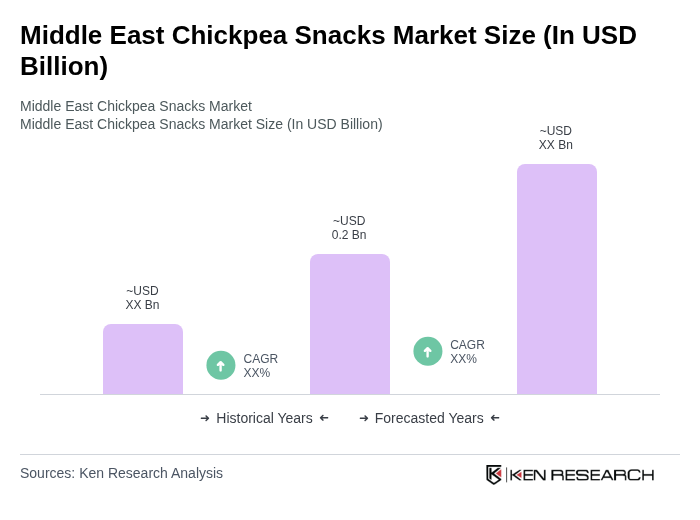
Middle East Chickpea Snacks Market, valued at USD 0.2 Bn, grows due to rising health awareness and plant-based trends, featuring roasted snacks and adult consumers as key segments.

Region:Middle East

Author(s):Dev

Product Code:KRAB1704

Pages:82

Published On:January 2026
About the Report

Base Year 2024

Middle East Chickpea Snacks Market Overview

  • The Middle East Chickpea Snacks Market is valued at USD 0.2 billion, based on a five-year historical analysis. This growth is primarily driven by the increasing demand for healthy snacking options, rising health consciousness among consumers, and the growing popularity of plant-based diets. The market has seen a significant shift towards nutritious snacks, with chickpea-based products gaining traction due to their high protein and fiber content and their positioning as gluten-free and minimally processed plant-based snacks.
  • Key country markets in this segment include Saudi Arabia, the United Arab Emirates, and Qatar, which together account for a substantial share of chickpea consumption and chickpea-based snack innovation within the broader Middle East chickpeas market. These countries benefit from an affluent consumer base, high disposable incomes, and a strong trend towards health and wellness, with urbanization and lifestyle changes further fueling demand for convenient, better-for-you snack options. Modern retail and e?commerce penetration in cities such as Riyadh, Jeddah, Dubai, Abu Dhabi, and Doha is also expanding shelf space for roasted chickpeas, chickpea chips, and ready-to-eat hummus-based formats.
  • In the United Arab Emirates, the government has introduced multiple policy measures to promote healthier food environments, including front-of-pack nutrition labelling and reformulation incentives, which affect snack categories. A key instrument is the “Healthy Food Environment Policy” framework and related initiatives led by the Ministry of Health and Prevention and local authorities, which encourage reductions in sugar, salt, and unhealthy fats in processed foods, support clear nutrition information, and promote healthier product portfolios in schools, hospitals, and public institutions. These measures encourage manufacturers and importers of snack products, including chickpea-based snacks, to innovate with baked, low-oil, reduced-sodium, and higher-fiber formulations aligned with growing consumer preference for nutritious food products.
Middle East Chickpea Snacks Market Size

Middle East Chickpea Snacks Market Segmentation

By Product Type:The product type segmentation includes various forms of chickpea snacks that cater to diverse consumer preferences. The subsegments are Roasted Chickpea Snacks, Chickpea Chips & Crackers, Extruded Chickpea Puffs, Baked Chickpea Bars & Bites, Hummus-Based and Dips Formats, and Others (Coated Nuts, Trail Mixes, etc.).
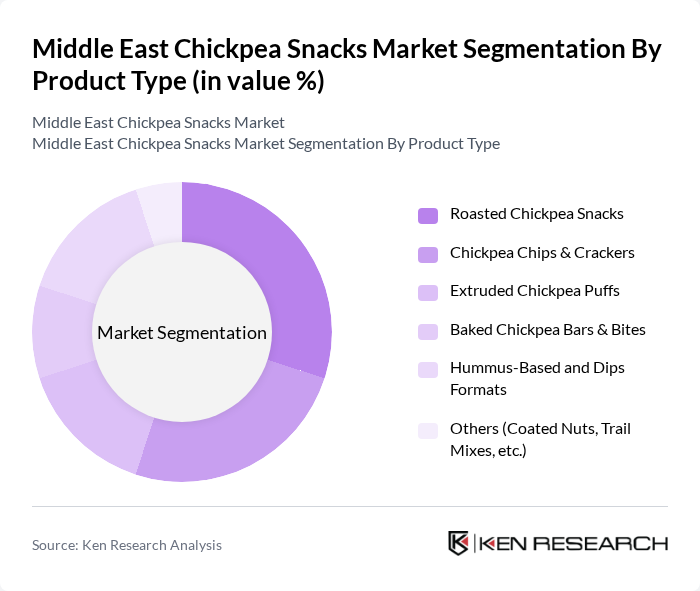
Middle East Chickpea Snacks Market segmentation by Product Type.

The Roasted Chickpea Snacks segment leads the market due to their popularity as a healthy snack alternative, appealing to health-conscious consumers who look for high-protein, high-fiber, and low-glycemic options. This segment benefits from the growing trend of snacking on plant-based, baked or dry-roasted products that are perceived as cleaner-label and better-for-you, with a wide range of regional and fusion flavors tailored to Middle Eastern tastes. Chickpea Chips & Crackers follow closely, driven by their convenience, on-the-go packaging, and the increasing demand for gluten-free and pulse-based alternatives to conventional potato or wheat-based snacks. The market is witnessing a shift towards innovative flavors (such as za’atar, chili-lime, and barbecue), clean-label ingredients, reduced oil usage, and higher protein claims, further enhancing the appeal of these products among both mainstream and niche health-focused consumers.

By Consumer Type:This segmentation focuses on the different consumer demographics that purchase chickpea snacks. The subsegments include Adults, Kids & Teens, Athletes & Fitness Enthusiasts, and Others.
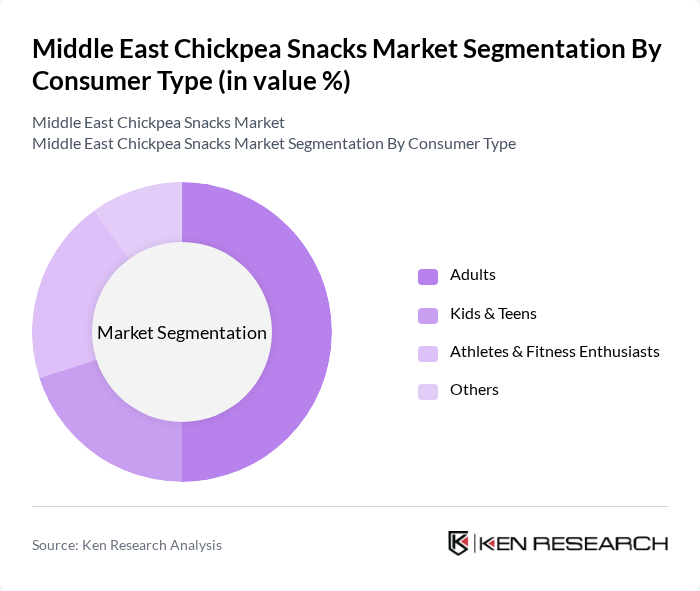
Middle East Chickpea Snacks Market segmentation by Consumer Type.

The Adults segment dominates the market, accounting for around half of the total consumption, as working-age consumers increasingly seek nutritious, portion-controlled snacks that fit busy urban lifestyles and support weight management and metabolic health. The Athletes & Fitness Enthusiasts segment is also significant, as these consumers prioritize high-protein, high-fiber, and low-additive snacks to support sports performance, gym routines, and active lifestyles, often favoring roasted chickpeas, puffs, and protein-enriched bars. The Kids & Teens segment is growing, driven by parents' preferences for healthier snack choices with cleaner ingredient lists and lower sugar content for their children, as well as school and government campaigns promoting better nutrition, which together further propel demand for chickpea-based options in lunchboxes and after-school snacking.

Middle East Chickpea Snacks Market Competitive Landscape

The Middle East Chickpea Snacks Market is characterized by a dynamic mix of regional and international players. Leading participants such as PepsiCo (Lay’s, Off The Eaten Path, Bare Snacks), Calbee Group, General Mills (Food Should Taste Good), The Good Bean Inc., Hippeas Organic Chickpea Snacks, Nestlé Middle East, Baladna Food Industries, Al Rifai Roastery, Hunter Foods LLC (Hunter’s Gourmet), Amazon Foods, B&G Foods (Biena Snacks), local & regional private label brands (Carrefour, Lulu, etc.), emerging D2C health snack brands in GCC, online-only chickpea snack brands, and other notable regional snack manufacturers contribute to innovation, geographic expansion, and service delivery in this space, often emphasizing clean-label positioning, plant protein, and regionally inspired flavors.

PepsiCo

1965

Purchase, New York, USA

Calbee Group

1949

Tokyo, Japan

General Mills

1928

Minneapolis, Minnesota, USA

The Good Bean Inc.

2010

Berkeley, California, USA

Hippeas Organic Chickpea Snacks

2016

Los Angeles, California, USA

Company

Establishment Year

Headquarters

Ownership / Group Type (Local, Regional, Global)

Middle East Chickpea Snack Revenues (USD Mn)

3-Year Revenue CAGR in Chickpea Snacks (%)

EBITDA Margin from Chickpea Snack Portfolio (%)

Market Share in Middle East Chickpea Snacks (%)

Number of SKUs / Product Lines in Chickpea Snacks

Middle East Chickpea Snacks Market Industry Analysis

Growth Drivers

  • Increasing Health Consciousness:The Middle East has seen a significant rise in health awareness, with 60% of consumers actively seeking healthier snack options. This trend is supported by the World Health Organization's report indicating that obesity rates in the region have increased by 30% over the past decade. As a result, chickpea snacks, known for their high protein and fiber content, are gaining traction among health-conscious consumers, driving market growth.
  • Rising Demand for Plant-Based Snacks:The plant-based snack market in the Middle East is projected to reach $1.8 billion in future, reflecting a growing preference for vegetarian and vegan diets. According to the International Food Information Council, 45% of consumers in the region are incorporating more plant-based foods into their diets. This shift is propelling the demand for chickpea snacks, which are perceived as nutritious and sustainable alternatives to traditional snacks.
  • Expansion of Retail Channels:The retail landscape in the Middle East is evolving, with a 30% increase in the number of health food stores and specialty shops over the last three years. The rise of e-commerce platforms, which saw a 35% growth in online grocery sales in future, is also facilitating access to chickpea snacks. This expansion allows consumers to easily find and purchase these products, further boosting market penetration and sales.

Market Challenges

  • High Competition from Traditional Snacks:The chickpea snacks market faces intense competition from established traditional snacks, which dominate 70% of the overall snack market in the Middle East. Brands like chips and cookies have strong consumer loyalty, making it challenging for chickpea snacks to gain market share. This competition is exacerbated by aggressive marketing strategies employed by traditional snack manufacturers, hindering the growth of healthier alternatives.
  • Price Sensitivity Among Consumers:Price sensitivity remains a significant barrier, with 55% of consumers in the Middle East indicating that cost is a primary factor in their snack choices. The average price of chickpea snacks is 20% higher than traditional snacks, which can deter price-conscious consumers. This challenge is particularly pronounced in lower-income segments, where affordability is crucial for market penetration and growth.

Middle East Chickpea Snacks Market Future Outlook

The future of the Middle East chickpea snacks market appears promising, driven by increasing health awareness and a shift towards plant-based diets. As consumers continue to prioritize nutrition, the demand for innovative and flavorful chickpea snacks is expected to rise. Additionally, the expansion of e-commerce and retail channels will facilitate greater accessibility, allowing brands to reach a broader audience. Companies that adapt to these trends and invest in marketing will likely thrive in this evolving landscape.

Market Opportunities

  • Growth in E-commerce Platforms:The e-commerce sector in the Middle East is projected to grow by 25% annually, providing a significant opportunity for chickpea snack brands to reach consumers directly. By leveraging online sales channels, companies can enhance visibility and cater to the increasing demand for convenient shopping options, ultimately driving sales and brand loyalty.
  • Introduction of New Flavors and Varieties:There is a growing consumer interest in diverse flavors, with 70% of snack consumers expressing a desire for unique taste experiences. By introducing innovative flavors and product variations, chickpea snack brands can attract new customers and differentiate themselves from competitors, tapping into the expanding market for gourmet and specialty snacks.

Scope of the Report

SegmentSub-Segments
By Product Type

Roasted Chickpea Snacks

Chickpea Chips & Crackers

Extruded Chickpea Puffs

Baked Chickpea Bars & Bites

Hummus-Based and Dips Formats

Others (Coated Nuts, Trail Mixes, etc.)

By Consumer Type

Adults

Kids & Teens

Athletes & Fitness Enthusiasts

Others

By Packaging Type

Single-Serve Packs

Multi-Serve / Family Packs

Bulk / HoReCa Packs

Others (Refill Packs, Combo Packs, etc.)

By Distribution Channel

Supermarkets/Hypermarkets

Convenience Stores

Specialty & Health Food Stores

Online Retail & Quick Commerce

Others (Vending, Gyms, Cafeterias, etc.)

By Flavor Profile

Traditional Middle Eastern (e.g., Za’atar, Sumac, Falafel)

Spicy & Hot

Herb & Savory

Sweet & Dessert-Inspired

Others

By Country

Saudi Arabia

United Arab Emirates

Qatar & Kuwait

Rest of GCC

Levant

Rest of Middle East

By Nutritional / Claim Positioning

High-Protein / Protein-Enhanced

Low-Calorie / Weight Management

Gluten-Free

Organic / Clean Label

Free-From (Vegan, Allergen-Free, etc.)

Others

Key Target Audience

Investors and Venture Capitalist Firms

Government and Regulatory Bodies (e.g., Ministry of Agriculture, Food Safety Authority)

Manufacturers and Producers

Distributors and Retailers

Food and Beverage Importers

Health and Wellness Organizations

Market Analysts and Industry Experts

Food Technology Innovators

Players Mentioned in the Report:

PepsiCo (Lays, Off The Eaten Path, Bare Snacks)

Calbee Group

General Mills (Food Should Taste Good)

The Good Bean Inc.

Hippeas Organic Chickpea Snacks

Nestle Middle East

Baladna Food Industries

Al Rifai Roastery

Hunter Foods LLC (Hunters Gourmet)

Amazon Foods

B&G Foods (Biena Snacks)

local & regional private label brands (Carrefour, Lulu, etc.)

Emerging D2C health snack brands in GCC

Online-only chickpea snack brands

Other notable regional snack manufacturers

Table of Contents

Market Assessment Phase

1. Executive Summary and Approach


2. Middle East Chickpea Snacks Market Overview

2.1 Key Insights and Strategic Recommendations

2.2 Middle East Chickpea Snacks Market Overview

2.3 Definition and Scope

2.4 Evolution of Market Ecosystem

2.5 Timeline of Key Regulatory Milestones

2.6 Value Chain & Stakeholder Mapping

2.7 Business Cycle Analysis

2.8 Policy & Incentive Landscape


3. Middle East Chickpea Snacks Market Analysis

3.1 Growth Drivers

3.1.1 Increasing Health Consciousness
3.1.2 Rising Demand for Plant-Based Snacks
3.1.3 Expansion of Retail Channels
3.1.4 Innovative Product Offerings

3.2 Market Challenges

3.2.1 High Competition from Traditional Snacks
3.2.2 Price Sensitivity Among Consumers
3.2.3 Limited Awareness of Chickpea Snacks
3.2.4 Supply Chain Disruptions

3.3 Market Opportunities

3.3.1 Growth in E-commerce Platforms
3.3.2 Introduction of New Flavors and Varieties
3.3.3 Partnerships with Health Food Brands
3.3.4 Export Potential to Neighboring Regions

3.4 Market Trends

3.4.1 Shift Towards Organic and Non-GMO Products
3.4.2 Increasing Popularity of Vegan Diets
3.4.3 Focus on Sustainable Packaging Solutions
3.4.4 Growth of Snack Subscription Services

3.5 Government Regulation

3.5.1 Food Safety Standards Compliance
3.5.2 Labeling Regulations for Health Claims
3.5.3 Import Tariffs on Snack Products
3.5.4 Support for Local Food Production Initiatives

4. SWOT Analysis


5. Stakeholder Analysis


6. Porter's Five Forces Analysis


7. Middle East Chickpea Snacks Market Market Size, 2019-2024

7.1 By Value

7.2 By Volume

7.3 By Average Selling Price


8. Middle East Chickpea Snacks Market Segmentation

8.1 By Product Type

8.1.1 Roasted Chickpea Snacks
8.1.2 Chickpea Chips & Crackers
8.1.3 Extruded Chickpea Puffs
8.1.4 Baked Chickpea Bars & Bites
8.1.5 Hummus-Based and Dips Formats
8.1.6 Others (Coated Nuts, Trail Mixes, etc.)

8.2 By Consumer Type

8.2.1 Adults
8.2.2 Kids & Teens
8.2.3 Athletes & Fitness Enthusiasts
8.2.4 Others

8.3 By Packaging Type

8.3.1 Single-Serve Packs
8.3.2 Multi-Serve / Family Packs
8.3.3 Bulk / HoReCa Packs
8.3.4 Others (Refill Packs, Combo Packs, etc.)

8.4 By Distribution Channel

8.4.1 Supermarkets/Hypermarkets
8.4.2 Convenience Stores
8.4.3 Specialty & Health Food Stores
8.4.4 Online Retail & Quick Commerce
8.4.5 Others (Vending, Gyms, Cafeterias, etc.)

8.5 By Flavor Profile

8.5.1 Traditional Middle Eastern (e.g., Za’atar, Sumac, Falafel)
8.5.2 Spicy & Hot
8.5.3 Herb & Savory
8.5.4 Sweet & Dessert-Inspired
8.5.5 Others

8.6 By Country

8.6.1 Saudi Arabia
8.6.2 United Arab Emirates
8.6.3 Qatar & Kuwait
8.6.4 Rest of GCC
8.6.5 Levant
8.6.6 Rest of Middle East

8.7 By Nutritional / Claim Positioning

8.7.1 High-Protein / Protein-Enhanced
8.7.2 Low-Calorie / Weight Management
8.7.3 Gluten-Free
8.7.4 Organic / Clean Label
8.7.5 Free-From (Vegan, Allergen-Free, etc.)
8.7.6 Others

9. Middle East Chickpea Snacks Market Competitive Analysis

9.1 Market Share of Key Players

9.2 Cross Comparison of Key Players

9.2.1 Company Name
9.2.2 Ownership / Group Type (Local, Regional, Global)
9.2.3 Middle East Chickpea Snack Revenues (USD Mn)
9.2.4 3-Year Revenue CAGR in Chickpea Snacks (%)
9.2.5 EBITDA Margin from Chickpea Snack Portfolio (%)
9.2.6 Market Share in Middle East Chickpea Snacks (%)
9.2.7 Number of SKUs / Product Lines in Chickpea Snacks
9.2.8 Average Net Realization per kg (USD/kg)
9.2.9 Weighted Average Consumer Price Index vs Category
9.2.10 Numeric & Weighted Distribution Reach (%)
9.2.11 E-commerce & Modern Trade Revenue Mix (%)
9.2.12 Marketing & Trade Spend as % of Sales
9.2.13 New Product Launches in Last 24 Months (Count)
9.2.14 R&D / Innovation Spend as % of Sales
9.2.15 Brand Awareness / Preference Score

9.3 SWOT Analysis of Top Players

9.4 Pricing Analysis

9.5 Detailed Profile of Major Companies

9.5.1 PepsiCo (Lay’s, Off The Eaten Path, Bare Snacks)
9.5.2 Calbee Group
9.5.3 General Mills (Food Should Taste Good)
9.5.4 The Good Bean Inc.
9.5.5 Hippeas Organic Chickpea Snacks
9.5.6 Nestlé Middle East
9.5.7 Baladna Food Industries
9.5.8 Al Rifai Roastery
9.5.9 Hunter Foods LLC (Hunter’s Gourmet)
9.5.10 Amazon Foods
9.5.11 B&G Foods (Biena Snacks)
9.5.12 local & regional private label brands (Carrefour, Lulu, etc.)
9.5.13 Emerging D2C health snack brands in GCC
9.5.14 Online-only chickpea snack brands
9.5.15 Other notable regional snack manufacturers

10. Middle East Chickpea Snacks Market End-User Analysis

10.1 Procurement Behavior of Key Ministries

10.1.1 Government Health Initiatives
10.1.2 Nutritional Program Requirements
10.1.3 Public Health Campaigns
10.1.4 Others

10.2 Corporate Spend on Infrastructure & Energy

10.2.1 Investment in Healthy Snack Options
10.2.2 Budget Allocation for Employee Wellness
10.2.3 Partnerships with Health Food Suppliers
10.2.4 Others

10.3 Pain Point Analysis by End-User Category

10.3.1 Health Concerns
10.3.2 Availability of Products
10.3.3 Pricing Issues
10.3.4 Others

10.4 User Readiness for Adoption

10.4.1 Awareness of Chickpea Benefits
10.4.2 Willingness to Try New Snacks
10.4.3 Accessibility of Products
10.4.4 Others

10.5 Post-Deployment ROI and Use Case Expansion

10.5.1 Measurement of Health Benefits
10.5.2 Consumer Feedback Mechanisms
10.5.3 Expansion into New Markets
10.5.4 Others

11. Middle East Chickpea Snacks Market Future Size, 2025-2030

11.1 By Value

11.2 By Volume

11.3 By Average Selling Price


Go-To-Market Strategy Phase

1. Whitespace Analysis + Business Model Canvas

1.1 Market Gaps Identification

1.2 Business Model Framework


2. Marketing and Positioning Recommendations

2.1 Branding Strategies

2.2 Product USPs


3. Distribution Plan

3.1 Urban Retail vs Rural NGO Tie-ups


4. Channel & Pricing Gaps

4.1 Underserved Routes

4.2 Pricing Bands


5. Unmet Demand & Latent Needs

5.1 Category Gaps

5.2 Consumer Segments


6. Customer Relationship

6.1 Loyalty Programs

6.2 After-sales Service


7. Value Proposition

7.1 Sustainability

7.2 Integrated Supply Chains


8. Key Activities

8.1 Regulatory Compliance

8.2 Branding

8.3 Distribution Setup


9. Entry Strategy Evaluation

9.1 Domestic Market Entry Strategy

9.1.1 Product Mix
9.1.2 Pricing Band
9.1.3 Packaging

9.2 Export Entry Strategy

9.2.1 Target Countries
9.2.2 Compliance Roadmap

10. Entry Mode Assessment

10.1 JV

10.2 Greenfield

10.3 M&A

10.4 Distributor Model


11. Capital and Timeline Estimation

11.1 Capital Requirements

11.2 Timelines


12. Control vs Risk Trade-Off

12.1 Ownership vs Partnerships


13. Profitability Outlook

13.1 Breakeven Analysis

13.2 Long-term Sustainability


14. Potential Partner List

14.1 Distributors

14.2 JVs

14.3 Acquisition Targets


15. Execution Roadmap

15.1 Phased Plan for Market Entry

15.1.1 Market Setup
15.1.2 Market Entry
15.1.3 Growth Acceleration
15.1.4 Scale & Stabilize

15.2 Key Activities and Milestones

15.2.1 Milestone Planning
15.2.2 Activity Tracking

Research Methodology

ApproachModellingSample

Phase 1: Approach1

Desk Research

  • Market reports from industry associations and trade publications focused on the Middle East snack food sector
  • Analysis of consumer behavior studies and dietary trends related to chickpea consumption
  • Review of government publications and agricultural reports on chickpea production and import/export statistics

Primary Research

  • Interviews with product development managers at leading snack manufacturers in the Middle East
  • Surveys with retailers and distributors to understand market demand and consumer preferences
  • Focus groups with health-conscious consumers to gauge perceptions of chickpea snacks

Validation & Triangulation

  • Cross-validation of findings through multiple data sources, including sales data and market trends
  • Triangulation of insights from primary interviews with secondary research findings
  • Sanity checks conducted through expert panel reviews comprising industry veterans and market analysts

Phase 2: Market Size Estimation1

Top-down Assessment

  • Estimation of the overall snack food market size in the Middle East, with a focus on the chickpea segment
  • Analysis of demographic trends and their impact on snack consumption patterns
  • Incorporation of economic indicators and consumer spending data to refine market size estimates

Bottom-up Modeling

  • Collection of sales data from key players in the chickpea snacks market
  • Estimation of average price points and volume sold across various distribution channels
  • Calculation of market size based on production capacity and consumption rates of chickpea snacks

Forecasting & Scenario Analysis

  • Multi-factor regression analysis incorporating variables such as health trends and dietary shifts
  • Scenario modeling based on potential market disruptions, including economic fluctuations and supply chain issues
  • Development of baseline, optimistic, and pessimistic forecasts through 2030

Phase 3: CATI Sample Composition1

Scope Item/SegmentSample SizeTarget Respondent Profiles
Retail Market Insights120Store Managers, Category Buyers
Consumer Preferences Survey150Health-Conscious Consumers, Snack Enthusiasts
Distribution Channel Analysis100Distributors, Wholesalers
Product Development Feedback80R&D Managers, Product Innovators
Market Trend Evaluation100Market Analysts, Industry Experts

Frequently Asked Questions

What is the current value of the Middle East Chickpea Snacks Market?

The Middle East Chickpea Snacks Market is valued at approximately USD 0.2 billion, reflecting a growing trend towards healthier snacking options and increased health consciousness among consumers in the region.

Which countries are the key markets for chickpea snacks in the Middle East?

What are the main drivers of growth in the Middle East Chickpea Snacks Market?

What types of chickpea snacks are popular in the Middle East?

Other Regional/Country Reports

Indonesia Chickpea Snacks Market

Malaysia Chickpea Snacks Market

KSA Chickpea Snacks Market

APAC Chickpea Snacks Market

SEA Chickpea Snacks Market

Vietnam Chickpea Snacks Market

Other Adjacent Reports

Philippines healthy snacks market report Size, Share, Growth Drivers, Trends, Opportunities & Forecast 2025–2030

Mexico Plant-Based Snacks Market

Indonesia Legume Snacks Market

Singapore Hummus Market

Bahrain Protein Snacks Market

Qatar Gluten-Free Snacks Market

Middle East Vegan Snacks Market

Bahrain Fitness Nutrition Market

Japan Baked Snacks Market

Malaysia Functional Foods Market

Why Buy From Us?

Refine Robust Result (RRR) Framework

What makes us stand out is that our consultants follow Robust, Refine and Result (RRR) methodology. Robust for clear definitions, approaches and sanity checking, Refine for differentiating respondents' facts and opinions, and Result for presenting data with story.

Our Reach Is Unmatched

We have set a benchmark in the industry by offering our clients with syndicated and customized market research reports featuring coverage of entire market as well as meticulous research and analyst insights.

Shifting the Research Paradigm

While we don't replace traditional research, we flip the method upside down. Our dual approach of Top Bottom & Bottom Top ensures quality deliverable by not just verifying company fundamentals but also looking at the sector and macroeconomic factors.

More Insights-Better Decisions

With one step in the future, our research team constantly tries to show you the bigger picture. We help with some of the tough questions you may encounter along the way: How is the industry positioned? Best marketing channel? KPI's of competitors? By aligning every element, we help maximize success.

Transparency and Trust

Our report gives you instant access to the answers and sources that other companies might choose to hide. We elaborate each steps of research methodology we have used and showcase you the sample size to earn your trust.

Round the Clock Support

If you need any support, we are here! We pride ourselves on universe strength, data quality, and quick, friendly, and professional service.

Why Clients Choose Us?

400000+
Reports in repository
150+
Consulting projects a year
100+
Analysts
8000+
Client Queries in 2022








