United Arab Emirates Corn Fiber Market Size Share Growth Drivers Trends Opportunities & Forecast 2025–2030

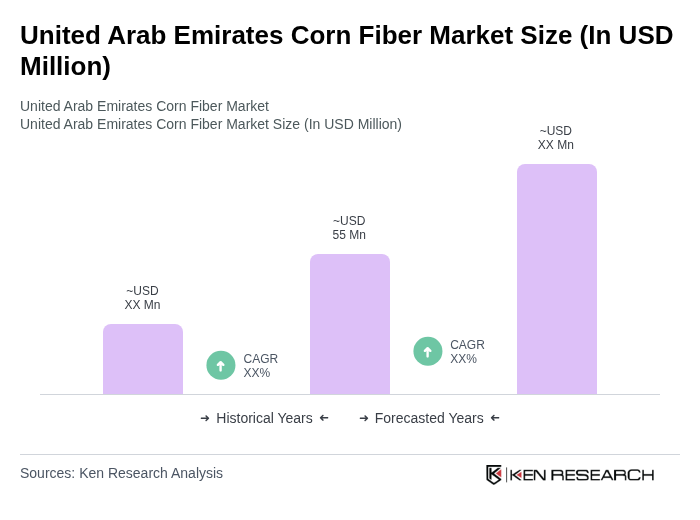
The UAE corn fiber market, worth USD 55 Mn, grows due to rising demand for natural, sustainable food ingredients and health awareness, segmented by source and type with strong future outlook.

Region:Middle East

Author(s):Dev

Product Code:KRAE4442

Pages:96

Published On:March 2026
About the Report

Base Year 2024

United Arab Emirates Corn Fiber Market Overview

  • The United Arab Emirates Corn Fiber Market is valued at USD 55 million, based on a five-year historical analysis. This growth is primarily driven by the increasing demand for natural and sustainable food ingredients, as well as the rising awareness of health benefits associated with corn fiber, such as improved digestive health and weight management.
  • Key cities such as Dubai and Abu Dhabi dominate the market due to their advanced infrastructure, high consumer purchasing power, and a growing trend towards health-conscious products. The presence of major food and beverage companies in these cities further enhances market growth, as they increasingly incorporate corn fiber into their product lines.
  • The UAE Food Safety Regulations, 2022 issued by the Ministry of Climate Change and Environment (MOCCAE), establish standards for food additives and ingredients including dietary fibers like corn fiber, requiring compliance with maximum permitted levels, labeling of nutritional content, and certification for imported and locally produced items to ensure safety and quality.
United Arab Emirates Corn Fiber Market Size

United Arab Emirates Corn Fiber Market Segmentation

By Source:The market is segmented into two primary sources: Conventional Corn and Organic Corn. Conventional Corn is widely used due to its availability and cost-effectiveness, while Organic Corn is gaining traction among health-conscious consumers who prefer natural and pesticide-free products. The demand for organic options is driven by increasing consumer awareness regarding health and environmental sustainability.
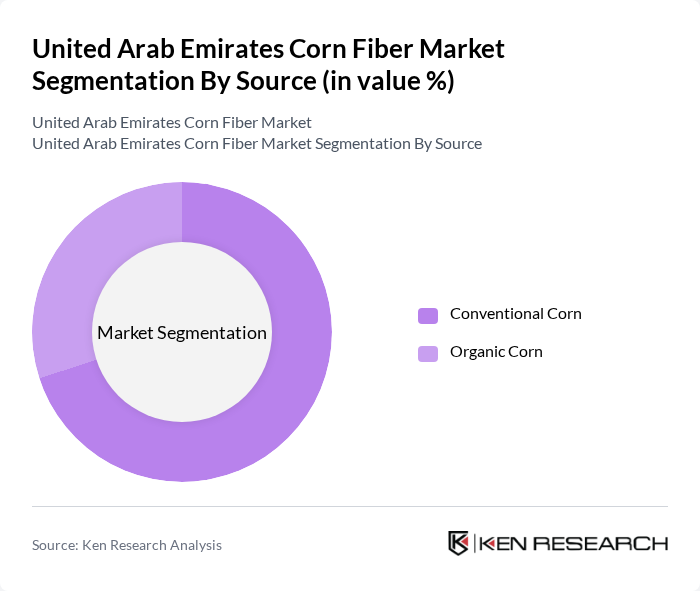
United Arab Emirates Corn Fiber Market segmentation by Source.

By Type:The market is further divided into Soluble Corn Fiber and Insoluble Corn Fiber. Soluble Corn Fiber is the leading subsegment, favored for its functional properties in food applications, such as enhancing texture and moisture retention. The growing trend of clean-label products is driving the demand for soluble options, as consumers seek healthier alternatives in their diets.
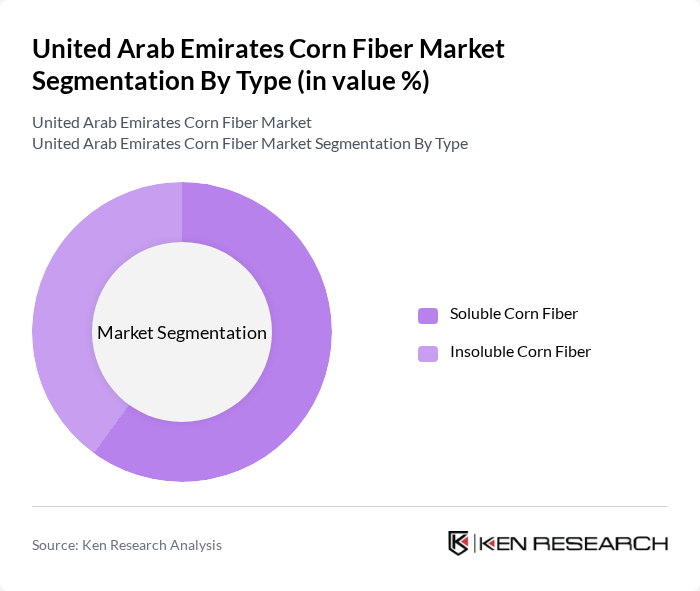
United Arab Emirates Corn Fiber Market segmentation by Type.

United Arab Emirates Corn Fiber Market Competitive Landscape

The United Arab Emirates Corn Fiber Market is characterized by a dynamic mix of regional and international players. Leading participants such as DuPont de Nemours, Inc., BASF SE, NatureWorks LLC, Cargill, Incorporated, ADM (Archer Daniels Midland Company), Corbion N.V., Green Dot Bioplastics, BioAmber Inc., Novamont S.p.A., Futerro, Tereos, Biome Bioplastics, Plantic Technologies Limited, Eco-Products, Inc., NatureFlex contribute to innovation, geographic expansion, and service delivery in this space.

DuPont de Nemours, Inc.

1802

Wilmington, Delaware, USA

BASF SE

1865

Ludwigshafen, Germany

NatureWorks LLC

2003

Minnetonka, Minnesota, USA

Cargill, Incorporated

1865

Wayzata, Minnesota, USA

ADM (Archer Daniels Midland Company)

1902

Chicago, Illinois, USA

Company

Establishment Year

Headquarters

Revenue Growth (CAGR %)

EBITDA Margin (%)

Market Share (%)

R&D Investment (% of Revenue)

Production Capacity (MT/Year)

Export Volume (% of Total Sales)

United Arab Emirates Corn Fiber Market Industry Analysis

Growth Drivers

  • Increasing Demand for Sustainable Materials:The United Arab Emirates is witnessing a significant shift towards sustainable materials, with the market for biodegradable products projected to reach AED 1.8 billion in future. This growth is driven by heightened consumer awareness and preference for eco-friendly alternatives, particularly in textiles and packaging. The UAE's commitment to sustainability, as outlined in its Vision 2021, further supports this trend, encouraging businesses to adopt sustainable practices and materials, including corn fiber.
  • Government Initiatives Promoting Eco-Friendly Products:The UAE government has implemented various initiatives to promote eco-friendly products, including the National Climate Change Plan, which allocates AED 1.5 billion for sustainable development projects. These initiatives aim to reduce carbon emissions and encourage the use of biodegradable materials. Additionally, the government offers incentives for companies that invest in sustainable manufacturing processes, thereby fostering a conducive environment for the growth of the corn fiber market.
  • Rising Consumer Awareness About Health Benefits:There is a growing awareness among consumers in the UAE regarding the health benefits associated with sustainable materials, particularly corn fiber. Research indicates that products made from corn fiber can reduce exposure to harmful chemicals found in synthetic materials. The health-conscious population, which is projected to reach 10 million in future, is increasingly seeking products that align with their values, driving demand for corn fiber in various applications, including textiles and food packaging.

Market Challenges

  • High Production Costs:One of the significant challenges facing the corn fiber market in the UAE is the high production costs associated with sourcing and processing corn fiber. Current estimates suggest that production costs can be up to 25% higher than those of synthetic fibers. This price disparity poses a barrier to entry for new manufacturers and limits the competitiveness of corn fiber products in price-sensitive markets, hindering overall market growth.
  • Limited Awareness Among End-Users:Despite the benefits of corn fiber, there remains a significant knowledge gap among end-users regarding its applications and advantages. A recent survey indicated that only 45% of consumers are aware of corn fiber as a sustainable alternative. This lack of awareness can impede market penetration and adoption, as consumers may opt for more familiar synthetic options, thereby stalling the growth of the corn fiber market in the UAE.

United Arab Emirates Corn Fiber Market Future Outlook

The future of the corn fiber market in the UAE appears promising, driven by increasing investments in research and development for innovative applications. As the demand for sustainable materials continues to rise, companies are likely to focus on enhancing processing technologies to improve efficiency and reduce costs. Additionally, the growing trend towards circular economy practices will encourage collaborations between manufacturers and local businesses, fostering a more integrated supply chain that supports sustainable growth in the corn fiber sector.

Market Opportunities

  • Growth in the Biodegradable Products Sector:The biodegradable products sector in the UAE is expected to expand significantly, with a projected market value of AED 1.5 billion in future. This growth presents a substantial opportunity for corn fiber manufacturers to cater to the increasing demand for eco-friendly packaging and textiles, positioning themselves as leaders in sustainable solutions.
  • Potential for Export to Neighboring Regions:The UAE's strategic location offers a unique opportunity for corn fiber exports to neighboring regions, including the Gulf Cooperation Council (GCC) countries. With a combined population of over 55 million, these markets present a lucrative avenue for growth, especially as they increasingly seek sustainable materials to meet their environmental goals.

Scope of the Report

SegmentSub-Segments
By Source

Conventional Corn

Organic Corn

By Type

Soluble Corn Fiber

Insoluble Corn Fiber

By Form

Powder/Granules

Liquid/Syrup

By End-Use Industry

Food & Beverages

Dietary Supplements & Nutraceuticals

Animal Nutrition

Textile & Apparels

Personal Care & Cosmetics

By Region

Abu Dhabi

Dubai

Sharjah

Others

Key Target Audience

Investors and Venture Capitalist Firms

Government and Regulatory Bodies (e.g., Ministry of Climate Change and Environment, Abu Dhabi Department of Economic Development)

Manufacturers and Producers

Distributors and Retailers

Food and Beverage Companies

Textile and Apparel Manufacturers

Packaging Industry Stakeholders

Biotechnology Firms

Players Mentioned in the Report:

DuPont de Nemours, Inc.

BASF SE

NatureWorks LLC

Cargill, Incorporated

ADM (Archer Daniels Midland Company)

Corbion N.V.

Green Dot Bioplastics

BioAmber Inc.

Novamont S.p.A.

Futerro

Tereos

Biome Bioplastics

Plantic Technologies Limited

Eco-Products, Inc.

NatureFlex

Table of Contents

Market Assessment Phase

1. Executive Summary and Approach


2. United Arab Emirates Corn Fiber Market Overview

2.1 Key Insights and Strategic Recommendations

2.2 United Arab Emirates Corn Fiber Market Overview

2.3 Definition and Scope

2.4 Evolution of Market Ecosystem

2.5 Timeline of Key Regulatory Milestones

2.6 Value Chain & Stakeholder Mapping

2.7 Business Cycle Analysis

2.8 Policy & Incentive Landscape


3. United Arab Emirates Corn Fiber Market Analysis

3.1 Growth Drivers

3.1.1 Increasing demand for sustainable materials
3.1.2 Government initiatives promoting eco-friendly products
3.1.3 Rising consumer awareness about health benefits
3.1.4 Expansion of the textile and automotive industries

3.2 Market Challenges

3.2.1 High production costs
3.2.2 Limited awareness among end-users
3.2.3 Competition from synthetic fibers
3.2.4 Regulatory hurdles in product approvals

3.3 Market Opportunities

3.3.1 Growth in the biodegradable products sector
3.3.2 Potential for export to neighboring regions
3.3.3 Innovations in processing technologies
3.3.4 Collaborations with local manufacturers

3.4 Market Trends

3.4.1 Shift towards circular economy practices
3.4.2 Increasing investment in R&D for corn fiber applications
3.4.3 Rise in online retail for eco-friendly products
3.4.4 Growing popularity of corn fiber in food packaging

3.5 Government Regulation

3.5.1 Standards for biodegradable materials
3.5.2 Incentives for sustainable manufacturing
3.5.3 Import/export regulations for corn fiber products
3.5.4 Environmental impact assessments for production facilities

4. SWOT Analysis


5. Stakeholder Analysis


6. Porter's Five Forces Analysis


7. United Arab Emirates Corn Fiber Market Market Size, 2019-2024

7.1 By Value

7.2 By Volume

7.3 By Average Selling Price


8. United Arab Emirates Corn Fiber Market Segmentation

8.1 By Source

8.1.1 Conventional Corn
8.1.2 Organic Corn

8.2 By Type

8.2.1 Soluble Corn Fiber
8.2.2 Insoluble Corn Fiber

8.3 By Form

8.3.1 Powder/Granules
8.3.2 Liquid/Syrup

8.4 By End-Use Industry

8.4.1 Food & Beverages
8.4.2 Dietary Supplements & Nutraceuticals
8.4.3 Animal Nutrition
8.4.4 Textile & Apparels
8.4.5 Personal Care & Cosmetics

8.5 By Region

8.5.1 Abu Dhabi
8.5.2 Dubai
8.5.3 Sharjah
8.5.4 Others

9. United Arab Emirates Corn Fiber Market Competitive Analysis

9.1 Market Share of Key Players

9.2 Cross Comparison of Key Players

9.2.1 Company Name
9.2.2 Revenue Growth (CAGR %)
9.2.3 EBITDA Margin (%)
9.2.4 Market Share (%)
9.2.5 R&D Investment (% of Revenue)
9.2.6 Production Capacity (MT/Year)
9.2.7 Export Volume (% of Total Sales)
9.2.8 Customer Acquisition Cost (USD)
9.2.9 Net Promoter Score (NPS)
9.2.10 Patent Filings (Annual)

9.3 SWOT Analysis of Top Players

9.4 Pricing Analysis

9.5 Detailed Profile of Major Companies

9.5.1 DuPont de Nemours, Inc.
9.5.2 BASF SE
9.5.3 NatureWorks LLC
9.5.4 Cargill, Incorporated
9.5.5 ADM (Archer Daniels Midland Company)
9.5.6 Corbion N.V.
9.5.7 Green Dot Bioplastics
9.5.8 BioAmber Inc.
9.5.9 Novamont S.p.A.
9.5.10 Futerro
9.5.11 Tereos
9.5.12 Biome Bioplastics
9.5.13 Plantic Technologies Limited
9.5.14 Eco-Products, Inc.
9.5.15 NatureFlex

10. United Arab Emirates Corn Fiber Market End-User Analysis

10.1 Procurement Behavior of Key Ministries

10.1.1 Ministry of Environment and Water
10.1.2 Ministry of Economy
10.1.3 Ministry of Climate Change and Environment
10.1.4 Others

10.2 Corporate Spend on Infrastructure & Energy

10.2.1 Investment in Sustainable Practices
10.2.2 Budget Allocation for Eco-Friendly Materials
10.2.3 Partnerships with Green Initiatives
10.2.4 Others

10.3 Pain Point Analysis by End-User Category

10.3.1 Textile Manufacturers
10.3.2 Food Packaging Companies
10.3.3 Automotive Suppliers
10.3.4 Others

10.4 User Readiness for Adoption

10.4.1 Awareness Levels
10.4.2 Training and Support Needs
10.4.3 Financial Incentives
10.4.4 Others

10.5 Post-Deployment ROI and Use Case Expansion

10.5.1 Measurement of ROI
10.5.2 Case Studies of Successful Implementations
10.5.3 Future Use Cases
10.5.4 Others

11. United Arab Emirates Corn Fiber Market Future Size, 2025-2030

11.1 By Value

11.2 By Volume

11.3 By Average Selling Price


Go-To-Market Strategy Phase

1. Whitespace Analysis + Business Model Canvas

1.1 Market Gaps Identification

1.2 Business Model Development


2. Marketing and Positioning Recommendations

2.1 Branding Strategies

2.2 Product USPs


3. Distribution Plan

3.1 Urban Retail Strategies

3.2 Rural NGO Tie-Ups


4. Channel & Pricing Gaps

4.1 Underserved Routes

4.2 Pricing Bands


5. Unmet Demand & Latent Needs

5.1 Category Gaps

5.2 Consumer Segments


6. Customer Relationship

6.1 Loyalty Programs

6.2 After-Sales Service


7. Value Proposition

7.1 Sustainability Initiatives

7.2 Integrated Supply Chains


8. Key Activities

8.1 Regulatory Compliance

8.2 Branding Efforts

8.3 Distribution Setup


9. Entry Strategy Evaluation

9.1 Domestic Market Entry Strategy

9.1.1 Product Mix
9.1.2 Pricing Band
9.1.3 Packaging

9.2 Export Entry Strategy

9.2.1 Target Countries
9.2.2 Compliance Roadmap

10. Entry Mode Assessment

10.1 Joint Ventures

10.2 Greenfield Investments

10.3 Mergers & Acquisitions

10.4 Distributor Model


11. Capital and Timeline Estimation

11.1 Capital Requirements

11.2 Timelines


12. Control vs Risk Trade-Off

12.1 Ownership Considerations

12.2 Partnerships


13. Profitability Outlook

13.1 Breakeven Analysis

13.2 Long-Term Sustainability


14. Potential Partner List

14.1 Distributors

14.2 Joint Ventures

14.3 Acquisition Targets


15. Execution Roadmap

15.1 Phased Plan for Market Entry

15.1.1 Market Setup
15.1.2 Market Entry
15.1.3 Growth Acceleration
15.1.4 Scale & Stabilize

15.2 Key Activities and Milestones

15.2.1 Activity Planning
15.2.2 Milestone Tracking

Research Methodology

ApproachModellingSample

Phase 1: Approach1

Desk Research

  • Analysis of industry reports from local and international market research firms
  • Review of government publications and trade statistics from the UAE Ministry of Economy
  • Examination of academic journals and articles focusing on sustainable materials and corn fiber applications

Primary Research

  • Interviews with key stakeholders in the textile and packaging industries
  • Surveys conducted with manufacturers utilizing corn fiber in their products
  • Focus group discussions with end-users to understand preferences and perceptions

Validation & Triangulation

  • Cross-validation of findings through multiple data sources including trade associations
  • Triangulation of market insights from interviews and surveys with secondary data
  • Sanity checks performed by industry experts to ensure data reliability

Phase 2: Market Size Estimation1

Top-down Assessment

  • Estimation of market size based on national consumption patterns of corn fiber products
  • Segmentation of the market by application areas such as textiles, packaging, and composites
  • Incorporation of growth rates from related sectors and sustainability trends

Bottom-up Modeling

  • Collection of production data from local manufacturers of corn fiber products
  • Estimation of market share based on sales volume and pricing strategies
  • Analysis of supply chain dynamics and cost structures for corn fiber production

Forecasting & Scenario Analysis

  • Development of forecasts using historical data and market trends
  • Scenario analysis based on potential regulatory changes and market disruptions
  • Creation of multiple growth scenarios to project market evolution through 2030

Phase 3: CATI Sample Composition1

Scope Item/SegmentSample SizeTarget Respondent Profiles
Textile Manufacturers Using Corn Fiber45Production Managers, Product Development Heads
Packaging Companies Incorporating Sustainable Materials40Procurement Managers, Sustainability Officers
Research Institutions Focused on Biodegradable Materials50Research Scientists, Academic Professors
Retailers Selling Corn Fiber Products70Category Managers, Marketing Directors
Consumers of Eco-friendly Products90Environmentally Conscious Shoppers, Trendsetters

Frequently Asked Questions

What is the current value of the United Arab Emirates Corn Fiber Market?

The United Arab Emirates Corn Fiber Market is valued at approximately USD 55 million, reflecting a growing demand for natural and sustainable food ingredients, driven by health benefits associated with corn fiber, such as improved digestive health and weight management.

Which cities are the primary markets for corn fiber in the UAE?

What are the main sources of corn fiber in the UAE market?

What types of corn fiber are available in the UAE market?

Why Buy From Us?

Refine Robust Result (RRR) Framework

What makes us stand out is that our consultants follow Robust, Refine and Result (RRR) methodology. Robust for clear definitions, approaches and sanity checking, Refine for differentiating respondents' facts and opinions, and Result for presenting data with story.

Our Reach Is Unmatched

We have set a benchmark in the industry by offering our clients with syndicated and customized market research reports featuring coverage of entire market as well as meticulous research and analyst insights.

Shifting the Research Paradigm

While we don't replace traditional research, we flip the method upside down. Our dual approach of Top Bottom & Bottom Top ensures quality deliverable by not just verifying company fundamentals but also looking at the sector and macroeconomic factors.

More Insights-Better Decisions

With one step in the future, our research team constantly tries to show you the bigger picture. We help with some of the tough questions you may encounter along the way: How is the industry positioned? Best marketing channel? KPI's of competitors? By aligning every element, we help maximize success.

Transparency and Trust

Our report gives you instant access to the answers and sources that other companies might choose to hide. We elaborate each steps of research methodology we have used and showcase you the sample size to earn your trust.

Round the Clock Support

If you need any support, we are here! We pride ourselves on universe strength, data quality, and quick, friendly, and professional service.

Why Clients Choose Us?

400000+
Reports in repository
150+
Consulting projects a year
100+
Analysts
8000+
Client Queries in 2022








