Region:Middle East
Author(s):Rebecca
Product Code:KRAC2287
Pages:100
Published On:January 2026
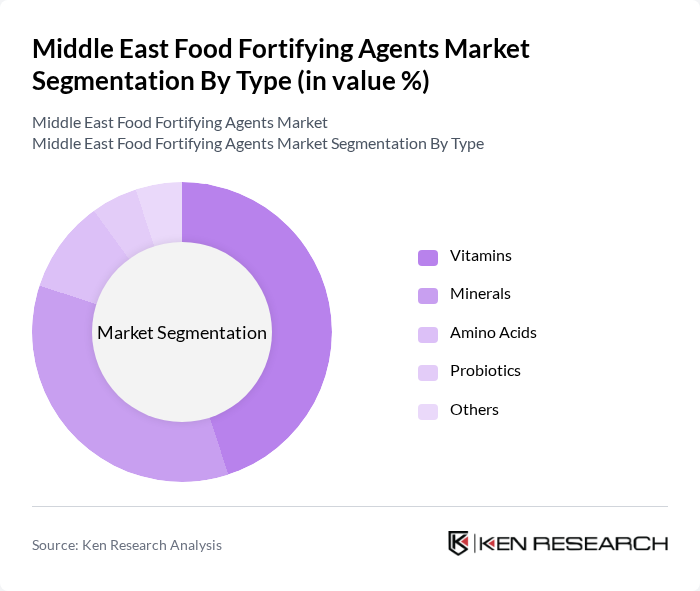
By Type:The market is segmented into various types of fortifying agents, including vitamins, minerals, amino acids, probiotics, and others. Among these, vitamins and minerals are the most widely used due to their essential roles in human health and nutrition. The increasing awareness of the benefits of vitamins and minerals in preventing deficiencies has led to a higher demand for these fortifying agents in food products.
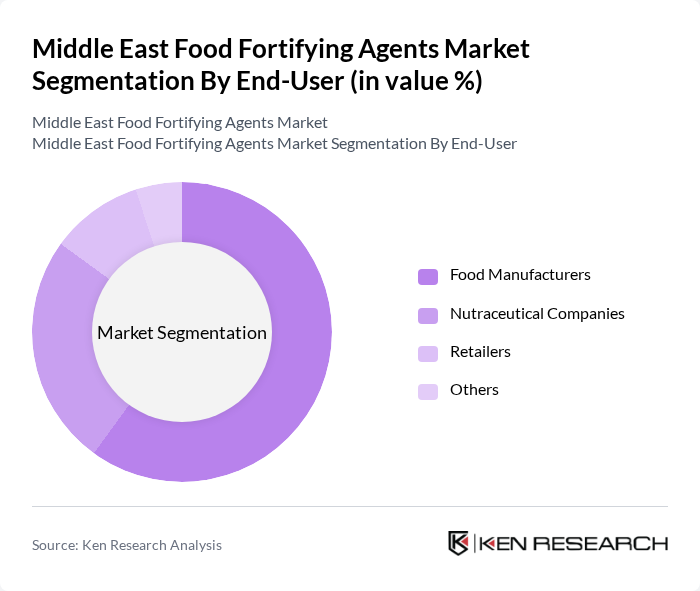
By End-User:The end-user segmentation includes food manufacturers, retailers, food service providers, households, and others. Food manufacturers are the leading segment, as they are the primary producers of fortified food products. The growing trend of health-conscious eating among consumers has prompted manufacturers to incorporate fortifying agents into their products to meet consumer demand for healthier options.
The Middle East Food Fortifying Agents Market is characterized by a dynamic mix of regional and international players. Leading participants such as DSM Nutritional Products, BASF SE, Archer Daniels Midland Company, DuPont de Nemours, Inc., Ingredion Incorporated, Cargill, Incorporated, Kerry Group plc, Tate & Lyle PLC, Nutraceutical Corporation, Ginkgo BioWorks, Inc., Naturex S.A., Royal DSM, Fonterra Co-operative Group Limited, Herbalife Nutrition Ltd., Glanbia plc contribute to innovation, geographic expansion, and service delivery in this space.
The future of the Middle East food fortifying agents market appears promising, driven by increasing consumer demand for healthier food options and supportive government policies. As awareness of nutritional deficiencies grows, manufacturers are likely to invest in innovative fortification technologies. Additionally, the rise of e-commerce platforms will facilitate greater access to fortified products, enabling consumers to make informed choices. The market is expected to evolve with a focus on sustainability and clean label products, aligning with global health trends.
| Segment | Sub-Segments |
|---|---|
| By Type | Vitamins Minerals Amino Acids Probiotics Others |
| By End-User | Food Manufacturers Retailers Food Service Providers Households Others |
| By Application | Bakery Products Dairy Products Beverages Snacks Others |
| By Distribution Channel | Supermarkets/Hypermarkets Online Retail Convenience Stores Direct Sales Others |
| By Region | GCC Countries Levant Region North Africa Others |
| By Consumer Demographics | Age Groups Income Levels Health Consciousness Others |
| By Product Form | Powdered Form Liquid Form Granular Form Others |
| Scope Item/Segment | Sample Size | Target Respondent Profiles |
|---|---|---|
| Food Manufacturers | 150 | Production Managers, Quality Assurance Officers |
| Health and Nutrition Experts | 100 | Dietitians, Public Health Officials |
| Retail Sector Stakeholders | 80 | Category Managers, Purchasing Agents |
| Consumer Focus Groups | 120 | Health-conscious Consumers, Parents |
| Regulatory Bodies | 50 | Policy Makers, Food Safety Inspectors |
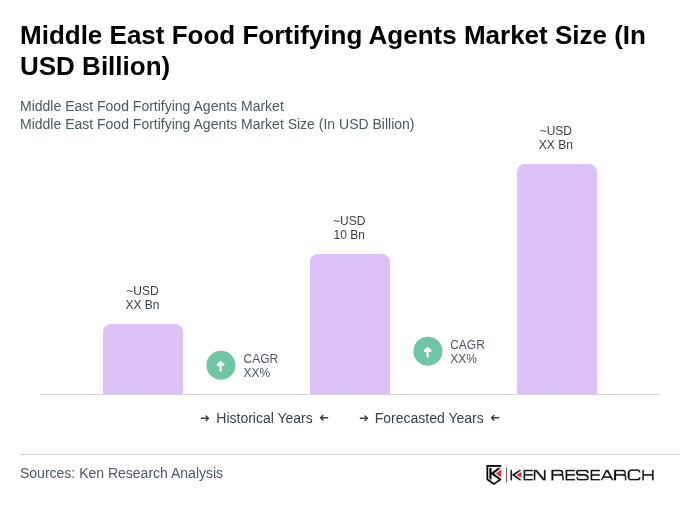
The Middle East Food Fortifying Agents Market is valued at approximately USD 1.2 billion, reflecting a significant growth trend driven by increasing health awareness, nutritional deficiencies, and government initiatives promoting food fortification to combat malnutrition.

What makes us stand out is that our consultants follow Robust, Refine and Result (RRR) methodology. Robust for clear definitions, approaches and sanity checking, Refine for differentiating respondents' facts and opinions, and Result for presenting data with story.

We have set a benchmark in the industry by offering our clients with syndicated and customized market research reports featuring coverage of entire market as well as meticulous research and analyst insights.

While we don't replace traditional research, we flip the method upside down. Our dual approach of Top Bottom & Bottom Top ensures quality deliverable by not just verifying company fundamentals but also looking at the sector and macroeconomic factors.

With one step in the future, our research team constantly tries to show you the bigger picture. We help with some of the tough questions you may encounter along the way: How is the industry positioned? Best marketing channel? KPI's of competitors? By aligning every element, we help maximize success.

Our report gives you instant access to the answers and sources that other companies might choose to hide. We elaborate each steps of research methodology we have used and showcase you the sample size to earn your trust.

If you need any support, we are here! We pride ourselves on universe strength, data quality, and quick, friendly, and professional service.













