Region:Middle East
Author(s):Geetanshi
Product Code:KRAD1244
Pages:83
Published On:November 2025
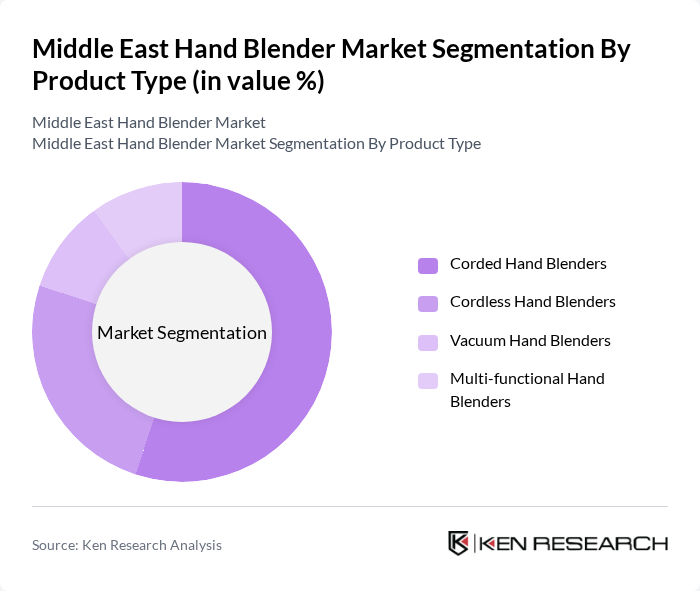
By Product Type:The product type segmentation includes corded hand blenders, cordless hand blenders, vacuum hand blenders, and multi-functional hand blenders. Among these, corded hand blenders currently lead the market due to their consistent power supply and efficiency in blending tasks. Consumers prefer corded models for their reliability and performance, especially in commercial and high-usage environments. Cordless models are gaining traction for their portability and convenience, but corded options remain the preferred choice for most users seeking durability and uninterrupted operation .
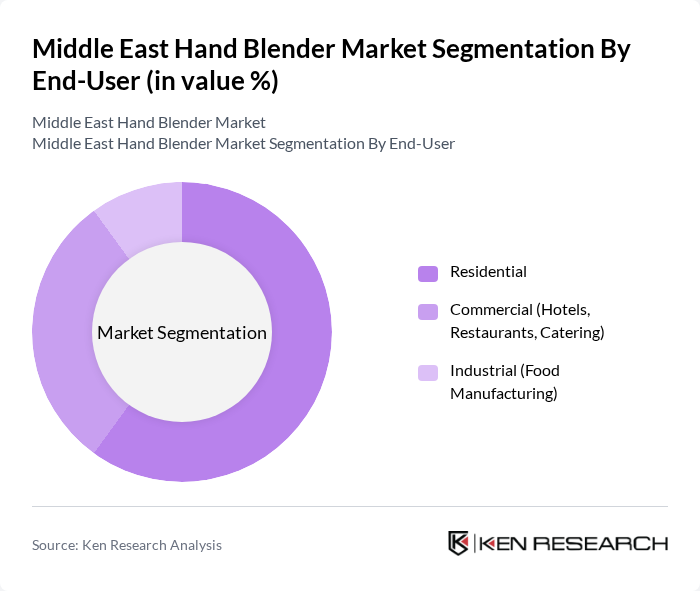
By End-User:The end-user segmentation covers residential, commercial (hotels, restaurants, catering), and industrial (food manufacturing) categories. The residential segment is the largest, propelled by the increasing trend of home cooking, health-focused lifestyles, and the adoption of compact appliances for modern kitchens. The commercial segment is also significant, as restaurants and catering services seek efficient blending solutions to optimize food preparation. The industrial segment, while smaller, remains essential for large-scale food manufacturing operations requiring robust and high-capacity blending equipment .
The Middle East Hand Blender Market is characterized by a dynamic mix of regional and international players. Leading participants such as Philips (Royal Philips Electronics), Braun (Procter & Gamble), Kenwood (Groupe SEB), Panasonic Corporation, Black+Decker (Stanley Black & Decker), Cuisinart (Conair Corporation), KitchenAid (Whirlpool Corporation), Russell Hobbs (Groupe SEB), Tefal (Groupe SEB), Morphy Richards (Groupe SEB), Smeg S.p.A., Hamilton Beach Brands, Oster (Sunbeam Products), Breville Group Limited, Xiaomi (Mijia Brand) contribute to innovation, geographic expansion, and service delivery in this space.
The Middle East hand blender market is poised for significant growth, driven by evolving consumer preferences towards convenience and health-conscious cooking. As the trend of smart kitchen appliances gains traction, manufacturers are likely to invest in innovative features that enhance user experience. Additionally, the increasing focus on sustainability will push brands to develop eco-friendly products, aligning with consumer demand for environmentally responsible options. This dynamic landscape presents opportunities for growth and adaptation in the coming years.
| Segment | Sub-Segments |
|---|---|
| By Product Type | Corded Hand Blenders Cordless Hand Blenders Vacuum Hand Blenders Multi-functional Hand Blenders |
| By End-User | Residential Commercial (Hotels, Restaurants, Catering) Industrial (Food Manufacturing) |
| By Geography | GCC Countries (UAE, Saudi Arabia, Kuwait, Qatar, Bahrain, Oman) Levant Region (Syria, Lebanon, Jordan, Palestine) North Africa (Egypt, Morocco, Algeria, Tunisia) Other Middle East Markets |
| By Application | Food Preparation & Purees Beverage Mixing & Smoothies Baby Food Preparation Soups & Sauces Others |
| By Distribution Channel | Online Retail (E-commerce Platforms) Offline Retail (Hypermarkets, Specialty Stores) Direct Sales & Brand Stores Wholesale & Distributor Networks |
| By Price Range | Budget (Entry-level) Mid-range Premium |
| By Customer Segment | Brand Loyal Customers Price-sensitive Customers First-time Buyers Health-conscious Consumers |
| Scope Item/Segment | Sample Size | Target Respondent Profiles |
|---|---|---|
| Retail Sales of Hand Blenders | 100 | Store Managers, Sales Representatives |
| Consumer Preferences and Usage | 120 | Home Cooks, Culinary Enthusiasts |
| Market Trends in Kitchen Appliances | 100 | Market Analysts, Industry Experts |
| Distribution Channels for Hand Blenders | 80 | Distributors, Supply Chain Managers |
| Impact of E-commerce on Sales | 100 | E-commerce Managers, Digital Marketing Specialists |
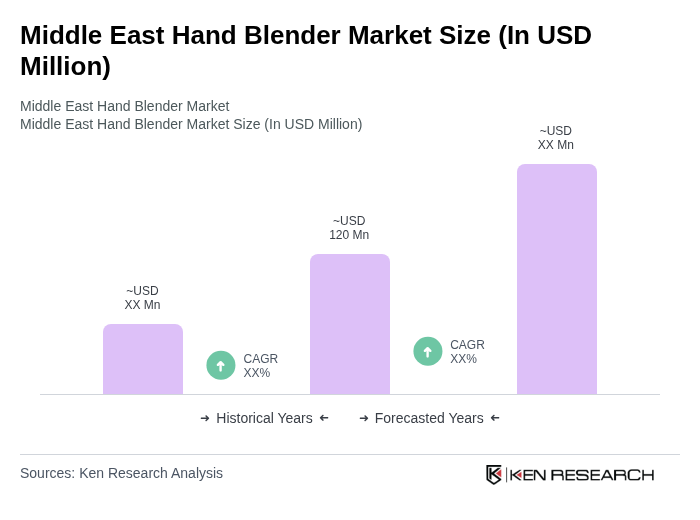
The Middle East Hand Blender Market is valued at approximately USD 120 million, driven by increasing demand for compact kitchen appliances, health consciousness, and the trend of home cooking, particularly accelerated by the COVID-19 pandemic.

What makes us stand out is that our consultants follow Robust, Refine and Result (RRR) methodology. Robust for clear definitions, approaches and sanity checking, Refine for differentiating respondents' facts and opinions, and Result for presenting data with story.

We have set a benchmark in the industry by offering our clients with syndicated and customized market research reports featuring coverage of entire market as well as meticulous research and analyst insights.

While we don't replace traditional research, we flip the method upside down. Our dual approach of Top Bottom & Bottom Top ensures quality deliverable by not just verifying company fundamentals but also looking at the sector and macroeconomic factors.

With one step in the future, our research team constantly tries to show you the bigger picture. We help with some of the tough questions you may encounter along the way: How is the industry positioned? Best marketing channel? KPI's of competitors? By aligning every element, we help maximize success.

Our report gives you instant access to the answers and sources that other companies might choose to hide. We elaborate each steps of research methodology we have used and showcase you the sample size to earn your trust.

If you need any support, we are here! We pride ourselves on universe strength, data quality, and quick, friendly, and professional service.













