About the Report
Base Year 2024Listen to the audio summary
Middle East Healthcare Professional Training Market Overview
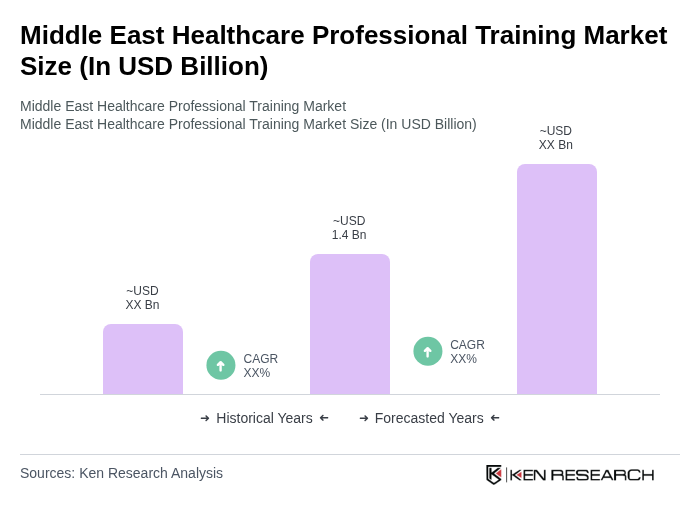
- The Middle East Healthcare Professional Training Market is valued at USD 1.4 billion, based on a five-year historical analysis, taking into account regional spending on healthcare workforce development, corporate training, and healthcare education within the broader Middle East healthcare ecosystem. This growth is primarily driven by the increasing demand for skilled healthcare professionals amid workforce shortages, rapid advancements in medical technology (including digital health, telemedicine, and AI-supported diagnostics), and the rising emphasis on continuous professional development and accreditation among healthcare workers across hospitals, academic medical centers, and private providers.
- Key players in this market include Saudi Arabia, the United Arab Emirates, and Qatar, which are among the leading Middle East healthcare and corporate training investors in the region. These countries dominate the market due to their substantial investments in healthcare infrastructure and workforce management, national transformation programs such as Saudi Vision 2030, UAE’s federal and emirate-level health strategies, and Qatar’s national health agenda, as well as government-backed initiatives to enhance medical education, simulation-based training, and e-learning platforms to serve a growing and increasingly complex patient population that demands high-quality healthcare services.
- In 2023, the Saudi Commission for Health Specialties implemented updated continuing professional development requirements under the Professional Classification and Registration Regulations, including a mandate that licensed healthcare practitioners complete a minimum of 20 to 30 hours of continuing medical education (CME) or continuing professional development (CPD) activities every year as part of license renewal. This regulation aims to ensure that healthcare providers remain updated with the latest medical practices, digital health tools, and patient safety standards through accredited courses, simulation training, and structured learning pathways, thereby improving quality of care, clinical outcomes, and patient safety across public and private healthcare facilities.
Middle East Healthcare Professional Training Market Segmentation
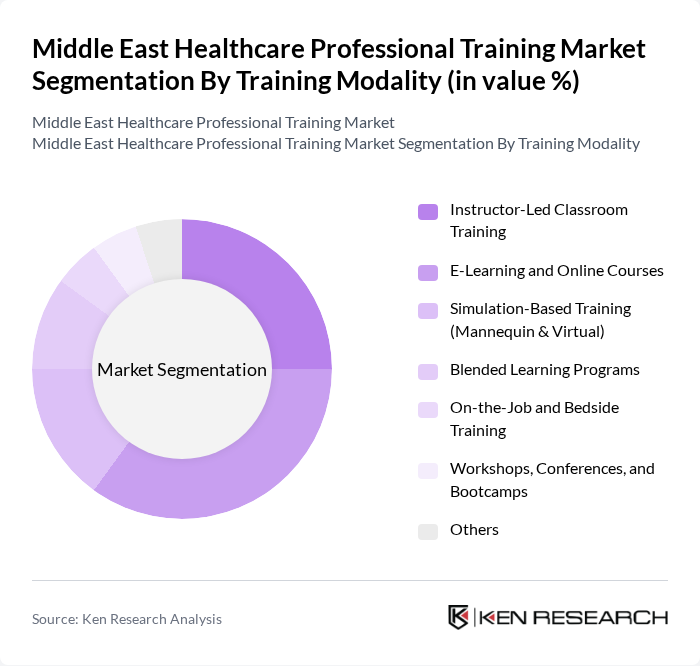
By Training Modality:The training modalities in the healthcare professional training market include various methods tailored to meet the diverse needs of healthcare professionals. The dominant sub-segment is E-Learning and Online Courses, which has gained strong traction in the Middle East due to its flexibility, lower delivery cost, and the widespread adoption of corporate e-learning and digital health platforms, allowing healthcare workers to learn at their own pace and from remote locations. Instructor-Led Classroom Training remains significant, especially for hands-on clinical skills, multidisciplinary team training, and certification courses delivered by hospitals and universities. Simulation-Based Training is increasingly utilized for practical experience in surgery, emergency care, critical care, and obstetrics, supported by investments in high-fidelity mannequins and virtual reality systems in the Middle East and Africa region. Blended Learning Programs combine structured face-to-face teaching with online modules, assessments, and virtual simulations, catering to different learning preferences and institutional requirements for flexible, scalable professional development.
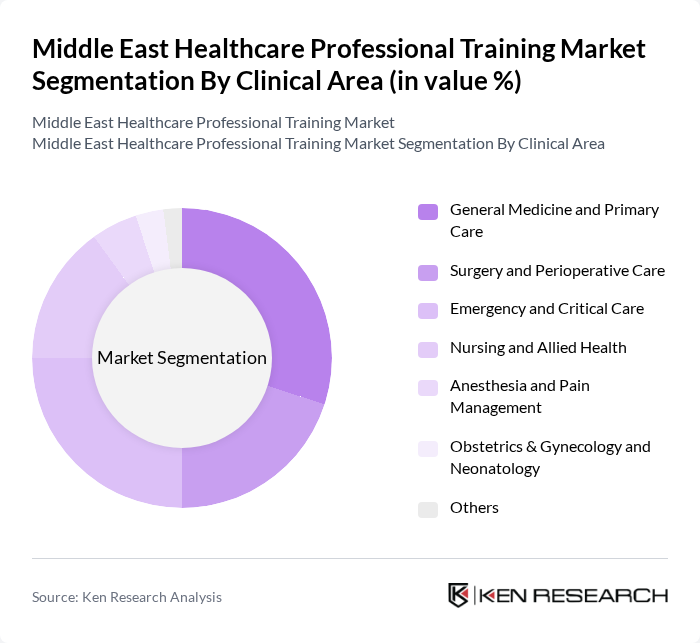
By Clinical Area:The clinical areas in the healthcare professional training market encompass various specialties essential for comprehensive healthcare delivery. General Medicine and Primary Care is the leading sub-segment in terms of training demand, reflecting the foundational role of primary care, family medicine, and internal medicine in healthcare systems and national strategies to strengthen first-contact care and manage non-communicable diseases. Emergency and Critical Care training is also crucial, especially in regions with high demand for urgent medical services and trauma care, where simulation-based and team-based training are widely used for emergency physicians, nurses, and paramedics. Nursing and Allied Health training is significant due to the growing need for skilled nursing professionals, respiratory therapists, laboratory technologists, and other allied health workers to address workforce shortages identified across the Middle East. Other areas, such as Surgery and Anesthesia, remain vital and highly specialized, with strong uptake of simulation, structured residency programs, and subspecialty fellowships to support complex procedures and perioperative care standards.
Middle East Healthcare Professional Training Market Competitive Landscape
The Middle East Healthcare Professional Training Market is characterized by a dynamic mix of regional and international players. Leading participants such as Saudi Commission for Health Specialties, Dubai Health Authority, Hamad Medical Corporation, Department of Health – Abu Dhabi, American University of Beirut – Faculty of Medicine, King Saud University – College of Medicine, Gulf Medical University, University of Sharjah – College of Health Sciences, Oman Medical Specialty Board, Jordan University of Science and Technology, The University of Jordan – School of Medicine, Al Ain University, Imam Abdulrahman Bin Faisal University (formerly University of Dammam), Mohammed Bin Rashid University of Medicine and Health Sciences, Royal College of Surgeons in Ireland – Bahrain contribute to innovation, geographic expansion, and service delivery in this space through accredited residency programs, fellowship training, CME/CPD activities, simulation centers, and digital learning platforms.
Middle East Healthcare Professional Training Market Industry Analysis
Growth Drivers
- Increasing Demand for Specialized Healthcare Training:The Middle East is witnessing a surge in demand for specialized healthcare training, driven by a growing population and rising prevalence of chronic diseases. For instance, the World Health Organization reported that the region's healthcare expenditure reached approximately $250 billion, reflecting a 6% increase from the previous year. This heightened investment necessitates a workforce equipped with specialized skills, thereby propelling the demand for targeted training programs across various healthcare sectors.
- Government Initiatives to Enhance Healthcare Standards:Governments across the Middle East are actively implementing initiatives to elevate healthcare standards, which significantly boosts the training market. For example, the UAE's Ministry of Health allocated $2 billion for healthcare improvements, including training programs. Such investments are aimed at ensuring healthcare professionals meet international standards, thereby increasing the need for comprehensive training solutions that align with these governmental objectives.
- Technological Advancements in Training Methodologies:The integration of advanced technologies in training methodologies is transforming the healthcare training landscape in the Middle East. In future, the adoption of e-learning platforms and simulation-based training saw a 35% increase, according to industry reports. This shift not only enhances the learning experience but also allows for scalable training solutions, making it easier for healthcare professionals to access high-quality education regardless of their location.
Market Challenges
- Limited Access to Training Resources in Remote Areas:One of the significant challenges facing the Middle East healthcare training market is the limited access to training resources in remote areas. According to the World Bank, approximately 25% of the population in rural regions lacks access to essential healthcare training facilities. This disparity creates a gap in skill development, hindering the overall growth of the healthcare workforce in these underserved areas.
- High Costs Associated with Advanced Training Programs:The financial burden of advanced training programs poses a challenge for many healthcare professionals in the Middle East. Reports indicate that the average cost of specialized training courses can exceed $6,000, which is prohibitive for a significant portion of the workforce. This financial barrier limits participation in essential training, ultimately affecting the quality of healthcare services provided in the region.
Middle East Healthcare Professional Training Market Future Outlook
The future of the Middle East healthcare professional training market appears promising, driven by ongoing technological advancements and increasing government support. As healthcare systems evolve, there will be a greater emphasis on innovative training solutions, including virtual reality and artificial intelligence. Additionally, the growing trend towards competency-based training frameworks will ensure that healthcare professionals are better equipped to meet the demands of modern healthcare environments, fostering a more skilled workforce.
Market Opportunities
- Expansion of Online and Remote Training Solutions:The rise of online training platforms presents a significant opportunity for the healthcare training market. With an estimated 70% of healthcare professionals in the region expressing interest in online courses, this trend can enhance accessibility and flexibility, allowing more individuals to pursue specialized training without geographical constraints.
- Partnerships with International Training Organizations:Collaborating with international training organizations can enhance the quality and credibility of local training programs. Such partnerships can facilitate knowledge transfer and best practices, potentially increasing the number of accredited training institutions in the region, which currently stands at around 200, thereby improving overall healthcare standards.
Scope of the Report
| Segment | Sub-Segments |
|---|---|
| By Training Modality | Instructor-Led Classroom Training E-Learning and Online Courses Simulation-Based Training (Mannequin & Virtual) Blended Learning Programs On-the-Job and Bedside Training Workshops, Conferences, and Bootcamps Others |
| By Clinical Area | General Medicine and Primary Care Surgery and Perioperative Care Emergency and Critical Care Nursing and Allied Health Anesthesia and Pain Management Obstetrics & Gynecology and Neonatology Others |
| By Professional Category | Physicians and Surgeons Nurses and Midwives Pharmacists Allied Health Professionals (Lab, Radiology, etc.) Administrative and Management Staff Students and Residents Others |
| By End-User | Public Hospitals and Health Systems Private Hospitals and Clinics Medical and Nursing Schools Professional Bodies and Licensing Authorities NGOs and International Agencies Corporate & Occupational Health Programs Others |
| By Delivery Model | Onsite / In-House Training Offsite Training Centers Fully Remote / Virtual Training Hybrid Delivery Others |
| By Certification Type | Mandatory Continuing Professional Development (CPD/CME) Regulatory & Compliance Certifications Skills and Procedure-Based Certifications Academic and Fellowship Programs Others |
| By Country | Saudi Arabia United Arab Emirates Qatar Kuwait Oman Bahrain Rest of Middle East |
Key Target Audience
Investors and Venture Capitalist Firms
Government and Regulatory Bodies (e.g., Ministry of Health, Health Authority Abu Dhabi)
Healthcare Providers and Hospitals
Medical Device Manufacturers
Pharmaceutical Companies
Healthcare Technology Companies
Professional Medical Associations
Insurance Companies and Payers
Players Mentioned in the Report:
Saudi Commission for Health Specialties
Dubai Health Authority
Hamad Medical Corporation
Department of Health Abu Dhabi
American University of Beirut Faculty of Medicine
King Saud University College of Medicine
Gulf Medical University
University of Sharjah College of Health Sciences
Oman Medical Specialty Board
Jordan University of Science and Technology
The University of Jordan School of Medicine
Al Ain University
Imam Abdulrahman Bin Faisal University (formerly University of Dammam)
Mohammed Bin Rashid University of Medicine and Health Sciences
Royal College of Surgeons in Ireland Bahrain
Table of Contents
Market Assessment Phase
1. Executive Summary and Approach
2. Middle East Healthcare Professional Training Market Overview
2.1 Key Insights and Strategic Recommendations
2.2 Middle East Healthcare Professional Training Market Overview
2.3 Definition and Scope
2.4 Evolution of Market Ecosystem
2.5 Timeline of Key Regulatory Milestones
2.6 Value Chain & Stakeholder Mapping
2.7 Business Cycle Analysis
2.8 Policy & Incentive Landscape
3. Middle East Healthcare Professional Training Market Analysis
3.1 Growth Drivers
3.1.1 Increasing demand for specialized healthcare training
3.1.2 Government initiatives to enhance healthcare standards
3.1.3 Rise in healthcare investments and infrastructure development
3.1.4 Technological advancements in training methodologies
3.2 Market Challenges
3.2.1 Limited access to training resources in remote areas
3.2.2 High costs associated with advanced training programs
3.2.3 Regulatory hurdles and compliance issues
3.2.4 Shortage of qualified trainers and educators
3.3 Market Opportunities
3.3.1 Expansion of online and remote training solutions
3.3.2 Partnerships with international training organizations
3.3.3 Development of customized training programs for local needs
3.3.4 Increased focus on continuous professional development
3.4 Market Trends
3.4.1 Growing emphasis on simulation-based training
3.4.2 Integration of AI and VR in training programs
3.4.3 Shift towards competency-based training frameworks
3.4.4 Rising popularity of blended learning approaches
3.5 Government Regulation
3.5.1 Mandatory accreditation for training institutions
3.5.2 Guidelines for continuing education requirements
3.5.3 Funding and grants for healthcare training initiatives
3.5.4 Policies promoting public-private partnerships in training
4. SWOT Analysis
5. Stakeholder Analysis
6. Porter's Five Forces Analysis
7. Middle East Healthcare Professional Training Market Market Size, 2019-2024
7.1 By Value
7.2 By Volume
7.3 By Average Selling Price
8. Middle East Healthcare Professional Training Market Segmentation
8.1 By Training Modality
8.1.1 Instructor-Led Classroom Training
8.1.2 E-Learning and Online Courses
8.1.3 Simulation-Based Training (Mannequin & Virtual)
8.1.4 Blended Learning Programs
8.1.5 On-the-Job and Bedside Training
8.1.6 Workshops, Conferences, and Bootcamps
8.1.7 Others
8.2 By Clinical Area
8.2.1 General Medicine and Primary Care
8.2.2 Surgery and Perioperative Care
8.2.3 Emergency and Critical Care
8.2.4 Nursing and Allied Health
8.2.5 Anesthesia and Pain Management
8.2.6 Obstetrics & Gynecology and Neonatology
8.2.7 Others
8.3 By Professional Category
8.3.1 Physicians and Surgeons
8.3.2 Nurses and Midwives
8.3.3 Pharmacists
8.3.4 Allied Health Professionals (Lab, Radiology, etc.)
8.3.5 Administrative and Management Staff
8.3.6 Students and Residents
8.3.7 Others
8.4 By End-User
8.4.1 Public Hospitals and Health Systems
8.4.2 Private Hospitals and Clinics
8.4.3 Medical and Nursing Schools
8.4.4 Professional Bodies and Licensing Authorities
8.4.5 NGOs and International Agencies
8.4.6 Corporate & Occupational Health Programs
8.4.7 Others
8.5 By Delivery Model
8.5.1 Onsite / In-House Training
8.5.2 Offsite Training Centers
8.5.3 Fully Remote / Virtual Training
8.5.4 Hybrid Delivery
8.5.5 Others
8.6 By Certification Type
8.6.1 Mandatory Continuing Professional Development (CPD/CME)
8.6.2 Regulatory & Compliance Certifications
8.6.3 Skills and Procedure-Based Certifications
8.6.4 Academic and Fellowship Programs
8.6.5 Others
8.7 By Country
8.7.1 Saudi Arabia
8.7.2 United Arab Emirates
8.7.3 Qatar
8.7.4 Kuwait
8.7.5 Oman
8.7.6 Bahrain
8.7.7 Rest of Middle East
9. Middle East Healthcare Professional Training Market Competitive Analysis
9.1 Market Share of Key Players
9.2 Cross Comparison of Key Players
9.2.1 Company Name
9.2.2 Group Size (Large, Medium, or Small as per industry convention)
9.2.3 Healthcare Training Revenue (USD Million)
9.2.4 3-Year CAGR of Training Revenue (%)
9.2.5 EBITDA Margin from Training Services (%)
9.2.6 Share of Digital / Online Training in Portfolio (%)
9.2.7 Number of Trainees Served Annually
9.2.8 Average Revenue per Trainee (USD)
9.2.9 Customer Retention Rate (%)
9.2.10 Number of Accredited Programs / Courses
9.2.11 Geographical Footprint (Number of Countries Covered)
9.3 SWOT Analysis of Top Players
9.4 Pricing Analysis
9.5 Detailed Profile of Major Companies
9.5.1 Saudi Commission for Health Specialties
9.5.2 Dubai Health Authority
9.5.3 Hamad Medical Corporation
9.5.4 Department of Health – Abu Dhabi
9.5.5 American University of Beirut – Faculty of Medicine
9.5.6 King Saud University – College of Medicine
9.5.7 Gulf Medical University
9.5.8 University of Sharjah – College of Health Sciences
9.5.9 Oman Medical Specialty Board
9.5.10 Jordan University of Science and Technology
9.5.11 The University of Jordan – School of Medicine
9.5.12 Al Ain University
9.5.13 Imam Abdulrahman Bin Faisal University (formerly University of Dammam)
9.5.14 Mohammed Bin Rashid University of Medicine and Health Sciences
9.5.15 Royal College of Surgeons in Ireland – Bahrain
10. Middle East Healthcare Professional Training Market End-User Analysis
10.1 Procurement Behavior of Key Ministries
10.1.1 Ministry of Health Initiatives
10.1.2 Budget Allocation for Training Programs
10.1.3 Collaboration with Educational Institutions
10.1.4 Evaluation Criteria for Training Providers
10.2 Corporate Spend on Infrastructure & Energy
10.2.1 Investment in Training Facilities
10.2.2 Funding for Technology Integration
10.2.3 Expenditure on Professional Development
10.2.4 Partnerships with Training Organizations
10.3 Pain Point Analysis by End-User Category
10.3.1 Healthcare Providers
10.3.2 Educational Institutions
10.3.3 Government Agencies
10.3.4 Private Sector Companies
10.4 User Readiness for Adoption
10.4.1 Assessment of Current Training Programs
10.4.2 Willingness to Invest in New Solutions
10.4.3 Feedback from Healthcare Professionals
10.4.4 Barriers to Adoption of New Training Methods
10.5 Post-Deployment ROI and Use Case Expansion
10.5.1 Measurement of Training Effectiveness
10.5.2 Long-Term Benefits of Training Investments
10.5.3 Opportunities for Program Expansion
10.5.4 Case Studies of Successful Implementations
11. Middle East Healthcare Professional Training Market Future Size, 2025-2030
11.1 By Value
11.2 By Volume
11.3 By Average Selling Price
Go-To-Market Strategy Phase
1. Whitespace Analysis + Business Model Canvas
1.1 Market Gaps Identification
1.2 Value Proposition Development
1.3 Revenue Streams Analysis
1.4 Cost Structure Evaluation
1.5 Key Partnerships Exploration
1.6 Customer Segmentation
1.7 Channels of Distribution
2. Marketing and Positioning Recommendations
2.1 Branding Strategies
2.2 Product USPs
3. Distribution Plan
3.1 Urban Retail vs Rural NGO Tie-Ups
4. Channel & Pricing Gaps
4.1 Underserved Routes
4.2 Pricing Bands
5. Unmet Demand & Latent Needs
5.1 Category Gaps
5.2 Consumer Segments
6. Customer Relationship
6.1 Loyalty Programs
6.2 After-Sales Service
7. Value Proposition
7.1 Sustainability
7.2 Integrated Supply Chains
8. Key Activities
8.1 Regulatory Compliance
8.2 Branding
8.3 Distribution Setup
9. Entry Strategy Evaluation
9.1 Domestic Market Entry Strategy
9.1.1 Product Mix
9.1.2 Pricing Band
9.1.3 Packaging
9.2 Export Entry Strategy
9.2.1 Target Countries
9.2.2 Compliance Roadmap
10. Entry Mode Assessment
10.1 JV
10.2 Greenfield
10.3 M&A
10.4 Distributor Model
11. Capital and Timeline Estimation
11.1 Capital Requirements
11.2 Timelines
12. Control vs Risk Trade-Off
12.1 Ownership vs Partnerships
13. Profitability Outlook
13.1 Breakeven Analysis
13.2 Long-Term Sustainability
14. Potential Partner List
14.1 Distributors
14.2 JVs
14.3 Acquisition Targets
15. Execution Roadmap
15.1 Phased Plan for Market Entry
15.1.1 Market Setup
15.1.2 Market Entry
15.1.3 Growth Acceleration
15.1.4 Scale & Stabilize
15.2 Key Activities and Milestones
15.2.1 Milestone Planning
15.2.2 Activity Tracking
Research Methodology
Phase 1: Approach1
Desk Research
- Analysis of healthcare training regulations and standards from regional health ministries
- Review of industry reports and white papers from healthcare associations in the Middle East
- Examination of demographic and economic data from national statistics offices to understand workforce needs
Primary Research
- Interviews with training program directors at leading healthcare institutions
- Surveys with healthcare professionals regarding training needs and preferences
- Focus groups with medical educators to gather insights on curriculum development
Validation & Triangulation
- Cross-validation of findings through multiple expert interviews and stakeholder feedback
- Triangulation of data from government reports, industry publications, and primary research
- Sanity checks through peer reviews and expert panels to ensure data reliability
Phase 2: Market Size Estimation1
Top-down Assessment
- Estimation of total healthcare expenditure in the region as a basis for training market size
- Segmentation of the market by healthcare sectors such as hospitals, clinics, and telemedicine
- Incorporation of government initiatives aimed at enhancing healthcare workforce capabilities
Bottom-up Modeling
- Collection of data on training program enrollments from major healthcare training providers
- Estimation of average training costs based on course offerings and duration
- Calculation of market size using the formula: Number of trainees x Average training cost
Forecasting & Scenario Analysis
- Multi-variable analysis considering factors such as population growth, healthcare demand, and technological advancements
- Scenario modeling based on potential changes in healthcare policies and funding
- Development of baseline, optimistic, and pessimistic forecasts through 2030
Phase 3: CATI Sample Composition1
| Scope Item/Segment | Sample Size | Target Respondent Profiles |
|---|---|---|
| Healthcare Training Programs | 120 | Training Coordinators, Program Directors |
| Medical Professionals' Training Needs | 140 | Doctors, Nurses, Allied Health Professionals |
| Telemedicine Training Initiatives | 60 | Telehealth Coordinators, IT Specialists |
| Continuing Medical Education (CME) Programs | 90 | Medical Educators, CME Administrators |
| Healthcare Policy Impact on Training | 50 | Healthcare Policy Analysts, Government Officials |
Frequently Asked Questions
What is the current value of the Middle East Healthcare Professional Training Market?
The Middle East Healthcare Professional Training Market is valued at approximately USD 1.4 billion, reflecting significant investments in healthcare workforce development, corporate training, and education across the region.
What factors are driving growth in the Middle East Healthcare Professional Training Market?
Which countries are leading in healthcare professional training investments in the Middle East?
What are the main training modalities used in the Middle East healthcare training market?
Other Regional/Country Reports
Other Adjacent Reports
Malaysia Healthcare E-Learning Market
UAE Medical Simulation MarketGlobal Telemedicine Market Report Size, Share, Growth Drivers, Trends, Opportunities & Forecast 2025–2030Asia Pacific Digital Health Market Outlook to 2030: Size, Share, Growth and TrendsMiddle East Healthcare Workforce Management Market Size, Share, Growth Drivers, Trends, Opportunities & Forecast 2025–2030Brazil Continuing Medical Education Market
Indonesia Nursing Education Market
South Africa Emergency Care Training Market
Oman Healthcare IT Solutions Market
Brazil Medical Accreditation Market
Why Buy From Us?

What makes us stand out is that our consultants follow Robust, Refine and Result (RRR) methodology. Robust for clear definitions, approaches and sanity checking, Refine for differentiating respondents' facts and opinions, and Result for presenting data with story.

We have set a benchmark in the industry by offering our clients with syndicated and customized market research reports featuring coverage of entire market as well as meticulous research and analyst insights.

While we don't replace traditional research, we flip the method upside down. Our dual approach of Top Bottom & Bottom Top ensures quality deliverable by not just verifying company fundamentals but also looking at the sector and macroeconomic factors.

With one step in the future, our research team constantly tries to show you the bigger picture. We help with some of the tough questions you may encounter along the way: How is the industry positioned? Best marketing channel? KPI's of competitors? By aligning every element, we help maximize success.

Our report gives you instant access to the answers and sources that other companies might choose to hide. We elaborate each steps of research methodology we have used and showcase you the sample size to earn your trust.

If you need any support, we are here! We pride ourselves on universe strength, data quality, and quick, friendly, and professional service.