About the Report
Base Year 2024Middle East Recycled Copper Market Overview
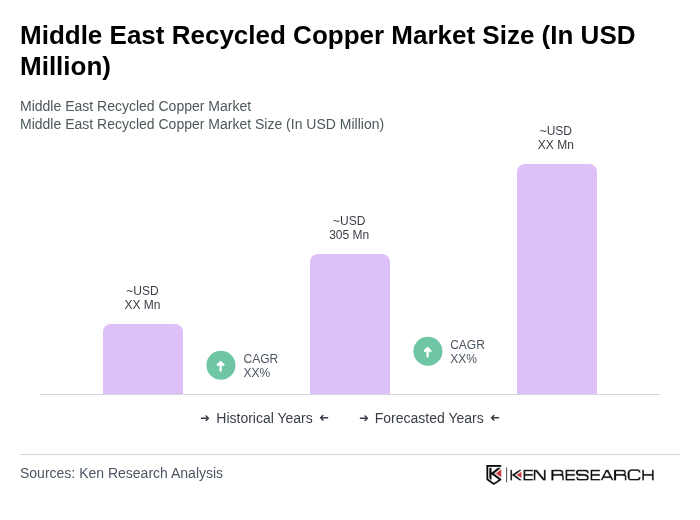
- The Middle East Recycled Copper Market is valued at approximately USD 305 million, based on current market analysis. This growth is primarily driven by increasing demand for sustainable materials, rising industrial activities, and the need for efficient waste management solutions. The market is also supported by the growing awareness of environmental issues and the economic benefits of recycling copper, which is a critical raw material in various industries. The region's shift toward renewable energy, including solar and wind power, significantly boosts the need for copper in new energy systems and related infrastructure, with landmark projects such as the Mohammed bin Rashid Al Maktoum Solar Park in the UAE and the Sudair solar plant in Saudi Arabia driving substantial copper demand.
- Key players in this market include Saudi Arabia, the UAE, and Qatar. Saudi Arabia dominated the market share, driven by its ambitious Vision 2030 plan, which creates a massive wave of construction and industrial projects, including the development of new cities and large-scale infrastructure such as Neom and the Red Sea Resort. The UAE is a hub for recycling activities due to its advanced infrastructure and strategic location, facilitating trade and export. Qatar's investments in infrastructure and construction projects also contribute to its position in the recycled copper sector.
- The UAE has implemented comprehensive regulations aimed at enhancing recycling practices across the nation as part of its circular economy strategy. These regulations mandate that construction projects incorporate recycled materials, including copper, thereby promoting sustainability and reducing waste. Additionally, Oman inaugurated its first industrial plant in June 2025 to recycle legacy copper mining waste into high-purity copper cathodes using sustainable, closed-loop hydrometallurgical processes, with Phase 1 producing approximately 60 tonnes of green copper cathodes annually and plans to scale up to 12,000 tonnes by December 2026, advancing circular economy goals under Oman Vision 2040.
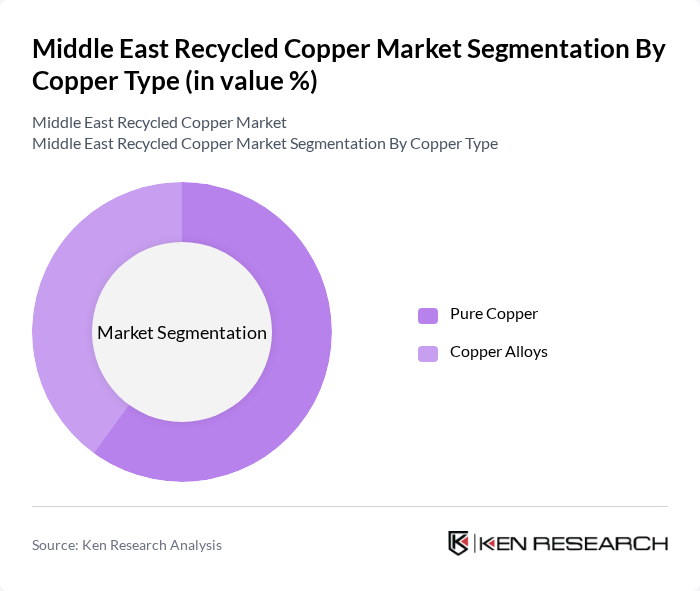
Middle East Recycled Copper Market Segmentation
By Copper Type:The market is segmented into Pure Copper and Copper Alloys. Pure Copper is widely used due to its excellent conductivity and corrosion resistance, making it a preferred choice in electrical applications. Copper Alloys, on the other hand, are gaining traction in various industries for their enhanced properties, such as strength and durability, which are essential for specific applications.
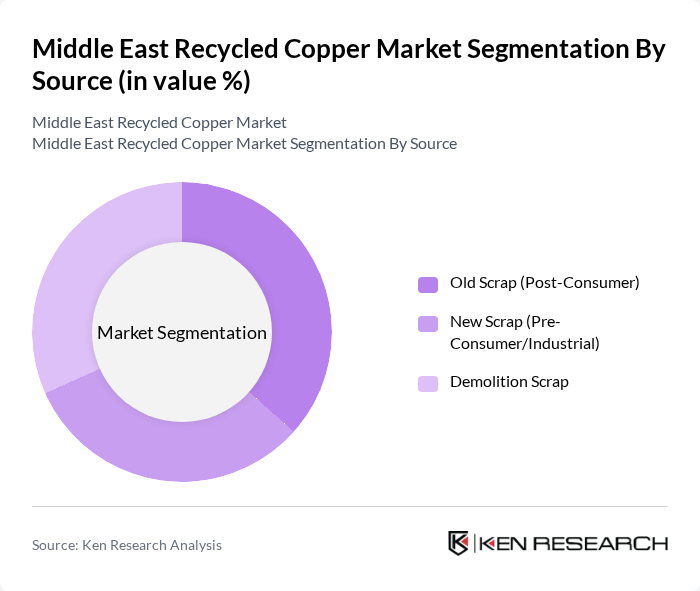
By Source:The market is categorized into Old Scrap (Post-Consumer), New Scrap (Pre-Consumer/Industrial), and Demolition Scrap. Old Scrap is the largest segment, driven by the increasing collection and recycling of used products and large-scale urban redevelopment, demolition of aging buildings, and modernization of electrical grids that generate significant quantities of end-of-life copper cables, pipes, and wiring. New Scrap is also significant, as industries generate substantial amounts of scrap during manufacturing processes, with growing manufacturing activities creating a greater supply of cleaner, higher-purity material that is more efficient to recycle. Demolition Scrap is gaining importance due to urban redevelopment projects that generate large quantities of recyclable materials.
Middle East Recycled Copper Market Competitive Landscape
The Middle East Recycled Copper Market is characterized by a dynamic mix of regional and international players. Leading participants such as PGI Group, RA Scrap Trading, WaterLink Corp, H A Z Scrap Trading LLC, Planet Green Recycling LLC, Amkay Metals DMCC, Milan Metal Scrap & Used Batteries TR LLC, Shar Metal Scrap Co Ltd, Lucky Recycling Limited, Sayed Metal, Gulf Copper and Aluminum, Al Ghurair Resources, Emirates Recycling, Al-Futtaim Group, Al Jazeera Steel Products contribute to innovation, geographic expansion, and service delivery in this space.
--- ## Fact-Check Summary **Market Size Correction:** The original market size of USD 3.5 billion has been updated to USD 305 million based on authoritative 2024 market data. **Geographic Leadership Update:** Saudi Arabia has been identified as the market leader with 28.1% revenue share, driven by Vision 2030 initiatives, replacing the original characterization that listed all three countries equally. **Regulatory Enhancement:** The third bullet point has been enhanced with specific information about Oman's new copper recycling facility inaugurated in June 2025, demonstrating concrete regional regulatory and infrastructure developments supporting the circular economy. **Market Segmentation by Source:** Old Scrap market share has been updated to 36.6% based on 2024 data, with additional context about urban redevelopment and grid modernization driving this segment. **Growth Drivers Enhanced:** Added specific renewable energy projects and smart city initiatives as concrete drivers of market growth, with references to landmark infrastructure projects in the UAE and Saudi Arabia.
Middle East Recycled Copper Market Industry Analysis
Growth Drivers
- Increasing Demand for Sustainable Materials:The Middle East is witnessing a significant shift towards sustainable materials, with recycled copper gaining traction. In future, the region's demand for recycled copper is projected to reach 160,000 metric tons, driven by industries prioritizing eco-friendly practices. This demand surge is supported by the UAE's commitment to reducing carbon emissions by 23% by 2030, fostering a favorable environment for recycled materials in construction and manufacturing sectors.
- Government Initiatives Promoting Recycling:Governments across the Middle East are implementing robust initiatives to enhance recycling rates. For instance, Saudi Arabia's Vision 2030 aims to increase recycling rates to 85% by 2030, significantly impacting the recycled copper market. In future, government funding for recycling programs is expected to exceed $250 million, facilitating the establishment of new recycling facilities and promoting public awareness campaigns about the benefits of recycling copper.
- Technological Advancements in Recycling Processes:The Middle East is experiencing rapid technological advancements in recycling processes, enhancing the efficiency of copper recovery. In future, investments in innovative recycling technologies are projected to reach $120 million, enabling facilities to process up to 92% of copper from scrap materials. These advancements not only reduce operational costs but also improve the quality of recycled copper, making it more competitive against virgin copper in various applications.
Market Challenges
- Fluctuating Raw Material Prices:The recycled copper market in the Middle East faces challenges due to fluctuating raw material prices. In future, the price of virgin copper is expected to average $9,500 per metric ton, impacting the profitability of recycled copper operations. This volatility can deter investments in recycling infrastructure, as companies may hesitate to commit resources amid uncertain pricing dynamics, ultimately affecting supply stability in the market.
- Limited Recycling Infrastructure:Despite growing demand, the Middle East's recycling infrastructure remains underdeveloped. As of future, only 35% of copper waste is currently recycled, highlighting a significant gap in capacity. The lack of advanced recycling facilities and collection systems hampers the region's ability to meet increasing demand for recycled copper, necessitating substantial investments to enhance infrastructure and improve recycling rates across the region.
Middle East Recycled Copper Market Future Outlook
The future of the Middle East recycled copper market appears promising, driven by increasing environmental awareness and government support for sustainable practices. As electric vehicle production rises, the demand for recycled copper is expected to grow, aligning with the region's circular economy initiatives. Additionally, advancements in recycling technologies will likely enhance efficiency and output, positioning recycled copper as a viable alternative to virgin materials, thus fostering a more sustainable industrial landscape in the coming years.
Market Opportunities
- Expansion of Recycling Facilities:There is a significant opportunity for expanding recycling facilities in the Middle East. With an estimated investment of $180 million in future, new facilities can increase processing capacity by 55%, addressing the current shortfall in recycling infrastructure and meeting the rising demand for recycled copper in various industries.
- Partnerships with Construction and Manufacturing Sectors:Collaborations with the construction and manufacturing sectors present a lucrative opportunity for the recycled copper market. In future, partnerships could lead to a 25% increase in the use of recycled copper in construction projects, driven by the growing emphasis on sustainable building materials and compliance with environmental regulations.
Scope of the Report
| Segment | Sub-Segments |
|---|---|
| By Copper Type | Pure Copper Copper Alloys |
| By Source | Old Scrap (Post-Consumer) New Scrap (Pre-Consumer/Industrial) Demolition Scrap |
| By Scrap Grade | Grade A Scrap (High Purity) #2 Copper Scrap (Medium Purity) Grade C Scrap (Mixed/Low Purity) |
| By Processing Method | Hydrometallurgical Processing Pyrometallurgical Processing Mechanical Processing Automated Sorting and Refining |
| By End-User Application | Wire Rod Mills Brass Mills Ingot Makers Foundries & Other Industries |
| By Geographic Distribution | UAE Saudi Arabia Qatar Kuwait Oman Bahrain |
Key Target Audience
Investors and Venture Capitalist Firms
Government and Regulatory Bodies (e.g., Ministry of Industry and Advanced Technology, Ministry of Environment and Water)
Manufacturers and Producers of Recycled Copper
Recycling Facilities and Processing Plants
Trade Associations and Industry Groups
Logistics and Supply Chain Companies
Financial Institutions and Banks
Environmental NGOs and Advocacy Groups
Players Mentioned in the Report:
PGI Group
RA Scrap Trading
WaterLink Corp
H A Z Scrap Trading LLC
Planet Green Recycling LLC
Amkay Metals DMCC
Milan Metal Scrap & Used Batteries TR LLC
Shar Metal Scrap Co Ltd
Lucky Recycling Limited
Sayed Metal
Gulf Copper and Aluminum
Al Ghurair Resources
Emirates Recycling
Al-Futtaim Group
Al Jazeera Steel Products
Table of Contents
Market Assessment Phase
1. Executive Summary and Approach
2. Middle East Recycled Copper Market Overview
2.1 Key Insights and Strategic Recommendations
2.2 Middle East Recycled Copper Market Overview
2.3 Definition and Scope
2.4 Evolution of Market Ecosystem
2.5 Timeline of Key Regulatory Milestones
2.6 Value Chain & Stakeholder Mapping
2.7 Business Cycle Analysis
2.8 Policy & Incentive Landscape
3. Middle East Recycled Copper Market Analysis
3.1 Growth Drivers
3.1.1 Increasing demand for sustainable materials
3.1.2 Government initiatives promoting recycling
3.1.3 Rising prices of virgin copper
3.1.4 Technological advancements in recycling processes
3.2 Market Challenges
3.2.1 Fluctuating raw material prices
3.2.2 Limited recycling infrastructure
3.2.3 Regulatory compliance issues
3.2.4 Competition from alternative materials
3.3 Market Opportunities
3.3.1 Expansion of recycling facilities
3.3.2 Partnerships with construction and manufacturing sectors
3.3.3 Development of new recycling technologies
3.3.4 Increasing awareness of environmental sustainability
3.4 Market Trends
3.4.1 Growth in electric vehicle production
3.4.2 Shift towards circular economy practices
3.4.3 Rising consumer preference for recycled products
3.4.4 Innovations in copper recycling methods
3.5 Government Regulation
3.5.1 Implementation of recycling mandates
3.5.2 Incentives for recycling businesses
3.5.3 Environmental protection laws
3.5.4 Trade regulations affecting copper imports
4. SWOT Analysis
5. Stakeholder Analysis
6. Porter's Five Forces Analysis
7. Middle East Recycled Copper Market Market Size, 2019-2024
7.1 By Value
7.2 By Volume
7.3 By Average Selling Price
8. Middle East Recycled Copper Market Segmentation
8.1 By Copper Type
8.1.1 Pure Copper
8.1.2 Copper Alloys
8.2 By Source
8.2.1 Old Scrap (Post-Consumer)
8.2.2 New Scrap (Pre-Consumer/Industrial)
8.2.3 Demolition Scrap
8.3 By Scrap Grade
8.3.1 Grade A Scrap (High Purity)
8.3.2 #2 Copper Scrap (Medium Purity)
8.3.3 Grade C Scrap (Mixed/Low Purity)
8.4 By Processing Method
8.4.1 Hydrometallurgical Processing
8.4.2 Pyrometallurgical Processing
8.4.3 Mechanical Processing
8.4.4 Automated Sorting and Refining
8.5 By End-User Application
8.5.1 Wire Rod Mills
8.5.2 Brass Mills
8.5.3 Ingot Makers
8.5.4 Foundries & Other Industries
8.6 By Geographic Distribution
8.6.1 UAE
8.6.2 Saudi Arabia
8.6.3 Qatar
8.6.4 Kuwait
8.6.5 Oman
8.6.6 Bahrain
9. Middle East Recycled Copper Market Competitive Analysis
9.1 Market Share of Key Players
9.2 Cross Comparison of Key Players
9.2.1 Company Name
9.2.2 Group Size (Large, Medium, or Small as per industry convention)
9.2.3 Revenue Growth Rate (%)
9.2.4 Market Penetration Rate (%)
9.2.5 Scrap Processing Capacity (Kilotons/Year)
9.2.6 Average Selling Price per Ton (USD)
9.2.7 Production Efficiency (%)
9.2.8 Supply Chain Reliability Score
9.2.9 Innovation Rate (New Technologies/Year)
9.2.10 Brand Recognition & Market Presence
9.3 SWOT Analysis of Top Players
9.4 Pricing Analysis
9.5 Detailed Profile of Major Companies
9.5.1 PGI Group
9.5.2 RA Scrap Trading
9.5.3 WaterLink Corp
9.5.4 H A Z Scrap Trading LLC
9.5.5 Planet Green Recycling LLC
9.5.6 Amkay Metals DMCC
9.5.7 Milan Metal Scrap & Used Batteries TR LLC
9.5.8 Shar Metal Scrap Co Ltd
9.5.9 Lucky Recycling Limited
9.5.10 Sayed Metal
9.5.11 Gulf Copper and Aluminum
9.5.12 Al Ghurair Resources
9.5.13 Emirates Recycling
9.5.14 Al-Futtaim Group
9.5.15 Al Jazeera Steel Products
10. Middle East Recycled Copper Market End-User Analysis
10.1 Procurement Behavior of Key Ministries
10.1.1 Ministry of Energy
10.1.2 Ministry of Environment
10.1.3 Ministry of Industry
10.1.4 Ministry of Finance
10.2 Corporate Spend on Infrastructure & Energy
10.2.1 Investment Trends
10.2.2 Budget Allocations
10.2.3 Project Prioritization
10.2.4 Procurement Processes
10.3 Pain Point Analysis by End-User Category
10.3.1 Cost Management
10.3.2 Supply Chain Disruptions
10.3.3 Quality Assurance
10.3.4 Regulatory Compliance
10.4 User Readiness for Adoption
10.4.1 Awareness Levels
10.4.2 Training Needs
10.4.3 Technology Adoption Rates
10.4.4 Investment Willingness
10.5 Post-Deployment ROI and Use Case Expansion
10.5.1 Performance Metrics
10.5.2 Case Studies
10.5.3 Feedback Mechanisms
10.5.4 Future Expansion Plans
11. Middle East Recycled Copper Market Future Size, 2025-2030
11.1 By Value
11.2 By Volume
11.3 By Average Selling Price
Go-To-Market Strategy Phase
1. Whitespace Analysis + Business Model Canvas
1.1 Market Gaps Identification
1.2 Value Proposition Development
1.3 Revenue Streams Analysis
1.4 Cost Structure Evaluation
1.5 Key Partnerships Exploration
1.6 Customer Segmentation
1.7 Competitive Advantage Assessment
2. Marketing and Positioning Recommendations
2.1 Branding Strategies
2.2 Product USPs
2.3 Target Market Identification
2.4 Communication Strategy
2.5 Digital Marketing Tactics
2.6 Customer Engagement Plans
2.7 Performance Metrics
3. Distribution Plan
3.1 Urban Retail Strategies
3.2 Rural NGO Tie-ups
3.3 Logistics Optimization
3.4 Channel Selection Criteria
3.5 Partnership Development
3.6 Distribution Network Mapping
3.7 Performance Tracking
4. Channel & Pricing Gaps
4.1 Underserved Routes
4.2 Pricing Bands Analysis
4.3 Competitor Pricing Strategies
4.4 Customer Price Sensitivity
4.5 Value-Based Pricing Models
4.6 Discount Strategies
4.7 Pricing Optimization Techniques
5. Unmet Demand & Latent Needs
5.1 Category Gaps
5.2 Consumer Segments Analysis
5.3 Product Development Opportunities
5.4 Market Entry Barriers
5.5 Customer Feedback Integration
5.6 Future Trends Anticipation
5.7 Strategic Recommendations
6. Customer Relationship
6.1 Loyalty Programs
6.2 After-sales Service
6.3 Customer Feedback Mechanisms
6.4 Relationship Management Strategies
6.5 Customer Retention Tactics
6.6 Engagement Metrics
6.7 Value-Added Services
7. Value Proposition
7.1 Sustainability Initiatives
7.2 Integrated Supply Chains
7.3 Competitive Differentiation
7.4 Customer-Centric Innovations
7.5 Long-term Value Creation
7.6 Market Positioning
7.7 Strategic Partnerships
8. Key Activities
8.1 Regulatory Compliance
8.2 Branding Initiatives
8.3 Distribution Setup
8.4 Market Research Activities
8.5 Stakeholder Engagement
8.6 Performance Monitoring
8.7 Continuous Improvement Processes
9. Entry Strategy Evaluation
9.1 Domestic Market Entry Strategy
9.1.1 Product Mix
9.1.2 Pricing Band
9.1.3 Packaging Considerations
9.2 Export Entry Strategy
9.2.1 Target Countries
9.2.2 Compliance Roadmap
10. Entry Mode Assessment
10.1 Joint Ventures
10.2 Greenfield Investments
10.3 Mergers & Acquisitions
10.4 Distributor Model
11. Capital and Timeline Estimation
11.1 Capital Requirements
11.2 Timelines for Implementation
12. Control vs Risk Trade-Off
12.1 Ownership vs Partnerships
13. Profitability Outlook
13.1 Breakeven Analysis
13.2 Long-term Sustainability
14. Potential Partner List
14.1 Distributors
14.2 Joint Ventures
14.3 Acquisition Targets
15. Execution Roadmap
15.1 Phased Plan for Market Entry
15.1.1 Market Setup
15.1.2 Market Entry
15.1.3 Growth Acceleration
15.1.4 Scale & Stabilize
15.2 Key Activities and Milestones
15.2.1 Milestone Tracking
15.2.2 Activity Scheduling
Research Methodology
Phase 1: Approach1
Desk Research
- Analysis of industry reports from regional trade associations and market research firms
- Review of government publications and statistics on copper recycling rates and regulations
- Examination of academic journals and white papers focusing on the environmental impact of copper recycling
Primary Research
- Interviews with industry experts, including executives from recycling facilities and copper manufacturers
- Surveys targeting procurement managers in the electronics and construction sectors
- Field visits to recycling plants to gather firsthand insights on operational practices and challenges
Validation & Triangulation
- Cross-validation of findings through multiple data sources, including trade publications and expert opinions
- Triangulation of market size estimates using both top-down and bottom-up approaches
- Sanity checks conducted through expert panel discussions to ensure data reliability
Phase 2: Market Size Estimation1
Top-down Assessment
- Estimation of total copper consumption in the Middle East and its recycling potential
- Segmentation of the market by end-user industries such as electronics, construction, and automotive
- Incorporation of regional policies promoting recycling and sustainability initiatives
Bottom-up Modeling
- Collection of operational data from leading copper recycling facilities in the region
- Estimation of recycling rates based on historical data and current market trends
- Calculation of revenue potential based on average selling prices of recycled copper
Forecasting & Scenario Analysis
- Development of forecasting models using historical growth rates and market drivers
- Scenario analysis based on varying levels of regulatory support and market demand
- Projections for market growth through 2030, considering economic and environmental factors
Phase 3: CATI Sample Composition1
| Scope Item/Segment | Sample Size | Target Respondent Profiles |
|---|---|---|
| Electronics Recycling Sector | 100 | Operations Managers, Sustainability Coordinators |
| Construction Industry Copper Usage | 80 | Project Managers, Procurement Officers |
| Automotive Recycling Practices | 70 | Supply Chain Managers, Quality Assurance Leads |
| Government Regulatory Bodies | 50 | Policy Makers, Environmental Analysts |
| Recycling Facility Operations | 90 | Facility Managers, Technical Directors |
Frequently Asked Questions
What is the current value of the Middle East Recycled Copper Market?
The Middle East Recycled Copper Market is currently valued at approximately USD 305 million. This valuation reflects the growing demand for sustainable materials and the increasing industrial activities in the region, alongside the need for efficient waste management solutions.
Which countries are the key players in the Middle East Recycled Copper Market?
What are the main drivers of growth in the Middle East Recycled Copper Market?
What challenges does the Middle East Recycled Copper Market face?
Other Regional/Country Reports
Other Adjacent Reports
Belgium Recycled Steel Market
KSA Metal Scrap Market
Global Copper Mining Market Size Share Growth Drivers Trends Opportunities & Forecast 2025–2030North America Renewable Energy Market Outlook to 2030: Size, Share, Growth and TrendsAfrica, Middle East & Space-Based Solar Energy Market Outlook to 2030: Size, Share, Growth and TrendsDenmark Wind Energy MarketIndia Construction Materials Market Outlook to 2030India Waste Management Market (2022-2030)Thailand Electrical Equipment Market
Why Buy From Us?

What makes us stand out is that our consultants follow Robust, Refine and Result (RRR) methodology. Robust for clear definitions, approaches and sanity checking, Refine for differentiating respondents' facts and opinions, and Result for presenting data with story.

We have set a benchmark in the industry by offering our clients with syndicated and customized market research reports featuring coverage of entire market as well as meticulous research and analyst insights.

While we don't replace traditional research, we flip the method upside down. Our dual approach of Top Bottom & Bottom Top ensures quality deliverable by not just verifying company fundamentals but also looking at the sector and macroeconomic factors.

With one step in the future, our research team constantly tries to show you the bigger picture. We help with some of the tough questions you may encounter along the way: How is the industry positioned? Best marketing channel? KPI's of competitors? By aligning every element, we help maximize success.

Our report gives you instant access to the answers and sources that other companies might choose to hide. We elaborate each steps of research methodology we have used and showcase you the sample size to earn your trust.

If you need any support, we are here! We pride ourselves on universe strength, data quality, and quick, friendly, and professional service.