Ken Research Logo

Middle East Safety Eyewear Market

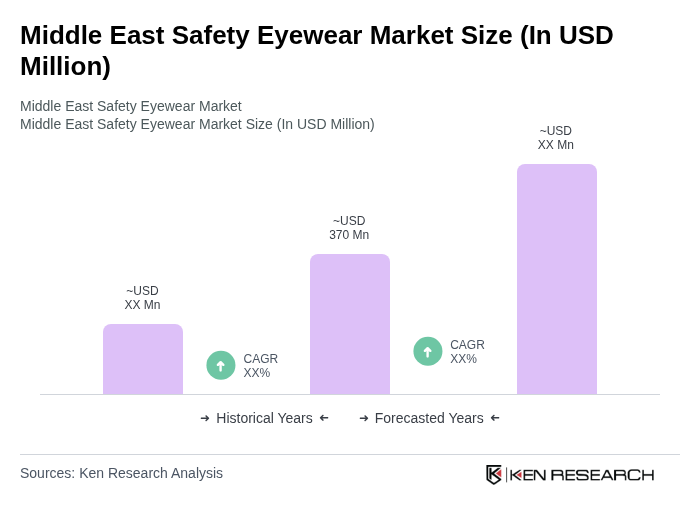
The Middle East Safety Eyewear Market is worth USD 370 million, fueled by rising workplace safety awareness and regulations in key sectors like construction and manufacturing.

Region:Middle East

Author(s):Geetanshi

Product Code:KRAD4136

Pages:89

Published On:December 2025
About the Report

Base Year 2024

Middle East Safety Eyewear Market Overview

  • The Middle East Safety Eyewear Market is valued at approximately USD 370 million, based on a recent regional market assessment of safety eyewear demand. This growth is primarily driven by increasing industrial activities, stringent safety regulations, and a heightened awareness of workplace safety among employers and employees alike. The rising demand for protective eyewear in various sectors, including construction, manufacturing, and healthcare, has significantly contributed to the market's expansion.
  • Key players in this market include Saudi Arabia, the United Arab Emirates, and Qatar. These countries are recognized for their robust industrial sectors, ongoing infrastructure projects, and government initiatives aimed at enhancing workplace safety standards. The presence of major oil and gas companies in these regions further boosts the demand for safety eyewear.
  • Ongoing enforcement and updates of health and safety requirements in the UAE and other Gulf states are supporting increased adoption of certified safety eyewear.
Middle East Safety Eyewear Market Size

Middle East Safety Eyewear Market Segmentation

By Type:The market is segmented into various types of safety eyewear, including Safety Glasses (prescription and non-prescription), Safety Goggles, Face Shields & Visors, Welding Protection Eyewear & Helmets, Over-the-Glass (OTG) Safety Spectacles, and Specialty & Laser Protection Eyewear. Among these, Safety Glasses are the most popular due to their versatility and comfort, making them suitable for a wide range of applications. Safety Goggles are also gaining traction, especially in environments where maximum protection is required. The demand for specialized eyewear is increasing as industries recognize the importance of tailored solutions for specific hazards.
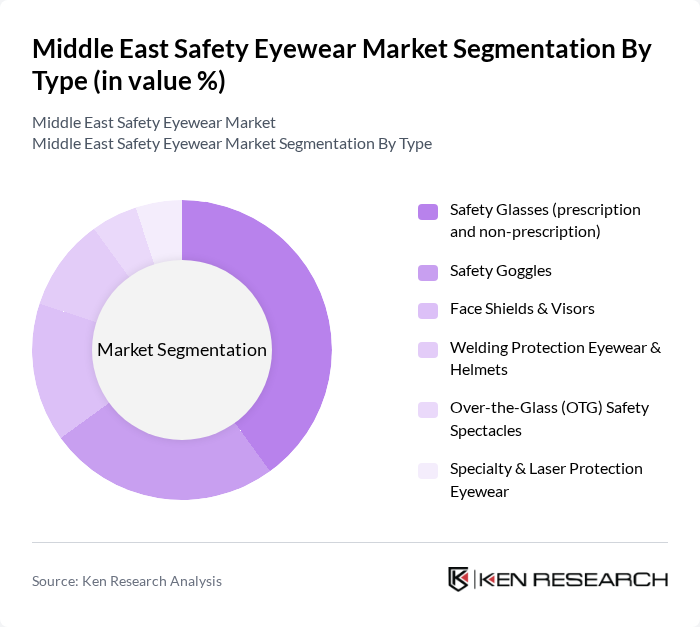
Middle East Safety Eyewear Market segmentation by Type.

By End-User:The market is segmented by end-user industries, including Construction & Infrastructure, Industrial Manufacturing & Automotive, Oil & Gas & Petrochemicals, Healthcare, Laboratories & Pharmaceuticals, Mining & Metals, and Utilities, Power & Other Industrial End-Users. The Construction & Infrastructure sector is the largest consumer of safety eyewear, driven by ongoing projects and stringent safety regulations. The Oil & Gas sector also significantly contributes to the market, as safety eyewear is essential for protecting workers in hazardous environments. The growing focus on safety in healthcare and laboratory settings is further propelling the demand for specialized eyewear.
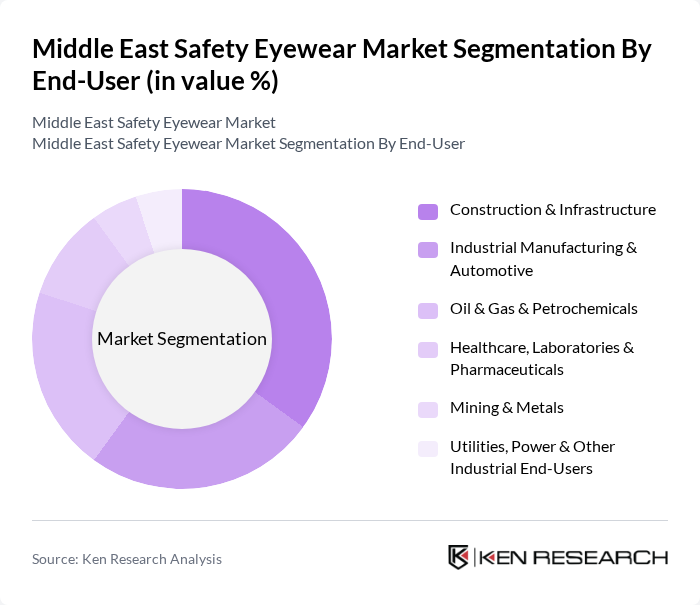
Middle East Safety Eyewear Market segmentation by End-User.

Middle East Safety Eyewear Market Competitive Landscape

The Middle East Safety Eyewear Market is characterized by a dynamic mix of regional and international players. Leading participants such as Honeywell International Inc., 3M Company, MCR Safety, UVEX Safety Group GmbH & Co. KG, Pyramex Safety Products LLC, JSP Limited, Bollé Safety (Bollé Brands), Delta Plus Group, Radians, Inc., Edge Eyewear, Wiley X, Inc., MSA Safety Incorporated, Kimberly-Clark Professional, Ansell Limited, Lakeland Industries, Inc. contribute to innovation, geographic expansion, and service delivery in this space.

Honeywell International Inc.

1906

Charlotte, North Carolina, USA

3M Company

1902

Maplewood, Minnesota, USA

MCR Safety

1974

Memphis, Tennessee, USA

UVEX Safety Group GmbH & Co. KG

1926

Fürth, Germany

Pyramex Safety Products LLC

1991

Memphis, Tennessee, USA

Company

Establishment Year

Headquarters

Company Type (Global Brand / Regional Player / Local Distributor)

Estimated Revenue from Safety Eyewear in Middle East

Safety Eyewear Revenue CAGR in Middle East

Market Share in Middle East Safety Eyewear Segment

Product Portfolio Breadth (basic, premium, specialized)

Average Selling Price Positioning (economy / mid / premium)

Middle East Safety Eyewear Market Industry Analysis

Growth Drivers

  • Increasing Workplace Safety Regulations:The Middle East has seen a significant rise in workplace safety regulations, with countries like Saudi Arabia and the UAE implementing stricter laws. For instance, the Saudi Ministry of Human Resources and Social Development reported a 25% increase in safety inspections in future. This regulatory push is driving demand for safety eyewear, as companies must comply with these standards to avoid penalties and ensure employee safety, leading to a projected increase in safety eyewear purchases.
  • Rising Awareness of Occupational Hazards:There is a growing recognition of occupational hazards among workers in the Middle East, particularly in high-risk industries such as construction and manufacturing. According to the International Labour Organization, workplace accidents in the region have increased by 10% over the past five years. This alarming trend has prompted companies to invest more in safety equipment, including eyewear, to protect their workforce, thereby boosting market demand significantly.
  • Growth in Construction and Manufacturing Sectors:The construction and manufacturing sectors in the Middle East are projected to grow by 3.5% and 4.2%, respectively, in future, according to the World Bank. This expansion is driven by major infrastructure projects, such as the NEOM city in Saudi Arabia, which necessitate enhanced safety measures. Consequently, the demand for safety eyewear is expected to rise as companies prioritize worker protection in these booming industries, further propelling market growth.

Market Challenges

  • High Cost of Advanced Safety Eyewear:The price of advanced safety eyewear can be a significant barrier to market growth. High-quality protective eyewear can cost between $60 to $180 per unit, which may deter smaller companies from investing in necessary safety equipment. This challenge is exacerbated by budget constraints in many industries, particularly in developing regions of the Middle East, where cost-effective solutions are often prioritized over advanced safety features.
  • Lack of Standardization in Safety Regulations:The absence of uniform safety regulations across the Middle East complicates the market landscape. Different countries have varying standards, which can lead to confusion among manufacturers and consumers. For example, the UAE has specific guidelines that differ from those in Qatar. This lack of standardization can hinder the adoption of safety eyewear, as companies may be uncertain about compliance requirements, ultimately affecting market growth.

Middle East Safety Eyewear Market Future Outlook

The future of the Middle East safety eyewear market appears promising, driven by increasing regulatory pressures and heightened awareness of workplace safety. As industries expand, particularly in construction and oil and gas, the demand for protective eyewear is expected to rise. Additionally, technological advancements in eyewear materials and designs will likely enhance product offerings, making safety eyewear more appealing to consumers. Companies that adapt to these trends will be well-positioned to capture market share in the evolving landscape.

Market Opportunities

  • Expansion of E-commerce Platforms:The rise of e-commerce in the Middle East presents a significant opportunity for safety eyewear manufacturers. With online sales projected to reach $30 billion by future, companies can leverage digital platforms to reach a broader audience, enhancing accessibility and convenience for consumers seeking safety eyewear solutions.
  • Increasing Demand for Customized Safety Eyewear:There is a growing trend towards personalized safety eyewear, with consumers seeking products tailored to their specific needs. This demand is supported by advancements in manufacturing technologies, allowing for customization at competitive prices. Companies that offer bespoke solutions can tap into this niche market, driving sales and customer loyalty.

Scope of the Report

SegmentSub-Segments
By Type

Safety Glasses (prescription and non-prescription)

Safety Goggles

Face Shields & Visors

Welding Protection Eyewear & Helmets

Over-the-Glass (OTG) Safety Spectacles

Specialty & Laser Protection Eyewear

By End-User

Construction & Infrastructure

Industrial Manufacturing & Automotive

Oil & Gas & Petrochemicals

Healthcare, Laboratories & Pharmaceuticals

Mining & Metals

Utilities, Power & Other Industrial End-Users

By Region

GCC Countries (Saudi Arabia, UAE, Qatar, Kuwait, Oman, Bahrain)

Levant Region (Jordan, Lebanon, etc.)

North Africa (Egypt and other key countries)

By Application

Workplace & Industrial Safety

Construction Site Safety

Laboratory & Medical Safety

Welding, Grinding & Cutting Operations

Sports, Outdoor & Recreational Protection

By Material

Polycarbonate Lenses

Trivex & Other Advanced Polymers

Glass Lenses

Acetate & Other Frame Materials

By Distribution Channel

Industrial/B2B Supply & Tender-Based Procurement

Specialty Safety Distributors & PPE Dealers

Online Retail & E-commerce Platforms

General Trade, Hypermarkets & Others

By Price Range

Budget / Entry-Level

Mid-Range

Premium & Branded

High-Performance / Niche Industrial

Key Target Audience

Investors and Venture Capitalist Firms

Government and Regulatory Bodies (e.g., Ministry of Health, Ministry of Labor)

Manufacturers and Producers

Distributors and Retailers

Construction and Industrial Companies

Occupational Safety and Health Organizations

Insurance Companies

Trade Associations and Industry Groups

Players Mentioned in the Report:

Honeywell International Inc.

3M Company

MCR Safety

UVEX Safety Group GmbH & Co. KG

Pyramex Safety Products LLC

JSP Limited

Bolle Safety (Bolle Brands)

Delta Plus Group

Radians, Inc.

Edge Eyewear

Wiley X, Inc.

MSA Safety Incorporated

Kimberly-Clark Professional

Ansell Limited

Lakeland Industries, Inc.

Table of Contents

Market Assessment Phase

1. Executive Summary and Approach


2. Middle East Safety Eyewear Market Overview

2.1 Key Insights and Strategic Recommendations

2.2 Middle East Safety Eyewear Market Overview

2.3 Definition and Scope

2.4 Evolution of Market Ecosystem

2.5 Timeline of Key Regulatory Milestones

2.6 Value Chain & Stakeholder Mapping

2.7 Business Cycle Analysis

2.8 Policy & Incentive Landscape


3. Middle East Safety Eyewear Market Analysis

3.1 Growth Drivers

3.1.1 Increasing workplace safety regulations
3.1.2 Rising awareness of occupational hazards
3.1.3 Growth in construction and manufacturing sectors
3.1.4 Technological advancements in eyewear materials

3.2 Market Challenges

3.2.1 High cost of advanced safety eyewear
3.2.2 Lack of standardization in safety regulations
3.2.3 Limited consumer awareness in certain regions
3.2.4 Competition from low-cost alternatives

3.3 Market Opportunities

3.3.1 Expansion of e-commerce platforms
3.3.2 Increasing demand for customized safety eyewear
3.3.3 Collaborations with safety training organizations
3.3.4 Growth in the oil and gas sector

3.4 Market Trends

3.4.1 Shift towards eco-friendly materials
3.4.2 Integration of smart technology in eyewear
3.4.3 Customization and personalization trends
3.4.4 Increased focus on employee wellness programs

3.5 Government Regulation

3.5.1 Implementation of stricter safety standards
3.5.2 Mandatory safety training for workers
3.5.3 Incentives for companies adopting safety measures
3.5.4 Regular audits and compliance checks

4. SWOT Analysis


5. Stakeholder Analysis


6. Porter's Five Forces Analysis


7. Middle East Safety Eyewear Market Market Size, 2019-2024

7.1 By Value

7.2 By Volume

7.3 By Average Selling Price


8. Middle East Safety Eyewear Market Segmentation

8.1 By Type

8.1.1 Safety Glasses (prescription and non-prescription)
8.1.2 Safety Goggles
8.1.3 Face Shields & Visors
8.1.4 Welding Protection Eyewear & Helmets
8.1.5 Over-the-Glass (OTG) Safety Spectacles
8.1.6 Specialty & Laser Protection Eyewear

8.2 By End-User

8.2.1 Construction & Infrastructure
8.2.2 Industrial Manufacturing & Automotive
8.2.3 Oil & Gas & Petrochemicals
8.2.4 Healthcare, Laboratories & Pharmaceuticals
8.2.5 Mining & Metals
8.2.6 Utilities, Power & Other Industrial End-Users

8.3 By Region

8.3.1 GCC Countries (Saudi Arabia, UAE, Qatar, Kuwait, Oman, Bahrain)
8.3.2 Levant Region (Jordan, Lebanon, etc.)
8.3.3 North Africa (Egypt and other key countries)

8.4 By Application

8.4.1 Workplace & Industrial Safety
8.4.2 Construction Site Safety
8.4.3 Laboratory & Medical Safety
8.4.4 Welding, Grinding & Cutting Operations
8.4.5 Sports, Outdoor & Recreational Protection

8.5 By Material

8.5.1 Polycarbonate Lenses
8.5.2 Trivex & Other Advanced Polymers
8.5.3 Glass Lenses
8.5.4 Acetate & Other Frame Materials

8.6 By Distribution Channel

8.6.1 Industrial/B2B Supply & Tender-Based Procurement
8.6.2 Specialty Safety Distributors & PPE Dealers
8.6.3 Online Retail & E-commerce Platforms
8.6.4 General Trade, Hypermarkets & Others

8.7 By Price Range

8.7.1 Budget / Entry-Level
8.7.2 Mid-Range
8.7.3 Premium & Branded
8.7.4 High-Performance / Niche Industrial

9. Middle East Safety Eyewear Market Competitive Analysis

9.1 Market Share of Key Players

9.2 Cross Comparison of Key Players

9.2.1 Company Name
9.2.2 Company Type (Global Brand / Regional Player / Local Distributor)
9.2.3 Estimated Revenue from Safety Eyewear in Middle East
9.2.4 Safety Eyewear Revenue CAGR in Middle East
9.2.5 Market Share in Middle East Safety Eyewear Segment
9.2.6 Product Portfolio Breadth (basic, premium, specialized)
9.2.7 Average Selling Price Positioning (economy / mid / premium)
9.2.8 Presence Across Key End-Use Verticals
9.2.9 Geographic Coverage within Middle East (number of countries)
9.2.10 Channel Mix (B2B, distributors, online, direct to customer)
9.2.11 Compliance with Regional/International Safety Standards (EN, ANSI, etc.)
9.2.12 New Product Launches & Innovation Intensity

9.3 SWOT Analysis of Top Players

9.4 Pricing Analysis

9.5 Detailed Profile of Major Companies

9.5.1 Honeywell International Inc.
9.5.2 3M Company
9.5.3 MCR Safety
9.5.4 UVEX Safety Group GmbH & Co. KG
9.5.5 Pyramex Safety Products LLC
9.5.6 JSP Limited
9.5.7 Bollé Safety (Bollé Brands)
9.5.8 Delta Plus Group
9.5.9 Radians, Inc.
9.5.10 Edge Eyewear
9.5.11 Wiley X, Inc.
9.5.12 MSA Safety Incorporated
9.5.13 Kimberly-Clark Professional
9.5.14 Ansell Limited
9.5.15 Lakeland Industries, Inc.

10. Middle East Safety Eyewear Market End-User Analysis

10.1 Procurement Behavior of Key Ministries

10.1.1 Government procurement policies
10.1.2 Budget allocation for safety equipment
10.1.3 Supplier selection criteria
10.1.4 Compliance with safety standards

10.2 Corporate Spend on Infrastructure & Energy

10.2.1 Investment trends in safety equipment
10.2.2 Budgeting for safety training
10.2.3 Impact of safety regulations on spending

10.3 Pain Point Analysis by End-User Category

10.3.1 Common safety hazards
10.3.2 Challenges in procurement
10.3.3 User feedback on existing products

10.4 User Readiness for Adoption

10.4.1 Awareness of safety eyewear benefits
10.4.2 Training and education needs

10.5 Post-Deployment ROI and Use Case Expansion

10.5.1 Measuring effectiveness of safety eyewear
10.5.2 Case studies of successful implementations

11. Middle East Safety Eyewear Market Future Size, 2025-2030

11.1 By Value

11.2 By Volume

11.3 By Average Selling Price


Go-To-Market Strategy Phase

1. Whitespace Analysis + Business Model Canvas

1.1 Market gaps and opportunities

1.2 Value proposition development

1.3 Revenue model

1.4 Key partnerships

1.5 Customer segments

1.6 Cost structure

1.7 Channels


2. Marketing and Positioning Recommendations

2.1 Branding strategies

2.2 Product USPs


3. Distribution Plan

3.1 Urban retail vs rural NGO tie-ups


4. Channel & Pricing Gaps

4.1 Underserved routes

4.2 Pricing bands


5. Unmet Demand & Latent Needs

5.1 Category gaps

5.2 Consumer segments


6. Customer Relationship

6.1 Loyalty programs

6.2 After-sales service


7. Value Proposition

7.1 Sustainability

7.2 Integrated supply chains


8. Key Activities

8.1 Regulatory compliance

8.2 Branding

8.3 Distribution setup


9. Entry Strategy Evaluation

9.1 Domestic Market Entry Strategy

9.1.1 Product mix
9.1.2 Pricing band
9.1.3 Packaging

9.2 Export Entry Strategy

9.2.1 Target countries
9.2.2 Compliance roadmap

10. Entry Mode Assessment

10.1 JV

10.2 Greenfield

10.3 M&A

10.4 Distributor Model


11. Capital and Timeline Estimation

11.1 Capital requirements

11.2 Timelines


12. Control vs Risk Trade-Off

12.1 Ownership vs Partnerships


13. Profitability Outlook

13.1 Breakeven analysis

13.2 Long-term sustainability


14. Potential Partner List

14.1 Distributors

14.2 JVs

14.3 Acquisition targets


15. Execution Roadmap

15.1 Phased Plan for Market Entry

15.1.1 Market Setup
15.1.2 Market Entry
15.1.3 Growth Acceleration
15.1.4 Scale & Stabilize

15.2 Key Activities and Milestones

15.2.1 Milestone planning
15.2.2 Activity tracking

Research Methodology

ApproachModellingSample

Phase 1: Approach1

Desk Research

  • Industry reports from regional safety eyewear associations and market research firms
  • Government publications on occupational safety regulations and compliance standards
  • Market analysis from trade journals focusing on the Middle East safety equipment sector

Primary Research

  • Interviews with safety officers in manufacturing and construction sectors
  • Surveys targeting procurement managers in industries requiring safety eyewear
  • Field interviews with distributors and retailers of safety eyewear products

Validation & Triangulation

  • Cross-validation of findings through multiple industry expert interviews
  • Triangulation of data from sales figures, regulatory updates, and market trends
  • Sanity checks through feedback from focus groups comprising industry stakeholders

Phase 2: Market Size Estimation1

Top-down Assessment

  • Analysis of total market size based on regional safety equipment expenditure
  • Segmentation by end-user industries such as construction, manufacturing, and healthcare
  • Incorporation of growth rates from government safety initiatives and regulations

Bottom-up Modeling

  • Volume estimates derived from sales data of leading safety eyewear brands
  • Cost analysis based on average pricing of safety eyewear products across segments
  • Estimation of market share distribution among various product categories

Forecasting & Scenario Analysis

  • Multi-variable forecasting using economic indicators and industry growth rates
  • Scenario planning based on potential regulatory changes and market dynamics
  • Development of baseline, optimistic, and pessimistic market projections through 2030

Phase 3: CATI Sample Composition1

Scope Item/SegmentSample SizeTarget Respondent Profiles
Construction Industry Safety Compliance 5100 3Safety Managers, Site Supervisors 5
Manufacturing Sector Safety Equipment Procurement 580 3Procurement Officers, Operations Managers 5
Healthcare Sector Eye Protection Standards 570 7Health and Safety Officers, Facility Managers 5
Retail Distribution of Safety Eyewear 560 3Retail Managers, Product Buyers 5
Regulatory Compliance in Safety Equipment 590 7Compliance Officers, Industry Regulators 7

Frequently Asked Questions

What is the current value of the Middle East Safety Eyewear Market?

The Middle East Safety Eyewear Market is valued at approximately USD 370 million, driven by increasing industrial activities, stringent safety regulations, and heightened awareness of workplace safety among employers and employees across various sectors.

Which countries are the key players in the Middle East Safety Eyewear Market?

What types of safety eyewear are available in the Middle East market?

Which sectors are the largest consumers of safety eyewear in the Middle East?

Other Regional/Country Reports

UAE Safety Eyewear Market

Indonesia Safety Eyewear Market

Malaysia Safety Eyewear Market

KSA Safety Eyewear Market

APAC Safety Eyewear Market

SEA Safety Eyewear Market

Other Adjacent Reports

UAE Personal Protective Equipment Market

Japan Industrial Safety Gear Market

South Korea Occupational Health Services Market

GCC Construction Safety Equipment Market Size, Share, Trends & Forecast 2025–2030

Mexico Oil and Gas Protective Wear Market

Bahrain Manufacturing Safety Solutions Market

Singapore Healthcare Protective Eyewear Market

Bahrain Welding Protection Market

Philippines Laser Safety Products Market

Oman Workplace Safety Training Market

Why Buy From Us?

Refine Robust Result (RRR) Framework

What makes us stand out is that our consultants follow Robust, Refine and Result (RRR) methodology. Robust for clear definitions, approaches and sanity checking, Refine for differentiating respondents' facts and opinions, and Result for presenting data with story.

Our Reach Is Unmatched

We have set a benchmark in the industry by offering our clients with syndicated and customized market research reports featuring coverage of entire market as well as meticulous research and analyst insights.

Shifting the Research Paradigm

While we don't replace traditional research, we flip the method upside down. Our dual approach of Top Bottom & Bottom Top ensures quality deliverable by not just verifying company fundamentals but also looking at the sector and macroeconomic factors.

More Insights-Better Decisions

With one step in the future, our research team constantly tries to show you the bigger picture. We help with some of the tough questions you may encounter along the way: How is the industry positioned? Best marketing channel? KPI's of competitors? By aligning every element, we help maximize success.

Transparency and Trust

Our report gives you instant access to the answers and sources that other companies might choose to hide. We elaborate each steps of research methodology we have used and showcase you the sample size to earn your trust.

Round the Clock Support

If you need any support, we are here! We pride ourselves on universe strength, data quality, and quick, friendly, and professional service.

Why Clients Choose Us?

400000+
Reports in repository
150+
Consulting projects a year
100+
Analysts
8000+
Client Queries in 2022








