Middle East Security Paper Market Size Share Growth Drivers Trends Opportunities & Forecast 2025–2030

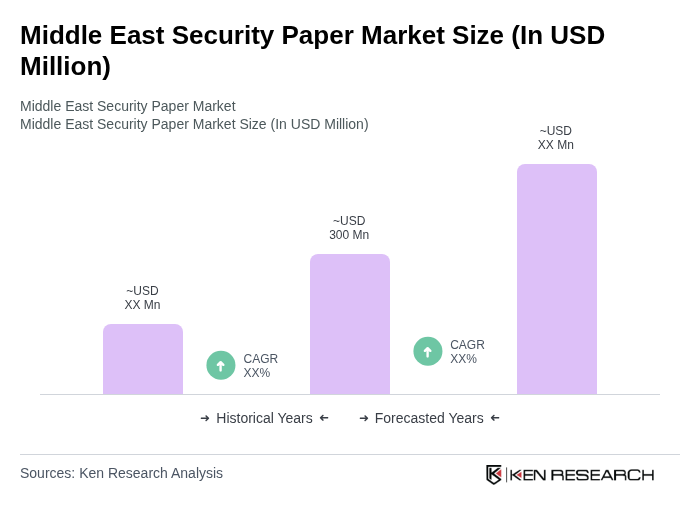
The Middle East security paper market, worth USD 300 million, is growing due to rising needs for anti-counterfeit solutions in finance and government, with key segments in hybrid and watermark papers.

Region:Middle East

Author(s):Rebecca

Product Code:KRAB2173

Pages:80

Published On:January 2026
About the Report

Base Year 2024

Middle East Security Paper Market Overview

  • The Middle East Security Paper Market is valued at USD 300 million, based on a five-year historical analysis of regional security printing and related secure document solutions in the Middle East and Africa. This growth is primarily driven by increasing demand for secure documents, such as banknotes and identification cards, alongside rising concerns over counterfeiting and fraud, particularly in financial services and government identity programs. The market is also influenced by advancements in printing technologies and the introduction of innovative security features in paper products, including hybrid substrates, embedded threads, and machine-readable elements.
  • Key players in this market include the GCC countries, particularly the United Arab Emirates and Saudi Arabia, which dominate due to their robust financial sectors, large-scale banknote and cheque usage, and government initiatives aimed at enhancing security measures in identity, travel, and civil registry documents. Additionally, countries like Egypt and Jordan are significant contributors, driven by their strategic importance in regional security, growing banking and remittance flows, and continuous upgrades of passports, national IDs, and other secure documents to align with international security and interoperability standards.
  • In 2023, the UAE government implemented a new regulation mandating the use of advanced security features in all official documents, including passports and national IDs. This regulation aims to combat identity theft and enhance the integrity of government-issued documents, thereby boosting the demand for high-security paper products in the region. Furthermore, the Federal Decree-Law No. 3 of 2016 on Child Rights and Federal Decree-Law No. 9 of 2021 on the Use of Digital Signatures and Trust Services are supported operationally by document-security standards that require tamper-resistant substrates, machine-readable zones, and multi-layer security features in vital records, civil status documents, and identity credentials issued in the UAE.
Middle East Security Paper Market Size

Middle East Security Paper Market Segmentation

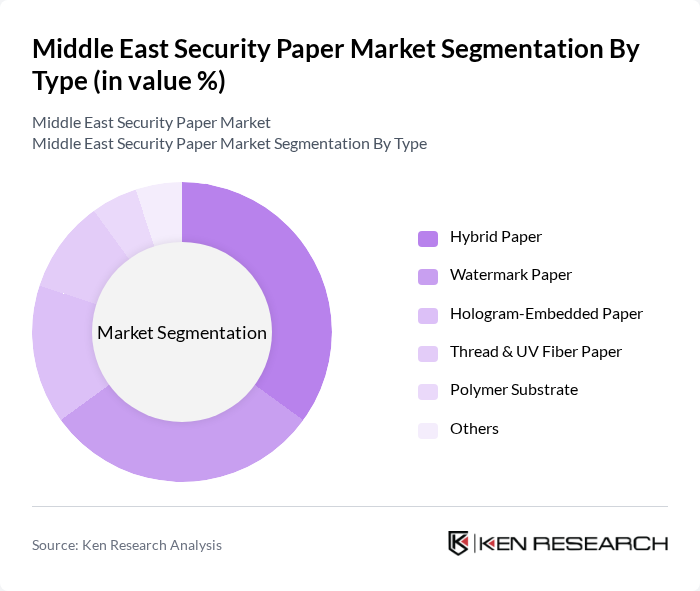
By Type:The market is segmented into various types of security paper, including Hybrid Paper, Watermark Paper, Hologram-Embedded Paper, Thread & UV Fiber Paper, Polymer Substrate, and Others. Among these, Hybrid Paper is gaining traction due to its versatility and enhanced security features, combining traditional cellulose-based paper with polymer or synthetic layers to improve durability, tear resistance, and multi-layer authentication options for banknotes and ID documents. Watermark Paper remains significant, especially in currency production, passports, and high-value certificates, as it provides a reliable method for preventing counterfeiting and enables quick visual verification by both machines and human inspectors.
Middle East Security Paper Market segmentation by Type.

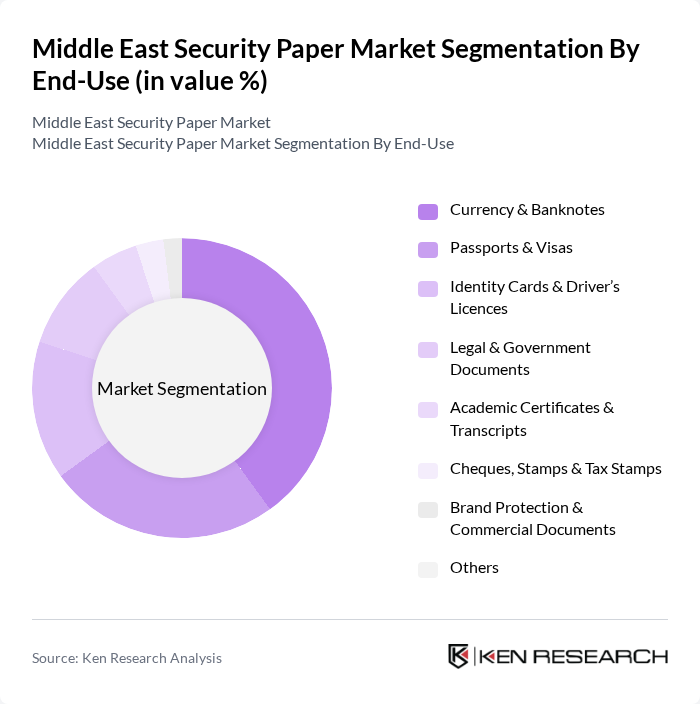
By End-Use:The end-use segmentation includes Currency & Banknotes, Passports & Visas, Identity Cards & Driver’s Licences, Legal & Government Documents, Academic Certificates & Transcripts, Cheques, Stamps & Tax Stamps, Brand Protection & Commercial Documents, and Others. Currency & Banknotes dominate this segment due to the high demand for secure and counterfeit-resistant materials in financial transactions, with central banks in the Middle East continuing to invest in upgraded banknote series that incorporate advanced substrates, threads, and optically variable features. At the same time, Passports & Visas and Identity Cards & Driver’s Licences are expanding rapidly, driven by e-passport rollouts, biometric ID programs, and digital-identity frameworks that still rely on secure physical documents as primary or backup credentials.
Middle East Security Paper Market segmentation by End-Use.

Middle East Security Paper Market Competitive Landscape

The Middle East Security Paper Market is characterized by a dynamic mix of regional and international players. Leading participants such as Giesecke+Devrient, De La Rue, Crane Currency, Oberthur Fiduciaire, Security Printing and Minting Corporation of India Ltd (SPMCIL), CCL Secure, Koenig & Bauer Banknote Solutions (formerly KBA-NotaSys), Thales Group (Digital Identity & Security, incl. Gemalto), Mühlbauer Group, Toppan, Securency International, Arjowiggins Security, Fedrigoni Group, Security Paper Limited, China Banknote Printing and Minting Corporation contribute to innovation, geographic expansion, and service delivery in this space.

Giesecke+Devrient

1852

Munich, Germany

De La Rue

1813

Basingstoke, United Kingdom

Crane Currency

1801

Stamford, Connecticut, United States

Oberthur Fiduciaire

1842

Paris, France

Security Printing and Minting Corporation of India Ltd (SPMCIL)

2006

New Delhi, India

Company

Establishment Year

Headquarters

Group Size (Large, Medium, or Small as per industry convention)

Regional Revenue (USD Mn)

3-Year Revenue CAGR (%)

EBITDA Margin (%)

Market Share in Middle East Security Paper (%)

Order Book / Backlog (USD Mn)

Middle East Security Paper Market Industry Analysis

Growth Drivers

  • Increasing Demand for Secure Documents:The Middle East has seen a significant rise in the demand for secure documents, driven by a growing emphasis on identity verification and fraud prevention. In future, the region is projected to witness a 15% increase in the issuance of secure documents, including passports and national IDs, as governments invest approximately $1.3 billion in enhancing document security. This trend is fueled by the need for robust security measures in both public and private sectors.
  • Government Initiatives for Enhanced Security:Governments across the Middle East are implementing stringent regulations to bolster security measures. In future, an estimated $900 million will be allocated to security paper initiatives, including the development of tamper-proof documents. These initiatives are part of broader national security strategies aimed at combating terrorism and organized crime, thereby driving the demand for advanced security paper solutions in the region.
  • Rise in Counterfeiting and Fraud:The increasing prevalence of counterfeiting and fraud in the Middle East is a major growth driver for the security paper market. In future, losses due to counterfeiting are expected to reach $1.6 billion, prompting businesses and governments to invest in secure document solutions. This urgency to protect intellectual property and maintain consumer trust is propelling the demand for innovative security paper technologies that can effectively deter fraudulent activities.

Market Challenges

  • High Production Costs:The production of security paper involves advanced technologies and materials, leading to high manufacturing costs. In future, the average cost of producing security paper is projected to be around $3.6 per square meter, which poses a challenge for manufacturers aiming to maintain competitive pricing. This financial burden can limit market entry for smaller players and hinder overall market growth in the region.
  • Limited Awareness Among End-Users:Despite the growing need for secure documents, there remains a significant gap in awareness among end-users regarding the benefits of security paper. In future, surveys indicate that only 45% of businesses in the Middle East are familiar with available security features. This lack of knowledge can impede the adoption of security paper solutions, ultimately affecting market penetration and growth potential.

Middle East Security Paper Market Future Outlook

The future of the Middle East security paper market appears promising, driven by increasing government investments and technological advancements. As the region continues to prioritize security, the integration of digital technologies into security paper production is expected to enhance product offerings. Additionally, the growing trend towards eco-friendly materials will likely shape the market landscape, encouraging manufacturers to innovate while adhering to sustainability goals. Overall, these developments will create a dynamic environment for growth and collaboration in the security paper sector.

Market Opportunities

  • Expansion into Emerging Markets:The Middle East presents significant opportunities for security paper manufacturers to expand into emerging markets. With a projected GDP growth rate of 5% in future, countries like Iraq and Yemen are increasingly investing in security infrastructure, creating demand for secure document solutions that can enhance governmental and commercial operations.
  • Development of Innovative Security Features:There is a growing opportunity for the development of innovative security features in paper products. In future, the market for advanced security features, such as holograms and watermarks, is expected to grow by 25%, driven by the need for enhanced protection against counterfeiting. This innovation can attract new clients and strengthen market positions for manufacturers.

Scope of the Report

SegmentSub-Segments
By Type

Hybrid Paper

Watermark Paper

Hologram-Embedded Paper

Thread & UV Fiber Paper

Polymer Substrate

Others

By End-Use

Currency & Banknotes

Passports & Visas

Identity Cards & Driver’s Licences

Legal & Government Documents

Academic Certificates & Transcripts

Cheques, Stamps & Tax Stamps

Brand Protection & Commercial Documents

Others

By Application

Banknotes

Passports

Identity Documents

Certificates & Tickets

Cheques & Financial Instruments

Brand Protection & Anti-Counterfeiting Labels

Others

By Security Feature

Watermarks

Security Threads

Holograms & Foils

Microprinting

UV & IR Features

Color-Shifting Inks & Optically Variable Features

Others

By Printing Technology

Intaglio Printing

Offset/Lithographic Printing

Letterpress Printing

Screen Printing

Digital Printing

Others

By Region

GCC Countries

Levant Region

North Africa

Others

Key Target Audience

Investors and Venture Capitalist Firms

Government and Regulatory Bodies (e.g., Ministry of Interior, Ministry of Defense)

Manufacturers and Producers of Security Paper

Distributors and Retailers of Security Products

Printing and Packaging Companies

Security Technology Providers

Industry Associations (e.g., Middle East Security Association)

Financial Institutions and Banks

Players Mentioned in the Report:

Giesecke+Devrient

De La Rue

Crane Currency

Oberthur Fiduciaire

Security Printing and Minting Corporation of India Ltd (SPMCIL)

CCL Secure

Koenig & Bauer Banknote Solutions (formerly KBA-NotaSys)

Thales Group (Digital Identity & Security, incl. Gemalto)

Muhlbauer Group

Toppan

Securency International

Arjowiggins Security

Fedrigoni Group

Security Paper Limited

China Banknote Printing and Minting Corporation

Table of Contents

Market Assessment Phase

1. Executive Summary and Approach


2. Middle East Security Paper Market Overview

2.1 Key Insights and Strategic Recommendations

2.2 Middle East Security Paper Market Overview

2.3 Definition and Scope

2.4 Evolution of Market Ecosystem

2.5 Timeline of Key Regulatory Milestones

2.6 Value Chain & Stakeholder Mapping

2.7 Business Cycle Analysis

2.8 Policy & Incentive Landscape


3. Middle East Security Paper Market Analysis

3.1 Growth Drivers

3.1.1 Increasing demand for secure documents
3.1.2 Government initiatives for enhanced security
3.1.3 Rise in counterfeiting and fraud
3.1.4 Technological advancements in security printing

3.2 Market Challenges

3.2.1 High production costs
3.2.2 Limited awareness among end-users
3.2.3 Regulatory compliance complexities
3.2.4 Competition from digital alternatives

3.3 Market Opportunities

3.3.1 Expansion into emerging markets
3.3.2 Development of innovative security features
3.3.3 Partnerships with government agencies
3.3.4 Increasing investment in security infrastructure

3.4 Market Trends

3.4.1 Growing adoption of eco-friendly materials
3.4.2 Integration of digital technologies in security paper
3.4.3 Customization and personalization of security features
3.4.4 Shift towards online procurement processes

3.5 Government Regulation

3.5.1 Standards for security paper production
3.5.2 Import/export regulations for security materials
3.5.3 Compliance with anti-counterfeiting laws
3.5.4 Incentives for local manufacturers

4. SWOT Analysis


5. Stakeholder Analysis


6. Porter's Five Forces Analysis


7. Middle East Security Paper Market Size, 2019-2024

7.1 By Value

7.2 By Volume

7.3 By Average Selling Price


8. Middle East Security Paper Market Segmentation

8.1 By Type

8.1.1 Hybrid Paper
8.1.2 Watermark Paper
8.1.3 Hologram-Embedded Paper
8.1.4 Thread & UV Fiber Paper
8.1.5 Polymer Substrate
8.1.6 Others

8.2 By End-Use

8.2.1 Currency & Banknotes
8.2.2 Passports & Visas
8.2.3 Identity Cards & Driver’s Licences
8.2.4 Legal & Government Documents
8.2.5 Academic Certificates & Transcripts
8.2.6 Cheques, Stamps & Tax Stamps
8.2.7 Brand Protection & Commercial Documents
8.2.8 Others

8.3 By Application

8.3.1 Banknotes
8.3.2 Passports
8.3.3 Identity Documents
8.3.4 Certificates & Tickets
8.3.5 Cheques & Financial Instruments
8.3.6 Brand Protection & Anti-Counterfeiting Labels
8.3.7 Others

8.4 By Security Feature

8.4.1 Watermarks
8.4.2 Security Threads
8.4.3 Holograms & Foils
8.4.4 Microprinting
8.4.5 UV & IR Features
8.4.6 Color-Shifting Inks & Optically Variable Features
8.4.7 Others

8.5 By Printing Technology

8.5.1 Intaglio Printing
8.5.2 Offset/Lithographic Printing
8.5.3 Letterpress Printing
8.5.4 Screen Printing
8.5.5 Digital Printing
8.5.6 Others

8.6 By Region

8.6.1 GCC Countries
8.6.2 Levant Region
8.6.3 North Africa
8.6.4 Others

9. Middle East Security Paper Market Competitive Analysis

9.1 Market Share of Key Players

9.2 Cross Comparison of Key Players

9.2.1 Company Name
9.2.2 Group Size (Large, Medium, or Small as per industry convention)
9.2.3 Regional Revenue (USD Mn)
9.2.4 3-Year Revenue CAGR (%)
9.2.5 EBITDA Margin (%)
9.2.6 Market Share in Middle East Security Paper (%)
9.2.7 Order Book / Backlog (USD Mn)
9.2.8 Share of Government Contracts (%)
9.2.9 Average Contract Ticket Size (USD)
9.2.10 R&D Intensity (% of Revenue)
9.2.11 Capex Intensity (% of Revenue)
9.2.12 Return on Invested Capital (ROIC, %)
9.2.13 Customer Concentration (Top-5 Share, %)
9.2.14 Geographic Diversification Index
9.2.15 Innovation & IP Score (Patents, Proprietary Features)

9.3 SWOT Analysis of Top Players

9.4 Pricing Analysis

9.5 Detailed Profile of Major Companies

9.5.1 Giesecke+Devrient
9.5.2 De La Rue
9.5.3 Crane Currency
9.5.4 Oberthur Fiduciaire
9.5.5 Security Printing and Minting Corporation of India Ltd (SPMCIL)
9.5.6 CCL Secure
9.5.7 Koenig & Bauer Banknote Solutions (formerly KBA-NotaSys)
9.5.8 Thales Group (Digital Identity & Security, incl. Gemalto)
9.5.9 Mühlbauer Group
9.5.10 Toppan
9.5.11 Securency International
9.5.12 Arjowiggins Security
9.5.13 Fedrigoni Group
9.5.14 Security Paper Limited
9.5.15 China Banknote Printing and Minting Corporation

10. Middle East Security Paper Market End-User Analysis

10.1 Procurement Behavior of Key Ministries

10.1.1 Ministry of Interior
10.1.2 Ministry of Finance
10.1.3 Ministry of Education
10.1.4 Ministry of Health

10.2 Corporate Spend on Infrastructure & Energy

10.2.1 Investment in Security Infrastructure
10.2.2 Budget Allocation for Document Security

10.3 Pain Point Analysis by End-User Category

10.3.1 Government Agencies
10.3.2 Financial Institutions
10.3.3 Corporates

10.4 User Readiness for Adoption

10.4.1 Awareness Levels
10.4.2 Training Needs

10.5 Post-Deployment ROI and Use Case Expansion

10.5.1 Measurement of Effectiveness
10.5.2 Future Use Cases

11. Middle East Security Paper Market Future Size, 2025-2030

11.1 By Value

11.2 By Volume

11.3 By Average Selling Price


Go-To-Market Strategy Phase

1. Whitespace Analysis + Business Model Canvas

1.1 Market Gaps Identification

1.2 Business Model Development


2. Marketing and Positioning Recommendations

2.1 Branding Strategies

2.2 Product USPs


3. Distribution Plan

3.1 Urban Retail Strategies

3.2 Rural NGO Tie-ups


4. Channel & Pricing Gaps

4.1 Underserved Routes

4.2 Pricing Bands


5. Unmet Demand & Latent Needs

5.1 Category Gaps

5.2 Consumer Segments


6. Customer Relationship

6.1 Loyalty Programs

6.2 After-sales Service


7. Value Proposition

7.1 Sustainability

7.2 Integrated Supply Chains


8. Key Activities

8.1 Regulatory Compliance

8.2 Branding

8.3 Distribution Setup


9. Entry Strategy Evaluation

9.1 Domestic Market Entry Strategy

9.1.1 Product Mix
9.1.2 Pricing Band
9.1.3 Packaging

9.2 Export Entry Strategy

9.2.1 Target Countries
9.2.2 Compliance Roadmap

10. Entry Mode Assessment

10.1 JV

10.2 Greenfield

10.3 M&A

10.4 Distributor Model


11. Capital and Timeline Estimation

11.1 Capital Requirements

11.2 Timelines


12. Control vs Risk Trade-Off

12.1 Ownership vs Partnerships


13. Profitability Outlook

13.1 Breakeven Analysis

13.2 Long-term Sustainability


14. Potential Partner List

14.1 Distributors

14.2 JVs

14.3 Acquisition Targets


15. Execution Roadmap

15.1 Phased Plan for Market Entry

15.1.1 Market Setup
15.1.2 Market Entry
15.1.3 Growth Acceleration
15.1.4 Scale & Stabilize

15.2 Key Activities and Milestones

15.2.1 Milestone Planning

Research Methodology

ApproachModellingSample

Phase 1: Approach1

Desk Research

  • Analysis of market reports from regional security agencies and think tanks
  • Review of government publications and white papers on security policies in the Middle East
  • Examination of trade publications and industry journals focusing on security technologies and services

Primary Research

  • Interviews with security experts and analysts specializing in Middle Eastern geopolitics
  • Surveys conducted with security service providers and technology vendors in the region
  • Field interviews with government officials and military personnel involved in security operations

Validation & Triangulation

  • Cross-validation of findings through multiple data sources, including academic research and industry insights
  • Triangulation of qualitative insights from interviews with quantitative data from market reports
  • Sanity checks through expert panel discussions and feedback sessions

Phase 2: Market Size Estimation1

Top-down Assessment

  • Estimation of total security expenditure by governments and private sectors in the Middle East
  • Segmentation of the market by security type, including physical security, cybersecurity, and surveillance
  • Incorporation of regional conflict data and its impact on security spending trends

Bottom-up Modeling

  • Collection of firm-level revenue data from leading security service providers in the region
  • Operational cost analysis based on service pricing and market demand
  • Volume x cost calculations for various security services offered across different sectors

Forecasting & Scenario Analysis

  • Multi-factor regression analysis incorporating geopolitical stability, economic growth, and technological advancements
  • Scenario modeling based on potential shifts in government policies and international relations
  • Development of baseline, optimistic, and pessimistic forecasts through 2030

Phase 3: CATI Sample Composition1

Scope Item/SegmentSample SizeTarget Respondent Profiles
Government Security Agencies100Security Directors, Policy Makers
Private Security Firms80Operations Managers, Business Development Heads
Cybersecurity Providers70Technical Leads, Product Managers
Military and Defense Contractors60Program Managers, Procurement Officers
Technology Vendors in Security90Sales Executives, Technical Support Managers

Frequently Asked Questions

What is the current value of the Middle East Security Paper Market?

The Middle East Security Paper Market is valued at approximately USD 300 million, driven by the increasing demand for secure documents such as banknotes and identification cards, alongside rising concerns over counterfeiting and fraud.

What factors are driving the growth of the Middle East Security Paper Market?

Which countries are the major players in the Middle East Security Paper Market?

What types of security paper are available in the Middle East market?

Other Adjacent Reports

Saudi Arabia security printing market size, share, growth drivers, trends, opportunities & forecast 2025–2030

Singapore Anti-Counterfeiting Technology Market

Germany Biometric Identification Market

Qatar Digital Identity Solutions Market Report Size Share Growth Drivers Trends Opportunities & Forecast 2025–2030

Oman Holographic Security Market

Indonesia Banknote Production Market

Germany Identity Card Market

KSA Fraud Detection Market

Bahrain Secure Packaging Market

UAE Document Management Systems Market

Why Buy From Us?

Refine Robust Result (RRR) Framework

What makes us stand out is that our consultants follow Robust, Refine and Result (RRR) methodology. Robust for clear definitions, approaches and sanity checking, Refine for differentiating respondents' facts and opinions, and Result for presenting data with story.

Our Reach Is Unmatched

We have set a benchmark in the industry by offering our clients with syndicated and customized market research reports featuring coverage of entire market as well as meticulous research and analyst insights.

Shifting the Research Paradigm

While we don't replace traditional research, we flip the method upside down. Our dual approach of Top Bottom & Bottom Top ensures quality deliverable by not just verifying company fundamentals but also looking at the sector and macroeconomic factors.

More Insights-Better Decisions

With one step in the future, our research team constantly tries to show you the bigger picture. We help with some of the tough questions you may encounter along the way: How is the industry positioned? Best marketing channel? KPI's of competitors? By aligning every element, we help maximize success.

Transparency and Trust

Our report gives you instant access to the answers and sources that other companies might choose to hide. We elaborate each steps of research methodology we have used and showcase you the sample size to earn your trust.

Round the Clock Support

If you need any support, we are here! We pride ourselves on universe strength, data quality, and quick, friendly, and professional service.

Why Clients Choose Us?

400000+
Reports in repository
150+
Consulting projects a year
100+
Analysts
8000+
Client Queries in 2022








